
Chapter 4 Information Gathering Interactive Methods Systems Analysis
- Slides: 42
Chapter 4 Information Gathering: Interactive Methods Systems Analysis and Design Kendall & Kendall Sixth Edition © Copyright Prentice Hall, 2005 Slide Design by Kendall & Kendall
Major Topics • Question format • Interviewing techniques • Joint Application Design (JAD) • Questionnaires Kendall & Kendall 2005 Pearson Prentice Hall 2
Interviewing • Interviewing is an important method for collecting data on information system requirements. • Interviews reveal information about: • Interviewee opinions. • Interviewee feelings about the current state of the system. • Organizational and personal goals. • Informal procedures. Kendall & Kendall 2005 Pearson Prentice Hall 3
Planning the Interview Five steps in planning the interview are: • Reading background material. • Establishing interview objectives. • Deciding whom to interview. • Preparing the interviewee. • Deciding on question types and structure. There are two basic types of interview questions: ©Open-ended. ©Closed. Kendall & Kendall 2005 Pearson Prentice Hall 4
Open-Ended Questions • Open-ended interview questions allow interviewees to respond how they wish, and to what length they wish. • Open-ended questions are appropriate when the analyst is interested in breadth and depth of reply. Kendall & Kendall 2005 Pearson Prentice Hall 5
Advantages of Open-Ended Questions Eight benefits of open-ended questions are: • Puts the interviewee at ease. • Allows the interviewer to pick up on the interviewee's vocabulary. • Reflect education, values, attitudes, and beliefs. • Provides richness of detail. • Reveals avenues of further questioning that may have gone untapped. • Provides more interest for the interviewee. • Allows more spontaneity. • Makes phrasing easier for the interviewer. • Useful if the interviewer is unprepared. Kendall & Kendall 2005 Pearson Prentice Hall 6
Disadvantages of Open-Ended Questions The five drawbacks include: • May result in too much irrelevant detail. • Possibly losing control of the interview. • May take too much time for the amount of useful information gained. • Potentially seeming that the interviewer is unprepared. • Possibly giving the impression that the interviewer is on a "fishing expedition” Kendall & Kendall 2005 Pearson Prentice Hall 7
Closed Interview Questions • Closed interview questions limit the number of possible responses. • Closed interview questions are appropriate for generating precise, reliable data that is easy to analyze. • The methodology is efficient, and it requires little skill for interviewers to administer. Kendall & Kendall 2005 Pearson Prentice Hall 8
Benefits of Closed Interview Questions Six benefits are: • Saving interview time. • Easily comparing interviews. • Getting to the point. • Keeping control of the interview. • Covering a large area quickly. • Getting to relevant data. Kendall & Kendall 2005 Pearson Prentice Hall 9
Disadvantages of Closed Interview Questions Four drawbacks of closed interview questions include: • Boring for the interviewee. • Failure to obtain rich detailing. • Missing main ideas. • Failing to build rapport between interviewer and interviewee. Kendall & Kendall 2005 Pearson Prentice Hall 10
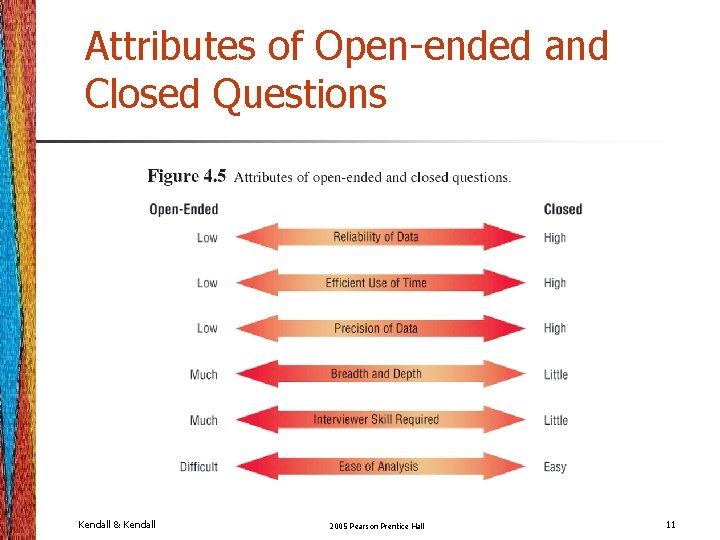
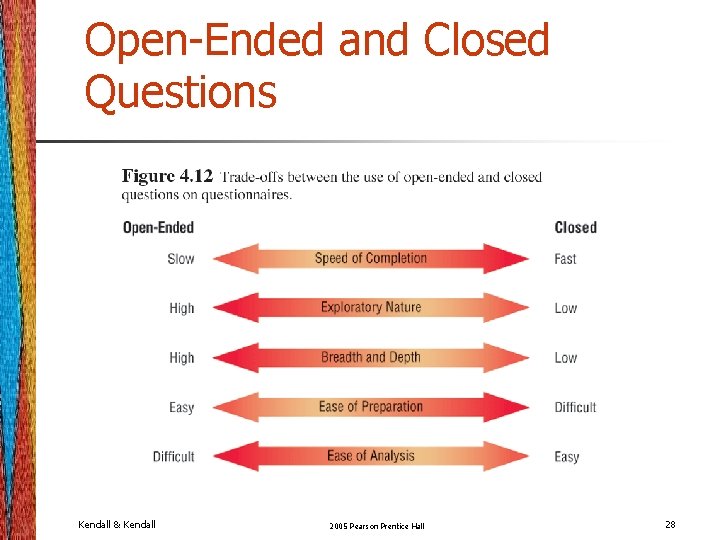
Attributes of Open-ended and Closed Questions Kendall & Kendall 2005 Pearson Prentice Hall 11
Bipolar Questions and Probes • Bipolar questions are those that may be answered with a ‘yes’ or ‘no’ or ‘agree’ or ‘disagree’. • Bipolar questions should be used sparingly. Kendall & Kendall 2005 Pearson Prentice Hall 12
Probing Questions • Probing questions elicit more detail about previous questions. • The purpose of probing questions is: • To get more meaning. • To clarify. • To draw out and expand on the interviewee's point. Kendall & Kendall 2005 Pearson Prentice Hall 13
Question Sequencing The three basic ways of structuring interviews are : • Pyramid, starting with closed questions and working toward open-ended questions. • Funnel, starting with open-ended questions and working toward closed questions. • Diamond, starting with closed, moving toward open-ended, and ending with closed questions. Kendall & Kendall 2005 Pearson Prentice Hall 14
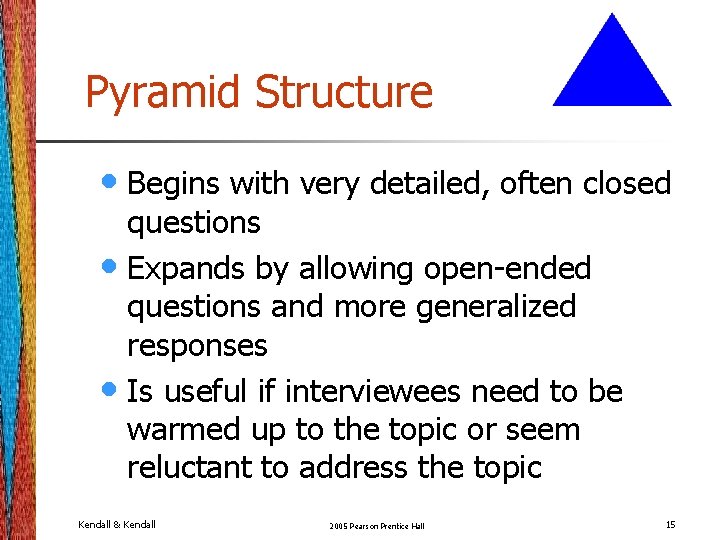
Pyramid Structure • Begins with very detailed, often closed questions • Expands by allowing open-ended questions and more generalized responses • Is useful if interviewees need to be warmed up to the topic or seem reluctant to address the topic Kendall & Kendall 2005 Pearson Prentice Hall 15
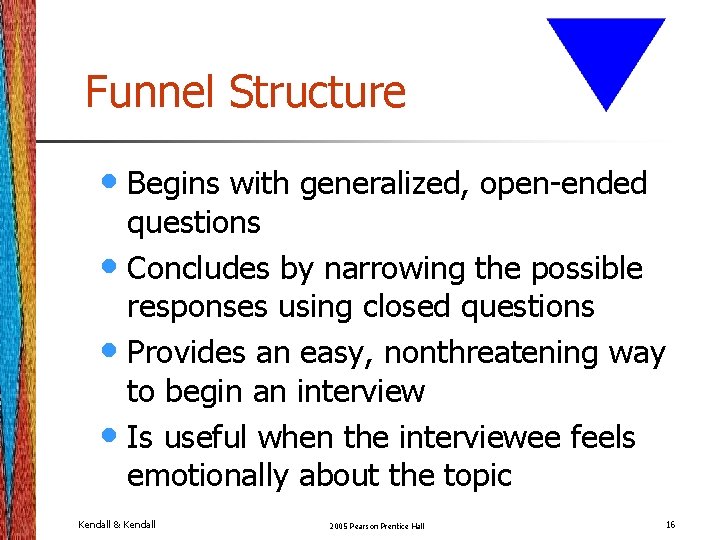
Funnel Structure • Begins with generalized, open-ended questions • Concludes by narrowing the possible responses using closed questions • Provides an easy, nonthreatening way to begin an interview • Is useful when the interviewee feels emotionally about the topic Kendall & Kendall 2005 Pearson Prentice Hall 16
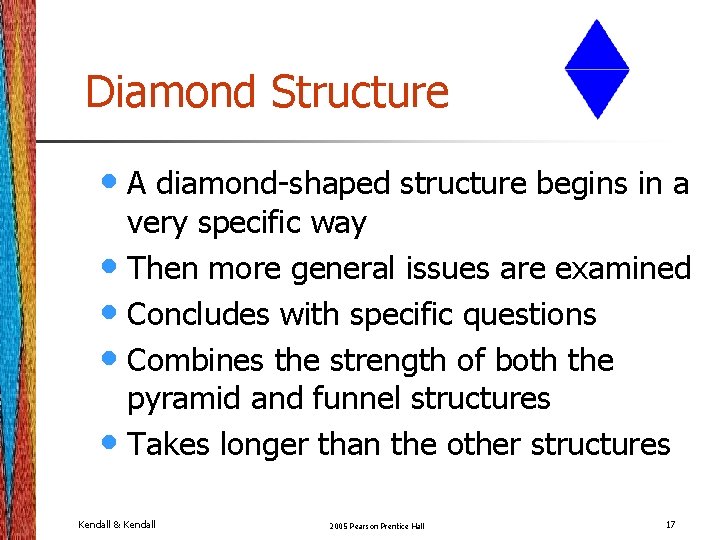
Diamond Structure • A diamond-shaped structure begins in a very specific way • Then more general issues are examined • Concludes with specific questions • Combines the strength of both the pyramid and funnel structures • Takes longer than the other structures Kendall & Kendall 2005 Pearson Prentice Hall 17
Closing the Interview • Always ask “Is there anything else that you would like to add? ” • Summarize and provide feedback on your impressions. • Ask whom you should talk with next. • Set up any future appointments. • Thank them for their time and shake hands. Kendall & Kendall 2005 Pearson Prentice Hall 18
Interview Report • Write as soon as possible after the interview. • Provide an initial summary, then more detail. • Review the report with the respondent. Kendall & Kendall 2005 Pearson Prentice Hall 19
Joint Application Design (JAD) • Joint Application Design (JAD) can replace a series of interviews with the user community. • JAD is a technique that allows the analyst to accomplish requirements analysis and design the user interface with the users in a group setting. Kendall & Kendall 2005 Pearson Prentice Hall 20
When to Use JAD may be used when: • Users are restless and want something new. • The organizational culture supports joint problem-solving behaviors. • Analysts forecast an increase in the number of ideas using JAD. • Personnel may be absent from their jobs for the length of time required. Kendall & Kendall 2005 Pearson Prentice Hall 21
JAD Personnel JAD involves: • Analysts • Users • Executives • Observers • Scribe • Session leader Kendall & Kendall 2005 Pearson Prentice Hall 22
Benefits of JAD The potential benefits of using JAD are: • Time is saved, compared with traditional interviewing. • Rapid development of systems. • Improved user ownership of the system. • Creative idea production is improved. Kendall & Kendall 2005 Pearson Prentice Hall 23
Drawbacks of Using JAD Potential drawbacks of using JAD are: • JAD requires a large block of time to be available for all session participants. • If preparation is incomplete, the session may not go very well. • If the follow-up report is incomplete, the session may not be successful. • The organizational skills and culture may not be conducive to a JAD session. Kendall & Kendall 2005 Pearson Prentice Hall 24
Questionnaires are useful in gathering information from key organization members about: • Attitudes. • Beliefs. • Behaviors. • Characteristics. Kendall & Kendall 2005 Pearson Prentice Hall 25
When to Use Questionnaires are valuable if: • Organization members are widely dispersed. • Many members are involved with the project. • Exploratory work is needed. • Problem solving prior to interviews is necessary. Kendall & Kendall 2005 Pearson Prentice Hall 26
Question Types Questions are designed as either: • Open-ended • Try to anticipate the response you will get. • Well suited for getting opinions. • Closed • Use when all the options may be listed. • When the options are mutually exclusive. Kendall & Kendall 2005 Pearson Prentice Hall 27
Open-Ended and Closed Questions Kendall & Kendall 2005 Pearson Prentice Hall 28
Questionnaire Language Questionnaire language should be: • Simple. • Specific. • Free of bias. • Not patronizing. • Technically accurate. • Addressed to those who are knowledgeable. • Appropriate for the reading level of the respondent. Kendall & Kendall 2005 Pearson Prentice Hall 29
Measurement Scales • The two different forms of measurement scales are : • Nominal. • Interval. Kendall & Kendall 2005 Pearson Prentice Hall 30
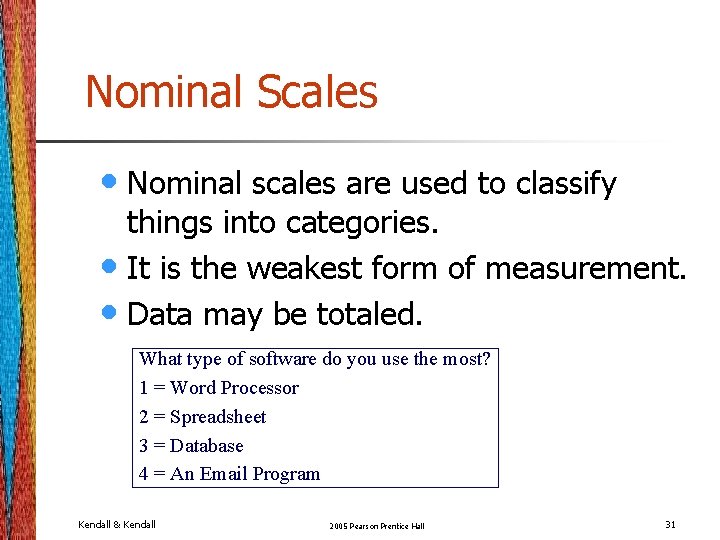
Nominal Scales • Nominal scales are used to classify things into categories. • It is the weakest form of measurement. • Data may be totaled. What type of software do you use the most? 1 = Word Processor 2 = Spreadsheet 3 = Database 4 = An Email Program Kendall & Kendall 2005 Pearson Prentice Hall 31
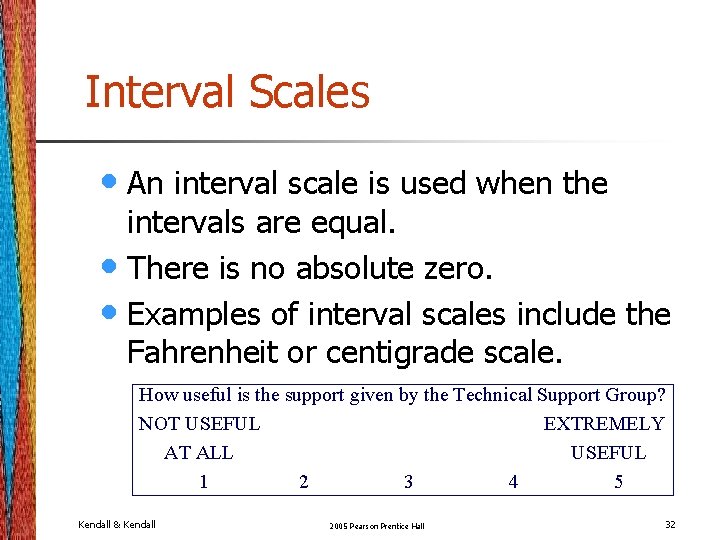
Interval Scales • An interval scale is used when the intervals are equal. • There is no absolute zero. • Examples of interval scales include the Fahrenheit or centigrade scale. How useful is the support given by the Technical Support Group? NOT USEFUL EXTREMELY AT ALL USEFUL 1 2 3 4 5 Kendall & Kendall 2005 Pearson Prentice Hall 32
Validity and Reliability Questionnaires must be valid and reliable. • Reliability of scales refers to consistency in response--getting the same results if the same questionnaire was administered again under the same conditions. • Validity is the degree to which the question measures what the analyst intends to measure. Kendall & Kendall 2005 Pearson Prentice Hall 33
Problems with Scales There are three problems associated with poorly constructed scales: • Leniency. • Central tendency. • Halo effect. Kendall & Kendall 2005 Pearson Prentice Hall 34
Leniency • Caused by easy raters. • Solution is to move the “average” category to the left or right of center. Kendall & Kendall 2005 Pearson Prentice Hall 35
Central Tendency Central tendency occurs when respondents rate everything as average. • Improve by making the differences smaller at the two ends. • Adjust the strength of the descriptors. • Create a scale with more points. Kendall & Kendall 2005 Pearson Prentice Hall 36
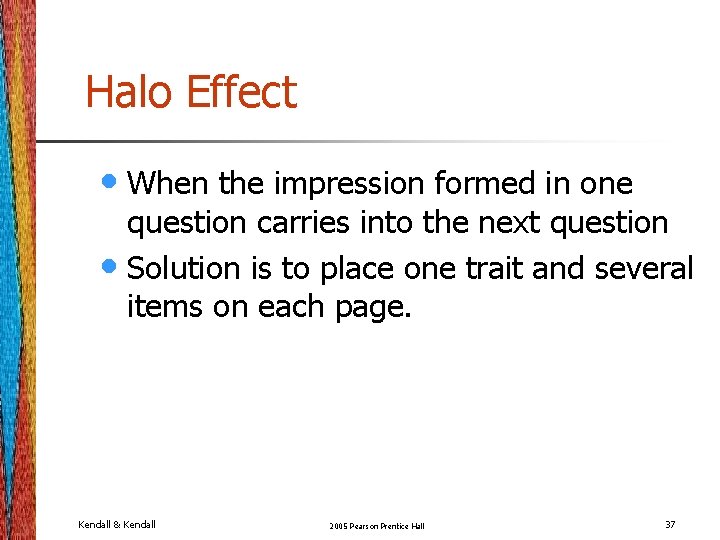
Halo Effect • When the impression formed in one question carries into the next question • Solution is to place one trait and several items on each page. Kendall & Kendall 2005 Pearson Prentice Hall 37
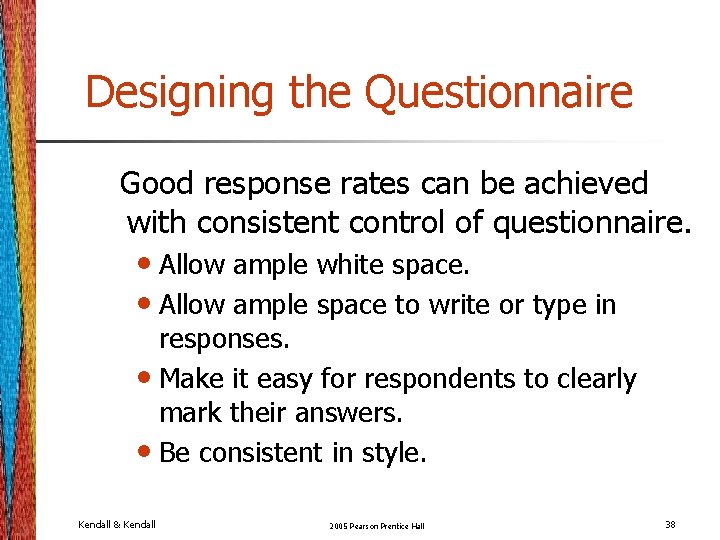
Designing the Questionnaire Good response rates can be achieved with consistent control of questionnaire. • Allow ample white space. • Allow ample space to write or type in responses. • Make it easy for respondents to clearly mark their answers. • Be consistent in style. Kendall & Kendall 2005 Pearson Prentice Hall 38
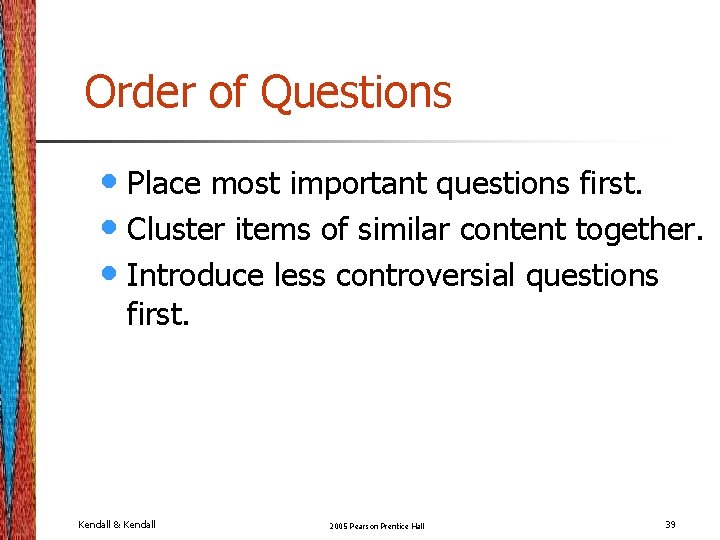
Order of Questions • Place most important questions first. • Cluster items of similar content together. • Introduce less controversial questions first. Kendall & Kendall 2005 Pearson Prentice Hall 39
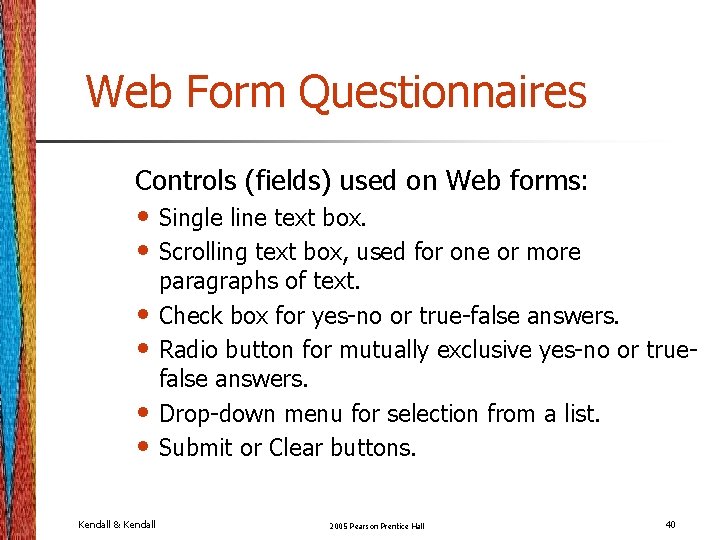
Web Form Questionnaires Controls (fields) used on Web forms: • Single line text box. • Scrolling text box, used for one or more • • Kendall & Kendall paragraphs of text. Check box for yes-no or true-false answers. Radio button for mutually exclusive yes-no or truefalse answers. Drop-down menu for selection from a list. Submit or Clear buttons. 2005 Pearson Prentice Hall 40
Methods of Administering the Questionnaire Methods of administering the questionnaire include: • Convening all concerned respondents together at one time. • Personally administering the questionnaire. • Allowing respondents to self-administer the questionnaire. • Mailing questionnaires. • Administering over the Web or via email. Kendall & Kendall 2005 Pearson Prentice Hall 41
Electronically Submitting Questionnaires Administering a questionnaire electronically has the following benefits: • Reduced costs. • Collecting and storing the results electronically. Kendall & Kendall 2005 Pearson Prentice Hall 42