
Chapter 4 Indexing structure Designing an IR System

- Slides: 29
Chapter 4 Indexing structure
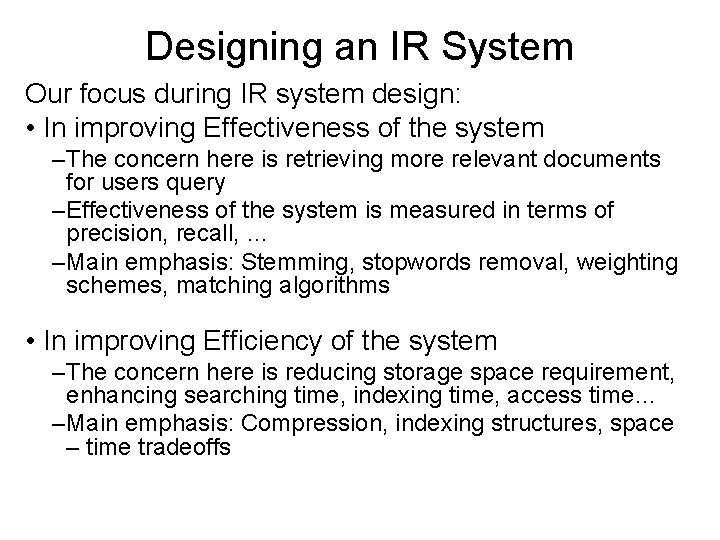
Designing an IR System Our focus during IR system design: • In improving Effectiveness of the system –The concern here is retrieving more relevant documents for users query –Effectiveness of the system is measured in terms of precision, recall, … –Main emphasis: Stemming, stopwords removal, weighting schemes, matching algorithms • In improving Efficiency of the system –The concern here is reducing storage space requirement, enhancing searching time, indexing time, access time… –Main emphasis: Compression, indexing structures, space – time tradeoffs
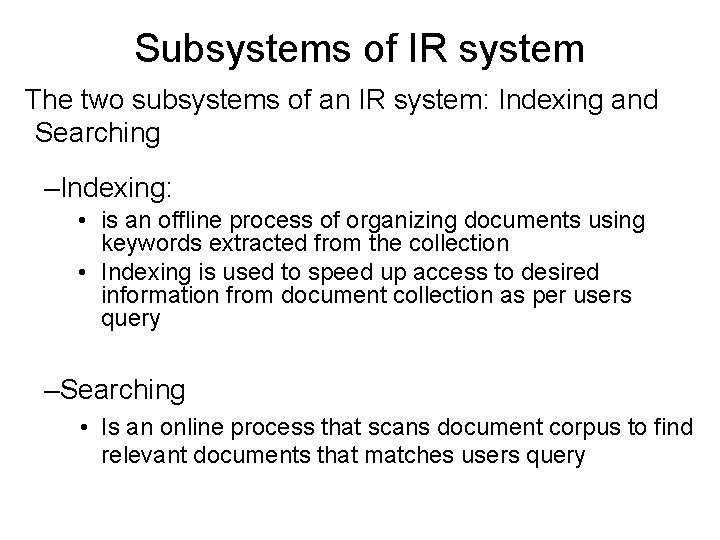
Subsystems of IR system The two subsystems of an IR system: Indexing and Searching –Indexing: • is an offline process of organizing documents using keywords extracted from the collection • Indexing is used to speed up access to desired information from document collection as per users query –Searching • Is an online process that scans document corpus to find relevant documents that matches users query
Indexing Subsystem Documents documents Assign document identifier document Tokenization IDs tokens Stopword removal non-stoplist tokens Stemming & Normalization stemmed terms Term weighting Weighted index terms Index File
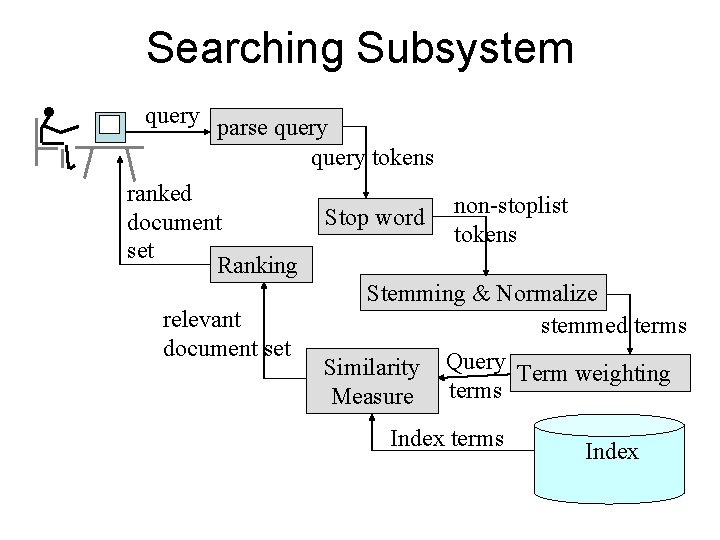
Searching Subsystem query parse query tokens ranked non-stoplist Stop word document tokens set Ranking Stemming & Normalize relevant stemmed terms document set Similarity Query Term weighting Measure terms Index
Basic assertion Indexing and searching: inexorably connected – you cannot search that was not first indexed in some manner or other – indexing of documents or objects is done in order to be searchable • there are many ways to do indexing – to index one needs an indexing language • there are many indexing languages • even taking every word in a document is an indexing language Knowing searching is knowing indexing
Implementation Issues • Storage of text: –The need for text compression: to reduce storage space • Indexing text –Organizing indexes • What techniques to use ? How to select it ? –Storage of indexes • Is compression required? Do we store on memory or in a disk ? • Accessing text –Accessing indexes • How to access to indexes ? What data/file structure to use? –Processing indexes • How to search a given query in the index? How to update the index? –Accessing documents
Text Compression • Text compression is about finding ways to represent the text in fewer bits or bytes such that the file size is reduced • Advantages: –Save storage space requirement. –Speed up document transmission time –Takes less time to search the compressed text • Disadvantages: –Consumes computational resources (both memory space and processor running time)
Indexing: Basic Concepts • Indexing is used to speed up access to desired information from document collection as per users query such that – It enhances efficiency in terms of time for retrieval. Relevant documents are searched and retrieved quick Example: author catalog in library • An index file consists of records, called index entries. – The usual unit for indexing is the word • Index terms - are used to look up records in a file. • Index files are much smaller than the original file. Do you agree?
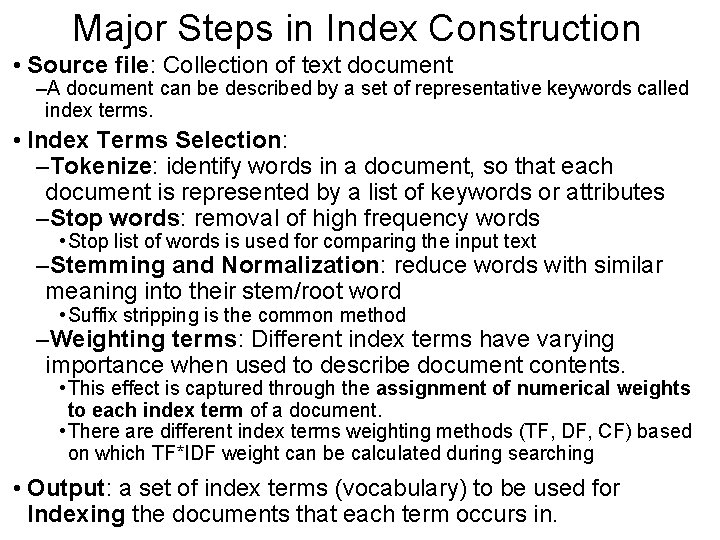
Major Steps in Index Construction • Source file: Collection of text document –A document can be described by a set of representative keywords called index terms. • Index Terms Selection: –Tokenize: identify words in a document, so that each document is represented by a list of keywords or attributes –Stop words: removal of high frequency words • Stop list of words is used for comparing the input text –Stemming and Normalization: reduce words with similar meaning into their stem/root word • Suffix stripping is the common method –Weighting terms: Different index terms have varying importance when used to describe document contents. • This effect is captured through the assignment of numerical weights to each index term of a document. • There are different index terms weighting methods (TF, DF, CF) based on which TF*IDF weight can be calculated during searching • Output: a set of index terms (vocabulary) to be used for Indexing the documents that each term occurs in.
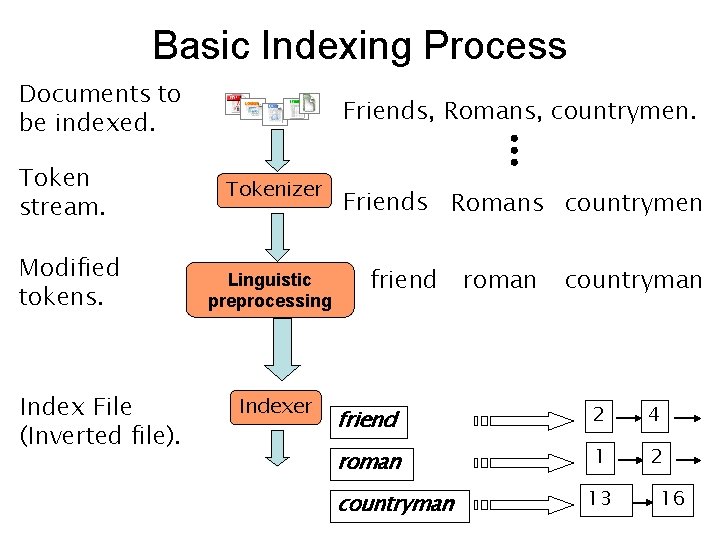
Basic Indexing Process Documents to be indexed. Token stream. Modified tokens. Index File (Inverted file). Friends, Romans, countrymen. Tokenizer Linguistic preprocessing Indexer Friends Romans countrymen friend roman countryman friend 2 4 roman 1 2 countryman 13 16
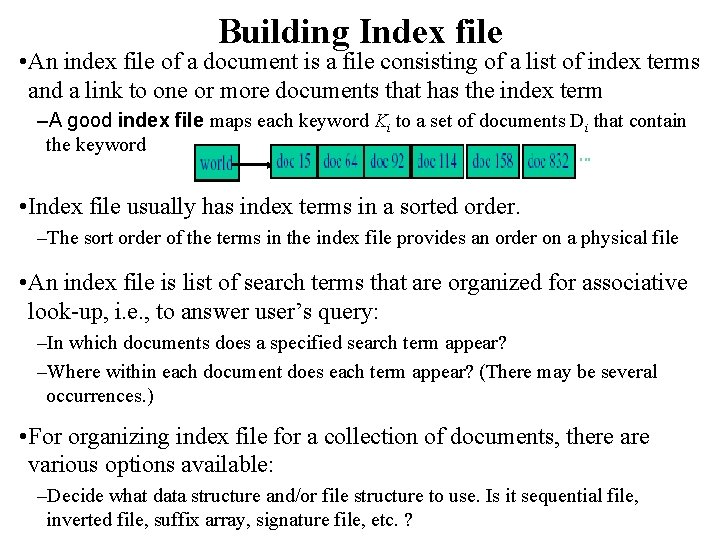
Building Index file • An index file of a document is a file consisting of a list of index terms and a link to one or more documents that has the index term –A good index file maps each keyword Ki to a set of documents Di that contain the keyword • Index file usually has index terms in a sorted order. –The sort order of the terms in the index file provides an order on a physical file • An index file is list of search terms that are organized for associative look-up, i. e. , to answer user’s query: –In which documents does a specified search term appear? –Where within each document does each term appear? (There may be several occurrences. ) • For organizing index file for a collection of documents, there are various options available: –Decide what data structure and/or file structure to use. Is it sequential file, inverted file, suffix array, signature file, etc. ?
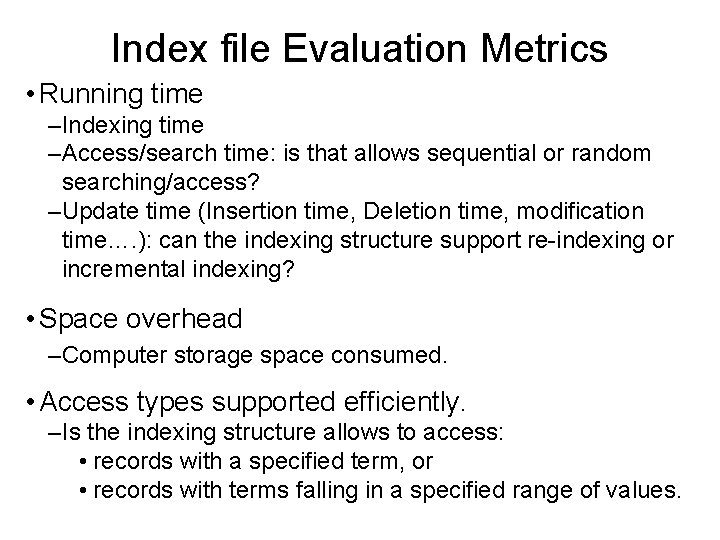
Index file Evaluation Metrics • Running time –Indexing time –Access/search time: is that allows sequential or random searching/access? –Update time (Insertion time, Deletion time, modification time…. ): can the indexing structure support re-indexing or incremental indexing? • Space overhead –Computer storage space consumed. • Access types supported efficiently. –Is the indexing structure allows to access: • records with a specified term, or • records with terms falling in a specified range of values.
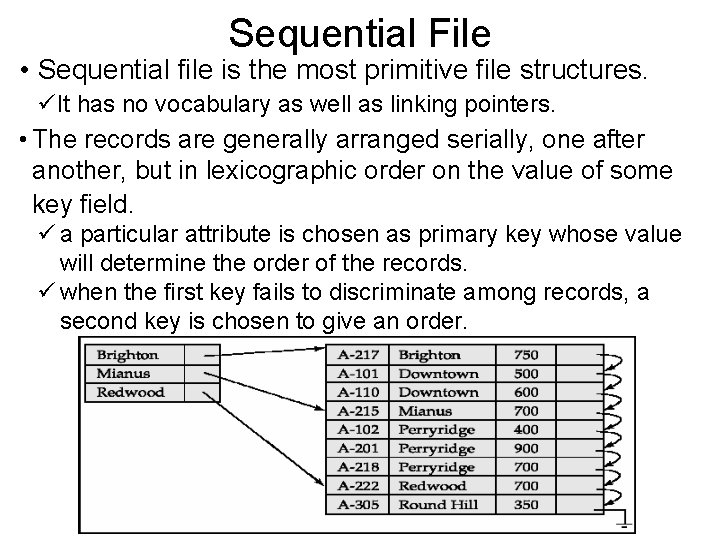
Sequential File • Sequential file is the most primitive file structures. üIt has no vocabulary as well as linking pointers. • The records are generally arranged serially, one after another, but in lexicographic order on the value of some key field. ü a particular attribute is chosen as primary key whose value will determine the order of the records. ü when the first key fails to discriminate among records, a second key is chosen to give an order.
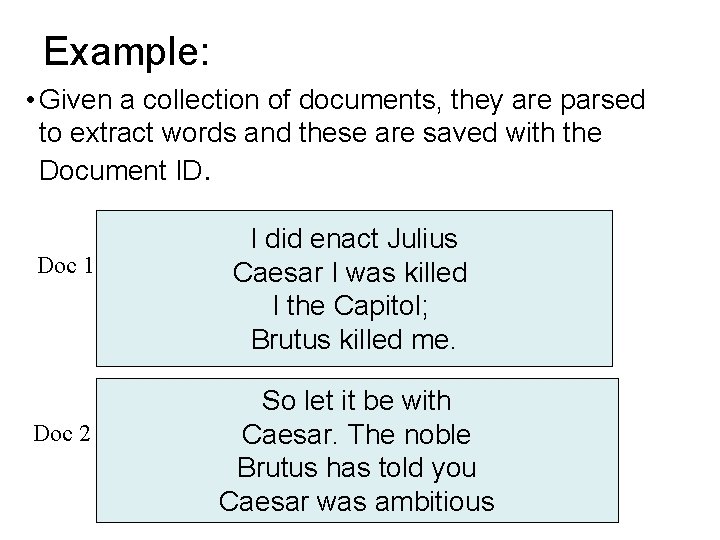
Example: • Given a collection of documents, they are parsed to extract words and these are saved with the Document ID. Doc 1 Doc 2 I did enact Julius Caesar I was killed I the Capitol; Brutus killed me. So let it be with Caesar. The noble Brutus has told you Caesar was ambitious
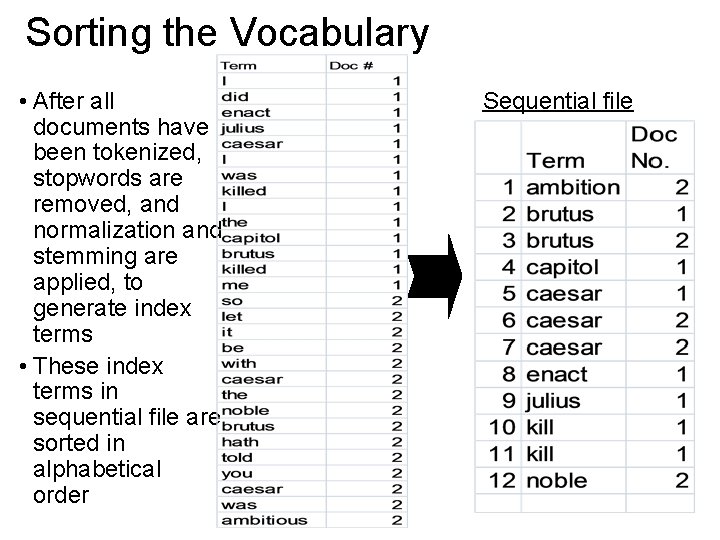
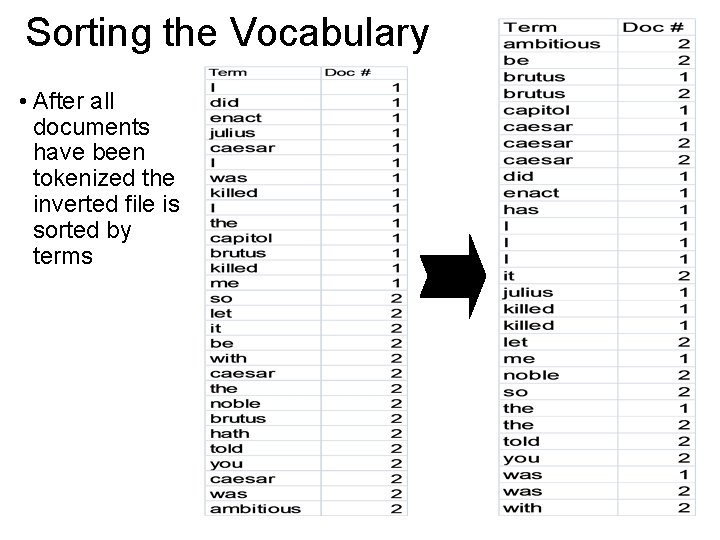
Sorting the Vocabulary • After all documents have been tokenized, stopwords are removed, and normalization and stemming are applied, to generate index terms • These index terms in sequential file are sorted in alphabetical order Sequential file
Sequential File • Its main advantages are: – easy to implement; – provides fast access to the next record using lexicographic order. – Instead of Linear time search, one can search in logarithmic time using binary search • Its disadvantages: – difficult to update. Index must be rebuilt if a new term is added. Inserting a new record may require moving a large proportion of the file; – random access is extremely slow. • The problem of update can be solved : – by ordering records by date of acquisition, than the key value; hence, the newest entries are added at the end of the file & therefore pose no difficulty to updating. But searching becomes very tough; it requires linear time
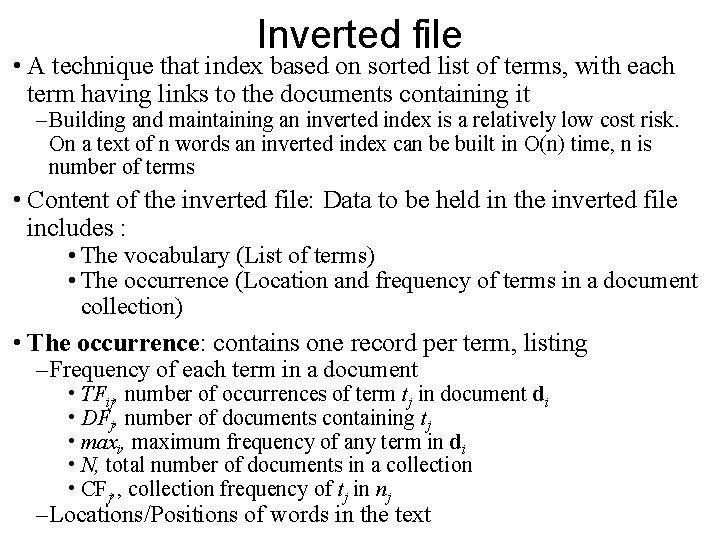
Inverted file • A technique that index based on sorted list of terms, with each term having links to the documents containing it – Building and maintaining an inverted index is a relatively low cost risk. On a text of n words an inverted index can be built in O(n) time, n is number of terms • Content of the inverted file: Data to be held in the inverted file includes : • The vocabulary (List of terms) • The occurrence (Location and frequency of terms in a document collection) • The occurrence: contains one record per term, listing – Frequency of each term in a document • TFij, number of occurrences of term tj in document di • DFj, number of documents containing tj • maxi, maximum frequency of any term in di • N, total number of documents in a collection • CFj, , collection frequency of tj in nj – Locations/Positions of words in the text
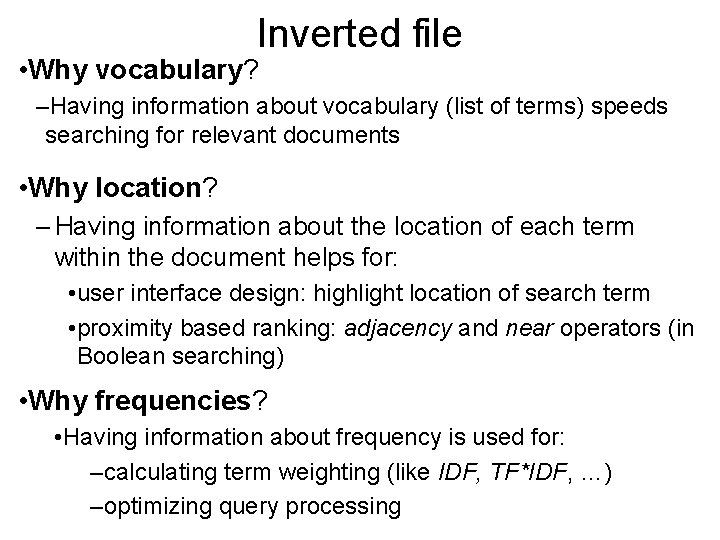
Inverted file • Why vocabulary? –Having information about vocabulary (list of terms) speeds searching for relevant documents • Why location? – Having information about the location of each term within the document helps for: • user interface design: highlight location of search term • proximity based ranking: adjacency and near operators (in Boolean searching) • Why frequencies? • Having information about frequency is used for: –calculating term weighting (like IDF, TF*IDF, …) –optimizing query processing
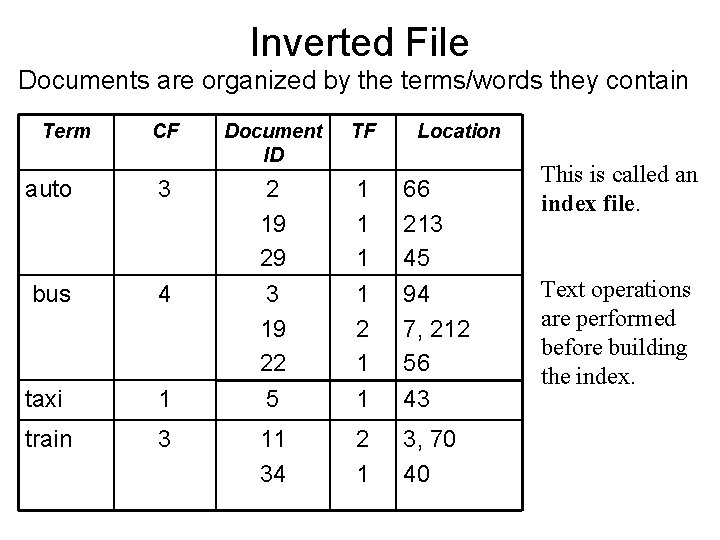
Inverted File Documents are organized by the terms/words they contain Term CF Document ID TF Location auto 3 2 19 29 1 1 1 66 213 45 bus 4 3 19 22 1 94 7, 212 56 taxi 1 5 1 43 train 3 11 34 2 1 3, 70 40 This is called an index file. Text operations are performed before building the index.
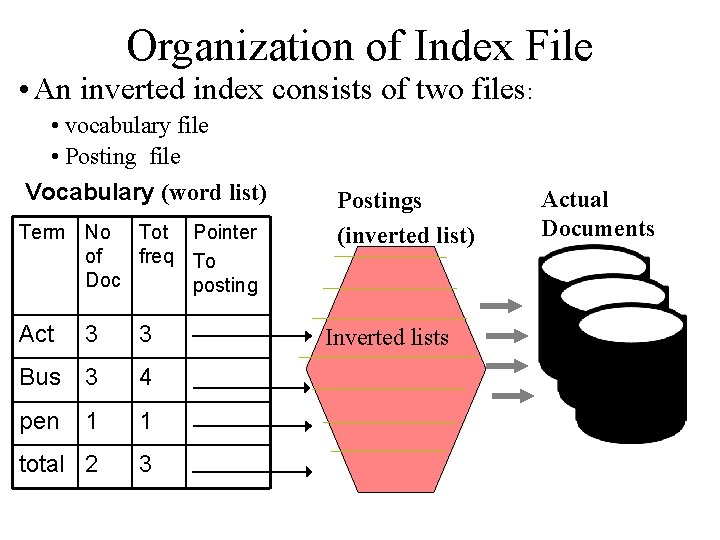
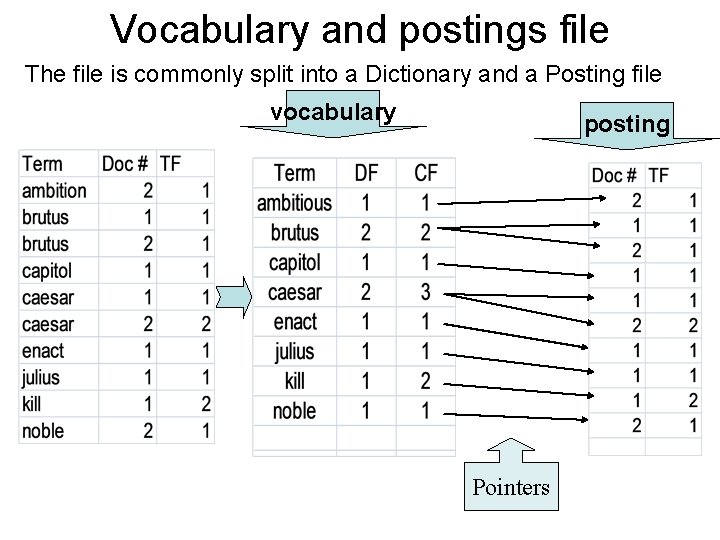
Organization of Index File • An inverted index consists of two files: • vocabulary file • Posting file Vocabulary (word list) Term No Tot Pointer of freq To Doc posting Act 3 3 Bus 3 4 pen 1 1 total 2 3 Postings (inverted list) Inverted lists Actual Documents
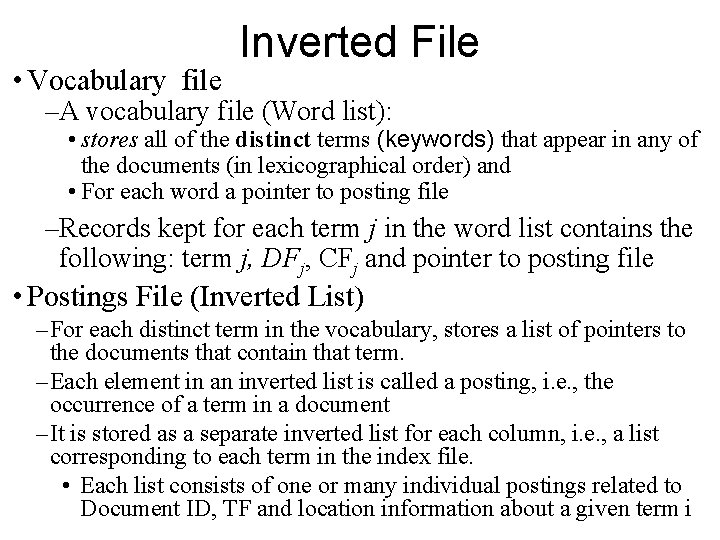
• Vocabulary file Inverted File –A vocabulary file (Word list): • stores all of the distinct terms (keywords) that appear in any of the documents (in lexicographical order) and • For each word a pointer to posting file –Records kept for each term j in the word list contains the following: term j, DFj, CFj and pointer to posting file • Postings File (Inverted List) – For each distinct term in the vocabulary, stores a list of pointers to the documents that contain that term. – Each element in an inverted list is called a posting, i. e. , the occurrence of a term in a document – It is stored as a separate inverted list for each column, i. e. , a list corresponding to each term in the index file. • Each list consists of one or many individual postings related to Document ID, TF and location information about a given term i
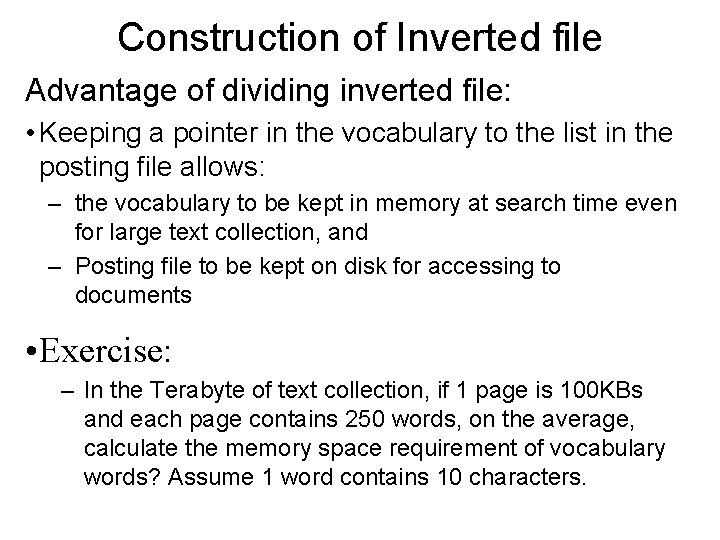
Construction of Inverted file Advantage of dividing inverted file: • Keeping a pointer in the vocabulary to the list in the posting file allows: – the vocabulary to be kept in memory at search time even for large text collection, and – Posting file to be kept on disk for accessing to documents • Exercise: – In the Terabyte of text collection, if 1 page is 100 KBs and each page contains 250 words, on the average, calculate the memory space requirement of vocabulary words? Assume 1 word contains 10 characters.
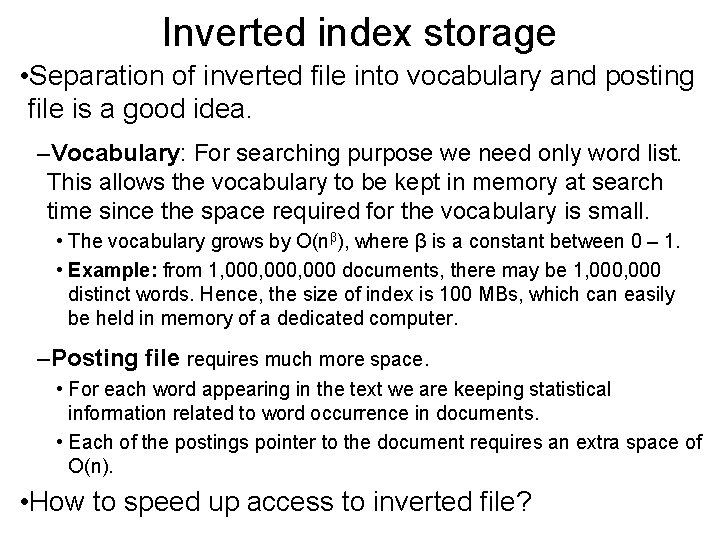
Inverted index storage • Separation of inverted file into vocabulary and posting file is a good idea. –Vocabulary: For searching purpose we need only word list. This allows the vocabulary to be kept in memory at search time since the space required for the vocabulary is small. • The vocabulary grows by O(nβ), where β is a constant between 0 – 1. • Example: from 1, 000, 000 documents, there may be 1, 000 distinct words. Hence, the size of index is 100 MBs, which can easily be held in memory of a dedicated computer. –Posting file requires much more space. • For each word appearing in the text we are keeping statistical information related to word occurrence in documents. • Each of the postings pointer to the document requires an extra space of O(n). • How to speed up access to inverted file?
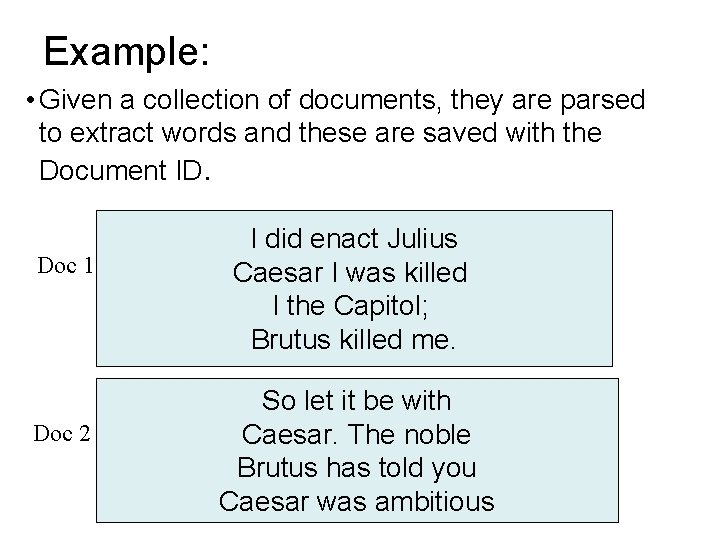
Example: • Given a collection of documents, they are parsed to extract words and these are saved with the Document ID. Doc 1 Doc 2 I did enact Julius Caesar I was killed I the Capitol; Brutus killed me. So let it be with Caesar. The noble Brutus has told you Caesar was ambitious
Sorting the Vocabulary • After all documents have been tokenized the inverted file is sorted by terms
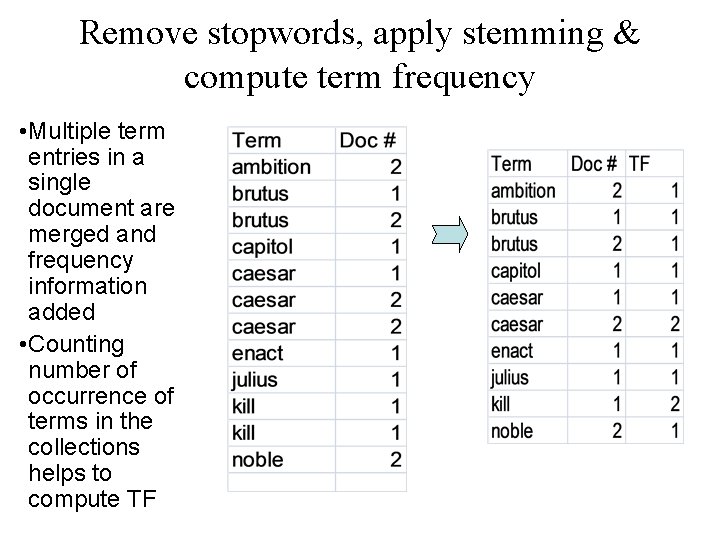
Remove stopwords, apply stemming & compute term frequency • Multiple term entries in a single document are merged and frequency information added • Counting number of occurrence of terms in the collections helps to compute TF
Vocabulary and postings file The file is commonly split into a Dictionary and a Posting file vocabulary posting Pointers
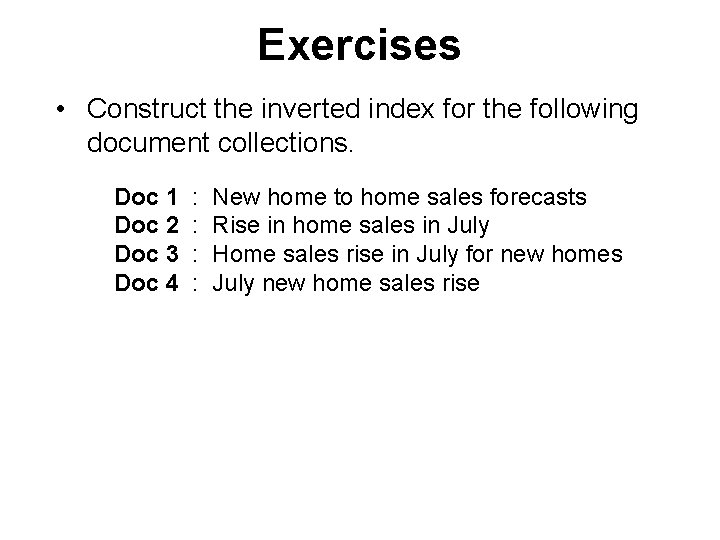
Exercises • Construct the inverted index for the following document collections. Doc 1 Doc 2 Doc 3 Doc 4 : : New home to home sales forecasts Rise in home sales in July Home sales rise in July for new homes July new home sales rise