
Chapter 4 How Language Works Prof Julia Nee
- Slides: 46
Chapter 4: How Language Works Prof. Julia Nee Comparative Linguistics Spring 2014, La. Salle University Based on The Language Instinct by Stephen Pinker
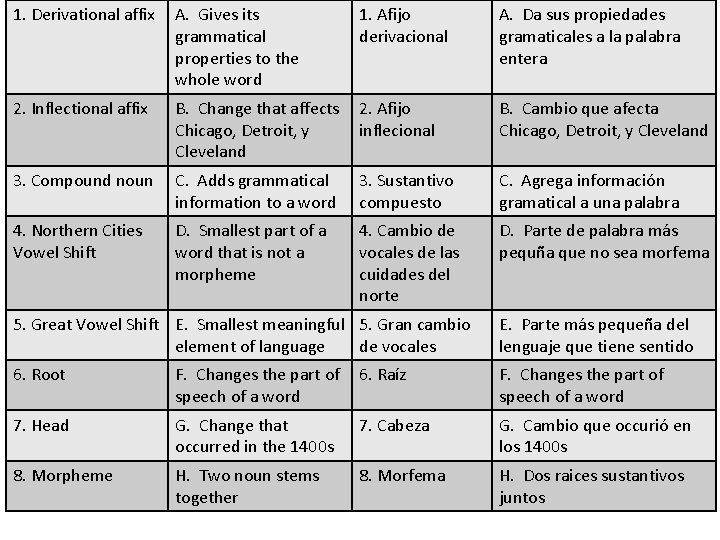
1. Derivational affix A. Gives its grammatical properties to the whole word 1. Afijo derivacional A. Da sus propiedades gramaticales a la palabra entera Quiz! 2. Inflectional affix B. Change that affects Chicago, Detroit, y Cleveland 2. Afijo inflecional B. Cambio que afecta Chicago, Detroit, y Cleveland 3. Compound noun C. Adds grammatical information to a word 3. Sustantivo compuesto C. Agrega información gramatical a una palabra 4. Northern Cities Vowel Shift D. Smallest part of a word that is not a morpheme 4. Cambio de vocales de las cuidades del norte D. Parte de palabra más pequña que no sea morfema 5. Great Vowel Shift E. Smallest meaningful 5. Gran cambio element of language de vocales E. Parte más pequeña del lenguaje que tiene sentido 6. Root F. Changes the part of speech of a word 6. Raíz F. Changes the part of speech of a word 7. Head G. Change that occurred in the 1400 s 7. Cabeza G. Cambio que occurió en los 1400 s 8. Morpheme H. Two noun stems together 8. Morfema H. Dos raices sustantivos juntos
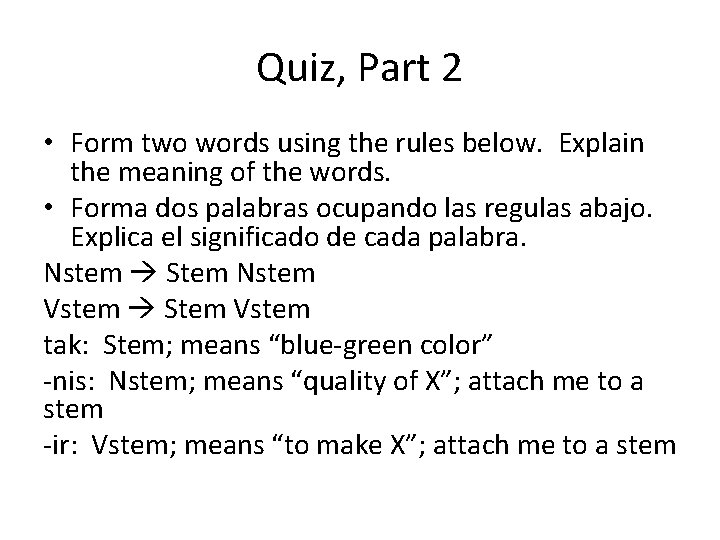
Quiz, Part 2 • Form two words using the rules below. Explain the meaning of the words. • Forma dos palabras ocupando las regulas abajo. Explica el significado de cada palabra. Nstem Stem Nstem Vstem Stem Vstem tak: Stem; means “blue-green color” -nis: Nstem; means “quality of X”; attach me to a stem -ir: Vstem; means “to make X”; attach me to a stem
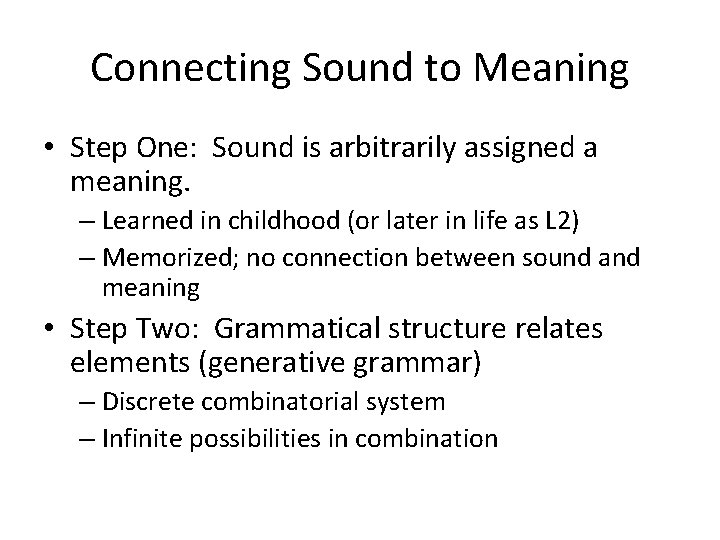
Connecting Sound to Meaning • Step One: Sound is arbitrarily assigned a meaning. – Learned in childhood (or later in life as L 2) – Memorized; no connection between sound and meaning • Step Two: Grammatical structure relates elements (generative grammar) – Discrete combinatorial system – Infinite possibilities in combination
Connecting Sound to Meaning • Each individual has: – Lexicon: mental dictionary of word roots and affixes with particular meanings – Grammar: set of rules for combining the elements from the lexicon • We can create and understand a near-infinite number of sentences • 10000000000 sentences!
Grammar and Cognition • Grammar and understanding are not the same • Some sentences which are not grammatical are understandable: – Is raining. – The child seems sleeping. – Welcome to Chinese Restaurant. Please try your Nice Chinese food with Chopsticks: the traditional and typical of Chinese glorious history and cultural
Grammar and Cognition • Some sentences which are not understandable are grammatical: – Colorless green ideas sleep furiously. • Clear that the sentence is grammatical: – What slept? – How? – What kind of ideas were they?
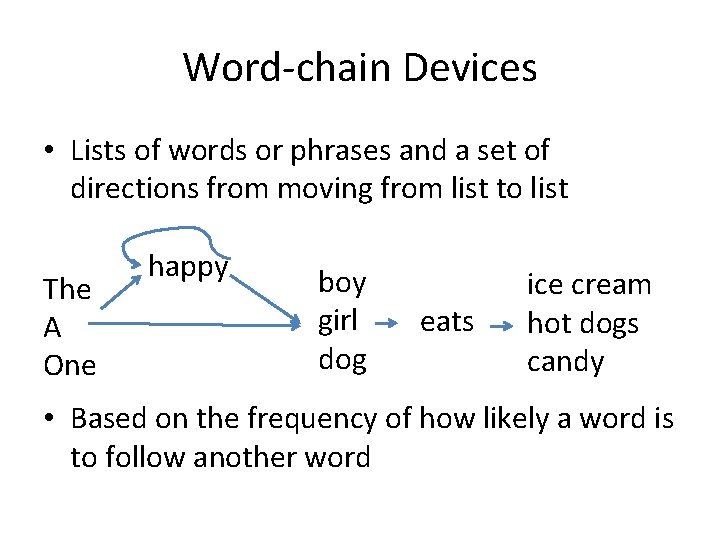
Word-chain Devices • Lists of words or phrases and a set of directions from moving from list to list The A One happy boy girl dog eats ice cream hot dogs candy • Based on the frequency of how likely a word is to follow another word
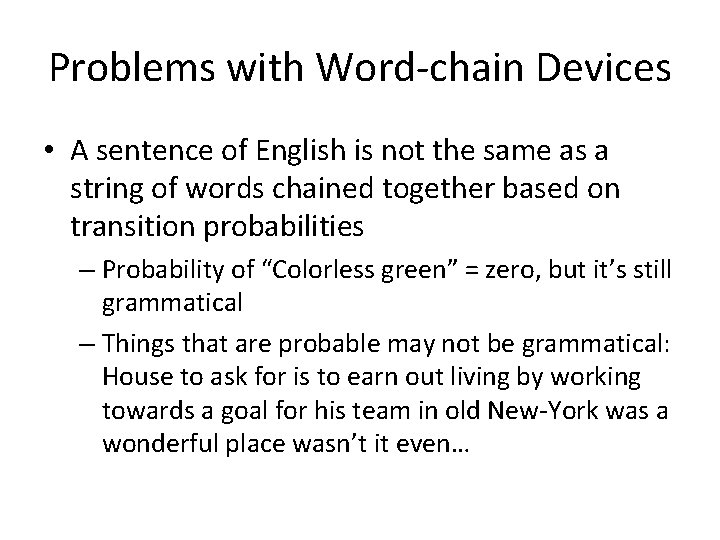
Problems with Word-chain Devices • A sentence of English is not the same as a string of words chained together based on transition probabilities – Probability of “Colorless green” = zero, but it’s still grammatical – Things that are probable may not be grammatical: House to ask for is to earn out living by working towards a goal for his team in old New-York was a wonderful place wasn’t it even…
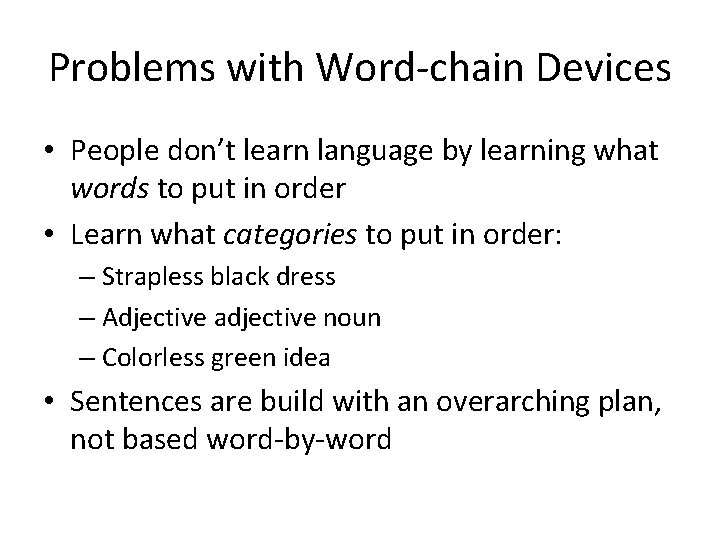
Problems with Word-chain Devices • People don’t learn language by learning what words to put in order • Learn what categories to put in order: – Strapless black dress – Adjective adjective noun – Colorless green idea • Sentences are build with an overarching plan, not based word-by-word
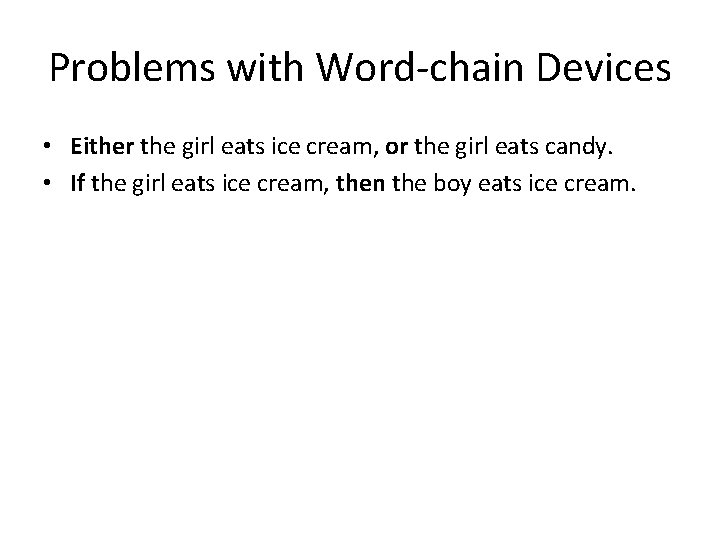
Problems with Word-chain Devices • Either the girl eats ice cream, or the girl eats candy. • If the girl eats ice cream, then the boy eats ice cream.
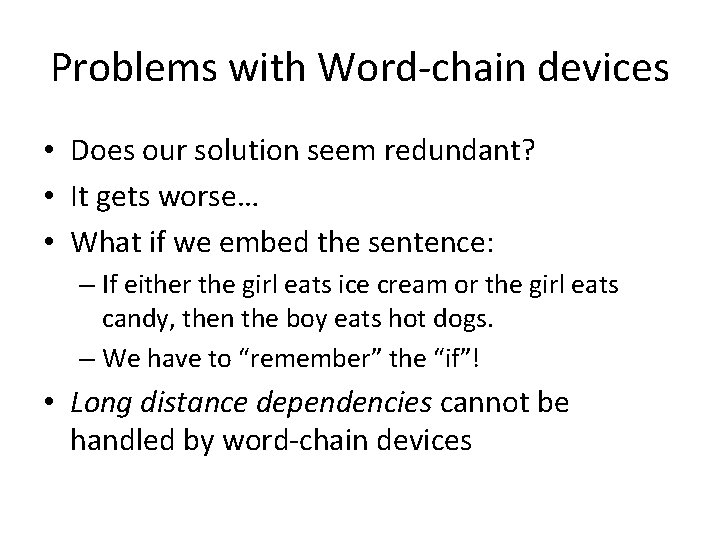
Problems with Word-chain devices • Does our solution seem redundant? • It gets worse… • What if we embed the sentence: – If either the girl eats ice cream or the girl eats candy, then the boy eats hot dogs. – We have to “remember” the “if”! • Long distance dependencies cannot be handled by word-chain devices
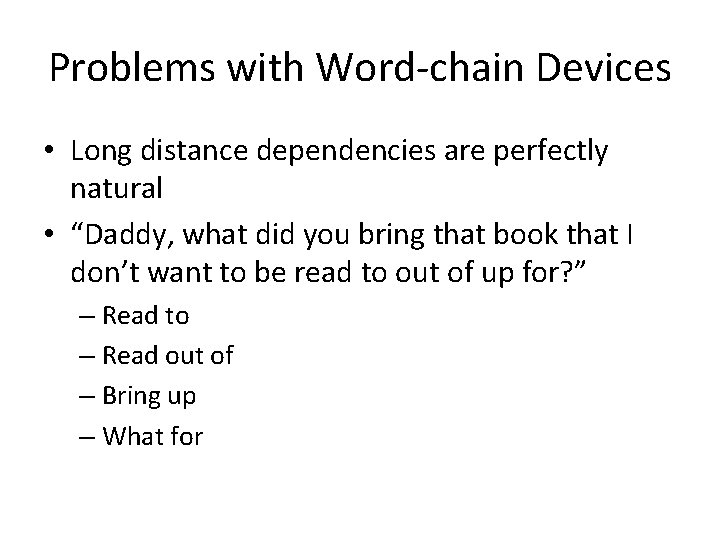
Problems with Word-chain Devices • Long distance dependencies are perfectly natural • “Daddy, what did you bring that book that I don’t want to be read to out of up for? ” – Read to – Read out of – Bring up – What for
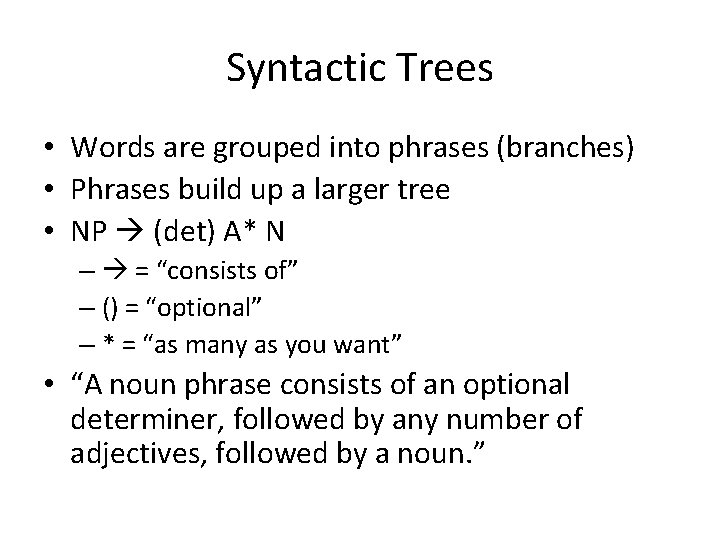
Syntactic Trees • Words are grouped into phrases (branches) • Phrases build up a larger tree • NP (det) A* N – = “consists of” – () = “optional” – * = “as many as you want” • “A noun phrase consists of an optional determiner, followed by any number of adjectives, followed by a noun. ”
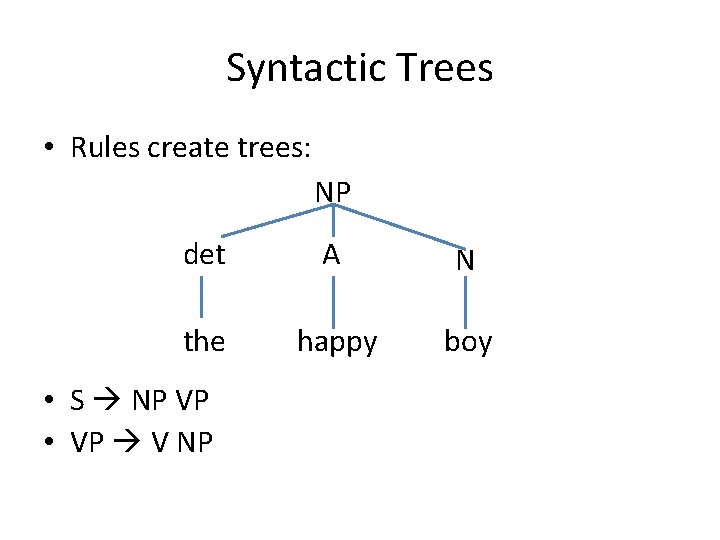
Syntactic Trees • Rules create trees: NP det A N the happy boy • S NP VP • VP V NP
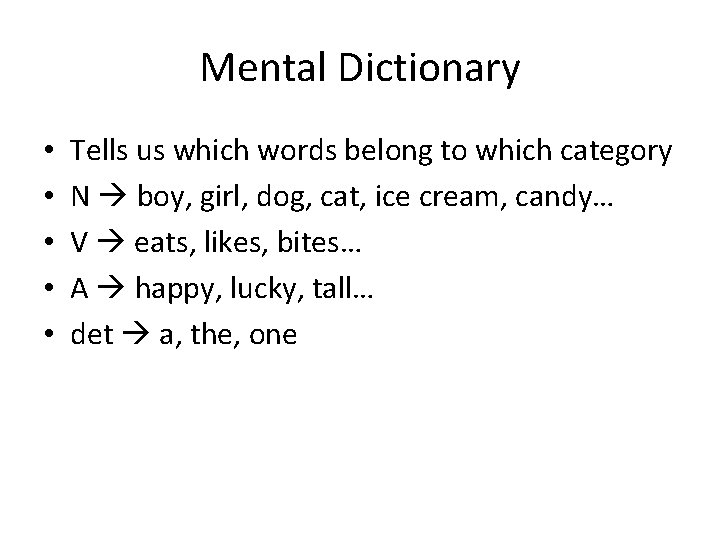
Mental Dictionary • • • Tells us which words belong to which category N boy, girl, dog, cat, ice cream, candy… V eats, likes, bites… A happy, lucky, tall… det a, the, one
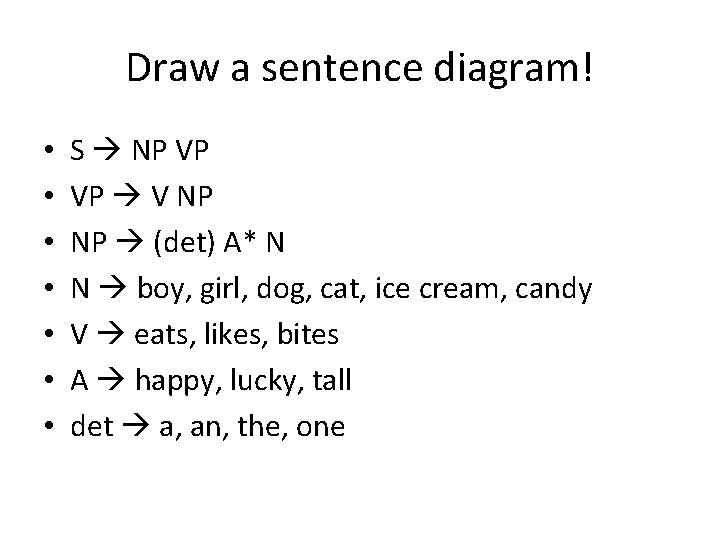
Draw a sentence diagram! • • S NP VP VP V NP NP (det) A* N N boy, girl, dog, cat, ice cream, candy V eats, likes, bites A happy, lucky, tall det a, an, the, one
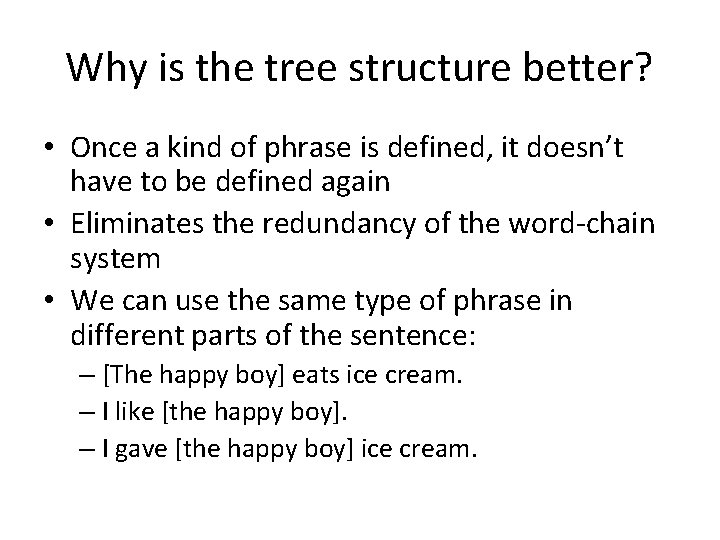
Why is the tree structure better? • Once a kind of phrase is defined, it doesn’t have to be defined again • Eliminates the redundancy of the word-chain system • We can use the same type of phrase in different parts of the sentence: – [The happy boy] eats ice cream. – I like [the happy boy]. – I gave [the happy boy] ice cream.
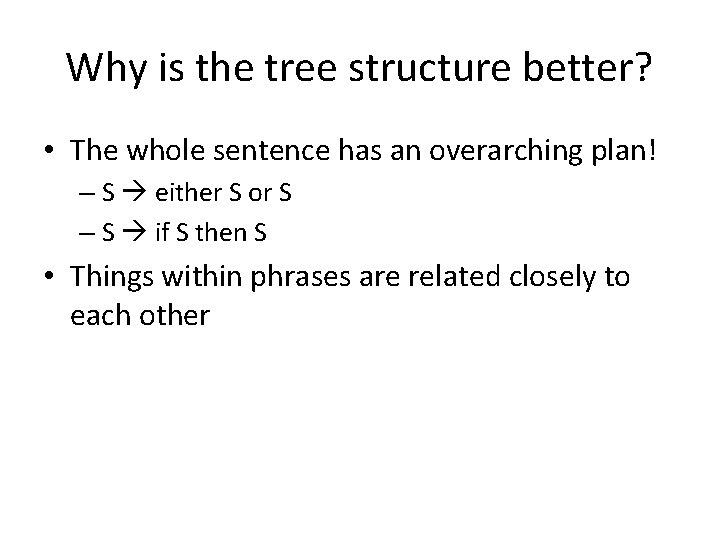
Why is the tree structure better? • The whole sentence has an overarching plan! – S either S or S – S if S then S • Things within phrases are related closely to each other
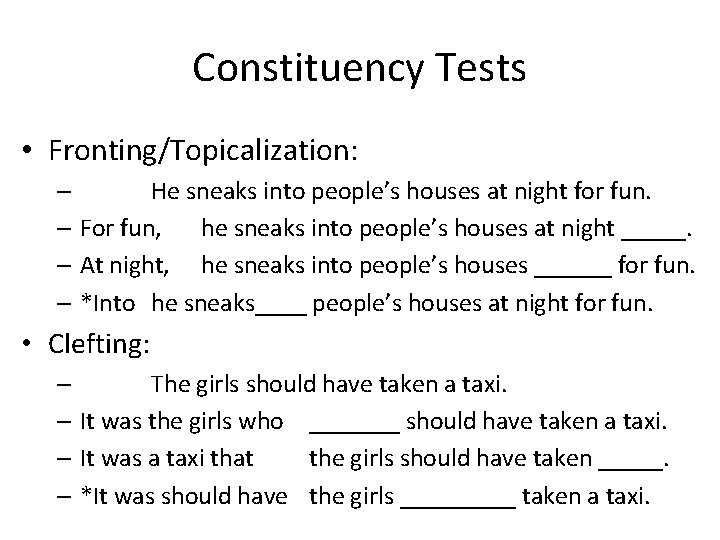
Constituency • Branches of a tree are composed of words that are bound together • They are known as constituents • Can be isolated through constituency tests
Constituency Tests • Fronting/Topicalization: – He sneaks into people’s houses at night for fun. – For fun, he sneaks into people’s houses at night _____. – At night, he sneaks into people’s houses ______ for fun. – *Into he sneaks____ people’s houses at night for fun. • Clefting: – The girls should have taken a taxi. – It was the girls who _______ should have taken a taxi. – It was a taxi that the girls should have taken _____. – *It was should have the girls _____ taken a taxi.
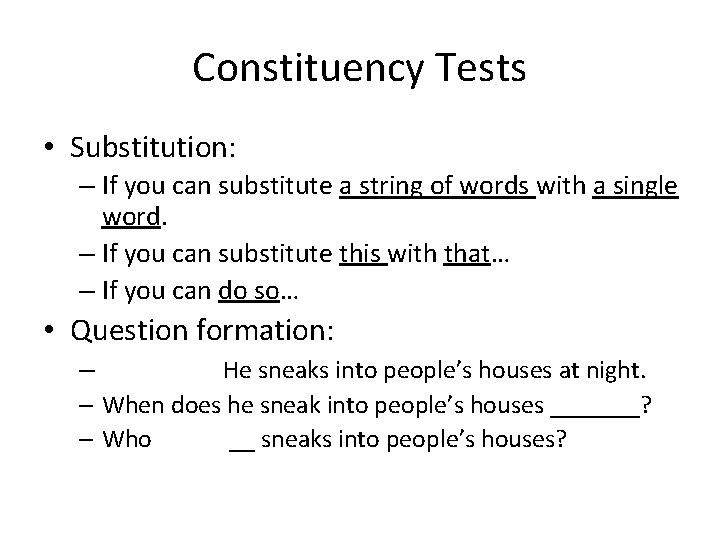
Constituency Tests • Substitution: – If you can substitute a string of words with a single word. – If you can substitute this with that… – If you can do so… • Question formation: – He sneaks into people’s houses at night. – When does he sneak into people’s houses _______? – Who __ sneaks into people’s houses?
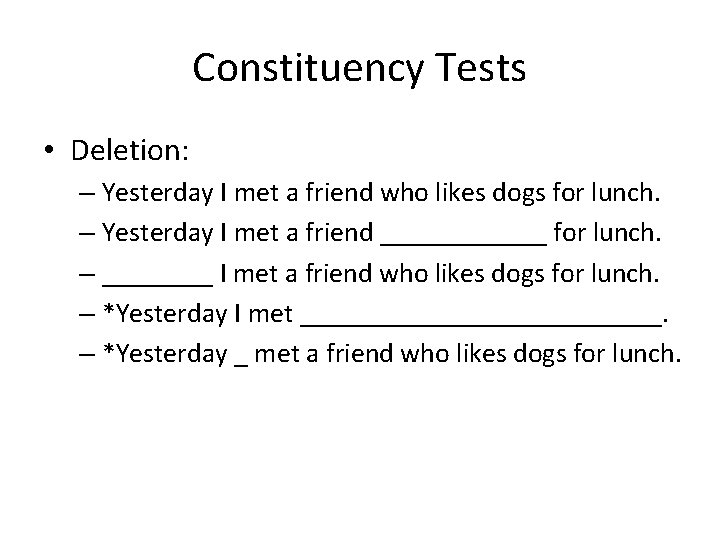
Constituency Tests • Deletion: – Yesterday I met a friend who likes dogs for lunch. – Yesterday I met a friend ______ for lunch. – ____ I met a friend who likes dogs for lunch. – *Yesterday I met _____________. – *Yesterday _ met a friend who likes dogs for lunch.
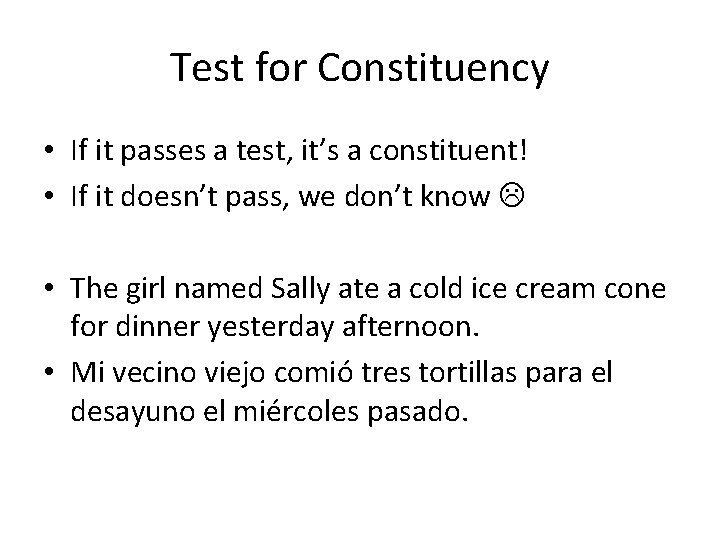
Test for Constituency • If it passes a test, it’s a constituent! • If it doesn’t pass, we don’t know • The girl named Sally ate a cold ice cream cone for dinner yesterday afternoon. • Mi vecino viejo comió tres tortillas para el desayuno el miércoles pasado.
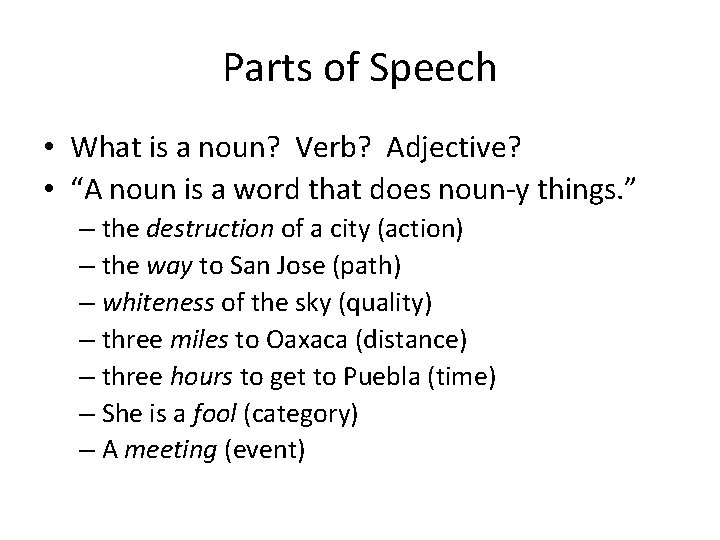
Parts of Speech • What is a noun? Verb? Adjective? • “A noun is a word that does noun-y things. ” – the destruction of a city (action) – the way to San Jose (path) – whiteness of the sky (quality) – three miles to Oaxaca (distance) – three hours to get to Puebla (time) – She is a fool (category) – A meeting (event)
Why are parts of speech useful? • Divide words into parts of speech to feed into rules • Rules describe the phrases and sentences that can be created from different word categories (parts of speech) • Parts of speech are abstract mental concepts!
Anatomy of Phrases 1. Head 2. Role-Players 3. Modifiers
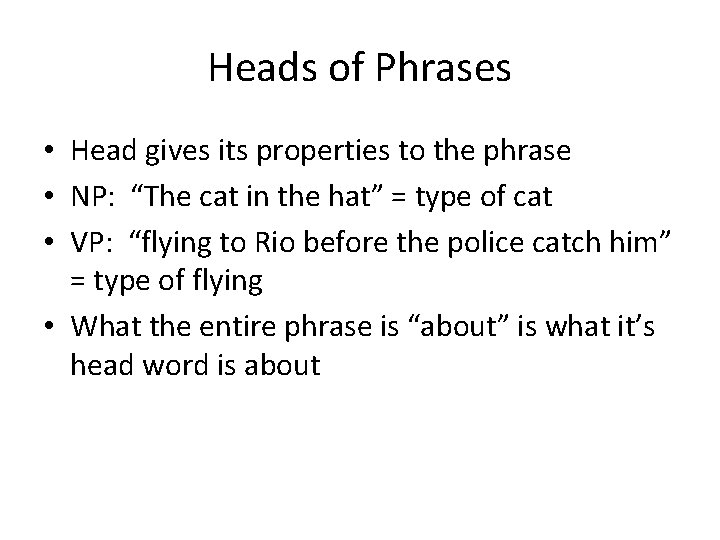
Heads of Phrases • Head gives its properties to the phrase • NP: “The cat in the hat” = type of cat • VP: “flying to Rio before the police catch him” = type of flying • What the entire phrase is “about” is what it’s head word is about
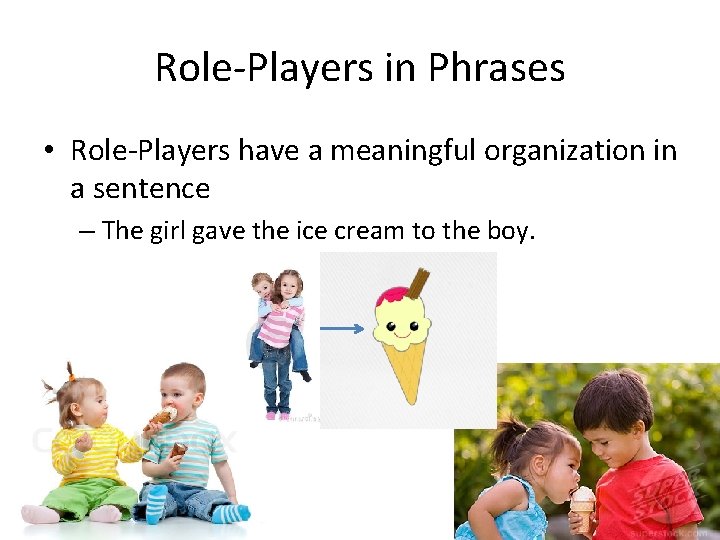
Role-Players in Phrases • Role-Players have a meaningful organization in a sentence – The girl gave the ice cream to the boy.
Role Players in Phrases • Head + role-players = subphrase – Nbar – Vbar • Governor of California
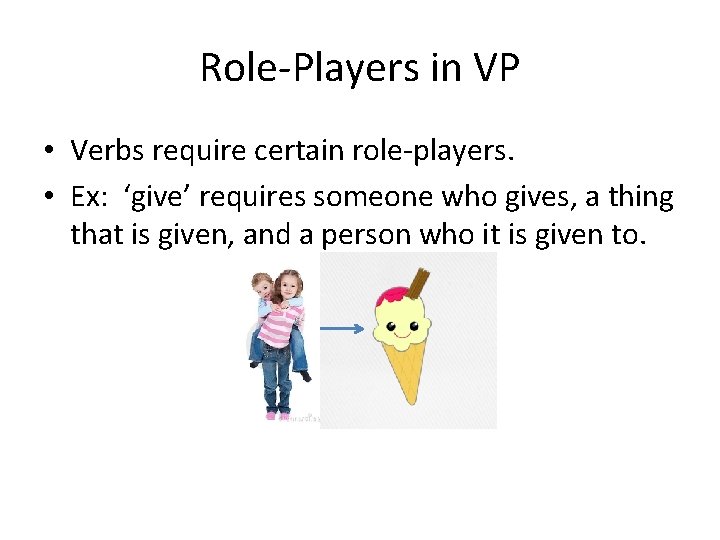
Role-Players in VP • Verbs require certain role-players. • Ex: ‘give’ requires someone who gives, a thing that is given, and a person who it is given to.
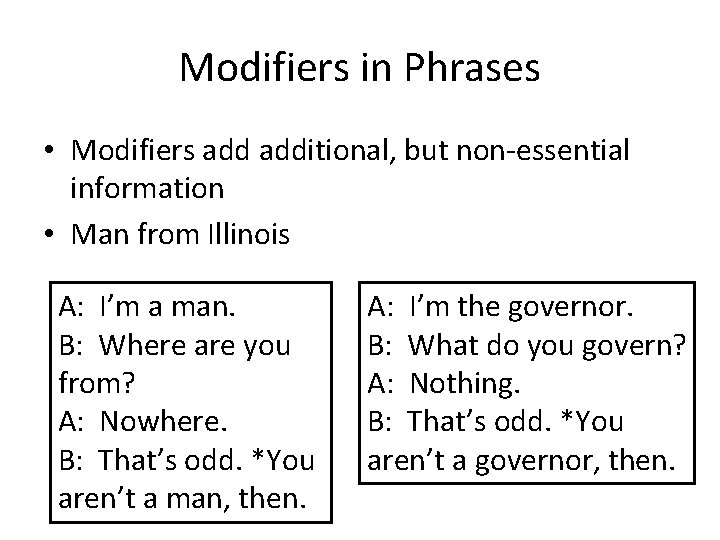
Modifiers in Phrases • Modifiers additional, but non-essential information • Man from Illinois A: I’m a man. B: Where are you from? A: Nowhere. B: That’s odd. *You aren’t a man, then. A: I’m the governor. B: What do you govern? A: Nothing. B: That’s odd. *You aren’t a governor, then.
Modifiers in Phrases • Modifiers attach within the phrase, but not within the subphrase. • “Governor of California from Illinois”
Modifiers vs. Role-Players • Role-players are required and modifiers are optional • Role-players stay close to the head, within the subphrase • Modifiers can move further out, within the phrase
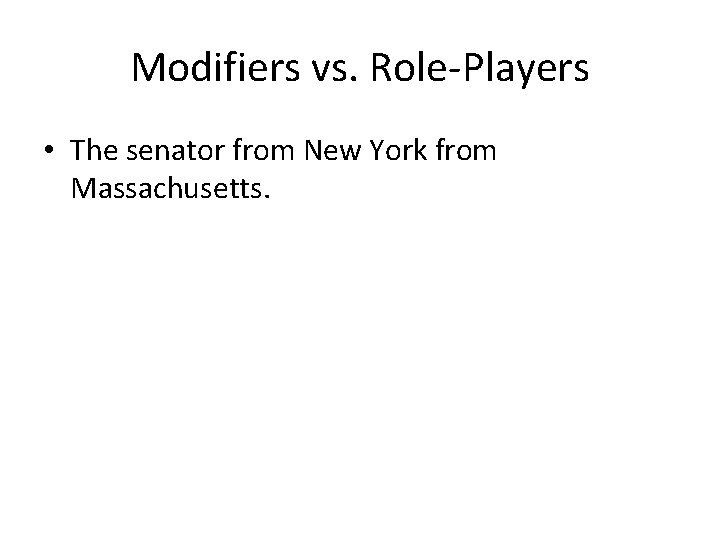
Modifiers vs. Role-Players • The senator from New York from Massachusetts.
Ambiguity • Sometimes, there are two or more possible constituents. • “Tonight’s program will discuss stress, exercise, nutrition, and sex with Ryan Seacrest. ” – [discuss stress, exercise, nutrition, and sex] with Ryan Seacrest – Discuss stress, exercise, nutrition, and [sex with Ryan Seacrest]
NP and VP • Have similar structure! • “The guitarists destroy the hotel room. ” • “The guitarists’ destruction of the hotel room. ”
Quiz • Draw a word-chain device that accounts for the following: – The short red-headed man eats bananas. – The tall blonde girl eats bananas. – The short boy eats bananas. – The blonde woman eats bananas. – *The red-headed short girl eats bananas. • Write the syntactic tree generation rules that account for the structure on the board.
X-Bar Theory • XP (SPEC) Xbar YP* – “A phrase consists of an optional subject, followed by an X-bar, followed by any number of modifiers. ” • Xbar X ZP* – “An X-bar consists of a head word, followed by any number of role-players. ”
How do we explain ambiguity? Diagram multiple interpretations of each sentence, in teams: 1. The tourist saw the man with the binoculars. 2. The mouse saw the cat on the mat with the hat. 3. The dog chased the cat and the rabbit with the mouse. 4. The man ate the rice in the cabinet with a knife. 5. The mouse with the cheese in the box saw the dog with the telescope. 6. The cat eating food in a bowl scared the mouse in the kitchen.
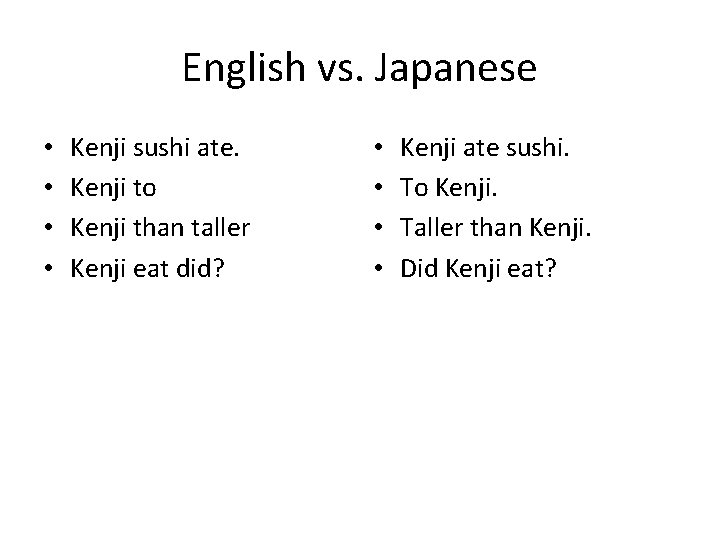
English vs. Japanese • • Kenji sushi ate. Kenji to Kenji than taller Kenji eat did? • • Kenji ate sushi. To Kenji. Taller than Kenji. Did Kenji eat?
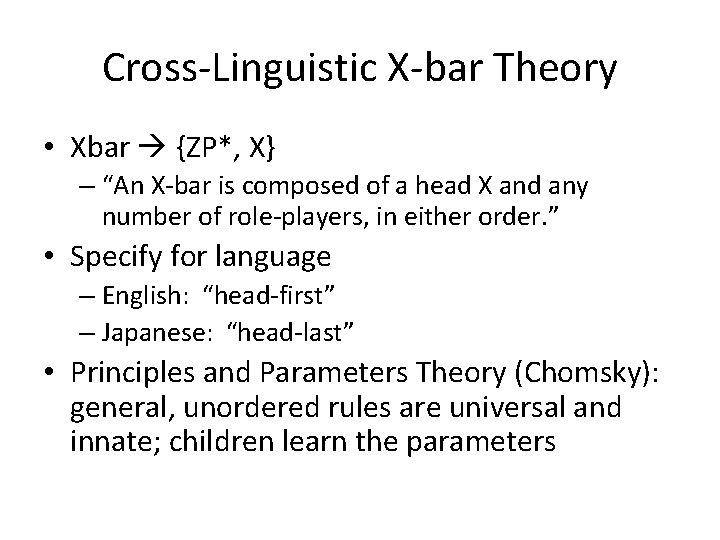
Cross-Linguistic X-bar Theory • Xbar {ZP*, X} – “An X-bar is composed of a head X and any number of role-players, in either order. ” • Specify for language – English: “head-first” – Japanese: “head-last” • Principles and Parameters Theory (Chomsky): general, unordered rules are universal and innate; children learn the parameters
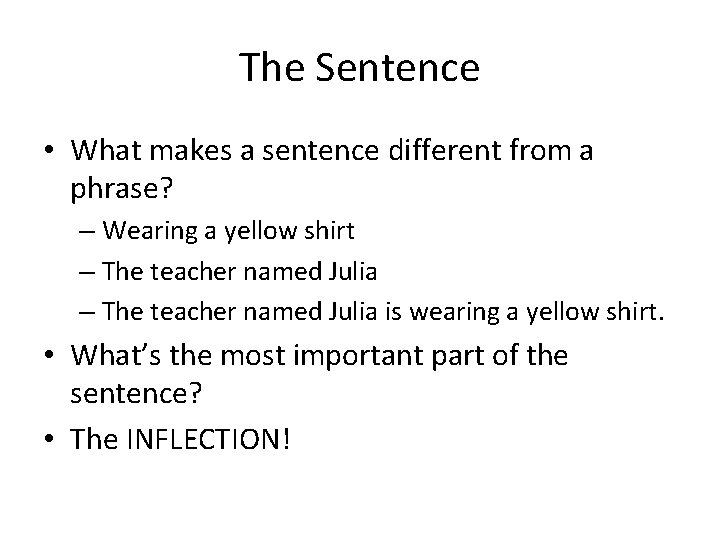
The Sentence • What makes a sentence different from a phrase? – Wearing a yellow shirt – The teacher named Julia is wearing a yellow shirt. • What’s the most important part of the sentence? • The INFLECTION!
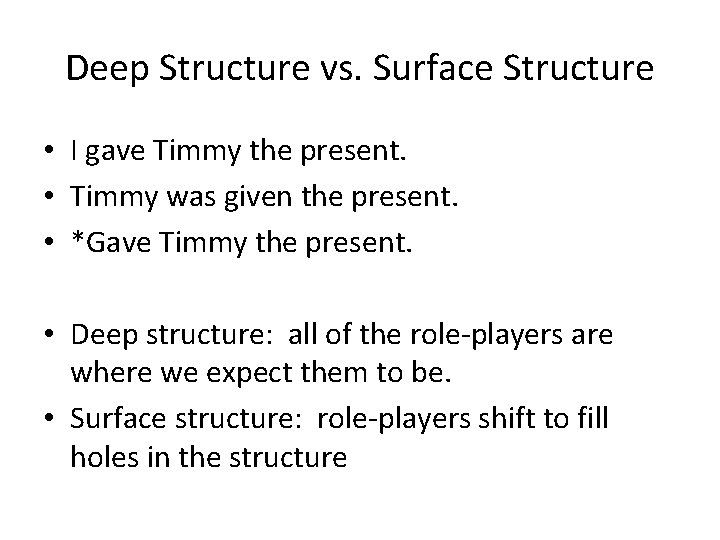
Deep Structure vs. Surface Structure • I gave Timmy the present. • Timmy was given the present. • *Gave Timmy the present. • Deep structure: all of the role-players are where we expect them to be. • Surface structure: role-players shift to fill holes in the structure
Question Formation • Question formation in English: – The unicorn is standing in the garden. – Is the unicorn standing in the garden? • More complex: – The unicorn who is eating grass is standing in the garden. – *Is the unicorn who ___ eating grass is standing in the garden? – Is the unicorn who is eating grass ___ standing in the garden?
Question Formation • Gives us the same underlying structure crosslinguistically! • Do you eat chocolate? • Comes tú chocolate?