
CHAPTER 4 GROUNDING AND GROUND GRID DESIGN 1
- Slides: 70
CHAPTER 4 GROUNDING AND GROUND GRID DESIGN 1
SUB-TOPIC 1. Defining Design Objective Grounding system Equipment grounding System Grounding Ground rod and Grounding electrode 2. Soil resistivity and Ground Resistance Measurement Soil Characteristic Resistivity Measurement Resistance Measurement 3. Grid substation Grounding 4. Ground Grid Calculation 5. Grid Resistance 6. Computer aided Ground grid design 2
INTRODUCTION GROUNDING? EARTHING? BONDING? 3
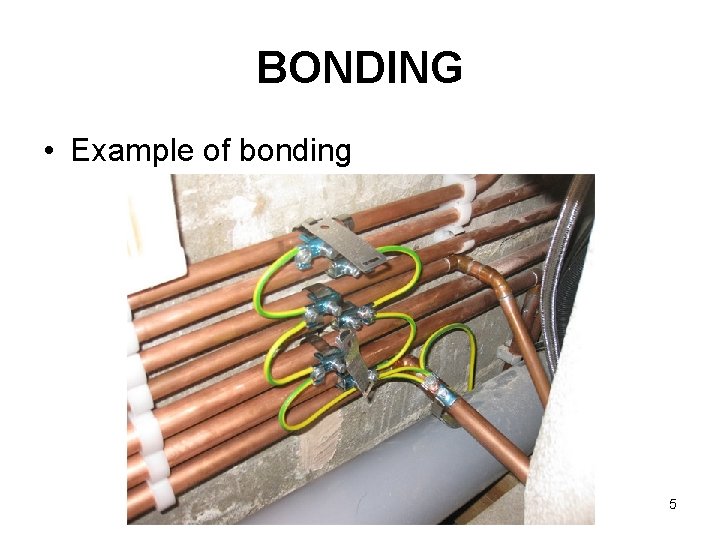
BONDING • Bonding is intentional electrical interconnecting of conductive path in order to ensure common electrical potential between the bounded parts. • Bonding is simply the act of joining two electrical conductors together. • These may be two wires, a wire and a pipe, or these may be two equipments. • Bonding has to be done by connecting of all the metal parts that are not supposed to be carrying current during normal operations to bringing them to the same electrical potential 4
BONDING • Example of bonding 5
EARTHING • Earthing means connecting the dead part (it means the part which does not carries current under normal condition) to the earth for example electrical equipment’s frames, enclosures, supports etc. • The purpose of earthing is to minimize the risk of receiving an electric shock if touching metal parts when a fault is present. • Generally green wire is used for this as a nomenclature. 6
GROUNDING • Grounding means connecting the live part (it means the part which carries current under normal condition) to the earth for example neutral of power transformer. • It is done for the protections of power system equipment and to provide an effective return path from the machine to the power source. • Because of lightning, line surges or unintentional contact with other high voltage lines, dangerously high voltages can develop in the electrical distribution system wires. • Grounding provides a safe, alternate path around the electrical system of your house thus minimizing damage from such occurrences. 7
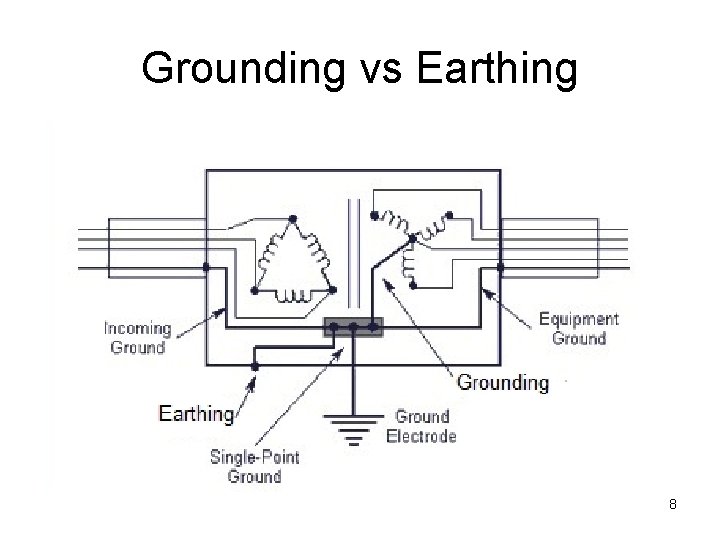
Grounding vs Earthing 8
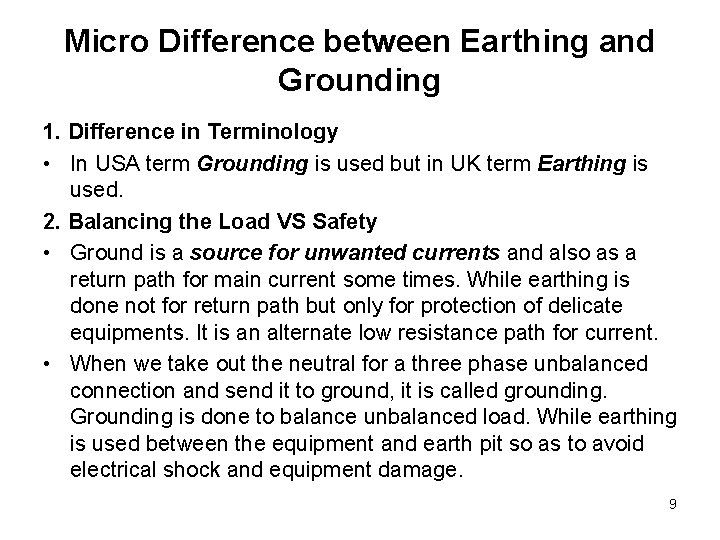
Micro Difference between Earthing and Grounding 1. Difference in Terminology • In USA term Grounding is used but in UK term Earthing is used. 2. Balancing the Load VS Safety • Ground is a source for unwanted currents and also as a return path for main current some times. While earthing is done not for return path but only for protection of delicate equipments. It is an alternate low resistance path for current. • When we take out the neutral for a three phase unbalanced connection and send it to ground, it is called grounding. Grounding is done to balance unbalanced load. While earthing is used between the equipment and earth pit so as to avoid electrical shock and equipment damage. 9
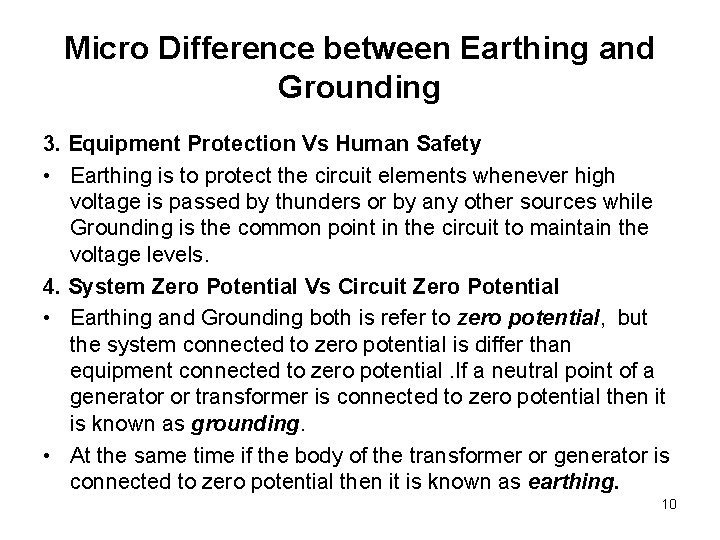
Micro Difference between Earthing and Grounding 3. Equipment Protection Vs Human Safety • Earthing is to protect the circuit elements whenever high voltage is passed by thunders or by any other sources while Grounding is the common point in the circuit to maintain the voltage levels. 4. System Zero Potential Vs Circuit Zero Potential • Earthing and Grounding both is refer to zero potential, but the system connected to zero potential is differ than equipment connected to zero potential. If a neutral point of a generator or transformer is connected to zero potential then it is known as grounding. • At the same time if the body of the transformer or generator is connected to zero potential then it is known as earthing. 10
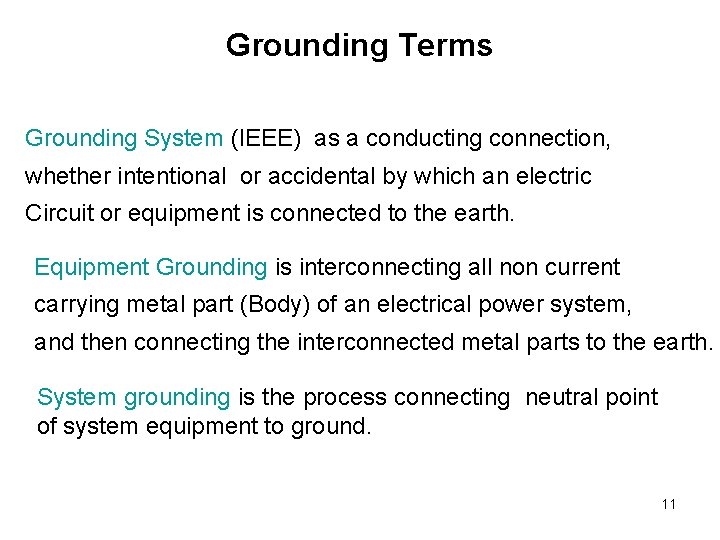
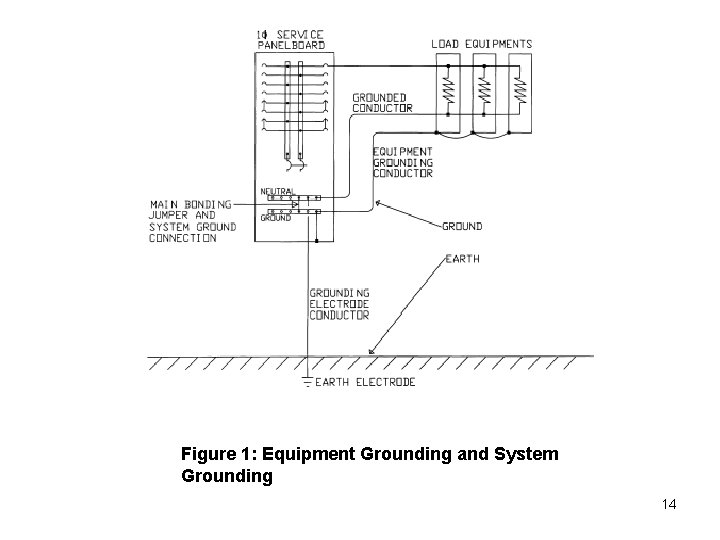
Grounding Terms Grounding System (IEEE) as a conducting connection, whether intentional or accidental by which an electric Circuit or equipment is connected to the earth. Equipment Grounding is interconnecting all non current carrying metal part (Body) of an electrical power system, and then connecting the interconnected metal parts to the earth. System grounding is the process connecting neutral point of system equipment to ground. 11
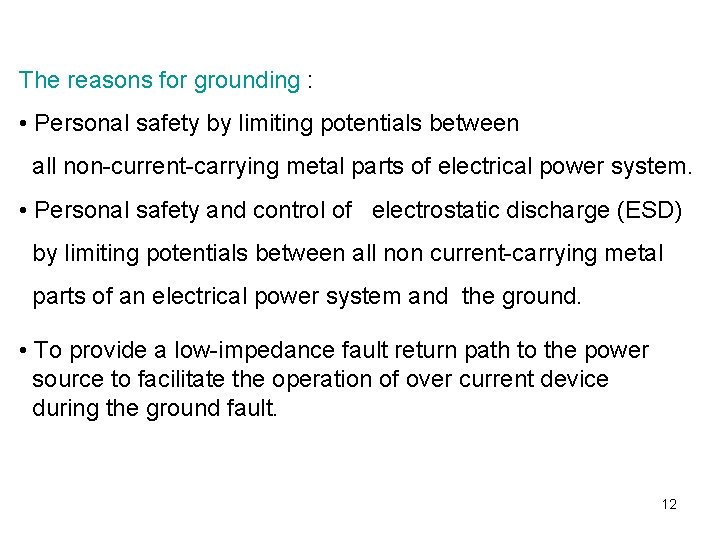
The reasons for grounding : • Personal safety by limiting potentials between all non-current-carrying metal parts of electrical power system. • Personal safety and control of electrostatic discharge (ESD) by limiting potentials between all non current-carrying metal parts of an electrical power system and the ground. • To provide a low-impedance fault return path to the power source to facilitate the operation of over current device during the ground fault. 12
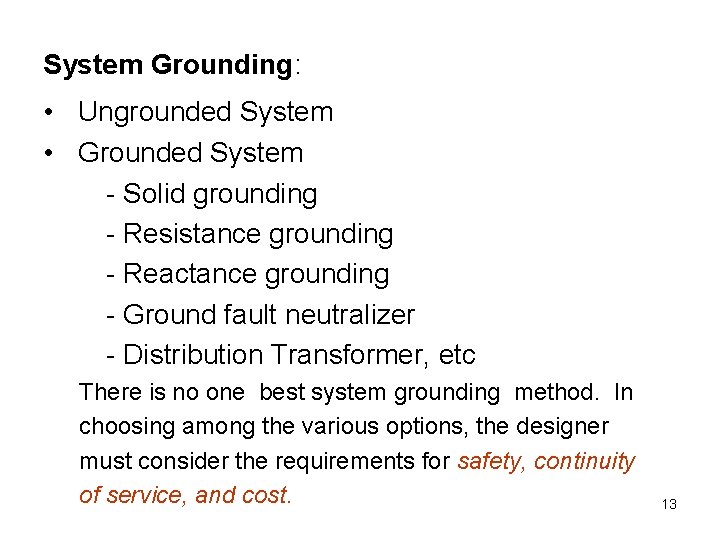
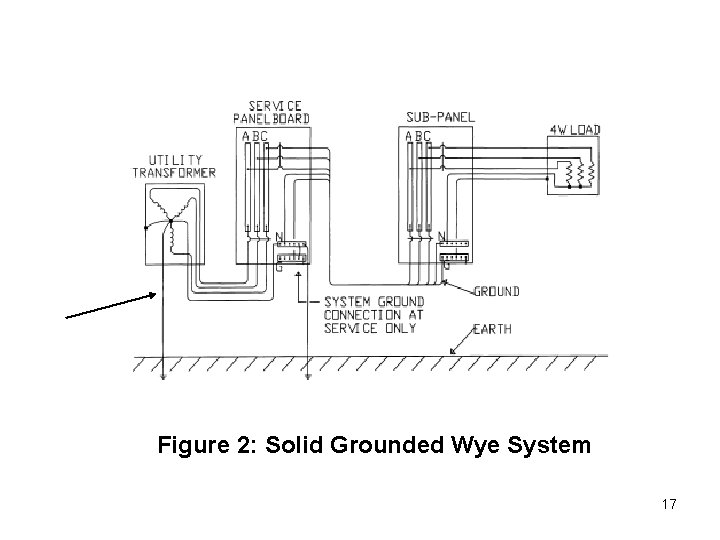
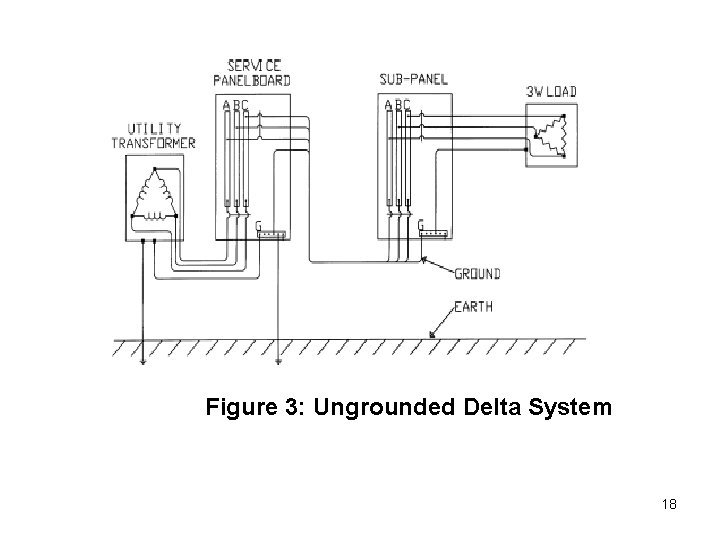
System Grounding: • Ungrounded System • Grounded System - Solid grounding - Resistance grounding - Reactance grounding - Ground fault neutralizer - Distribution Transformer, etc There is no one best system grounding method. In choosing among the various options, the designer must consider the requirements for safety, continuity of service, and cost. 13
Figure 1: Equipment Grounding and System Grounding 14
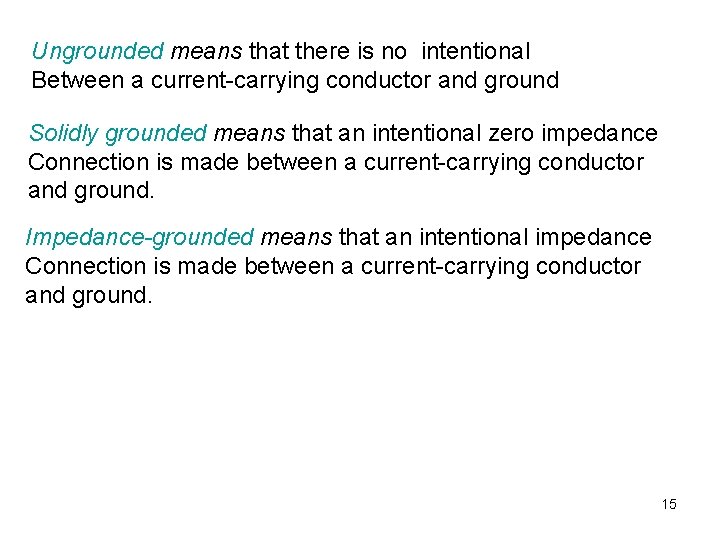
Ungrounded means that there is no intentional Between a current-carrying conductor and ground Solidly grounded means that an intentional zero impedance Connection is made between a current-carrying conductor and ground. Impedance-grounded means that an intentional impedance Connection is made between a current-carrying conductor and ground. 15
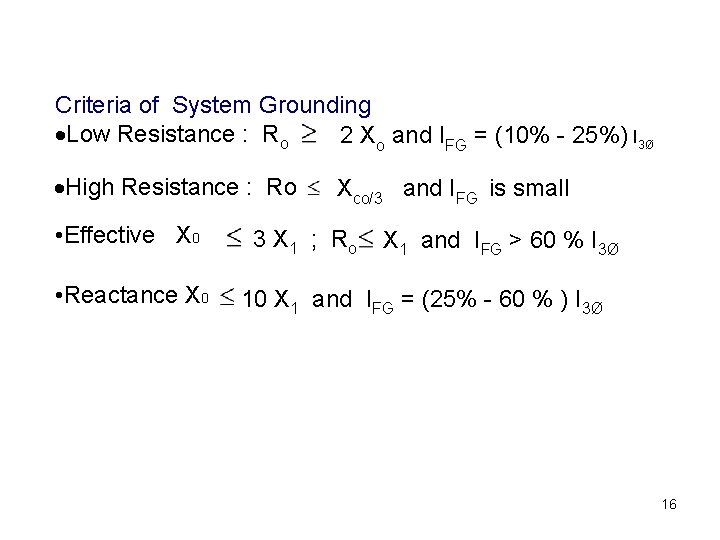
Criteria of System Grounding Low Resistance : Ro 2 Xo and IFG = (10% - 25%) I 3Ø High Resistance : Ro • Effective X 0 • Reactance X 0 Xco/3 and IFG is small 3 X 1 ; R o X 1 and IFG > 60 % I 3Ø 10 X 1 and IFG = (25% - 60 % ) I 3Ø 16
Figure 2: Solid Grounded Wye System 17
Figure 3: Ungrounded Delta System 18
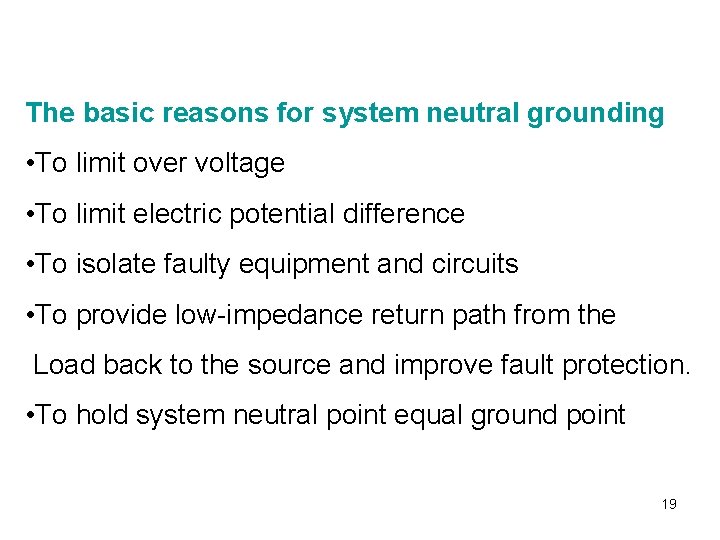
The basic reasons for system neutral grounding • To limit over voltage • To limit electric potential difference • To isolate faulty equipment and circuits • To provide low-impedance return path from the Load back to the source and improve fault protection. • To hold system neutral point equal ground point 19
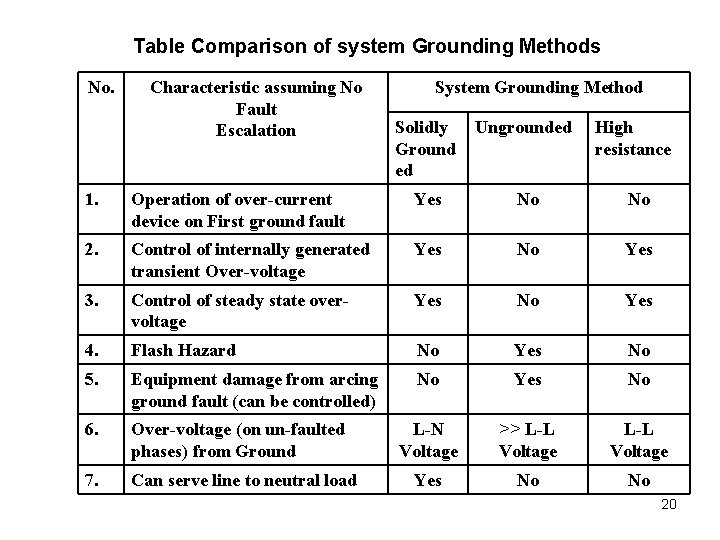
Table Comparison of system Grounding Methods No. Characteristic assuming No Fault Escalation System Grounding Method Solidly Ground ed Ungrounded High resistance 1. Operation of over-current device on First ground fault Yes No No 2. Control of internally generated transient Over-voltage Yes No Yes 3. Control of steady state overvoltage Yes No Yes 4. Flash Hazard No Yes No 5. Equipment damage from arcing ground fault (can be controlled) No Yes No 6. Over-voltage (on un-faulted phases) from Ground L-N Voltage >> L-L Voltage 7. Can serve line to neutral load Yes No No 20
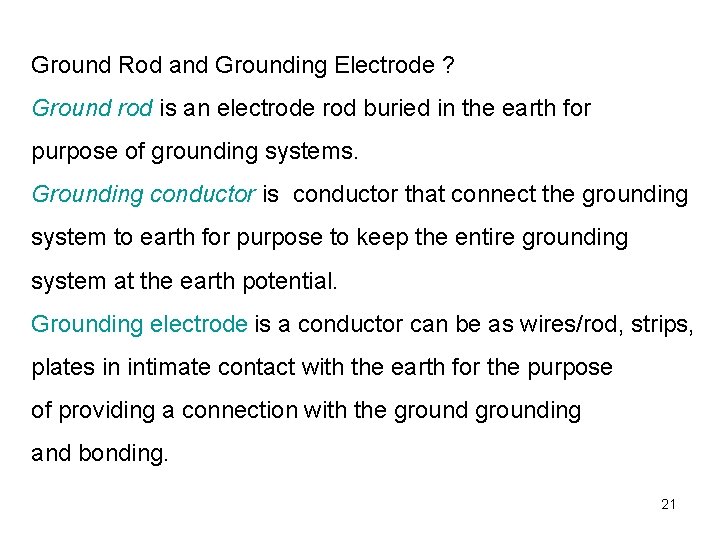
Ground Rod and Grounding Electrode ? Ground rod is an electrode rod buried in the earth for purpose of grounding systems. Grounding conductor is conductor that connect the grounding system to earth for purpose to keep the entire grounding system at the earth potential. Grounding electrode is a conductor can be as wires/rod, strips, plates in intimate contact with the earth for the purpose of providing a connection with the grounding and bonding. 21
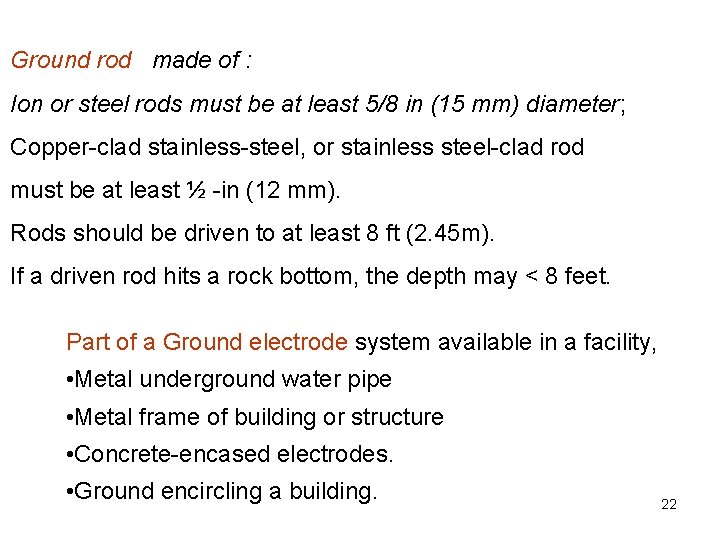
Ground rod made of : Ion or steel rods must be at least 5/8 in (15 mm) diameter; Copper-clad stainless-steel, or stainless steel-clad rod must be at least ½ -in (12 mm). Rods should be driven to at least 8 ft (2. 45 m). If a driven rod hits a rock bottom, the depth may < 8 feet. Part of a Ground electrode system available in a facility, • Metal underground water pipe • Metal frame of building or structure • Concrete-encased electrodes. • Ground encircling a building. 22
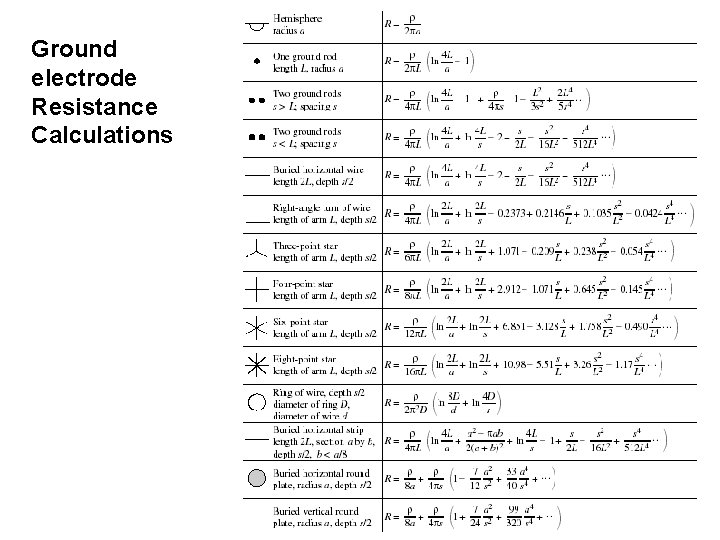
Ground electrode Resistance Calculations 23
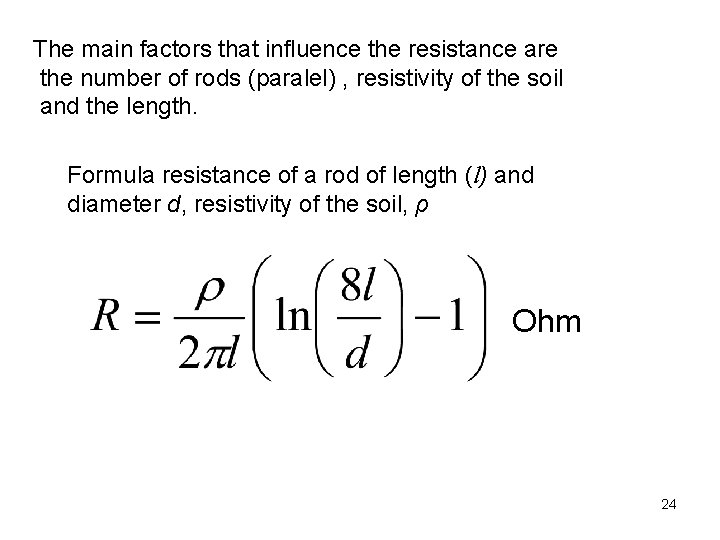
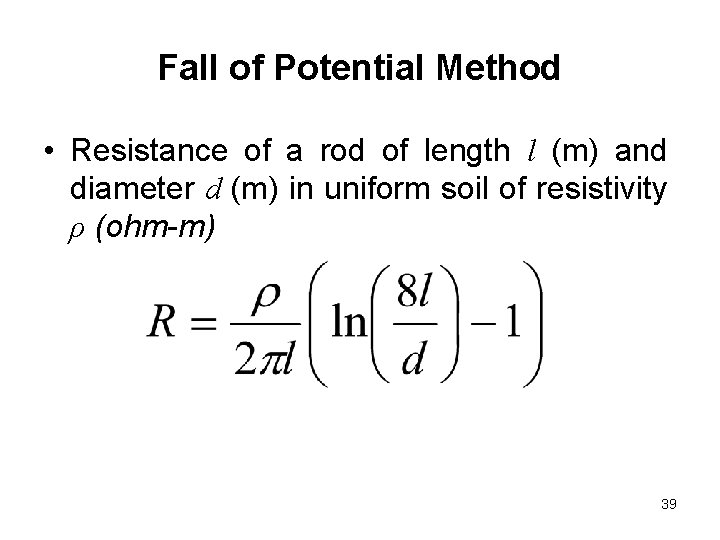
The main factors that influence the resistance are the number of rods (paralel) , resistivity of the soil and the length. Formula resistance of a rod of length (l) and diameter d, resistivity of the soil, ρ Ohm 24
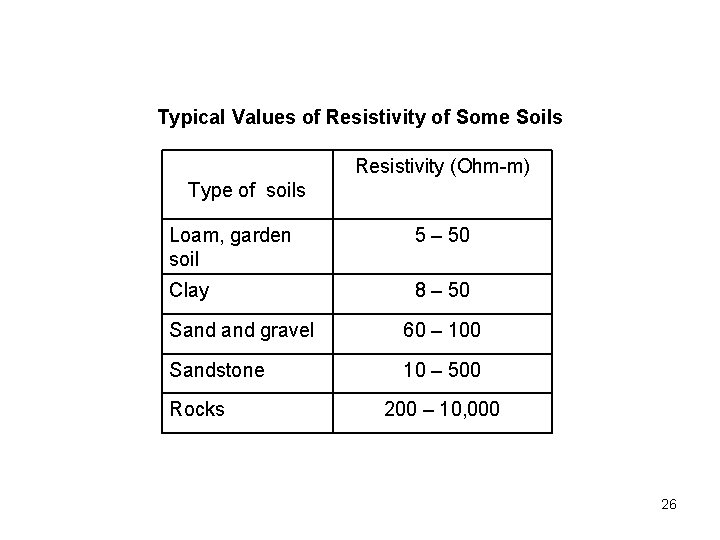
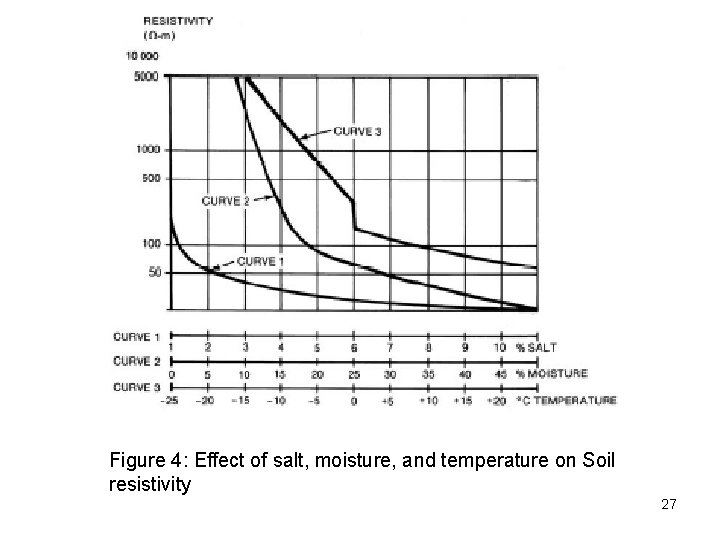
Soil Resistivity Soil resistivity is one of the most important factors, in designing, grounding system of a substation. The characteristic of the soil resistivity are primarily affected by: • Soil type (size, variability and density), • Moisture • Temperature • Salt content • Compactness 25
Typical Values of Resistivity of Some Soils Resistivity (Ohm-m) Type of soils Loam, garden soil 5 – 50 Clay 8 – 50 Sand gravel 60 – 100 Sandstone 10 – 500 Rocks 200 – 10, 000 26
Figure 4: Effect of salt, moisture, and temperature on Soil resistivity 27
Permissible Ground Resistance • IEEE recommend a ground resistance value of 5 ohms or less for domestic user 28
Soil Resistivity Measurement 1) Wenner Method (Equally spaced) 2) Schlumberger-Palmer Method (Unequally spaced) 29
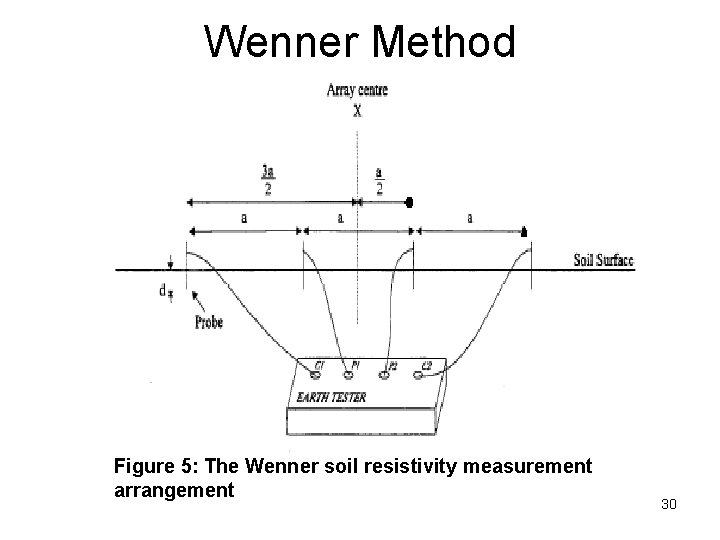
Wenner Method Figure 5: The Wenner soil resistivity measurement arrangement 30
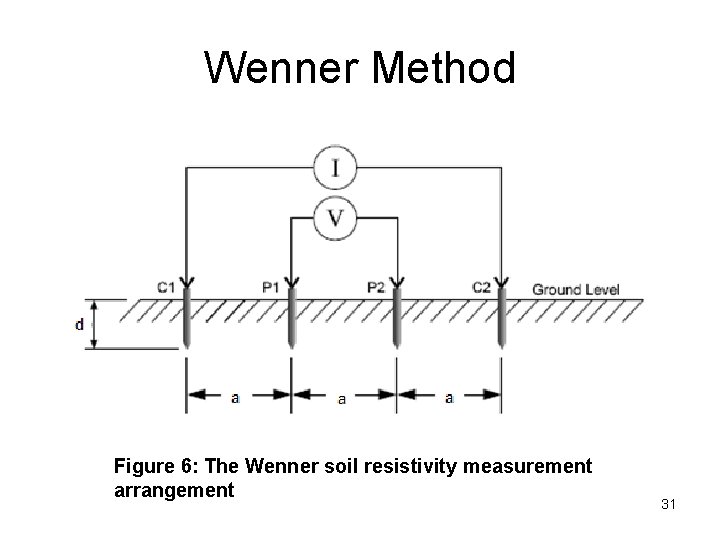
Wenner Method Figure 6: The Wenner soil resistivity measurement arrangement 31
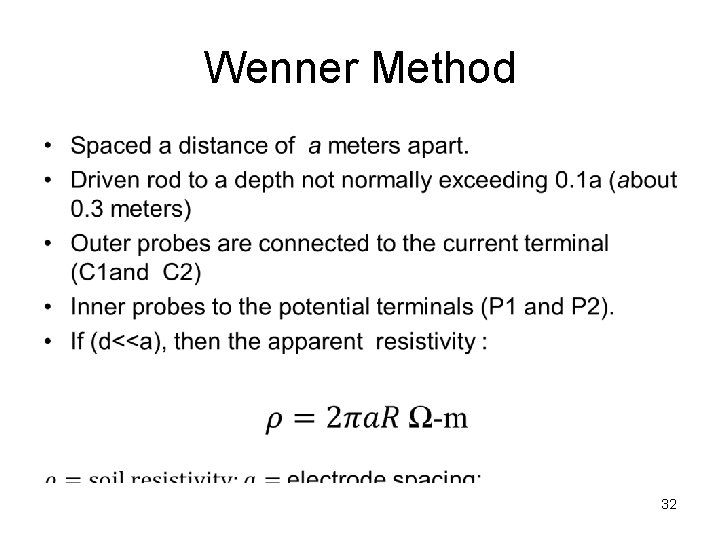
Wenner Method • 32
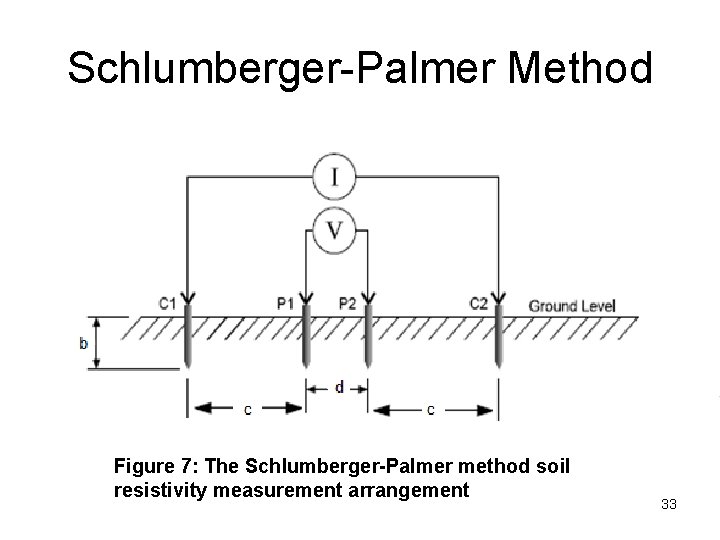
Schlumberger-Palmer Method Figure 7: The Schlumberger-Palmer method soil resistivity measurement arrangement 33
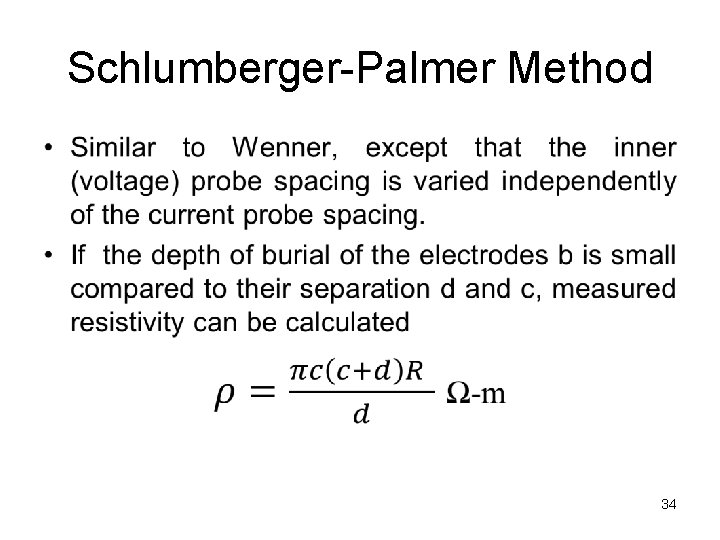
Schlumberger-Palmer Method • 34
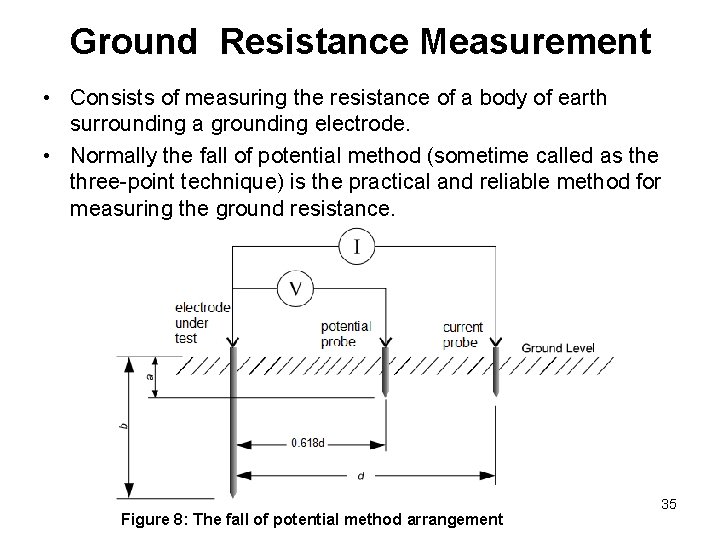
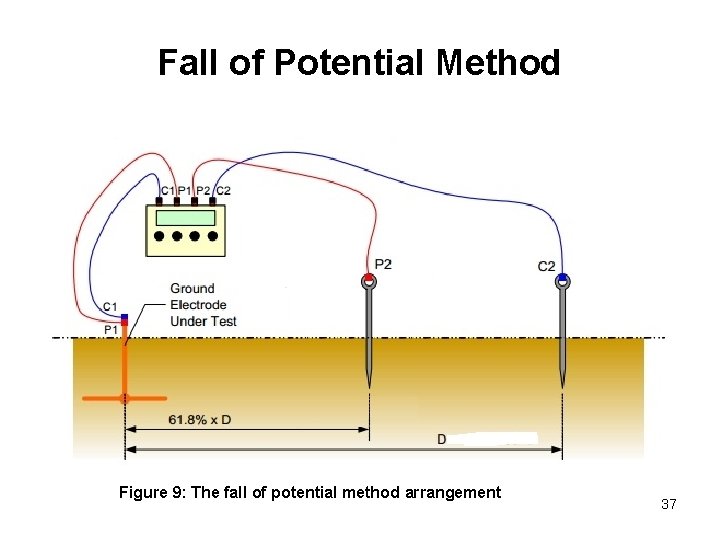
Ground Resistance Measurement • Consists of measuring the resistance of a body of earth surrounding a grounding electrode. • Normally the fall of potential method (sometime called as the three-point technique) is the practical and reliable method for measuring the ground resistance. Figure 8: The fall of potential method arrangement 35
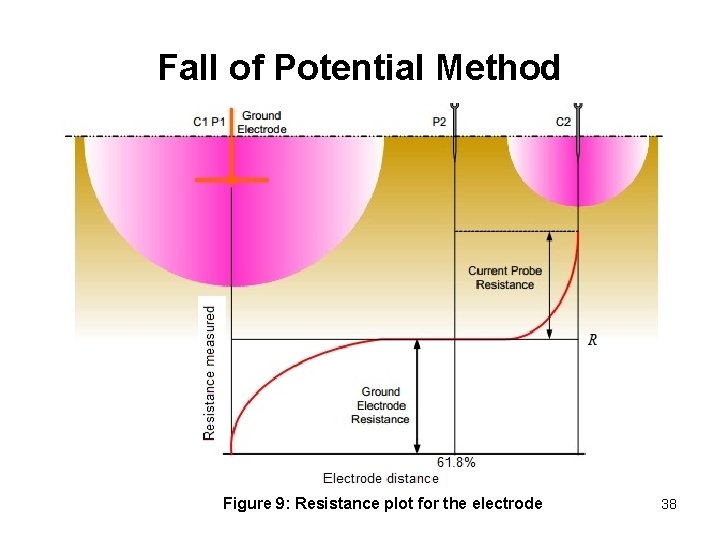
Fall of Potential Method • In this method, a current I is injected into the earth using current probe. • The potential probe which is inserted at intervals within the current path will measure the voltage drop produce by the current. • The form of fall of potential method is obtained when the ground electrode, potential probe and current probe are on a straight line and potential probe is located between ground electrode and current probe. • When Vx/I is plotted as a function of the potential probe distance, the curve as shown in Figure 9 are produced. • It is usually accepted that the flat section of the curve give the correct magnitude of the resistance measured. 36
Fall of Potential Method Figure 9: The fall of potential method arrangement 37
Fall of Potential Method Figure 9: Resistance plot for the electrode 38
Fall of Potential Method • Resistance of a rod of length l (m) and diameter d (m) in uniform soil of resistivity ρ (ohm-m) 39
Grid Substation Grounding • A common method for obtaining a low ground resistance at high voltage substation is to use interconnected ground grid. • The substation grounding provides the ground connection for the neutral system, the discharge path for surge arresters and ensure safety to operating personal. • It also provides a low resistance path to ground to minimize the rise in ground potential. • Many utilities add ground rods for further reduction of the resistance. 40
Grid Substation Grounding Two main design goals to be achieved 1) To provide means to dissipate electric currents into the earth without exceeding any operating and equipment limits. 2) To assure that a person in the vicinity of grounded facilities is not exposed to the danger of critical electric shock. 41
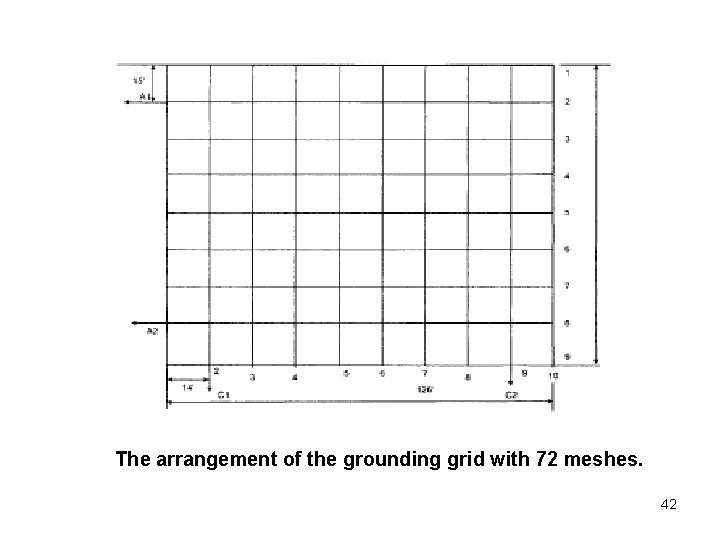
The arrangement of the grounding grid with 72 meshes. 42
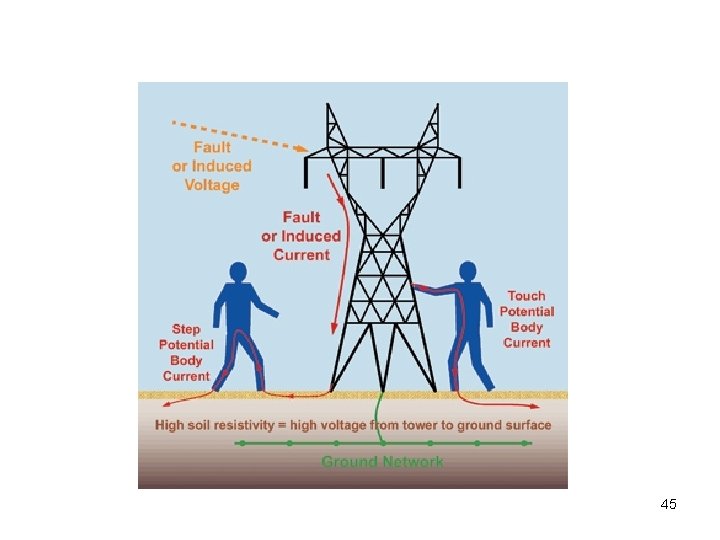
There are two conditions that person within or round the substation may be experience • Touch voltage • Step voltage A touch voltage is normally considered a hand to foot or a hand to hand contact; A step voltage creates a path through the legs from one foot to the other. 43
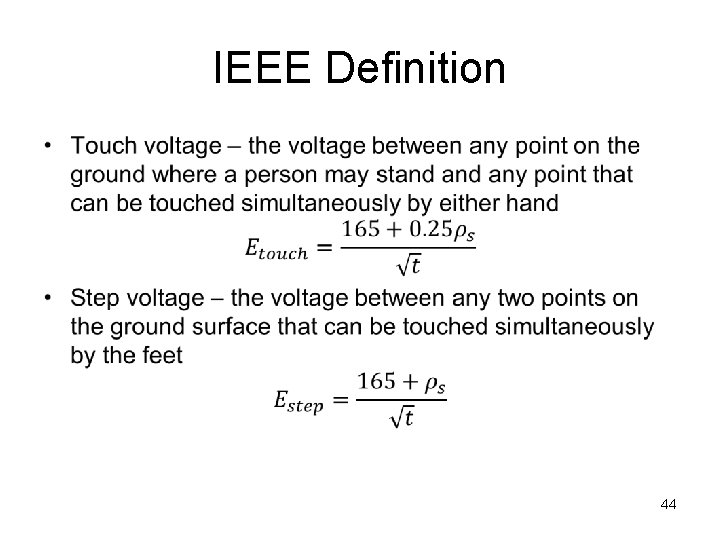
IEEE Definition • 44
45
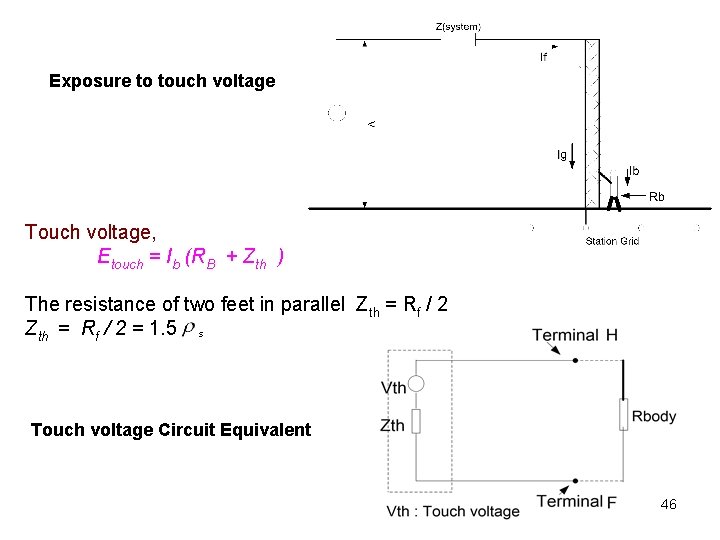
Exposure to touch voltage Touch voltage, Etouch = Ib (RB + Zth ) The resistance of two feet in parallel Zth = Rf / 2 = 1. 5 s Touch voltage Circuit Equivalent 46
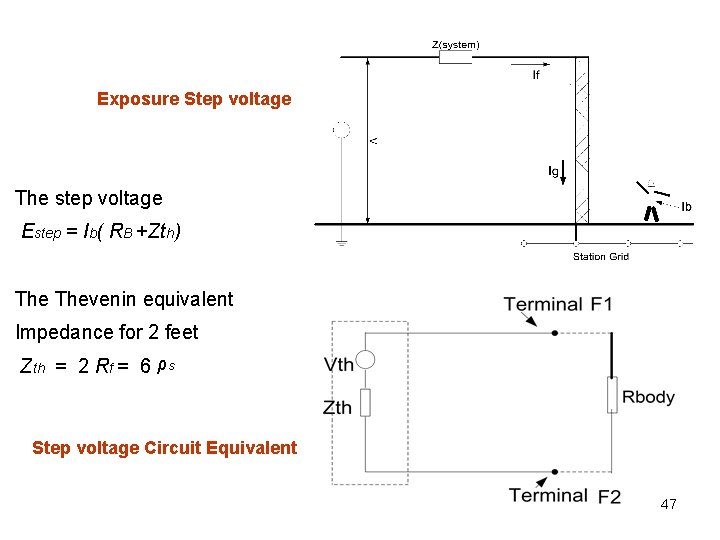
Exposure Step voltage The step voltage Estep = Ib( RB +Zth) Thevenin equivalent Impedance for 2 feet Zth = 2 Rf = 6 ρS Step voltage Circuit Equivalent 47
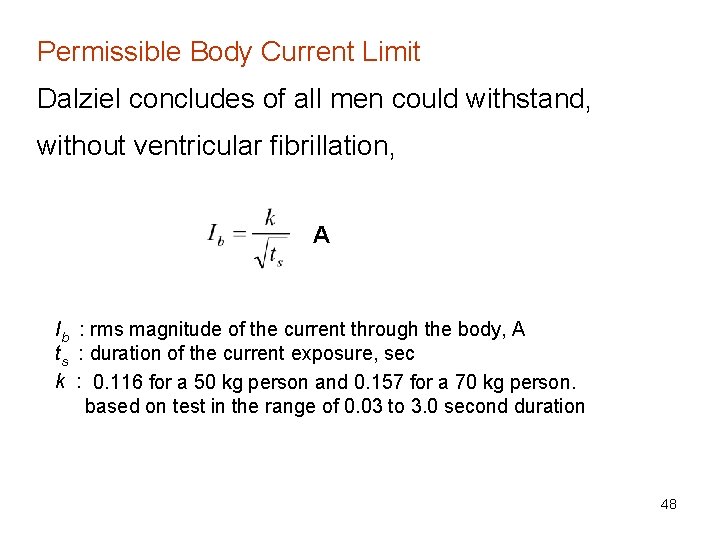
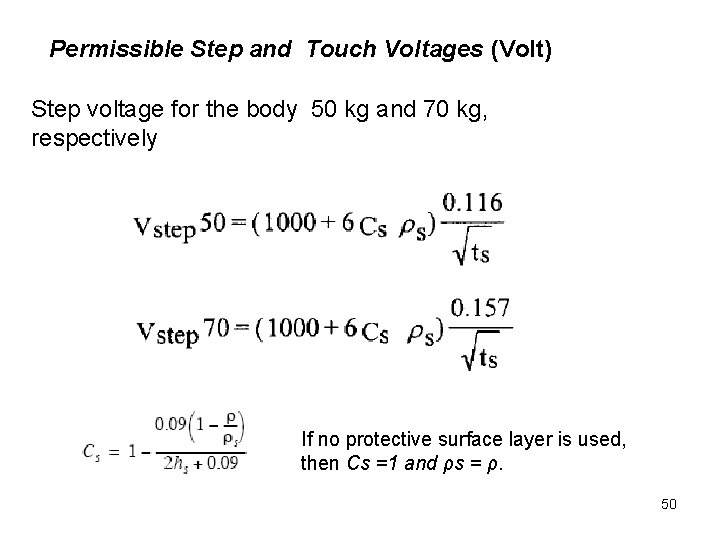
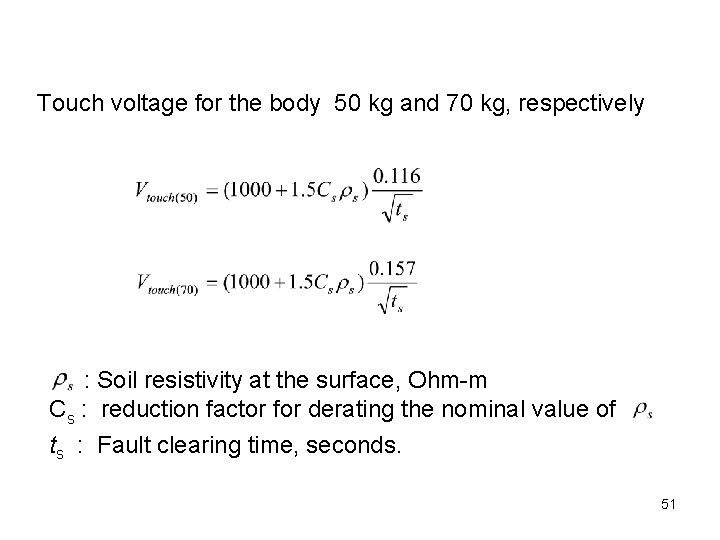
Permissible Body Current Limit Dalziel concludes of all men could withstand, without ventricular fibrillation, A Ib : rms magnitude of the current through the body, A ts : duration of the current exposure, sec k : 0. 116 for a 50 kg person and 0. 157 for a 70 kg person. based on test in the range of 0. 03 to 3. 0 second duration 48
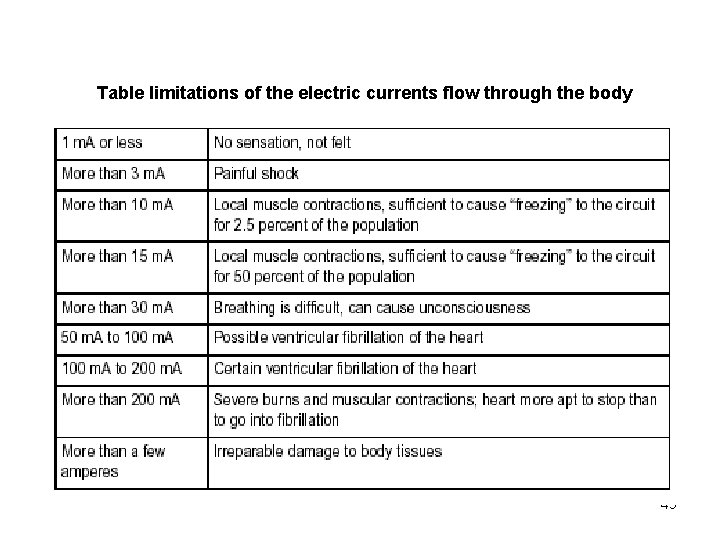
Table limitations of the electric currents flow through the body 49
Permissible Step and Touch Voltages (Volt) Step voltage for the body 50 kg and 70 kg, respectively If no protective surface layer is used, then Cs =1 and ρs = ρ. 50
Touch voltage for the body 50 kg and 70 kg, respectively : Soil resistivity at the surface, Ohm-m Cs : reduction factor for derating the nominal value of ts : Fault clearing time, seconds. 51
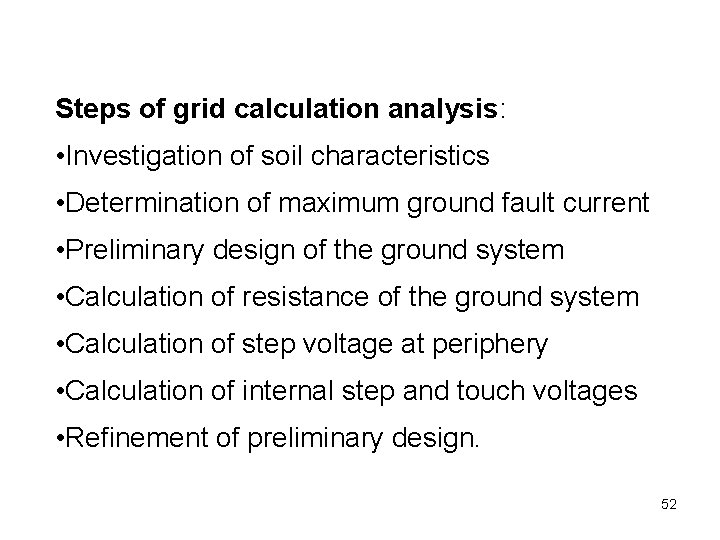
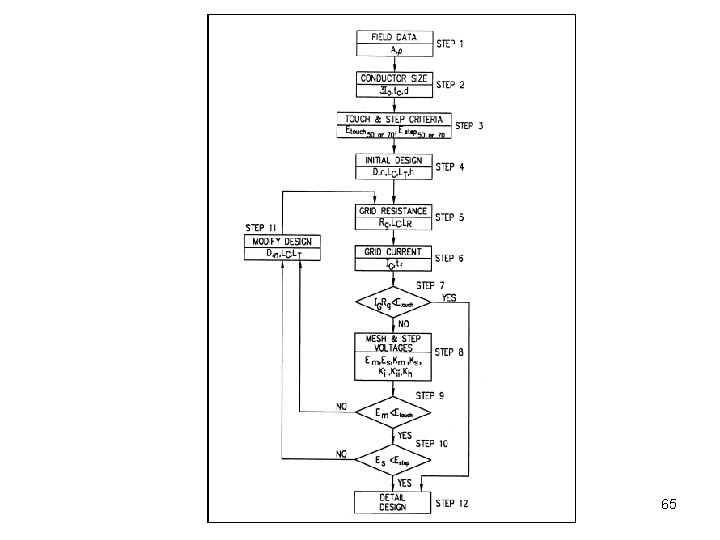
Steps of grid calculation analysis: • Investigation of soil characteristics • Determination of maximum ground fault current • Preliminary design of the ground system • Calculation of resistance of the ground system • Calculation of step voltage at periphery • Calculation of internal step and touch voltages • Refinement of preliminary design. 52
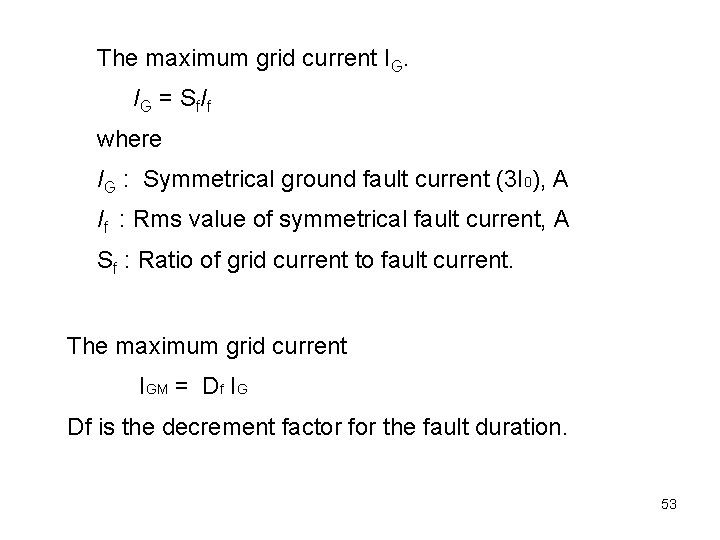
The maximum grid current IG. I G = S f. I f where IG : Symmetrical ground fault current (3 I 0), A If : Rms value of symmetrical fault current, A Sf : Ratio of grid current to fault current. The maximum grid current IGM = Df IG Df is the decrement factor for the fault duration. 53
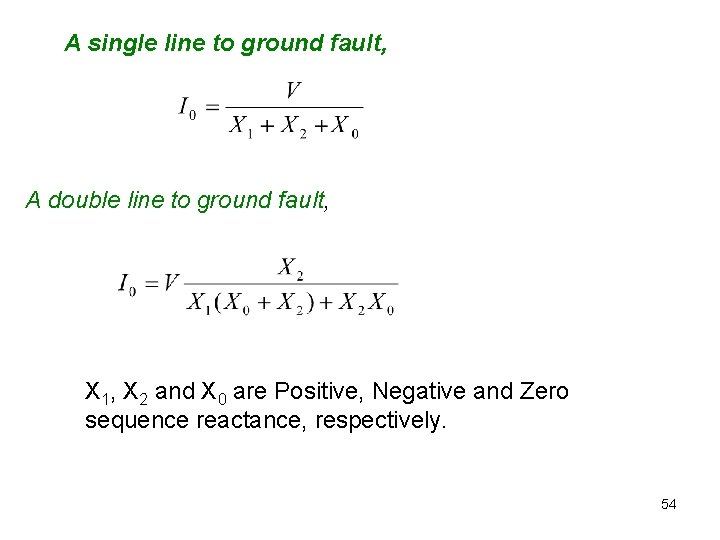
A single line to ground fault, A double line to ground fault, X 1, X 2 and X 0 are Positive, Negative and Zero sequence reactance, respectively. 54
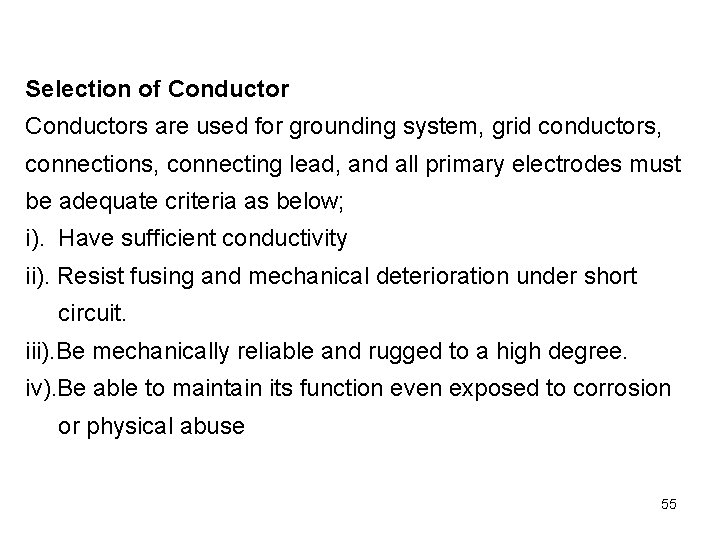
Selection of Conductors are used for grounding system, grid conductors, connections, connecting lead, and all primary electrodes must be adequate criteria as below; i). Have sufficient conductivity ii). Resist fusing and mechanical deterioration under short circuit. iii). Be mechanically reliable and rugged to a high degree. iv). Be able to maintain its function even exposed to corrosion or physical abuse 55
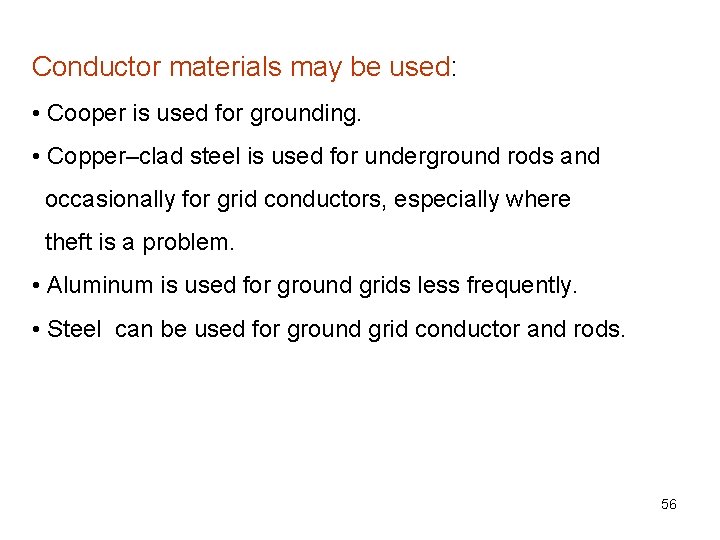
Conductor materials may be used: • Cooper is used for grounding. • Copper–clad steel is used for underground rods and occasionally for grid conductors, especially where theft is a problem. • Aluminum is used for ground grids less frequently. • Steel can be used for ground grid conductor and rods. 56
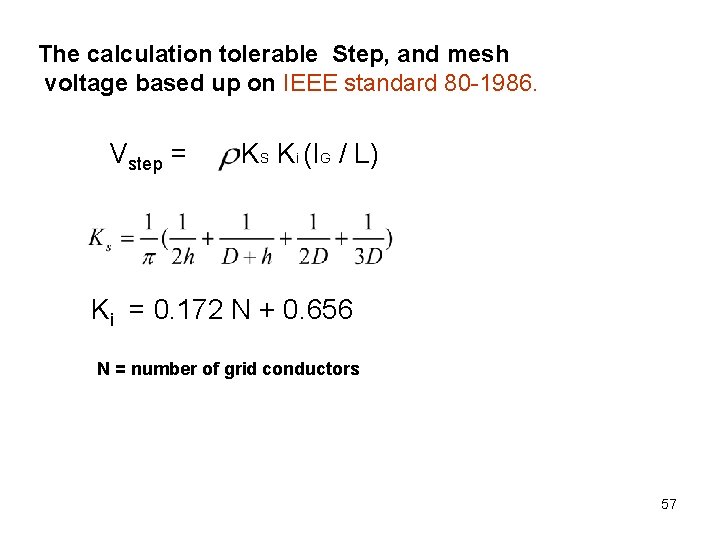
The calculation tolerable Step, and mesh voltage based up on IEEE standard 80 -1986. Vstep = KS Ki (IG / L) Ki = 0. 172 N + 0. 656 N = number of grid conductors 57
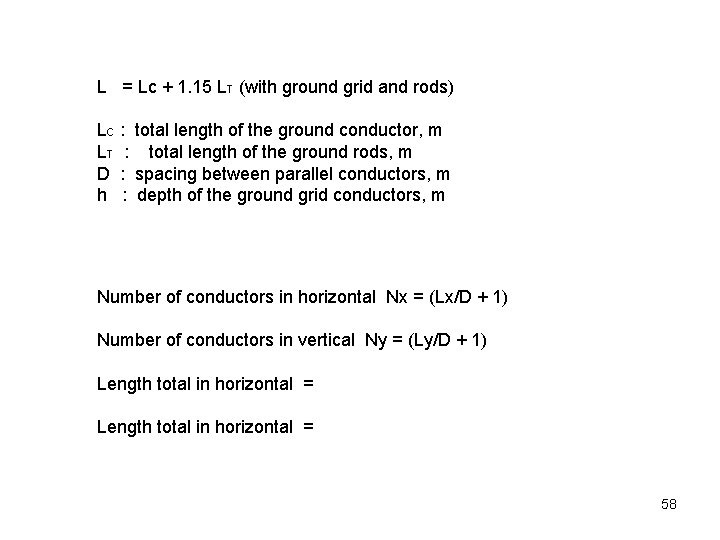
L = Lc + 1. 15 LT (with ground grid and rods) LC : total length of the ground conductor, m LT : total length of the ground rods, m D : spacing between parallel conductors, m h : depth of the ground grid conductors, m Number of conductors in horizontal Nx = (Lx/D + 1) Number of conductors in vertical Ny = (Ly/D + 1) Length total in horizontal = 58
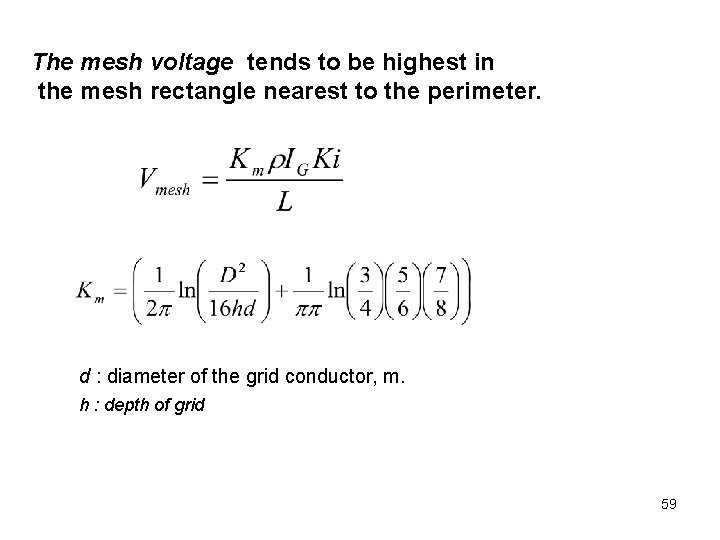
The mesh voltage tends to be highest in the mesh rectangle nearest to the perimeter. d : diameter of the grid conductor, m. h : depth of grid 59
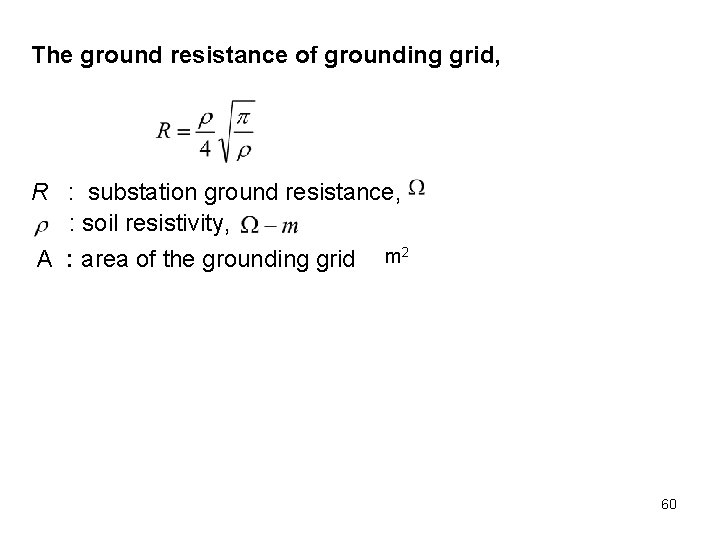
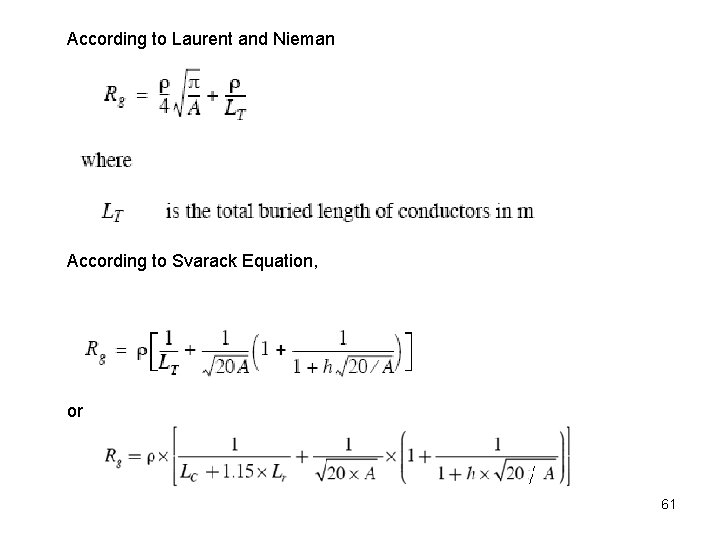
The ground resistance of grounding grid, R : substation ground resistance, : soil resistivity, A : area of the grounding grid m 2 60
According to Laurent and Nieman According to Svarack Equation, or 61
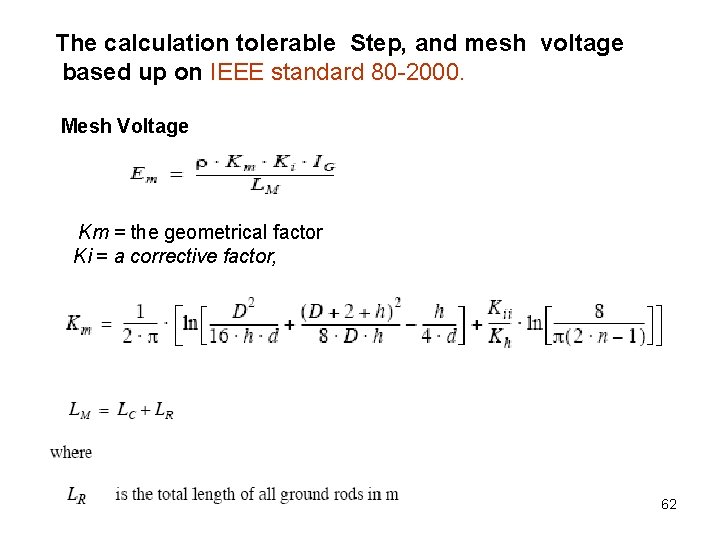
The calculation tolerable Step, and mesh voltage based up on IEEE standard 80 -2000. Mesh Voltage Km = the geometrical factor Ki = a corrective factor, 62
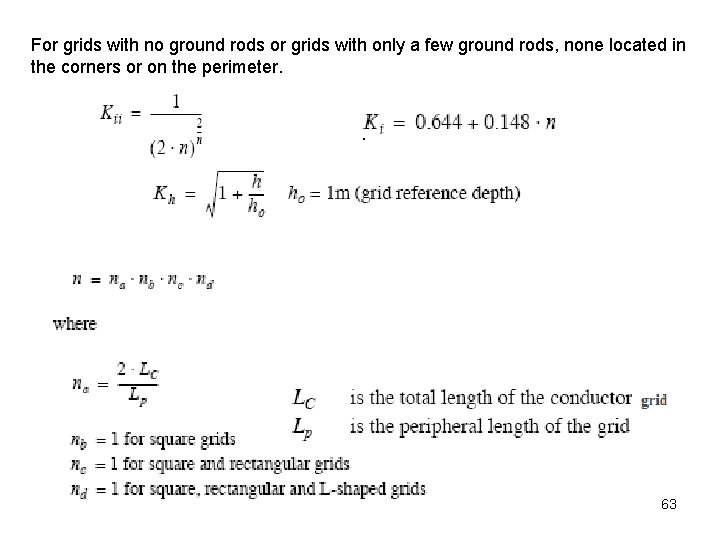
For grids with no ground rods or grids with only a few ground rods, none located in the corners or on the perimeter. 63
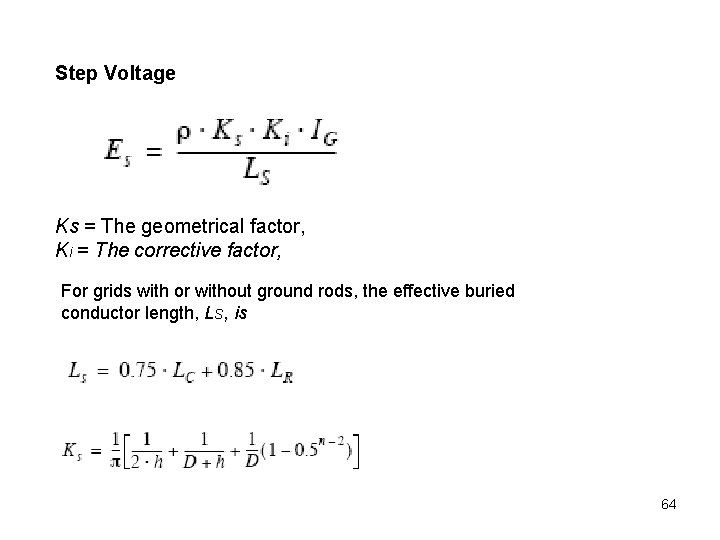
Step Voltage Ks = The geometrical factor, Ki = The corrective factor, For grids with or without ground rods, the effective buried conductor length, LS, is 64
65
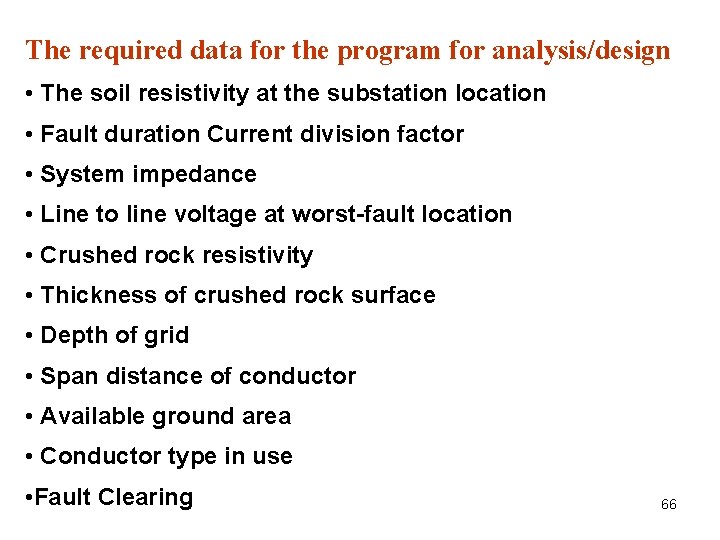
The required data for the program for analysis/design • The soil resistivity at the substation location • Fault duration Current division factor • System impedance • Line to line voltage at worst-fault location • Crushed rock resistivity • Thickness of crushed rock surface • Depth of grid • Span distance of conductor • Available ground area • Conductor type in use • Fault Clearing 66
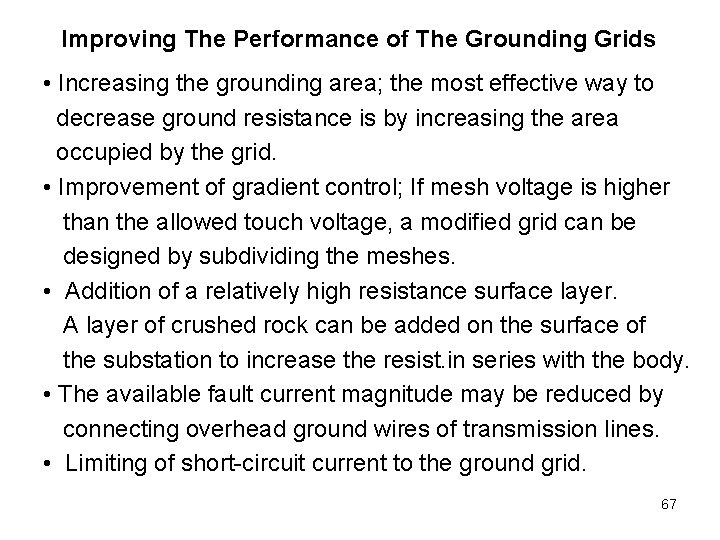
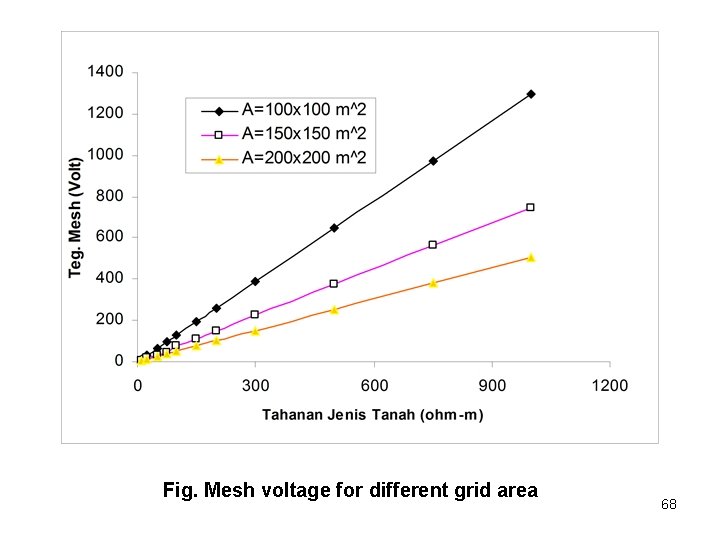
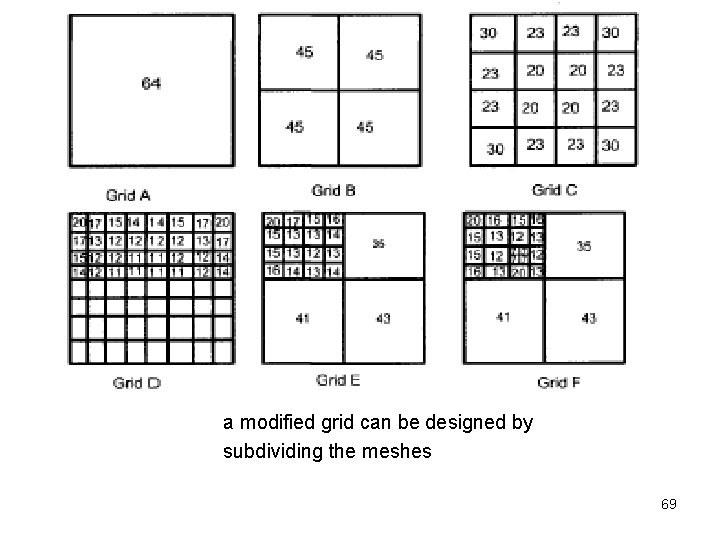
Improving The Performance of The Grounding Grids • Increasing the grounding area; the most effective way to decrease ground resistance is by increasing the area occupied by the grid. • Improvement of gradient control; If mesh voltage is higher than the allowed touch voltage, a modified grid can be designed by subdividing the meshes. • Addition of a relatively high resistance surface layer. A layer of crushed rock can be added on the surface of the substation to increase the resist. in series with the body. • The available fault current magnitude may be reduced by connecting overhead ground wires of transmission lines. • Limiting of short-circuit current to the ground grid. 67
Fig. Mesh voltage for different grid area 68
a modified grid can be designed by subdividing the meshes 69
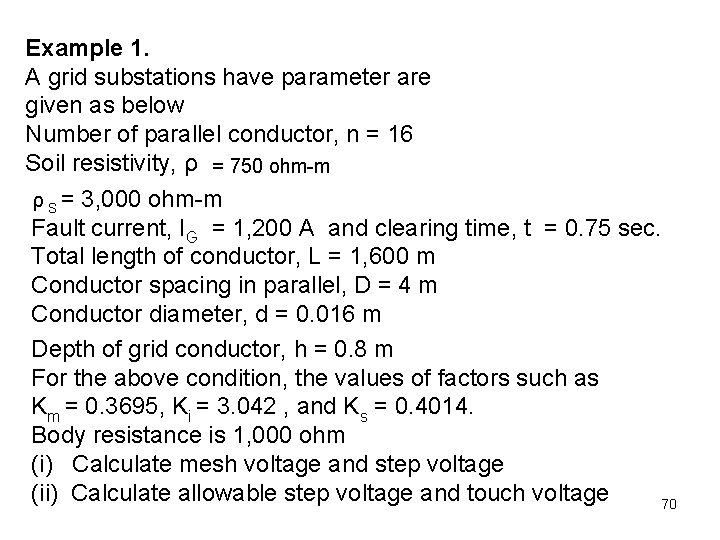
Example 1. A grid substations have parameter are given as below Number of parallel conductor, n = 16 Soil resistivity, ρ = 750 ohm-m ρ S = 3, 000 ohm-m Fault current, IG = 1, 200 A and clearing time, t = 0. 75 sec. Total length of conductor, L = 1, 600 m Conductor spacing in parallel, D = 4 m Conductor diameter, d = 0. 016 m Depth of grid conductor, h = 0. 8 m For the above condition, the values of factors such as Km = 0. 3695, Ki = 3. 042 , and Ks = 0. 4014. Body resistance is 1, 000 ohm (i) Calculate mesh voltage and step voltage (ii) Calculate allowable step voltage and touch voltage 70