
Chapter 4 Goal Setting and Decision Making Objectives
Chapter 4 Goal Setting and Decision Making
Objectives Define and understand goals Define and set long-term and short-term goals Define 3 components of hope Apply the STAMPS method of goal setting Define motivation & its importance in achieving goals Define intrinsic and extrinsic motivation Define decision making and compare different processes of decision making List the steps in the decision making process List the characteristics of effective decision making and potential barriers to the process Apply goal-setting and decision making skills 2
What is a goal? Objective or aim toward which you direct your effort Result of effort and a directed pathway Acts as a guide Gives your work direction, purpose, or focus Helps you set priorities Influences decisions and choices Provides motivation 3
Goal Setting Goals are temporal—short and long term Long-term— 6 months- one year to complete Short-term—hours to weeks or months, move you toward long-term goal Goals are directional—they move you toward behaviors and decisions Goals are motivational—they are related to the dynamics of your needs Goals are expressive—they relate directly to who you are and what you value—if they don’t relate to your values you will experience stress Goals are integrative—they are a focus of your energy— physical and mental
To make goals work Make them clear Be sure they reflect your values Make them realistic Be sure they are tied to a commitment to action Understand they may require a sacrifice
Hope-necessary to complete goals Perception you can reach your goal 3 components Goal-oriented thinking—thinking often about your goal to keep it in mind Agency thinking—thinking that you are the agent who can start and maintain your goal—this is positive thinking Pathways to achievement—planning on multiple ways to achieve your goal so you have alternatives if one way doesn’t work out 6
STAMPS Model— Characteristics of Effective Goals Specific—state exactly what you want to accomplish Timely—set a specific deadline for your goal Achievable—set goals that are challenging, but not out of reach Measurable—set criteria to determine when you have achieved your goal Positive—set a goal that is action-oriented what you will do rather than what you won’t do Self-chosen—set goals that you want, not that someone else wants. Goals need to speak to your values

Do the Goals and Action Plans Portfolio
Success Strategies for Accomplishing Your Goals Write them down Keep them visible Tell others Identify barriers Identify resources you need
Motivation—influences that result in behaviors Intrinsic motivations Come from within the individual Interest, enjoyment, personal enrichment Extrinsic motivations Come from outside or other people Grades, awards, money Long term goals cannot be achieved solely through external motivations 10
Decision Making Styles Manner in which a person approaches, responds to, and acts when decisions need to be made Rational decision making style—using reason and logic to make decisions Intuitive decision making style—using feelings or sensing how to make decisions Dependent decision making style—relying on others to tell you what to do Effective decision making is taking charge of your decisions and using them to move toward your goal—a rational approach

Decision Making Process 6. Evaluate the results 1. Identify the goal or problem 2. Develop alternatives 5. Develop and implement action plan 4. Choose the best alternative 3. Evaluate alternatives
1. Identify the Goal or Problem Examine your current situation What is the difference between what is and what you want to be Develop a clear picture of what you actually want 13
2. Develop alternatives Develop multiple ways of addressing the problem Don’t evaluate these possibilities yet Use creative thinking 14
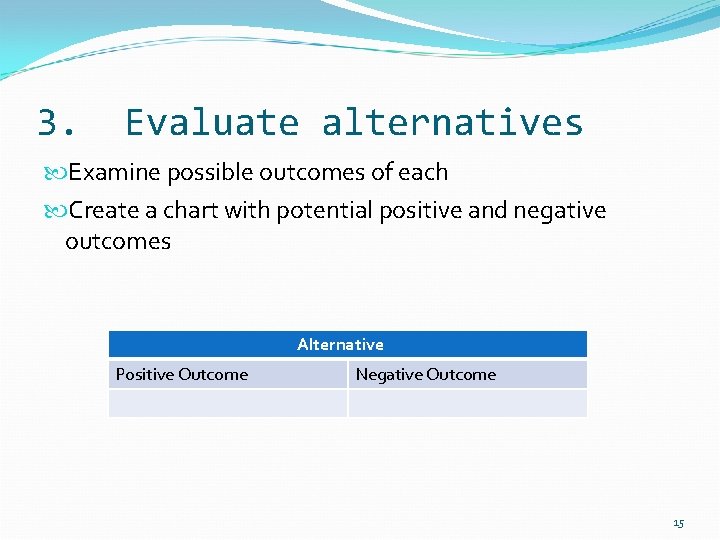
3. Evaluate alternatives Examine possible outcomes of each Create a chart with potential positive and negative outcomes Alternative Positive Outcome Negative Outcome 15
4. Select the Best Alternative Examine chart and determine which alternative has the most positive outcomes and the least negative outcomes Consider the resources at your disposal to implement each alternative Choose the alternative that will have the best long-term outcome and move you toward your goals. 16
5. Develop and Implement an Action Plan Write down the steps to implement the solution Include a timeline for each step Rate your commitment to the plan 17
6. Evaluate the Results Determine if this decision has indeed moved you toward your goals Realize that each decision leads to other decisionmaking processes—there always new choices to make along the way 18
Barriers to Effective Decision Making Failure to commit Don’t waste time wondering if you should have made another decision Failure to make a decision in a timely manner Failure to strategize well—if you use the strategies in this chapter you should do fine 19
- Slides: 19