
Chapter 4 GK General Properties of Radiation Detectors








- Slides: 30
Chapter 4 -GK General Properties of Radiation Detectors Lec-5 Copyright © 2014 John Wiley & Sons, Inc. All rights reserved.
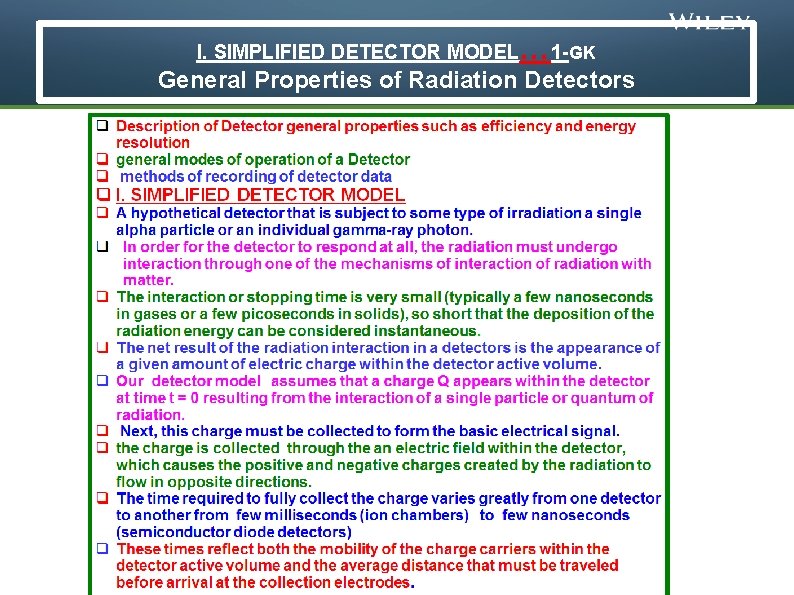
I. SIMPLIFIED DETECTOR MODEL … 1 -GK General Properties of Radiation Detectors © 2014 John Wiley & Sons, Inc. All rights reserved.
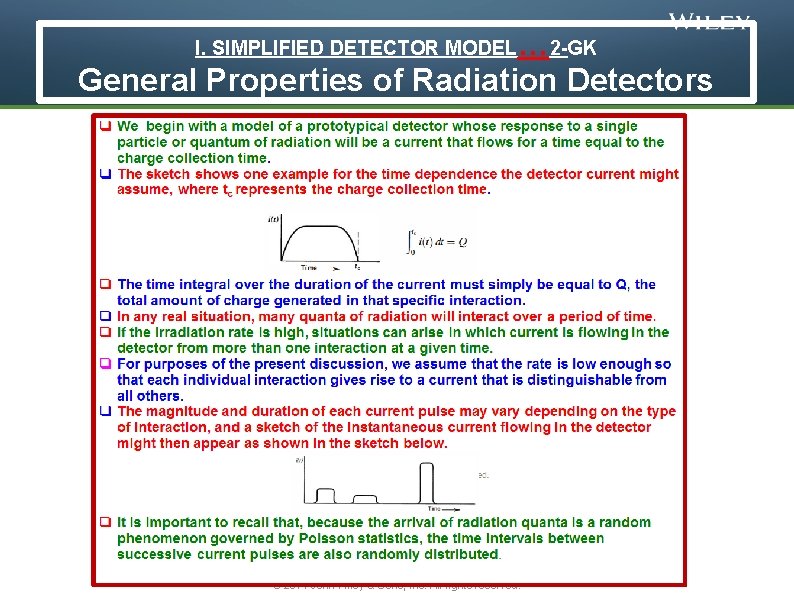
… 2 -GK General Properties of Radiation Detectors I. SIMPLIFIED DETECTOR MODEL © 2014 John Wiley & Sons, Inc. All rights reserved.
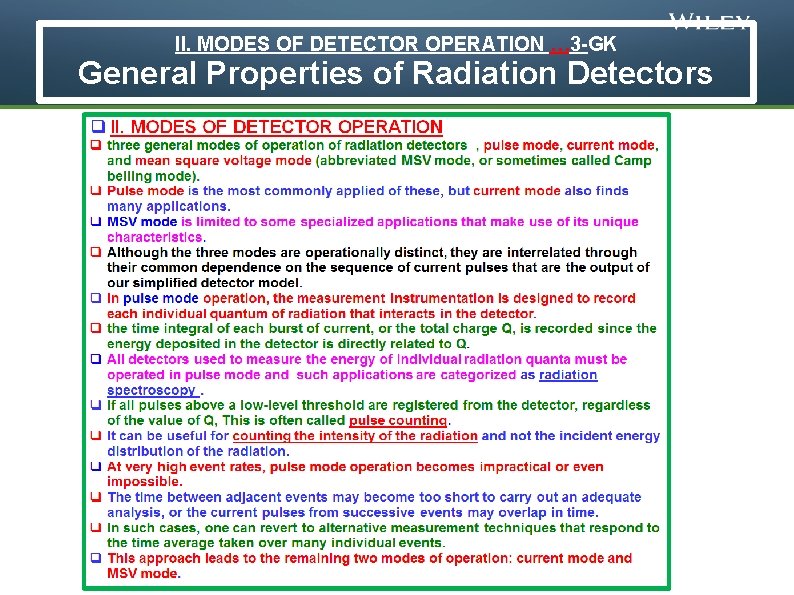
II. MODES OF DETECTOR OPERATION … 3 -GK General Properties of Radiation Detectors © 2014 John Wiley & Sons, Inc. All rights reserved.
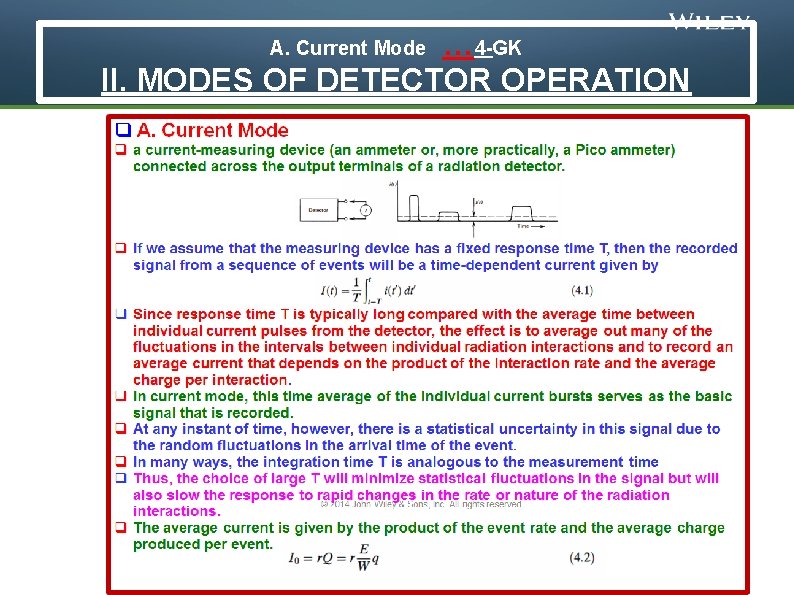
… 4 -GK II. MODES OF DETECTOR OPERATION A. Current Mode © 2014 John Wiley & Sons, Inc. All rights reserved.
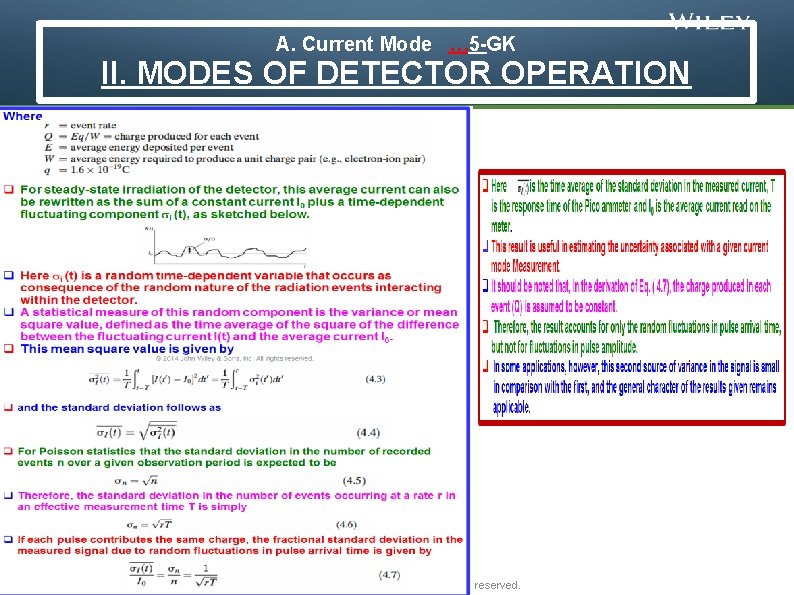
A. Current Mode … 5 -GK II. MODES OF DETECTOR OPERATION © 2014 John Wiley & Sons, Inc. All rights reserved.
… 6 -GK II. MODES OF DETECTOR OPERATION B… MSV Mode © 2014 John Wiley & Sons, Inc. All rights reserved.
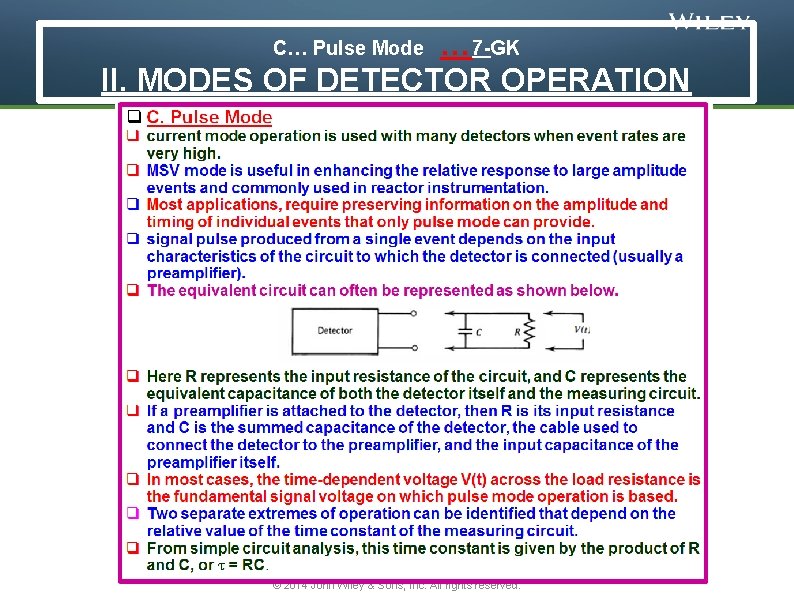
… 7 -GK II. MODES OF DETECTOR OPERATION C… Pulse Mode © 2014 John Wiley & Sons, Inc. All rights reserved.
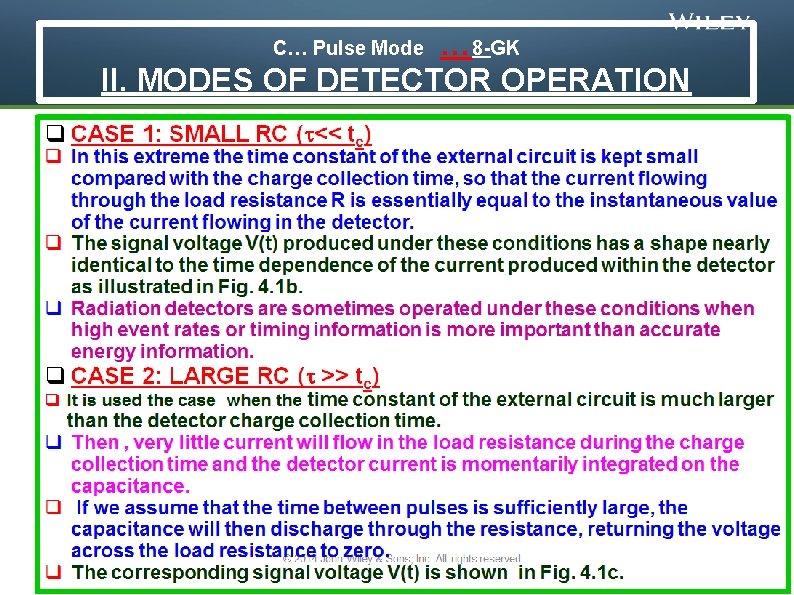
… 8 -GK II. MODES OF DETECTOR OPERATION C… Pulse Mode © 2014 John Wiley & Sons, Inc. All rights reserved.
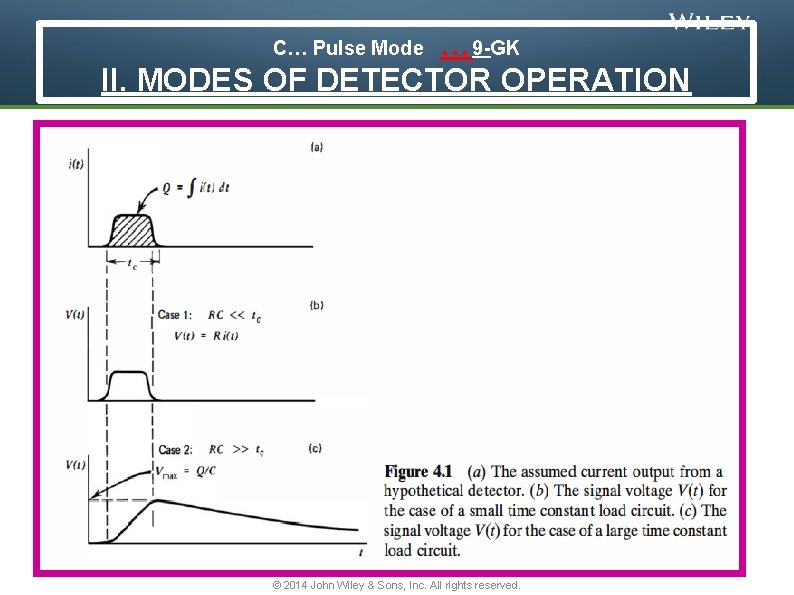
… 9 -GK II. MODES OF DETECTOR OPERATION C… Pulse Mode © 2014 John Wiley & Sons, Inc. All rights reserved.
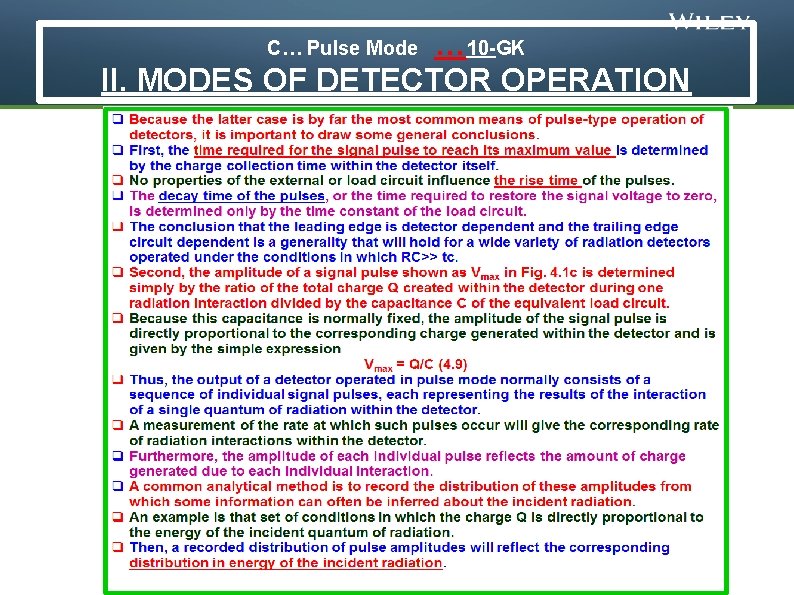
… 10 -GK II. MODES OF DETECTOR OPERATION C… Pulse Mode © 2014 John Wiley & Sons, Inc. All rights reserved.
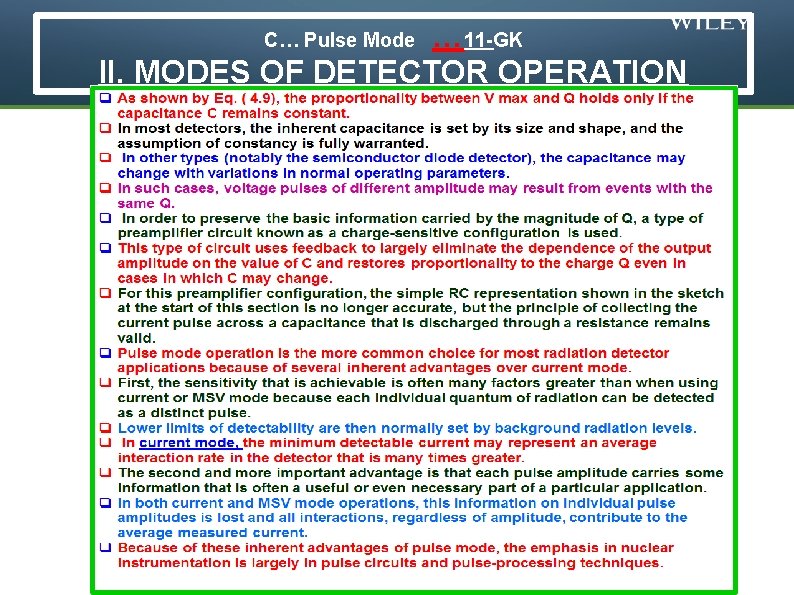
… 11 -GK II. MODES OF DETECTOR OPERATION C… Pulse Mode © 2014 John Wiley & Sons, Inc. All rights reserved.
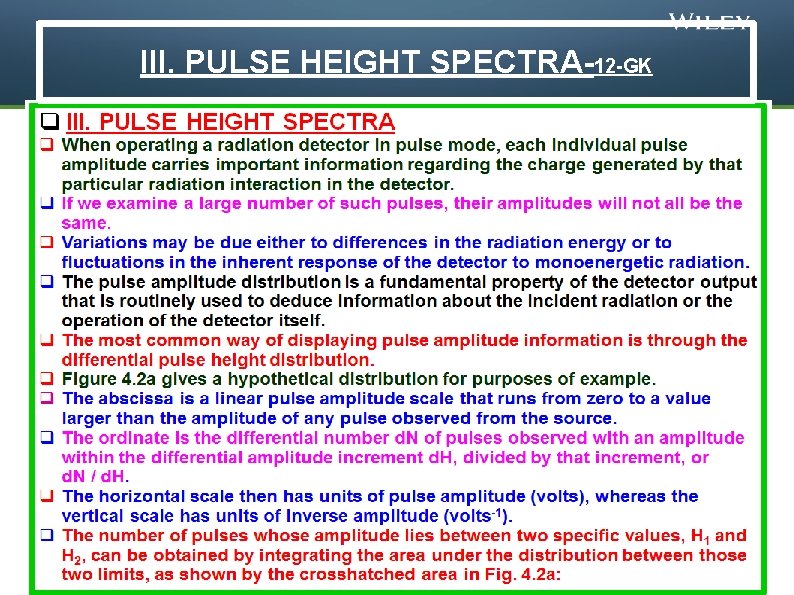
III. PULSE HEIGHT SPECTRA-12 -GK © 2014 John Wiley & Sons, Inc. All rights reserved.
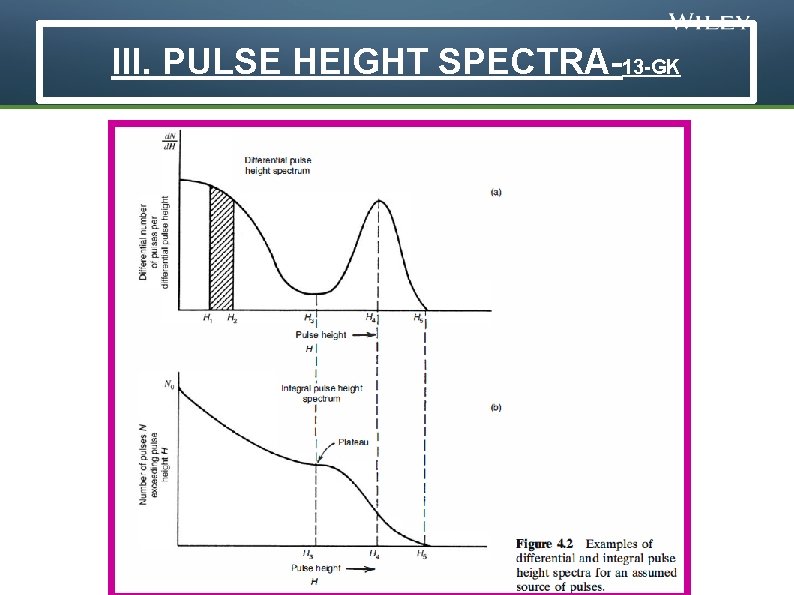
III. PULSE HEIGHT SPECTRA-13 -GK © 2014 John Wiley & Sons, Inc. All rights reserved.
III. PULSE HEIGHT SPECTRA-14 -GK © 2014 John Wiley & Sons, Inc. All rights reserved.
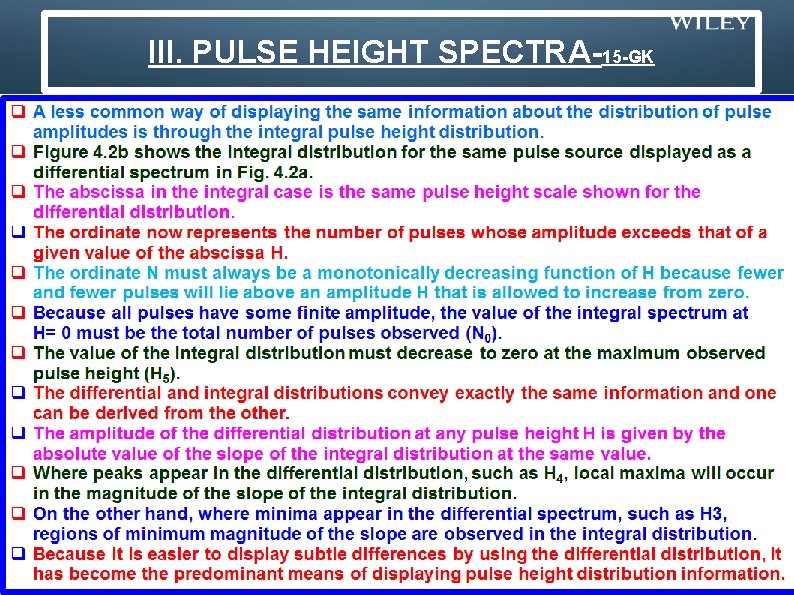
III. PULSE HEIGHT SPECTRA-15 -GK © 2014 John Wiley & Sons, Inc. All rights reserved.
IV. COUNTING CURVES AND PLATEAUS-16 -GK © 2014 John Wiley & Sons, Inc. All rights reserved.
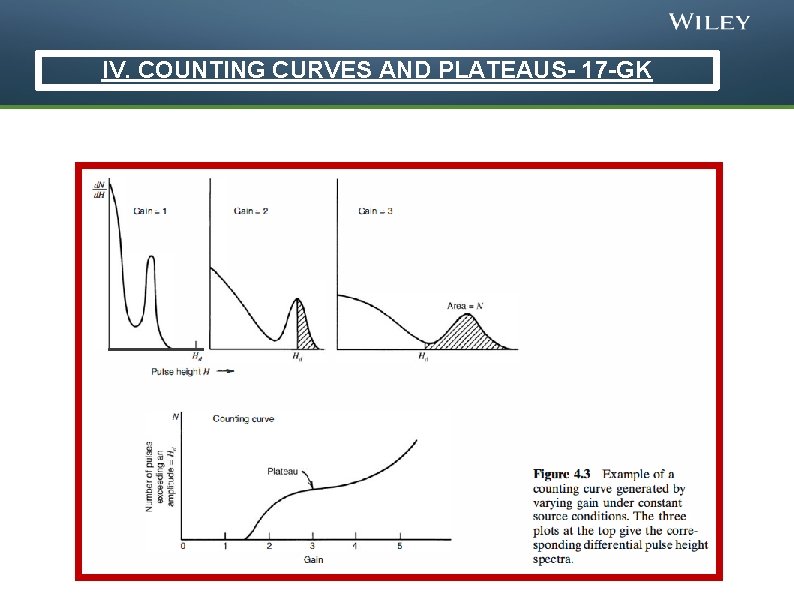
IV. COUNTING CURVES AND PLATEAUS- 17 -GK © 2014 John Wiley & Sons, Inc. All rights reserved.
IV. COUNTING CURVES AND PLATEAUS- 17 -GK
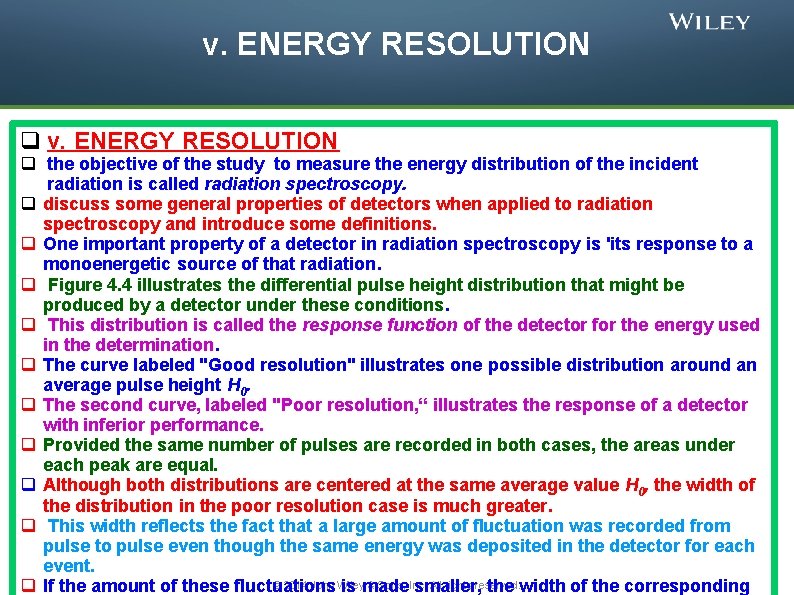
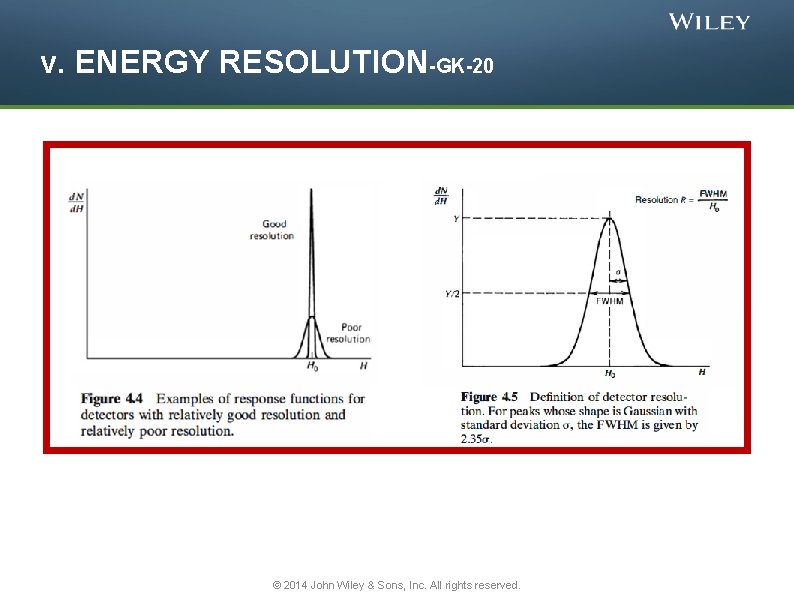
v. ENERGY RESOLUTION q the objective of the study to measure the energy distribution of the incident radiation is called radiation spectroscopy. q discuss some general properties of detectors when applied to radiation spectroscopy and introduce some definitions. q One important property of a detector in radiation spectroscopy is 'its response to a monoenergetic source of that radiation. q Figure 4. 4 illustrates the differential pulse height distribution that might be produced by a detector under these conditions. q This distribution is called the response function of the detector for the energy used in the determination. q The curve labeled "Good resolution" illustrates one possible distribution around an average pulse height H 0. q The second curve, labeled "Poor resolution, “ illustrates the response of a detector with inferior performance. q Provided the same number of pulses are recorded in both cases, the areas under each peak are equal. q Although both distributions are centered at the same average value H 0, the width of the distribution in the poor resolution case is much greater. q This width reflects the fact that a large amount of fluctuation was recorded from pulse to pulse even though the same energy was deposited in the detector for each event. © 2014 John Wiley & Sons, Inc. All rights reserved. q If the amount of these fluctuations is made smaller, the width of the corresponding
v. ENERGY RESOLUTION-GK-18 © 2014 John Wiley & Sons, Inc. All rights reserved.
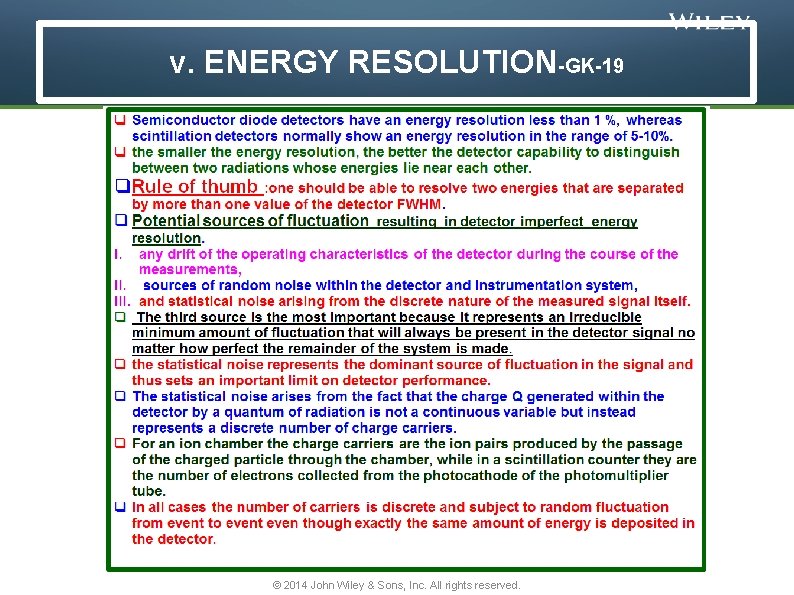
v. ENERGY RESOLUTION-GK-19 q Semiconductor diode detectors have an energy resolution less than 1 %, whereas scintillation detectors normally show an energy resolution in the range of 5 -10%. q the smaller the energy resolution, the better the detector capability to distinguish between two radiations whose energies lie near each other. q. Rule of thumb : one should be able to resolve two energies that are separated by more than one value of the detector FWHM. q Potential sources of fluctuation resulting in detector imperfect energy resolution. I. any drift of the operating characteristics of the detector during the course of the measurements, II. sources of random noise within the detector and instrumentation system, III. and statistical noise arising from the discrete nature of the measured signal itself. q The third source is the most important because it represents an irreducible minimum amount of fluctuation that will always be present in the detector signal no matter how perfect the remainder of the system is made. q the statistical noise represents the dominant source of fluctuation in the signal and thus sets an important limit on detector performance. q The statistical noise arises from the fact that the charge Q generated within the detector by a quantum of radiation is not a continuous variable but instead represents a discrete number of charge carriers. q For an ion chamber the charge carriers are the ion pairs produced by the passage of the charged particle through the chamber, while in a scintillation counter they are © 2014 John Wiley & Sons, Inc. All rights reserved.
v. ENERGY RESOLUTION-GK-19 © 2014 John Wiley & Sons, Inc. All rights reserved.
v. ENERGY RESOLUTION-GK-20 © 2014 John Wiley & Sons, Inc. All rights reserved.
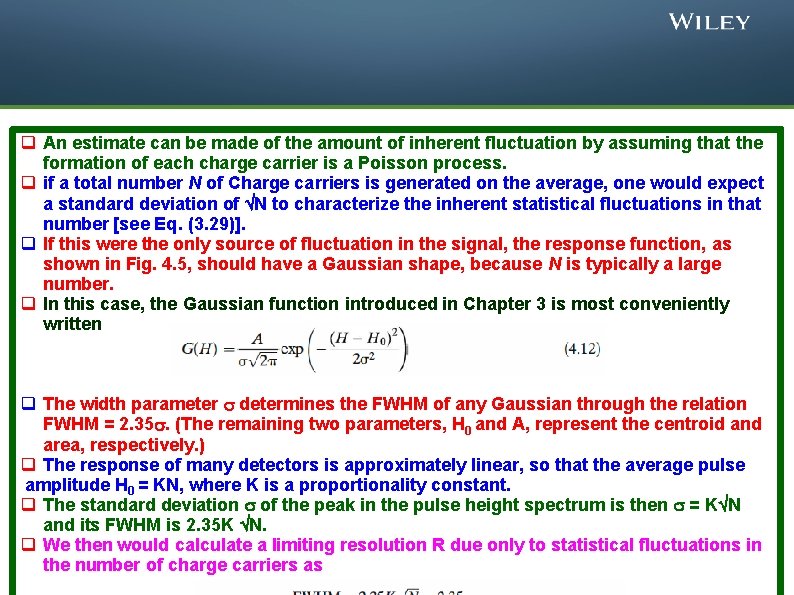
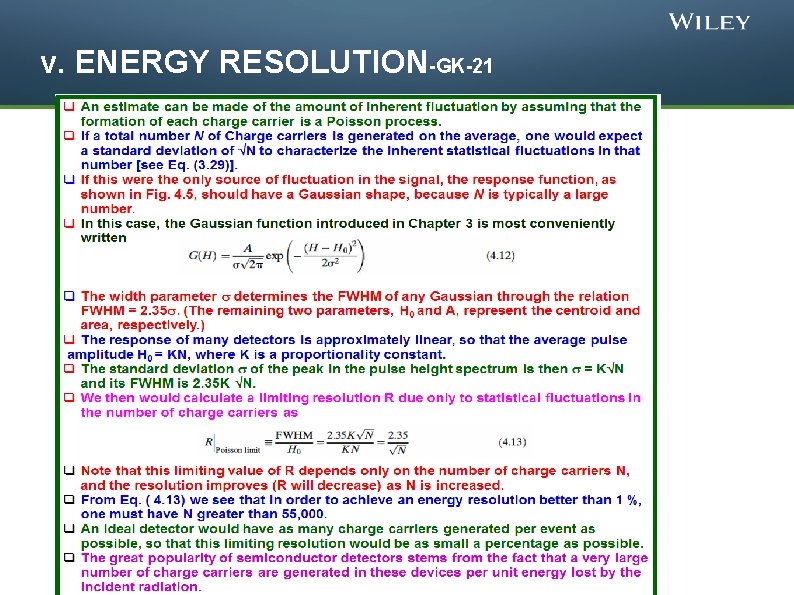
q An estimate can be made of the amount of inherent fluctuation by assuming that the formation of each charge carrier is a Poisson process. q if a total number N of Charge carriers is generated on the average, one would expect a standard deviation of N to characterize the inherent statistical fluctuations in that number [see Eq. (3. 29)]. q If this were the only source of fluctuation in the signal, the response function, as shown in Fig. 4. 5, should have a Gaussian shape, because N is typically a large number. q In this case, the Gaussian function introduced in Chapter 3 is most conveniently written q The width parameter determines the FWHM of any Gaussian through the relation FWHM = 2. 35. (The remaining two parameters, H 0 and A, represent the centroid and area, respectively. ) q The response of many detectors is approximately linear, so that the average pulse amplitude H 0 = KN, where K is a proportionality constant. q The standard deviation of the peak in the pulse height spectrum is then = K N and its FWHM is 2. 35 K N. q We then would calculate a limiting resolution R due only to statistical fluctuations in the number of charge carriers as © 2014 John Wiley & Sons, Inc. All rights reserved.
v. ENERGY RESOLUTION-GK-21 © 2014 John Wiley & Sons, Inc. All rights reserved.
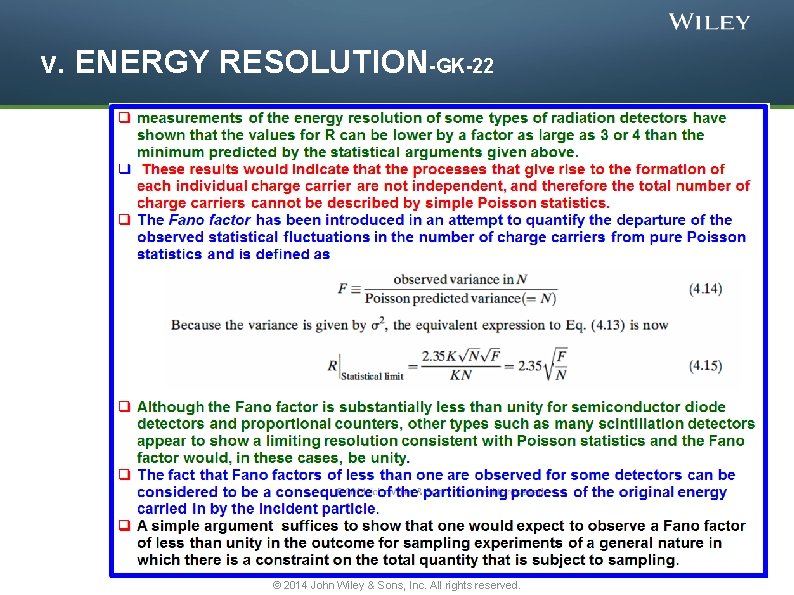
q measurements of the energy resolution of some types of radiation detectors have shown that the values for R can be lower by a factor as large as 3 or 4 than the minimum predicted by the statistical arguments given above. q These results would indicate that the processes that give rise to the formation of each individual charge carrier are not independent, and therefore the total number of charge carriers cannot be described by simple Poisson statistics. q The Fano factor has been introduced in an attempt to quantify the departure of the observed statistical fluctuations in the number of charge carriers from pure Poisson statistics and is defined as q Although the Fano factor is substantially less than unity for semiconductor diode detectors and proportional counters, other types such as many scintillation detectors appear to show a limiting resolution consistent with Poisson statistics and the Fano factor would, in these cases, be unity. q The fact that Fano factors of less than one are observed for some detectors can be © 2014 John Sons, Inc. All rights reserved. considered to be a consequence of Wiley the&partitioning process of the original energy
v. ENERGY RESOLUTION-GK-22 © 2014 John Wiley & Sons, Inc. All rights reserved.
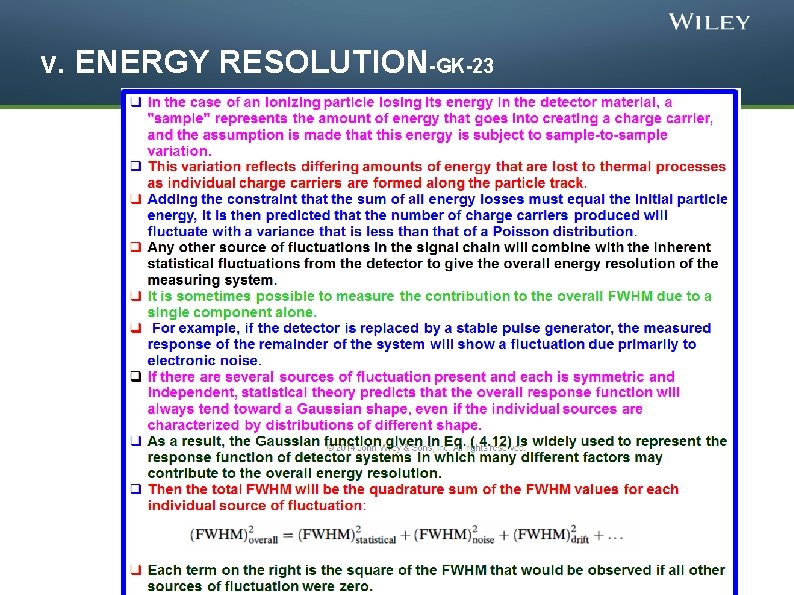
q In the case of an ionizing particle losing its energy in the detector material, a "sample" represents the amount of energy that goes into creating a charge carrier, and the assumption is made that this energy is subject to sample-to-sample variation. q This variation reflects differing amounts of energy that are lost to thermal processes as individual charge carriers are formed along the particle track. q Adding the constraint that the sum of all energy losses must equal the initial particle energy, it is then predicted that the number of charge carriers produced will fluctuate with a variance that is less than that of a Poisson distribution. q Any other source of fluctuations in the signal chain will combine with the inherent statistical fluctuations from the detector to give the overall energy resolution of the measuring system. q It is sometimes possible to measure the contribution to the overall FWHM due to a single component alone. q For example, if the detector is replaced by a stable pulse generator, the measured response of the remainder of the system will show a fluctuation due primarily to electronic noise. q If there are several sources of fluctuation present and each is symmetric and independent, statistical theory predicts that the overall response function will always tend toward a Gaussian shape, even if the individual sources are characterized by distributions of different shape. q As a result, the Gaussian function given in Eq. ( 4. 12) is widely used to represent the © 2014 John Wiley & Sons, Inc. All rights reserved.
v. ENERGY RESOLUTION-GK-23 © 2014 John Wiley & Sons, Inc. All rights reserved.