
Chapter 4 Generalizing from a Sample Learning Objectives
Chapter 4 Generalizing from a Sample
Learning Objectives • Articulate the difference between sample coefficients (b) and population coefficients (β) • Develop the three steps to generalize from a sample to a population • Explain the classical regression assumptions • Connect the data type to potential assumption failures and potential relevant populations
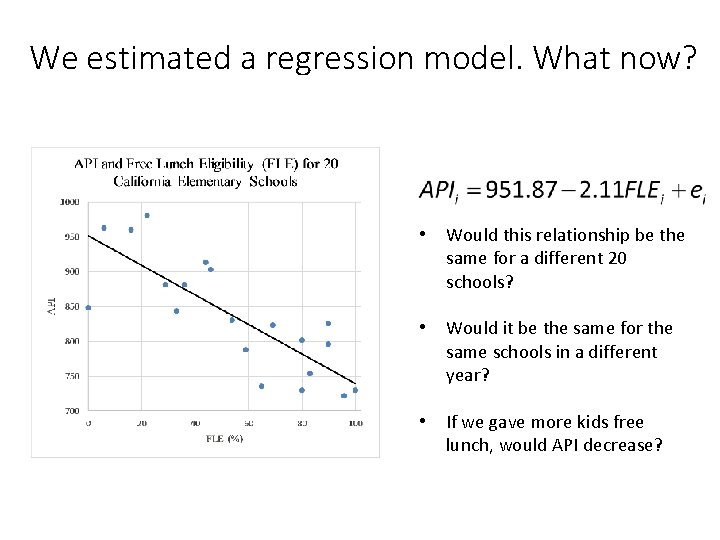
We estimated a regression model. What now? • Would this relationship be the same for a different 20 schools? • Would it be the same for the same schools in a different year? • If we gave more kids free lunch, would API decrease?
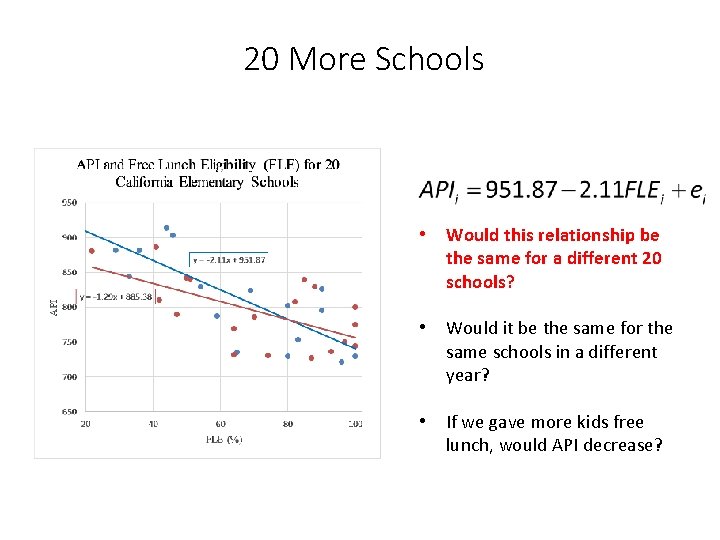
20 More Schools • Would this relationship be the same for a different 20 schools? • Would it be the same for the same schools in a different year? • If we gave more kids free lunch, would API decrease?
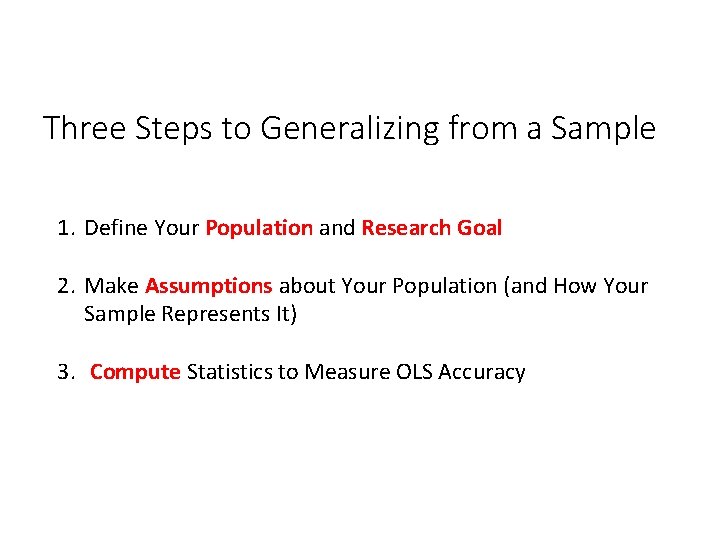
Three Steps to Generalizing from a Sample 1. Define Your Population and Research Goal 2. Make Assumptions about Your Population (and How Your Sample Represents It) 3. Compute Statistics to Measure OLS Accuracy
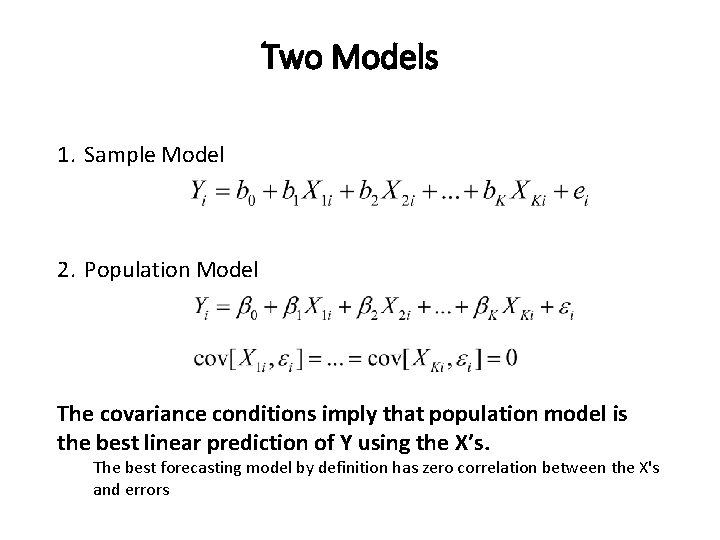
Two Models 1. Sample Model 2. Population Model The covariance conditions imply that population model is the best linear prediction of Y using the X’s. The best forecasting model by definition has zero correlation between the X's and errors
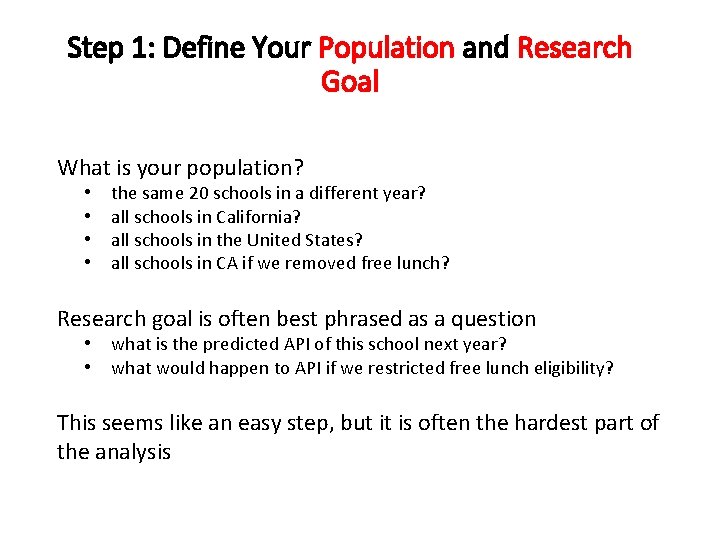
Step 1: Define Your Population and Research Goal What is your population? • • the same 20 schools in a different year? all schools in California? all schools in the United States? all schools in CA if we removed free lunch? Research goal is often best phrased as a question • • what is the predicted API of this school next year? what would happen to API if we restricted free lunch eligibility? This seems like an easy step, but it is often the hardest part of the analysis
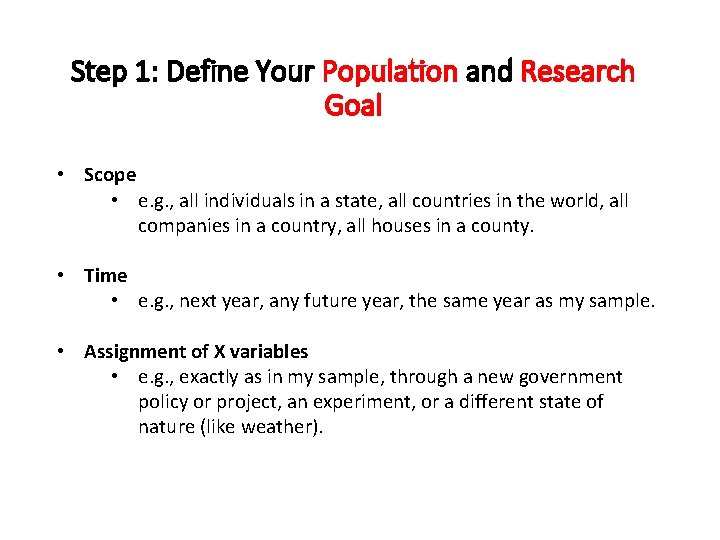
Step 1: Define Your Population and Research Goal • Scope • e. g. , all individuals in a state, all countries in the world, all companies in a country, all houses in a county. • Time • e. g. , next year, any future year, the same year as my sample. • Assignment of X variables • e. g. , exactly as in my sample, through a new government policy or project, an experiment, or a different state of nature (like weather).

Step 1: Define Your Population and Research Goal Examples: • Do good teachers produce better student outcomes? • Does the law of demand hold for electricity? • Is it possible to forecast stock returns?
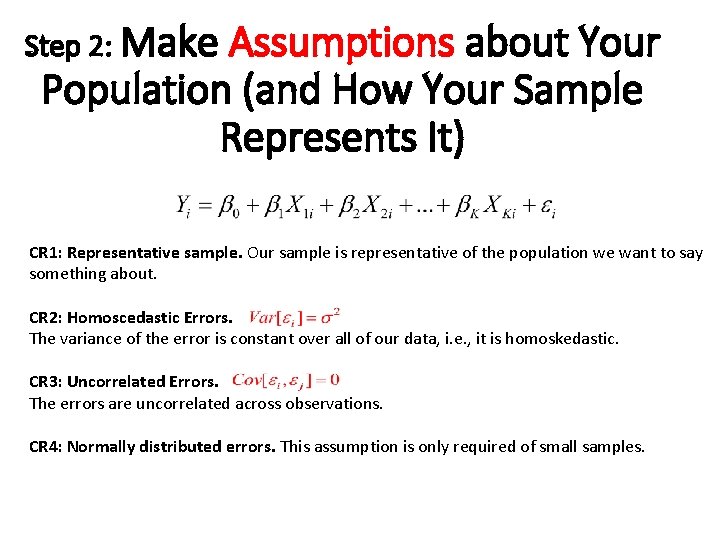
Step 2: Make Assumptions about Your Population (and How Your Sample Represents It) CR 1: Representative sample. Our sample is representative of the population we want to say something about. CR 2: Homoscedastic Errors. The variance of the error is constant over all of our data, i. e. , it is homoskedastic. CR 3: Uncorrelated Errors. The errors are uncorrelated across observations. CR 4: Normally distributed errors. This assumption is only required of small samples.
Sometimes we need one more assumption (Ch 1112) CR 5: Exogenous X. The values of the explanatory variable are exogenous, or given (there are no errors in the X-direction). Example: Google Flu trends
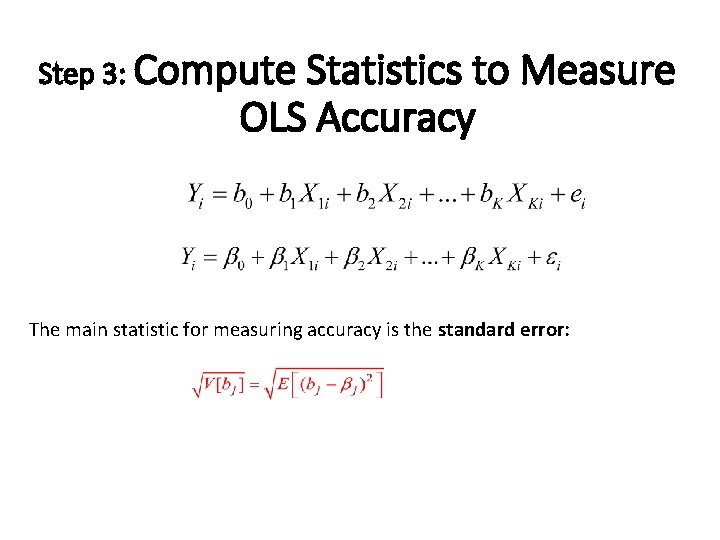
Step 3: Compute Statistics to Measure OLS Accuracy The main statistic for measuring accuracy is the standard error:
Recap: Three Steps to Generalizing from a Sample 1. Define Your Population and Research Goal 2. Make Assumptions about Your Population (and How Your Sample Represents It) 3. Compute Statistics to Measure OLS Accuracy
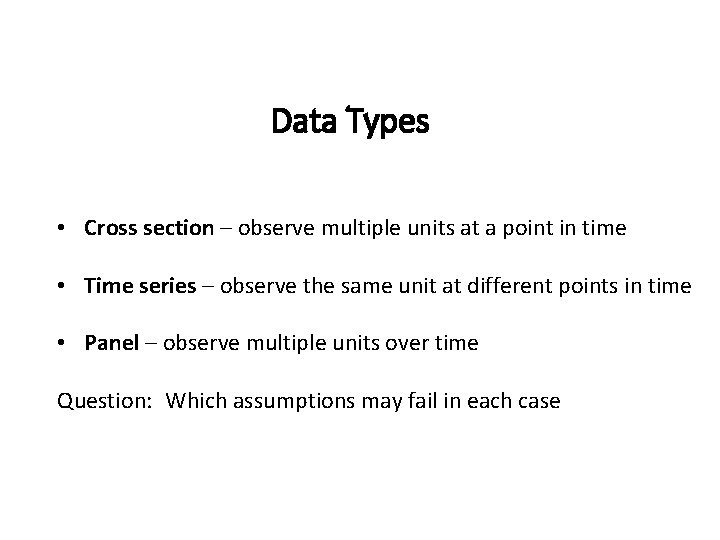
Data Types • Cross section – observe multiple units at a point in time • Time series – observe the same unit at different points in time • Panel – observe multiple units over time Question: Which assumptions may fail in each case
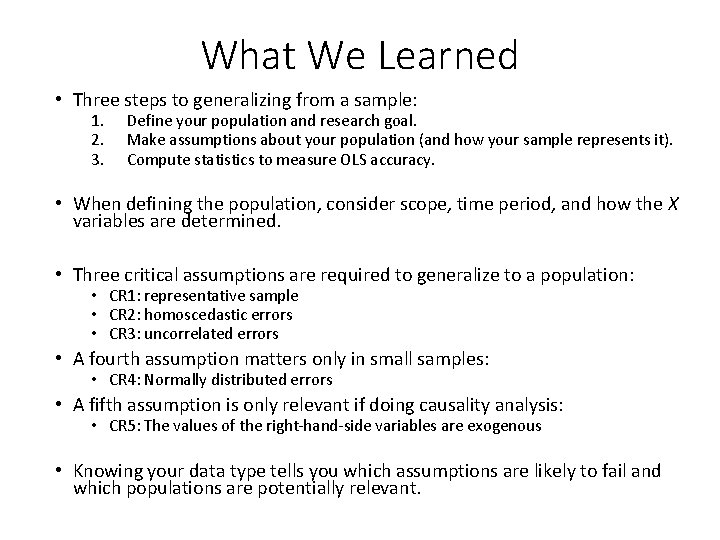
What We Learned • Three steps to generalizing from a sample: 1. 2. 3. Define your population and research goal. Make assumptions about your population (and how your sample represents it). Compute statistics to measure OLS accuracy. • When defining the population, consider scope, time period, and how the X variables are determined. • Three critical assumptions are required to generalize to a population: • CR 1: representative sample • CR 2: homoscedastic errors • CR 3: uncorrelated errors • A fourth assumption matters only in small samples: • CR 4: Normally distributed errors • A fifth assumption is only relevant if doing causality analysis: • CR 5: The values of the right-hand-side variables are exogenous • Knowing your data type tells you which assumptions are likely to fail and which populations are potentially relevant.
- Slides: 15