
CHAPTER 4 FUTURE TIME WILL Will Verb I

CHAPTER 4 FUTURE TIME
WILL Will + Verb I will grade your quizzes soon. I will not finish grading your quizzes tonight. Will you finish your assignment soon? Where will you live in ten years?
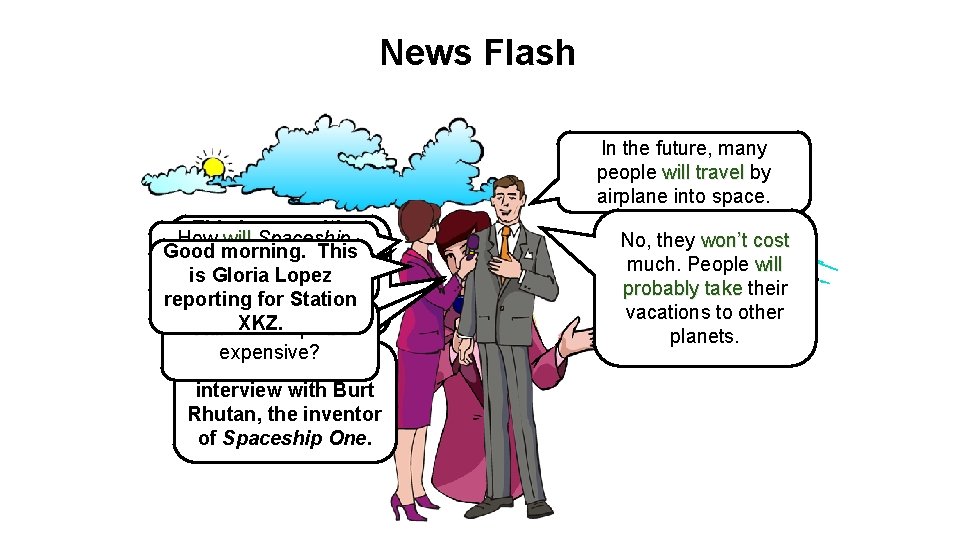
News Flash In the future, many people will travel by airplane into space. Thiswill is Spaceship an exciting How Good morning. This day. We’re One change the way iswatching Gloria Lopez the first people travel? reporting Station airplanefor travel into XKZ. space! Will these trips be expensive? Let’s go now to an interview with Burt Rhutan, the inventor of Spaceship One. No, they won’t cost much. People will probably take their vacations to other planets.
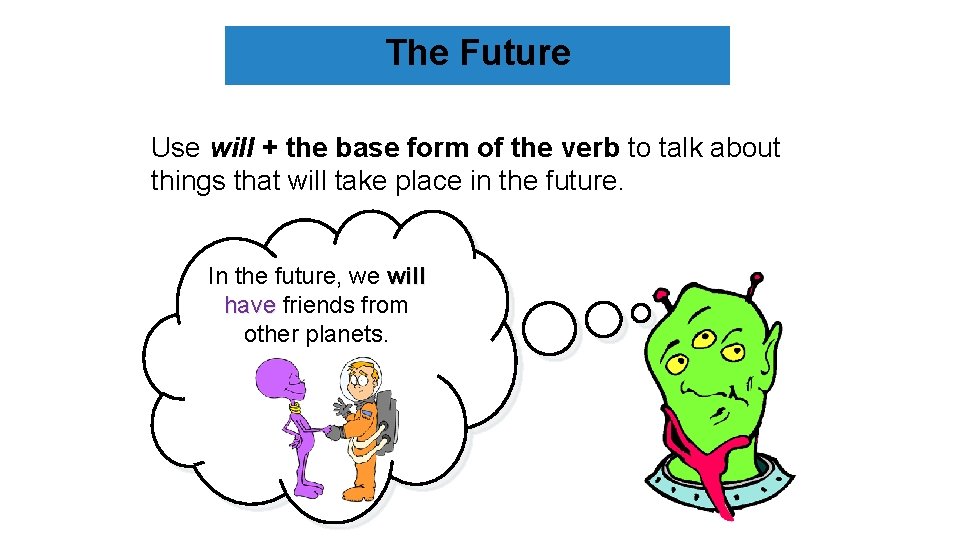
The Future Use will + the base form of the verb to talk about things that will take place in the future. In the future, we will have friends from other planets.
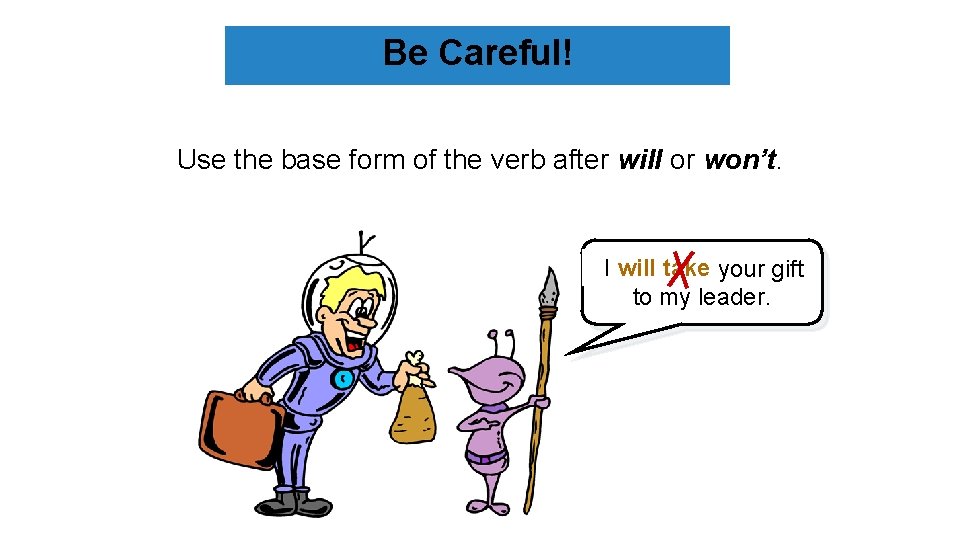
Be Careful! Use the base form of the verb after will or won’t. willtakes take your gift II will to my leader.
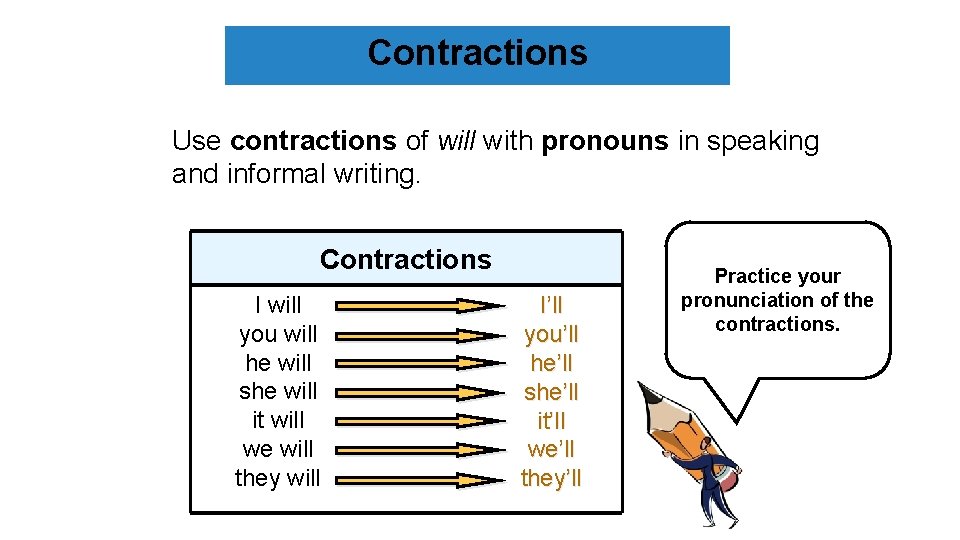
Contractions Use contractions of will with pronouns in speaking and informal writing. Contractions I will you will he will she will it will we will they will I’ll you’ll he’ll she’ll it’ll we’ll they’ll Practice your pronunciation of the contractions.
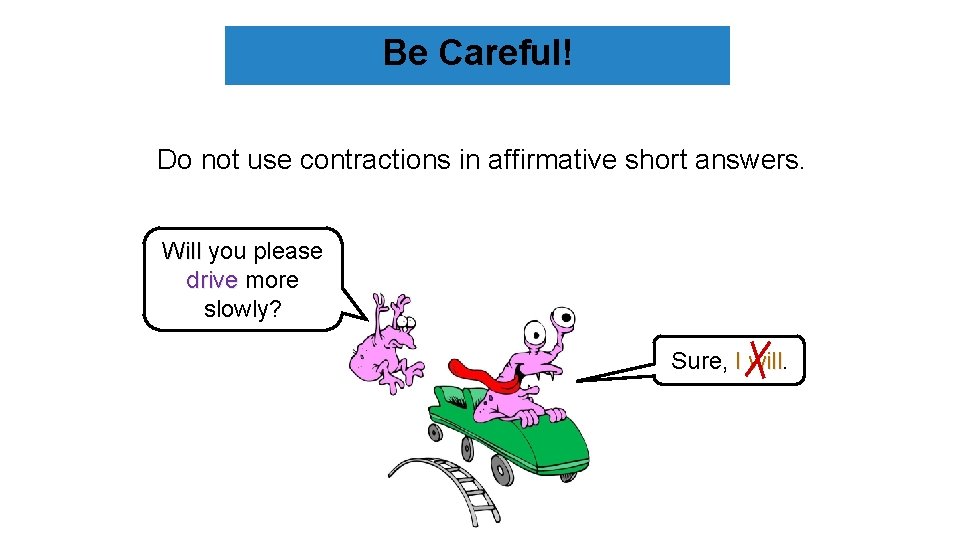
Be Careful! Do not use contractions in affirmative short answers. Will you please drive more slowly? Sure, I I’ll. Sure, will
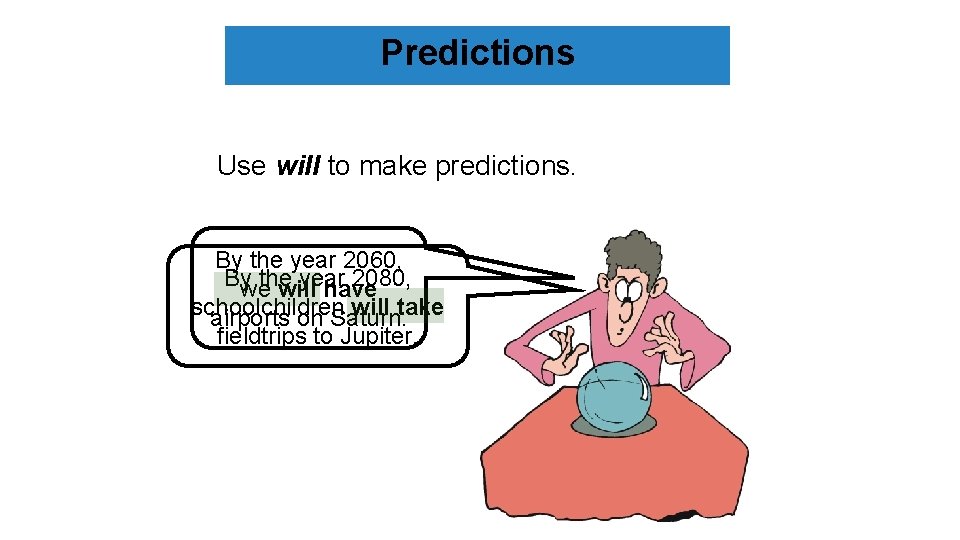
Predictions Use will to make predictions. By the year 2060, Bywe the year 2080, will have schoolchildren will take airports on Saturn. fieldtrips to Jupiter.
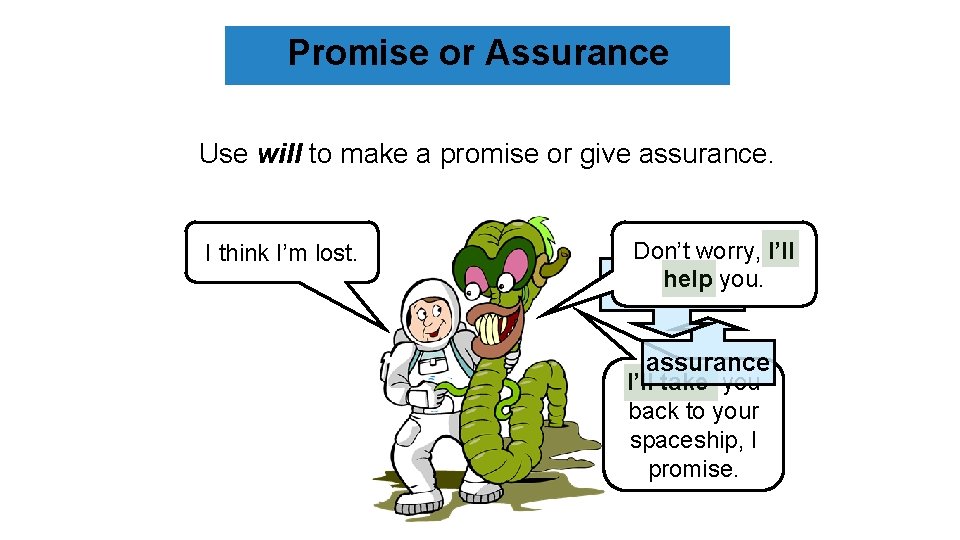
Promise or Assurance Use will to make a promise or give assurance. I think I’m lost. Don’t worry, I’ll help you. promise assurance I’ll take you back to your spaceship, I promise.
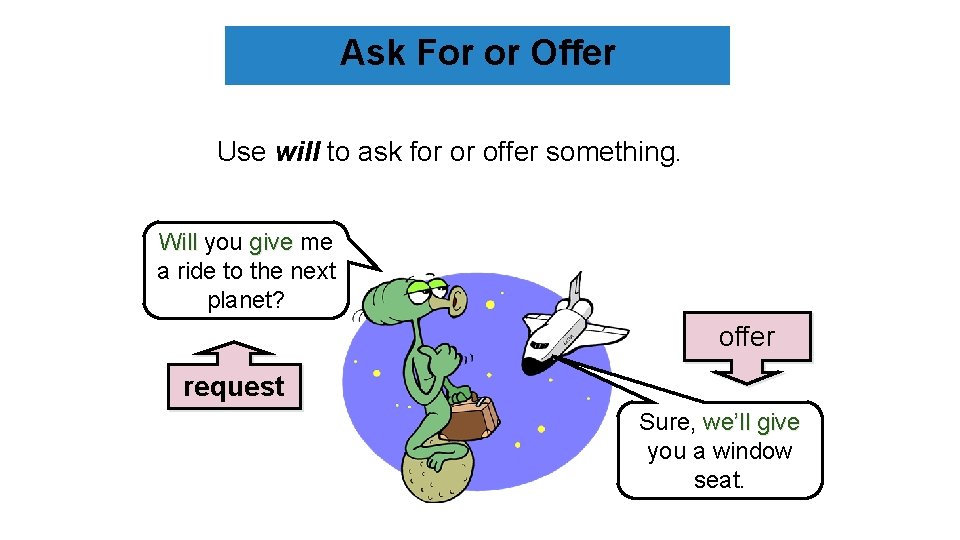
Ask For or Offer Use will to ask for or offer something. Will you give me a ride to the next planet? offer request Sure, we’ll give you a window seat.
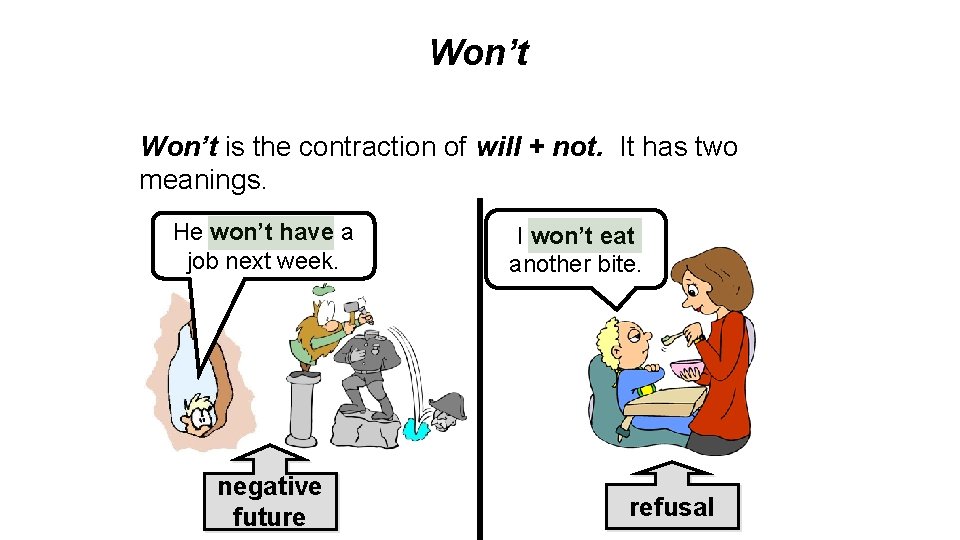
Won’t is the contraction of will + not. It has two meanings. He won’t have a job next week. negative future I won’t eat another bite. refusal
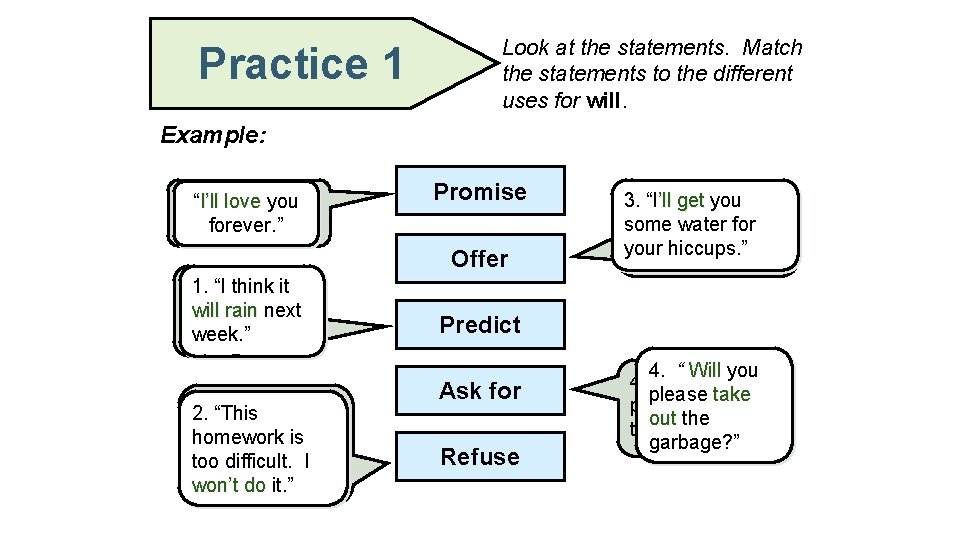
Practice 1 Look at the statements. Match the statements to the different uses for will. Example: “I’llloveyou forever. ” Promise Offer 1. 1. “I“Ithinkitit willrainnext week. ” 2. “This 2. homework is is too homework difficult. I won’t too difficult. I do it. ” won’t 3. 3. “I“I’ll’llget getyou somewaterfor yourhiccups. ” Predict Ask for Refuse 4. “ Will you please take out the garbage? ”
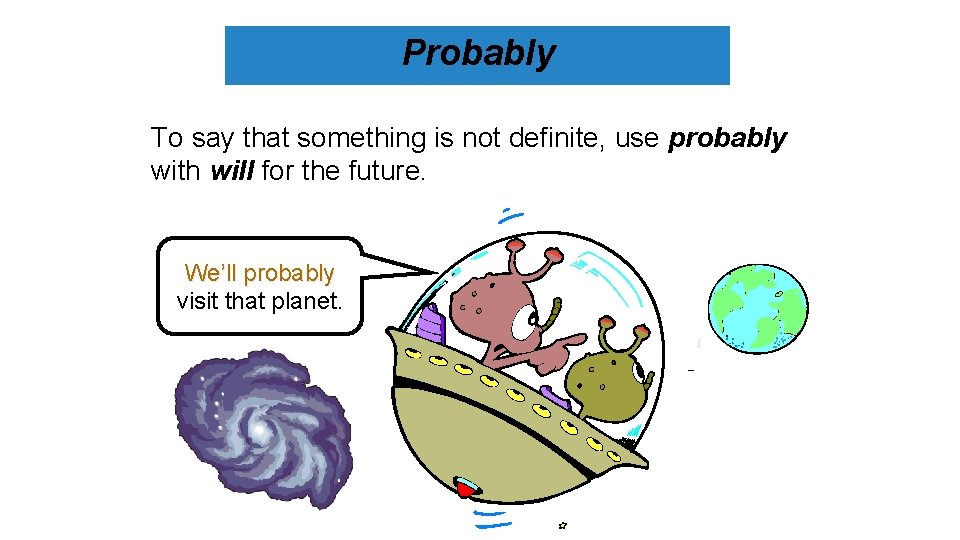
Probably To say that something is not definite, use probably with will for the future. We’ll probably visit that planet.
Practice 2 Use will to answer the questions with a partner. 1. What will you do in ten years? 2. Where will you live? 3. Will you take vacations to other planets? 4. Will you take English classes next year? 5. What classes will you take?
BE GOING TO be (am/is/are) + going to + verb It is going to rain tonight. We are not going to have class Friday. Is it going to rain tonight? Why are we going to have class Thursday? (In informal speech, going to is often pronounced “gonna”)
WILL VS. BE GOING TO ØWill and Be Going To mean the same when they make predictions about the future. It will be cloudy tomorrow. It is going to be cloudy tomorrow. ØBe Going To is used to express a prior plan (a plan you made before speaking) I’m going to paint my bedroom tomorrow. ØWill is used to express willingness (a decision you made at the moment of speaking) “The phone is ringing. ” “I will get it. ” ØWill as a negative can also express refusal with a person or object.
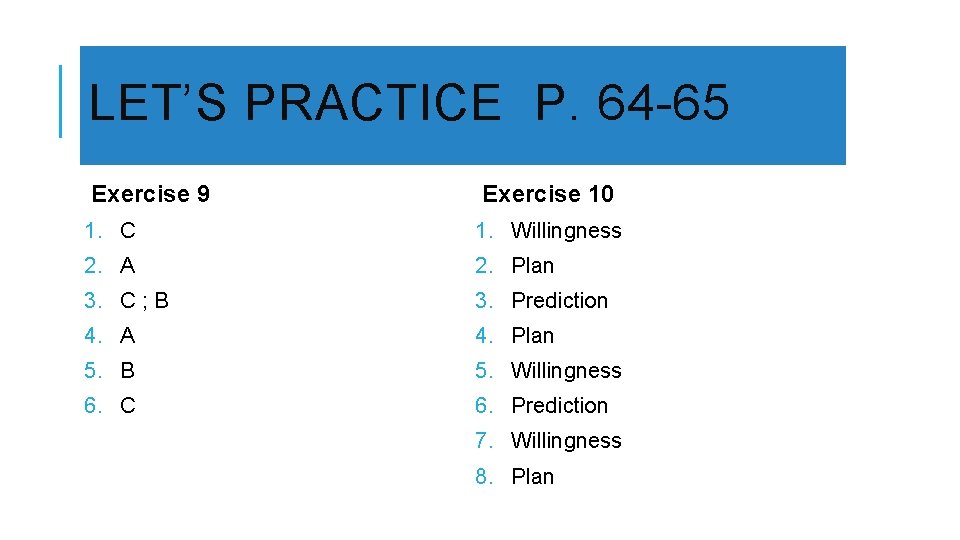
LET’S PRACTICE P. 64 -65 Exercise 9 Exercise 10 1. C 1. Willingness 2. A 2. Plan 3. C ; B 3. Prediction 4. A 4. Plan 5. B 5. Willingness 6. C 6. Prediction 7. Willingness 8. Plan
LET’S PRACTICE P. 65 Exercise 11 1. will translate 2. am going to go (am going) 3. B: ‘ll do… C: ‘ll do 4. ‘s going to erase 5. B: ‘ll meet…A: ‘ll see then 6. ‘m going to meet 7. won’t tell 8. won’t open
FUTURE TIME CLAUSE (P. 67) ØWhen the meaning of the time clause is in the future, the simple present is used – will and be going to are not used in time clauses. When Bob arrives, we will see him. Before Linda leaves, she is going to finish her work. ØSometimes the present progressive is used with a time clause to describe a process that will be in progress in the near future. While I am traveling in Europe next year, I’m going to save money by staying in cheap hotels. (Time clauses begins with: when, before, after, as soon as, until, and while)
LET’S PRACTICE P. 67 -68 Exercise 14 Exercise 15 1. will finish/is going to finish; leaves 2. eat; will probably take/am probably going to take 3. Get; ‘ll give /am going to give 4. Watch; ‘ll call/ am going to call 5. ‘ll wait/am going to wait; comes 6. Stops; ‘ll walk/am going to walk 7. Graduate; intend; ’ll go/am going to go; get 8. ‘ll listen/am going to listen; sleep / am sleeping
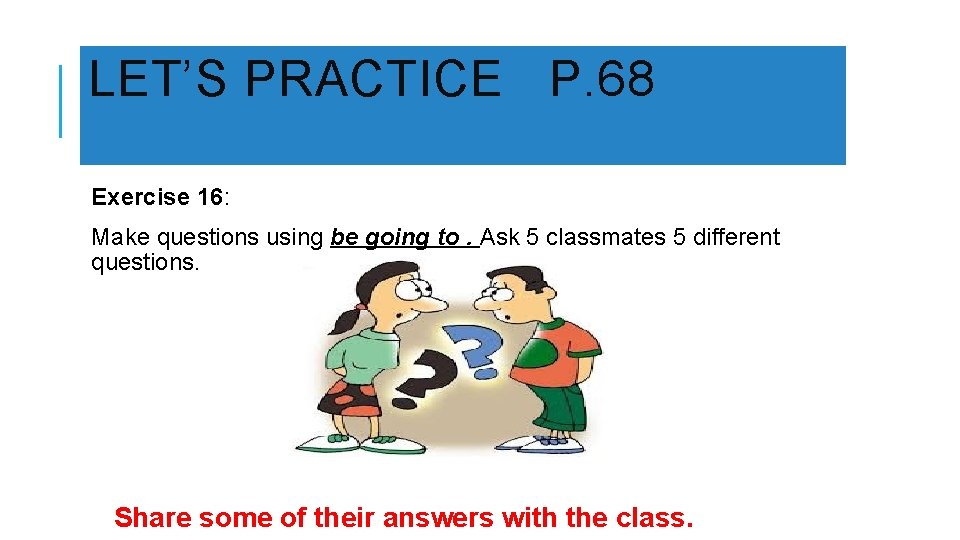
LET’S PRACTICE P. 68 Exercise 16: Make questions using be going to. Ask 5 classmates 5 different questions. Share some of their answers with the class.
PRESENT PROGRESSIVE AS FUTURE (P. 69) May be used to express future time for a planned event or a definite intention. My wife has an appointment. She is seeing the doctor next Tuesday. I’m meeting Jim at the airport tomorrow. We are going shopping this afternoon. There is usually a suggestion that more than one person is aware of the event and that some preparation has already happened for the event (i. e. the event has been planned previously). (Note: occurs with time word/phrase to let the reader/listener know you are talking about the future and not now)
PRESENT PROGRESSIVE AS FUTURE – EXAMPLES: She is leaving. (Indicates she’s leaving NOW) She is leaving in a few minutes. (indicates action in the future) Is she leaving? (now) Is she leaving in a few minutes? (future) I am grading your quizzes. (now) I am grading your quizzes tonight. (future) Are you grading our quizzes? (now) Are you grading our quizzes tonight? (future)
SIMPLE PRESENT AS FUTURE Use when the statements are based on present facts that are fixed – like a schedule or calendar. These sentences usually contain time words/phrases. §The store opens at 10 a. m. tomorrow. §The plane leaves at noon.
SIMPLE PRESENT/PRESENT PROGRESSIVE AS FUTURE Choose the correct ending(s) for the sentence. There may be more than one correct answer. We have tickets for a puppet show today. The show _____. A. starts at 2: 00 p. m. B. is starting at 2: 00 p. m. C. Is going to start at 2: 00 p. m.
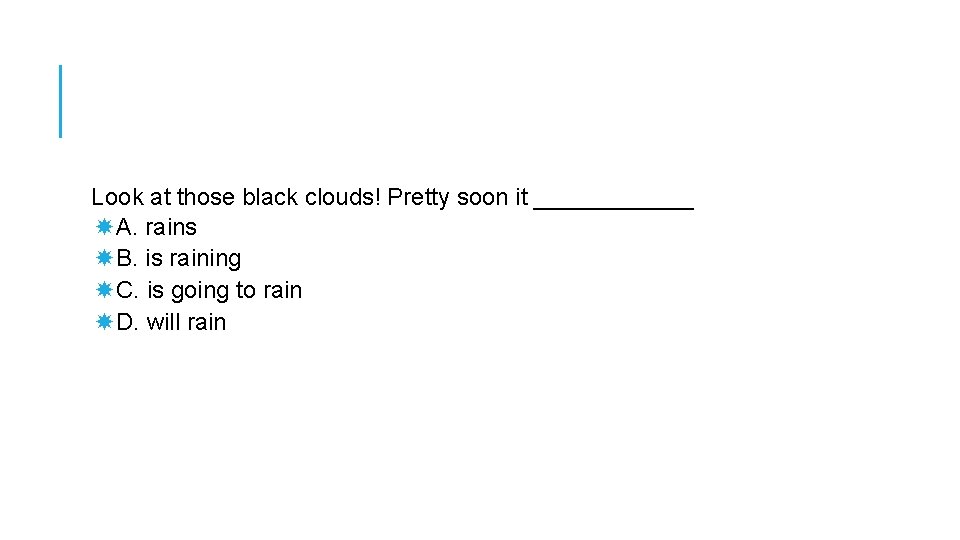
Look at those black clouds! Pretty soon it ______ A. rains B. is raining C. is going to rain D. will rain
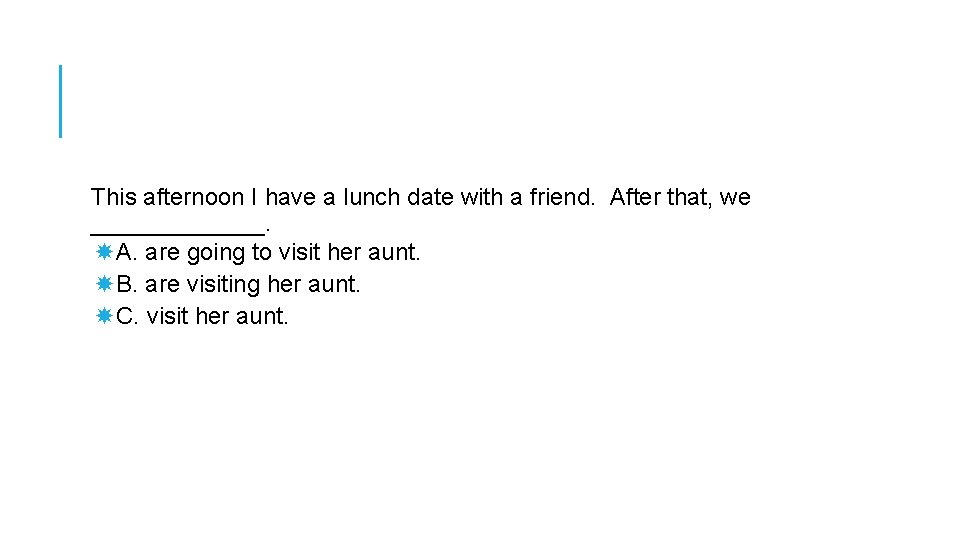
This afternoon I have a lunch date with a friend. After that, we _______. A. are going to visit her aunt. B. are visiting her aunt. C. visit her aunt.
PRACTICE Exercises 18 and 19 P. 69 -71
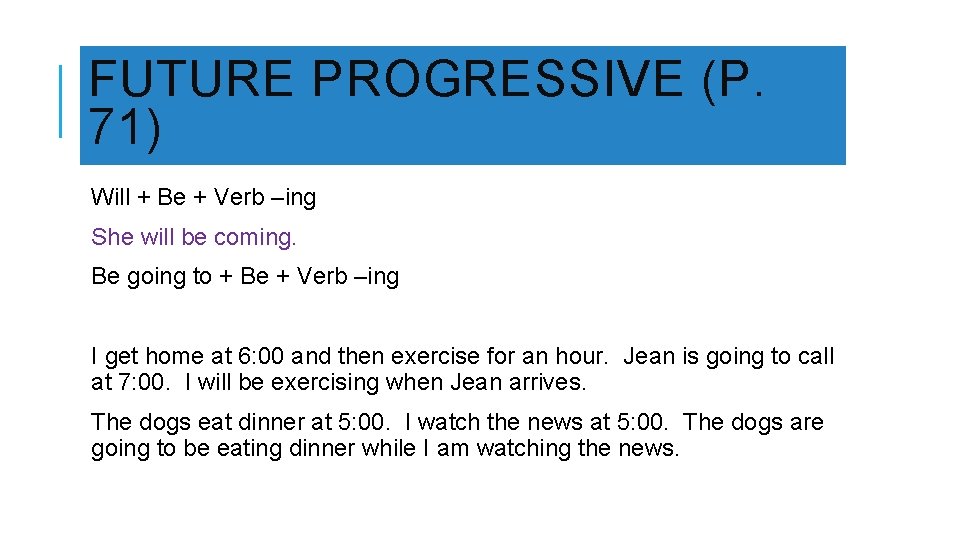
FUTURE PROGRESSIVE (P. 71) Will + Be + Verb –ing She will be coming. Be going to + Be + Verb –ing I get home at 6: 00 and then exercise for an hour. Jean is going to call at 7: 00. I will be exercising when Jean arrives. The dogs eat dinner at 5: 00. I watch the news at 5: 00. The dogs are going to be eating dinner while I am watching the news.
FUTURE PROGRESSIVE Expresses an activity that will be in progress at a specific time in the future. The activity is ongoing Sometimes there is NO difference between the future progressive and will/be going to: Don’t worry, she will be coming soon. Don’t worry. She will come soon.
FUTURE CONTINUOUS – MORE EXAMPLES I will be returning at 5: 00 p. m. They will be arriving later. You will not be watching a movie tonight. You are going to be attending the lecture while I eat lunch. The dogs are not going to be getting a bath tonight.
LET’S PRACTICE P. 72 Exercises 22 1. is going to be sleeping / will be sleeping; is going to be studying / will be studying; am going to be finishing / will be finishing 2. is going to be seeing / will be seeing; is going to be doing / will be doing; is going to be talking / will be talking Exercise 23 1. arrive; is going to be waiting/ will be waiting 2. get; is going to be shining / will be shining; are going to be singing /will be singing; is going to be lying / will be lying 3. am going to be enjoying / will be enjoying; am going to be thinking / will be thinking 4. am going to be visiting / will be visiting 5. am going to be working / will be working
- Slides: 32