
Chapter 4 From Cells to Organ Systems Tissues
- Slides: 18
Chapter 4 From Cells to Organ Systems § Tissues § Anatomical terms § Integumentary system- Skin Copyright © 2009 Pearson Education, Inc.
Tissues § Groups of cells with a common function § Four primary tissues § Epithelia § Connective tissues § Muscle § Nervous Copyright © 2009 Pearson Education, Inc.
Epithelial Tissues § Line body cavities and cover surfaces Copyright © 2009 Pearson Education, Inc.
Epithelial Tissues: Classification § Shape § Squamous: flattened cells; line vessels, part of lungs, body surface § Cuboidal: cube shaped; form lining of tubules, glandular tissue § Columnar: column shaped; line respiratory, digestive, reproductive tracts Copyright © 2009 Pearson Education, Inc.
Epithelial Tissues: Classification § Number of layers § Simple/single–layered: adapted for diffusion across cell barriers; line glands, and respiratory, digestive, reproductive systems § Stratified/multiple–layered: provide protection, as in the skin surface Copyright © 2009 Pearson Education, Inc.
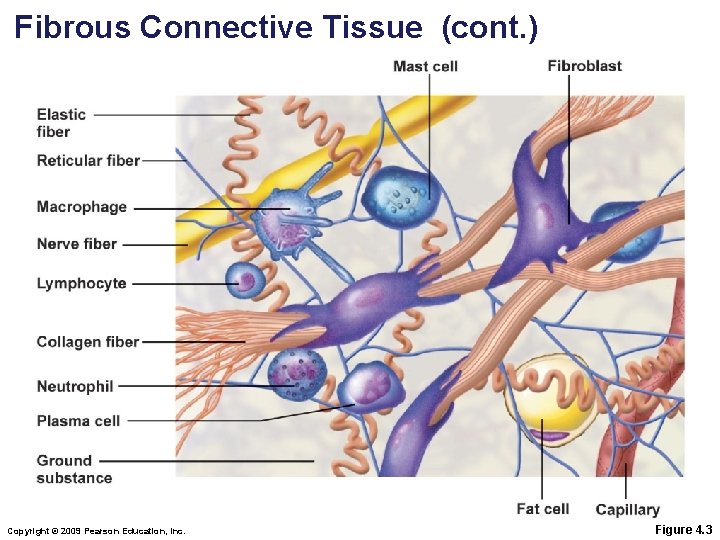
Connective Tissue Supports and Connects Body Parts: Basement Membrane § Fibrous connective tissue § Loose: surrounds many organs, lines cavities around blood vessels § Dense: forms tendons, ligaments, deeper layers of skin Copyright © 2009 Pearson Education, Inc.
Connective Tissue Supports and Connects Body Parts (cont. ) § Special connective tissue § Cartilage: produced by chondroblasts; found in lacunae; no blood vessels; high collagen content § Bone: inorganic matrix with calcium salts for hardness § Blood: fluid matrix of plasma, red blood cells, white blood cells, and platelets § Adipose tissue: fat cells; function in insulation, protection, and energy storage Copyright © 2009 Pearson Education, Inc.
Fibrous Connective Tissue (cont. ) Copyright © 2009 Pearson Education, Inc. Figure 4. 3
Muscle Tissue: Contracts for Movement § Skeletal muscle § Moves body parts § Voluntary, multinucleated § Cardiac muscle § Functions in the heart § Involuntary, single nucleus § Smooth muscle § Surrounds hollow structures § Involuntary, single nucleus Copyright © 2009 Pearson Education, Inc.
Nervous Tissue: Transmits Impulses § Neuron: specialized nervous system cell § Structural components: cell body, dendrites, axon § Glial cells support neurons Copyright © 2009 Pearson Education, Inc.
Organs and Organ Systems Perform Complex Functions § Organ systems § Groups of organs that perform a common function § Examples § Digestive system: mouth, throat, stomach, intestines, and liver § Lymphatic system: lymph nodes, tonsils, and spleen Copyright © 2009 Pearson Education, Inc.
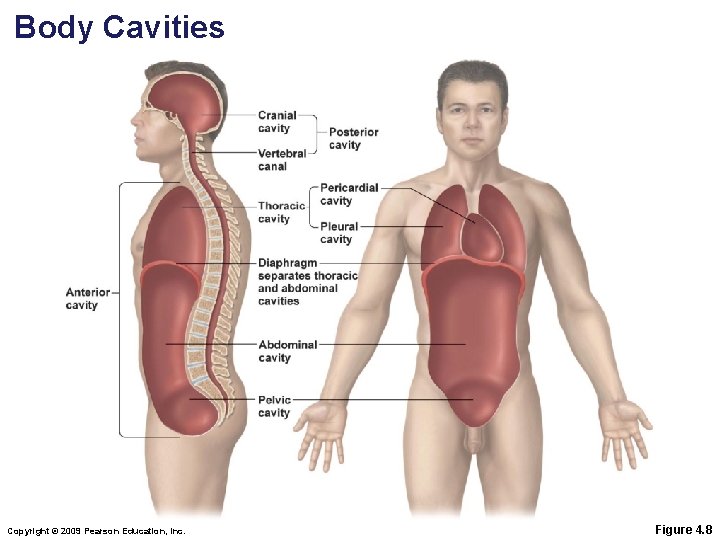
Body Cavities Copyright © 2009 Pearson Education, Inc. Figure 4. 8
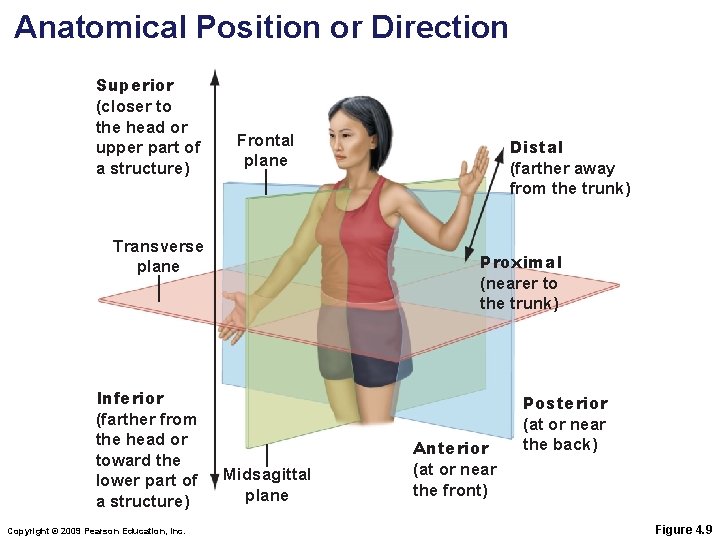
Anatomical Position or Direction Superior (closer to the head or upper part of a structure) Frontal plane Transverse plane Inferior (farther from the head or toward the lower part of a structure) Copyright © 2009 Pearson Education, Inc. Distal (farther away from the trunk) Proximal (nearer to the trunk) Midsagittal plane Anterior (at or near the front) Posterior (at or near the back) Figure 4. 9
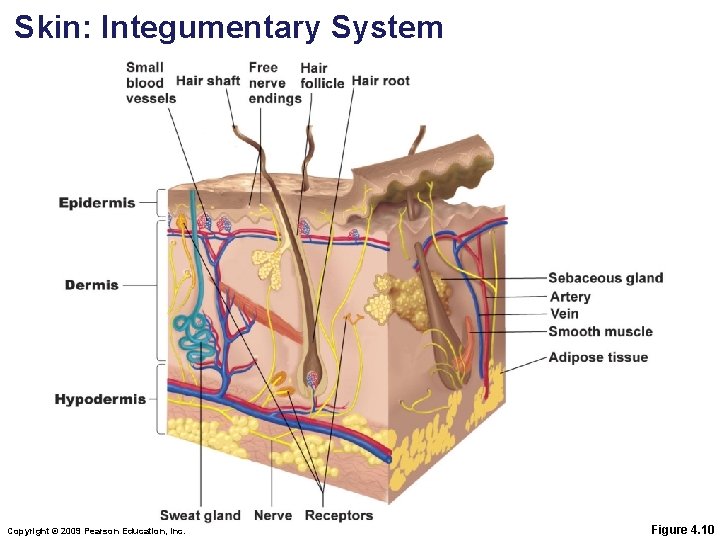
Skin: Integumentary System Copyright © 2009 Pearson Education, Inc. Figure 4. 10
Skin: Integumentary System § Functions: prevents dehydration, protects from injury, serves as defense against microorganisms, regulates body temperature, makes vitamin D, provides sensation § Structure § Epidermis: outer layer, stratified squamous epithelial cells, no blood vessels, specialized keratinocytes and melanocytes § Dermis: deeper layer, support tissues, fibers Copyright © 2009 Pearson Education, Inc.
Accessory Structures of Dermis § Hair: shaft, follicle § Smooth muscle: attached to hair follicle, raises hair to upright position § Oil glands/sebaceous glands: secretion moistens and softens skin Copyright © 2009 Pearson Education, Inc.
Accessory Structures of Dermis (cont. ) § Sweat glands: secrete sweat, help in temperature regulation § Blood vessels: supply nutrients, remove waste, assist in temperature regulation § Sensory nerve endings: detect heat, cold, touch, deep pressure, vibration Copyright © 2009 Pearson Education, Inc.
Homeostasis § Maintenance of relative constancy of the conditions of the internal environment § Mechanisms § Negative feedback: deviations from normal detected and counteracted § Components: controlled variable, sensor, control center, effector § Positive feedback: amplifies original change: § Rarely found in organisms Copyright © 2009 Pearson Education, Inc.