
Chapter 4 Formative Assessment Frey Modern Classroom Assessment
- Slides: 18
Chapter 4 Formative Assessment Frey, Modern Classroom Assessment © 2014 SAGE Publications, Inc.
Objectives The learner will be able to: • Define formative assessment • Describe why self-directed learning and feedback are the primary advantages of formative assessment in the classroom • Outline what we know about formative assessment and how it works • Explain how to design a classroom environment appropriate formal and informal assessment • Describe how to assess the quality of your own formative assessment with a scoring rubric Frey, Modern Classroom Assessment © 2014 SAGE Publications, Inc.
What is formative assessment? Assessment that provides information to students during a unit, before instruction has been completed Allows students to judge their own ongoing learning and progress, monitor, control, and improve their own learning Allows teachers to gather information to modify their instruction, change course, or alter strategy while learning is still taking place Not counted toward grades The only type of educational testing that is designed to directly affect and accelerate learning A reverse of "teaching to the test" because the test is the teaching Frey, Modern Classroom Assessment © 2014 SAGE Publications, Inc.
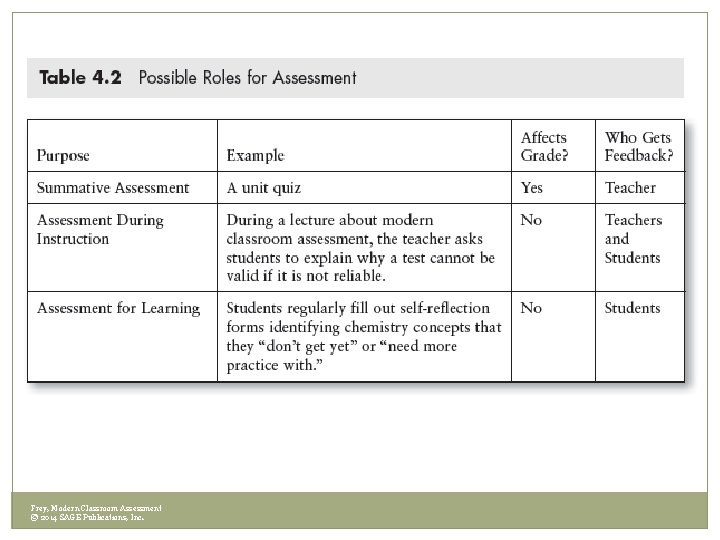
Frey, Modern Classroom Assessment © 2014 SAGE Publications, Inc.
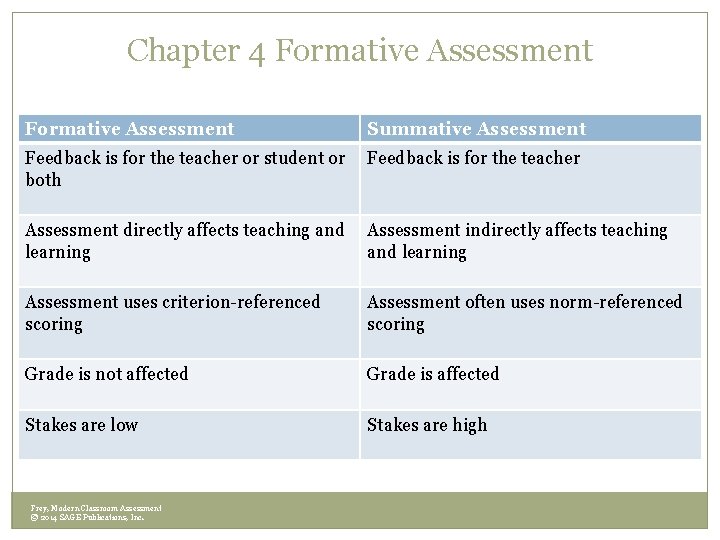
Chapter 4 Formative Assessment Summative Assessment Feedback is for the teacher or student or both Feedback is for the teacher Assessment directly affects teaching and learning Assessment indirectly affects teaching and learning Assessment uses criterion-referenced scoring Assessment often uses norm-referenced scoring Grade is not affected Grade is affected Stakes are low Stakes are high Frey, Modern Classroom Assessment © 2014 SAGE Publications, Inc.
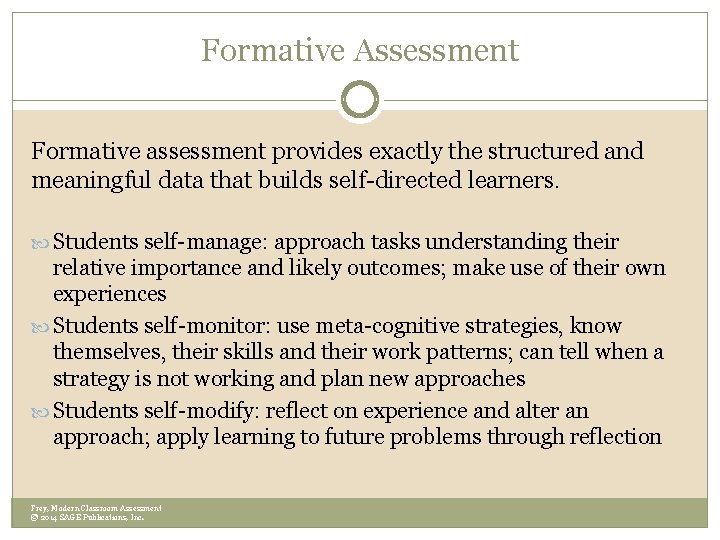
Formative Assessment Formative assessment provides exactly the structured and meaningful data that builds self-directed learners. Students self-manage: approach tasks understanding their relative importance and likely outcomes; make use of their own experiences Students self-monitor: use meta-cognitive strategies, know themselves, their skills and their work patterns; can tell when a strategy is not working and plan new approaches Students self-modify: reflect on experience and alter an approach; apply learning to future problems through reflection Frey, Modern Classroom Assessment © 2014 SAGE Publications, Inc.
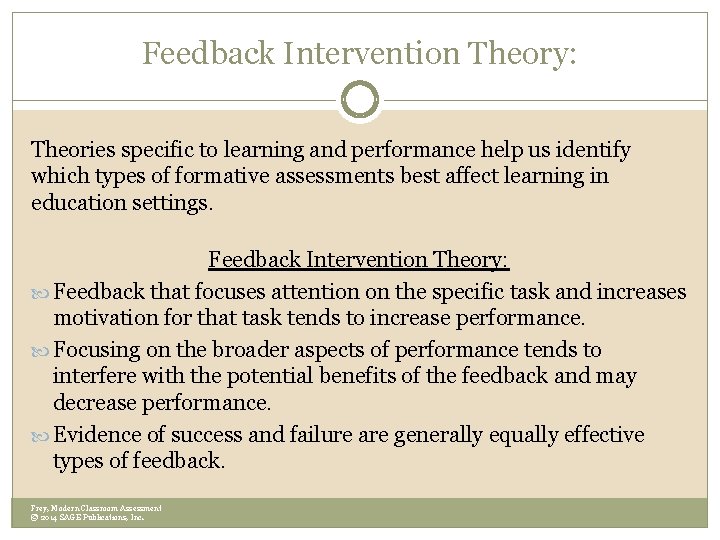
Feedback Intervention Theory: Theories specific to learning and performance help us identify which types of formative assessments best affect learning in education settings. Feedback Intervention Theory: Feedback that focuses attention on the specific task and increases motivation for that task tends to increase performance. Focusing on the broader aspects of performance tends to interfere with the potential benefits of the feedback and may decrease performance. Evidence of success and failure are generally equally effective types of feedback. Frey, Modern Classroom Assessment © 2014 SAGE Publications, Inc.
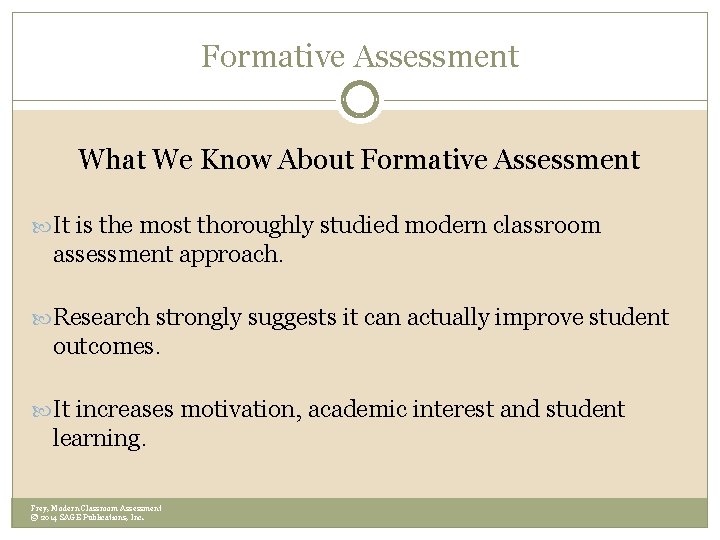
Formative Assessment What We Know About Formative Assessment It is the most thoroughly studied modern classroom assessment approach. Research strongly suggests it can actually improve student outcomes. It increases motivation, academic interest and student learning. Frey, Modern Classroom Assessment © 2014 SAGE Publications, Inc.
Five Characteristics of Classroom Assessment Found to Influence Learning: Frequent use Learning goals that are valued by students Self-assessment Student reflection on assessment data Low emphasis on grades Frey, Modern Classroom Assessment © 2014 SAGE Publications, Inc.
Designing Formative Assessments That Work To be most useful, formative assessment must meet two goals: Provide meaningful and accurate feedback Allow students to control their own learning Frey, Modern Classroom Assessment © 2014 SAGE Publications, Inc.
Validity Framework Formative assessment is not valid unless there is evidence that it increases learning. Validity framework: Assessment feedback must provide information about a student's current level of achievement. Information must be narrowly related to the learning goal Interpretations of the feedback must allow for progress to be made. Students need to know exactly what behaviors they need to change or what aspects of a concept they are misunderstanding. Frey, Modern Classroom Assessment © 2014 SAGE Publications, Inc.
How to Use Informal Formative Assessment during instruction involves being able to judge whether a student or classroom full of students is "getting it. ” Some assessment targets for teachers evaluating their teaching while they teach are: Interest level of students Appropriateness of the instructional strategy Students to call on Pace of instruction Level of understanding reflected in students' answers to questions Best time to start or stop an activity Frey, Modern Classroom Assessment © 2014 SAGE Publications, Inc.
How to Use Formal Formative Assessment Formats that appear to be valid: Quizzes or exams that do not affect grades Conferences in which work plans and strategies are discussed Performance control charts on which students have a numeric criterion for success on an assignment Practice exercises in textbooks Guided interviews of student self-reflection worksheets to identify areas of struggle or difficulty A written statement of specific academic goals Self-scoring rubrics for quality, skills, or abilities Letters to parents Checklists with steps or objectives and options like "sometimes" and "not yet" Frey, Modern Classroom Assessment © 2014 SAGE Publications, Inc.
How to Create a Formative Assessment Environment Three key components of a comprehensive formative assessment system are: 1. Lesson Plans 2. Role of the Teacher 3. Creation of Feedback Opportunities Frey, Modern Classroom Assessment © 2014 SAGE Publications, Inc.
A Comprehensive Formative Assessment System Design of lesson plans "Big Question" approach works well: lesson begins with a big question chosen to lead students through a problem-solving process towards an objective Role of the teacher The teacher is in charge. Teachers have two broad goals for students: learning and developing skills to control their own learning Teachers focus on engaging students, guiding and clarifying understanding, and modeling and demonstrating self-evaluation skills. Creation of feedback opportunities Relevant and frequent Frey, Modern Classroom Assessment © 2014 SAGE Publications, Inc.
Formative Assessment with Young Children Develop reasonable expectations for performance which are still appropriately challenging. Empower students. Promote respect among students. Create a climate free from embarrassment and ridicule. Encourage risk taking and the freedom to make mistakes. Talk with students about characteristics of quality that are important and that they have control over. Frey, Modern Classroom Assessment © 2014 SAGE Publications, Inc.
Things to Think About How might you use formative assessment in your classroom? 2. Who do you think might be resistant to formative assessment? Teachers, administrators, parents, students? Why? 3. Are there circumstances in which feedback might hurt performance? 4. Do you remember a teacher who was especially good at providing students with helpful feedback that encouraged growth and learning? What sorts of tactics did he or she use when providing feedback? 1. Frey, Modern Classroom Assessment © 2014 SAGE Publications, Inc.
Key Points • Formative assessment provides meaningful feedback to • • students and teachers. Teachers use formative assessment to improve their teaching during instruction. Students use formative assessment to evaluate their own learning and adjust their understanding during instruction. Classrooms can be designed as formative assessment environments where students view feedback as useful information, not as an evaluation of their abilities or worth. Qualitative formative assessment is frequent, specific, and student-centered. Frey, Modern Classroom Assessment © 2014 SAGE Publications, Inc.