
Chapter 4 Forces Between Particles 4 8 Shapes
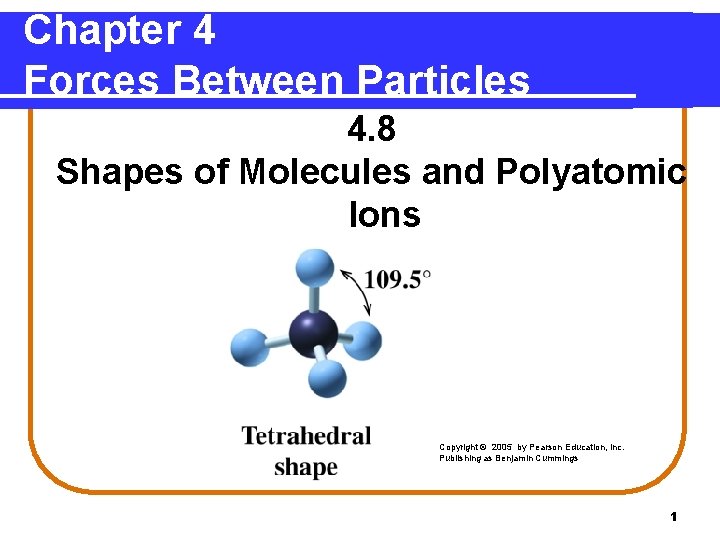
Chapter 4 Forces Between Particles 4. 8 Shapes of Molecules and Polyatomic Ions Copyright © 2005 by Pearson Education, Inc. Publishing as Benjamin Cummings 1
VSEPR In the valence-shell electron-pair repulsion theory (VSEPR), the electron groups around a central atom • are arranged as far apart from each other as possible. • have the least amount of repulsion of the negatively charged electrons. • have a geometry around the central atom that determines molecular shape. 2
Guide to Predicting Molecular Shape (VSEPR Theory) 1. Write the electron-dot structure. 2. Arrange the electron groups around the central atom to minimize repulsion. 3. Use the atoms bonded to the central to determine the shape of the molecule. 3
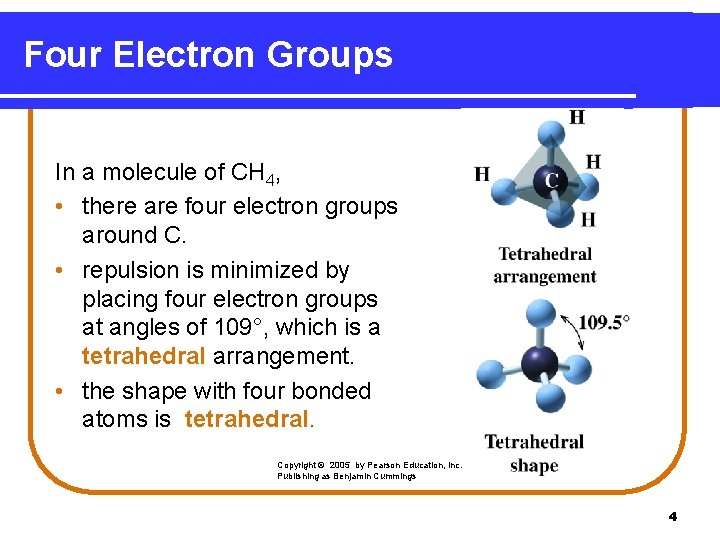
Four Electron Groups In a molecule of CH 4, • there are four electron groups around C. • repulsion is minimized by placing four electron groups at angles of 109°, which is a tetrahedral arrangement. • the shape with four bonded atoms is tetrahedral. Copyright © 2005 by Pearson Education, Inc. Publishing as Benjamin Cummings 4
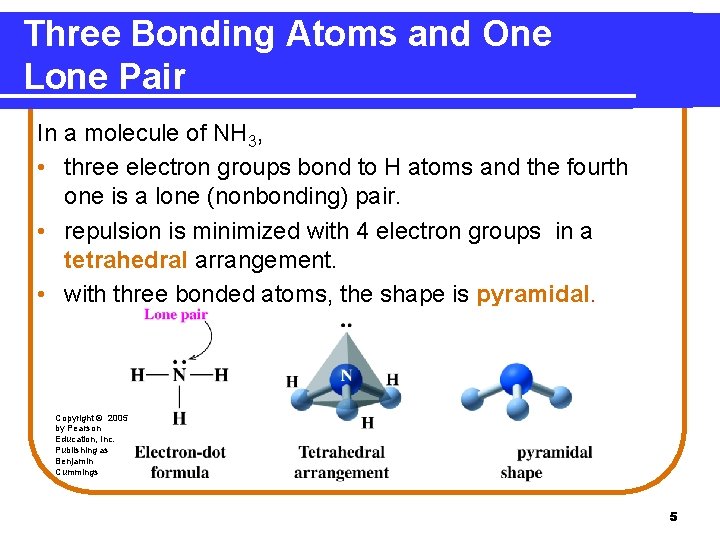
Three Bonding Atoms and One Lone Pair In a molecule of NH 3, • three electron groups bond to H atoms and the fourth one is a lone (nonbonding) pair. • repulsion is minimized with 4 electron groups in a tetrahedral arrangement. • with three bonded atoms, the shape is pyramidal. Copyright © 2005 by Pearson Education, Inc. Publishing as Benjamin Cummings 5
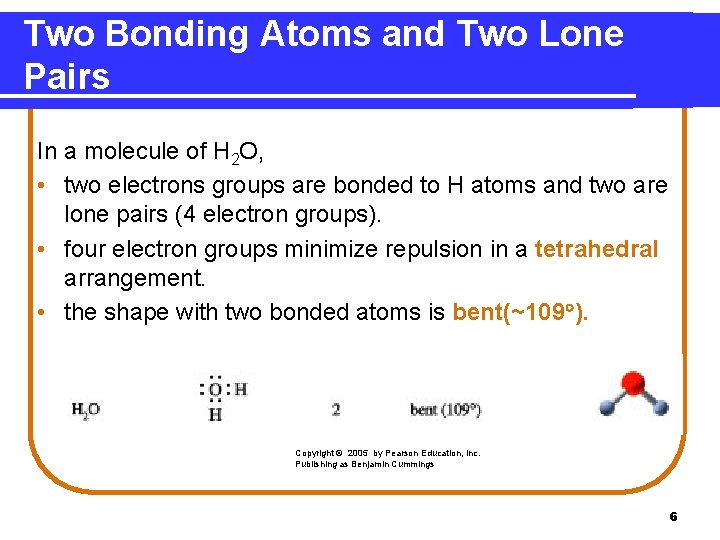
Two Bonding Atoms and Two Lone Pairs In a molecule of H 2 O, • two electrons groups are bonded to H atoms and two are lone pairs (4 electron groups). • four electron groups minimize repulsion in a tetrahedral arrangement. • the shape with two bonded atoms is bent(~109 ). Copyright © 2005 by Pearson Education, Inc. Publishing as Benjamin Cummings 6
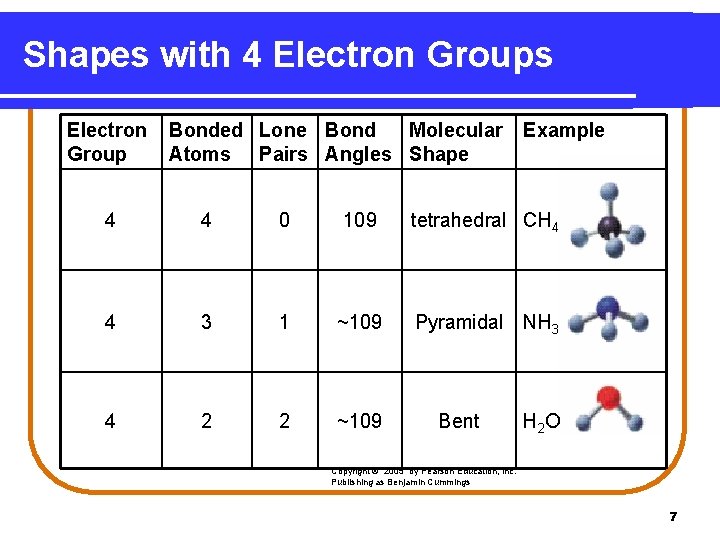
Shapes with 4 Electron Groups Electron Group Bonded Lone Bond Molecular Atoms Pairs Angles Shape Example 4 4 0 109 tetrahedral CH 4 4 3 1 ~109 Pyramidal NH 3 4 2 2 ~109 Bent H 2 O Copyright © 2005 by Pearson Education, Inc. Publishing as Benjamin Cummings 7
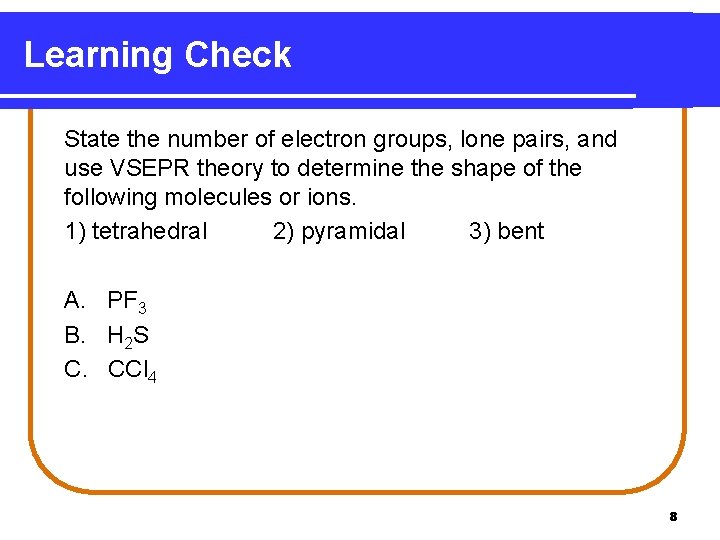
Learning Check State the number of electron groups, lone pairs, and use VSEPR theory to determine the shape of the following molecules or ions. 1) tetrahedral 2) pyramidal 3) bent A. PF 3 B. H 2 S C. CCl 4 8
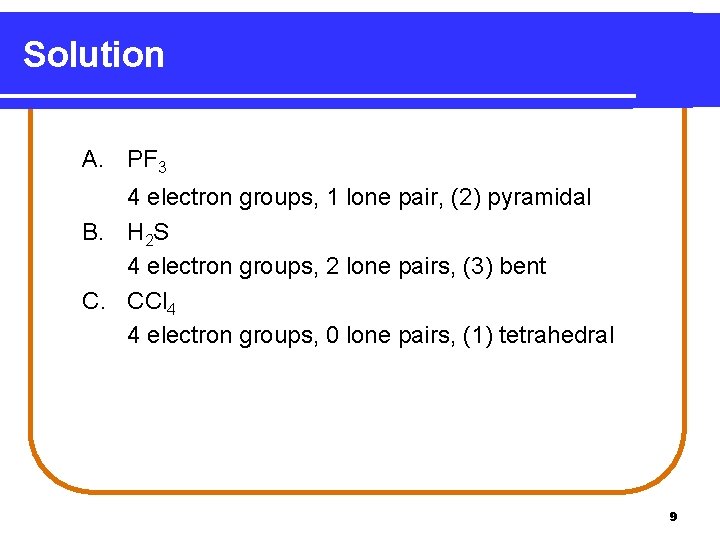
Solution A. PF 3 4 electron groups, 1 lone pair, (2) pyramidal B. H 2 S 4 electron groups, 2 lone pairs, (3) bent C. CCl 4 4 electron groups, 0 lone pairs, (1) tetrahedral 9
- Slides: 9