
Chapter 4 Focus on the Big Picture not

Chapter 4 Focus on the Big Picture, not the Numbers Team 1: Alec Wegmann, Mark Beal, Adrienne Collins, Jessica Drummond, Mike Sanchez, Spencer Thomas Mario Santos, & Chad Hensley
Typical Red Ocean Strategy Plan � Lengthy industry analysis � Tactics to increase market shares, capture new segments, and cut costs � A full budget it almost invariably attached � Produced by people in various parts of the company, often with conflicting agendas.
These “Typical” Strategies don’t make sense � Often these plans do not contain strategy at all � Rather a compilation of tactics that individually make sense, but collectively do not add up to a clear unified direction.
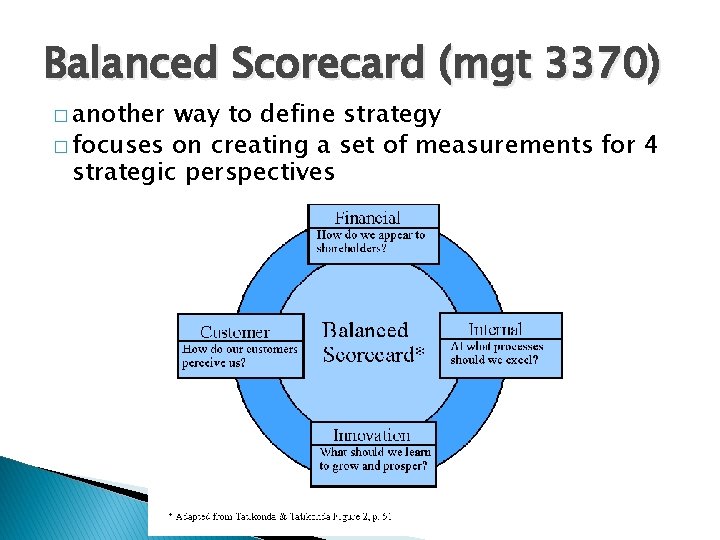
Balanced Scorecard (mgt 3370) � another way to define strategy � focuses on creating a set of measurements for 4 strategic perspectives
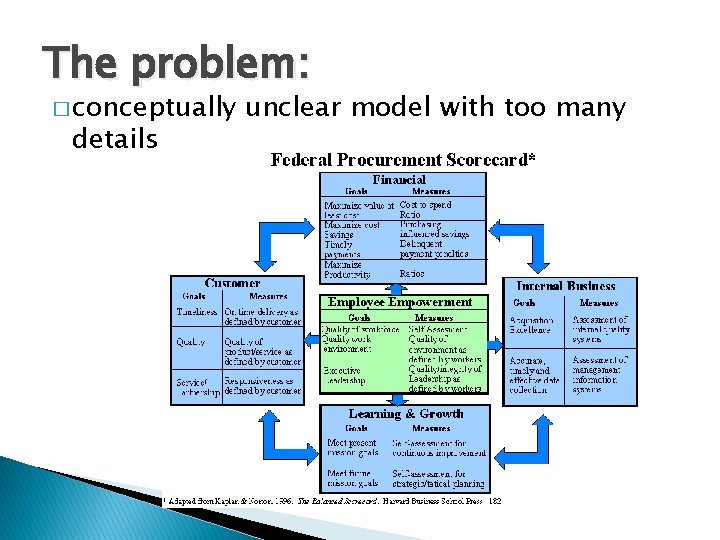
The problem: � conceptually details unclear model with too many
Focusing on the BIG PICTURE � By drawing an effective strategy canvas, a company and it’s managers can focus on the big picture rather than emersion in numbers, jargon, and operational details.
Strategy Canvas Accomplishes (3) things � First, it shows the strategic profile of the industry � Second, it shows the strategic profile of current and potential competitors. � Finally, it shows the company’s strategic profile, or value curve. � As stated before in Chp. 2, a Strategic Profile needs to have focus, divergence, and a compelling tagline.
The Strategy Canvas � Maps out what will separate you from your competition � Red Ocean strategy→Blue Ocean strategy requires a strong leader or a crisis. � Four steps to complete the Strategy Canvas.
Step 1: Realizing Current Strategy � Find out what the current positioning of the strategy is. � EFS (European Financial Services) suffered from ill-defined strategy. � ISQS 3344 (Flamm)
“European Financial Services” (EFS) and its Competitive Strategy � EFS’s Problem=No Defined Strategy ◦ Management from Europe, North America, Asia, and Oceania convened and could not agree on its competitive advantage ◦ It was the belief that regions and demographics contributed to different strategies
Awakening to Current Strategy � Contradictions in competitive strategies ◦ Website advanced but slow � Comparison with Clearskies ◦ Focused, original strategy ◦ Moving away from red ocean ◦ Strategy canvas very different from competitors and EFS (evidence of a blue ocean)
Step 2: Visual Exploration �A team needs to be sent into the field, putting managers face-to-face with what they must make sense of: how people use or don’t use their products or services. �A company should never outsource its eyes. There is simply no substitute for seeing for yourself.
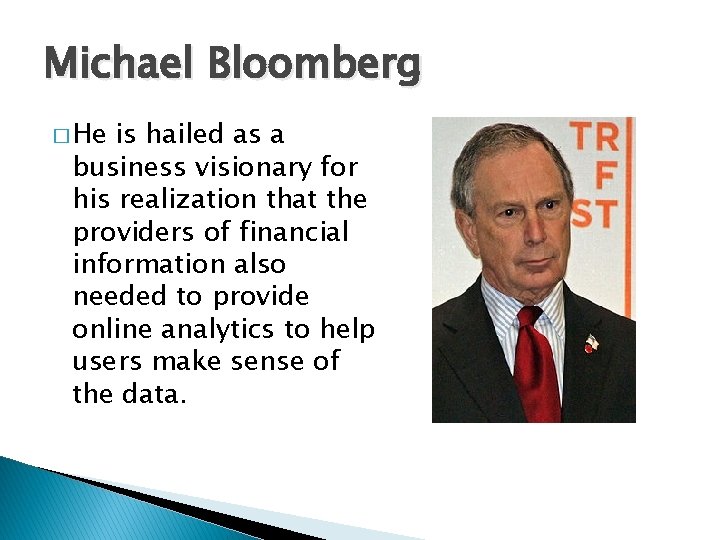
Michael Bloomberg � He is hailed as a business visionary for his realization that the providers of financial information also needed to provide online analytics to help users make sense of the data.
� Using business intelligence software called Web. FOCUS from Information Builders, Brinker restaurants can calculate sales by shift and by restaurant to determine optimal labor costs. � From there, managers can decide how many employees are needed at any given site and time, and adjust workforce levels accordingly, on a day-by-day basis, to reflect demand.
EFS Example � The managers were sent into the field for 4 weeks to explore the 6 paths to creating blue oceans. � Each manager was to interview and observe 10 people involved in corporate foreign exchange.
EFS’s Findings � The managers concluded that customers valued speedy confirmation of transactions most. ◦ Not account relationship managers, like the managers first hypothesized. � Then each team had to propose a new strategy with 6 new value curves.
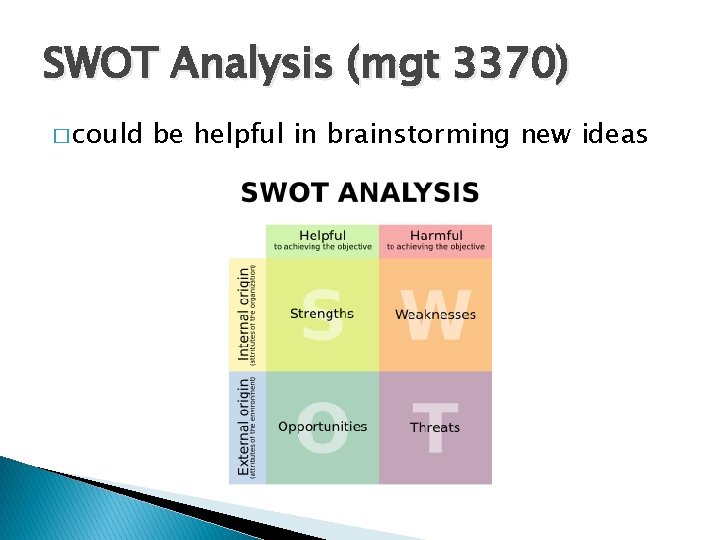
SWOT Analysis (mgt 3370) � could be helpful in brainstorming new ideas
Step 3: Visual Strategy Fair � Part a: Teams present their newly redrawn strategy canvases ◦ draw your canvas based on insights from field observations ◦ show new ideas to a variety of people � Ex: EFS teams presented their new canvases to noncustomers, customers of competitors, and current customers, and corporate executives.
Step 3: Visual Strategy Fair � Part b: Get feedback on alternative strategy canvases from customers, competitor’s customers, and noncustomers � get invitees to explain what they like and dislike about the different value curve proposals � Ex: Teams presented their curves, judges picked their favorites and gave feedback
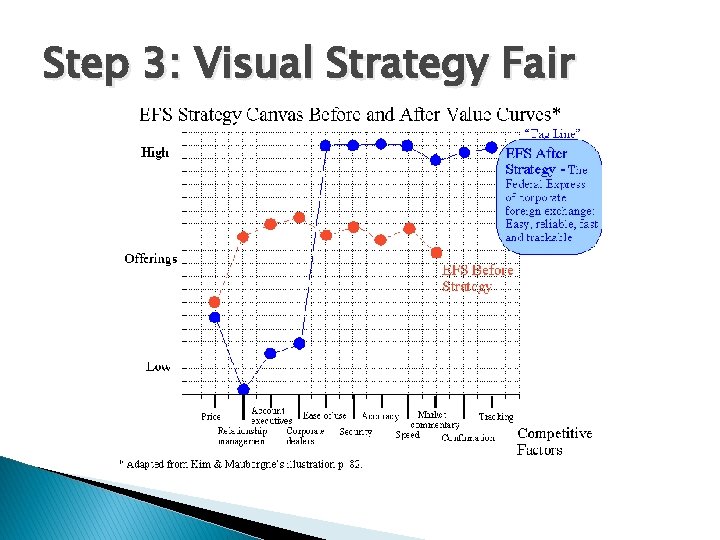
Step 3: Visual Strategy Fair � Part c: After collecting feedback, determine the optimal new strategy ◦ should be based criteria you have found that will create a successful strategy � Ex: following the strategy fair, the teams were able to come up with a final value curve that reduced costs, focused on factors important to the customer, and had a compelling tagline
Step 3: Visual Strategy Fair
Step 4: Visual Communications � After future strategy is set, the last step is to communicate it in a way that can easily be understood by any employee � A visual layout helps show where the company currently stands and which areas it may need improvement in
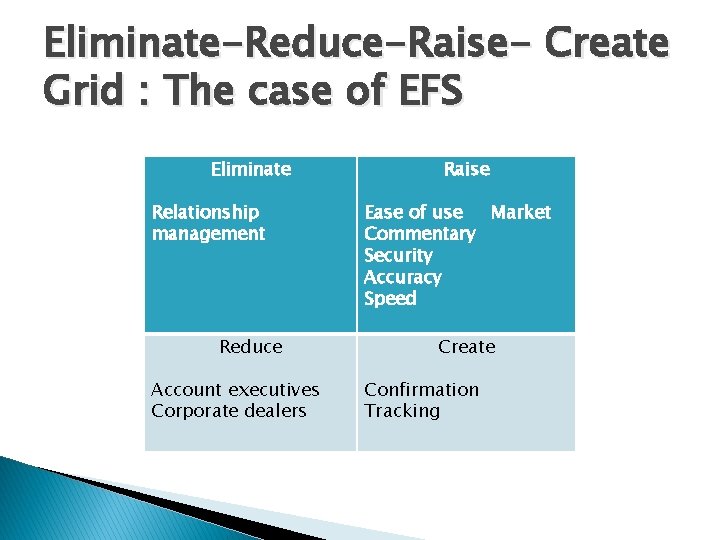
Eliminate-Reduce-Raise- Create Grid : The case of EFS Eliminate Relationship management Reduce Account executives Corporate dealers Raise Ease of use Market Commentary Security Accuracy Speed Create Confirmation Tracking
Visualizing Strategy at the Corporate Level �A visual strategy creates more cohesion among the business and its entities. ◦ Easier communication ◦ Uniformed business
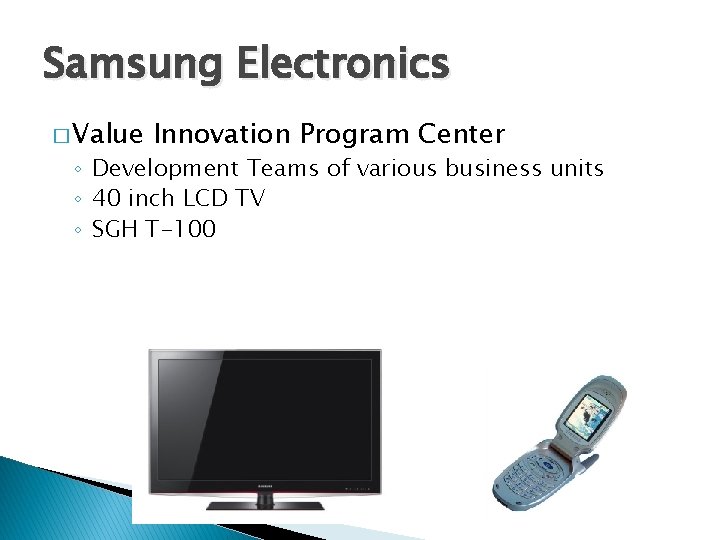
Samsung Electronics � Value Innovation Program Center ◦ Development Teams of various business units ◦ 40 inch LCD TV ◦ SGH T-100
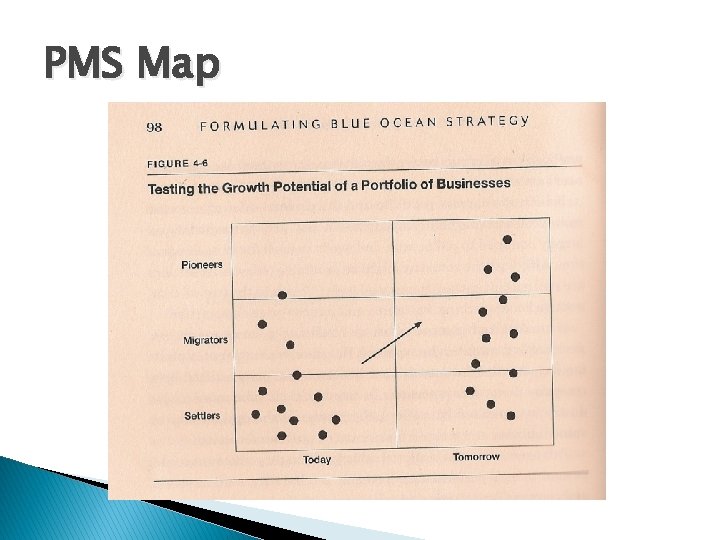
Pioneer-Migrator-Settler Map � Pioneers (Blue Ocean) ◦ Offers unprecedented value ◦ Value curve diverges from competition ◦ Most powerful source of profitability growth � Settlers (Red Ocean) ◦ “Me too” businesses ◦ Value curve similar to the industry norm ◦ Not a big contributor to future growth � Migrators ◦ In between the two ◦ Extends value curve ◦ Offer improved value, not innovative value
Evaluating Your Company’s Portfolio � Plot current & planned portfolio’s on a PMS map � Valuable exercise in visualizing future performance � Portfolio consisting mainly of settlers ◦ Low growth trajectory ◦ Conformed to benchmarking, imitating, and price competition � Portfolio with a lot of migrators ◦ Not exploiting growth potential ◦ Are marginalized by value-innovating company’s
The Goal for Management � Shift the balance of future portfolio’s ◦ Towards pioneers ◦ Path to profitable growth � Balance the portfolio of businesses ◦ Between profitable growth & cash flow ◦ Settlers �Frequently today’s cash generators (Provides liquidity) ◦ Pioneers �Large growth potential (Investment with high return) �Require cash at outset
PMS Map
Overcoming Limitations of Strategic Planning � Strategic planning should be more about collective wisdom building than top-down or bottom-up planning � Building the big picture is more important than number crunching exercises � A creative element is necessary, along with motivational techniques to invoke willing commitment, rather than bargaining to produce negotiated commitment
Overcoming Limitations of Strategic Planning � Building the process around a picture address many of managers’ discontents with existing strategic planning and yields much better results � “The soul never thinks without an image” Aristotle
Overview � Focusing on the big picture ◦ -Visualizing a company’s current strategic position and charting its future strategy � Drawing ◦ ◦ 1. 2. 3. 4. your strategy canvas Realizing Current Strategy Visual Exploration Visual Strategy Fair Visual Communication
Overview � Visualizing Strategy at the Corporate Level ◦ Using the Strategy Canvas ◦ Using the PMS Map � Overcoming Planning the Limitations of Strategic
- Slides: 33