
Chapter 4 Finite Fields GroupRingField Modular Arithmetic Euclids
- Slides: 29
Chapter 4 – Finite Fields • • Group/Ring/Field Modular Arithmetic Euclid’s Algo Finite Field of the form GF(p) • Polynomial Arithmetic • Finite Field of the form GF(2 n)
Introduction • will now introduce finite fields • of increasing importance in cryptography – AES, Elliptic Curve, IDEA, Public Key • concern operations on “numbers” – where what constitutes a “number” and the type of operations varies considerably • start with concepts of groups, rings, fields from abstract algebra
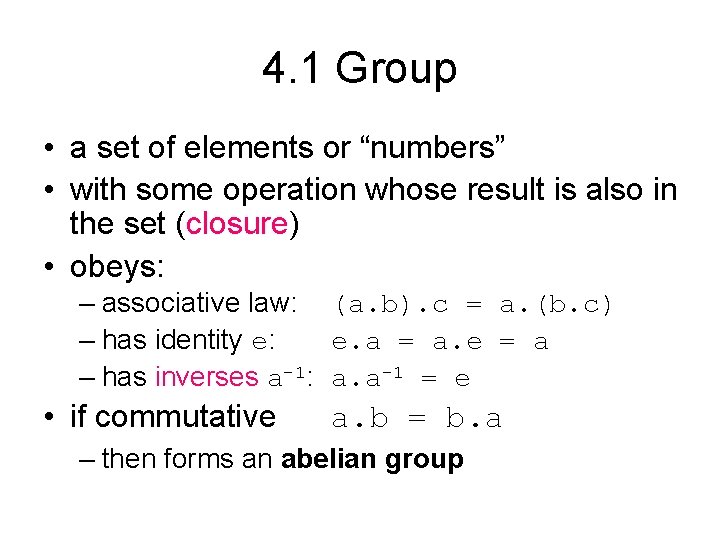
4. 1 Group • a set of elements or “numbers” • with some operation whose result is also in the set (closure) • obeys: – associative law: (a. b). c = a. (b. c) – has identity e: e. a = a. e = a – has inverses a-1: a. a-1 = e • if commutative a. b = b. a – then forms an abelian group
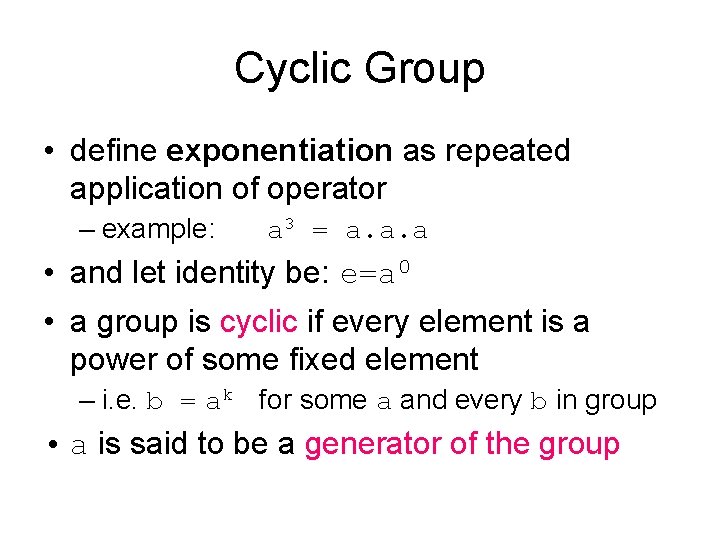
Cyclic Group • define exponentiation as repeated application of operator – example: a 3 = a. a. a • and let identity be: e=a 0 • a group is cyclic if every element is a power of some fixed element – i. e. b = ak for some a and every b in group • a is said to be a generator of the group
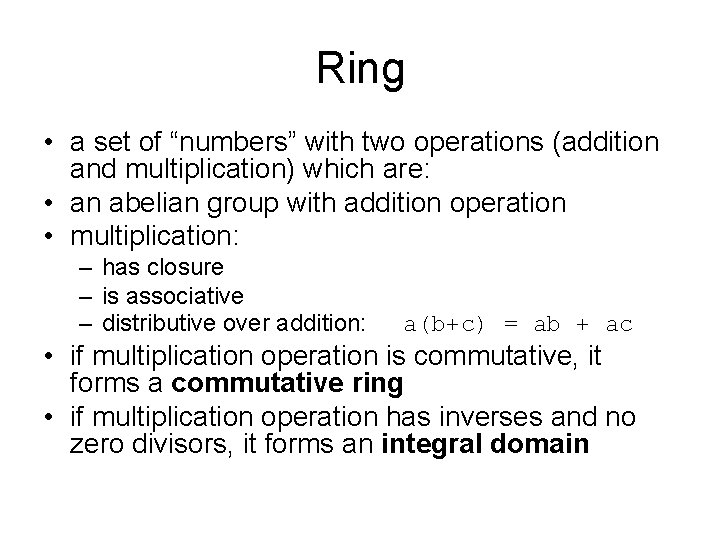
Ring • a set of “numbers” with two operations (addition and multiplication) which are: • an abelian group with addition operation • multiplication: – has closure – is associative – distributive over addition: a(b+c) = ab + ac • if multiplication operation is commutative, it forms a commutative ring • if multiplication operation has inverses and no zero divisors, it forms an integral domain
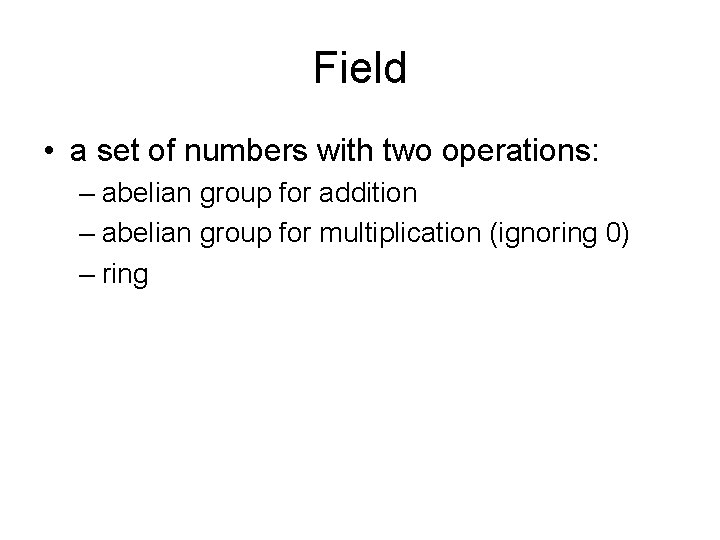
Field • a set of numbers with two operations: – abelian group for addition – abelian group for multiplication (ignoring 0) – ring
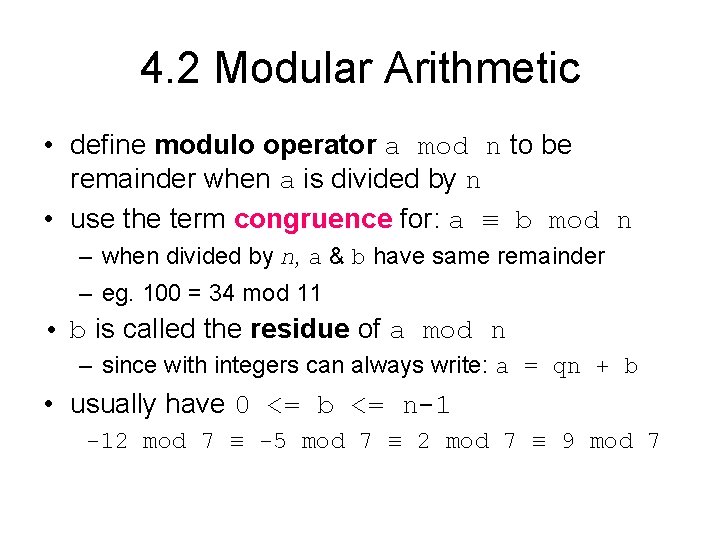
4. 2 Modular Arithmetic • define modulo operator a mod n to be remainder when a is divided by n • use the term congruence for: a ≡ b mod n – when divided by n, a & b have same remainder – eg. 100 = 34 mod 11 • b is called the residue of a mod n – since with integers can always write: a = qn + b • usually have 0 <= b <= n-1 -12 mod 7 ≡ -5 mod 7 ≡ 2 mod 7 ≡ 9 mod 7
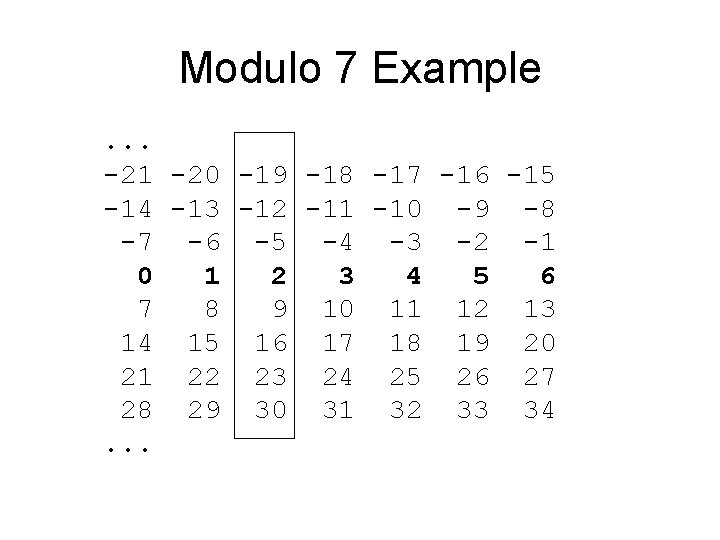
Modulo 7 Example. . . -21 -20 -19 -18 -17 -16 -15 -14 -13 -12 -11 -10 -9 -8 -7 -6 -5 -4 -3 -2 -1 0 1 2 3 4 5 6 7 8 9 10 11 12 13 14 15 16 17 18 19 20 21 22 23 24 25 26 27 28 29 30 31 32 33 34. . .
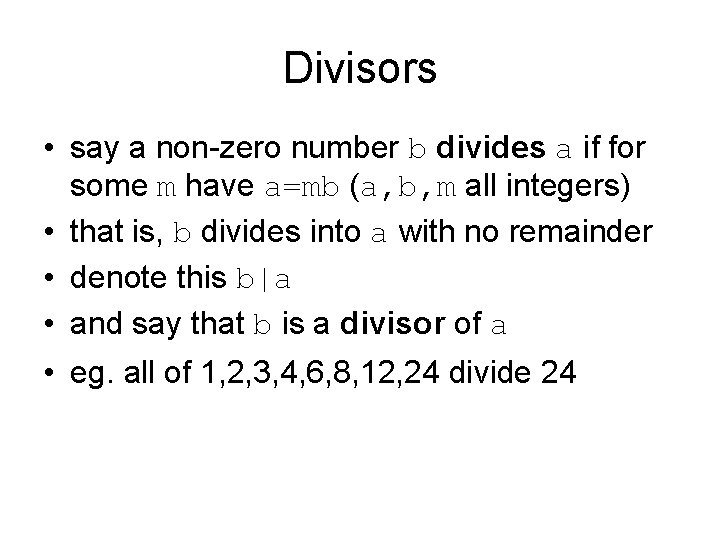
Divisors • say a non-zero number b divides a if for some m have a=mb (a, b, m all integers) • that is, b divides into a with no remainder • denote this b|a • and say that b is a divisor of a • eg. all of 1, 2, 3, 4, 6, 8, 12, 24 divide 24
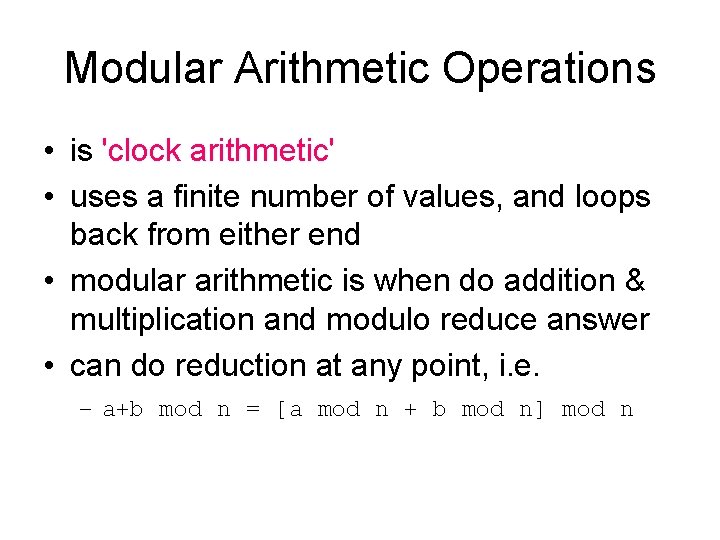
Modular Arithmetic Operations • is 'clock arithmetic' • uses a finite number of values, and loops back from either end • modular arithmetic is when do addition & multiplication and modulo reduce answer • can do reduction at any point, i. e. – a+b mod n = [a mod n + b mod n] mod n
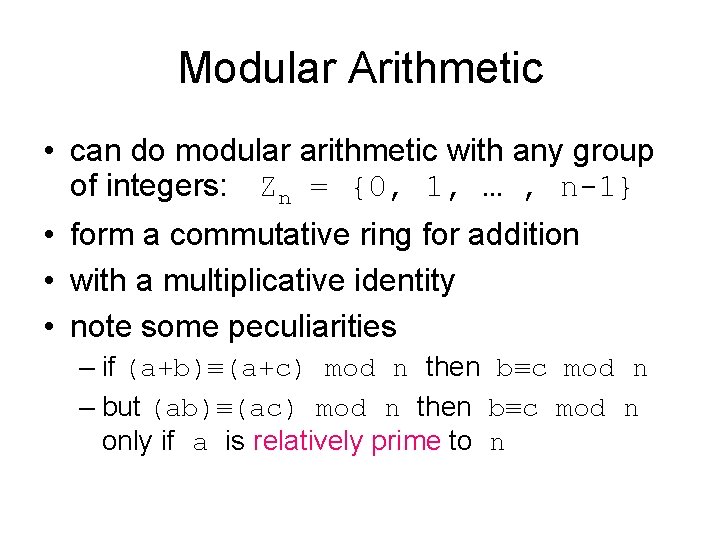
Modular Arithmetic • can do modular arithmetic with any group of integers: Zn = {0, 1, … , n-1} • form a commutative ring for addition • with a multiplicative identity • note some peculiarities – if (a+b)≡(a+c) mod n then b≡c mod n – but (ab)≡(ac) mod n then b≡c mod n only if a is relatively prime to n
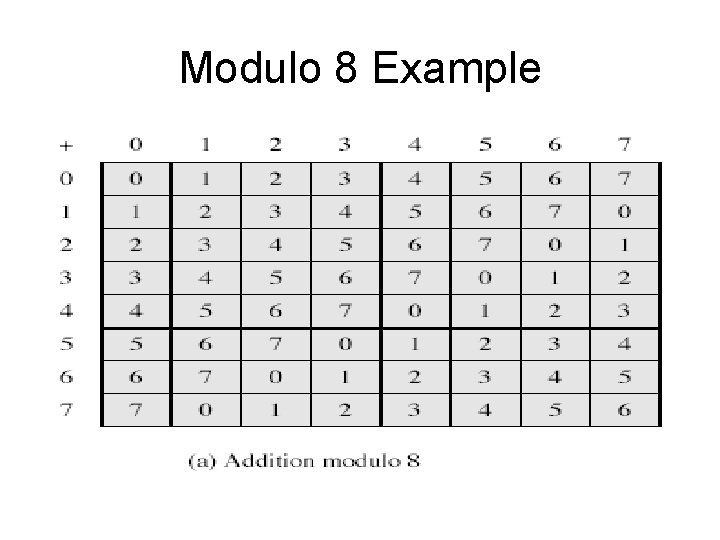
Modulo 8 Example
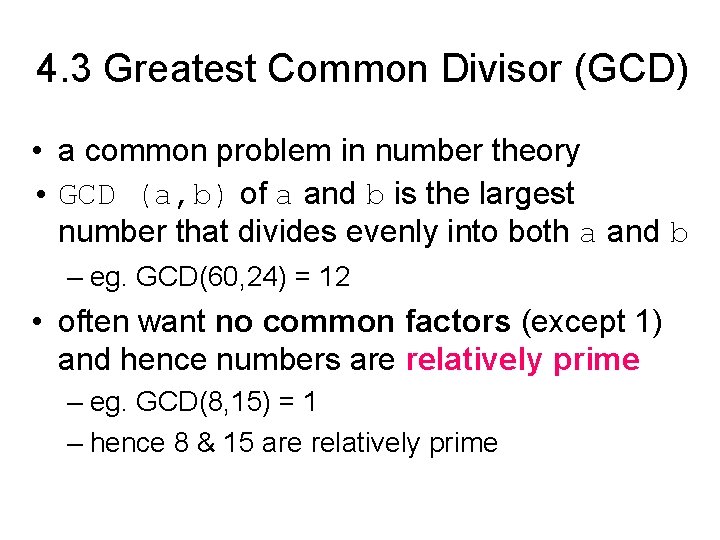
4. 3 Greatest Common Divisor (GCD) • a common problem in number theory • GCD (a, b) of a and b is the largest number that divides evenly into both a and b – eg. GCD(60, 24) = 12 • often want no common factors (except 1) and hence numbers are relatively prime – eg. GCD(8, 15) = 1 – hence 8 & 15 are relatively prime
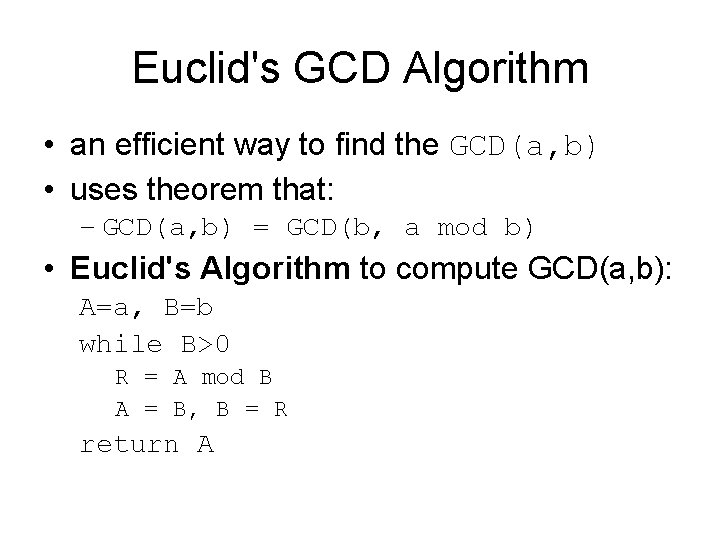
Euclid's GCD Algorithm • an efficient way to find the GCD(a, b) • uses theorem that: – GCD(a, b) = GCD(b, a mod b) • Euclid's Algorithm to compute GCD(a, b): A=a, B=b while B>0 R = A mod B A = B, B = R return A
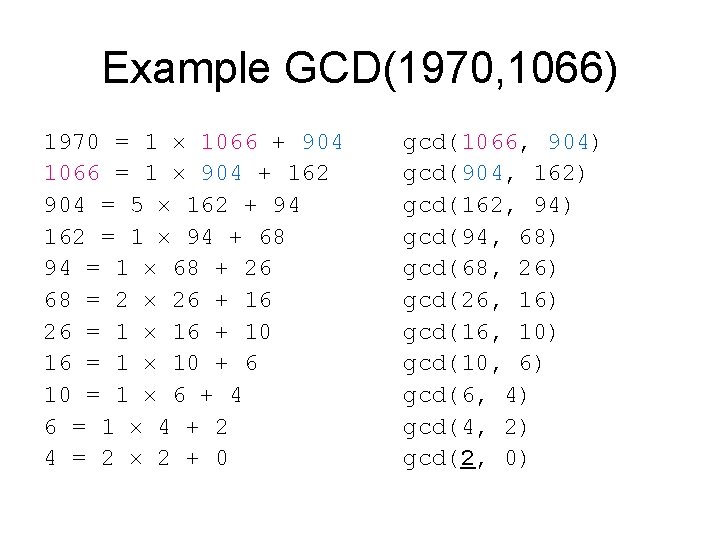
Example GCD(1970, 1066) 1970 = 1 1066 + 904 1066 = 1 904 + 162 904 = 5 162 + 94 162 = 1 94 + 68 94 = 1 68 + 26 68 = 2 26 + 16 26 = 1 16 + 10 16 = 1 10 + 6 10 = 1 6 + 4 6 = 1 4 + 2 4 = 2 2 + 0 gcd(1066, 904) gcd(904, 162) gcd(162, 94) gcd(94, 68) gcd(68, 26) gcd(26, 16) gcd(16, 10) gcd(10, 6) gcd(6, 4) gcd(4, 2) gcd(2, 0)
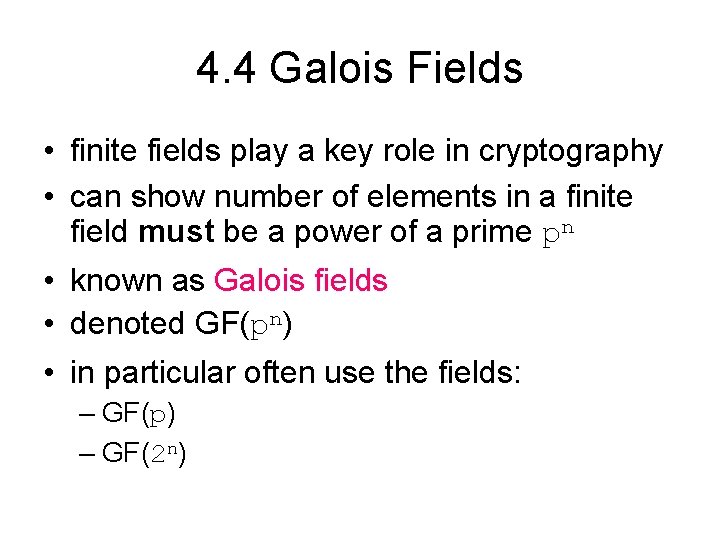
4. 4 Galois Fields • finite fields play a key role in cryptography • can show number of elements in a finite field must be a power of a prime pn • known as Galois fields • denoted GF(pn) • in particular often use the fields: – GF(p) – GF(2 n)
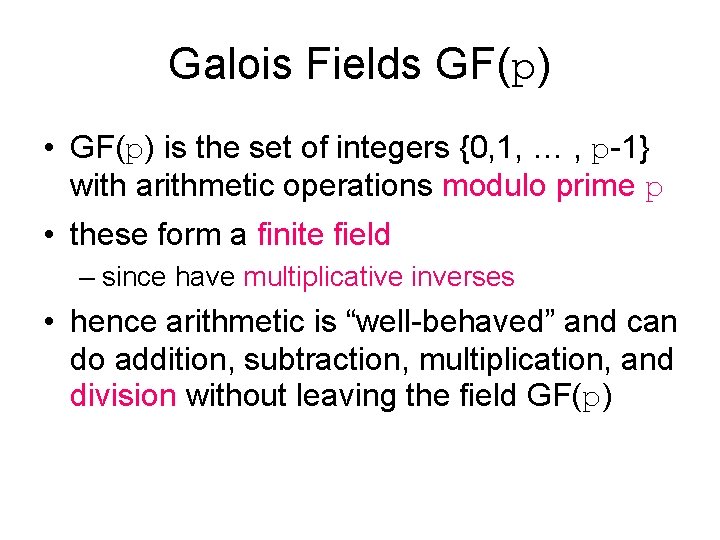
Galois Fields GF(p) • GF(p) is the set of integers {0, 1, … , p-1} with arithmetic operations modulo prime p • these form a finite field – since have multiplicative inverses • hence arithmetic is “well-behaved” and can do addition, subtraction, multiplication, and division without leaving the field GF(p)
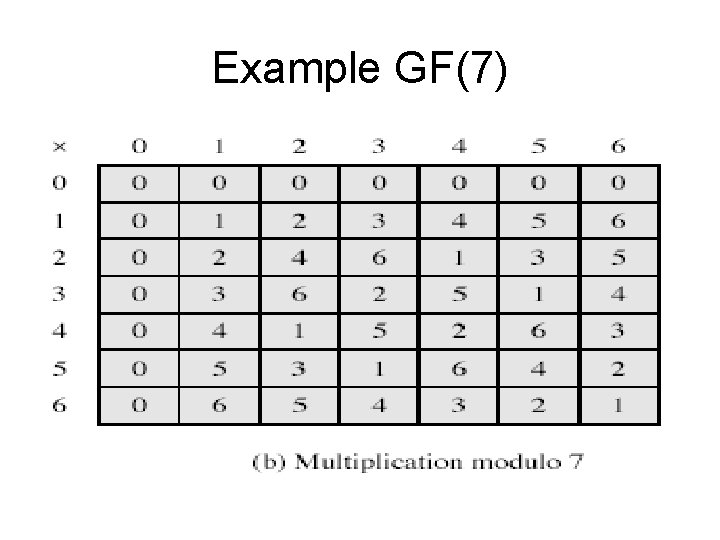
Example GF(7)
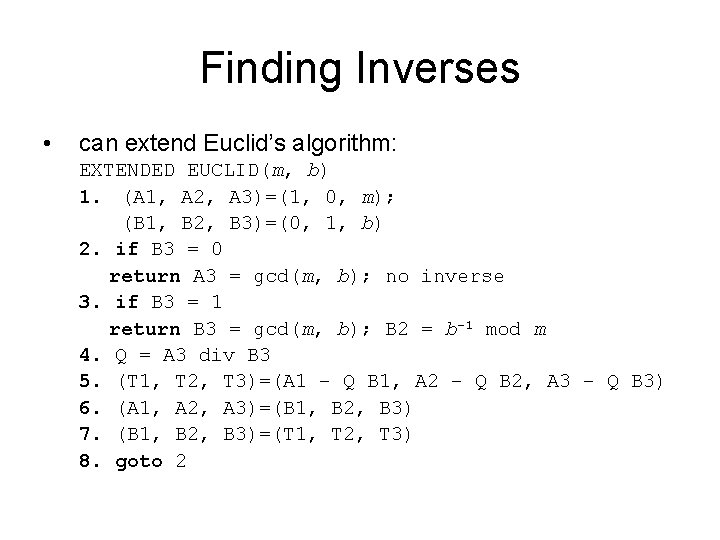
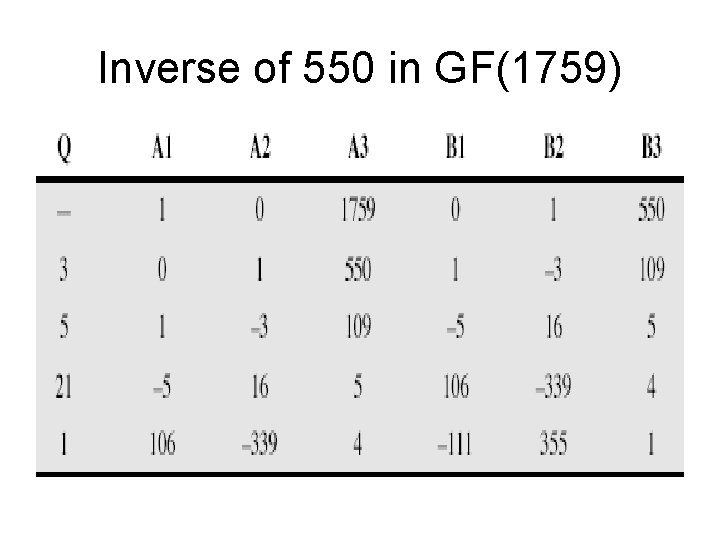
Finding Inverses • can extend Euclid’s algorithm: EXTENDED EUCLID(m, b) 1. (A 1, A 2, A 3)=(1, 0, m); (B 1, B 2, B 3)=(0, 1, b) 2. if B 3 = 0 return A 3 = gcd(m, b); no inverse 3. if B 3 = 1 return B 3 = gcd(m, b); B 2 = b– 1 mod m 4. Q = A 3 div B 3 5. (T 1, T 2, T 3)=(A 1 – Q B 1, A 2 – Q B 2, A 3 – Q B 3) 6. (A 1, A 2, A 3)=(B 1, B 2, B 3) 7. (B 1, B 2, B 3)=(T 1, T 2, T 3) 8. goto 2
Inverse of 550 in GF(1759)
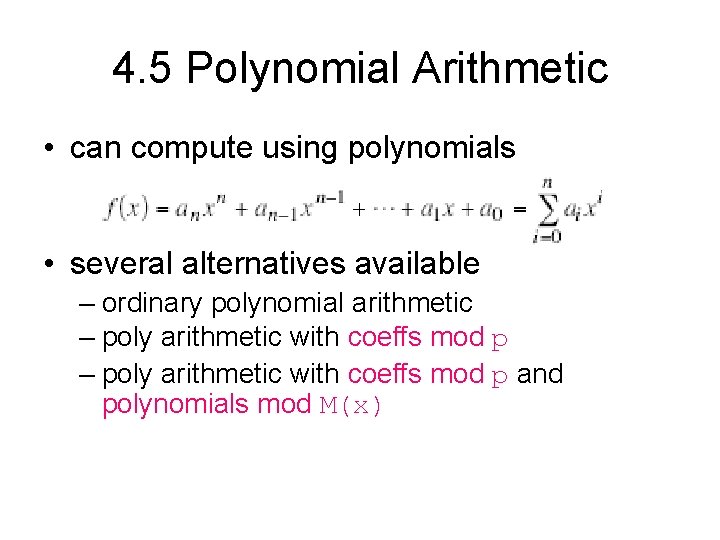
4. 5 Polynomial Arithmetic • can compute using polynomials • several alternatives available – ordinary polynomial arithmetic – poly arithmetic with coeffs mod p and polynomials mod M(x)
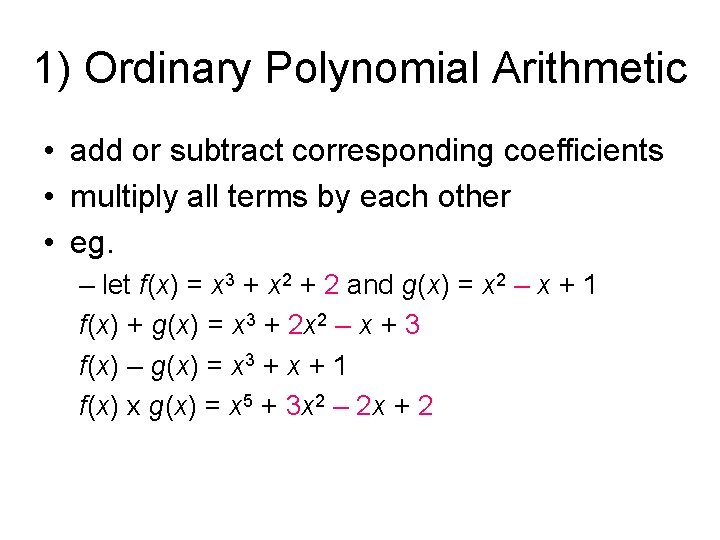
1) Ordinary Polynomial Arithmetic • add or subtract corresponding coefficients • multiply all terms by each other • eg. – let f(x) = x 3 + x 2 + 2 and g(x) = x 2 – x + 1 f(x) + g(x) = x 3 + 2 x 2 – x + 3 f(x) – g(x) = x 3 + x + 1 f(x) x g(x) = x 5 + 3 x 2 – 2 x + 2
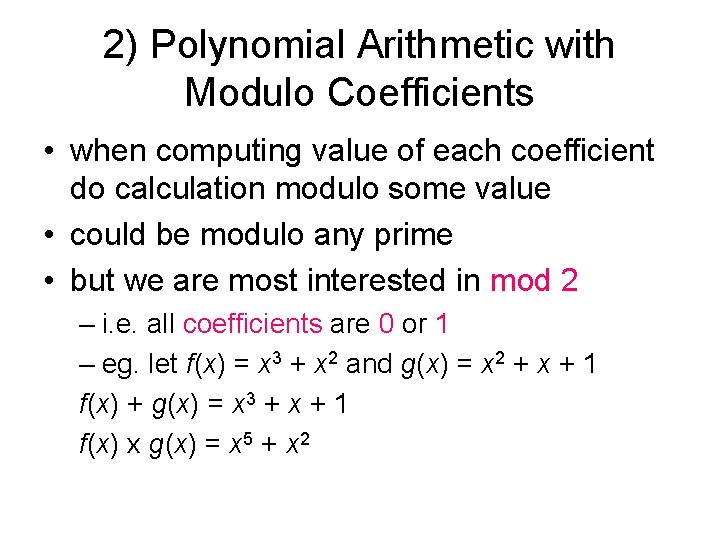
2) Polynomial Arithmetic with Modulo Coefficients • when computing value of each coefficient do calculation modulo some value • could be modulo any prime • but we are most interested in mod 2 – i. e. all coefficients are 0 or 1 – eg. let f(x) = x 3 + x 2 and g(x) = x 2 + x + 1 f(x) + g(x) = x 3 + x + 1 f(x) x g(x) = x 5 + x 2
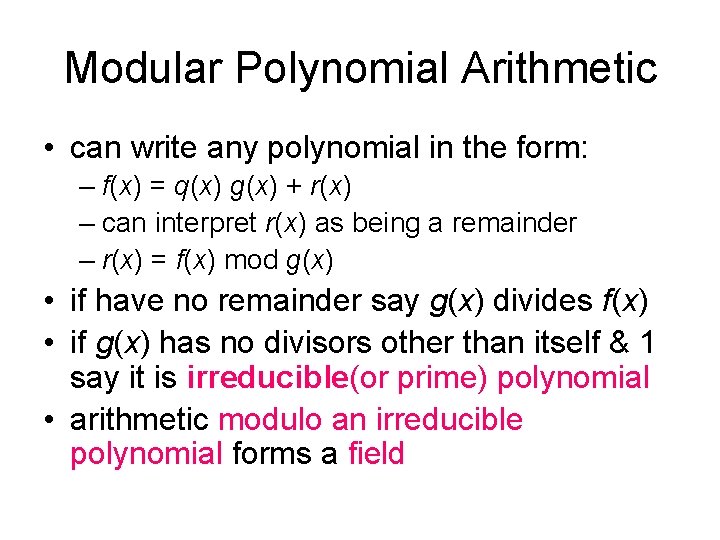
Modular Polynomial Arithmetic • can write any polynomial in the form: – f(x) = q(x) g(x) + r(x) – can interpret r(x) as being a remainder – r(x) = f(x) mod g(x) • if have no remainder say g(x) divides f(x) • if g(x) has no divisors other than itself & 1 say it is irreducible(or prime) polynomial • arithmetic modulo an irreducible polynomial forms a field
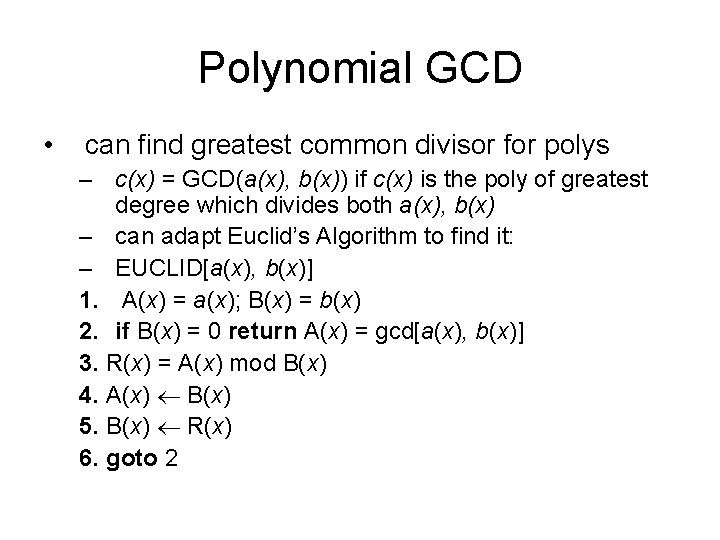
Polynomial GCD • can find greatest common divisor for polys – c(x) = GCD(a(x), b(x)) if c(x) is the poly of greatest degree which divides both a(x), b(x) – can adapt Euclid’s Algorithm to find it: – EUCLID[a(x), b(x)] 1. A(x) = a(x); B(x) = b(x) 2. if B(x) = 0 return A(x) = gcd[a(x), b(x)] 3. R(x) = A(x) mod B(x) 4. A(x) B(x) 5. B(x) R(x) 6. goto 2
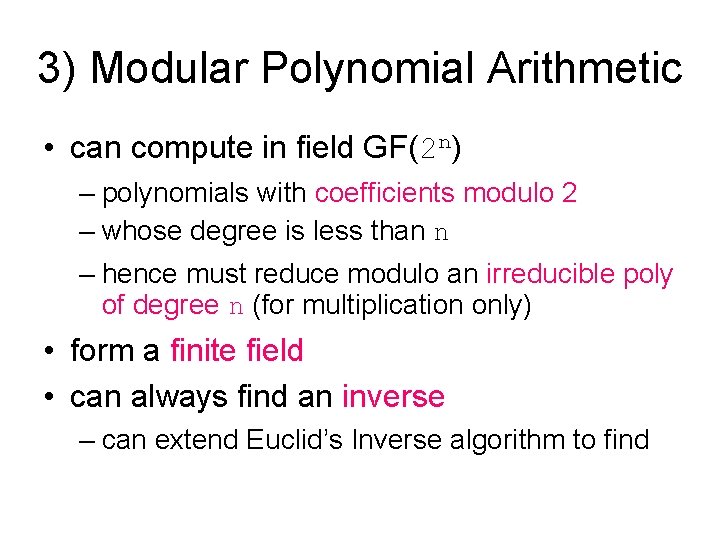
3) Modular Polynomial Arithmetic • can compute in field GF(2 n) – polynomials with coefficients modulo 2 – whose degree is less than n – hence must reduce modulo an irreducible poly of degree n (for multiplication only) • form a finite field • can always find an inverse – can extend Euclid’s Inverse algorithm to find
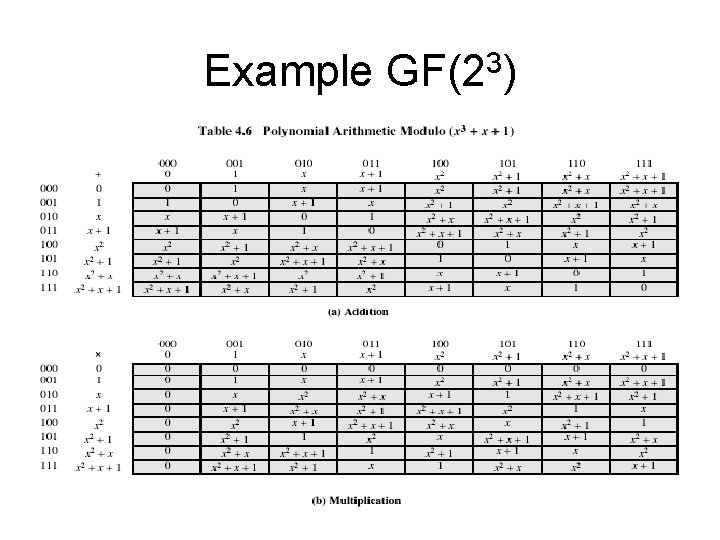
Example GF(23)
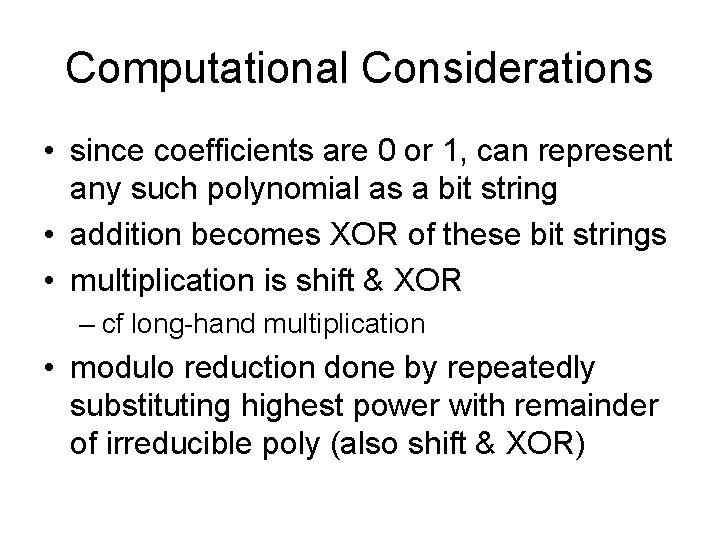
Computational Considerations • since coefficients are 0 or 1, can represent any such polynomial as a bit string • addition becomes XOR of these bit strings • multiplication is shift & XOR – cf long-hand multiplication • modulo reduction done by repeatedly substituting highest power with remainder of irreducible poly (also shift & XOR)
Summary • have considered: – concept of groups, rings, fields – modular arithmetic with integers – Euclid’s algorithm for GCD – finite fields GF(p) – polynomial arithmetic in general and in GF(2 n)