
Chapter 4 Fingerprints Fingerprint impression of the pattern
- Slides: 19
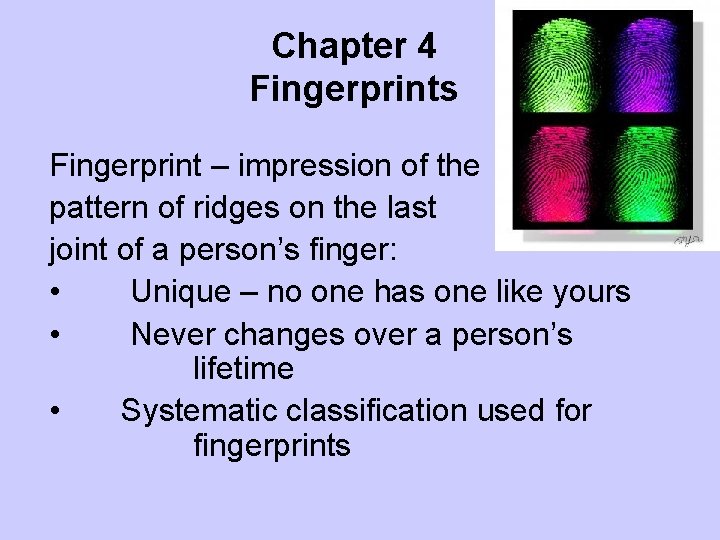
Chapter 4 Fingerprints Fingerprint – impression of the pattern of ridges on the last joint of a person’s finger: • Unique – no one has one like yours • Never changes over a person’s lifetime • Systematic classification used for fingerprints
Major components of Fingerprints from Sweat • • Na+ sodium K+ Potassium Ca++ Calcium Fe++ Iron Cl- Chlorine F- Florine Br- Bromine I- Iodine
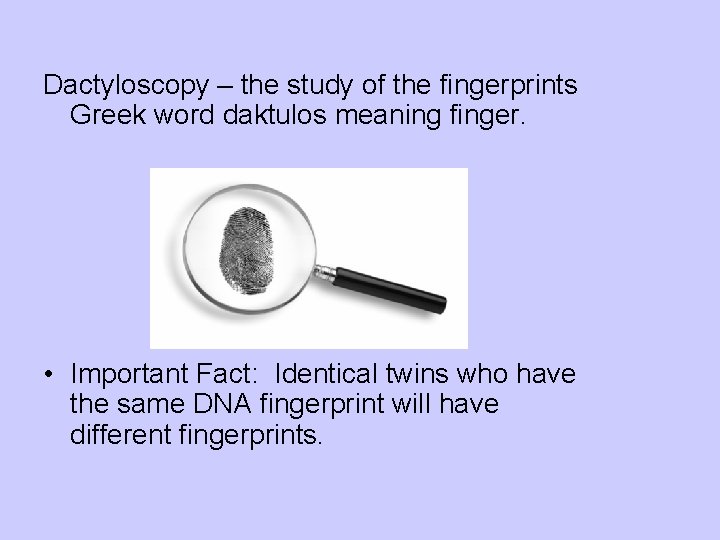
Dactyloscopy – the study of the fingerprints Greek word daktulos meaning finger. • Important Fact: Identical twins who have the same DNA fingerprint will have different fingerprints.
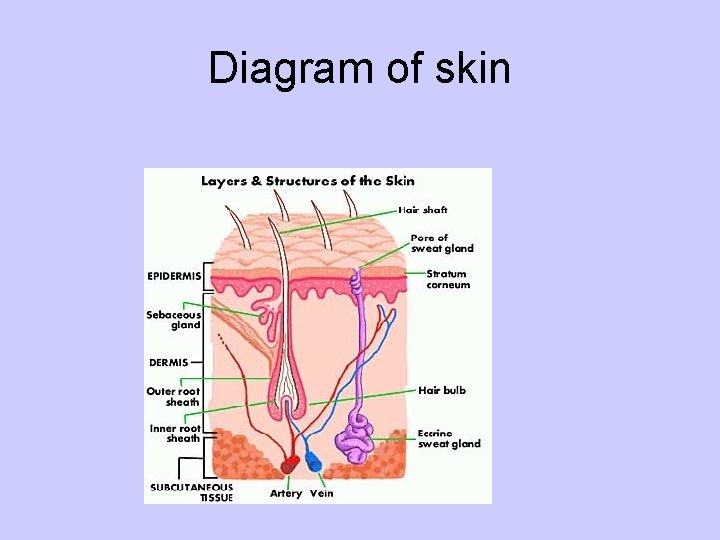
Diagram of skin
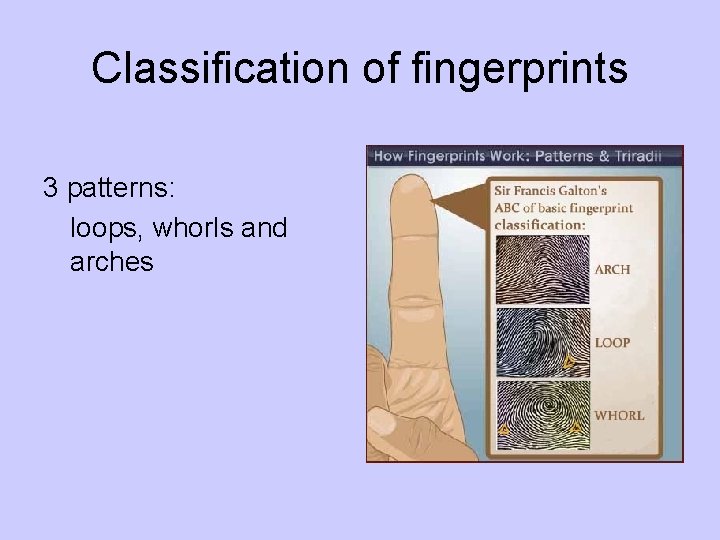
Classification of fingerprints 3 patterns: loops, whorls and arches
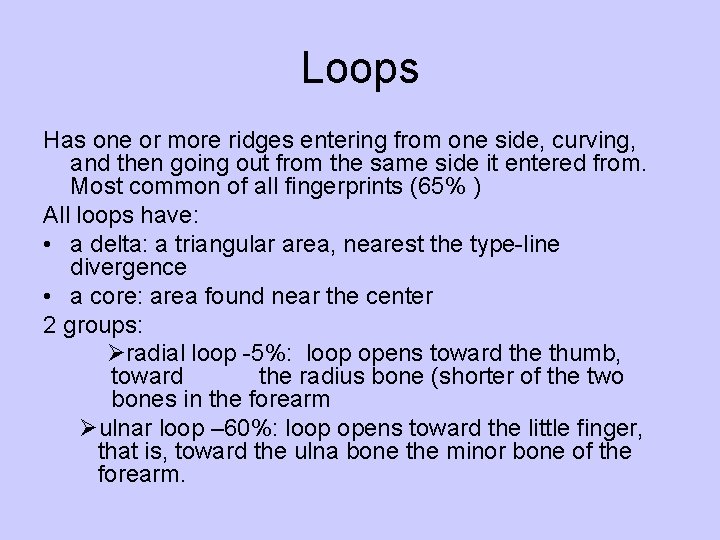
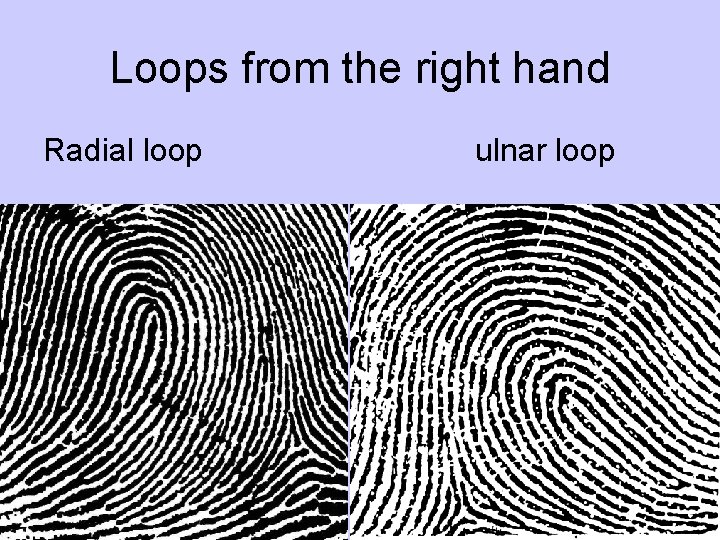
Loops Has one or more ridges entering from one side, curving, and then going out from the same side it entered from. Most common of all fingerprints (65% ) All loops have: • a delta: a triangular area, nearest the type-line divergence • a core: area found near the center 2 groups: Øradial loop -5%: loop opens toward the thumb, toward the radius bone (shorter of the two bones in the forearm Øulnar loop – 60%: loop opens toward the little finger, that is, toward the ulna bone the minor bone of the forearm.
Loops from the right hand Radial loop ulnar loop
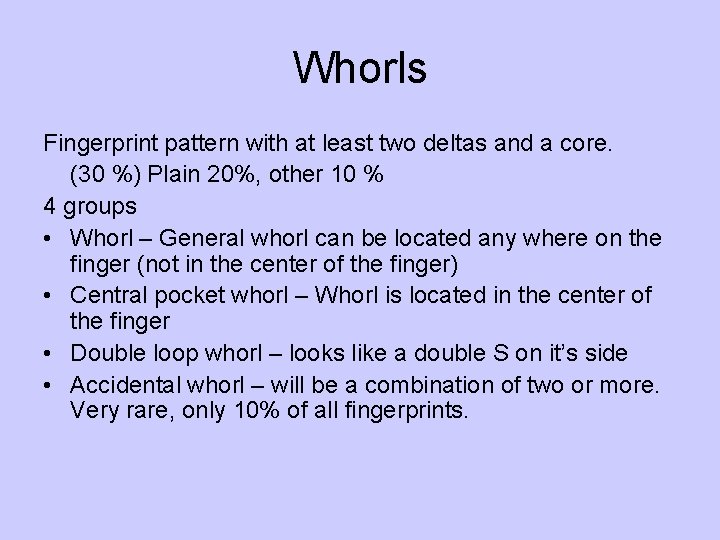
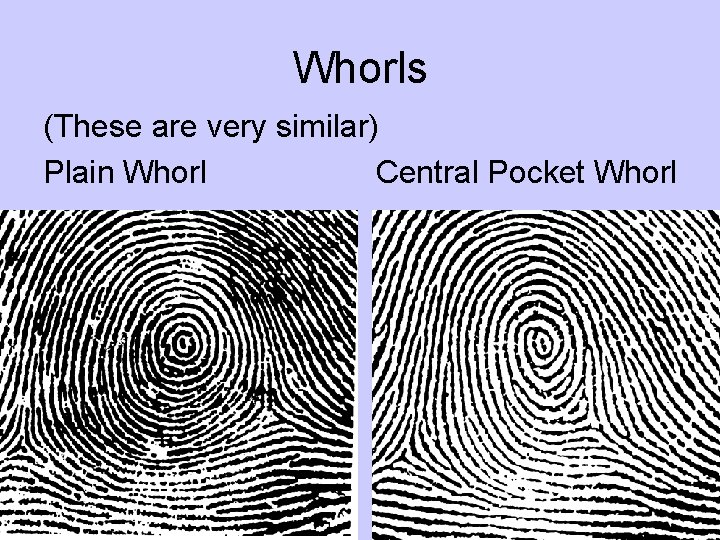
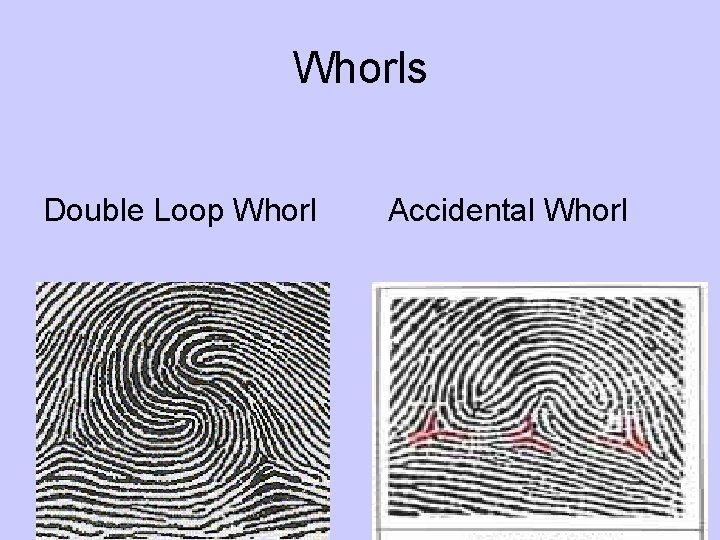
Whorls Fingerprint pattern with at least two deltas and a core. (30 %) Plain 20%, other 10 % 4 groups • Whorl – General whorl can be located any where on the finger (not in the center of the finger) • Central pocket whorl – Whorl is located in the center of the finger • Double loop whorl – looks like a double S on it’s side • Accidental whorl – will be a combination of two or more. Very rare, only 10% of all fingerprints.
Whorls (These are very similar) Plain Whorl Central Pocket Whorl
Whorls Double Loop Whorl Accidental Whorl
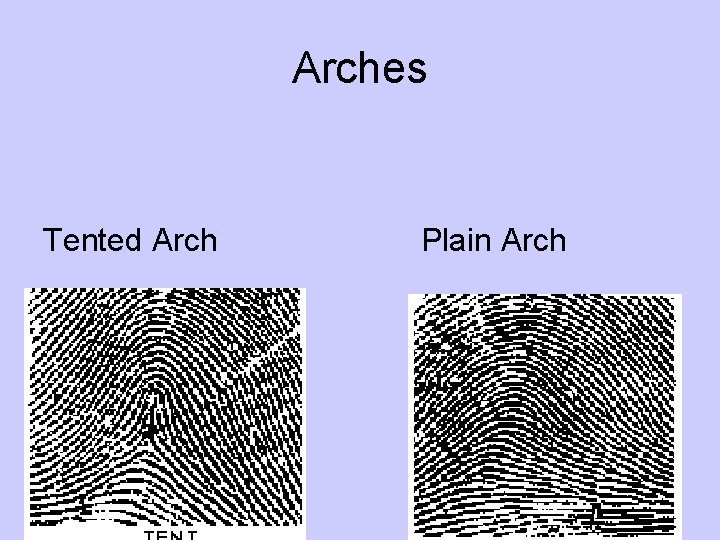
Arch Are the least common and the simplest of all fingerprint patterns. They have no delta or cores. All ridges enter one side and exit the other side. Lines rise in the middle. (5%) 2 groups: Ø Plain Arch - 4%: wave like lines Ø Tented arch – 1%: more pointed lines
Arches Tented Arch Plain Arch
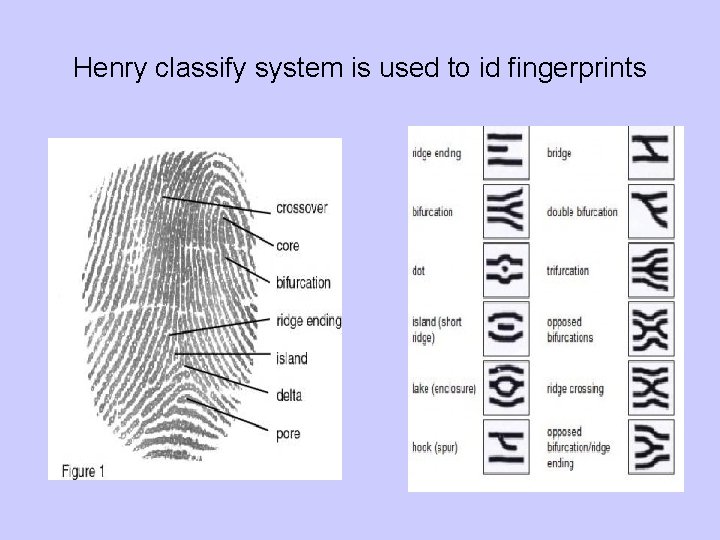
Henry classify system is used to id fingerprints
A fingerprint is an individual characteristic, no two fingers have yet been found to posses identical ridge characteristics • Ridge ending – point at which a friction ridge ends or begins. • Island – dot or short ridge with ridges on either side. • Bridge • Enclosure – a friction ridge bifurcates and then converges to form a continuation of a single ridge • Delta • Bifurcation or fork – friction ridge that diverges or fords • Dot – very small portion of a friction ridge • Spur • Double bifurcation • Trifurcation
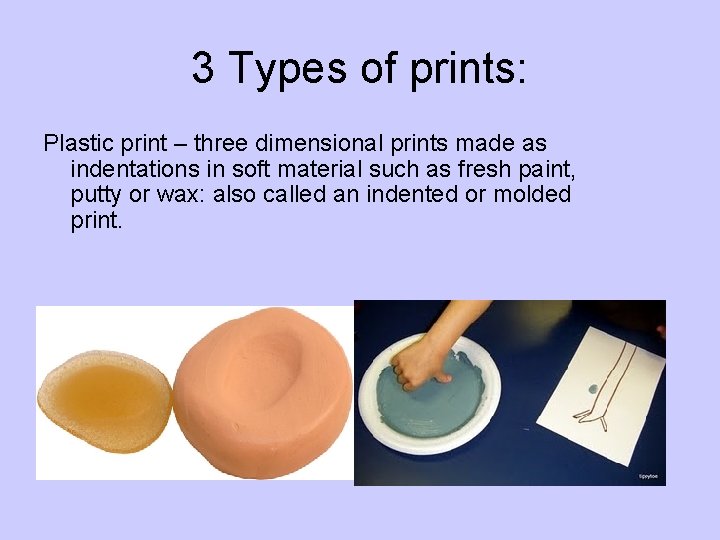
3 Types of prints: Plastic print – three dimensional prints made as indentations in soft material such as fresh paint, putty or wax: also called an indented or molded print.
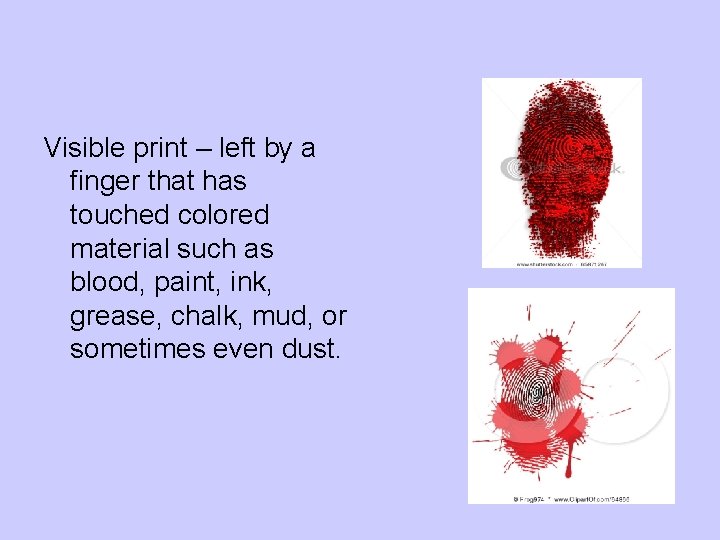
Visible print – left by a finger that has touched colored material such as blood, paint, ink, grease, chalk, mud, or sometimes even dust.
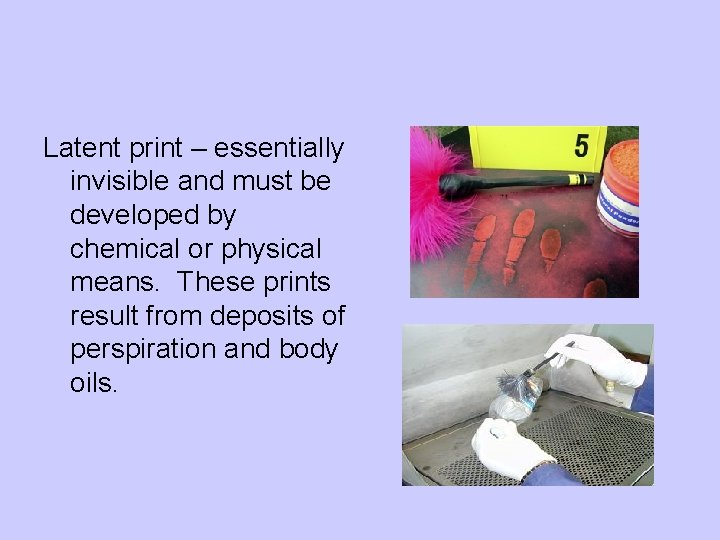
Latent print – essentially invisible and must be developed by chemical or physical means. These prints result from deposits of perspiration and body oils.
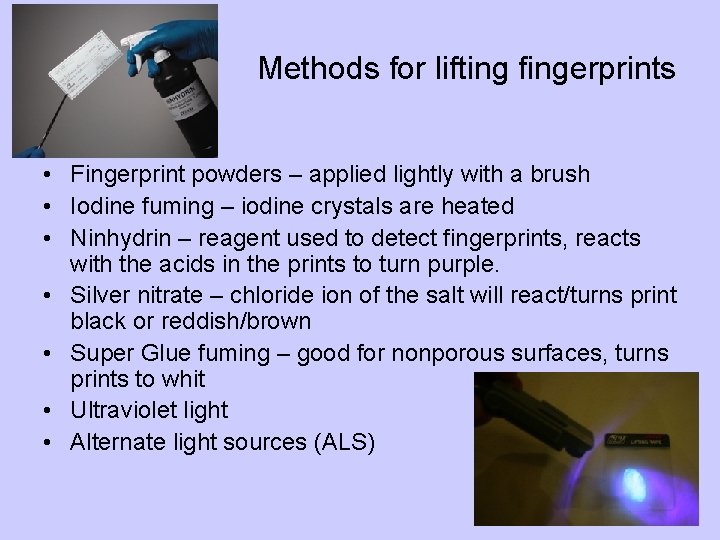
Methods for lifting fingerprints • Fingerprint powders – applied lightly with a brush • Iodine fuming – iodine crystals are heated • Ninhydrin – reagent used to detect fingerprints, reacts with the acids in the prints to turn purple. • Silver nitrate – chloride ion of the salt will react/turns print black or reddish/brown • Super Glue fuming – good for nonporous surfaces, turns prints to whit • Ultraviolet light • Alternate light sources (ALS)
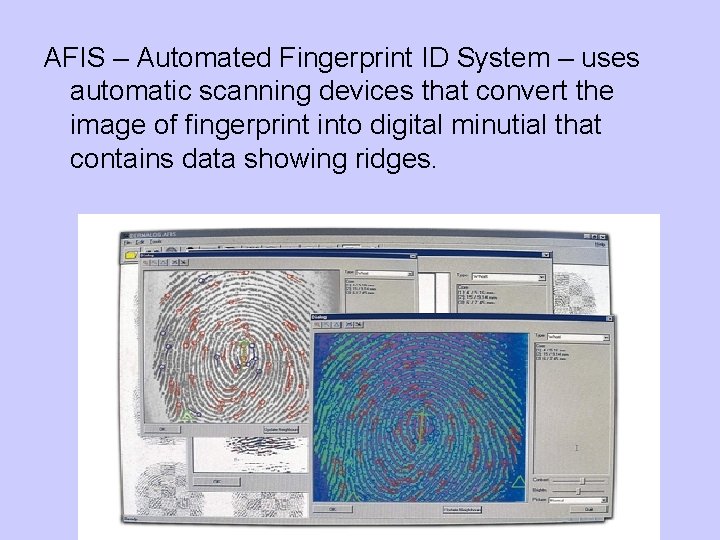
AFIS – Automated Fingerprint ID System – uses automatic scanning devices that convert the image of fingerprint into digital minutial that contains data showing ridges.