
Chapter 4 Ethics and Social Responsibility 2014 Cengage
Chapter 4 Ethics and Social Responsibility © 2014 Cengage Learning MGMT 7
4 -1 identify common kinds of workplace deviance 4 -2 describe the U. S. Sentencing Commission Guidelines for Organizations and explain how they both encourage ethical behavior and punish unethical behavior by businesses 4 -3 describe what influences ethical decision making 4 -4 explain what practical steps managers can take to improve ethical decision making 4 -5 explain to whom organizations are socially responsible 4 -6 explain for what organizations are socially responsible 4 -7 explain how organizations can choose to respond to societal demands for social responsibility 4 -8 explain whether social responsibility hurts or helps an organization’s economic performance © 2014 Cengage Learning
Workplace Deviance • Ethical behavior – conforms to a society’s accepted principles of right and wrong. • Workplace deviance – unethical behavior that violates organizational norms about right and wrong. © 2014 Cengage Learning 4 -1
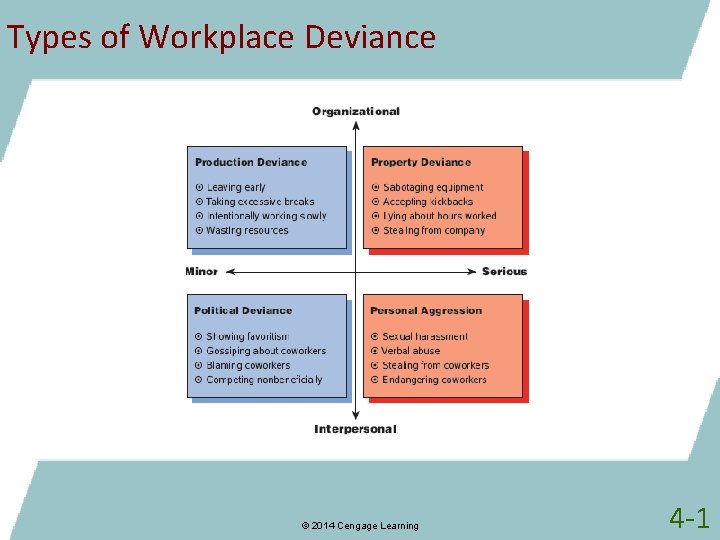
Types of Workplace Deviance © 2014 Cengage Learning 4 -1
Who, What, and Why • Who – nearly all companies: nonprofits, partnerships, labor unions, unincorporated organizations, pension funds, trusts, joint stock companies • What – offenses defined by federal laws: invasion of privacy, price fixing, fraud, theft, embezzlement, etc. • Why – The purpose of the guidelines is not just to punish companies after violations, but to encourage companies to prevent violations before they happen. 4 -2 © 2014 Cengage Learning
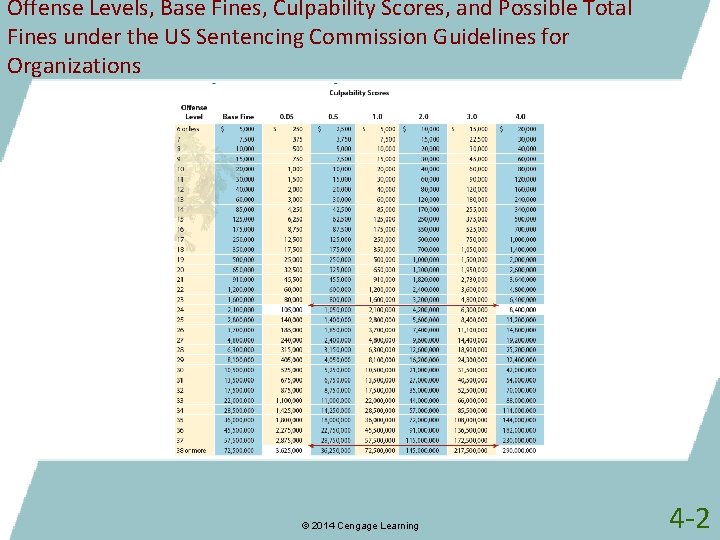
Offense Levels, Base Fines, Culpability Scores, and Possible Total Fines under the US Sentencing Commission Guidelines for Organizations © 2014 Cengage Learning 4 -2
Influences on Ethical Decision Making • Ethical intensity • Moral development • Ethical principles © 2014 Cengage Learning 4 -3
Principles of Ethical Decision Making • • Principle of long-term self interest Principle of personal virtue Principle of religious injunctions Principle of government requirements Principle of utilitarian benefits Principle of individual rights Principle of distributive justice © 2014 Cengage Learning 4 -3
Selecting and Hiring Ethical Employees • Overt integrity tests • Personality-based integrity tests 4 -4 © 2014 Cengage Learning
Codes of Ethics • A company must communicate its code inside and outside the company. • Management must develop practical ethical standards and procedures specific to the company’s line of business. 4 -4 © 2014 Cengage Learning
Objectives of Ethics Training • Develop employees’ awareness of ethics • Achieve credibility with employees • Teach employees a practical model of ethical decision making © 2014 Cengage Learning 4 -4
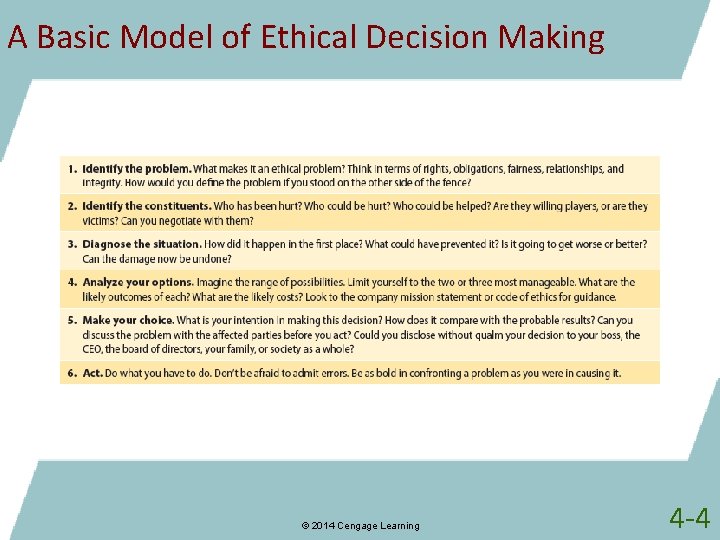
A Basic Model of Ethical Decision Making © 2014 Cengage Learning 4 -4
Ethical Climate • Organizational culture is key to fostering ethical decision making. • Management needs to be active in and committed to the ethics program. • Encourage managers and employees to report ethical violations (whistleblowing) 4 -4 © 2014 Cengage Learning
To Whom Are Organizations Socially Responsible? • Shareholder model – the only social responsibility that businesses have is to maximize profits • Stakeholder model – management’s most important responsibility is not just maximizing profits, but the firm’s long termsurvival. © 2014 Cengage Learning 4 -5
Stakeholder Model of Corporate Social Responsibility People or groups who are interested in and affected by the organization’s actions. • Primary stakeholders • Secondary stakeholders 4 -5 © 2014 Cengage Learning
For What Are Organizations Socially Responsible? • Economic responsibility • Legal responsibility • Ethical responsibility • Discretionary responsibility 4 -6 © 2014 Cengage Learning
Social Responsiveness Strategies • • 4 -7 Reactive Defensive Accommodative Proactive © 2014 Cengage Learning
Social Responsibility and Economic Performance • There is no tradeoff between being socially responsible and economic performance. • It usually does pay to be socially responsible. • There is no guarantee that socially responsible companies will be profitable. © 2014 Cengage Learning 4 -8
- Slides: 18