
Chapter 4 Ethical and Social Issues in Information
- Slides: 5
Chapter 4 Ethical and Social Issues in Information Systems 4. 1 Copyright © 2014 Pearson Education, Inc.
Management Information Systems Chapter 4: Ethical and Social Issues in Information Systems Understanding Ethical and Social Issues Related to Systems • Ethics – Principles of right and wrong that individuals, acting as free moral agents, use to make choices to guide their behaviors • Privacy: – Claim of individuals to be left alone, free from surveillance or interference from other individuals, organizations, or state; claim to be able to control information about yourself 4. 2 Copyright © 2014 Pearson Education, Inc.
Management Information Systems Chapter 4: Ethical and Social Issues in Information Systems The Moral Dimensions of Information Systems • Internet challenges to privacy: – Cookies • Identify browser and track visits to site • Super cookies (Flash cookies) – Web beacons (Web bugs) • Tiny graphics embedded in e-mails and Web pages • Monitor who is reading e-mail message or visiting site – Spyware • Surreptitiously installed on user’s computer • May transmit user’s keystrokes or display unwanted ads – Google services and behavioral targeting 4. 3 Copyright © 2014 Pearson Education, Inc.
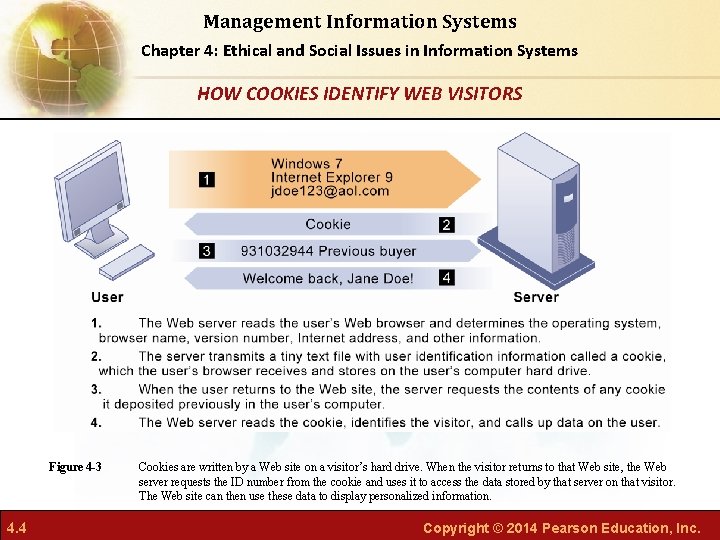
Management Information Systems Chapter 4: Ethical and Social Issues in Information Systems HOW COOKIES IDENTIFY WEB VISITORS Figure 4 -3 4. 4 Cookies are written by a Web site on a visitor’s hard drive. When the visitor returns to that Web site, the Web server requests the ID number from the cookie and uses it to access the data stored by that server on that visitor. The Web site can then use these data to display personalized information. Copyright © 2014 Pearson Education, Inc.
Management Information Systems Chapter 4: Ethical and Social Issues in Information Systems The Moral Dimensions of Information Systems • Property rights: Intellectual property – Intellectual property: intangible property of any kind created by individuals or corporations – Three main ways that intellectual property is protected: • Trade secret: intellectual work or product belonging to business, not in the public domain • Copyright: statutory grant protecting intellectual property from being copied for the life of the author, plus 70 years • Patents: grants creator of invention an exclusive monopoly on ideas behind invention for 20 years 4. 5 Copyright © 2014 Pearson Education, Inc.