
Chapter 4 EPIDEMIOLOGY AND NEUROBIOLOGY OF ADDICTION Definition
Chapter 4 EPIDEMIOLOGY AND NEUROBIOLOGY OF ADDICTION
Definition of Controlled Substance Schedules • Drugs and other substances that are considered controlled substances under the Controlled Substances Act (CSA) are divided into five schedules • Substances are placed in their respective schedules based on whether they have a currently accepted medical use in treatment in the United States, their relative abuse potential, and likelihood of causing dependence when abused

Controlled Substance Schedules Schedule I Substances in this schedule have: • No currently accepted medical use in the United States • A lack of accepted safety for use under medical supervision, and • A high potential for abuse. Examples include: heroin, lysergic acid diethylamide (LSD), marijuana (cannabis), peyote, and 3, 4 -methylenedioxymethamphetamine (“Ecstasy”). Schedule II Substances have a high potential for abuse, which may lead to severe psychological or physical dependence. Examples of opiates include: methadone (Dolophine®), oxycodone (Oxy. Contin®, Percocet®), fentanyl (Sublimaze®, Duragesic®), morphine, opium, and codeine. Examples of stimulants include: amphetamine (Dexedrine®, Adderall®), methamphetamine (Desoxyn®), and methylphenidate (Ritalin®).
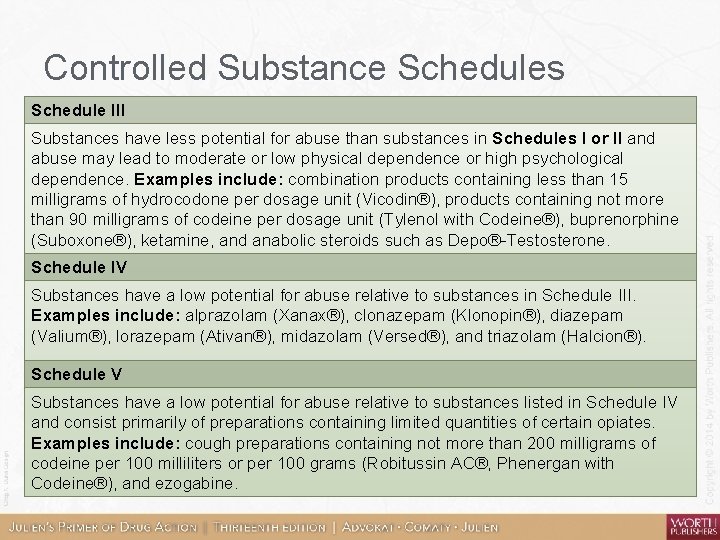
Controlled Substance Schedules Schedule III Substances have less potential for abuse than substances in Schedules I or II and abuse may lead to moderate or low physical dependence or high psychological dependence. Examples include: combination products containing less than 15 milligrams of hydrocodone per dosage unit (Vicodin®), products containing not more than 90 milligrams of codeine per dosage unit (Tylenol with Codeine®), buprenorphine (Suboxone®), ketamine, and anabolic steroids such as Depo®-Testosterone. Schedule IV Substances have a low potential for abuse relative to substances in Schedule III. Examples include: alprazolam (Xanax®), clonazepam (Klonopin®), diazepam (Valium®), lorazepam (Ativan®), midazolam (Versed®), and triazolam (Halcion®). Schedule V Substances have a low potential for abuse relative to substances listed in Schedule IV and consist primarily of preparations containing limited quantities of certain opiates. Examples include: cough preparations containing not more than 200 milligrams of codeine per 100 milliliters or per 100 grams (Robitussin AC®, Phenergan with Codeine®), and ezogabine.
Extent of the Drug Problem Cost to Society • Estimated cost of drug use to society in the United States in lost productivity, health care expense, and crime-related and other costs, exceeds half a trillion dollars annually 2012 National Drug Control Strategy • • Establish and promote a balance of evidence-based public health and safety initiatives focusing on key areas such as substance abuse prevention, treatment, and recovery Reduce drug use and its consequences in the U. S.
Extent of the Drug Problem • Drug use is highest among people in their late teens and twenties • Drug use is increasing among people in their fifties • 5 -year trends are showing significant increases in current marijuana use • Abuse of prescription stimulants increasing
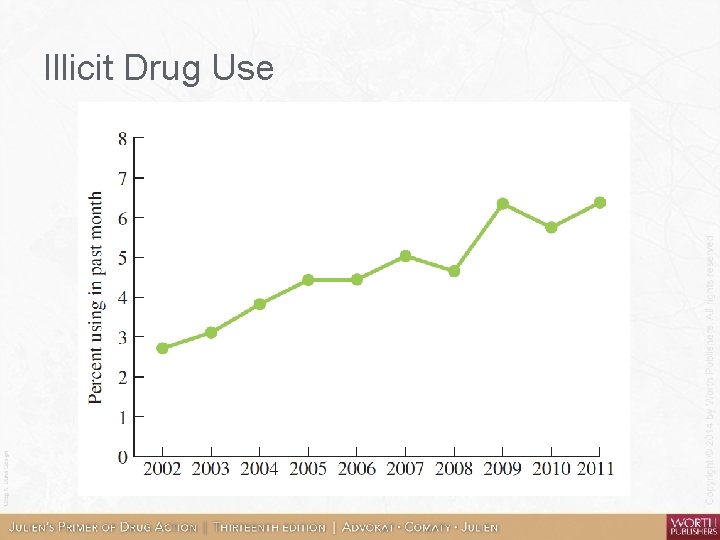
Illicit Drug Use
Nosology and Psychopathology of Substance Abuse DSM-5: Substance Use Disorder • New category allows experts to diagnose people with an alcohol and/or drug problem more easily by looking at a continuum of severity • Dual diagnosis
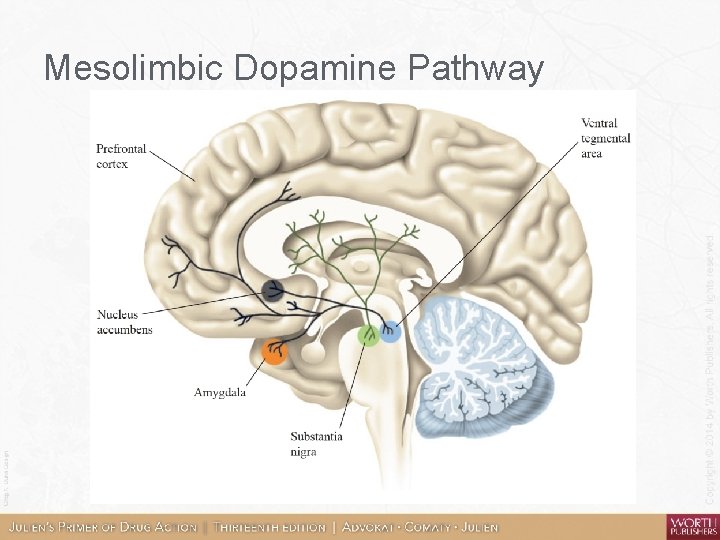
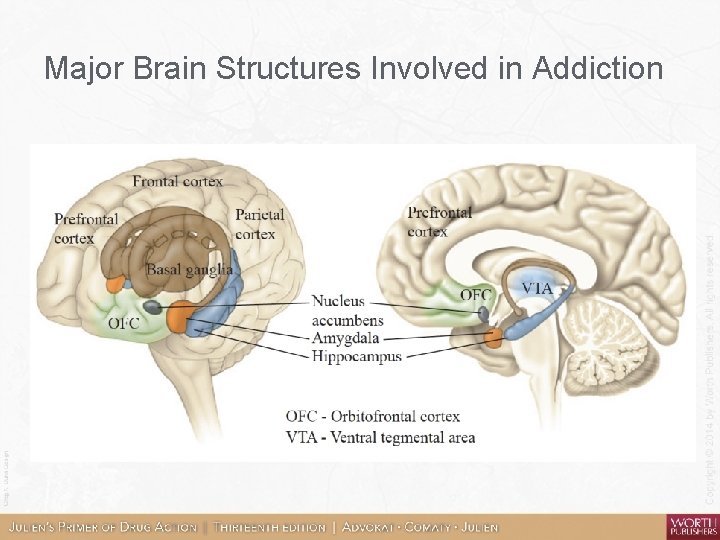
Neurobiology of Addiction Neurobiology of ‘Pleasure’ • Electrical stimulation of the brain – – Existence of a ‘reward circuit’ in the brain Discovered by accident by Olds and Milner in 1950 s. Sites are in the limbic system. Drugs of abuse act on the same structures. • Ventral tegmental area to nucleus accumbens and back to VTA mediates the acute pleasurable sensation. – Chronic drug use sensitizes this response. • Hippocampus and amygdala (‘extended amygdala’) are responsible for memories of ‘pleasure’ – people, places and activities associated with use. • Prefrontal cortex impairments mediate long-term changes involved in loss of control, relapse.
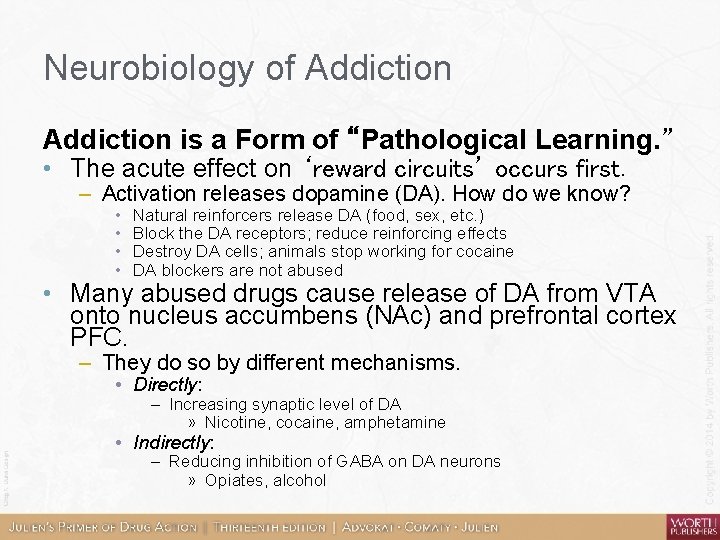
Neurobiology of Addiction is a Form of “Pathological Learning. ” • The acute effect on ‘reward circuits’ occurs first. – Activation releases dopamine (DA). How do we know? • • Natural reinforcers release DA (food, sex, etc. ) Block the DA receptors; reduce reinforcing effects Destroy DA cells; animals stop working for cocaine DA blockers are not abused • Many abused drugs cause release of DA from VTA onto nucleus accumbens (NAc) and prefrontal cortex PFC. – They do so by different mechanisms. • Directly: – Increasing synaptic level of DA » Nicotine, cocaine, amphetamine • Indirectly: – Reducing inhibition of GABA on DA neurons » Opiates, alcohol
Mesolimbic Dopamine Pathway
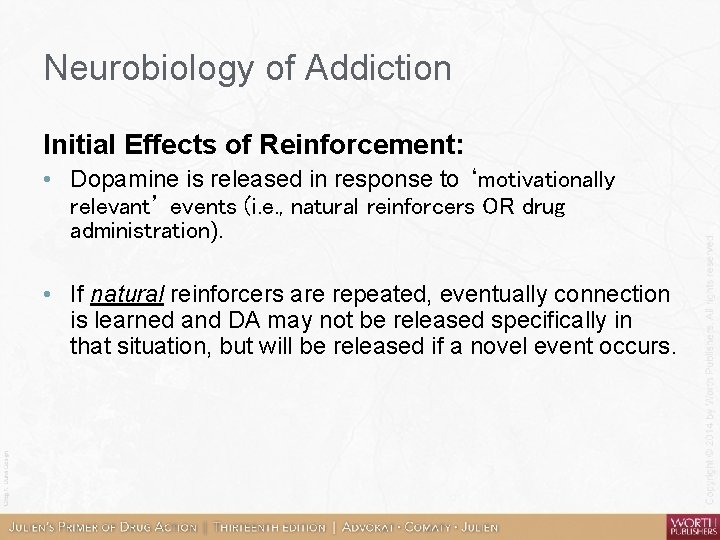
Neurobiology of Addiction Initial Effects of Reinforcement: • Dopamine is released in response to ‘motivationally relevant’ events (i. e. , natural reinforcers OR drug administration). • If natural reinforcers are repeated, eventually connection is learned and DA may not be released specifically in that situation, but will be released if a novel event occurs.
Neurobiology of Addiction What is the difference between someone who can drink or dabble in illicit drugs without developing dependence (or many negative consequences) versus someone who becomes an addict? • Researchers believe that there is great variability among individuals when it comes to their vulnerability to becoming addicted. – One major predictor of becoming addicted is the level of stress a person is trying to cope with. “The more stress, the more likely it is you will get addicted. ” • But risk of addiction is also driven by individual's genetic background, other biological factors, environment, and social context in which drug use is occurring.
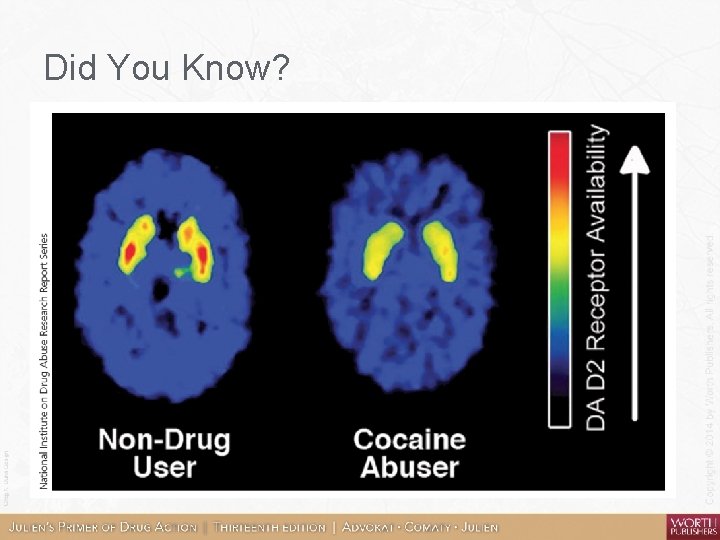
From Abuse to Addiction • Repeated drug use may develop into chronic drug use that can become compulsive and result in addiction • Frontal lobe is profoundly altered by chronic drug abuse • Cortical hypofrontality - fewer dopamine receptors in the NAc than normal and a lower metabolic rate in the frontal lobe
Did You Know?
From Abuse to Addiction As a result of chronic drug use, natural rewards become less pleasurable, and release less dopamine despite greater response in dopaminergic transmission than normal Frontal cortex becomes inherently less active and less responsive to normal rewards, but it is overactive in response to drugs or the stimuli that predict drug Over time, stimuli that “predict” drugs produce a greater response in the reward pathway than the rewarding stimuli themselves Such conditioned, or learned, responses could elicit powerful craving sensations in the frontal cortex Memory of positive effects of a drug provides the motivation for compulsive use, and is believed to be responsible for relapse • This memory is mediated by the amygdala and hippocampus Frontal lobes become sensitized to drugrelated stimuli
Major Brain Structures Involved in Addiction
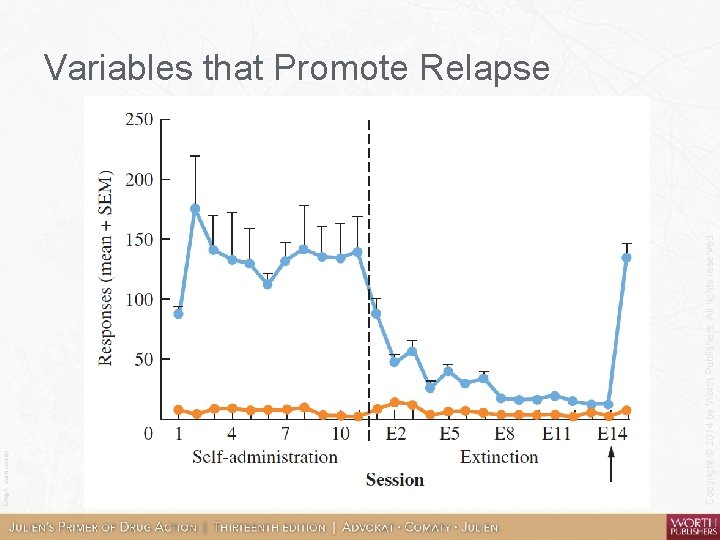
Variables that Promote Relapse
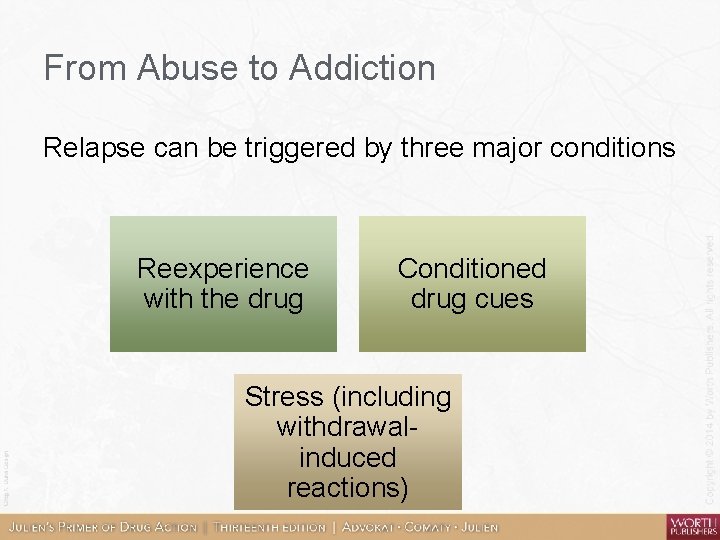
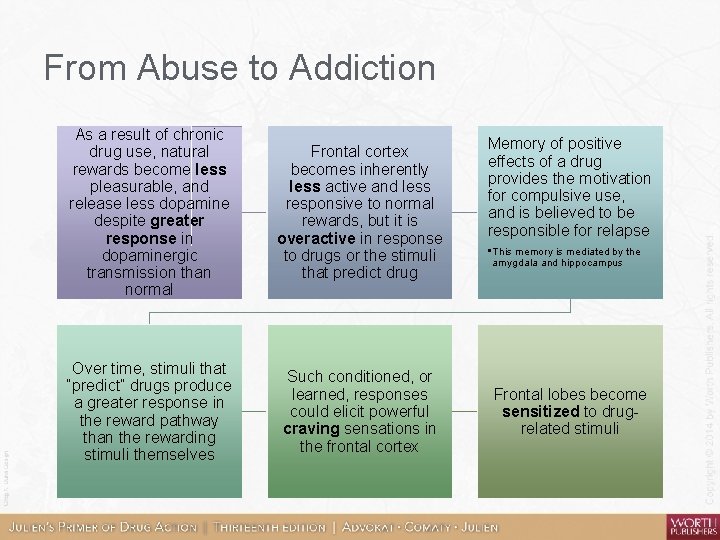
From Abuse to Addiction Relapse can be triggered by three major conditions Reexperience with the drug Conditioned drug cues Stress (including withdrawalinduced reactions)
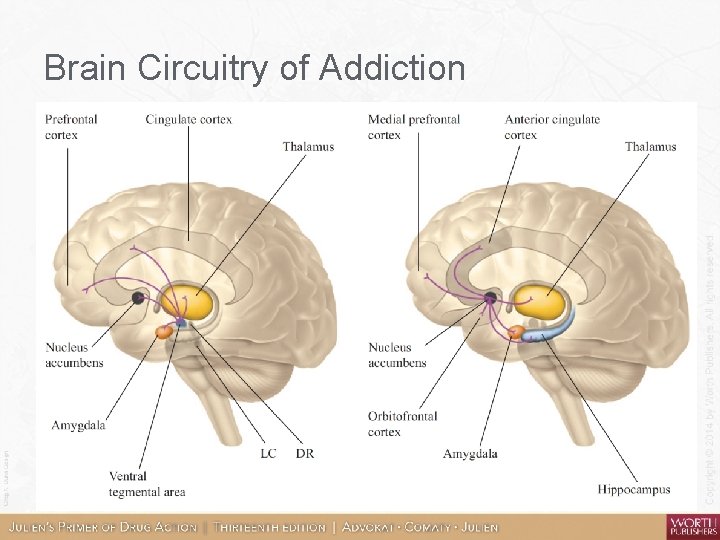
Brain Circuitry of Addiction
Glutamatergic Substrates of Addiction Heightened Craving Sensations • Heightened craving sensations are transmitted from the frontal cortex through downstream nerve pathways that feed back onto the reward pathway Transmitter Glutamate Released • Nerve fibers that connect the frontal lobe structures with the downstream reward circuit are not primarily dopaminergic
Glutamatergic Substrates of Addiction Hypersensitivity of the Frontal Cortex Supports Craving • Hypersensitivity of the frontal cortex to drugs or drug cues (learning), which develops in addiction, is the basis of the phenomenon of craving. • Craving is biologically mediated as increased glutamatergic reactivity within the reward circuit.
Glutamatergic Substrates of Addiction Several Types of Functional Changes Are Involved in the Development of Addiction • Alterations in dopaminergic reward systems (VTA) signal the significance or desirability of a stimulus, the motivational circuits (the NAc, amygdala) provide incentive for obtaining the reward, the conditioning/learning pathways (hippocampus) strengthen the behaviors that obtain the reward, and the inhibitory processes (frontal lobe) normally exert control over inappropriate or destructive behavior
Epigenetic – “above and beyond genetics” Influences in Addiction • Multiple drugs of abuse produce changes in histone acetylation (genetic material) in the brain, including cocaine, alcohol, and cannabis (THC)
Pharmacotherapy of Substance Use Disorders Agonist Substitution Treatment • Prescribing a substitute drug for the abused agent Opioid Addiction • Methadone Nicotine Addiction • Nicotine lozenges, gum, and patches Alcohol Addiction • Disulfiram (Antabuse)
Partial Agonist Substitution Treatment • Buprenorphine: partial agonist for opiate addiction • Varenicline: α 4 β 2 partial nicotinic agonist for nicotine addiction • Dopamine partial agonists: should provide enough dopamine activation to reduce the effects of withdrawal yet block the consequences of illicit stimulant use
Antagonists as Treatments for Addiction • Antagonists directly block the reinforcing effect and eventually reduce the compulsive behavior • Opiate antagonists – Naloxone – Naltrexone – Nalmefene • No positive reinforcement makes adherence difficult and relapse likely
Targeting Nondopaminergic Neurotransmitter Systems GABAergic System • GABA-B agonists, such as baclofen, can reduce the reinforcing effects of several different classes of abused drugs • Other GABAergic medications being tested as possible agents for preventing cocaine relapse are anticonvulsants
Opioids • Mu receptors: mu activation increases DA activity in nucleus accumbens. • Kappa receptors: stimulation reduces activity in the nucleus accumbens; can result in dysphoria. • Delta receptors: antagonists reduce alcohol self-administration; thus, increased kappa activity should play role in reinforcement and kappa antagonists might be potential therapeutic agents for alcohol dependency.
Opioids and Naltrexone • Reported useful in alcoholism • Thought to be a consequence of its ability to block actions of endorphins that are released by alcohol and mediate pleasure
Cannabinoids Opioids and Cannabinoids Very Similar • Opioid-cannabinoid interactions important in addiction • Cannabinoids can increase endorphin synthesis or release • Opioid antagonists can block some effects of THC and induce withdrawal in THC-dependent rats • Marijuana may reduce symptoms of opioid withdrawal, but increase relapse in detoxified persons
- Slides: 31