
Chapter 4 Entity Relationship ER Modeling 2017 Cengage
- Slides: 43
Chapter 4 Entity Relationship (ER) Modeling © 2017 Cengage Learning®. May not be scanned, copied or duplicated, or posted to a publicly accessible website, in whole or in part, except for use as permitted in a license distributed with a certain product or service or otherwise on a password-protected website or school-approved learning management system for classroom use.
Learning Objectives § In this chapter, you will learn: § The main characteristics of entity relationship components § How relationships between entities are defined, refined, and incorporated into the database design process § How ERD components affect database design and implementation § That real-world database design often requires the reconciliation of conflicting goals © 2017 Cengage Learning®. May not be scanned, copied or duplicated, or posted to a publicly accessible website, in whole or in part, except for use as permitted in a license distributed with a certain product or service or otherwise on a password-protected website or school-approved learning management system for classroom use. 2
Entity Relationship Model (ERM) § Basis of an entity relationship diagram (ERD) § ERD depicts the: § Conceptual database as viewed by end user § Database’s main components § Entities § Attributes § Relationships § Entity - Refers to the entity set and not to a single entity occurrence © 2017 Cengage Learning®. May not be scanned, copied or duplicated, or posted to a publicly accessible website, in whole or in part, except for use as permitted in a license distributed with a certain product or service or otherwise on a password-protected website or school-approved learning management system for classroom use. 3
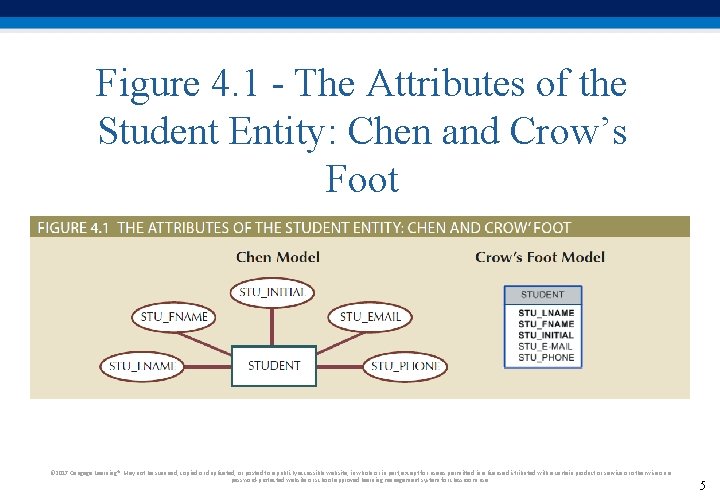
Attributes § Characteristics of entities § Required attribute: Must have a value, cannot be left empty § Optional attribute: Does not require a value, can be left empty § Domain - Set of possible values for a given attribute § Identifiers: One or more attributes that uniquely identify each entity instance © 2017 Cengage Learning®. May not be scanned, copied or duplicated, or posted to a publicly accessible website, in whole or in part, except for use as permitted in a license distributed with a certain product or service or otherwise on a password-protected website or school-approved learning management system for classroom use. 4
Figure 4. 1 - The Attributes of the Student Entity: Chen and Crow’s Foot © 2017 Cengage Learning®. May not be scanned, copied or duplicated, or posted to a publicly accessible website, in whole or in part, except for use as permitted in a license distributed with a certain product or service or otherwise on a password-protected website or school-approved learning management system for classroom use. 5
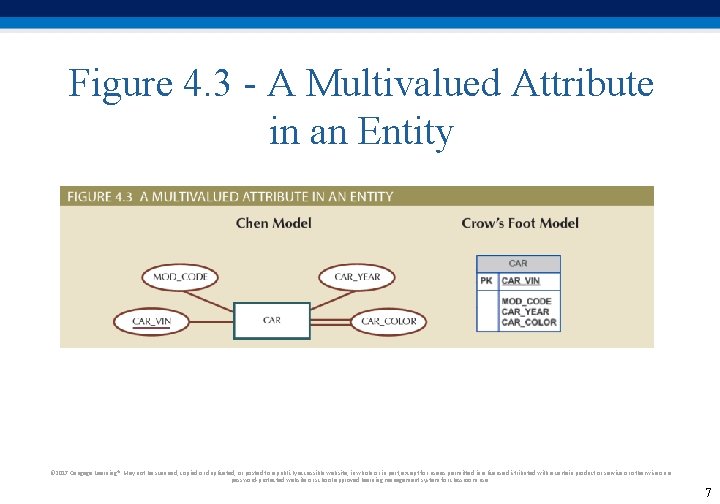
Attributes § Composite identifier: Primary key composed of more than one attribute § Composite attribute: Attribute that can be subdivided to yield additional attributes § Simple attribute: Attribute that cannot be subdivided § Single-valued attribute: Attribute that has only a single value § Multivalued attributes: Attributes that have many values © 2017 Cengage Learning®. May not be scanned, copied or duplicated, or posted to a publicly accessible website, in whole or in part, except for use as permitted in a license distributed with a certain product or service or otherwise on a password-protected website or school-approved learning management system for classroom use. 6
Figure 4. 3 - A Multivalued Attribute in an Entity © 2017 Cengage Learning®. May not be scanned, copied or duplicated, or posted to a publicly accessible website, in whole or in part, except for use as permitted in a license distributed with a certain product or service or otherwise on a password-protected website or school-approved learning management system for classroom use. 7
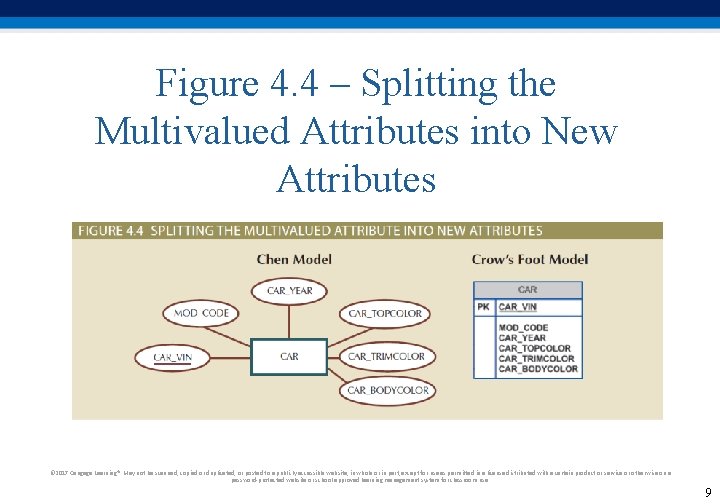
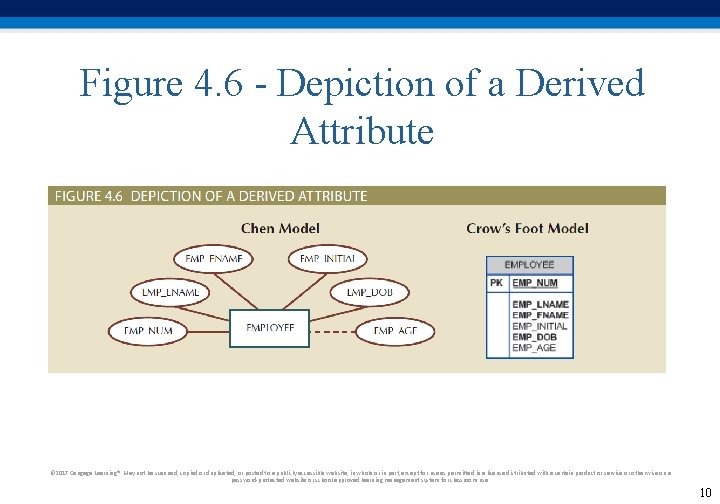
Attributes § Multivalued attributes: Attributes that have many values and require creating: § Several new attributes, one for each component of the original multivalued attribute § A new entity composed of the original multivalued attribute’s components § Derived attribute: Attribute whose value is calculated from other attributes § Derived using an algorithm © 2017 Cengage Learning®. May not be scanned, copied or duplicated, or posted to a publicly accessible website, in whole or in part, except for use as permitted in a license distributed with a certain product or service or otherwise on a password-protected website or school-approved learning management system for classroom use. 8
Figure 4. 4 – Splitting the Multivalued Attributes into New Attributes © 2017 Cengage Learning®. May not be scanned, copied or duplicated, or posted to a publicly accessible website, in whole or in part, except for use as permitted in a license distributed with a certain product or service or otherwise on a password-protected website or school-approved learning management system for classroom use. 9
Figure 4. 6 - Depiction of a Derived Attribute © 2017 Cengage Learning®. May not be scanned, copied or duplicated, or posted to a publicly accessible website, in whole or in part, except for use as permitted in a license distributed with a certain product or service or otherwise on a password-protected website or school-approved learning management system for classroom use. 10
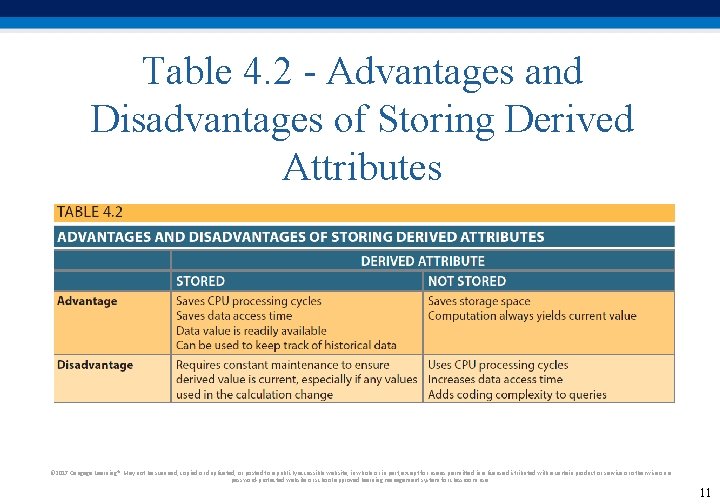
Table 4. 2 - Advantages and Disadvantages of Storing Derived Attributes © 2017 Cengage Learning®. May not be scanned, copied or duplicated, or posted to a publicly accessible website, in whole or in part, except for use as permitted in a license distributed with a certain product or service or otherwise on a password-protected website or school-approved learning management system for classroom use. 11
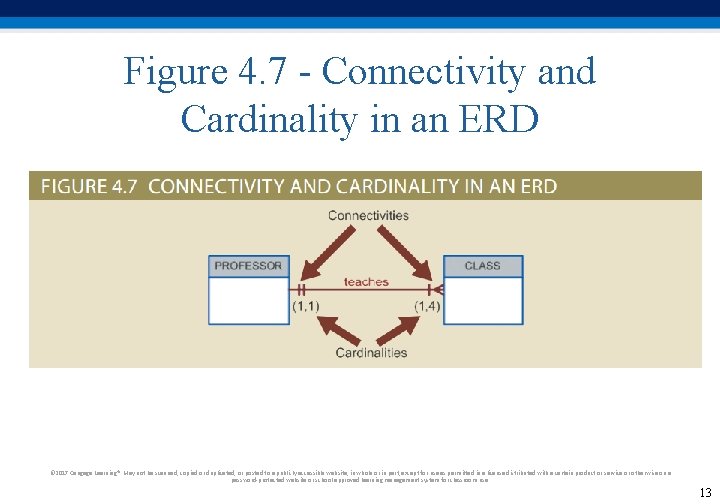
Relationships § Association between entities that always operate in both directions § Participants: Entities that participate in a relationship § Connectivity: Describes the relationship classification § Cardinality: Expresses the minimum and maximum number of entity occurrences associated with one occurrence of related entity © 2017 Cengage Learning®. May not be scanned, copied or duplicated, or posted to a publicly accessible website, in whole or in part, except for use as permitted in a license distributed with a certain product or service or otherwise on a password-protected website or school-approved learning management system for classroom use. 12
Figure 4. 7 - Connectivity and Cardinality in an ERD © 2017 Cengage Learning®. May not be scanned, copied or duplicated, or posted to a publicly accessible website, in whole or in part, except for use as permitted in a license distributed with a certain product or service or otherwise on a password-protected website or school-approved learning management system for classroom use. 13
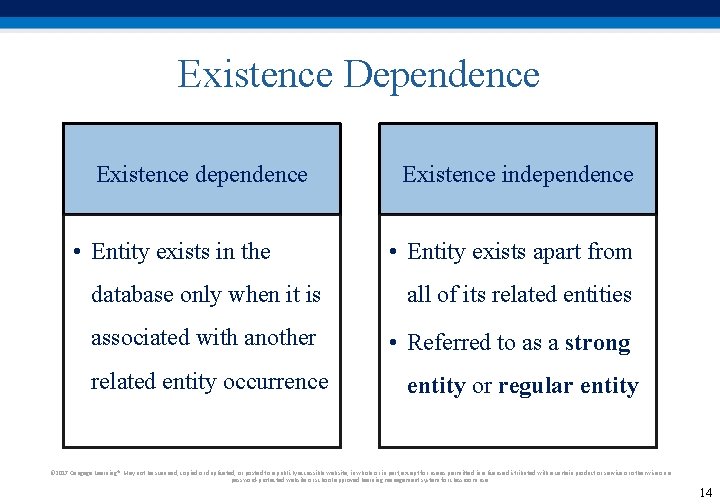
Existence Dependence Existence dependence • Entity exists in the Existence independence • Entity exists apart from database only when it is all of its related entities associated with another • Referred to as a strong related entity occurrence entity or regular entity © 2017 Cengage Learning®. May not be scanned, copied or duplicated, or posted to a publicly accessible website, in whole or in part, except for use as permitted in a license distributed with a certain product or service or otherwise on a password-protected website or school-approved learning management system for classroom use. 14
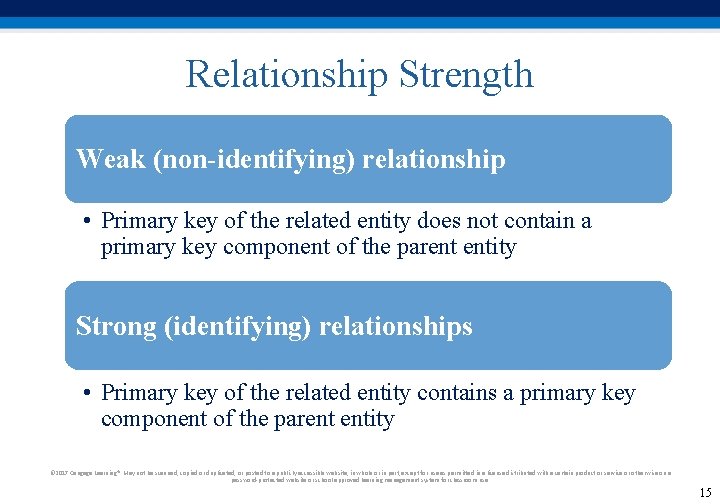
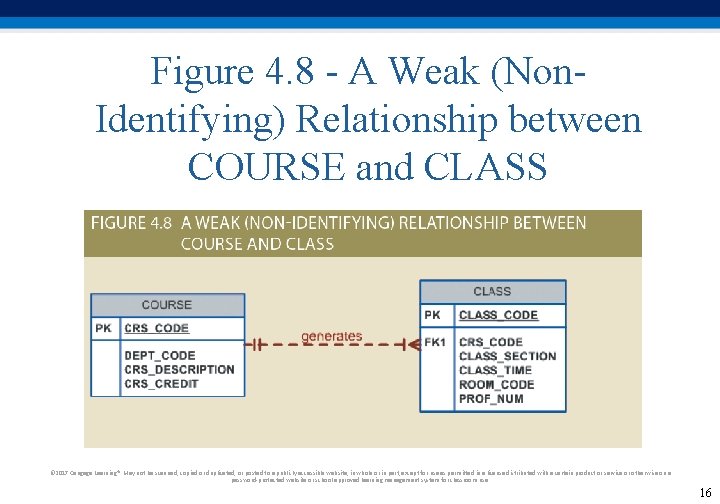
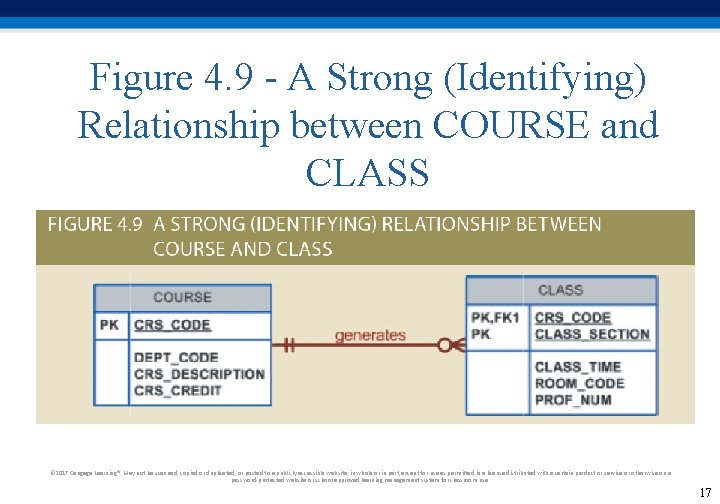
Relationship Strength Weak (non-identifying) relationship • Primary key of the related entity does not contain a primary key component of the parent entity Strong (identifying) relationships • Primary key of the related entity contains a primary key component of the parent entity © 2017 Cengage Learning®. May not be scanned, copied or duplicated, or posted to a publicly accessible website, in whole or in part, except for use as permitted in a license distributed with a certain product or service or otherwise on a password-protected website or school-approved learning management system for classroom use. 15
Figure 4. 8 - A Weak (Non. Identifying) Relationship between COURSE and CLASS © 2017 Cengage Learning®. May not be scanned, copied or duplicated, or posted to a publicly accessible website, in whole or in part, except for use as permitted in a license distributed with a certain product or service or otherwise on a password-protected website or school-approved learning management system for classroom use. 16
Figure 4. 9 - A Strong (Identifying) Relationship between COURSE and CLASS © 2017 Cengage Learning®. May not be scanned, copied or duplicated, or posted to a publicly accessible website, in whole or in part, except for use as permitted in a license distributed with a certain product or service or otherwise on a password-protected website or school-approved learning management system for classroom use. 17
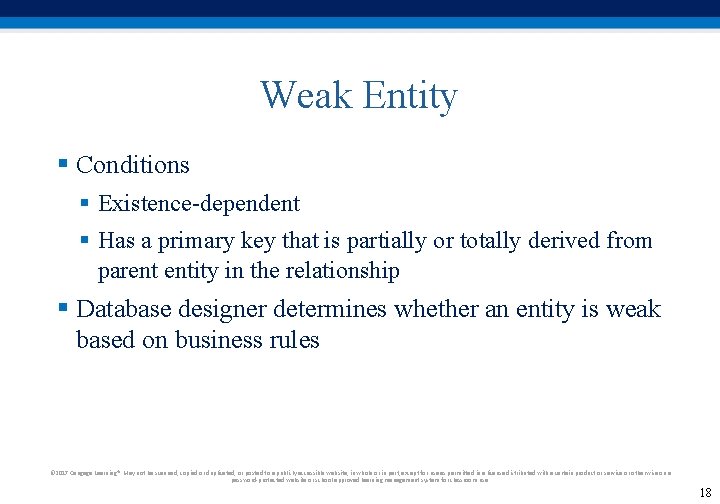
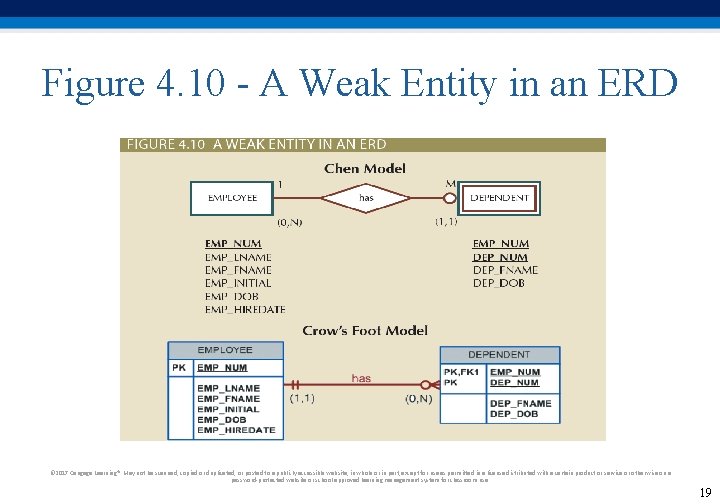
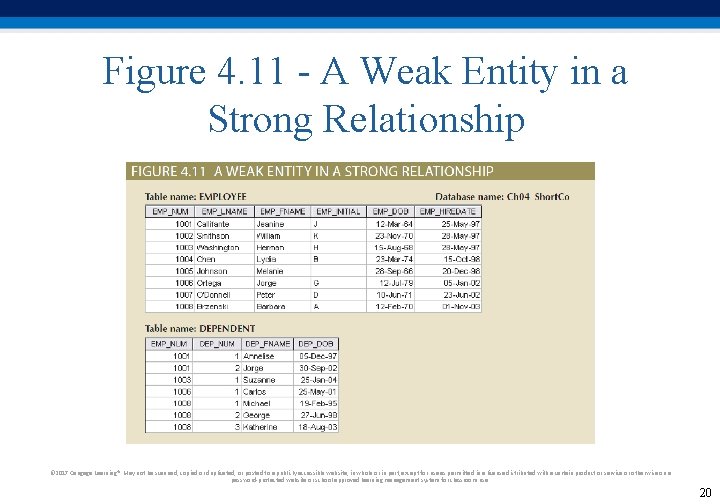
Weak Entity § Conditions § Existence-dependent § Has a primary key that is partially or totally derived from parent entity in the relationship § Database designer determines whether an entity is weak based on business rules © 2017 Cengage Learning®. May not be scanned, copied or duplicated, or posted to a publicly accessible website, in whole or in part, except for use as permitted in a license distributed with a certain product or service or otherwise on a password-protected website or school-approved learning management system for classroom use. 18
Figure 4. 10 - A Weak Entity in an ERD © 2017 Cengage Learning®. May not be scanned, copied or duplicated, or posted to a publicly accessible website, in whole or in part, except for use as permitted in a license distributed with a certain product or service or otherwise on a password-protected website or school-approved learning management system for classroom use. 19
Figure 4. 11 - A Weak Entity in a Strong Relationship © 2017 Cengage Learning®. May not be scanned, copied or duplicated, or posted to a publicly accessible website, in whole or in part, except for use as permitted in a license distributed with a certain product or service or otherwise on a password-protected website or school-approved learning management system for classroom use. 20
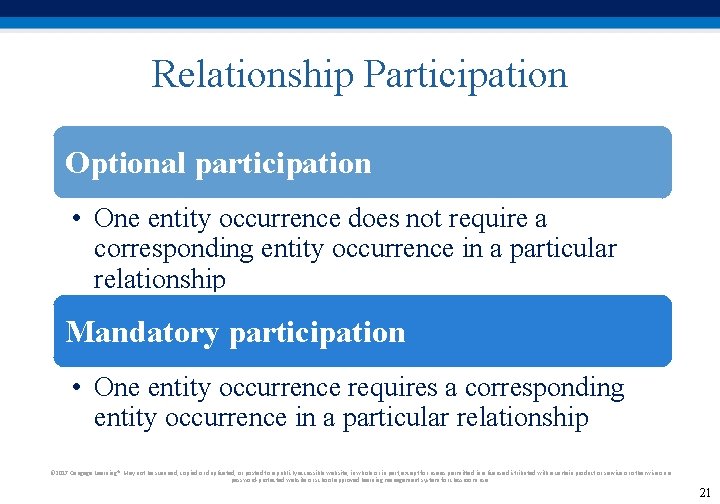
Relationship Participation Optional participation • One entity occurrence does not require a corresponding entity occurrence in a particular relationship Mandatory participation • One entity occurrence requires a corresponding entity occurrence in a particular relationship © 2017 Cengage Learning®. May not be scanned, copied or duplicated, or posted to a publicly accessible website, in whole or in part, except for use as permitted in a license distributed with a certain product or service or otherwise on a password-protected website or school-approved learning management system for classroom use. 21
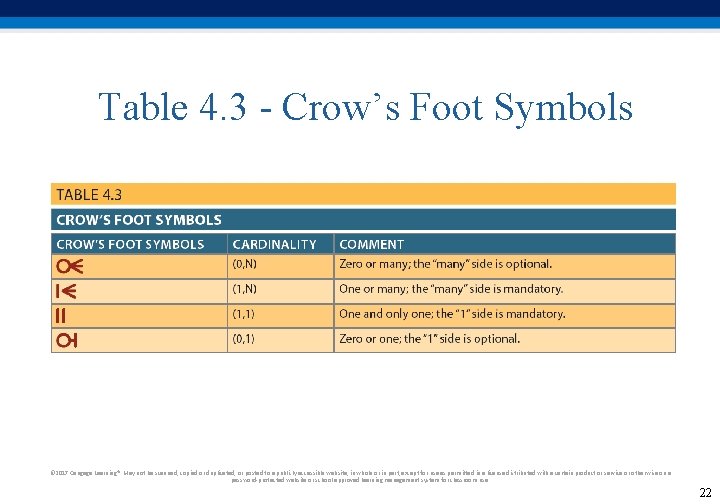
Table 4. 3 - Crow’s Foot Symbols © 2017 Cengage Learning®. May not be scanned, copied or duplicated, or posted to a publicly accessible website, in whole or in part, except for use as permitted in a license distributed with a certain product or service or otherwise on a password-protected website or school-approved learning management system for classroom use. 22
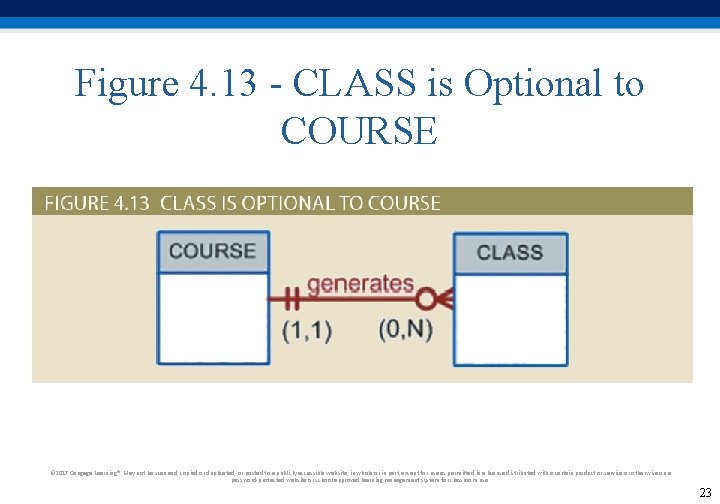
Figure 4. 13 - CLASS is Optional to COURSE © 2017 Cengage Learning®. May not be scanned, copied or duplicated, or posted to a publicly accessible website, in whole or in part, except for use as permitted in a license distributed with a certain product or service or otherwise on a password-protected website or school-approved learning management system for classroom use. 23
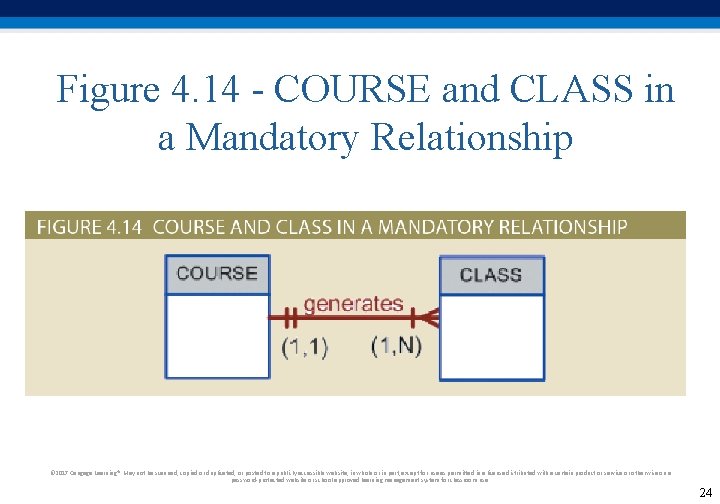
Figure 4. 14 - COURSE and CLASS in a Mandatory Relationship © 2017 Cengage Learning®. May not be scanned, copied or duplicated, or posted to a publicly accessible website, in whole or in part, except for use as permitted in a license distributed with a certain product or service or otherwise on a password-protected website or school-approved learning management system for classroom use. 24
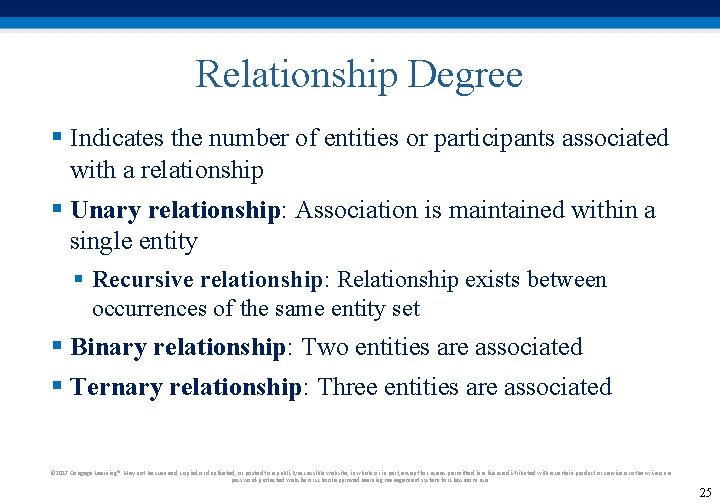
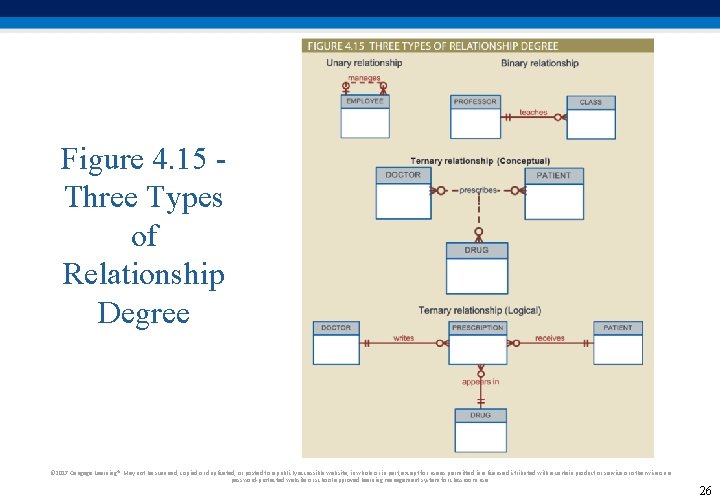
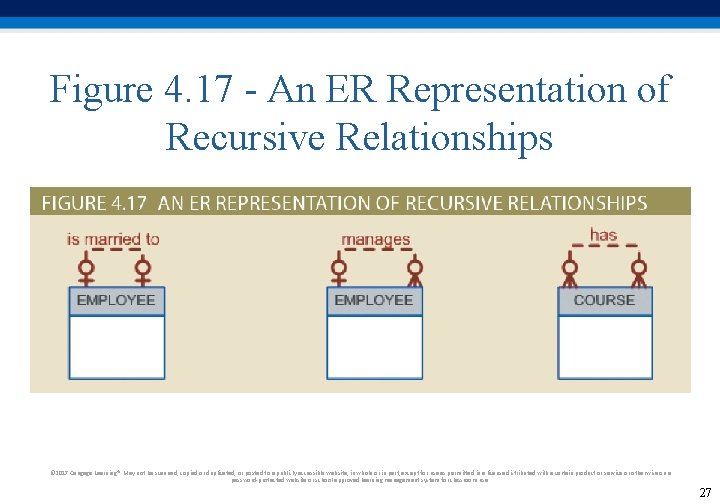
Relationship Degree § Indicates the number of entities or participants associated with a relationship § Unary relationship: Association is maintained within a single entity § Recursive relationship: Relationship exists between occurrences of the same entity set § Binary relationship: Two entities are associated § Ternary relationship: Three entities are associated © 2017 Cengage Learning®. May not be scanned, copied or duplicated, or posted to a publicly accessible website, in whole or in part, except for use as permitted in a license distributed with a certain product or service or otherwise on a password-protected website or school-approved learning management system for classroom use. 25
Figure 4. 15 Three Types of Relationship Degree © 2017 Cengage Learning®. May not be scanned, copied or duplicated, or posted to a publicly accessible website, in whole or in part, except for use as permitted in a license distributed with a certain product or service or otherwise on a password-protected website or school-approved learning management system for classroom use. 26
Figure 4. 17 - An ER Representation of Recursive Relationships © 2017 Cengage Learning®. May not be scanned, copied or duplicated, or posted to a publicly accessible website, in whole or in part, except for use as permitted in a license distributed with a certain product or service or otherwise on a password-protected website or school-approved learning management system for classroom use. 27
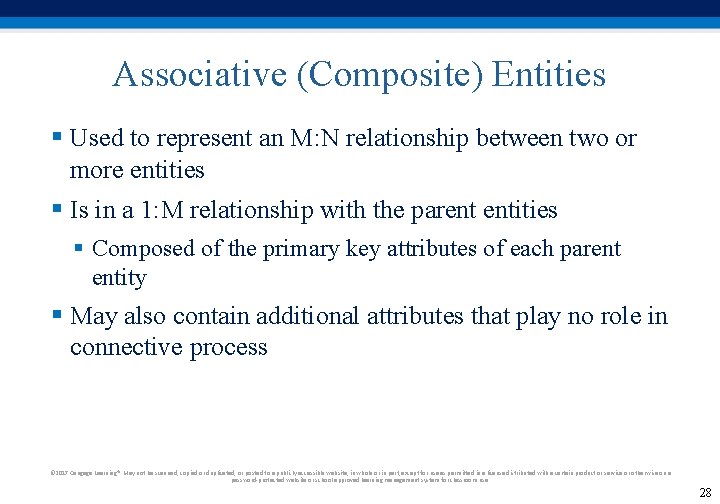
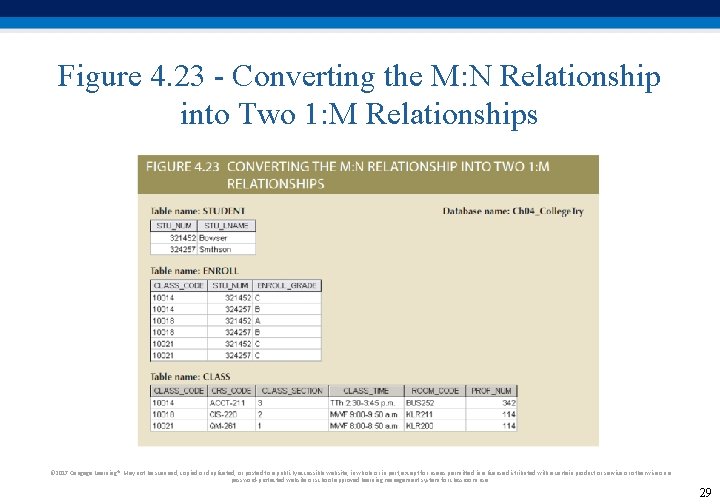
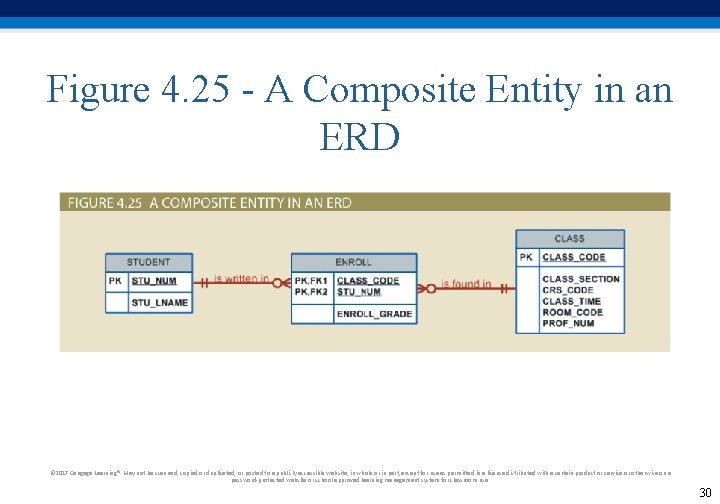
Associative (Composite) Entities § Used to represent an M: N relationship between two or more entities § Is in a 1: M relationship with the parent entities § Composed of the primary key attributes of each parent entity § May also contain additional attributes that play no role in connective process © 2017 Cengage Learning®. May not be scanned, copied or duplicated, or posted to a publicly accessible website, in whole or in part, except for use as permitted in a license distributed with a certain product or service or otherwise on a password-protected website or school-approved learning management system for classroom use. 28
Figure 4. 23 - Converting the M: N Relationship into Two 1: M Relationships © 2017 Cengage Learning®. May not be scanned, copied or duplicated, or posted to a publicly accessible website, in whole or in part, except for use as permitted in a license distributed with a certain product or service or otherwise on a password-protected website or school-approved learning management system for classroom use. 29
Figure 4. 25 - A Composite Entity in an ERD © 2017 Cengage Learning®. May not be scanned, copied or duplicated, or posted to a publicly accessible website, in whole or in part, except for use as permitted in a license distributed with a certain product or service or otherwise on a password-protected website or school-approved learning management system for classroom use. 30
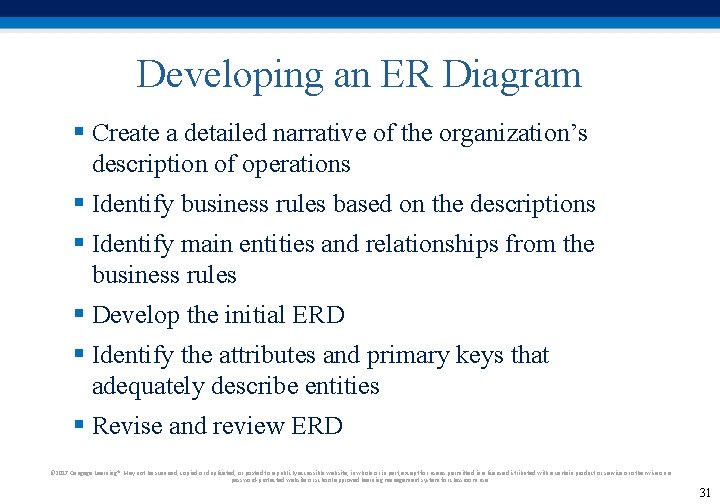
Developing an ER Diagram § Create a detailed narrative of the organization’s description of operations § Identify business rules based on the descriptions § Identify main entities and relationships from the business rules § Develop the initial ERD § Identify the attributes and primary keys that adequately describe entities § Revise and review ERD © 2017 Cengage Learning®. May not be scanned, copied or duplicated, or posted to a publicly accessible website, in whole or in part, except for use as permitted in a license distributed with a certain product or service or otherwise on a password-protected website or school-approved learning management system for classroom use. 31
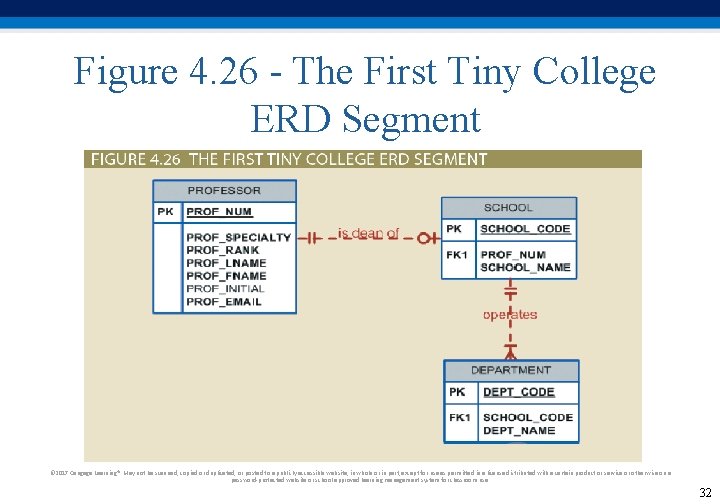
Figure 4. 26 - The First Tiny College ERD Segment © 2017 Cengage Learning®. May not be scanned, copied or duplicated, or posted to a publicly accessible website, in whole or in part, except for use as permitted in a license distributed with a certain product or service or otherwise on a password-protected website or school-approved learning management system for classroom use. 32
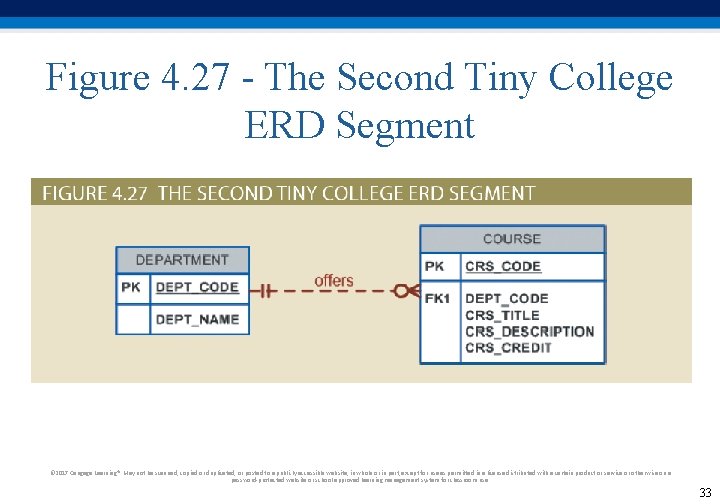
Figure 4. 27 - The Second Tiny College ERD Segment © 2017 Cengage Learning®. May not be scanned, copied or duplicated, or posted to a publicly accessible website, in whole or in part, except for use as permitted in a license distributed with a certain product or service or otherwise on a password-protected website or school-approved learning management system for classroom use. 33
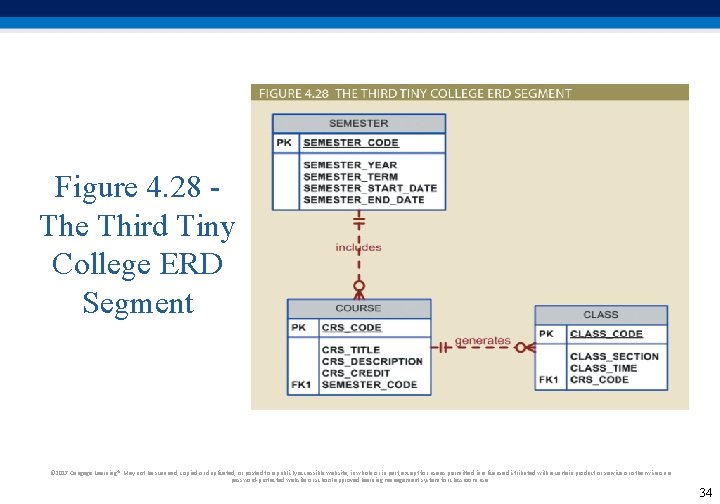
Figure 4. 28 The Third Tiny College ERD Segment © 2017 Cengage Learning®. May not be scanned, copied or duplicated, or posted to a publicly accessible website, in whole or in part, except for use as permitted in a license distributed with a certain product or service or otherwise on a password-protected website or school-approved learning management system for classroom use. 34
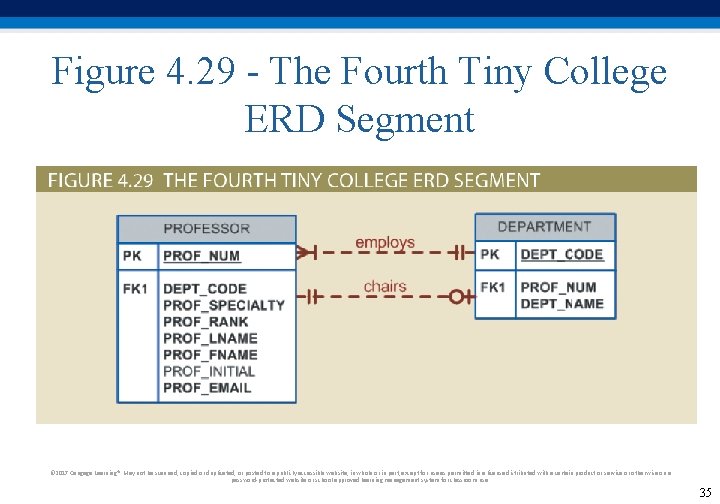
Figure 4. 29 - The Fourth Tiny College ERD Segment © 2017 Cengage Learning®. May not be scanned, copied or duplicated, or posted to a publicly accessible website, in whole or in part, except for use as permitted in a license distributed with a certain product or service or otherwise on a password-protected website or school-approved learning management system for classroom use. 35
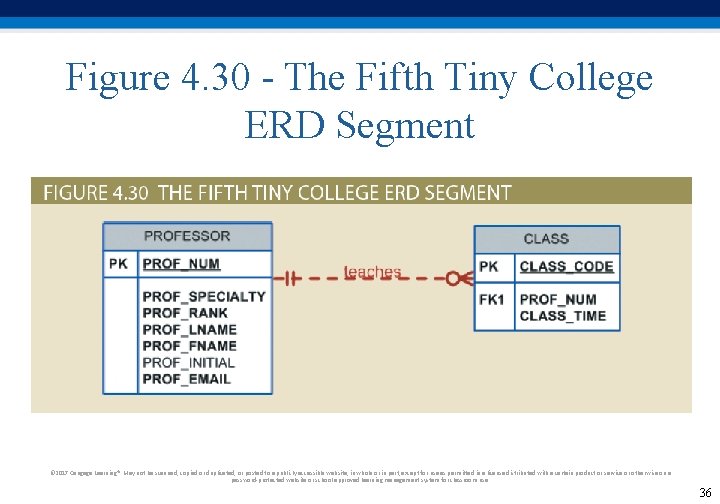
Figure 4. 30 - The Fifth Tiny College ERD Segment © 2017 Cengage Learning®. May not be scanned, copied or duplicated, or posted to a publicly accessible website, in whole or in part, except for use as permitted in a license distributed with a certain product or service or otherwise on a password-protected website or school-approved learning management system for classroom use. 36
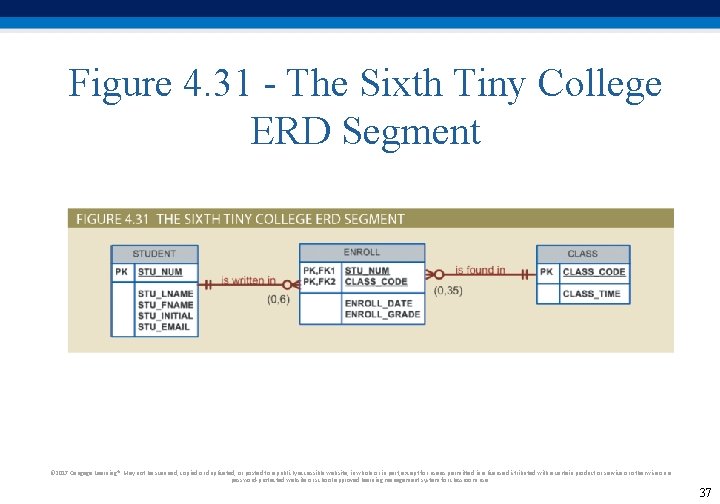
Figure 4. 31 - The Sixth Tiny College ERD Segment © 2017 Cengage Learning®. May not be scanned, copied or duplicated, or posted to a publicly accessible website, in whole or in part, except for use as permitted in a license distributed with a certain product or service or otherwise on a password-protected website or school-approved learning management system for classroom use. 37
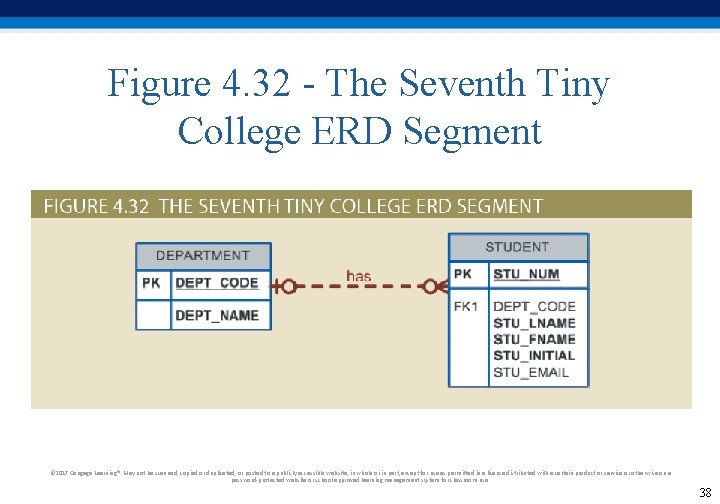
Figure 4. 32 - The Seventh Tiny College ERD Segment © 2017 Cengage Learning®. May not be scanned, copied or duplicated, or posted to a publicly accessible website, in whole or in part, except for use as permitted in a license distributed with a certain product or service or otherwise on a password-protected website or school-approved learning management system for classroom use. 38
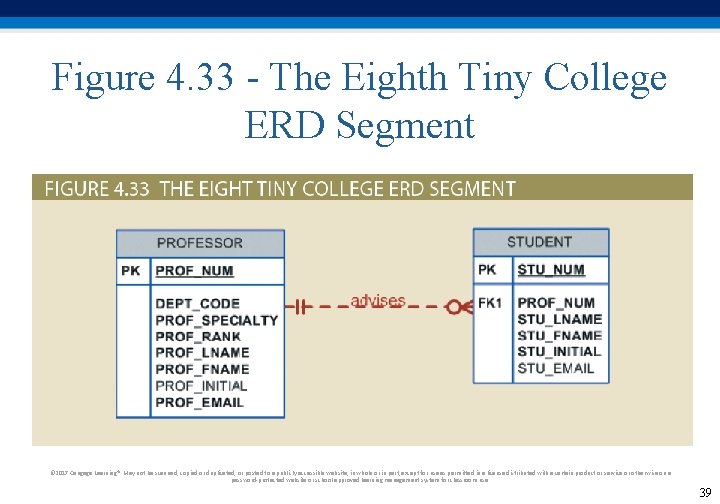
Figure 4. 33 - The Eighth Tiny College ERD Segment © 2017 Cengage Learning®. May not be scanned, copied or duplicated, or posted to a publicly accessible website, in whole or in part, except for use as permitted in a license distributed with a certain product or service or otherwise on a password-protected website or school-approved learning management system for classroom use. 39
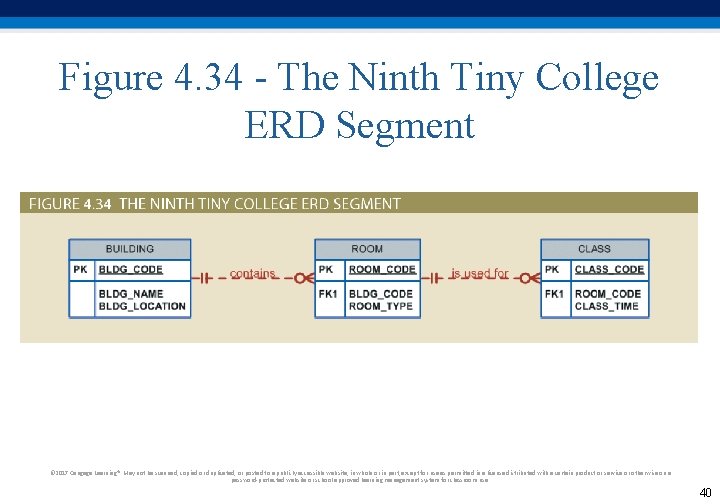
Figure 4. 34 - The Ninth Tiny College ERD Segment © 2017 Cengage Learning®. May not be scanned, copied or duplicated, or posted to a publicly accessible website, in whole or in part, except for use as permitted in a license distributed with a certain product or service or otherwise on a password-protected website or school-approved learning management system for classroom use. 40
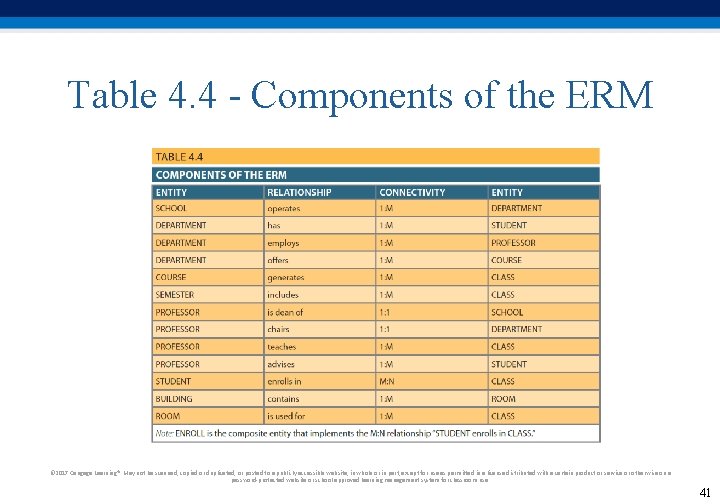
Table 4. 4 - Components of the ERM © 2017 Cengage Learning®. May not be scanned, copied or duplicated, or posted to a publicly accessible website, in whole or in part, except for use as permitted in a license distributed with a certain product or service or otherwise on a password-protected website or school-approved learning management system for classroom use. 41
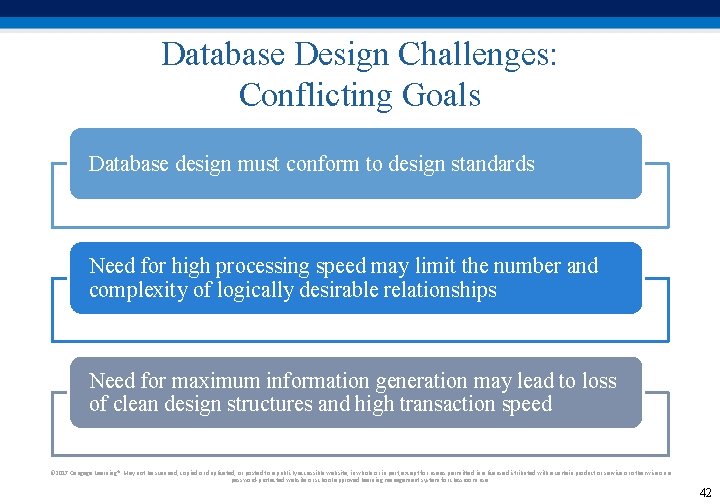
Database Design Challenges: Conflicting Goals Database design must conform to design standards Need for high processing speed may limit the number and complexity of logically desirable relationships Need for maximum information generation may lead to loss of clean design structures and high transaction speed © 2017 Cengage Learning®. May not be scanned, copied or duplicated, or posted to a publicly accessible website, in whole or in part, except for use as permitted in a license distributed with a certain product or service or otherwise on a password-protected website or school-approved learning management system for classroom use. 42
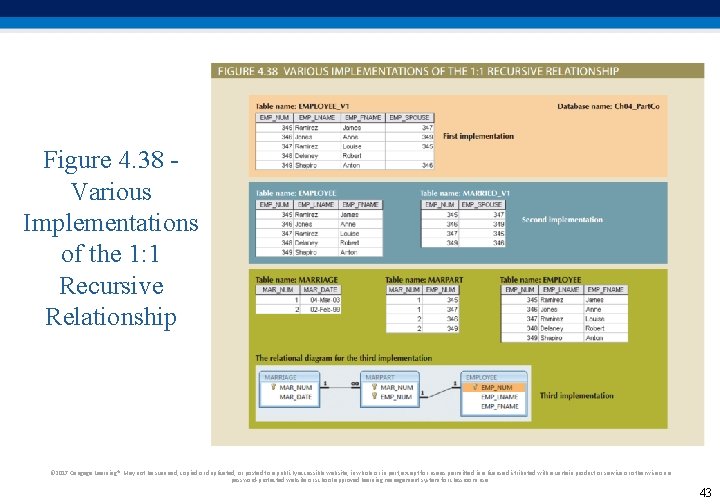
Figure 4. 38 Various Implementations of the 1: 1 Recursive Relationship © 2017 Cengage Learning®. May not be scanned, copied or duplicated, or posted to a publicly accessible website, in whole or in part, except for use as permitted in a license distributed with a certain product or service or otherwise on a password-protected website or school-approved learning management system for classroom use. 43