
Chapter 4 Elements Compounds and Mixtures Section 1

- Slides: 29
Chapter 4 Elements, Compounds, and Mixtures
Section 1 - Elements n Terms to Learn – Element – Pure Substance – Metals – Nonmetals – Metalloids
Elements n n Element is a pure substance that cannot be separated into simpler substances by physical or chemical means Has only one type of particle A hunk of gold is made of many particles but they are all the same A Meteorite has the same iron in it as your pans
Elements n Every element has a unique set of properties (characteristic properties) – Characteristic properties do not depend on the amount of the substance – Can be either physical or chemical properties (boiling point, melting point, reactivity with acid, density) – Used to identify the element
Groups Categories – metals, nonmetals, metalloids n Grouped together by their shared properties. (music store) n
Metals Shiny and good conductors of thermal energy and electric current. n Malleable (can be hammered into thin sheets) n Ductile (they can be drawn into thin wires) n
Non Metals Dull (not shiny) and are poor conductors of thermal energy and electric current n Solid non metals tend to be brittle and unmalleable (graphite) n
Metalloids Also called semiconductors n Have properties of both metals and nonmetals. n Some are shiny while others are dull n Somewhat malleable and ductile n Some conduct thermal energy and electricity n Examples – Silicon, Antimony, Boron n
Section 2 - Compounds n Terms to Learn – Compound
Compounds Compound is a pure substance composed of two or more elements that are chemically combined n In order for a compound to be made the two elements have to react (undergo a chemical change) n
Water n Water is always H 2 O. It is always 1 gram of Hydrogen to 8 grams of Oxygen. If it were different mass ratio then it could not be water.
Compounds n n n Like elements each compound has a unique set of characteristics like boiling point, melting point, density, and color A compound has different properties from the elements that formed it Table salt (Na. Cl) is formed from sodium which reacts violently with water and chloride which is poisonous.
Some compounds can be broken down into simpler substances through chemical changes n Table salt if electrified breaks into sodium and chloride n Compounds cannot be broken down by physical changes n
Compounds in your World Nitrogen is needed for life and you get nitrogen from animals that eat it in plants that obtain it from the soil. n Aluminum that is used in cans is not found alone in nature it is broken down by humans from aluminum oxide n
Section 3 - Mixtures n Terms to Learn – – – – Mixture Solution Solute Solvent Concentration Solubility Suspension Colloid
Properties of Mixtures All mixtures share certain properties n A mixture is a combination of two or more substances that are not chemically combined n – Two or more materials together form a mixture if they do not react to form a compound
Properties of mixtures Substances in a mixture keep their chemical makeup, they are just mixed together n Mixtures can be physically separated whereas compounds can only be broken down through chemical changes n
Ways to separate mixtures Distillation – separates based on the boiling points of the components n Magnets – can be used to separate anything iron n Centrifuge – Separates using the densities of the components n
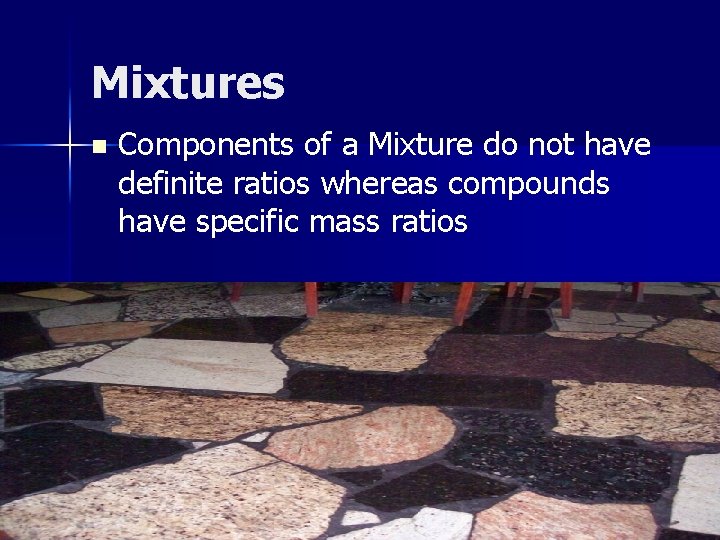
Mixtures n Components of a Mixture do not have definite ratios whereas compounds have specific mass ratios
Mixtures vs Compounds n n Components are elements, compounds, or both Components keep their original properties Separated by physical means Formed using any ratios n n Components are elements Components lose their original properties Separated by chemical means Formed using a set mass ratio of components
Solutions n Solution is a mixture that appears to be a single substance but is composed of two or more substances that are evenly distributed. – Often called homogenous mixture because they have the same appearance and properties
Solutions n n Dissolving is the process where particles of substances separate and spread evenly throughout the mixture Solute is the substance being dissolved Solvent is the substance doing the dissolving If it is soluble then it is able to be dissolved if it in insoluble then it would be a mixture not a solution
Example of a Solution Salt water n Which is the solute n Which is the solvent n Substance with the greater volume is the solvent n
Solutions can also be air, Gasoline, and soda n Alloys are solid solutions of metals and nonmetals dissolved in metals n Particles in solutions are extremely small and never settle out n
Concentration is a measure of the amount of solute dissolved in a solvent (g/m. L) n Solutions can be concentrated or dilute n It is saturated if it can not hold any more solute, if it can hold more then it is unsaturated n
Solubility is the amount of solute needed to make a saturated solution with a given amount of solvent n Mixing, Heating, or Crushing the solid helps it dissolve faster n
Suspension is a mixture in which particles of a material are dispersed throughout a liquid or a gas but are large enough to settle out n Also called Heterogeneous mixtures because you can see the particles n
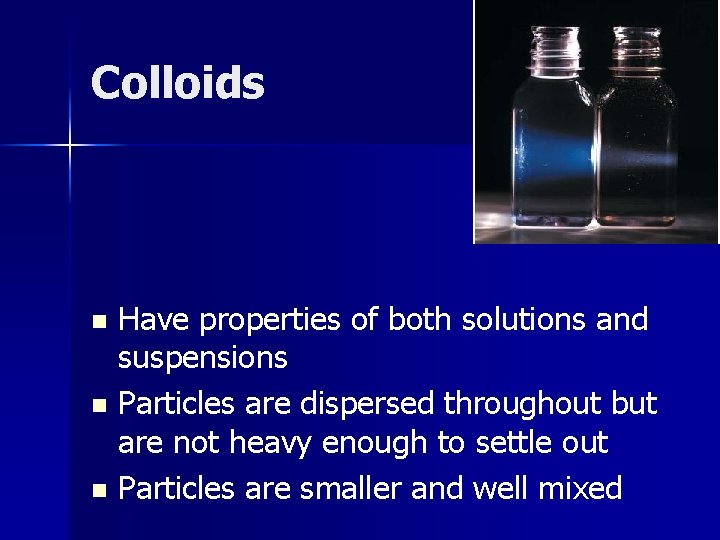
Colloids Have properties of both solutions and suspensions n Particles are dispersed throughout but are not heavy enough to settle out n Particles are smaller and well mixed n