
CHAPTER 4 ELEMENTS AND ATOMS THE ELEMENTS 400
- Slides: 39
CHAPTER 4 – ELEMENTS AND ATOMS THE ELEMENTS 400 BC Greeks thought there were 4 elements: Earth, Wind, Fire, Water 2017 AD There are 118 known elements (94 that occur naturally) 2 B-1 (of 39) (5 – 17 -18 + 1 -21) (6 – 22 -33) (7 – 34 -39 + 1 -22)
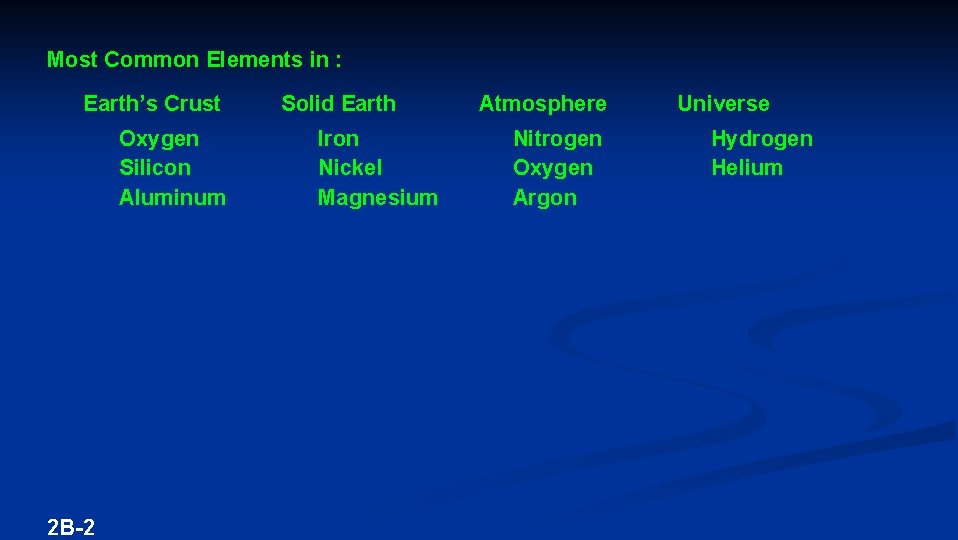
Most Common Elements in : Earth’s Crust Oxygen Silicon Aluminum 2 B-2 Solid Earth Iron Nickel Magnesium Atmosphere Nitrogen Oxygen Argon Universe Hydrogen Helium
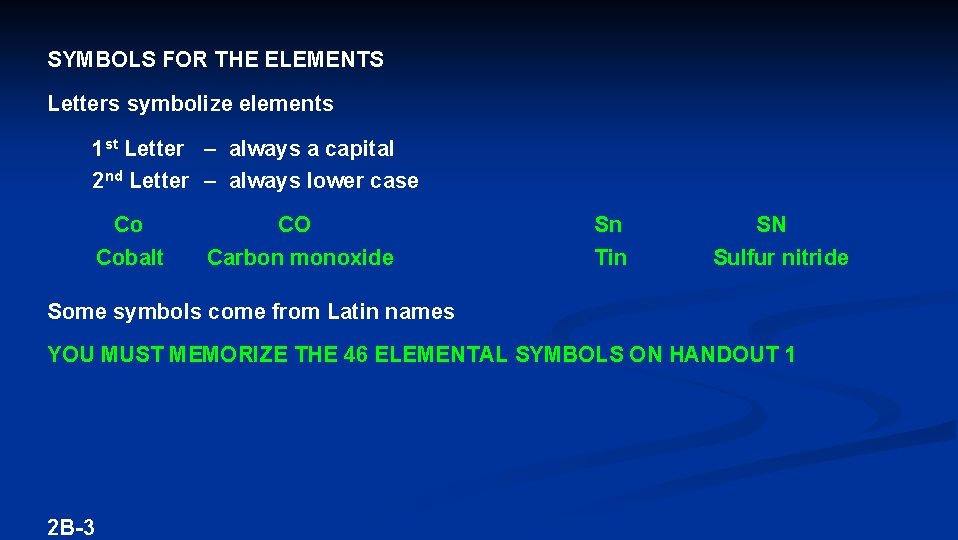
SYMBOLS FOR THE ELEMENTS Letters symbolize elements 1 st Letter – always a capital 2 nd Letter – always lower case Co Cobalt CO Carbon monoxide Sn Tin SN Sulfur nitride Some symbols come from Latin names YOU MUST MEMORIZE THE 46 ELEMENTAL SYMBOLS ON HANDOUT 1 2 B-3
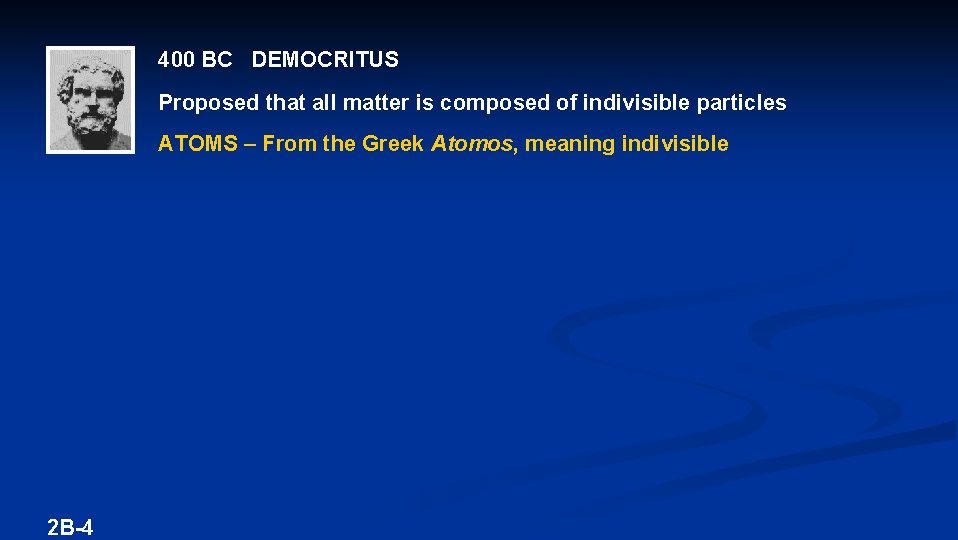
400 BC DEMOCRITUS Proposed that all matter is composed of indivisible particles ATOMS – From the Greek Atomos, meaning indivisible 2 B-4
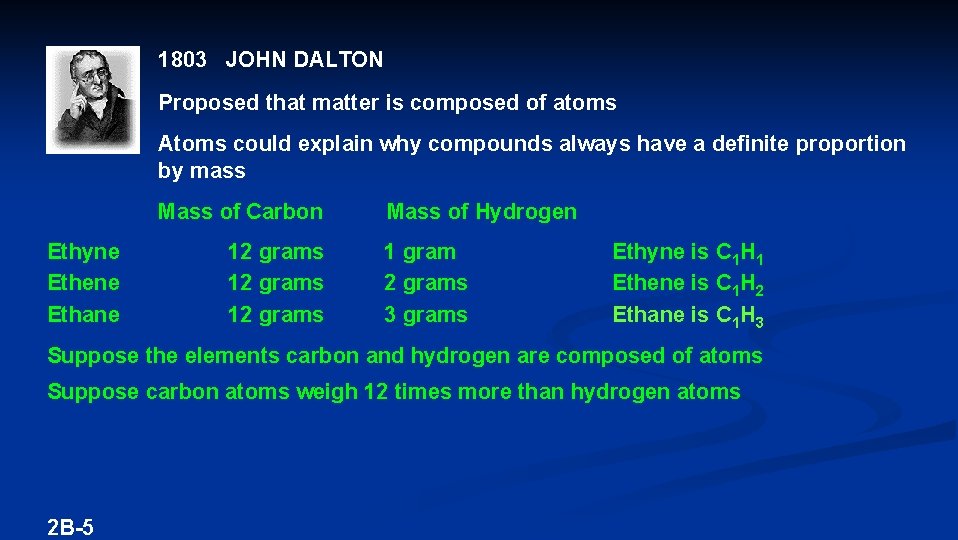
1803 JOHN DALTON Proposed that matter is composed of atoms Atoms could explain why compounds always have a definite proportion by mass Mass of Carbon Ethyne Ethene Ethane 12 grams Mass of Hydrogen 1 gram 2 grams 3 grams Ethyne is C 1 H 1 Ethene is C 1 H 2 Ethane is C 1 H 3 Suppose the elements carbon and hydrogen are composed of atoms Suppose carbon atoms weigh 12 times more than hydrogen atoms 2 B-5
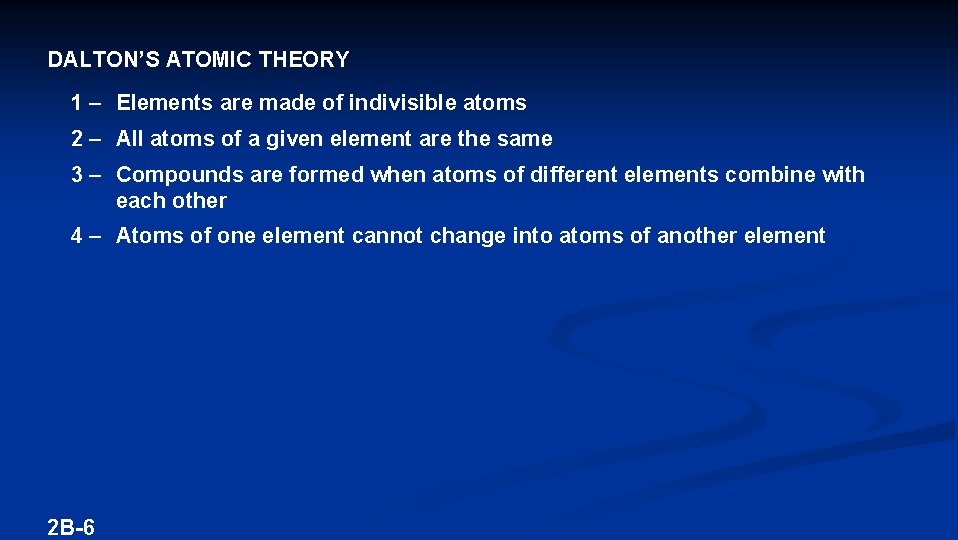
DALTON’S ATOMIC THEORY 1 – Elements are made of indivisible atoms 2 – All atoms of a given element are the same 3 – Compounds are formed when atoms of different elements combine with each other 4 – Atoms of one element cannot change into atoms of another element 2 B-6
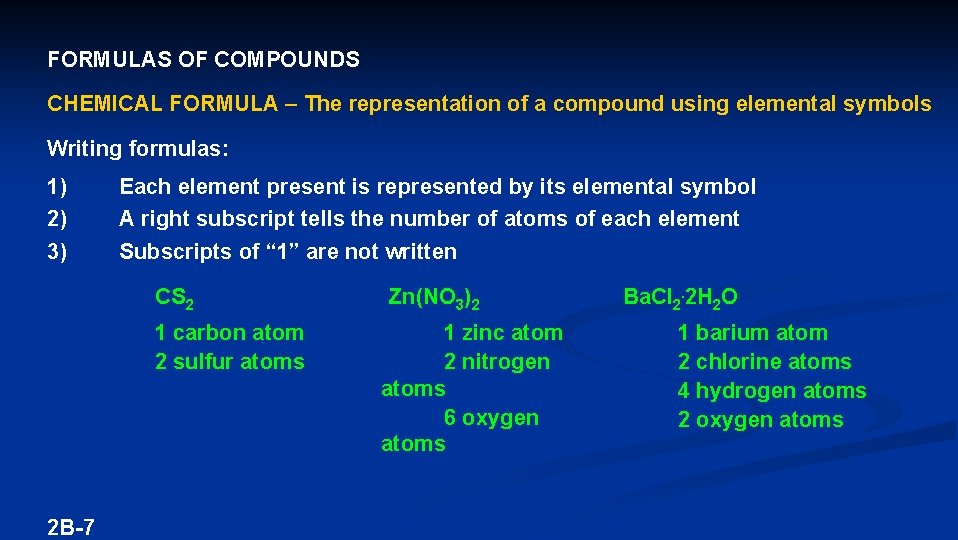
FORMULAS OF COMPOUNDS CHEMICAL FORMULA – The representation of a compound using elemental symbols Writing formulas: 1) 2) 3) Each element present is represented by its elemental symbol A right subscript tells the number of atoms of each element Subscripts of “ 1” are not written CS 2 1 carbon atom 2 sulfur atoms 2 B-7 Zn(NO 3)2 1 zinc atom 2 nitrogen atoms 6 oxygen atoms Ba. Cl 2. 2 H 2 O 1 barium atom 2 chlorine atoms 4 hydrogen atoms 2 oxygen atoms
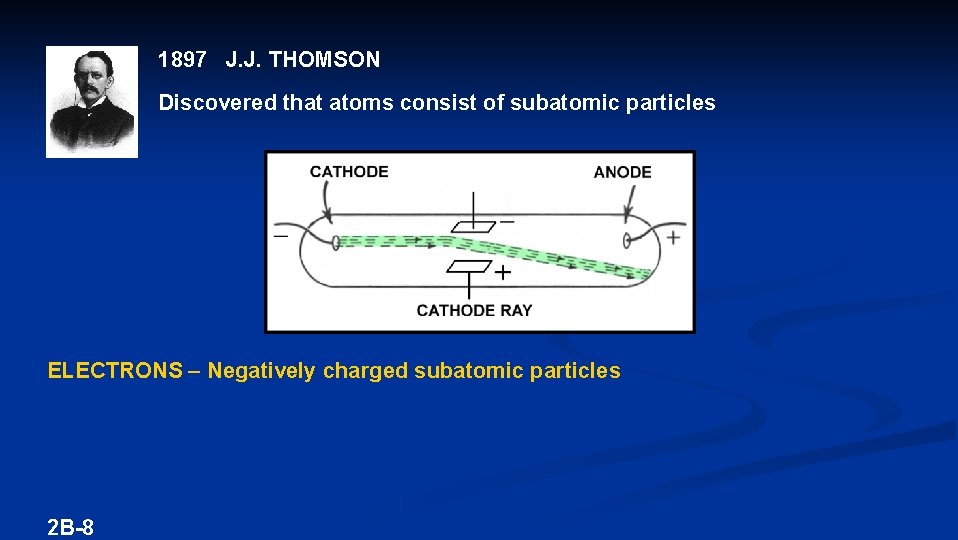
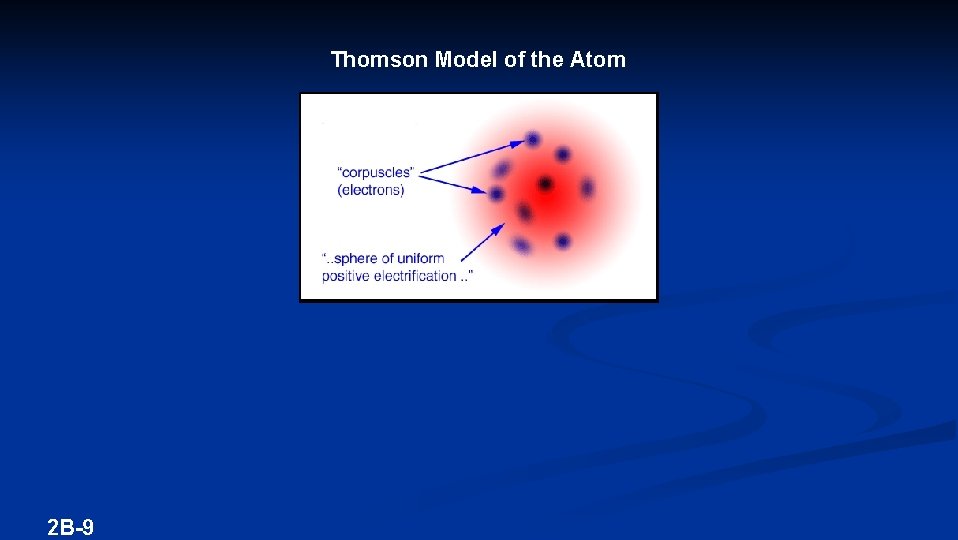
1897 J. J. THOMSON Discovered that atoms consist of subatomic particles ELECTRONS – Negatively charged subatomic particles 2 B-8
Thomson Model of the Atom 2 B-9
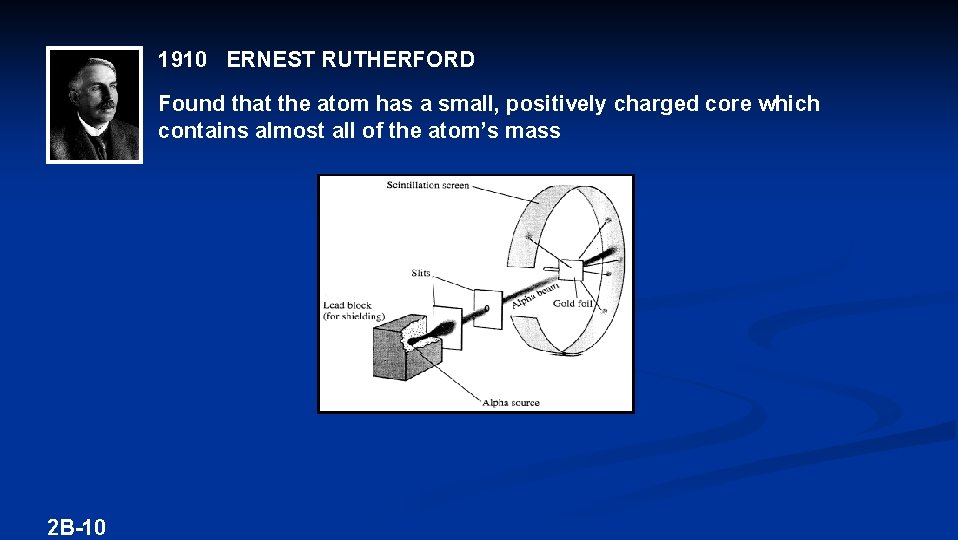
1910 ERNEST RUTHERFORD Found that the atom has a small, positively charged core which contains almost all of the atom’s mass 2 B-10
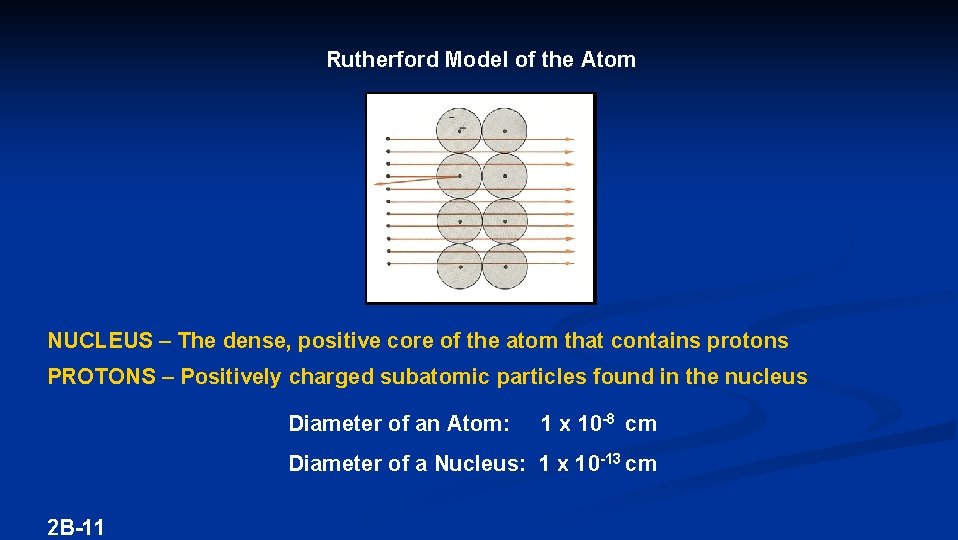
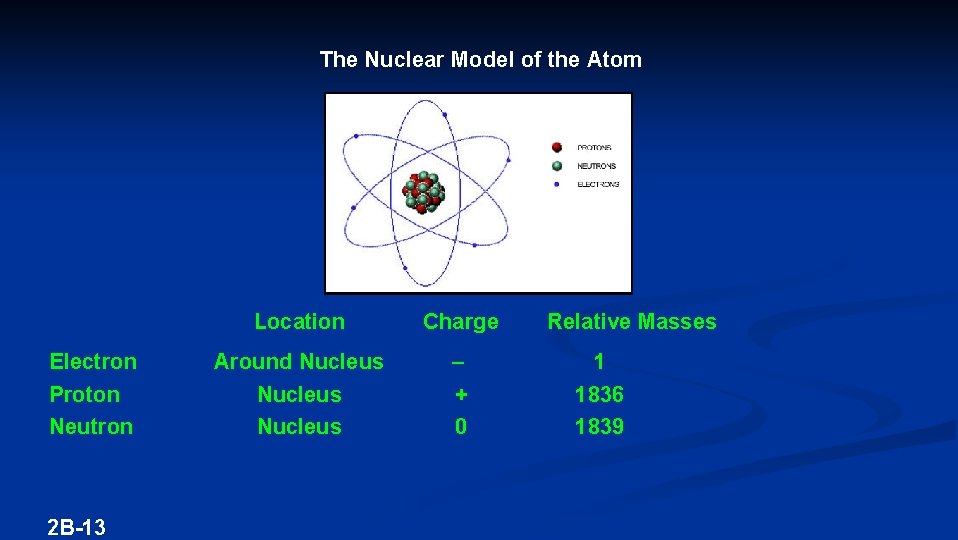
Rutherford Model of the Atom NUCLEUS – The dense, positive core of the atom that contains protons PROTONS – Positively charged subatomic particles found in the nucleus Diameter of an Atom: 1 x 10 -8 cm Diameter of a Nucleus: 1 x 10 -13 cm 2 B-11
1932 JAMES CHADWICK Discovered a third subatomic particle This subatomic particle was found the in nuclei of atoms NEUTRONS – Neutral subatomic particles 2 B-12
The Nuclear Model of the Atom Electron Proton Neutron 2 B-13 Location Charge Around Nucleus – + 0 Relative Masses 1 1836 1839
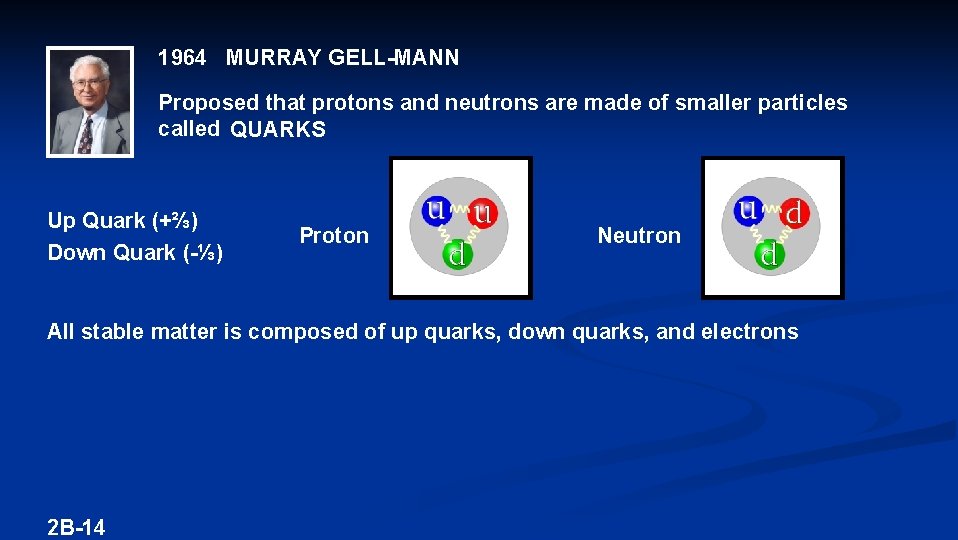
1964 MURRAY GELL-MANN Proposed that protons and neutrons are made of smaller particles called QUARKS Up Quark (+⅔) Down Quark (-⅓) Proton Neutron All stable matter is composed of up quarks, down quarks, and electrons 2 B-14
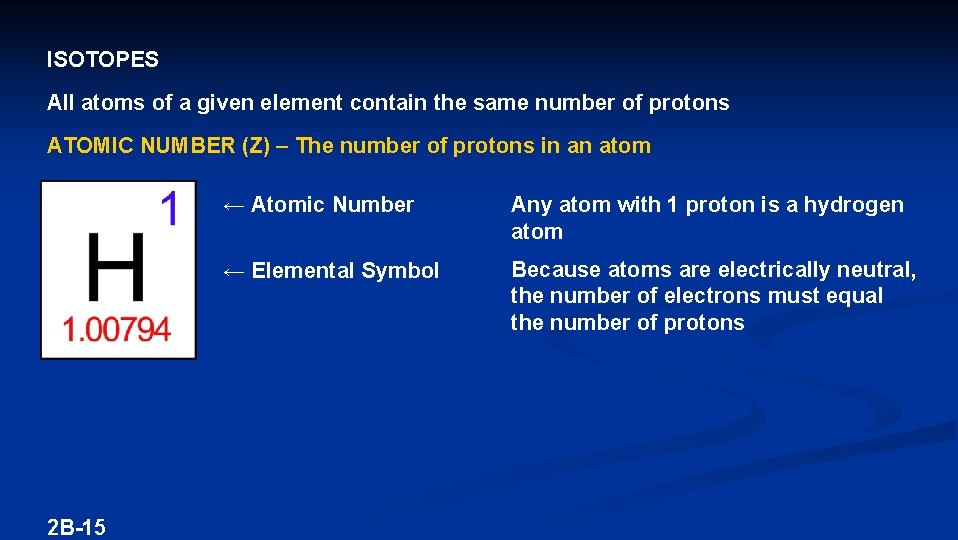
ISOTOPES All atoms of a given element contain the same number of protons ATOMIC NUMBER (Z) – The number of protons in an atom 2 B-15 ← Atomic Number Any atom with 1 proton is a hydrogen atom ← Elemental Symbol Because atoms are electrically neutral, the number of electrons must equal the number of protons
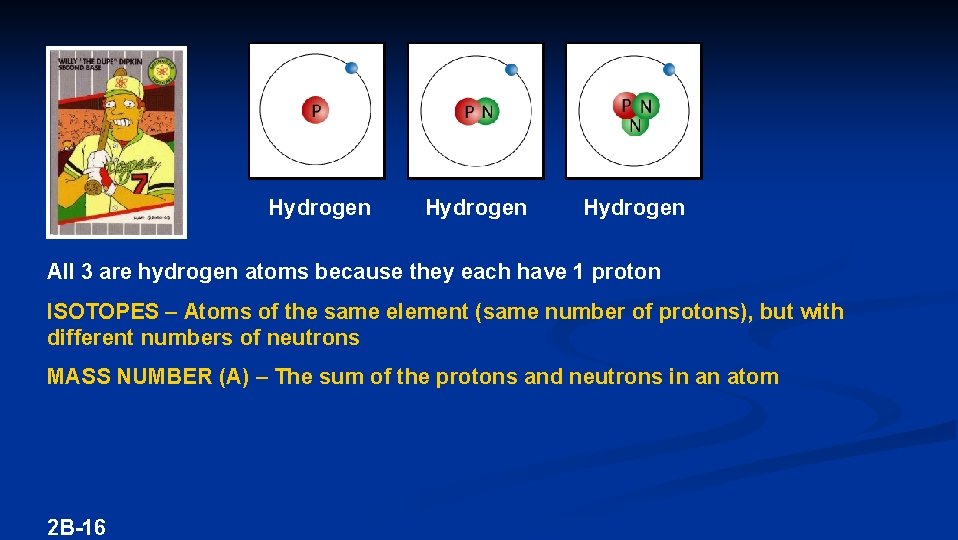
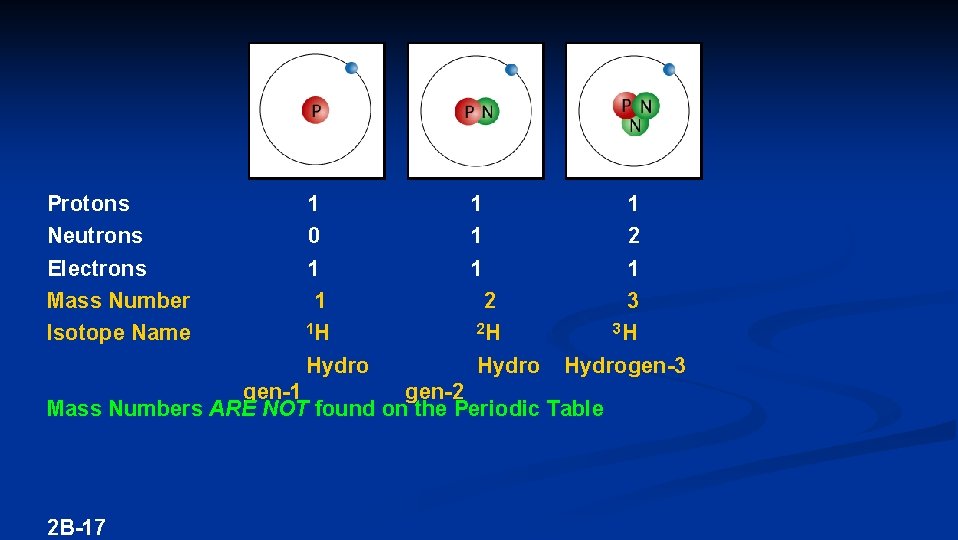
Hydrogen All 3 are hydrogen atoms because they each have 1 proton ISOTOPES – Atoms of the same element (same number of protons), but with different numbers of neutrons MASS NUMBER (A) – The sum of the protons and neutrons in an atom 2 B-16
Protons Neutrons Electrons Mass Number Isotope Name 1 0 1 1 1 H Hydro 1 1 1 2 2 H Hydro 1 2 1 3 3 H Hydrogen-3 gen-1 gen-2 Mass Numbers ARE NOT found on the Periodic Table 2 B-17
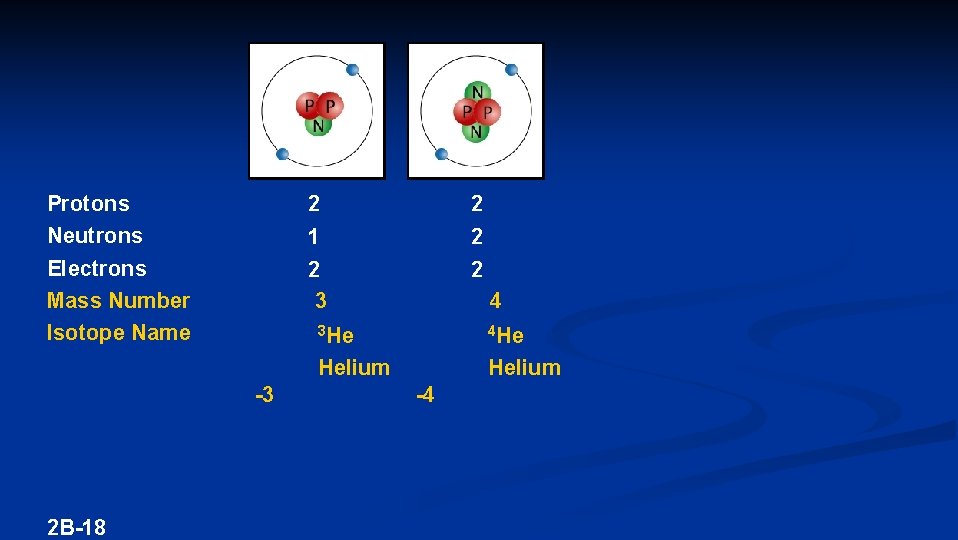
Protons Neutrons Electrons Mass Number Isotope Name 2 1 2 3 -3 2 B-18 2 2 2 4 3 He 4 He Helium -4
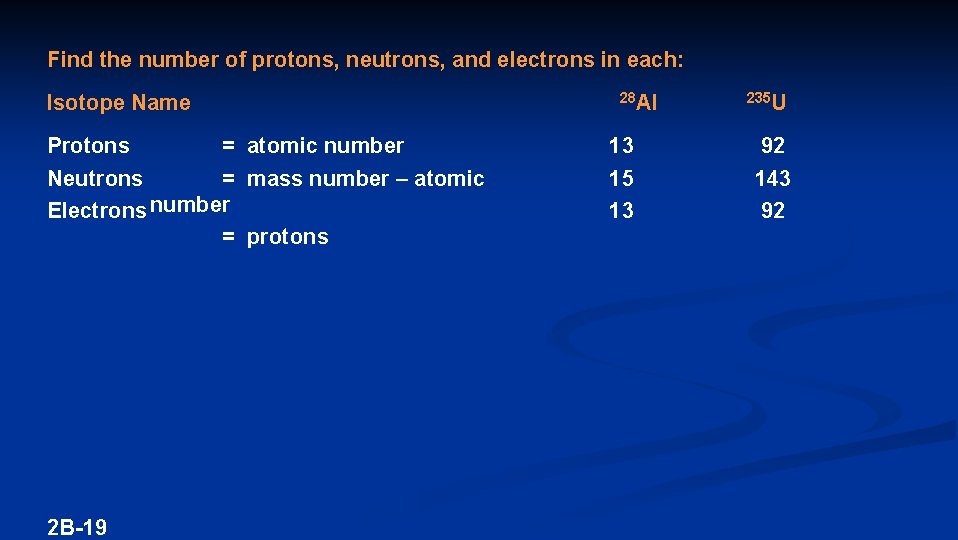
Find the number of protons, neutrons, and electrons in each: Isotope Name Protons = atomic number Neutrons = mass number – atomic Electrons number = protons 2 B-19 28 Al 13 15 13 235 U 92 143 92
THE PERIODIC TABLE An arrangement of the chemical elements in order of atomic number, with elements having similar properties placed in columns 2 B-20
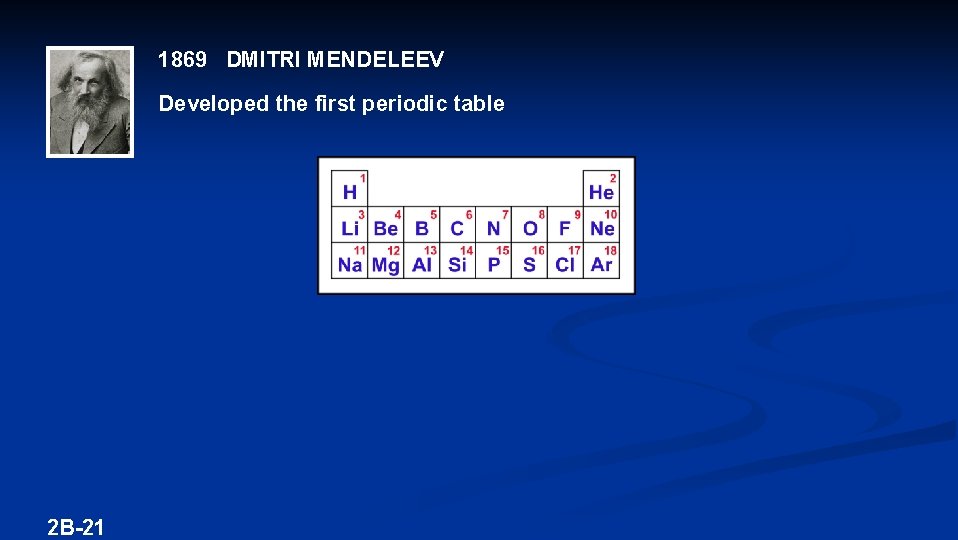
1869 DMITRI MENDELEEV Developed the first periodic table 2 B-21
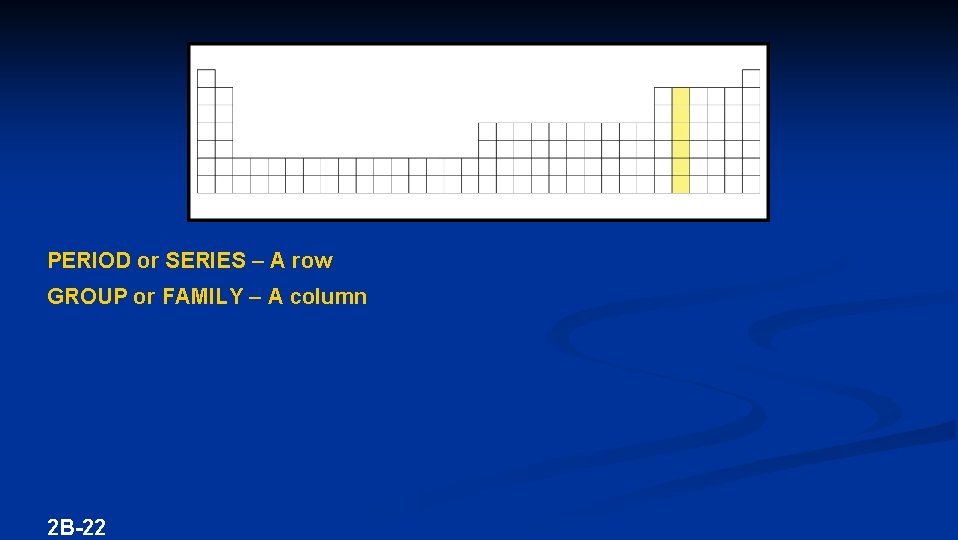
PERIOD or SERIES – A row GROUP or FAMILY – A column 2 B-22
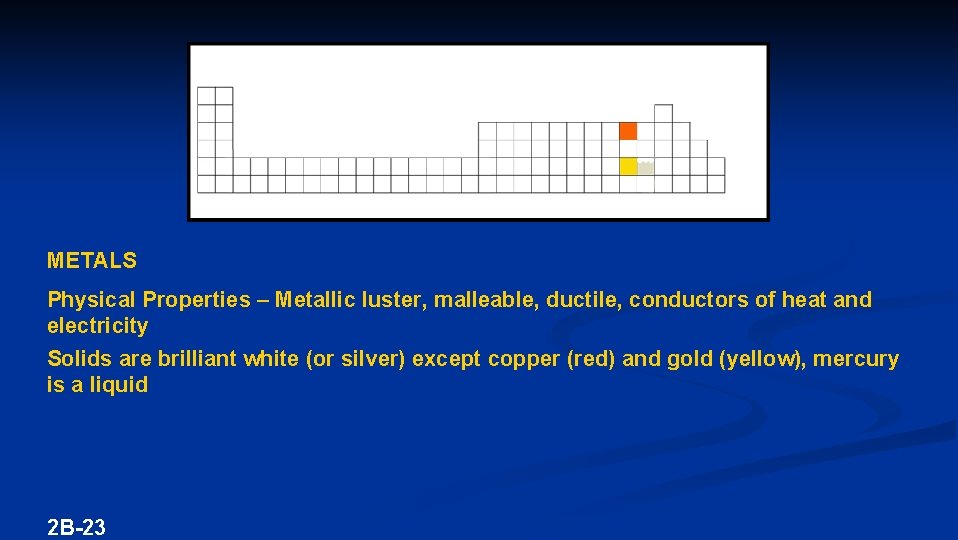
METALS Physical Properties – Metallic luster, malleable, ductile, conductors of heat and electricity Solids are brilliant white (or silver) except copper (red) and gold (yellow), mercury is a liquid 2 B-23
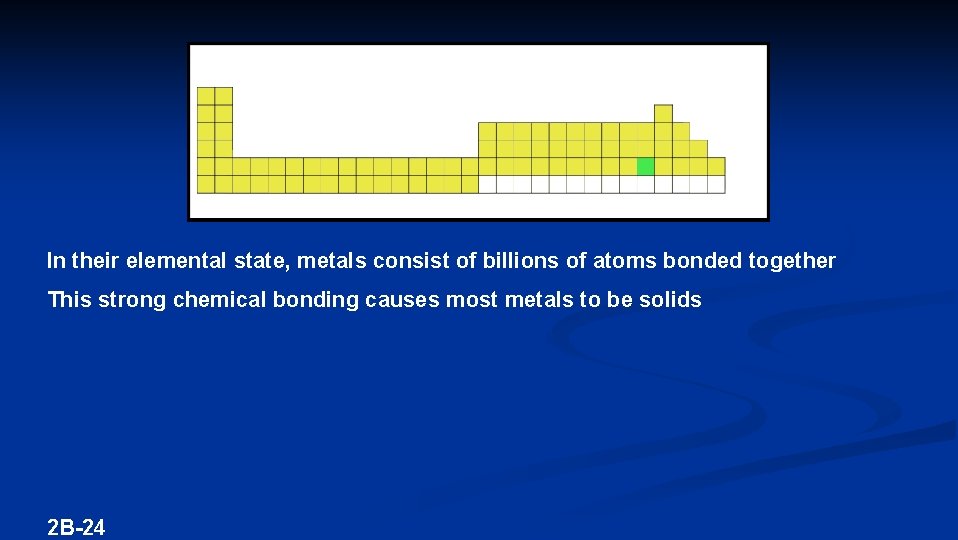
In their elemental state, metals consist of billions of atoms bonded together This strong chemical bonding causes most metals to be solids 2 B-24
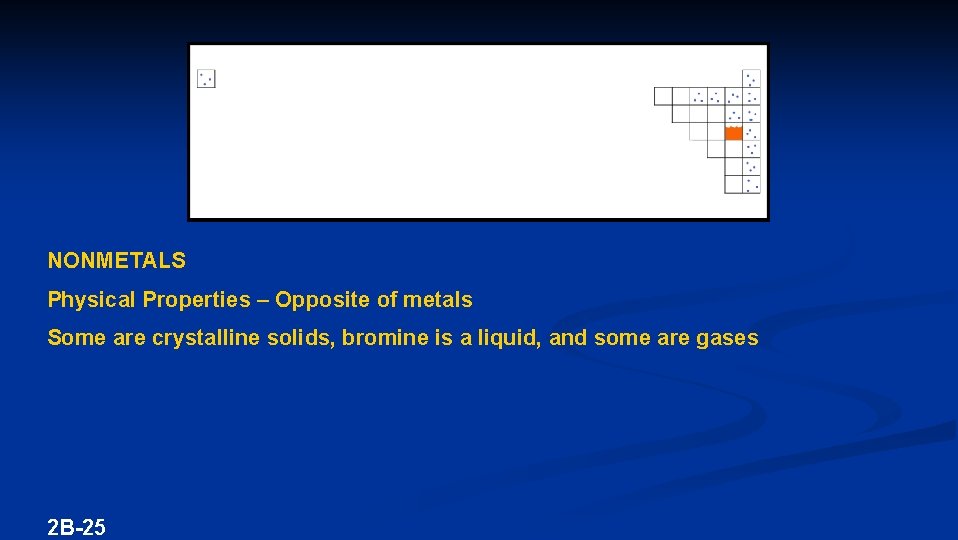
NONMETALS Physical Properties – Opposite of metals Some are crystalline solids, bromine is a liquid, and some are gases 2 B-25
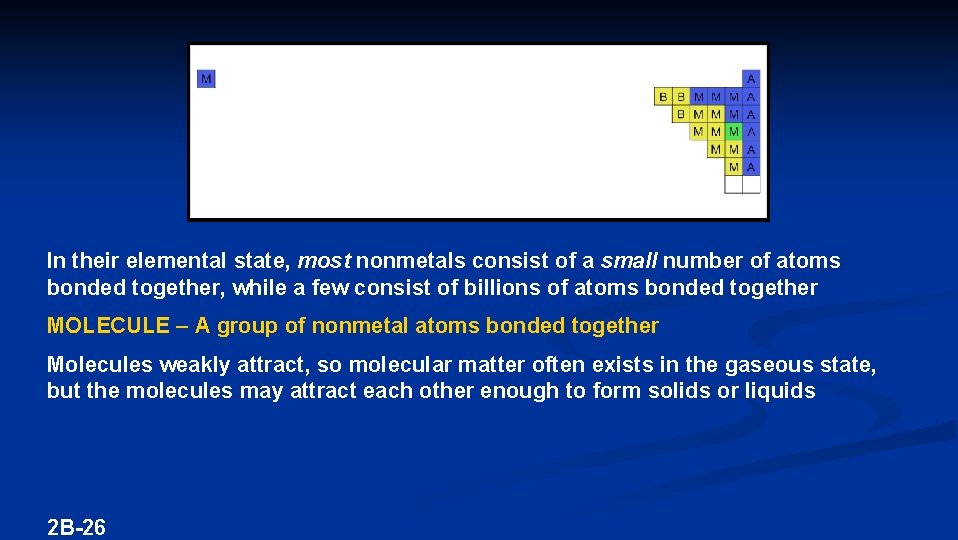
In their elemental state, most nonmetals consist of a small number of atoms bonded together, while a few consist of billions of atoms bonded together MOLECULE – A group of nonmetal atoms bonded together Molecules weakly attract, so molecular matter often exists in the gaseous state, but the molecules may attract each other enough to form solids or liquids 2 B-26
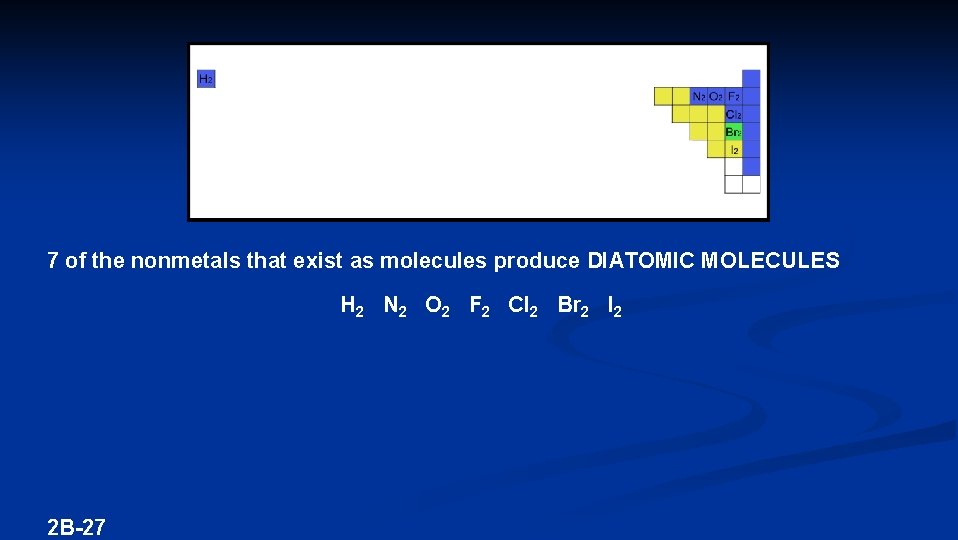
7 of the nonmetals that exist as molecules produce DIATOMIC MOLECULES H 2 N 2 O 2 F 2 Cl 2 Br 2 I 2 2 B-27
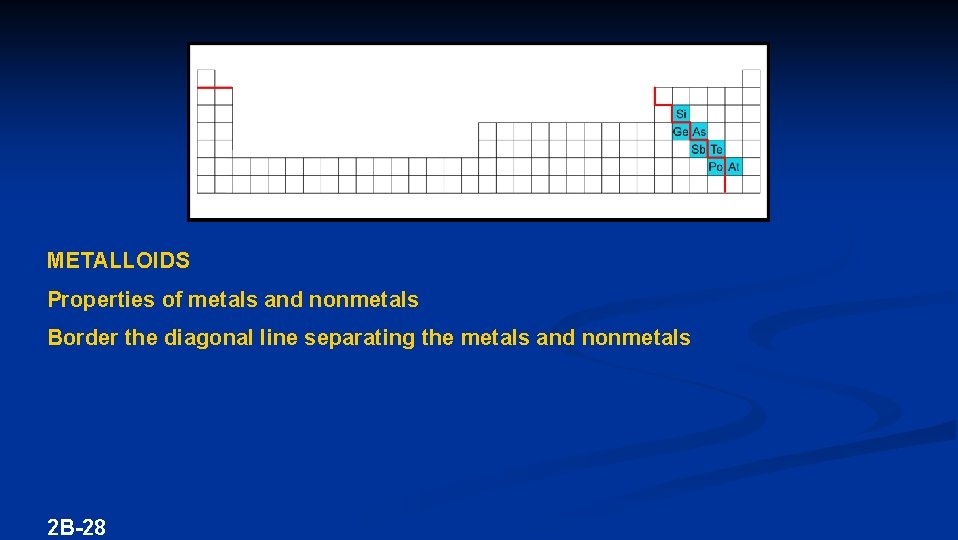
METALLOIDS Properties of metals and nonmetals Border the diagonal line separating the metals and nonmetals 2 B-28
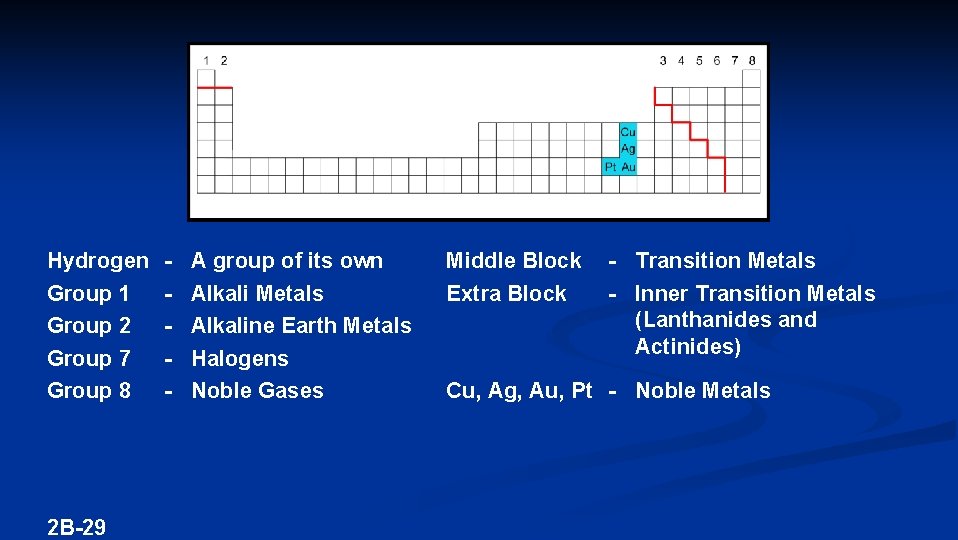
Hydrogen Group 1 Group 2 Group 7 Group 8 2 B-29 - A group of its own Alkali Metals Alkaline Earth Metals Halogens Noble Gases Middle Block Extra Block - Transition Metals - Inner Transition Metals (Lanthanides and Actinides) Cu, Ag, Au, Pt - Noble Metals
NATURAL STATE OF MATTER Most elements are ACTIVE, so they easily form compounds Matter is mostly compounds, not elements INERT elements can be found in their elemental form 1) Noble Metals : Cu, Ag, Au, Pt 2) Noble Gases : He, Ne, Ar, Kr, Xe, Rn To see any other element in its elemental state, compounds must be decomposed 2 B-30
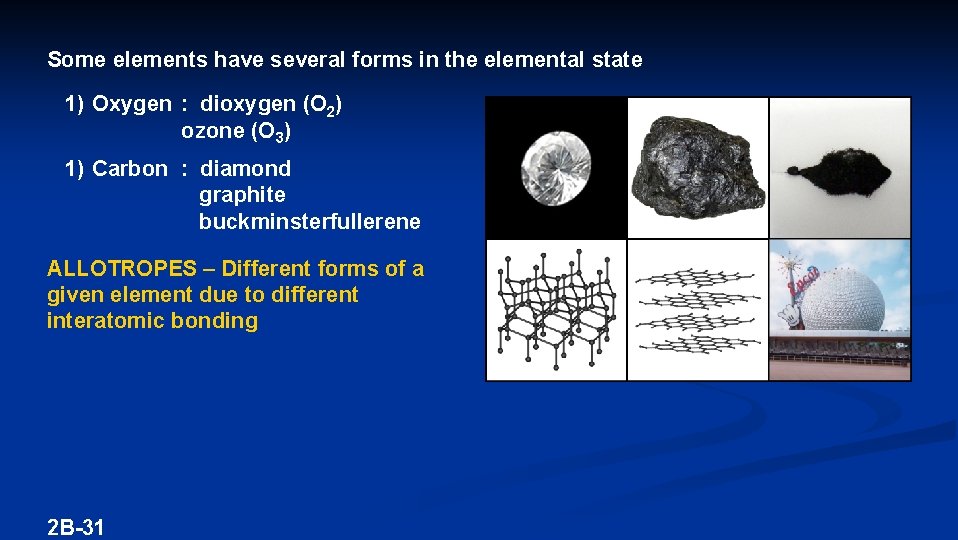
Some elements have several forms in the elemental state 1) Oxygen : dioxygen (O 2) ozone (O 3) 1) Carbon : diamond graphite buckminsterfullerene ALLOTROPES – Different forms of a given element due to different interatomic bonding 2 B-31
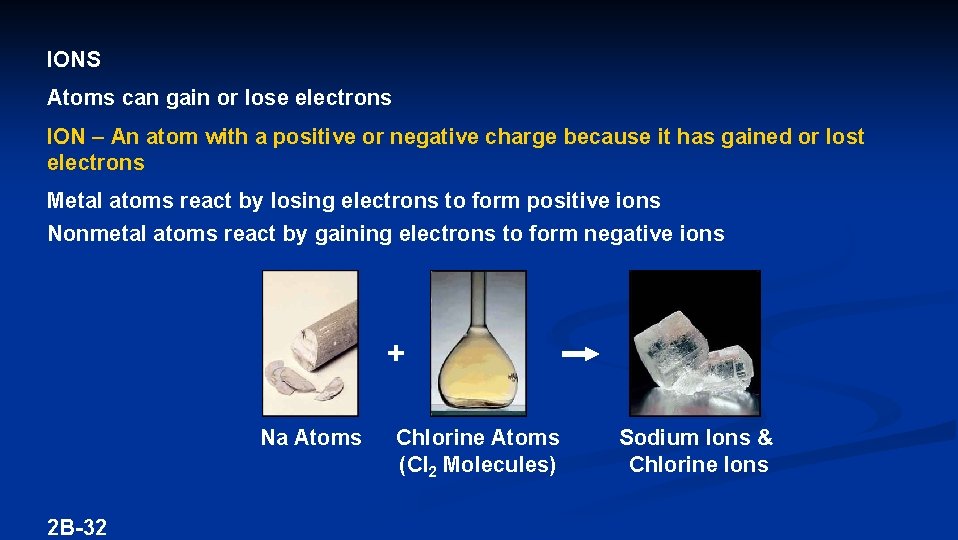
IONS Atoms can gain or lose electrons ION – An atom with a positive or negative charge because it has gained or lost electrons Metal atoms react by losing electrons to form positive ions Nonmetal atoms react by gaining electrons to form negative ions + Na Atoms 2 B-32 Chlorine Atoms (Cl 2 Molecules) Sodium Ions & Chlorine Ions
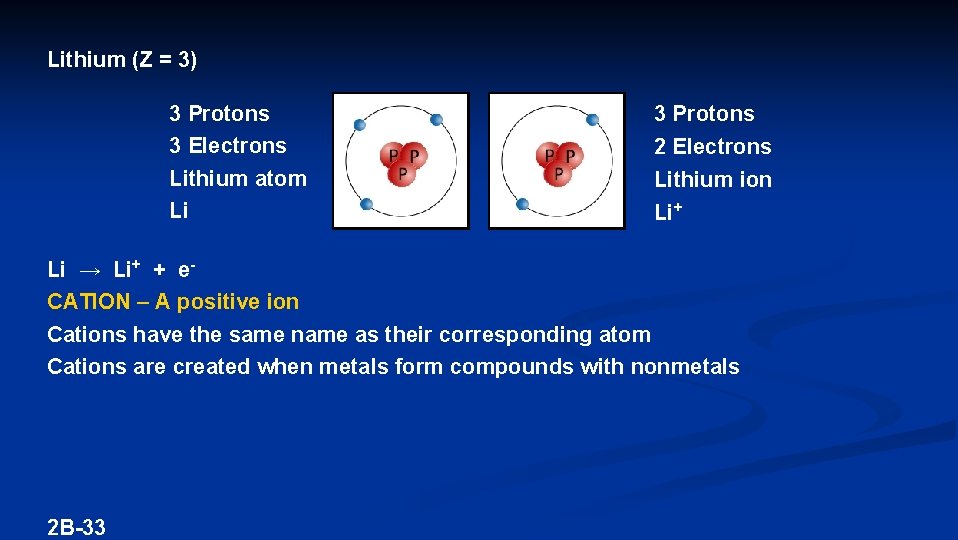
Lithium (Z = 3) 3 Protons 3 Electrons Lithium atom Li 3 Protons 2 Electrons Lithium ion Li+ Li → Li+ + e. CATION – A positive ion Cations have the same name as their corresponding atom Cations are created when metals form compounds with nonmetals 2 B-33
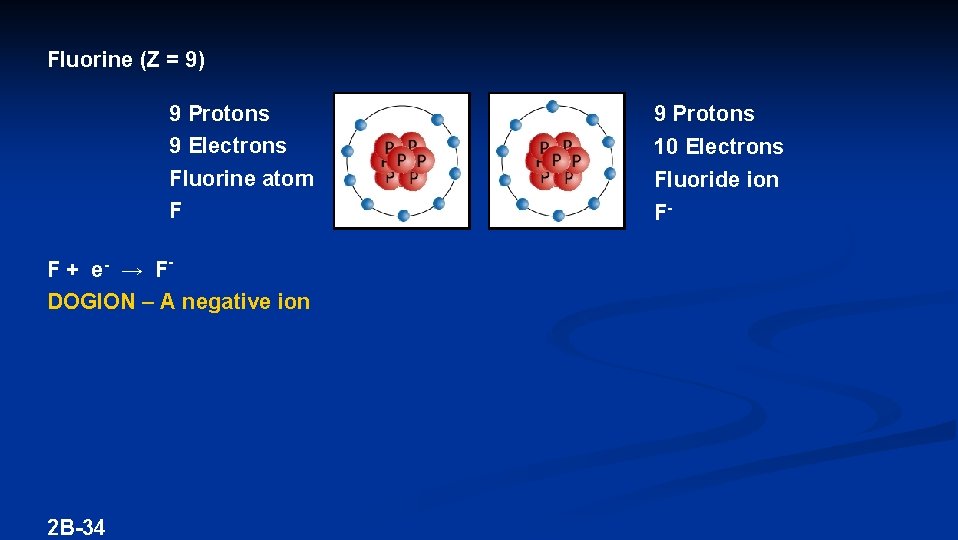
Fluorine (Z = 9) 9 Protons 9 Electrons Fluorine atom F F + e- → F DOGION – A negative ion 2 B-34 9 Protons 10 Electrons Fluoride ion F-
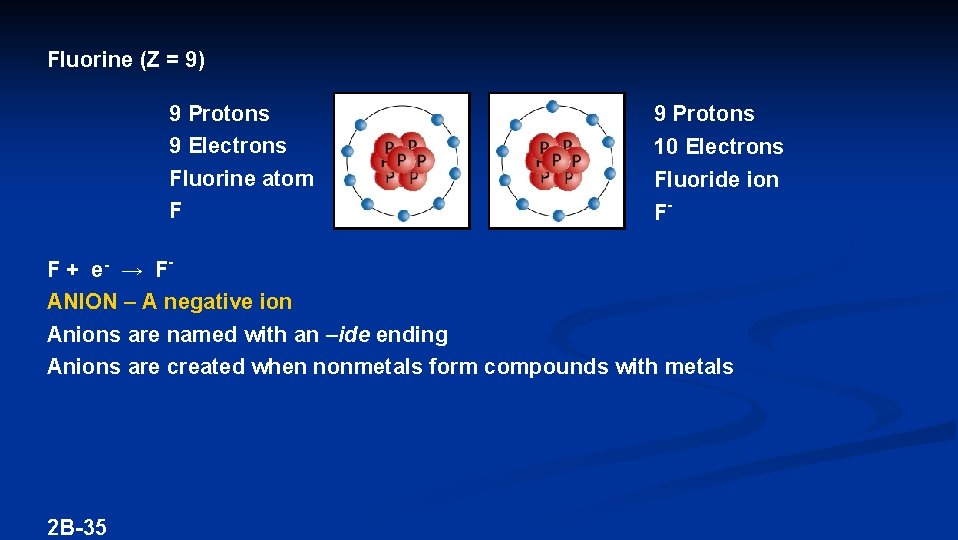
Fluorine (Z = 9) 9 Protons 9 Electrons Fluorine atom F 9 Protons 10 Electrons Fluoride ion F- F + e- → F ANION – A negative ion Anions are named with an –ide ending Anions are created when nonmetals form compounds with metals 2 B-35
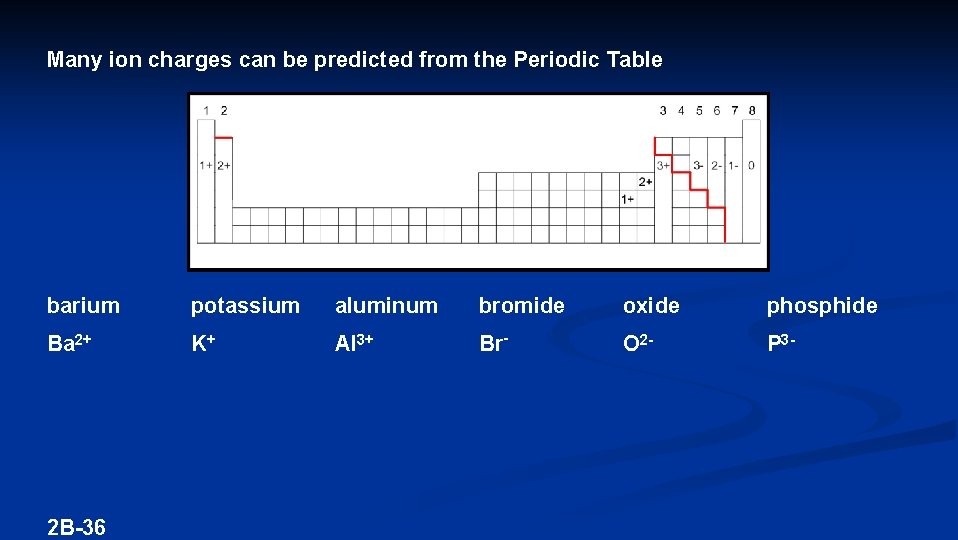
Many ion charges can be predicted from the Periodic Table barium potassium aluminum bromide oxide phosphide Ba 2+ K+ Al 3+ Br- O 2 - P 3 - 2 B-36
REVIEW FOR TEST 46 elemental names and symbols Solid, liquid, gas Substance, element, compound Heterogeneous, homogeneous Mixture, solution Physical and chemical changes Filtration Distillation 2 B-37
REVIEW FOR TEST Energy Specific heat capacity Heat calculations Scientists and their work Atomic structure Protons, neutrons, electrons Atomic number Mass number Isotopes Formulas of compounds 2 B-38
REVIEW FOR TEST Elemental abundances Periodic Table Properties of metals, nonmetals, metalloids Group names Active and inert elements Diatomic elements Allotropes Cations and anions Ion charges from the Periodic Table 2 B-39