
Chapter 4 Elasticity PRICE ELASTICITY OF DEMAND Definition

- Slides: 44
Chapter 4 Elasticity
PRICE ELASTICITY OF DEMAND Definition: The Price elasticity of demand is a units-free measure of the responsiveness of the quantity demanded of a good to a change in its price when all other influences on buying plans remains the same.
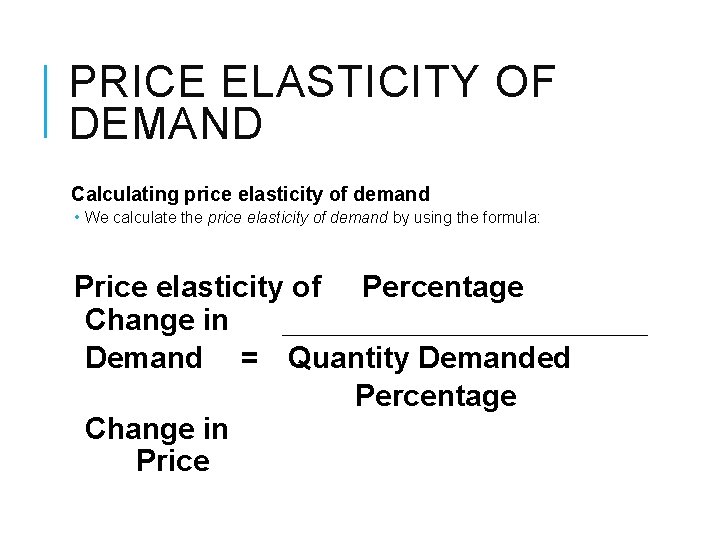
PRICE ELASTICITY OF DEMAND Calculating price elasticity of demand • We calculate the price elasticity of demand by using the formula: Price elasticity of Percentage Change in Demand = Quantity Demanded Percentage Change in Price
PRICE ELASTICITY OF DEMAND To calculate the price elasticity of demand for pizza: • We need to know the quantity demanded of pizza at two different prices. • We express the change in price as a percentage change of the average price • And, the change in quantity demanded as a percentage change of the average quantity.
PRICE ELASTICITY OF DEMAND
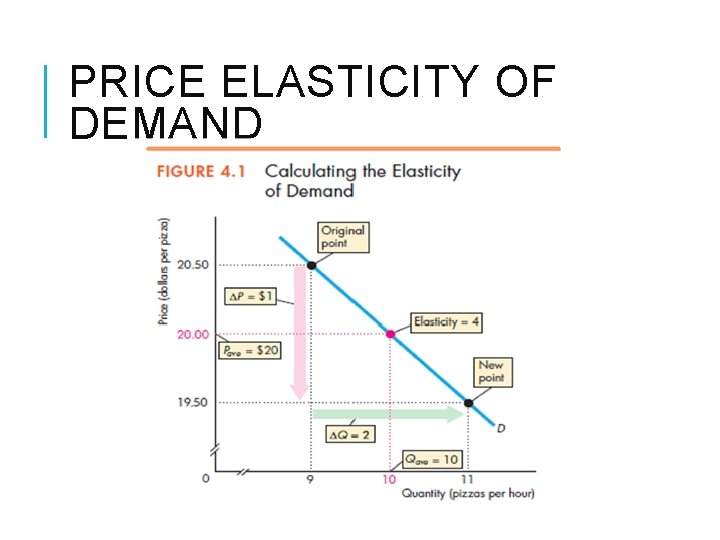
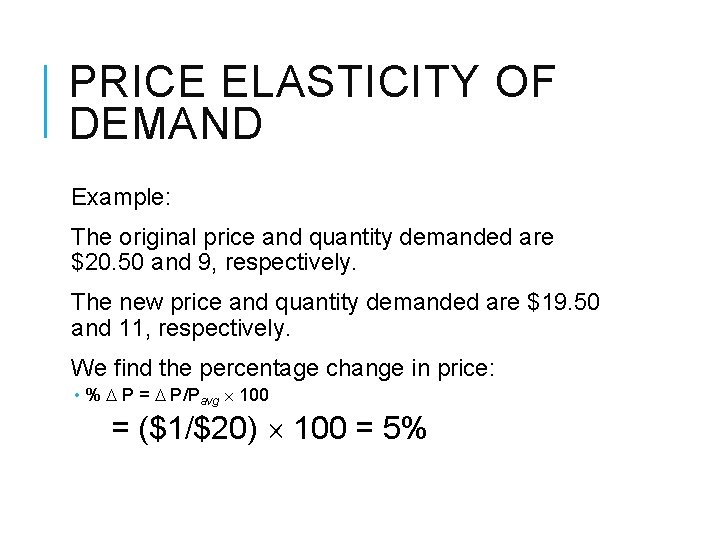
PRICE ELASTICITY OF DEMAND Example: The original price and quantity demanded are $20. 50 and 9, respectively. The new price and quantity demanded are $19. 50 and 11, respectively. We find the percentage change in price: • % P = P/Pavg 100 = ($1/$20) 100 = 5%
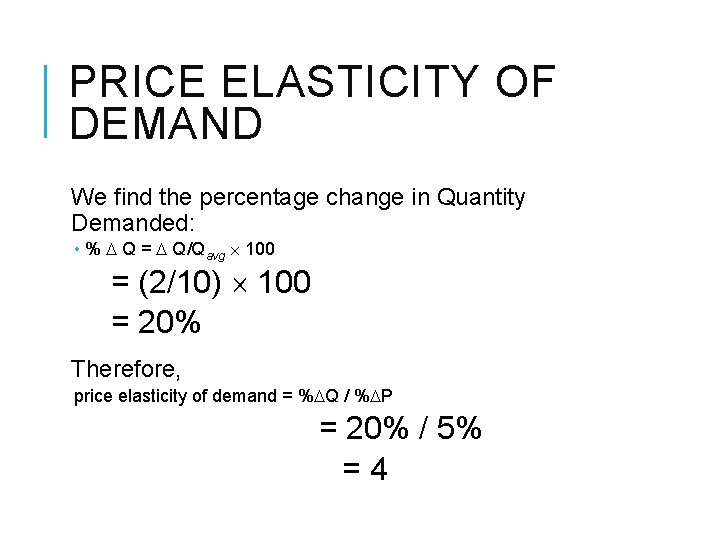
PRICE ELASTICITY OF DEMAND We find the percentage change in Quantity Demanded: • % Q = Q/Qavg 100 = (2/10) 100 = 20% Therefore, price elasticity of demand = % Q / % P = 20% / 5% =4
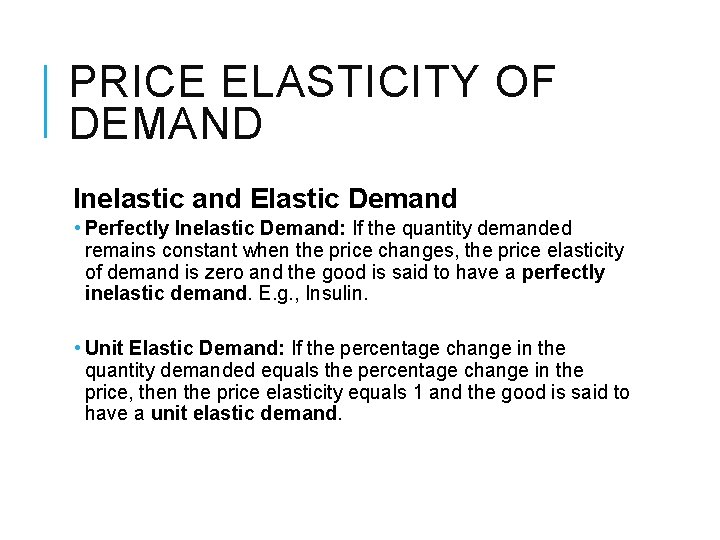
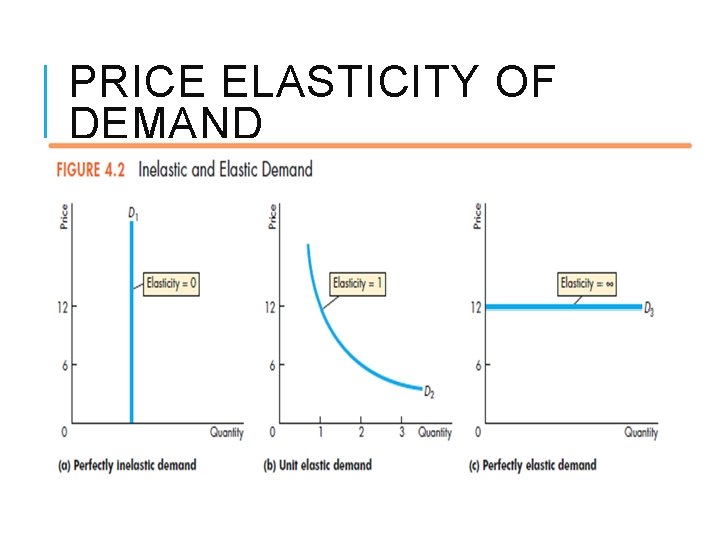
PRICE ELASTICITY OF DEMAND Inelastic and Elastic Demand • Perfectly Inelastic Demand: If the quantity demanded remains constant when the price changes, the price elasticity of demand is zero and the good is said to have a perfectly inelastic demand. E. g. , Insulin. • Unit Elastic Demand: If the percentage change in the quantity demanded equals the percentage change in the price, then the price elasticity equals 1 and the good is said to have a unit elastic demand.
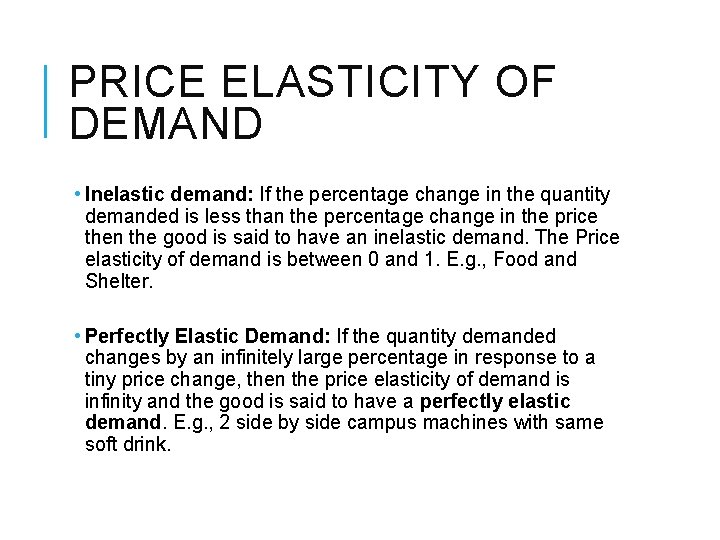
PRICE ELASTICITY OF DEMAND • Inelastic demand: If the percentage change in the quantity demanded is less than the percentage change in the price then the good is said to have an inelastic demand. The Price elasticity of demand is between 0 and 1. E. g. , Food and Shelter. • Perfectly Elastic Demand: If the quantity demanded changes by an infinitely large percentage in response to a tiny price change, then the price elasticity of demand is infinity and the good is said to have a perfectly elastic demand. E. g. , 2 side by side campus machines with same soft drink.
PRICE ELASTICITY OF DEMAND • Elastic Demand: This is between unit elastic demand perfectly elastic demand. The percentage change in the quantity demanded exceeds the percentage change in the price. The price elasticity of demand is greater than 1 and the good is said to have an elastic demand.
PRICE ELASTICITY OF DEMAND
PRICE ELASTICITY OF DEMAND The Factors that Influence the Elasticity of Demand The elasticity of demand for a good depends on The closeness of substitutes The proportion of income spent on the good The time elapsed since the price change.
PRICE ELASTICITY OF DEMAND Closeness of Substitutes • The closer the substitute for a good, the more elastic is the demand for it. • Oil as fuel or raw material for chemicals has no close substitute: Inelastic demand • Plastics are close substitutes for metal; demand for metal is elastic. • Necessities have inelastic demand luxuries have elastic demand.
PRICE ELASTICITY OF DEMAND Proportion of Income Spent on the Good • Other things remaining the same, the greater the proportion of income spent on a good, the more elastic is the demand for it. Time elapsed since price change • The longer the time that has elapsed since a price change, the more elastic is demand.
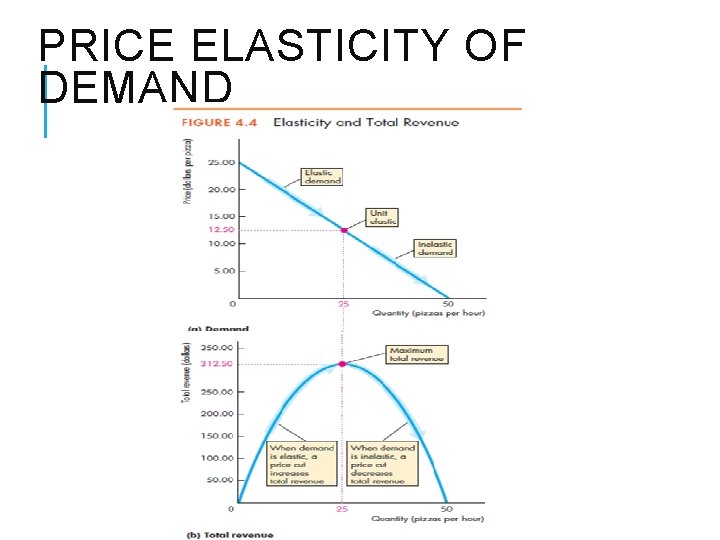
PRICE ELASTICITY OF DEMAND Elasticity Along a Linear Demand Curve • Elasticity of demand is not the same as slope. • A curve that has a constant slope can have varying elasticity. • Let’s calculate elasticity at different points: Midpoint of demand curve: Price $ 12. 50 and Quantity 25 pizzas per hour Suppose, price rises from $10 to $15 and Quantity falls from 30 to 20 pizzas an hour. Find price elasticity of demand.
PRICE ELASTICITY OF DEMAND Price elasticity of demand is 1. At prices above midpoint demand is elastic; price elasticity of demand is greater than 1. Suppose, price rises from $15 to $25 and Quantity falls from 20 to 0 pizzas an hour. Find price elasticity of demand. Answer: 4 At prices below midpoint demand is inelastic; price elasticity of demand is less than 1. Suppose, price rises from $0 to $10 and Quantity falls from 50 to 30 pizzas an hour. Find price elasticity of demand. Answer: 1/4
PRICE ELASTICITY OF DEMAND Total Revenue and Elasticity • The total revenue from the sale of a good equals the price of the good multiplied by the quantity sold. • When a price changes, total revenue also changes. • But decrease in price does not always decrease total revenue.
PRICE ELASTICITY OF DEMAND • The change in total revenue depends on the elasticity of demand in the following ways: Elastic Demand: 1% price cut increases quantity sold by more than 1%; Total Revenue increases. Inelastic Demand: 1% price cut increases quantity sold by less than 1%; Total Revenue decreases. Unit Elastic Demand: 1% price cut increases quantity sold by 1%; Total Revenue does not change.
PRICE ELASTICITY OF DEMAND
PRICE ELASTICITY OF DEMAND A price cut: • In the elastic range : Total Revenue Increases • In the inelastic range : Total Revenue decreases • At unit elasticity : Total Revenue is at maximum A total revenue test is a method of estimating the price elasticity of demand by observing the change in total revenue, that results from change in the price, other influences on quantity sold remaining the same.
PRICE ELASTICITY OF DEMAND If a price cut: • Increases total revenue, demand is elastic • Decreases total revenue, demand is inelastic • Leaves total revenue unchanged, demand is unit elastic
MORE ELASTICITIES OF DEMAND Income Elasticity of Demand • Definition: The income elasticity of demand is a measure of the responsiveness of the demand for a good or service to a change in income, other things remaining the same. • It tells us by how much a demand curve shifts at a given price.
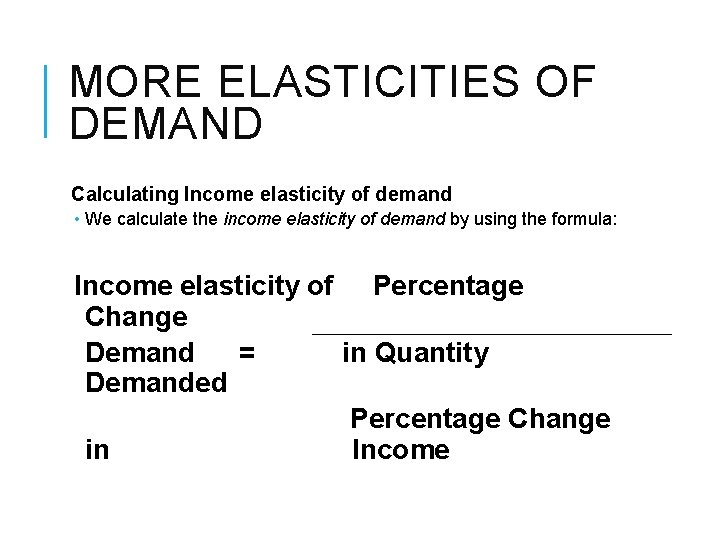
MORE ELASTICITIES OF DEMAND Calculating Income elasticity of demand • We calculate the income elasticity of demand by using the formula: Income elasticity of Percentage Change Demand = in Quantity Demanded Percentage Change in Income
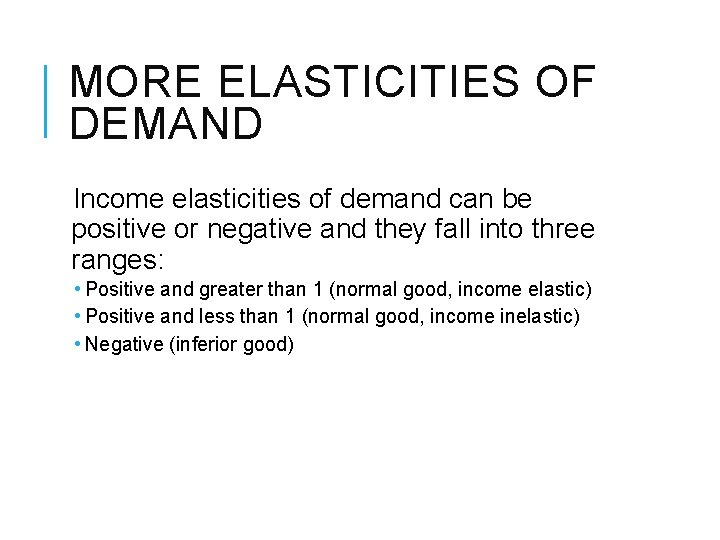
MORE ELASTICITIES OF DEMAND Income elasticities of demand can be positive or negative and they fall into three ranges: • Positive and greater than 1 (normal good, income elastic) • Positive and less than 1 (normal good, income inelastic) • Negative (inferior good)
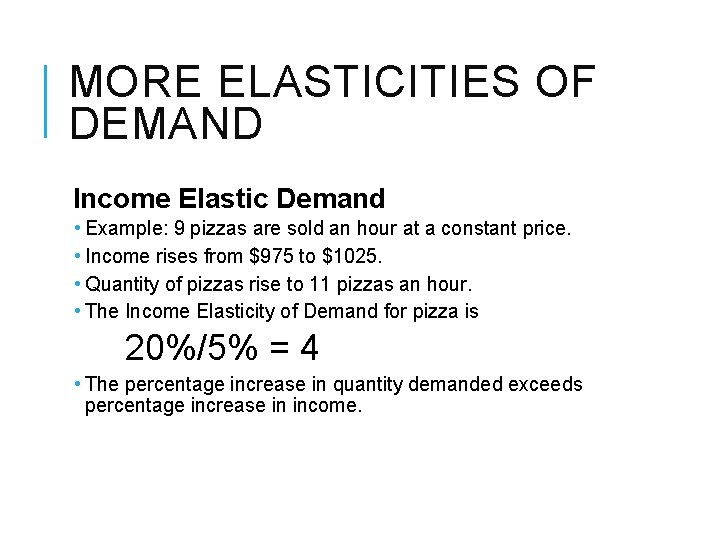
MORE ELASTICITIES OF DEMAND Income Elastic Demand • Example: 9 pizzas are sold an hour at a constant price. • Income rises from $975 to $1025. • Quantity of pizzas rise to 11 pizzas an hour. • The Income Elasticity of Demand for pizza is 20%/5% = 4 • The percentage increase in quantity demanded exceeds percentage increase in income.
MORE ELASTICITIES OF DEMAND Income Inelastic Demand • If the income elasticity of demand is positive but less than 1, demand is income inelastic. • The percentage increase in the quantity demanded is positive, but less than the percentage increase in income.
MORE ELASTICITIES OF DEMAND Income Elastic Demand for good: Percentage of income spent on that good increases as income increases. Income Inelastic Demand for good: Percentage of income spent on that good decreases as income increases.
MORE ELASTICITIES OF DEMAND Inferior Goods • If the income elasticity of demand is negative, the good is an inferior good. • The quantity demanded of an inferior good and the amount spent on it decrease when income increases. • Examples include small motorcycles, potatoes, and rice.
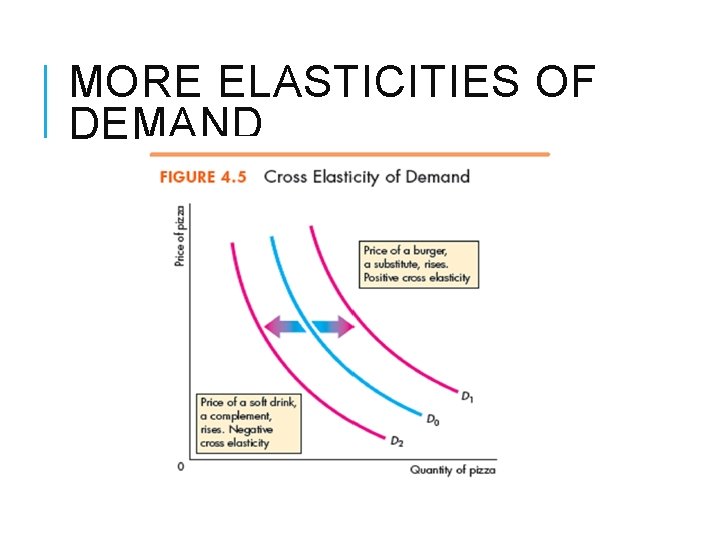
MORE ELASTICITIES OF DEMAND Cross Elasticity of Demand • The cross elasticity of demand is a measure of the responsiveness of the demand for a good to a change in the price of a substitute or complement, other things remaining the same. • Example: Pizza and Burger are substitutes; cross elasticity of demand is positive. • Pizza and soft drinks are complements; cross elasticity of demand is negative.
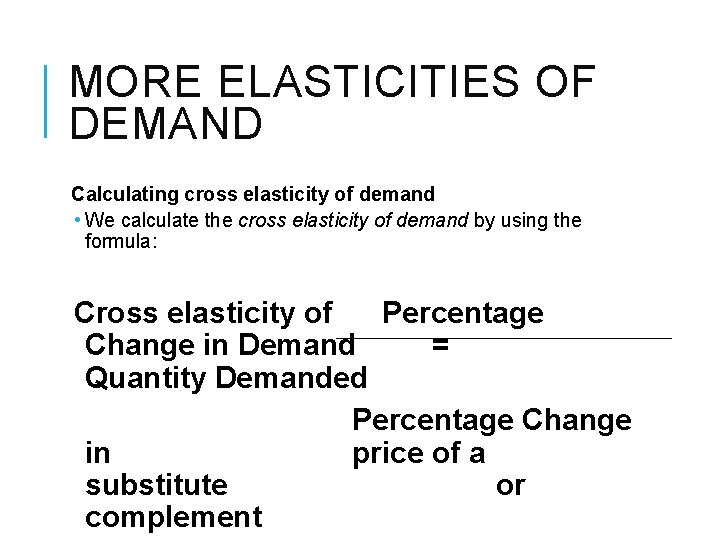
MORE ELASTICITIES OF DEMAND Calculating cross elasticity of demand • We calculate the cross elasticity of demand by using the formula: Cross elasticity of Percentage Change in Demand = Quantity Demanded Percentage Change in price of a substitute or complement
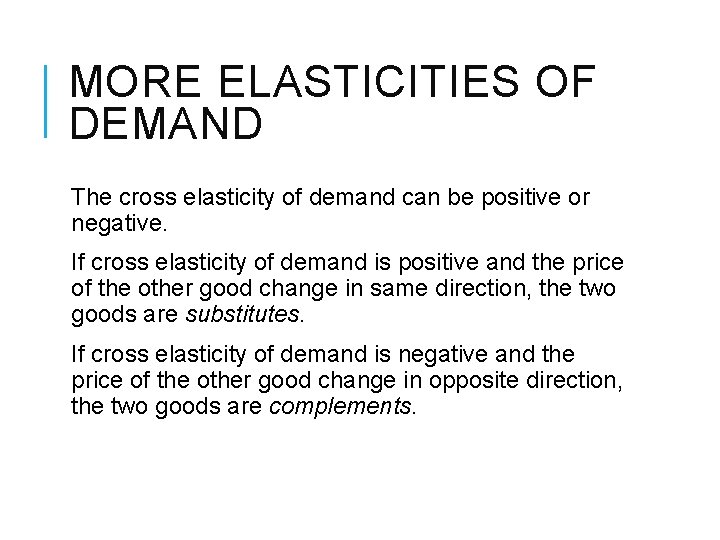
MORE ELASTICITIES OF DEMAND The cross elasticity of demand can be positive or negative. If cross elasticity of demand is positive and the price of the other good change in same direction, the two goods are substitutes. If cross elasticity of demand is negative and the price of the other good change in opposite direction, the two goods are complements.
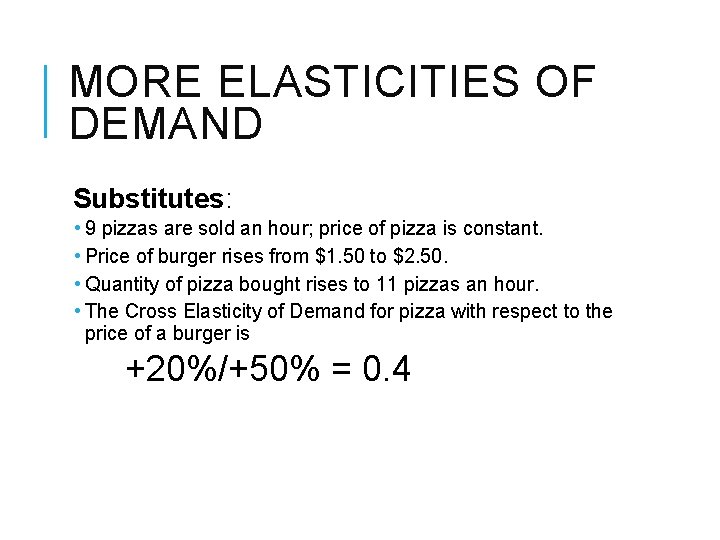
MORE ELASTICITIES OF DEMAND Substitutes: • 9 pizzas are sold an hour; price of pizza is constant. • Price of burger rises from $1. 50 to $2. 50. • Quantity of pizza bought rises to 11 pizzas an hour. • The Cross Elasticity of Demand for pizza with respect to the price of a burger is +20%/+50% = 0. 4
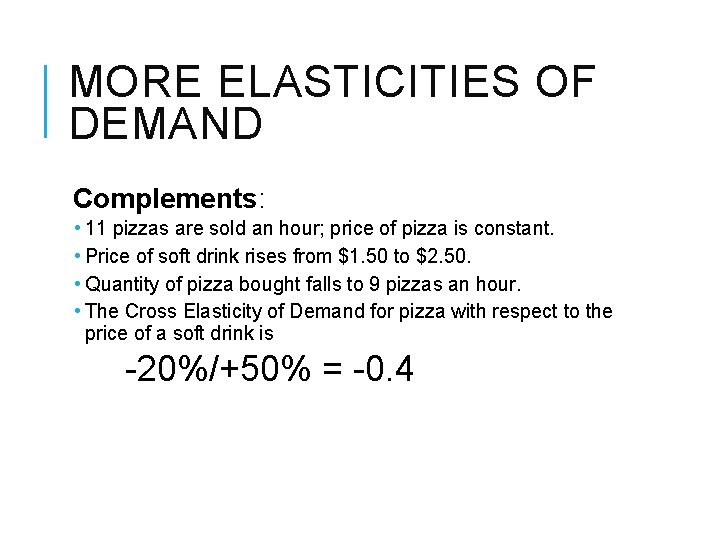
MORE ELASTICITIES OF DEMAND Complements: • 11 pizzas are sold an hour; price of pizza is constant. • Price of soft drink rises from $1. 50 to $2. 50. • Quantity of pizza bought falls to 9 pizzas an hour. • The Cross Elasticity of Demand for pizza with respect to the price of a soft drink is -20%/+50% = -0. 4
MORE ELASTICITIES OF DEMAND
ELASTICITY OF SUPPLY Definition: The elasticity of supply measures the responsiveness of the quantity supplied to a change in the price of a good when all other influences on selling plans remain the same.
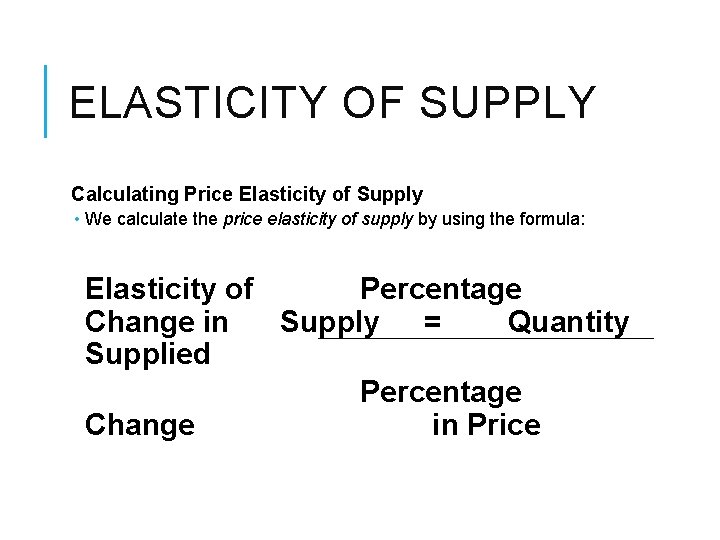
ELASTICITY OF SUPPLY Calculating Price Elasticity of Supply • We calculate the price elasticity of supply by using the formula: Elasticity of Percentage Change in Supply = Quantity Supplied Percentage Change in Price
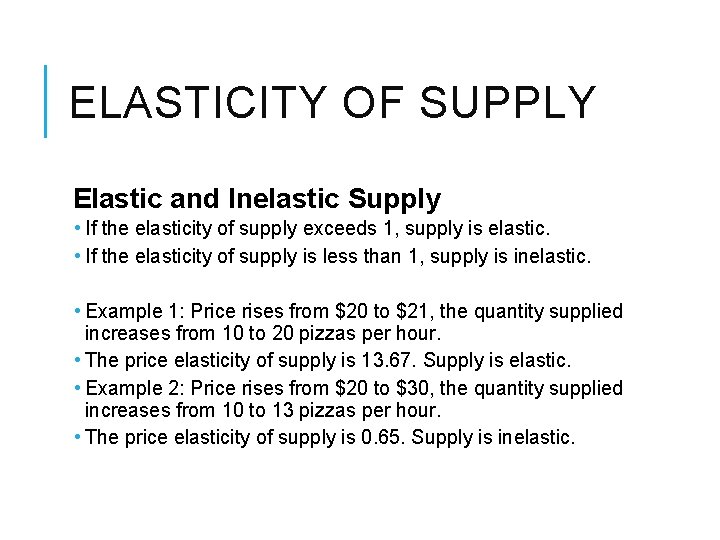
ELASTICITY OF SUPPLY Elastic and Inelastic Supply • If the elasticity of supply exceeds 1, supply is elastic. • If the elasticity of supply is less than 1, supply is inelastic. • Example 1: Price rises from $20 to $21, the quantity supplied increases from 10 to 20 pizzas per hour. • The price elasticity of supply is 13. 67. Supply is elastic. • Example 2: Price rises from $20 to $30, the quantity supplied increases from 10 to 13 pizzas per hour. • The price elasticity of supply is 0. 65. Supply is inelastic.
ELASTICITY OF SUPPLY Perfectly Inelastic Supply: If the quantity supplied is fixed regardless of the price, the supply curve is vertical and the elasticity of supply is zero. Supply is perfectly inelastic.
ELASTICITY OF SUPPLY Unit Elastic Supply: A special intermediate case occurs when the percentage change in price equals the percentage change in quantity. Supply is then unit elastic. If a supply curve is linear and passes through the origin it is unit elastic. Perfectly Elastic Supply: If there is a price at which sellers are willing to supply any quantity for sale, the supply curve is horizontal and the elasticity of supply is infinite. Supply is perfectly elastic.
ELASTICITY OF SUPPLY The Factors that Influence the Elasticity of Supply • Resource substitution possibilities • Time frame for the supply decision
ELASTICITY OF SUPPLY Resource Substitution Possibilities • Some goods and services require unique or rare productive resources. These items have a low, perhaps even zero elasticity of supply. E. g. A Van Gogh painting. • Other goods and services can be produced using commonly available resources that could be allocated to a wide range of alternative tasks. E. g. , wheat and corn can be produced on same land, so supply curve for wheat is highly elastic. • The supply of most goods and services lies between these two extremes. Supply increases as price rises.
ELASTICITY OF SUPPLY Time Frame for the Supply Decision • Three time frames of supply Momentary supply Short-run supply Long-run supply
ELASTICITY OF SUPPLY Momentary Supply • When the price of a good changes, the immediate response of the quantity supplied is determined by the momentary supply of that good. • E. g. , Fruits and vegetables have perfectly inelastic momentary supply. • Long-distance phone calls have a perfectly elastic momentary supply. Short-Run Supply • The response of the quantity supplied to a price change when only some of the possible adjustments to production can be made is determined by short-run supply. • Most goods have an inelastic short-run supply.
ELASTICITY OF SUPPLY Long-Run Supply • The response of the quantity supplied to a price change after all the technologically possible ways of adjusting supply has been exploited is determined by long-run supply. • For most goods and services long-run supply is elastic or even perfectly elastic.