
Chapter 4 Elasticity 2005 Economic Principles Demand sensitivity








































- Slides: 71
Chapter 4 Elasticity © 2005
Economic Principles Demand sensitivity Determinants of demand Sensitivity to price changes Price elasticity of demand Cross elasticity © 2005 Gottheil - Principles of Economics, 4 e 2
Economic Principles Substitute and complementary goods Normal and inferior goods Supply elasticity Relationship between price Elasticity of supply and tax revenues © 2005 Gottheil - Principles of Economics, 4 e 3
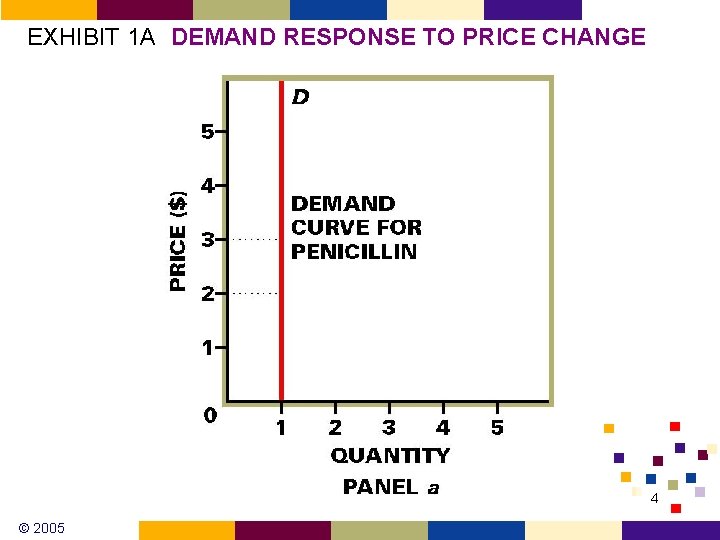
EXHIBIT 1 A DEMAND RESPONSE TO PRICE CHANGE 4 © 2005
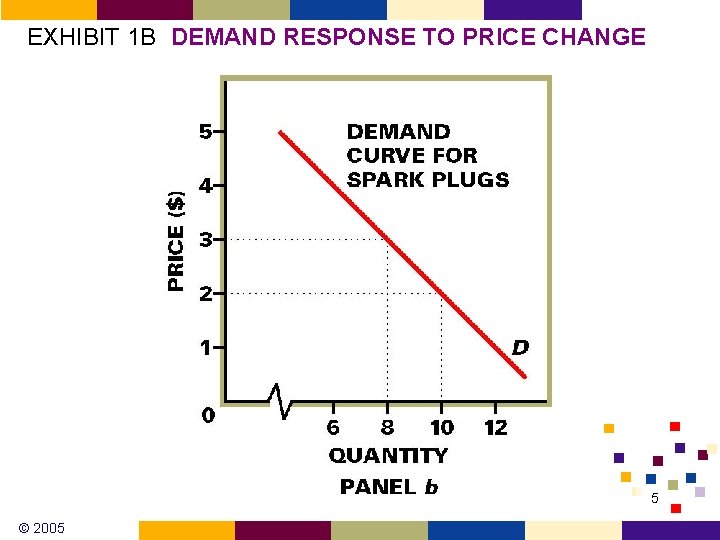
EXHIBIT 1 B DEMAND RESPONSE TO PRICE CHANGE 5 © 2005
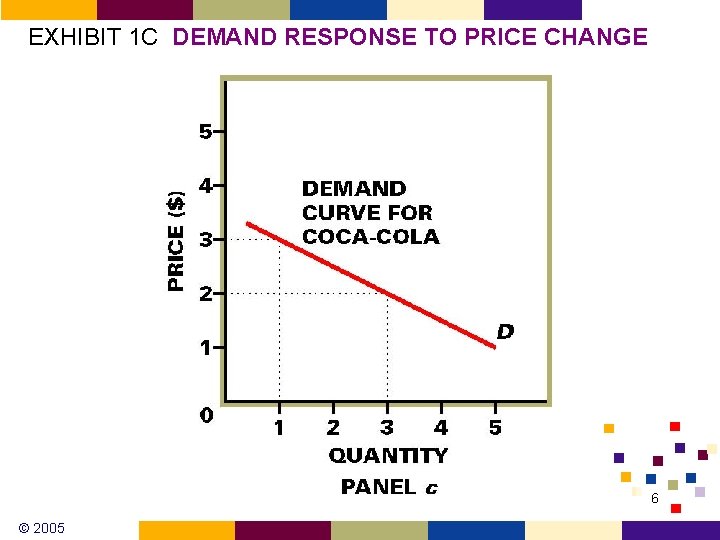
EXHIBIT 1 C DEMAND RESPONSE TO PRICE CHANGE 6 © 2005
Exhibit 1: Demand Response to Price Change 1. The demand curve in panel a can be described as: • Vertical © 2005 Gottheil - Principles of Economics, 4 e 7
Exhibit 1: Demand Response to Price Change The demand curve is vertical in panel a because: • The demand for penicillin doesn’t change –regardless of what price is charged. © 2005 Gottheil - Principles of Economics, 4 e 8
Exhibit 1: Demand Response to Price Change The demand curve in panel b can be described as: • Fairly steep © 2005 Gottheil - Principles of Economics, 4 e 9
Exhibit 1: Demand Response to Price Change The demand curve in panel b compares to the demand curve in panel c: • The demand curve in panel b is steeper than in panel c. © 2005 Gottheil - Principles of Economics, 4 e 10
Exhibit 1: Demand Response to Price Change This tells us that the demand response for spark plugs versus Coca-Cola: • When price is cut, the demand response for Coca-Cola is greater than the demand response for spark plugs. © 2005 Gottheil - Principles of Economics, 4 e 11
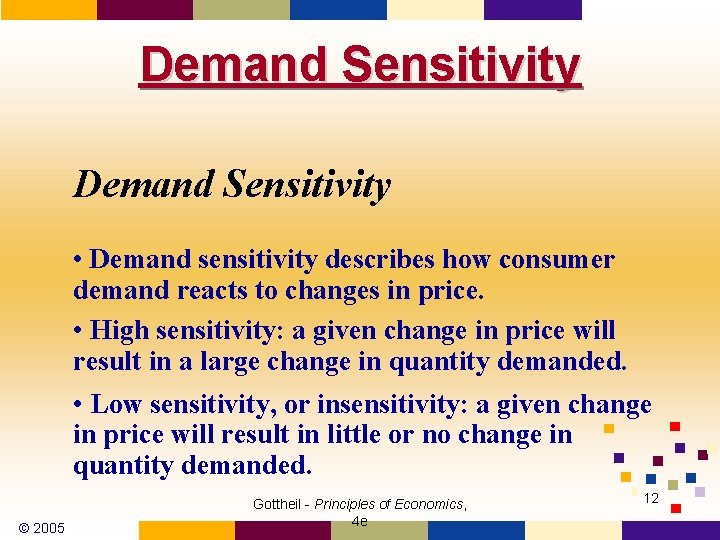
Demand Sensitivity • Demand sensitivity describes how consumer demand reacts to changes in price. • High sensitivity: a given change in price will result in a large change in quantity demanded. • Low sensitivity, or insensitivity: a given change in price will result in little or no change in quantity demanded. © 2005 Gottheil - Principles of Economics, 4 e 12
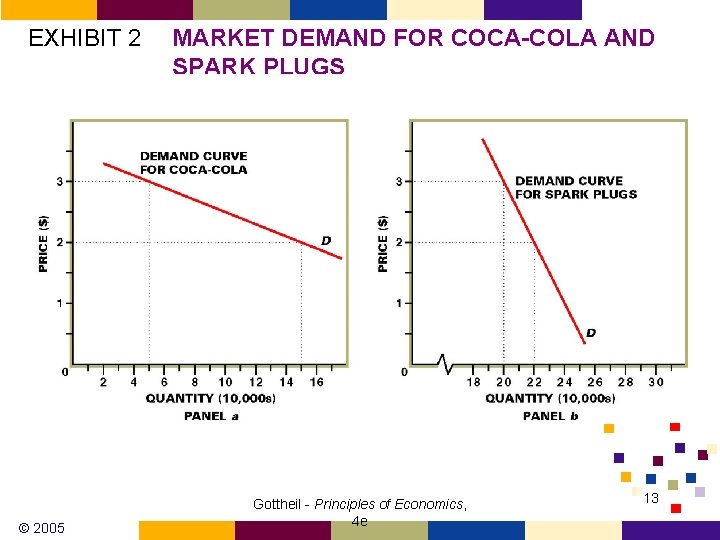
EXHIBIT 2 © 2005 MARKET DEMAND FOR COCA-COLA AND SPARK PLUGS Gottheil - Principles of Economics, 4 e 13
Exhibit 2: Market Demand for Coca-Cola and Spark Plugs In Exhibit 2, which demand curve, Panel a or b, has a steeper slope? • Panel a, the demand for Coca-Cola, has a steeper slope. © 2005 Gottheil - Principles of Economics, 4 e 14
Exhibit 2: Market Demand for Coca-Cola and Spark Plugs Which panel depicts high demand sensitivity? • Panel a depicts high demand sensitivity. • A decrease in the price of Coca-Cola results in a large increase in quantity demanded. • The slope of the demand curve is steep. © 2005 Gottheil - Principles of Economics, 4 e 15
What Factors Influence Demand Sensitivity? All else equal, the demand for lowpriced goods is less elastic than high-priced goods. • When something is inexpensive people are less price sensitive. © 2005 Gottheil - Principles of Economics, 4 e 16
What Factors Influence Demand Sensitivity? The elasticity of demand for poor people is larger than for rich people. • Poor people are more sensitive to price changes than rich people. © 2005 Gottheil - Principles of Economics, 4 e 17
What Factors Influence Demand Sensitivity? The price elasticity of demand for basic goods (necessities) is not larger than for less essential goods. • There are fewer substitutes for basic goods (such as bread, electricity, or gasoline) than for less essential goods (such as slices of pizza or specific brands of running shoes). © 2005 Gottheil - Principles of Economics, 4 e 18
What Factors Influence Demand Sensitivity? A product used as a compliment with an essential good will have the elasticity characteristics of the essential good. • If something is used in conjunction with an essential good, then consumption will not decline very much if price rises. © 2005 Gottheil - Principles of Economics, 4 e 19
What Factors Influence Demand Sensitivity? In which of the following situations will the price elasticity of demand be largest: • When people have a brief period of time to adjust • When people have a long time period to adjust. © 2005 Gottheil - Principles of Economics, 4 e 20
What Factors Influence Demand Sensitivity? In which of the following situations will the price elasticity of demand be largest: • When people have a brief period of time to adjust • When people have a long time period to adjust. © 2005 Gottheil - Principles of Economics, 4 e 21
From Sensitivity to Elasticity The price elasticity of demand is not the same thing as the slope of the demand curve. • The slope of the demand curve will differ based on the units used to measure price and quantity. © 2005 Gottheil - Principles of Economics, 4 e 22
From Sensitivity to Elasticity The price elasticity of demand is not the same thing as the slope of the demand curve. • We want a measure of sensitivity that will be the same regardless of the units used to measure price and quantity. © 2005 Gottheil - Principles of Economics, 4 e 23
From Sensitivity to Elasticity The price elasticity of demand is not the same thing as the slope of the demand curve. • Price elasticity of demand is the percent change in quantity demanded divided by the percentage change in price. © 2005 Gottheil - Principles of Economics, 4 e 24
From Sensitivity to Elasticity Formula for computing the price elasticity of demand: • ed = (Q 2 - Q 1)/[(Q 2 + Q 1)/2] divided by (P 2 - P 1)/[(P 2 + P 1)/2] © 2005 Gottheil - Principles of Economics, 4 e 25
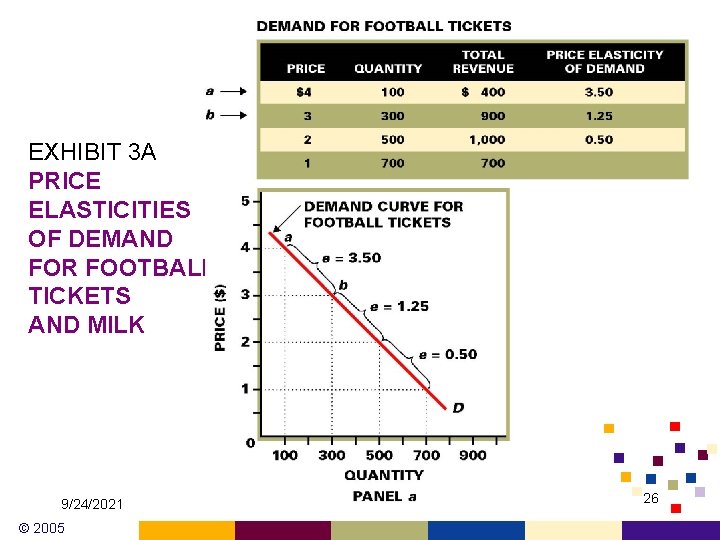
EXHIBIT 3 A PRICE ELASTICITIES OF DEMAND FOR FOOTBALL TICKETS AND MILK 9/24/2021 © 2005 26
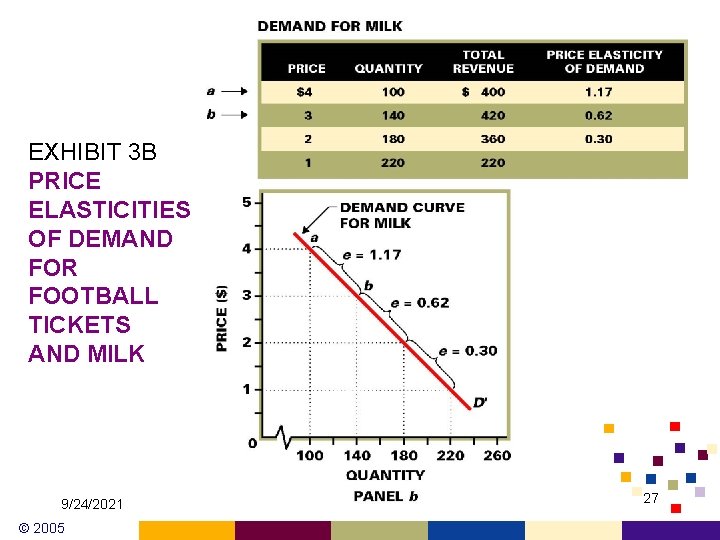
EXHIBIT 3 B PRICE ELASTICITIES OF DEMAND FOR FOOTBALL TICKETS AND MILK 9/24/2021 © 2005 27
Exhibit 3: Price Elasticities of Demand for Football Tickets and Milk In Exhibit 3, elasticity of demand for football tickets within the $4 to $3 price range is 3. 5. This means: • A price elasticity of 3. 5 means that a 1 percent change in price generates a 3. 5 percent change in quantity demanded. © 2005 Gottheil - Principles of Economics, 4 e 28
Exhibit 3: Price Elasticities of Demand for Football Tickets and Milk In Exhibit 3, elasticity of demand for football tickets within the $4 to $3 price range is 3. 5. This means: • Elasticities greater than 1. 0 are price elastic. © 2005 Gottheil - Principles of Economics, 4 e 29
Exhibit 3: Price Elasticities of Demand for Football Tickets and Milk In the $2 to $1 price range, elasticity of demand for football tickets falls to 0. 5. This means: • A 0. 5 price elasticity means that a 1 percent change in price generates a 0. 5 percent change in quantity demanded. © 2005 Gottheil - Principles of Economics, 4 e 30
Exhibit 3: Price Elasticities of Demand for Football Tickets and Milk In the $2 to $1 price range, elasticity of demand for football tickets falls to 0. 5. This means: • Elasticities less than 1. 0 are price inelastic. © 2005 Gottheil - Principles of Economics, 4 e 31
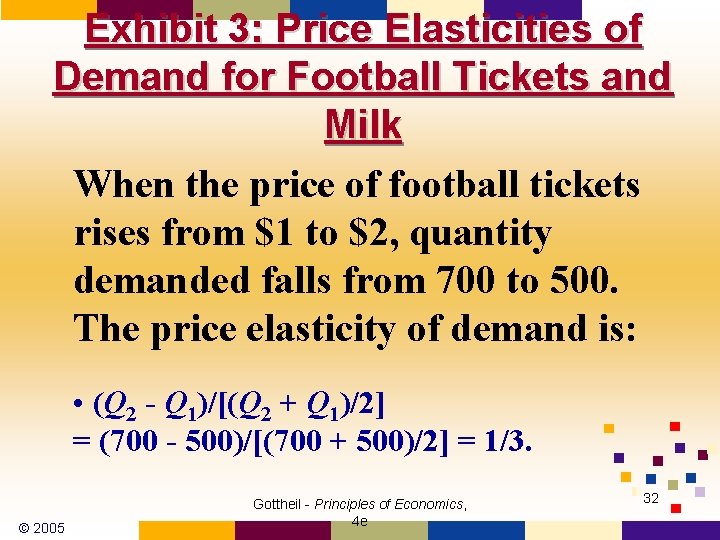
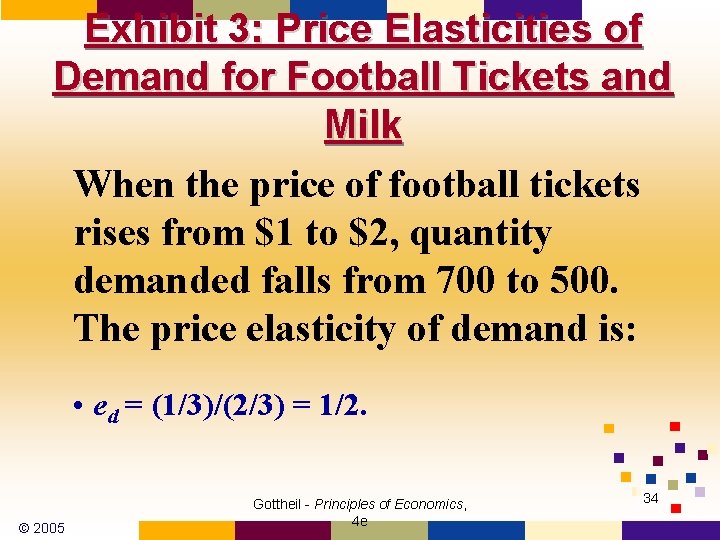
Exhibit 3: Price Elasticities of Demand for Football Tickets and Milk When the price of football tickets rises from $1 to $2, quantity demanded falls from 700 to 500. The price elasticity of demand is: • (Q 2 - Q 1)/[(Q 2 + Q 1)/2] = (700 - 500)/[(700 + 500)/2] = 1/3. © 2005 Gottheil - Principles of Economics, 4 e 32
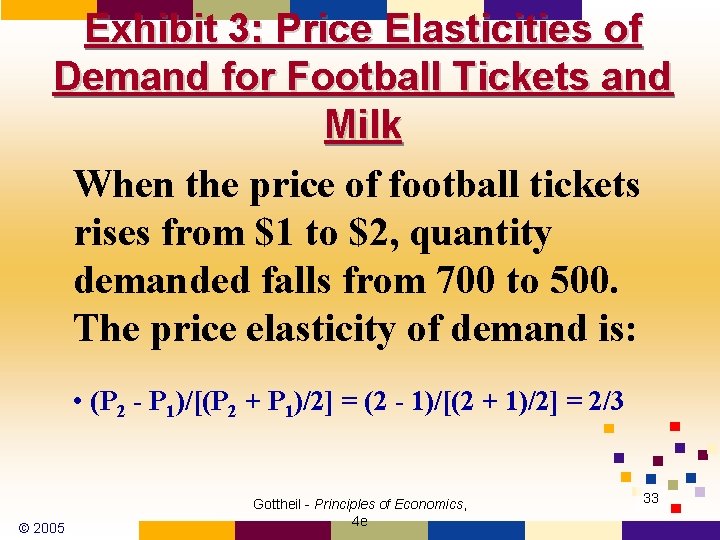
Exhibit 3: Price Elasticities of Demand for Football Tickets and Milk When the price of football tickets rises from $1 to $2, quantity demanded falls from 700 to 500. The price elasticity of demand is: • (P 2 - P 1)/[(P 2 + P 1)/2] = (2 - 1)/[(2 + 1)/2] = 2/3 © 2005 Gottheil - Principles of Economics, 4 e 33
Exhibit 3: Price Elasticities of Demand for Football Tickets and Milk When the price of football tickets rises from $1 to $2, quantity demanded falls from 700 to 500. The price elasticity of demand is: • ed = (1/3)/(2/3) = 1/2. © 2005 Gottheil - Principles of Economics, 4 e 34
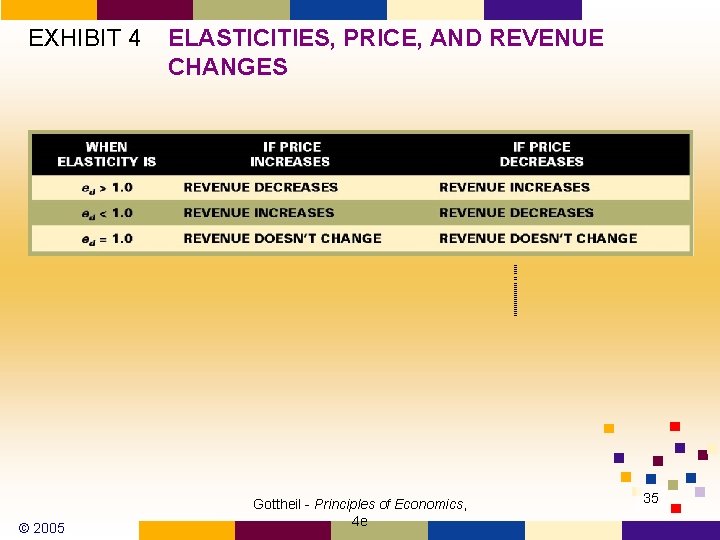
EXHIBIT 4 © 2005 ELASTICITIES, PRICE, AND REVENUE CHANGES Gottheil - Principles of Economics, 4 e 35
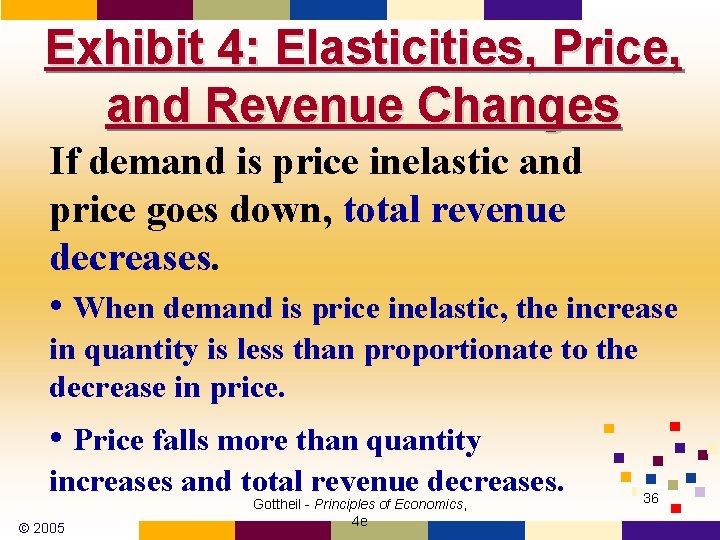
Exhibit 4: Elasticities, Price, and Revenue Changes If demand is price inelastic and price goes down, total revenue decreases. • When demand is price inelastic, the increase in quantity is less than proportionate to the decrease in price. • Price falls more than quantity increases and total revenue decreases. © 2005 Gottheil - Principles of Economics, 4 e 36
Cross Elasticity Cross elasticity of demand • It is the ratio of a percentage change in quantity demand of one good to a percentage change in the price of another good. © 2005 Gottheil - Principles of Economics, 4 e 37
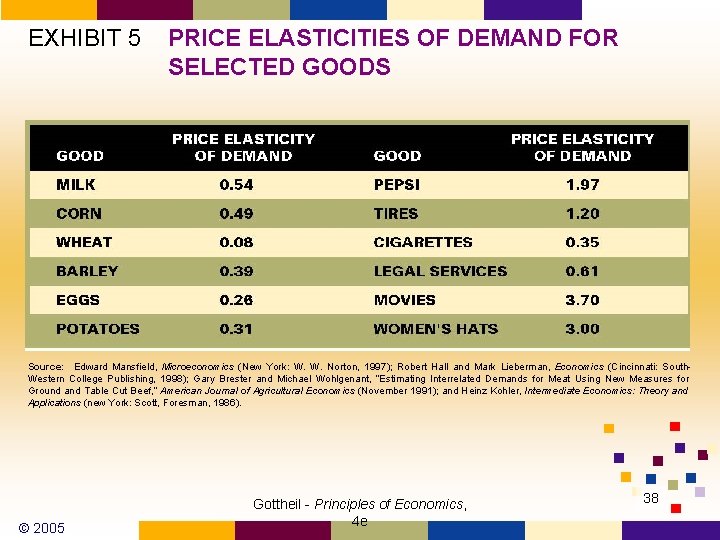
EXHIBIT 5 PRICE ELASTICITIES OF DEMAND FOR SELECTED GOODS Source: Edward Mansfield, Microeconomics (New York: W. W. Norton, 1997); Robert Hall and Mark Lieberman, Economics (Cincinnati: South. Western College Publishing, 1998); Gary Brester and Michael Wohlgenant, “Estimating Interrelated Demands for Meat Using New Measures for Ground and Table Cut Beef, ” American Journal of Agricultural Economics (November 1991); and Heinz Kohler, Intermediate Economics: Theory and Applications (new York: Scott, Foresman, 1986). © 2005 Gottheil - Principles of Economics, 4 e 38
Exhibit 5: Price Elasticities of Demand for Selected Goods Which of the following has the largest price elasticity of demand? • Corn • Cigarettes • Movies © 2005 Gottheil - Principles of Economics, 4 e 39
Exhibit 5: Price Elasticities of Demand for Selected Goods Which of the following has the largest price elasticity of demand? • Corn • Cigarettes • Movies © 2005 Gottheil - Principles of Economics, 4 e 40
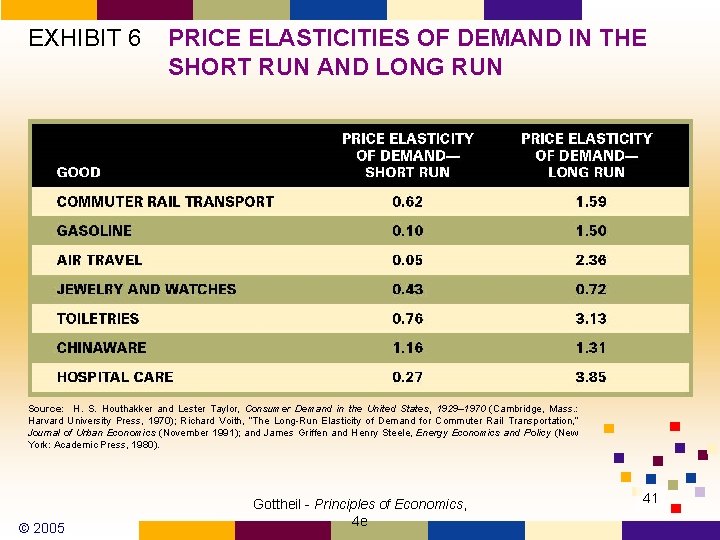
EXHIBIT 6 PRICE ELASTICITIES OF DEMAND IN THE SHORT RUN AND LONG RUN Source: H. S. Houthakker and Lester Taylor, Consumer Demand in the United States, 1929– 1970 (Cambridge, Mass. : Harvard University Press, 1970); Richard Voith, “The Long-Run Elasticity of Demand for Commuter Rail Transportation, ” Journal of Urban Economics (November 1991); and James Griffen and Henry Steele, Energy Economics and Policy (New York: Academic Press, 1980). © 2005 Gottheil - Principles of Economics, 4 e 41
Exhibit 6: Price Elasticities of Demand in the Short Run and Long Run Which of the following has the smallest price elasticity of demand in the long run? • Gasoline • Jewelry and watches • Hospital care © 2005 Gottheil - Principles of Economics, 4 e 42
Exhibit 6: Price Elasticities of Demand in the Short Run and Long Run Which of the following has the smallest price elasticity of demand in the long run? • Gasoline • Jewelry and watches • Hospital care © 2005 Gottheil - Principles of Economics, 4 e 43
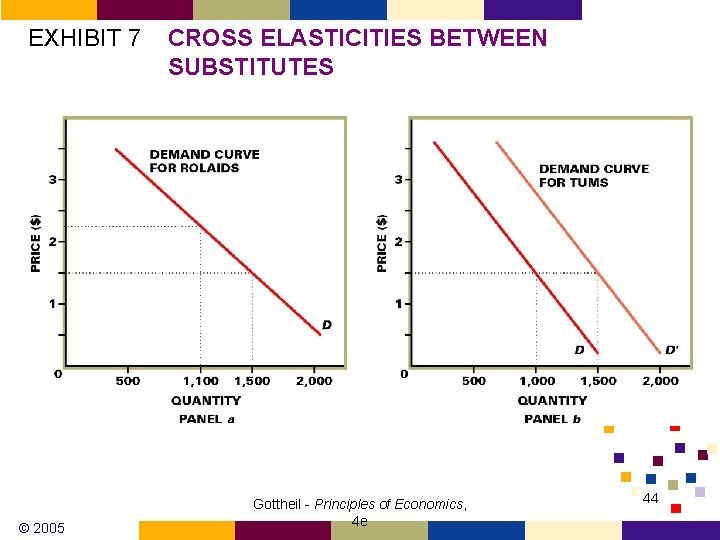
EXHIBIT 7 © 2005 CROSS ELASTICITIES BETWEEN SUBSTITUTES Gottheil - Principles of Economics, 4 e 44
Exhibit 7: Cross Elasticities Between Substitutes In Exhibit 7, the demand for Tums increase when the price of Rolaids increased because: • Tums and Rolaids are substitute goods— goods that can replace each other. • When the price of Rolaids increases, some consumers are willing to switch to a cheaper substitute—Tums. © 2005 Gottheil - Principles of Economics, 4 e 45
Exhibit 7: Cross Elasticities Between Substitutes In Exhibit 7, the demand for Tums increase when the price of Rolaids increased because: • Cross elasticities for substitute goods are positive. • A decrease (or increase) in the price of one good generates a corresponding decrease (or a corresponding increase) in the quantity demanded of the other. 46 © 2005
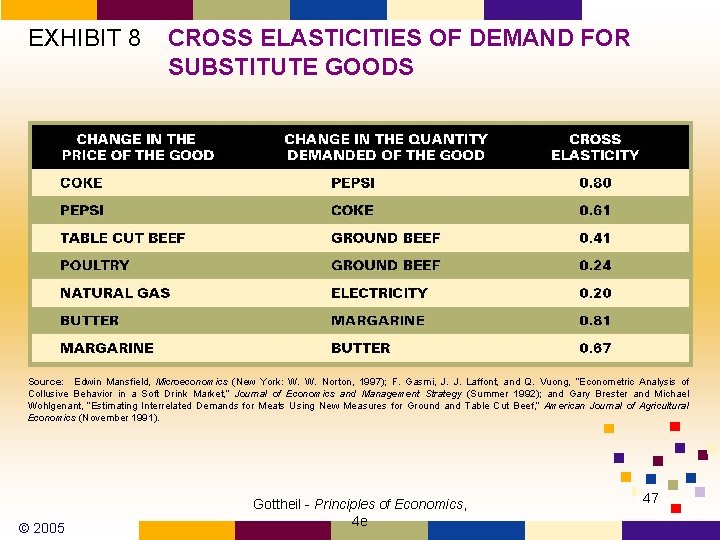
EXHIBIT 8 CROSS ELASTICITIES OF DEMAND FOR SUBSTITUTE GOODS Source: Edwin Mansfield, Microeconomics (New York: W. W. Norton, 1997); F. Gasmi, J. J. Laffont, and Q. Vuong, “Econometric Analysis of Collusive Behavior in a Soft Drink Market, ” Journal of Economics and Management Strategy (Summer 1992); and Gary Brester and Michael Wohlgenant, “Estimating Interrelated Demands for Meats Using New Measures for Ground and Table Cut Beef, ” American Journal of Agricultural Economics (November 1991). © 2005 Gottheil - Principles of Economics, 4 e 47
Exhibit 8: Cross Elasticities of Demand for Substitute Goods Which of the following are the closest substitutes, according to Exhibit 8: • Butter and margarine • Poultry and ground beef • Natural gas and electricity © 2005 Gottheil - Principles of Economics, 4 e 48
Exhibit 8: Cross Elasticities of Demand for Substitute Goods Which of the following are the closest substitutes, according to Exhibit 8: • Butter and margarine • Poultry and ground beef • Natural gas and electricity © 2005 Gottheil - Principles of Economics, 4 e 49
Exhibit 8: Cross Elasticities of Demand for Substitute Goods Butter and margarine the closest substitutes because: • They have the largest cross elasticity of demand. © 2005 Gottheil - Principles of Economics, 4 e 50
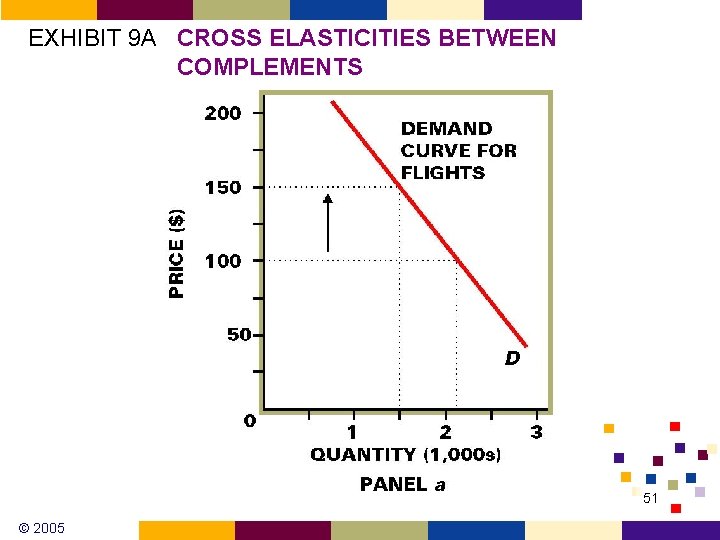
EXHIBIT 9 A CROSS ELASTICITIES BETWEEN COMPLEMENTS 51 © 2005
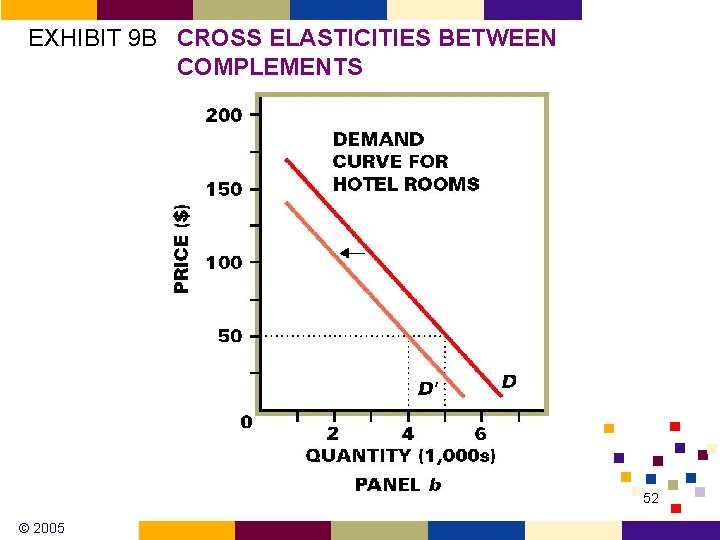
EXHIBIT 9 B CROSS ELASTICITIES BETWEEN COMPLEMENTS 52 © 2005
Exhibit 9: Cross Elasticities Between Complements When the price of flights decreases, the demand for hotel rooms: • The demand for hotel rooms will increase, because people fly more and need more hotel rooms. © 2005 Gottheil - Principles of Economics, 4 e 53
Income Elasticity Income elasticity • It is the ratio of the percentage change in quantity demanded to the percentage change in income. © 2005 Gottheil - Principles of Economics, 4 e 54
Income Elasticity Income elasticity • A good is considered income elastic when a 1 percent change in income generates a greater than 1 percent change in quantity demanded. © 2005 Gottheil - Principles of Economics, 4 e 55
Income Elasticity Income elasticity • A good is considered income inelastic when a 1 percent change in income generates a less than 1 percent change in quantity demanded. © 2005 Gottheil - Principles of Economics, 4 e 56
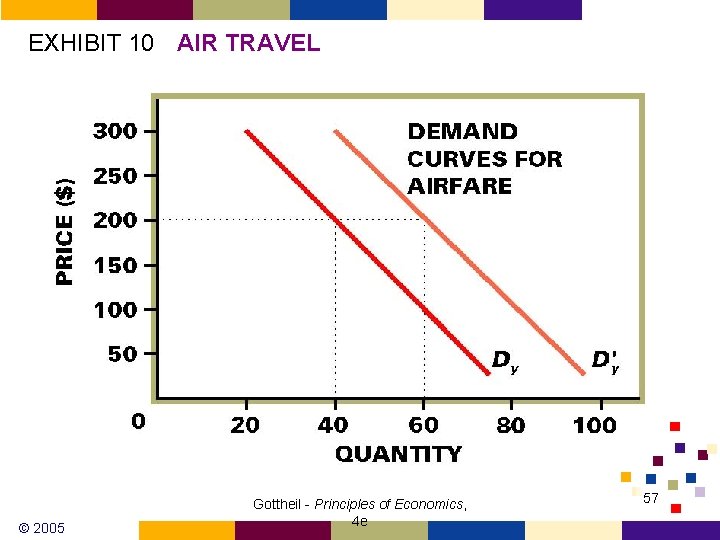
EXHIBIT 10 AIR TRAVEL © 2005 Gottheil - Principles of Economics, 4 e 57
Exhibit 10: Air Travel The demand curve in Exhibit 10 shift from Dy to D′y even though price remains constant because: • In Exhibit 10, the demand for air travel is income elastic. As income increases, the demand for flights increases, even though the price of flights remains unchanged. © 2005 Gottheil - Principles of Economics, 4 e 58
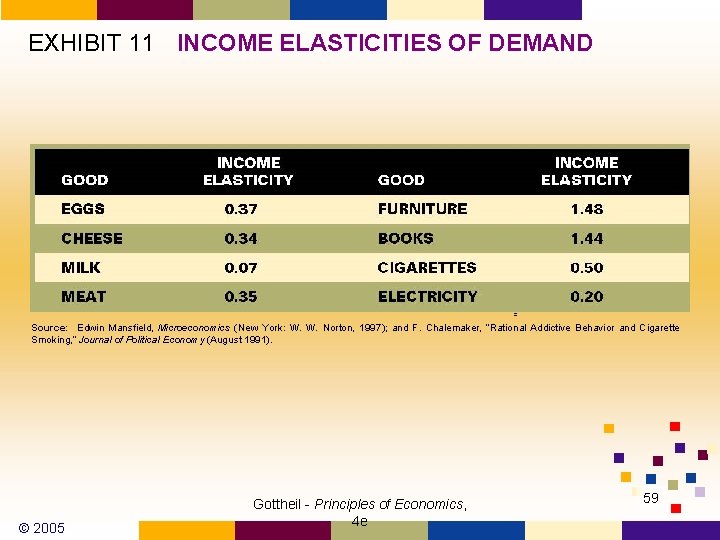
EXHIBIT 11 INCOME ELASTICITIES OF DEMAND Source: Edwin Mansfield, Microeconomics (New York: W. W. Norton, 1997); and F. Chalemaker, “Rational Addictive Behavior and Cigarette Smoking, ” Journal of Political Economy (August 1991). © 2005 Gottheil - Principles of Economics, 4 e 59
Exhibit 11: Income Elasticities of Demand The income elasticity of demand for electricity so much lower than for furniture because: • Electricity is a necessity, while furniture is a luxury. © 2005 Gottheil - Principles of Economics, 4 e 60
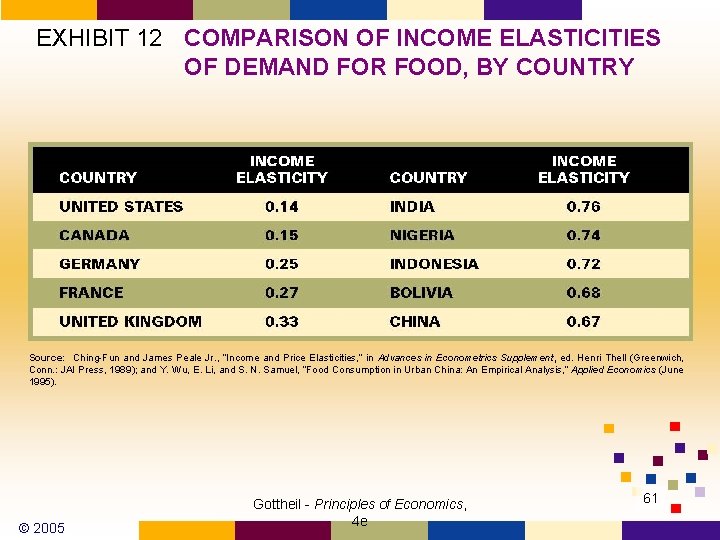
EXHIBIT 12 COMPARISON OF INCOME ELASTICITIES OF DEMAND FOR FOOD, BY COUNTRY Source: Ching-Fun and James Peale Jr. , “Income and Price Elasticities, ” in Advances in Econometrics Supplement, ed. Henri Thell (Greenwich, Conn. : JAI Press, 1989); and Y. Wu, E. Li, and S. N. Samuel, “Food Consumption in Urban China: An Empirical Analysis, ” Applied Economics (June 1995). © 2005 Gottheil - Principles of Economics, 4 e 61
Exhibit 12: Comparison of Income Elasticities of Demand for Food, by Country The type of countries which tend to have the lowest income elasticity for food are: • Industrialized countries © 2005 Gottheil - Principles of Economics, 4 e 62
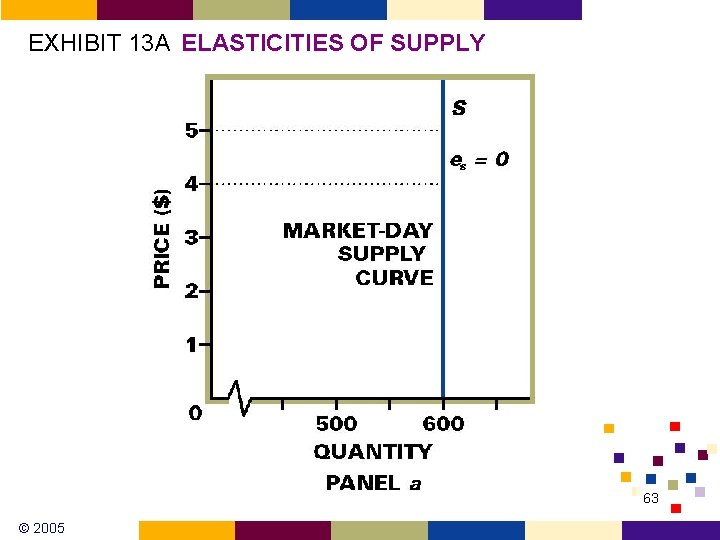
EXHIBIT 13 A ELASTICITIES OF SUPPLY 63 © 2005
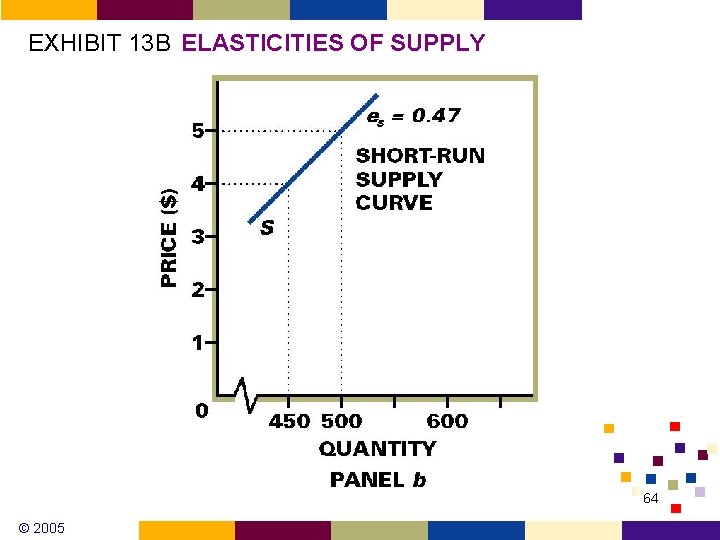
EXHIBIT 13 B ELASTICITIES OF SUPPLY 64 © 2005
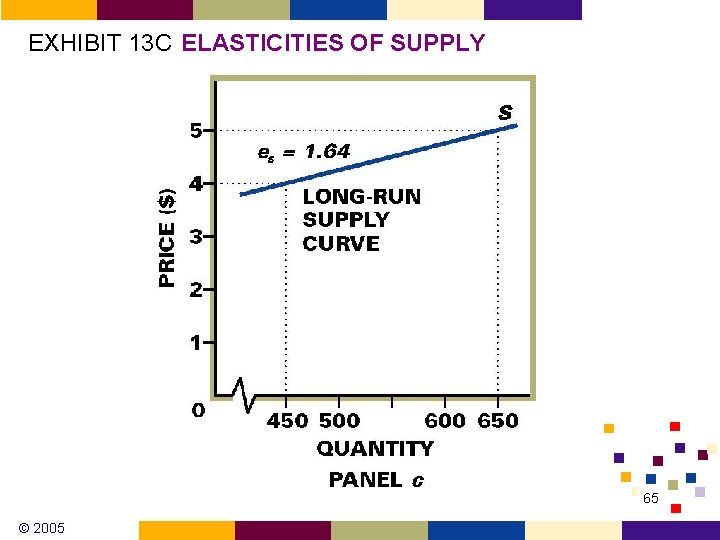
EXHIBIT 13 C ELASTICITIES OF SUPPLY 65 © 2005
Exhibit 13: Elasticities of Supply In Exhibit 13, the different supply curves have different price elasticities because: • Panel a depicts the market-day supply curve. • At any price suppliers are unable to adjust supply. • The price elasticity of supply is 0. © 2005 Gottheil - Principles of Economics, 4 e 66
Exhibit 13: Elasticities of Supply In Exhibit 13, the different supply curves have different price elasticities because: • Panel b depicts the short-run supply curve. • Suppliers are willing, but not able, to meet all the demand. • Suppliers can only increase production with existing capacity. • Price elasticity is 0. 47. © 2005 67
Exhibit 13: Elasticities of Supply In Exhibit 13, the different supply curves have different price elasticities because: • Panel c depicts the long-run supply curve. • Suppliers encounter no obstacles in adjusting quantity supplied to price. • The price elasticity is 1. 64. © 2005 Gottheil - Principles of Economics, 4 e 68
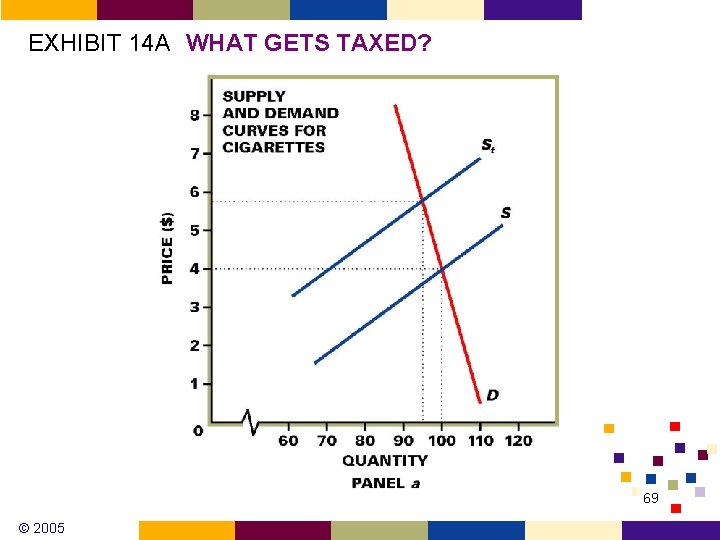
EXHIBIT 14 A WHAT GETS TAXED? 69 © 2005
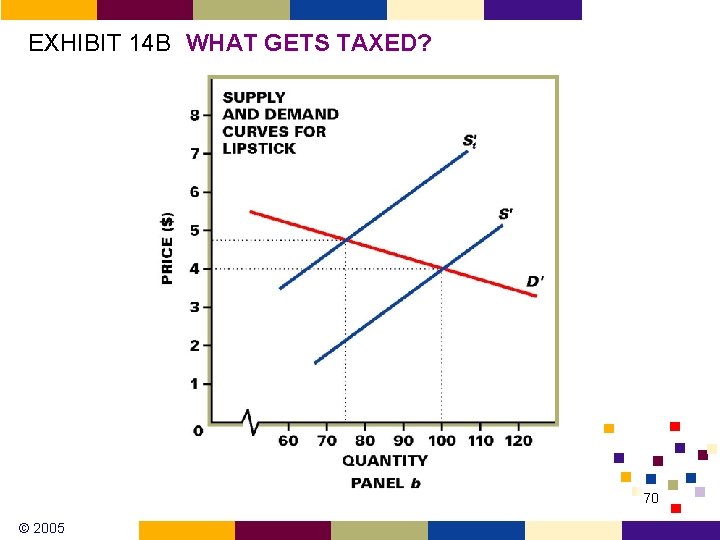
EXHIBIT 14 B WHAT GETS TAXED? 70 © 2005
Exhibit 14: What Gets Taxed If government imposes a per unit tax, the type of demand (elastic or inelastic) which will generate the most revenue is: • Inelastic. • Quantity will not decline very much when the tax raises the price of the product. © 2005 Gottheil - Principles of Economics, 4 e 71