
Chapter 4 EHR Project Management Roles in Design
- Slides: 28
Chapter 4 EHR Project Management: Roles in Design and Implementation 1 © 2007
Prerequisites for EHR Success • Planning – An EHR project should not be viewed solely as an IT project • Executive Management Support – EHR projects are long-term, expensive undertakings – Obtaining executive management support is a critical prerequisite to a successful EHR © 2007
Prerequisites for EHR Success • Medical staff ownership – Medical staff will be some of its primary users. – Our healthcare environment is truly informationbased, and members of the medical staff are also coming to that realization • Use a physician champion – The physician champion must understand change management © 2007
User Involvement • Users include clinicians as well as administrative, financial, and other persons who rely on the health record to carry out their responsibilities in support of the healthcare facility. • User concerns: – Users need to understand that they are not being replaced or required to work harder. © 2007
Resources • EHR design and implementation will require resources: – Appropriate – Sustained • For example, building the cost of the EHR into another strategic project, such as building a center of excellence or adding a new wing, links the EHR to the organization’s strategic initiatives. © 2007
Project Scope and Characteristics • Have a defined beginning and end, usually follow a standard SDLC, and have a defined budget* • Are a line function, though with special staffing often through volunteerism from many parts of organization • Concern something new and therefore involve uncertainty and change • Require great attention to detail, while maintaining the ability to see the big picture © 2007
* EHR Projects • EHR projects become ongoing programs • Spiral life cycle results from many modules and additional components being added to the core functionality • Precautions must be taken to keep an eye on project milestones, budget, and goals to ensure all components are completed © 2007
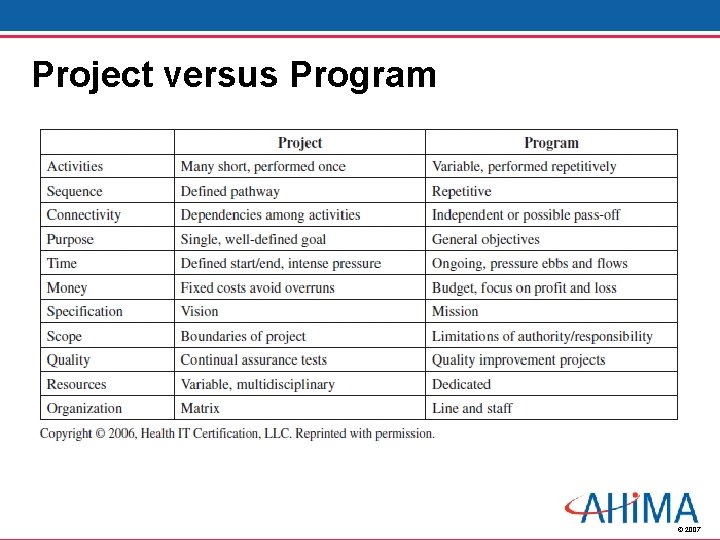
Project versus Program © 2007
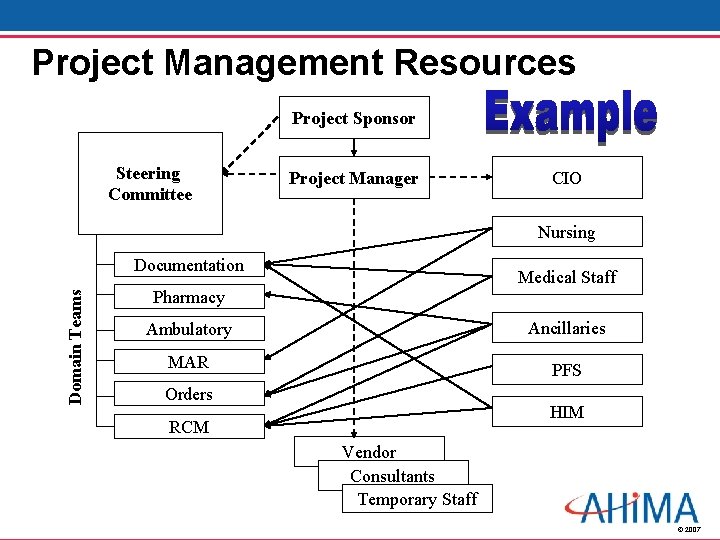
Project Management Resources Project Sponsor Steering Committee Project Manager CIO Nursing Domain Teams Documentation Medical Staff Pharmacy Ambulatory Ancillaries MAR PFS Orders HIM RCM Vendor Consultants Temporary Staff © 2007
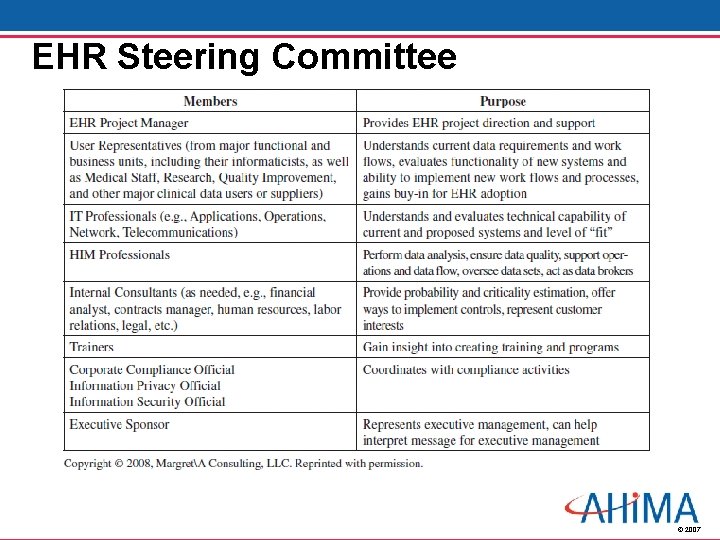
EHR Steering Committee © 2007
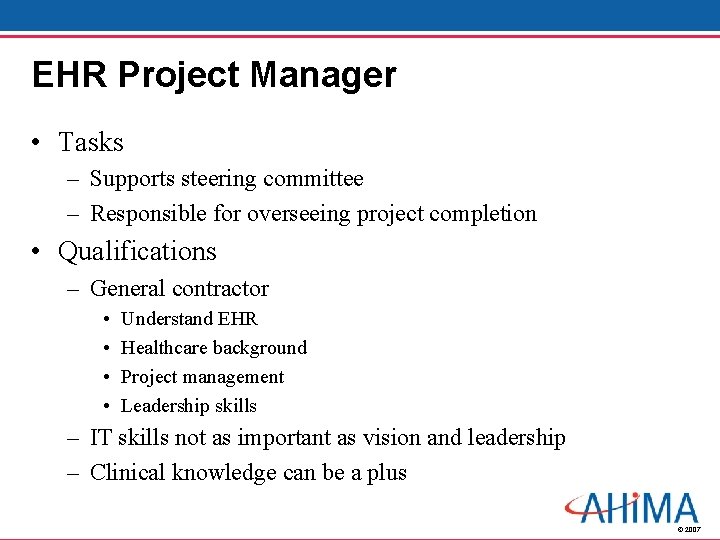
EHR Project Manager • Tasks – Supports steering committee – Responsible for overseeing project completion • Qualifications – General contractor • • Understand EHR Healthcare background Project management Leadership skills – IT skills not as important as vision and leadership – Clinical knowledge can be a plus © 2007
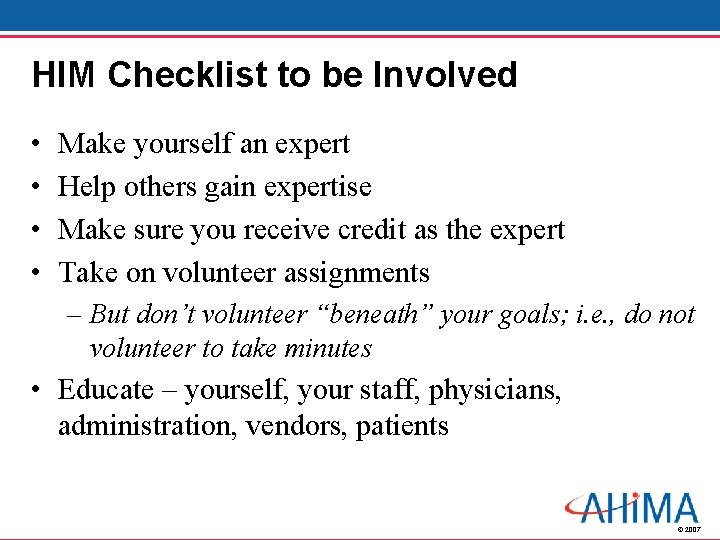
HIM Checklist to be Involved • • Make yourself an expert Help others gain expertise Make sure you receive credit as the expert Take on volunteer assignments – But don’t volunteer “beneath” your goals; i. e. , do not volunteer to take minutes • Educate – yourself, your staff, physicians, administration, vendors, patients © 2007
HIM Checklist • EHRs are intended to be used at the point of care for care delivery • Documentation is important, but secondary to care delivery © 2007
Project Manager Skills • Leadership – not necessarily “leader” • Communication – Listening, speaking, reading, writing – Up, down, peers, partners – Internal team, external vendors, internal customers, external public • Negotiation – reaching consensus • Problem Solving – requires: – Problem definition – Decision making • Influence – but not necessarily “POWER” © 2007
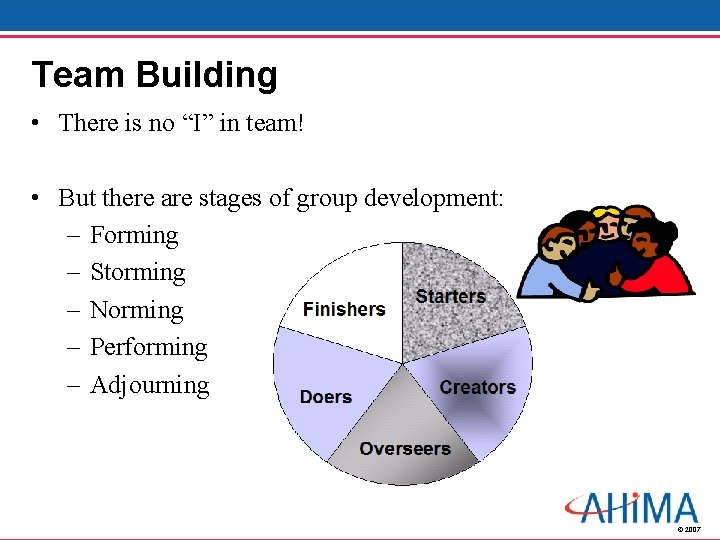
Team Building • There is no “I” in team! • But there are stages of group development: – Forming – Storming – Norming – Performing – Adjourning © 2007
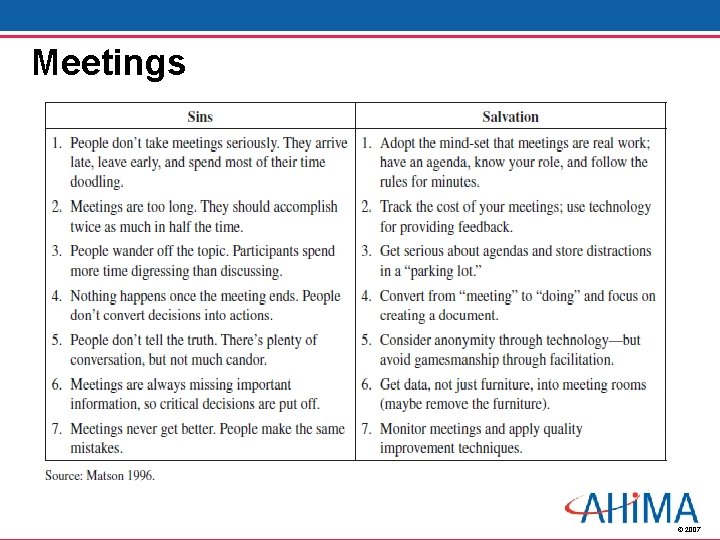
Meetings © 2007
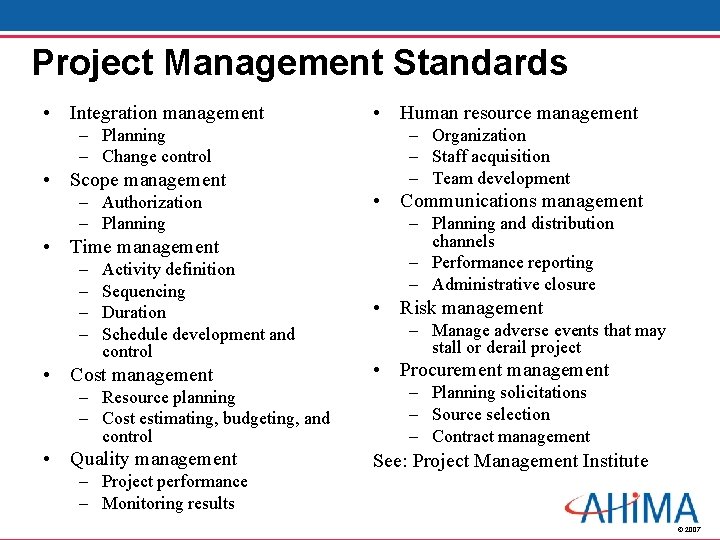
Project Management Standards • Integration management – Planning – Change control • Scope management – Authorization – Planning • Time management – – Activity definition Sequencing Duration Schedule development and control • Cost management – Resource planning – Cost estimating, budgeting, and control • Quality management – Project performance – Monitoring results • Human resource management – Organization – Staff acquisition – Team development • Communications management – Planning and distribution channels – Performance reporting – Administrative closure • Risk management – Manage adverse events that may stall or derail project • Procurement management – Planning solicitations – Source selection – Contract management See: Project Management Institute © 2007
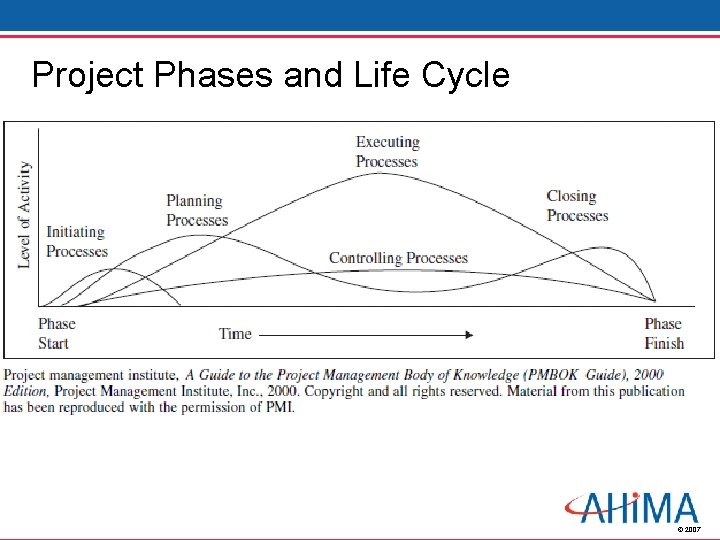
Project Phases and Life Cycle © 2007
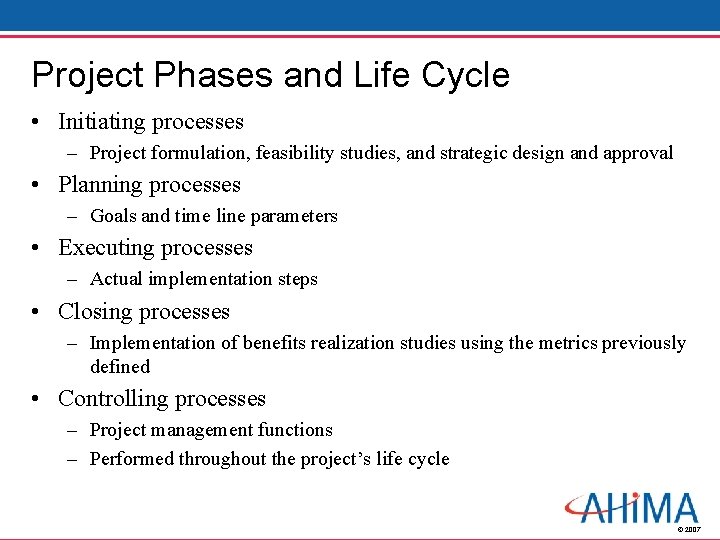
Project Phases and Life Cycle • Initiating processes – Project formulation, feasibility studies, and strategic design and approval • Planning processes – Goals and time line parameters • Executing processes – Actual implementation steps • Closing processes – Implementation of benefits realization studies using the metrics previously defined • Controlling processes – Project management functions – Performed throughout the project’s life cycle © 2007
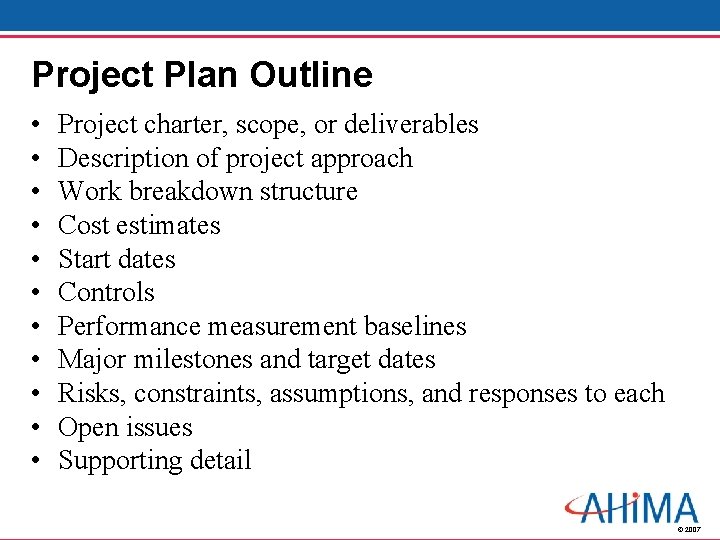
Project Plan Outline • • • Project charter, scope, or deliverables Description of project approach Work breakdown structure Cost estimates Start dates Controls Performance measurement baselines Major milestones and target dates Risks, constraints, assumptions, and responses to each Open issues Supporting detail © 2007
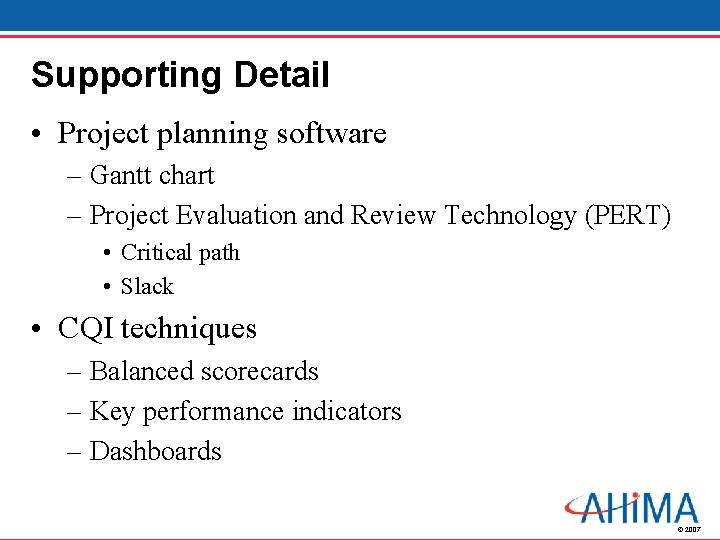
Supporting Detail • Project planning software – Gantt chart – Project Evaluation and Review Technology (PERT) • Critical path • Slack • CQI techniques – Balanced scorecards – Key performance indicators – Dashboards © 2007
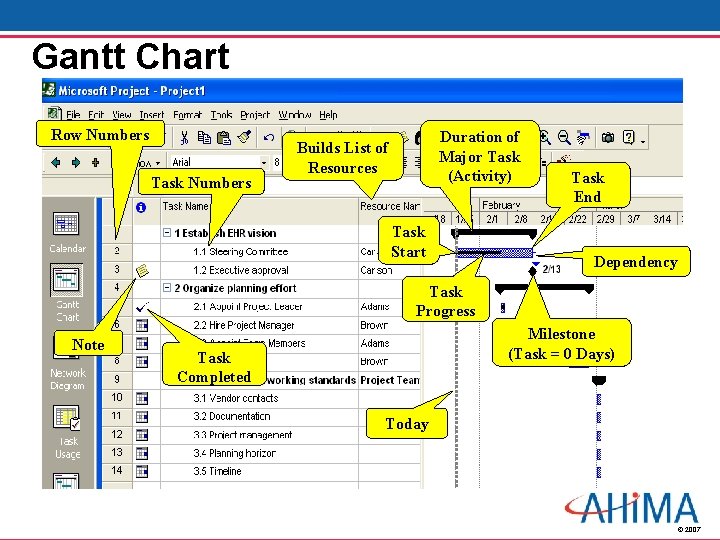
Gantt Chart Row Numbers Task Numbers Duration of Major Task (Activity) Builds List of Resources Task Start Task End Dependency Task Progress Note Milestone (Task = 0 Days) Task Completed Today © 2007
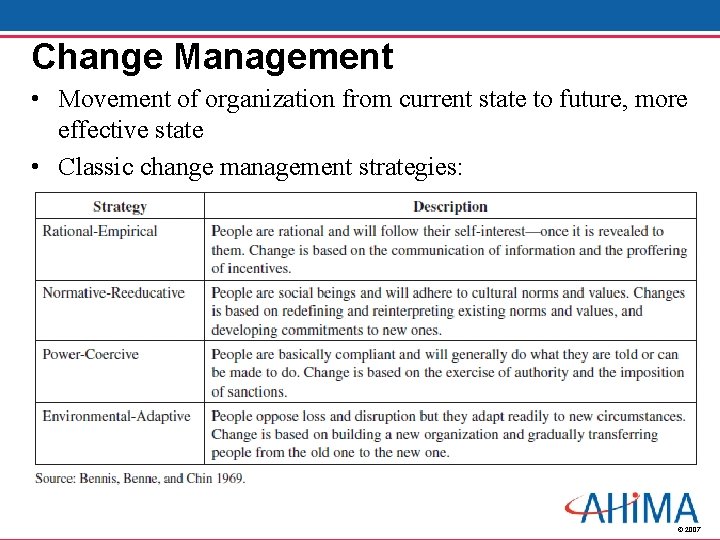
Change Management • Movement of organization from current state to future, more effective state • Classic change management strategies: © 2007
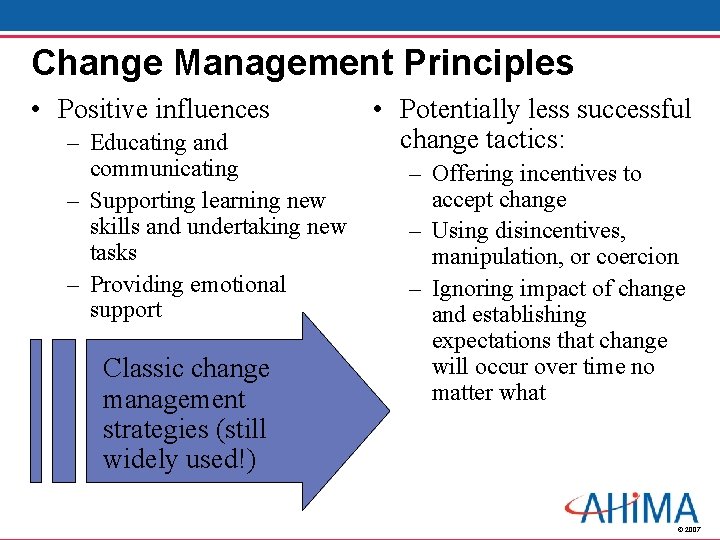
Change Management Principles • Positive influences – Educating and communicating – Supporting learning new skills and undertaking new tasks – Providing emotional support Classic change management strategies (still widely used!) • Potentially less successful change tactics: – Offering incentives to accept change – Using disincentives, manipulation, or coercion – Ignoring impact of change and establishing expectations that change will occur over time no matter what © 2007
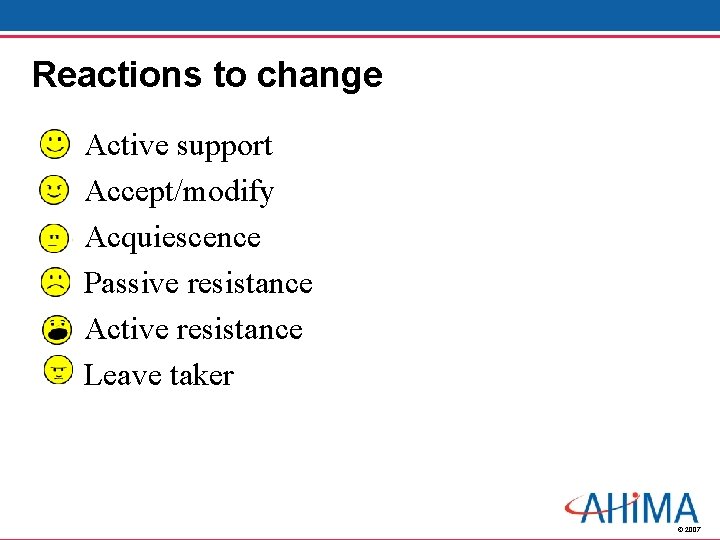
Reactions to change Active support Accept/modify Acquiescence Passive resistance Active resistance Leave taker © 2007
Clinical and Cultural Transformation • Clinical transformation – Integration of enabling technology throughout the redesign process – Untethering of information for use when and where needed – Evidence based – Sustained organizational and cultural change – Transfer of knowledge and effective communications • Core values for performance excellence – – – – – Voluntary leadership Patient focused excellence Organizational and personal learning Valuing staff and partners Agility Focus on the future Managing for innovation Management by fact Social responsibility and community health – Focus on results and creating value – Systems perspective © 2007
Roles of Participants • IT Professionals – Understand are able to evaluate technical capability of both current and proposed systems – Challenge is to include significantly more outreach and work effectively with end users • e-HIM Professionals – – – Perform data analysis Ensure data quality Support operations Manage data flow Oversee data sets Serve as data brokers Informatics • American Medical Informatics Association (AMIA) defines medical informatics as a discipline having “to do with all aspects of understanding and promoting the effective organization, analysis, management, and use of information in health care. ” © 2007
Conclusion • EHR project management is a critical function and an exciting opportunity – Yet is not for everyone • Those who choose not to be a project manager are valued as: – Steering committee members – Domain team leaders – Department directors and managers – Trainers – Compliance officers – All e-HIM roles © 2007