
Chapter 4 Earthquakes 4 1 Forces in Earths
- Slides: 24
Chapter 4: Earthquakes 4. 1 Forces in Earth’s Crust
Stress • Stress is a force that acts on rock to change its shape or volume. • Energy caused by stress is stored in rocks until it changes shape or breaks.
Stress • Tension: stress force that pulls on the crust and thins rocks in the middle; occurs when plates pull apart. • Compression: stress force that squeezes rock until it folds or bends; occurs when plate comes together. • Shearing: stress that pushes a mass of rock in opposite directions; occurs when plates slide past each other.
Normal Faults • formed from rocks being pulled apart at divergent boundaries • one block, called the hanging wall, sits over the fault and the other block, called the footwall, sits beneath the fault. • The hanging wall slides down and the footwall moves up.
Reverse Faults • formed from rocks being pushed together at convergent boundaries • The hanging wall moves up and the footwall moves down.
Strike-slip Faults • The rocks on either side of the fault slip past each other at a transform boundary. • There is little up and down movement.
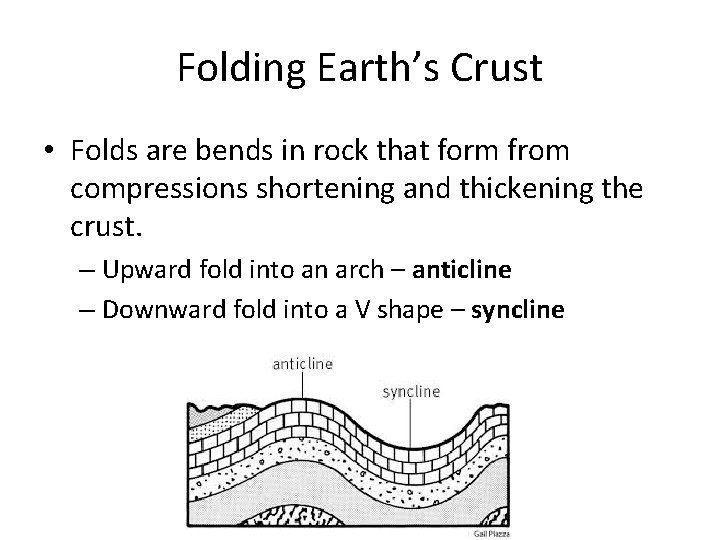
Folding Earth’s Crust • Folds are bends in rock that form from compressions shortening and thickening the crust. – Upward fold into an arch – anticline – Downward fold into a V shape – syncline
Forming Mountains • Compression from convergent plates colliding can build mountain ranges. • Fault block mountains form from tension in Earth’s crust and faulting. – If there are two normal faults near each other, the land between could eventually drop down creating a valley.
Plateaus • Plateau: large area of flat land elevated high above sea level. • Forces push up large, flat blocks of rock.
Chapter 4: Earthquakes 4. 2 Earthquakes and Seismic Waves
Seismic Waves • Earthquake: shaking and trembling that results from movement of rock beneath Earth’s surface. • Plate movements and stress in Earth’s crust can lead to earthquakes, releasing great amounts of energy.
Seismic Waves • Seismic waves: vibrations that are similar to sound waves; travel through Earth carrying energy from earthquakes. • The focus of an earthquake is the area beneath Earth’s surface where the rocks are shifted (action that causes Earthquake). • The epicenter is the point on Earth’s surface above the focus.
Seismic Waves P waves (primary waves) • compress and expand the ground • first waves/fastest moving • travel through solid, liquid, and gas
Seismic Waves S waves (secondary waves) • travel at half the speed of P waves and arrive second • travel through solids only • strong enough to shake structures
Seismic Waves Surface waves • move most slowly • produce severe ground movements; can cause ground to roll or buildings to shake back and forth.
Measuring Earthquakes • Seismograph: instrument that records and measures the seismic waves.
Measuring Earthquakes Modified Mercalli Scale • Rates the amount of shaking • Rated by observations; useful in areas where there aren’t instruments available.
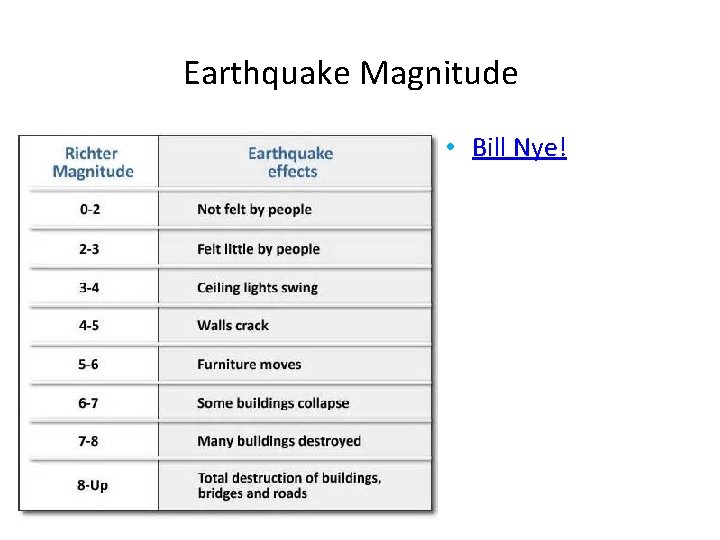
Measuring Earthquakes Richter Scale • Finds the magnitude; a number assigned to an earthquake based on size. • Depend on the size of the waves recorded by a seismograph.
Earthquake Magnitude • Bill Nye!
Measuring Earthquakes Moment Magnitude Scale • Rates the total energy an earthquake releases. • Geologists use data from seismographs and other sources.
Comparing Magnitudes • A 1 -point increase on a scale represents an increase of 32 -times more energy. • The higher an earthquake is rated, the more energy it has and the more damage it can do.
Locating an Earthquake • You need seismogram info from 3 places: – Find the difference of arrival times between the P and the S waves. – The difference is used to find the distance to the epicenter – the longer it takes, the farther away the epicenter. – A circle is drawn around each point (location). The point where they all cross is the epicenter.
Chapter 4: Earthquakes 4. 3 Monitoring Earthquakes
Earthquake Risk • Largely depends on how close a given location is to a plate boundary. • In N. America, there are plate boundaries in California, Washington, and Alaska. • Around the world, the Ring of Fire contains boundaries where several volcanoes and earthquakes occur.