
Chapter 4 Distribution of Drugs by Dr Arshad
Chapter 4 Distribution of Drugs by Dr. Arshad Ali Khan Faculty of Engineering Technology arshad@ump. edu. my By Dr. Arshad Ali Khan
What is distribution? • Refers to the reversible movement of drug from blood to various tissues of the body. (Rowland Tozer 2005) • It is basically depends on the physicochemical properties of therapeutic agent and blood circulation in the tissue. • Passive process, driving force is concentration gradient between the blood and the extravascular tissues. (Brahmankar and Jaiswal 1995) • The rate and extent of distribution to different tissues affects the duration and magnitude of therapeutic effect and toxicity. (Shargel and Yu 1999) By Dr. Arshad Ali Khan
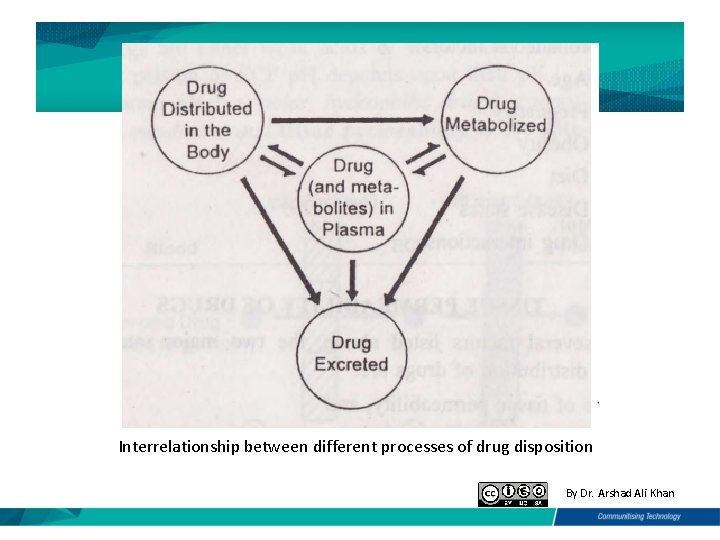
Interrelationship between different processes of drug disposition By Dr. Arshad Ali Khan
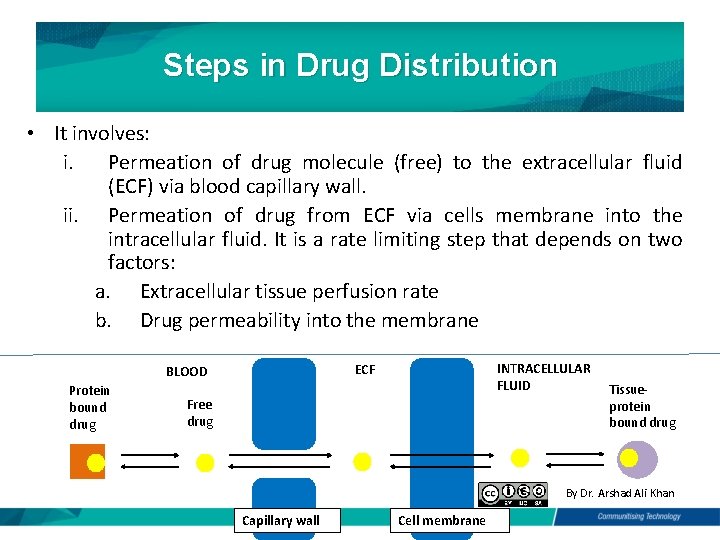
Steps in Drug Distribution • It involves: i. Permeation of drug molecule (free) to the extracellular fluid (ECF) via blood capillary wall. ii. Permeation of drug from ECF via cells membrane into the intracellular fluid. It is a rate limiting step that depends on two factors: a. Extracellular tissue perfusion rate b. Drug permeability into the membrane Protein bound drug INTRACELLULAR FLUID ECF BLOOD Free drug Tissueprotein bound drug By Dr. Arshad Ali Khan Capillary wall Cell membrane
Protein Binding of Drugs By Dr. Arshad Ali Khan
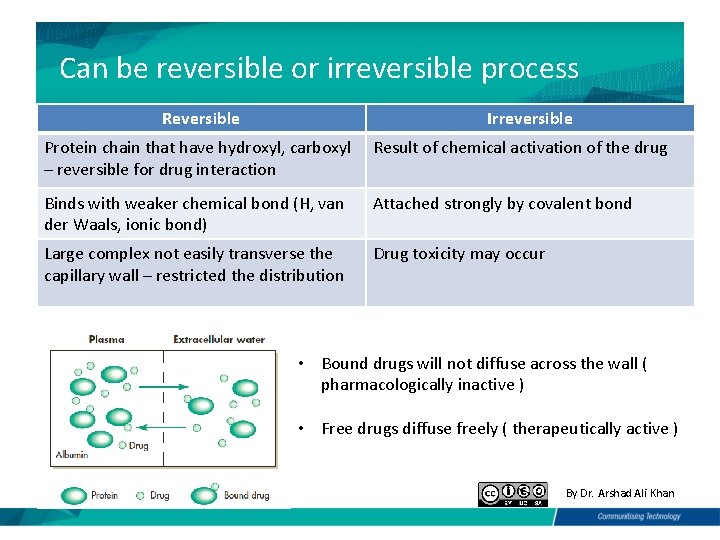
Can be reversible or irreversible process Reversible Irreversible Protein chain that have hydroxyl, carboxyl Result of chemical activation of the drug – reversible for drug interaction Binds with weaker chemical bond (H, van der Waals, ionic bond) Attached strongly by covalent bond Large complex not easily transverse the capillary wall – restricted the distribution Drug toxicity may occur • Bound drugs will not diffuse across the wall ( pharmacologically inactive ) • Free drugs diffuse freely ( therapeutically active ) By Dr. Arshad Ali Khan
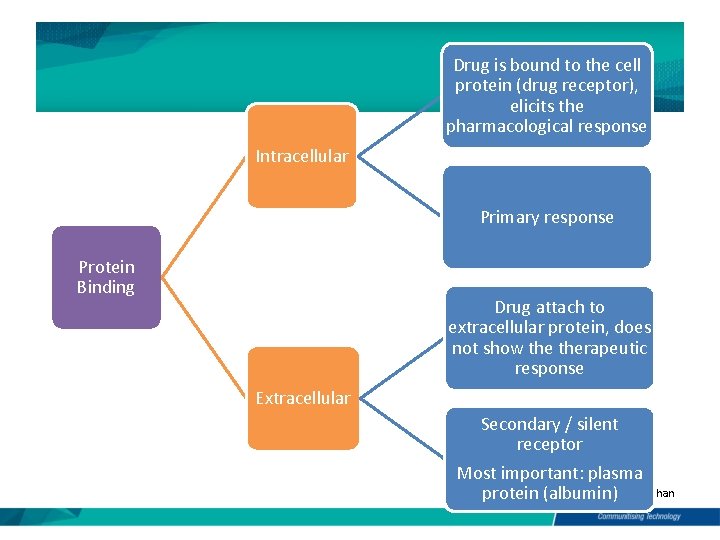
Drug is bound to the cell protein (drug receptor), elicits the pharmacological response Intracellular Primary response Protein Binding Drug attach to extracellular protein, does not show therapeutic response Extracellular Secondary / silent receptor Most important: plasma By Dr. Arshad Ali Khan protein (albumin)
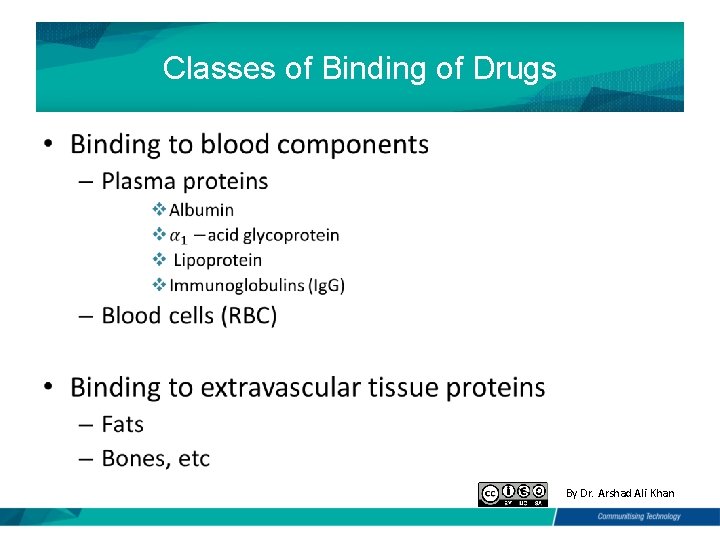
Classes of Binding of Drugs • By Dr. Arshad Ali Khan
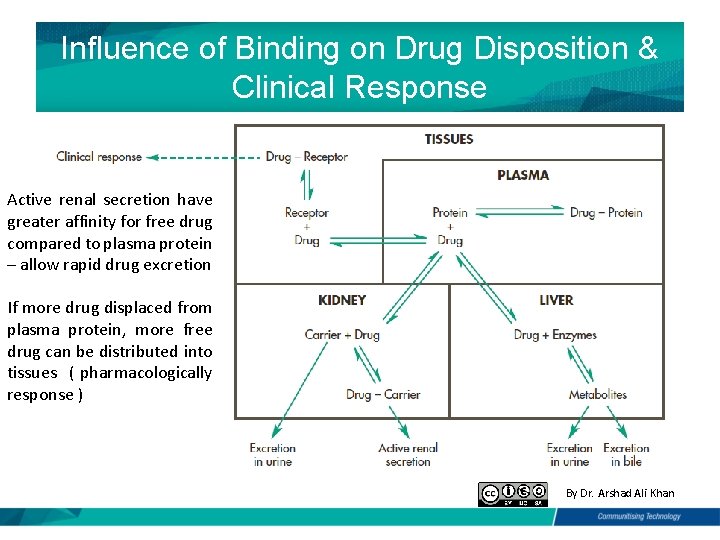
Influence of Binding on Drug Disposition & Clinical Response Active renal secretion have greater affinity for free drug compared to plasma protein – allow rapid drug excretion If more drug displaced from plasma protein, more free drug can be distributed into tissues ( pharmacologically response ) By Dr. Arshad Ali Khan

Plasma Protein-Drug Binding • Reversible • Order of binding of drugs to plasma protein Proteins m. W (k. Da) Concentration Albumin 65 35 – 50 g/L Both anionic and cationic, involves hydrophobic bond Glycoprotein 44 0. 4 – 1. 0 g/L Basic drugs Lipoproteins 200 – 3, 400 Variable 59 0. 03 – 0. 07 g/L Steroids 132 0. 25 – 0. 6 g/L Vitamins 64. 5 110 – 160 g/L Phenytoin, pentobarbital Blood cell Bind to Basic, lipophilic drugs By Dr. Arshad Ali Khan
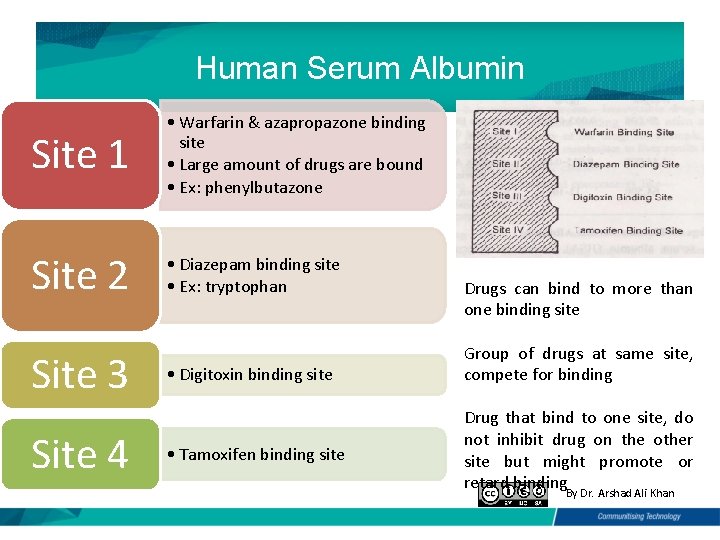
Human Serum Albumin Site 1 • Warfarin & azapropazone binding site • Large amount of drugs are bound • Ex: phenylbutazone Site 2 • Diazepam binding site • Ex: tryptophan Site 3 Site 4 • Digitoxin binding site • Tamoxifen binding site Drugs can bind to more than one binding site Group of drugs at same site, compete for binding Drug that bind to one site, do not inhibit drug on the other site but might promote or retard binding By Dr. Arshad Ali Khan
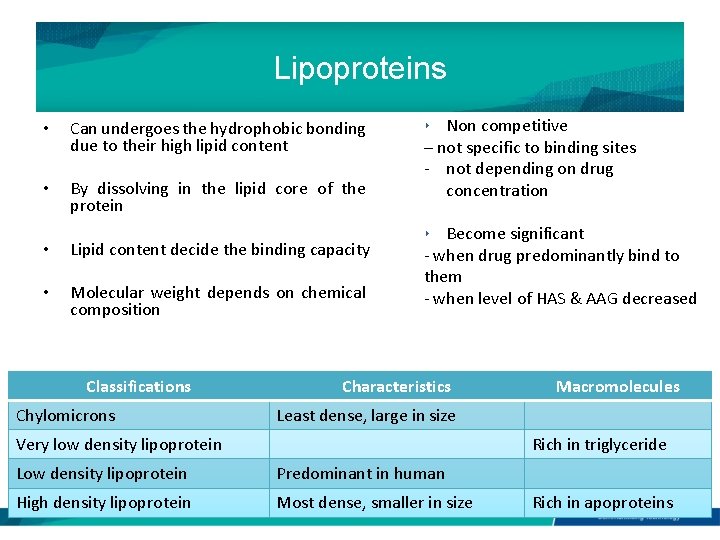
Lipoproteins • Can undergoes the hydrophobic bonding due to their high lipid content • By dissolving in the lipid core of the protein • Lipid content decide the binding capacity • Molecular weight depends on chemical composition Classifications Chylomicrons ‣ Non competitive – not specific to binding sites - not depending on drug concentration ‣ Become significant - when drug predominantly bind to them - when level of HAS & AAG decreased Characteristics Macromolecules Least dense, large in size Very low density lipoprotein Rich in triglyceride Low density lipoprotein Predominant in human High density lipoprotein Most dense, smaller in size By Dr. Arshad Ali Khan Rich in apoproteins
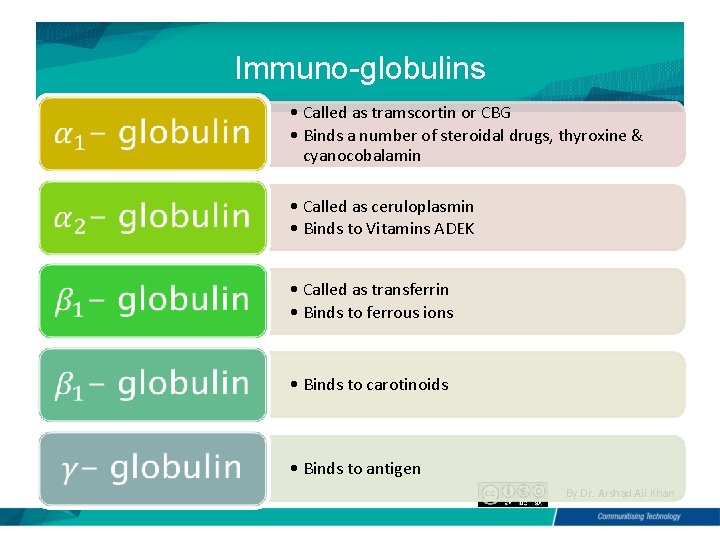
Immuno-globulins • Called as tramscortin or CBG • Binds a number of steroidal drugs, thyroxine & cyanocobalamin • Called as ceruloplasmin • Binds to Vitamins ADEK • Called as transferrin • Binds to ferrous ions • Binds to carotinoids • Binds to antigen By Dr. Arshad Ali Khan
Drug Distribution & Drug Effects • The drugs which are highly bound to the plasma proteins have low fraction of free drugs, thus lowering the volume of distribution • Plasma protein-bound drug does not diffuse easily hence less extensively distributed to tissues • The drugs bounded with plasma protein does not diffuse readily and thus the distribution into the tissue is also very low • Therefore, the free drug molecules are responsible for the drugs’ therapeutic activity ∴Free-drug concentration correlates with the effects By Dr. Arshad Ali Khan
Factors Affecting Distribution Of Drugs By Dr. Arshad Ali Khan
There are some important reason for the non uniform distribution of the drug throughout the body. q Drug uptake from plasma to tissue is different in different tissue due to different rate and extent of drug uptake. q Other factors that affects the drug distribution By Dr. Arshad Ali Khan
1. Drug tissue permeability Ø Physicochemical properties of the drug Ø Physiological barriers in diffusion process 2. Organ or tissue and perfusion rate 3. Binding of drug to tissue components Ø Drug binding to blood components Ø Drug binding to extra vascular tissue proteins By Dr. Arshad Ali Khan
4. Miscellaneous factors: Ø Age Ø Pregnancy Ø Obesity Ø Diet Ø Diseased state Ø Drug interaction By Dr. Arshad Ali Khan
References 1. 2. 3. 4. 5. 6. 7. 8. 9. Rowland, M. and T. N. Tozer (2005). Clinical pharmacokinetics/pharmacodynamics, Lippincott Williams and Wilkins Philadelphia. Shargel, L. and A. B. C. Yu (1999). Applied biopharmaceutics & pharmacokinetics. Stamford, Conn. : , Appleton & Lange. Shargel, L. , et al. (2005). Applied biopharmaceutics & pharmacokinetics. New York : , Appleton & Lange Reviews/Mc. Graw-Hill, Medical Pub. Division. Brahmankar, D. M. and S. B. Jaiswal (1995). Biopharmaceutics and Pharmacokinetics: A Treatise, Vallabh Prakashan. Panyam, J. and Y. Patil (2008). "Distribution: Movement of Drugs through the Body. " Pharmaceutical Sciences Encyclopedia. Mac. Kichan, J. J. (1984). "Pharmacokinetic consequences of drug displacement from blood and tissue proteins. " Clinical pharmacokinetics 9(1): 32 -41. Lloyd, J. B. (2000). "Lysosome membrane permeability: implications for drug delivery. " Advanced drug delivery reviews 41(2): 189 -200. Mushambi, C. , et al. (2003). "Physiology of pregnancy. " Fundamentals of Anaesthesia. Second edition. Greenwich Medical Media, London: 511 -528. Pacifici, G. M. and R. Nottoli (1995). "Placental transfer of drugs administered to the mother. " Clinical pharmacokinetics 28(3): 235 -269. By Dr. Arshad Ali Khan

Thank you By Dr. Arshad Ali Khan
- Slides: 20