
Chapter 4 Distributing Services Through Physical and Electronic
Chapter 4: Distributing Services Through Physical and Electronic Channels Slide © 2007 by Christopher Lovelock and Jochen Wirtz Services Marketing 6/E Chapter 4 - 1
Overview of Chapter 4 § Distribution in a Services Context § Determining Type of Contact: Options for Service Delivery § Place and Time Decisions § Delivering Services in Cyberspace § The Role of Intermediaries § The Challenge of Distribution in Large Domestic Markets § Distributing Services Internationally Slide © 2007 by Christopher Lovelock and Jochen Wirtz Services Marketing 6/E Chapter 4 - 2
Distribution in a Services Context Slide © 2007 by Christopher Lovelock and Jochen Wirtz Services Marketing 6/E Chapter 4 - 3
Applying the Flow Model of Distribution to Services Distribution embraces two interrelated elements: § Information and promotion flow Ø To get customer interested in buying the service § Negotiation flow Ø To sell the right to use a service Slide © 2007 by Christopher Lovelock and Jochen Wirtz Services Marketing 6/E Chapter 4 - 4
Distinguishing between Distribution of Supplementary and Core Services Distribution relates to both core services and supplementary services § Core services for people processing and possession processing services require physical locations § Core services for mental stimulus processing and information processing can be distributed electronically § Supplementary services can be tangible or intangible in nature; latter can be distributed widely and costeffectively via nonphysical channels Ø Telephone Ø Internet Slide © 2007 by Christopher Lovelock and Jochen Wirtz Services Marketing 6/E Chapter 4 - 5
Determining Type of Contact: Options for Service Delivery Slide © 2007 by Christopher Lovelock and Jochen Wirtz Services Marketing 6/E Chapter 4 - 6
Distribution Options for Serving Customers § Customers visit service site Ø Convenience of service factory locations and operational schedules important when customer has to be physically present § Service providers go to customers Ø Unavoidable when object of service is immovable Ø More expensive and time-consuming for service provider § Service transaction is conducted remotely Ø Achieved with help of logistics and telecommunications Slide © 2007 by Christopher Lovelock and Jochen Wirtz Services Marketing 6/E Chapter 4 - 7
Channel Preferences Vary among Customers § For complex and high-perceived risk services, people tend to rely on personal channels § Individuals with greater confidence and knowledge about a service/channel tend to use impersonal and self-service channels § Customers with social motives tend to use personal channels § Convenience is a key driver of channel choice Slide © 2007 by Christopher Lovelock and Jochen Wirtz Services Marketing 6/E Chapter 4 - 8
Place and Time Decisions Slide © 2007 by Christopher Lovelock and Jochen Wirtz Services Marketing 6/E Chapter 4 - 9
Time of Service Delivery § Traditionally, schedules were restricted Ø Service availability limited to daytime, 40 to 50 hours a week Ø Sunday historically considered as a rest day in Christian tradition, Saturday in Jewish tradition, and Friday in Muslim tradition § Today Ø For flexible, responsive service operations: - 24/7 service— 24 hours a day, 7 days a week, around the world (Service Perspectives 4. 3) Ø Some organizations still avoid 7 -day operations, for example: “Being closed on Sunday is part of our value proposition” Slide © 2007 by Christopher Lovelock and Jochen Wirtz Services Marketing 6/E Chapter 4 - 10
Delivering Services in Cyberspace Slide © 2007 by Christopher Lovelock and Jochen Wirtz Services Marketing 6/E Chapter 4 - 11
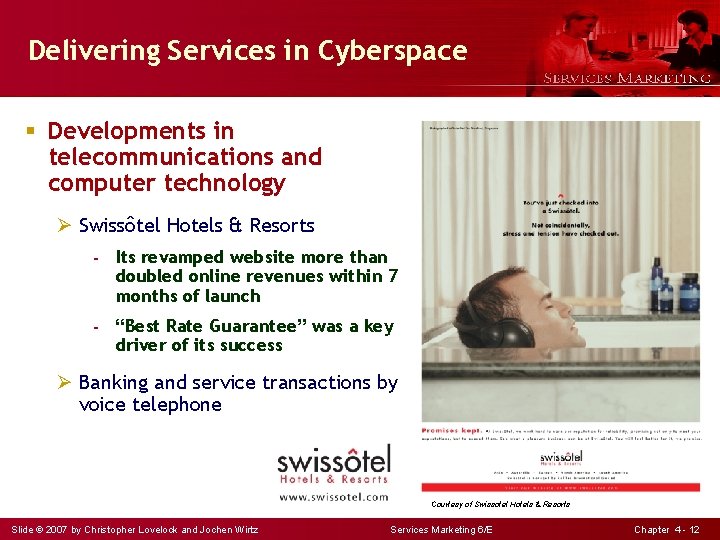
Delivering Services in Cyberspace § Developments in telecommunications and computer technology Ø Swissôtel Hotels & Resorts - Its revamped website more than doubled online revenues within 7 months of launch - “Best Rate Guarantee” was a key driver of its success Ø Banking and service transactions by voice telephone Courtesy of Swissotel Hotels & Resorts Slide © 2007 by Christopher Lovelock and Jochen Wirtz Services Marketing 6/E Chapter 4 - 12
Service Delivery Innovations Facilitated by Technology § Technological Innovations Ø Development of “smart” mobile telephones and PDAs as well as Wi -Fi high-speed Internet technology that links users to Internet from almost anywhere Ø Voice-recognition technology Ø Websites Ø Smart cards - Store detailed information about customer - Act as electronic purse containing digital money § Increase accessibility of services § Deliver right information or interaction at right time § Create and maintain up-to-date real-time information Slide © 2007 by Christopher Lovelock and Jochen Wirtz Services Marketing 6/E Chapter 4 - 13
e-Commerce: Move to Cyberspace (1) § Internet facilitates 5 categories of “flow” Ø Information Ø Negotiation Ø Service Ø Transactions Ø Promotion § Electronic channels offer complement/alternative to traditional physical channels § Convenience (24 -hour availability, save time, effort) § Ease of obtaining information online and searching for desired items § Better prices than in many bricks-and-mortar stores § Broad selection Slide © 2007 by Christopher Lovelock and Jochen Wirtz Services Marketing 6/E Chapter 4 - 14
e-Commerce: Move to Cyberspace (2) § Recent Developments link Websites, customer management (CRM) systems, and mobile telephony § Integrating mobile devices into the service delivery infrastructure can be used as means to: Ø Access services Ø Alert customers to opportunities/problems Ø Update information in real time Slide © 2007 by Christopher Lovelock and Jochen Wirtz Services Marketing 6/E Chapter 4 - 15
Role of Intermediaries Slide © 2007 by Christopher Lovelock and Jochen Wirtz Services Marketing 6/E Chapter 4 - 16
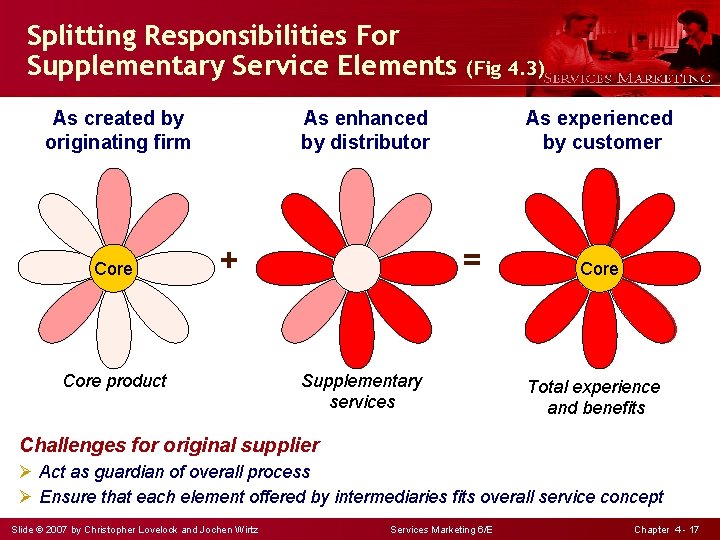
Splitting Responsibilities For Supplementary Service Elements As created by originating firm Core (Fig 4. 3) As enhanced by distributor + Core product As experienced by customer = Supplementary services Core Total experience and benefits Challenges for original supplier Ø Act as guardian of overall process Ø Ensure that each element offered by intermediaries fits overall service concept Slide © 2007 by Christopher Lovelock and Jochen Wirtz Services Marketing 6/E Chapter 4 - 17
Franchising (1) § Popular way to expand delivery of effective service concept § Franchising is a fast growth strategy, when Ø Resources are limited Ø Long-term commitment of store managers is crucial Ø Local knowledge is important Ø Fast growth is necessary to preempt competition § Study shows significant attrition rate among franchisors in the early years of a new franchise system Ø One-third of all systems fail within first 4 years Ø Three-fourths of all franchisors cease to exist after 12 years Slide © 2007 by Christopher Lovelock and Jochen Wirtz Services Marketing 6/E Chapter 4 - 18
Franchising (2) § Disadvantages of franchising Ø Some loss of control over delivery system and, thereby, over how customers experience actual service Ø Effective quality control is important yet difficult Ø Conflict between franchisees may arise especially as they gain experience Slide © 2007 by Christopher Lovelock and Jochen Wirtz Services Marketing 6/E Chapter 4 - 19
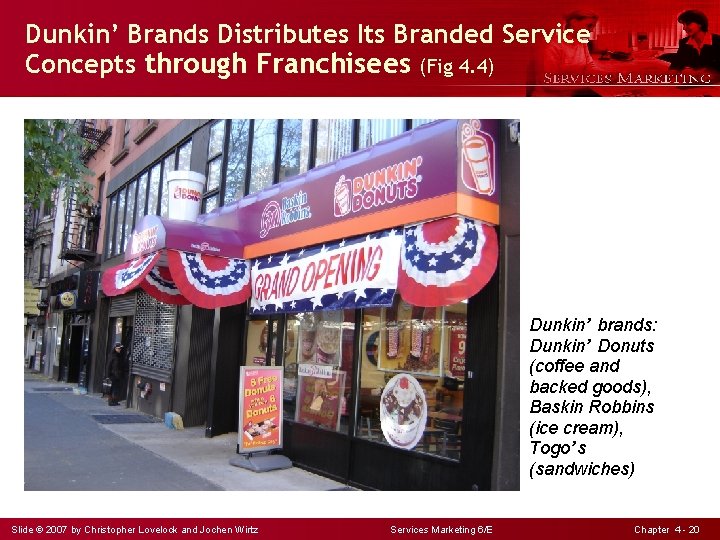
Dunkin’ Brands Distributes Its Branded Service Concepts through Franchisees (Fig 4. 4) Dunkin’ brands: Dunkin’ Donuts (coffee and backed goods), Baskin Robbins (ice cream), Togo’s (sandwiches) Slide © 2007 by Christopher Lovelock and Jochen Wirtz Services Marketing 6/E Chapter 4 - 20
The Challenge of Distribution in Large Domestic Markets Slide © 2007 by Christopher Lovelock and Jochen Wirtz Services Marketing 6/E Chapter 4 - 21
The Challenge of Distribution In Large Domestic Markets § Marketing services (i. e. , physical logistics) face challenges due to: Ø Distances involved (geographic areas) Ø Existence of multiple time zones Ø Multiculturalism (especially, immigrants and indigenous people) Ø Differences in laws and tax rates § Large U. S. companies counter this by: Ø Targeting specific market segments Ø Seeking out narrow market niches Q: Choose any one service that may be classed as targeting a “niche market” and list the various consequences, both positive and negative of targeting such a niche in a certain location Slide © 2007 by Christopher Lovelock and Jochen Wirtz Services Marketing 6/E Chapter 4 - 22
Distributing Services Internationally Slide © 2007 by Christopher Lovelock and Jochen Wirtz Services Marketing 6/E Chapter 4 - 23
How Service Processes Affect International Market Entry § People processing services require direct contact with customers Ø Export service concept - Acting alone or in partnership with local suppliers - For example, e. g. , chain restaurants, hotels, car rental firms Ø Import customers - Inviting customers from overseas to firm’s home country - For example, holding academic conferences. Ø Transport customers to new locations - Passenger transportation (air, sea, rail, road) Slide © 2007 by Christopher Lovelock and Jochen Wirtz Services Marketing 6/E Chapter 4 - 24
Barriers to International Trade in Services § Passage of free-trade legislation is important facilitator of transnational operations Ø Notable developments: Trade Blocs. Examples? § Despite efforts of WTO, operating in international markets still difficult Ø Restrictions on international airline operating rights Ø Administrative delays Ø Limited availability of work permits Ø Heavy taxation Ø Legal restrictions Ø Lack of broadly agreed accounting standards Ø Cultural issues Slide © 2007 by Christopher Lovelock and Jochen Wirtz Services Marketing 6/E Chapter 4 - 25
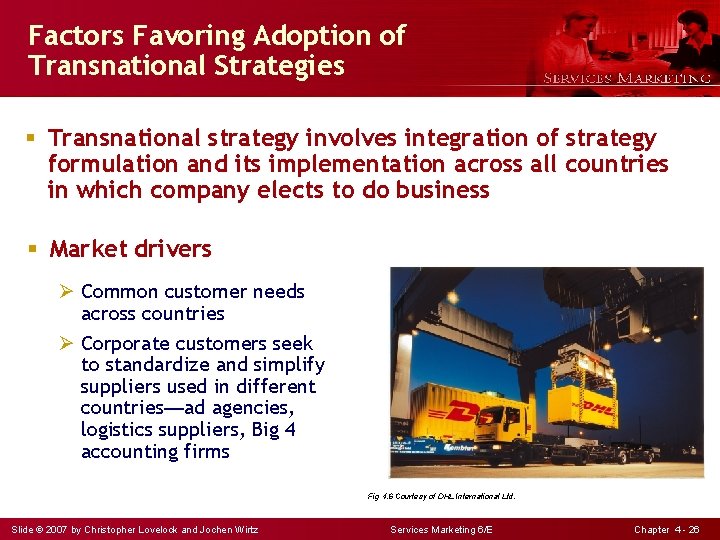
Factors Favoring Adoption of Transnational Strategies § Transnational strategy involves integration of strategy formulation and its implementation across all countries in which company elects to do business § Market drivers Ø Common customer needs across countries Ø Corporate customers seek to standardize and simplify suppliers used in different countries—ad agencies, logistics suppliers, Big 4 accounting firms Fig 4. 6 Courtesy of DHL International Ltd. Slide © 2007 by Christopher Lovelock and Jochen Wirtz Services Marketing 6/E Chapter 4 - 26
Summary of Chapter 4: Distributing Services (1) § Distribution relates to both core and supplementary services and embraces three interrelated elements Ø Information and promotion flow, negotiation flow, product flow § Channel preferences vary among customers, options include: Ø Customers visit the service site Ø Service providers go to their customers Ø Service transaction is conducted remotely § Place and time decisions include where services should be delivered in bricks-and-mortar context, when it should be delivered § Delivery in cyberspace is facilitated by technology and e-commerce allows 24 -hour delivery, saving time and effort § Intermediaries play roles in distributing services Ø Franchising brings both advantages and disadvantages to the firm Slide © 2007 by Christopher Lovelock and Jochen Wirtz Services Marketing 6/E Chapter 4 - 27
Summary of Chapter 4: Distributing Services (2) § Service processes affect international market entry differently § There are different drivers of globalization of services and their distribution Ø Ø Ø Market drivers Competition drivers Technology drivers Cost drivers Government drivers § People processing services, possession processing services, and information-based services impact five groups of drivers differently Slide © 2007 by Christopher Lovelock and Jochen Wirtz Services Marketing 6/E Chapter 4 - 28
- Slides: 28