
Chapter 4 Discrete Probability Distributions Sections 4 9
Chapter 4. Discrete Probability Distributions Sections 4. 9, 4. 10: Moment Generating Function and Probability Generating Function Jiaping Wang Department of Mathematical Science 03/06/2013, Wednesday The UNIVERSITY of NORTH CAROLINA at CHAPEL HILL
Outline Moment Generating Function Probability Generating Function More Examples Homework #7 The UNIVERSITY of NORTH CAROLINA at CHAPEL HILL
Part 1. Moment Generating Function The UNIVERSITY of NORTH CAROLINA at CHAPEL HILL

K-th Moment and Its Moment Generating Function It often is easier to evaluate M(t) and its derivatives than to find the moments of the random variable directly. The UNIVERSITY of NORTH CAROLINA at CHAPEL HILL

Example 4. 27 Evaluate the moment generating function (mgf) for the geometric distribution and use it to find the mean and the variance of this distribution. The UNIVERSITY of NORTH CAROLINA at CHAPEL HILL
Part 2. Probability Generating Function The UNIVERSITY of NORTH CAROLINA at CHAPEL HILL
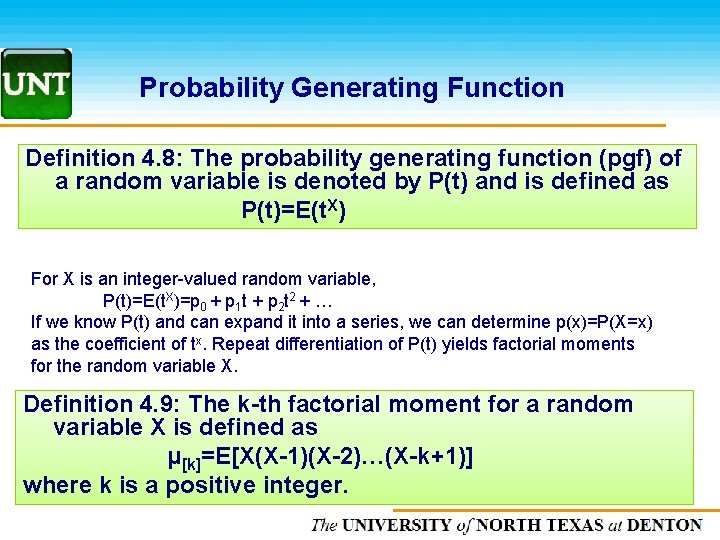
Probability Generating Function Definition 4. 8: The probability generating function (pgf) of a random variable is denoted by P(t) and is defined as P(t)=E(t. X) For X is an integer-valued random variable, P(t)=E(t. X)=p 0 + p 1 t + p 2 t 2 + … If we know P(t) and can expand it into a series, we can determine p(x)=P(X=x) as the coefficient of tx. Repeat differentiation of P(t) yields factorial moments for the random variable X. Definition 4. 9: The k-th factorial moment for a random variable X is defined as μ[k]=E[X(X-1)(X-2)…(X-k+1)] where k is a positive integer. The UNIVERSITY of NORTH CAROLINA at CHAPEL HILL
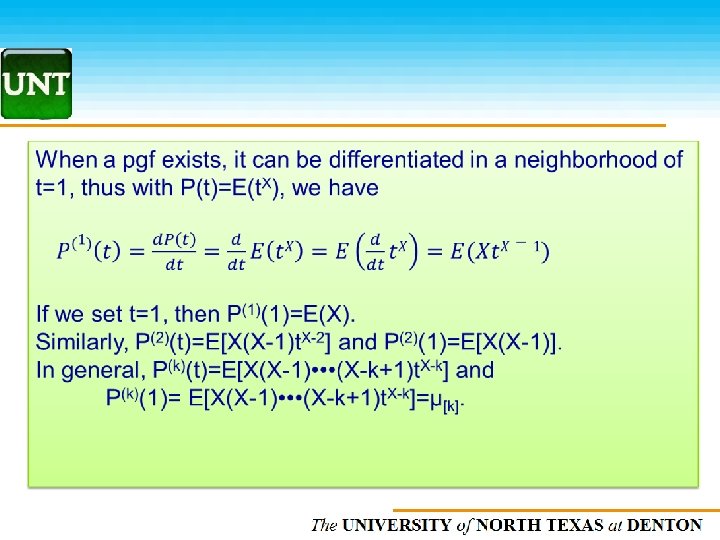
The UNIVERSITY of NORTH CAROLINA at CHAPEL HILL
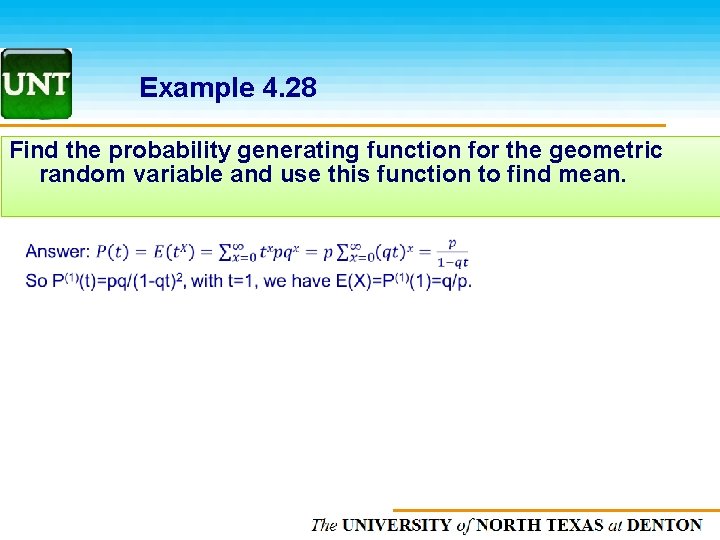
Example 4. 28 Find the probability generating function for the geometric random variable and use this function to find mean. The UNIVERSITY of NORTH CAROLINA at CHAPEL HILL

Part 3. More Examples The UNIVERSITY of NORTH CAROLINA at CHAPEL HILL
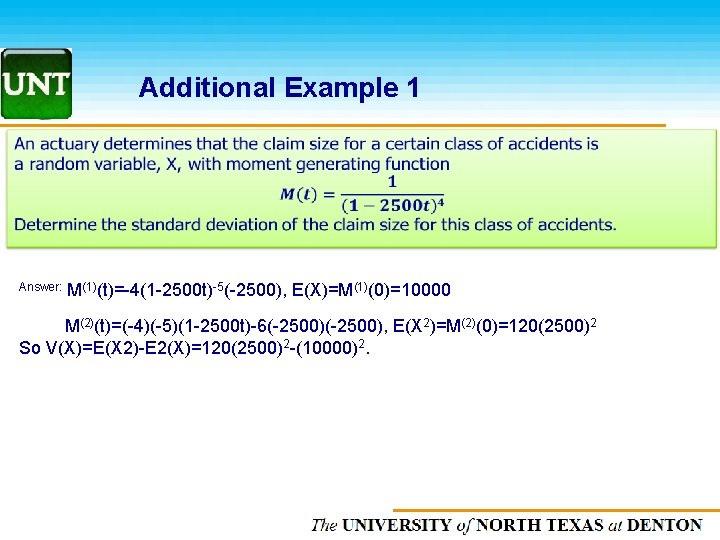
Additional Example 1 Answer: M(1)(t)=-4(1 -2500 t)-5(-2500), E(X)=M(1)(0)=10000 M(2)(t)=(-4)(-5)(1 -2500 t)-6(-2500), E(X 2)=M(2)(0)=120(2500)2 So V(X)=E(X 2)-E 2(X)=120(2500)2 -(10000)2. The UNIVERSITY of NORTH CAROLINA at CHAPEL HILL
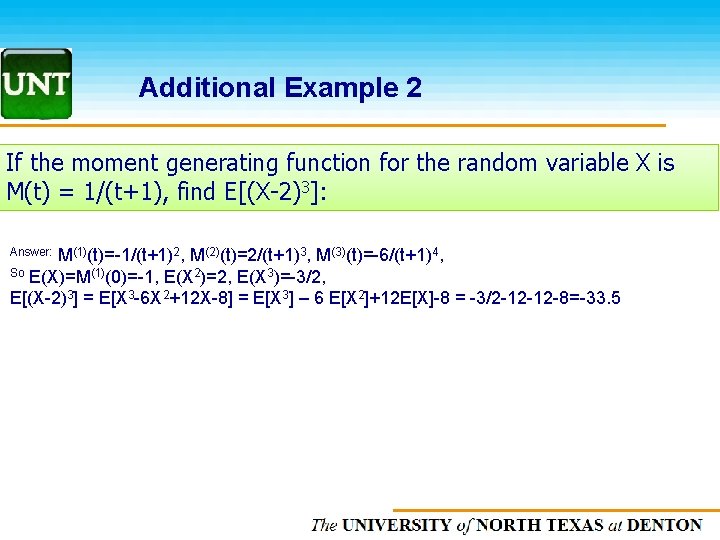
Additional Example 2 If the moment generating function for the random variable X is M(t) = 1/(t+1), find E[(X-2)3]: Answer: M(1)(t)=-1/(t+1)2, M(2)(t)=2/(t+1)3, M(3)(t)=-6/(t+1)4, So E(X)=M(1)(0)=-1, E(X 2)=2, E(X 3)=-3/2, E[(X-2)3] = E[X 3 -6 X 2+12 X-8] = E[X 3] – 6 E[X 2]+12 E[X]-8 = -3/2 -12 -12 -8=-33. 5 The UNIVERSITY of NORTH CAROLINA at CHAPEL HILL
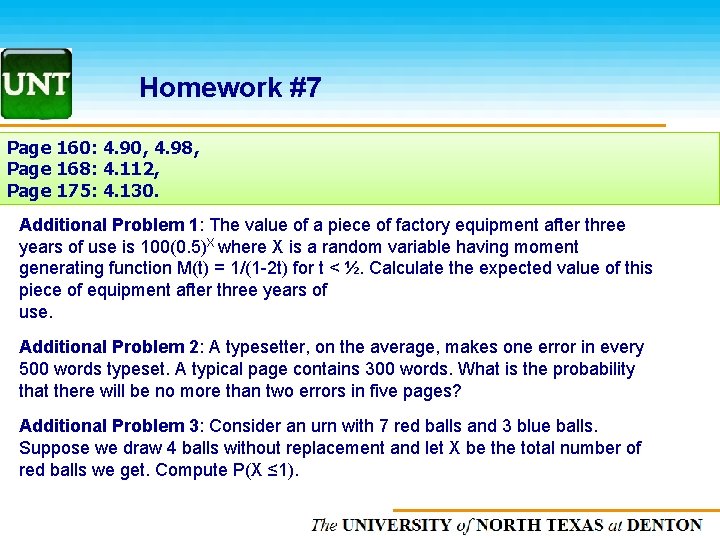
Homework #7 Page 160: 4. 90, 4. 98, Page 168: 4. 112, Page 175: 4. 130. Additional Problem 1: The value of a piece of factory equipment after three years of use is 100(0. 5)X where X is a random variable having moment generating function M(t) = 1/(1 -2 t) for t < ½. Calculate the expected value of this piece of equipment after three years of use. Additional Problem 2: A typesetter, on the average, makes one error in every 500 words typeset. A typical page contains 300 words. What is the probability that there will be no more than two errors in five pages? Additional Problem 3: Consider an urn with 7 red balls and 3 blue balls. Suppose we draw 4 balls without replacement and let X be the total number of red balls we get. Compute P(X ≤ 1). The UNIVERSITY of NORTH CAROLINA at CHAPEL HILL
- Slides: 13