
Chapter 4 Dimensions Hierarchies Operations Modeling Prof Bayer
Chapter 4: Dimensions, Hierarchies, Operations, Modeling Prof. Bayer, DWH, Ch. 4, SS 2002 1
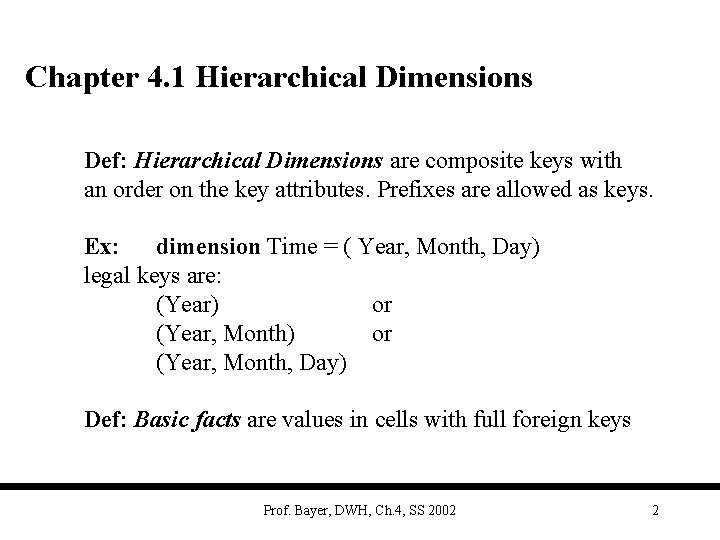
Chapter 4. 1 Hierarchical Dimensions Def: Hierarchical Dimensions are composite keys with an order on the key attributes. Prefixes are allowed as keys. Ex: dimension Time = ( Year, Month, Day) legal keys are: (Year) or (Year, Month, Day) Def: Basic facts are values in cells with full foreign keys Prof. Bayer, DWH, Ch. 4, SS 2002 2
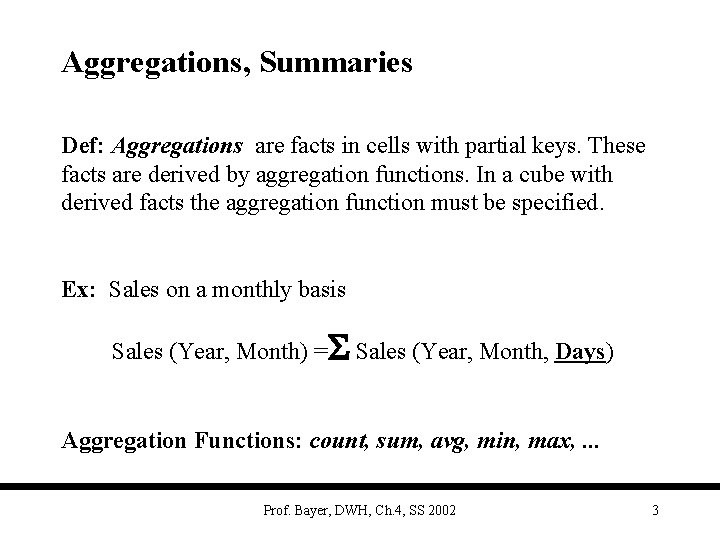
Aggregations, Summaries Def: Aggregations are facts in cells with partial keys. These facts are derived by aggregation functions. In a cube with derived facts the aggregation function must be specified. Ex: Sales on a monthly basis Sales (Year, Month) = S Sales (Year, Month, Days) Aggregation Functions: count, sum, avg, min, max, . . . Prof. Bayer, DWH, Ch. 4, SS 2002 3
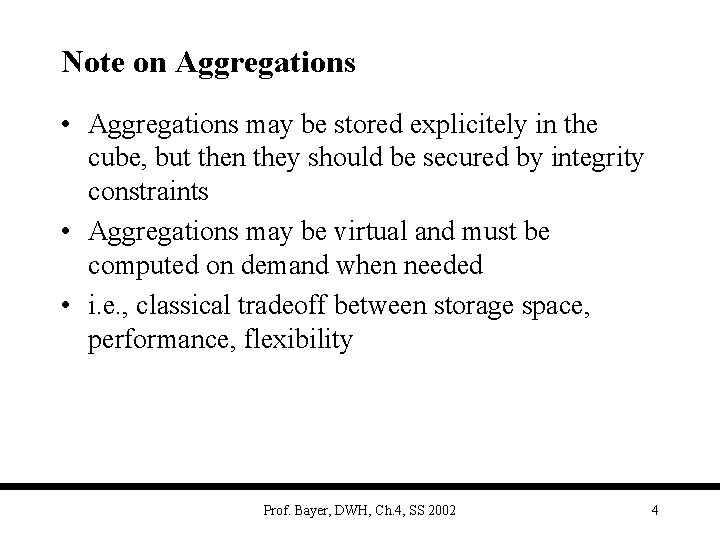
Note on Aggregations • Aggregations may be stored explicitely in the cube, but then they should be secured by integrity constraints • Aggregations may be virtual and must be computed on demand when needed • i. e. , classical tradeoff between storage space, performance, flexibility Prof. Bayer, DWH, Ch. 4, SS 2002 4
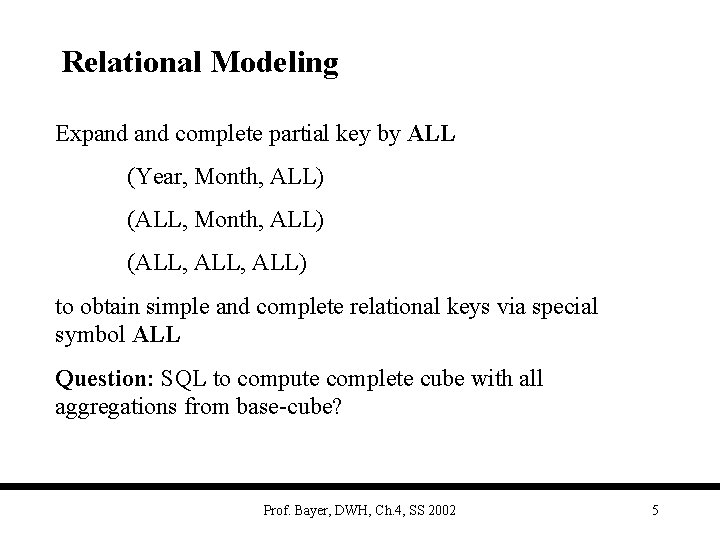
Relational Modeling Expand complete partial key by ALL (Year, Month, ALL) (ALL, ALL) to obtain simple and complete relational keys via special symbol ALL Question: SQL to compute complete cube with all aggregations from base-cube? Prof. Bayer, DWH, Ch. 4, SS 2002 5
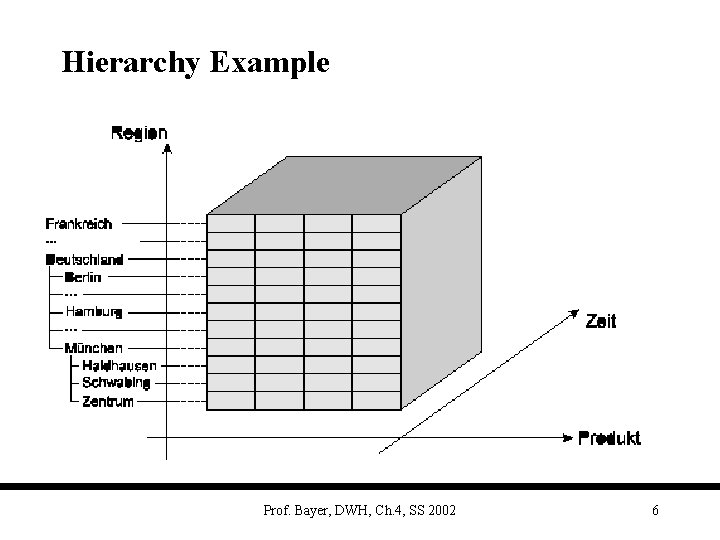
Hierarchy Example Prof. Bayer, DWH, Ch. 4, SS 2002 6
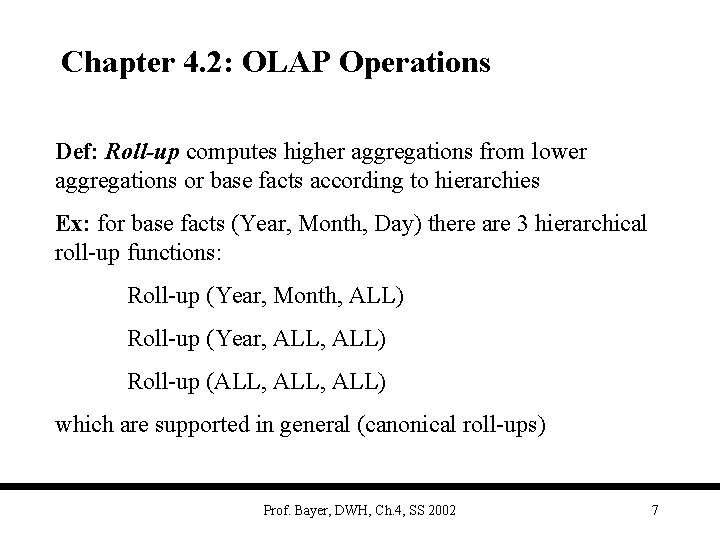
Chapter 4. 2: OLAP Operations Def: Roll-up computes higher aggregations from lower aggregations or base facts according to hierarchies Ex: for base facts (Year, Month, Day) there are 3 hierarchical roll-up functions: Roll-up (Year, Month, ALL) Roll-up (Year, ALL) Roll-up (ALL, ALL) which are supported in general (canonical roll-ups) Prof. Bayer, DWH, Ch. 4, SS 2002 7
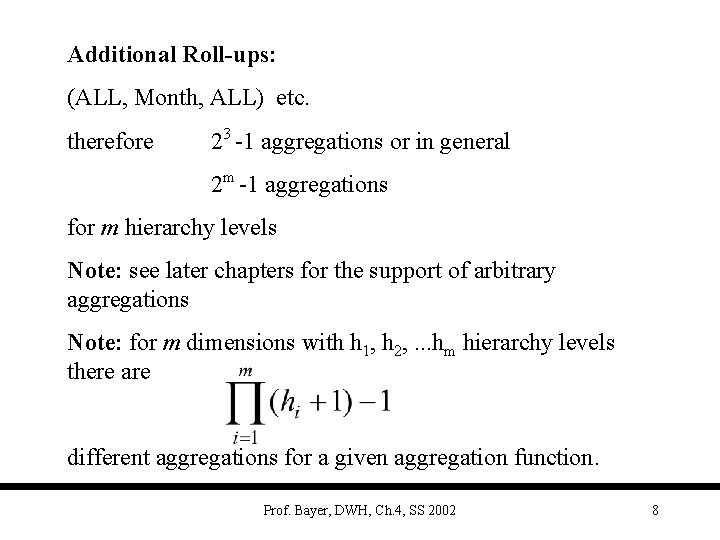
Additional Roll-ups: (ALL, Month, ALL) etc. therefore 23 -1 aggregations or in general 2 m -1 aggregations for m hierarchy levels Note: see later chapters for the support of arbitrary aggregations Note: for m dimensions with h 1, h 2, . . . hm hierarchy levels there are different aggregations for a given aggregation function. Prof. Bayer, DWH, Ch. 4, SS 2002 8
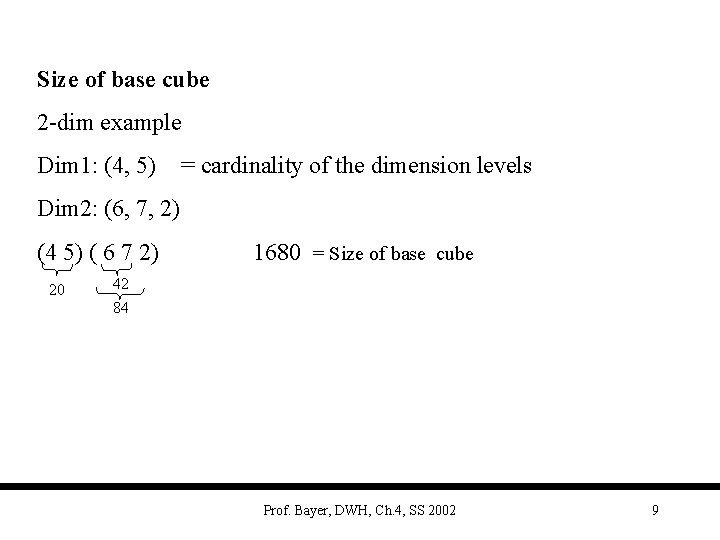
Size of base cube 2 -dim example Dim 1: (4, 5) = cardinality of the dimension levels Dim 2: (6, 7, 2) (4 5) ( 6 7 2) 20 1680 = Size of base cube 42 84 Prof. Bayer, DWH, Ch. 4, SS 2002 9
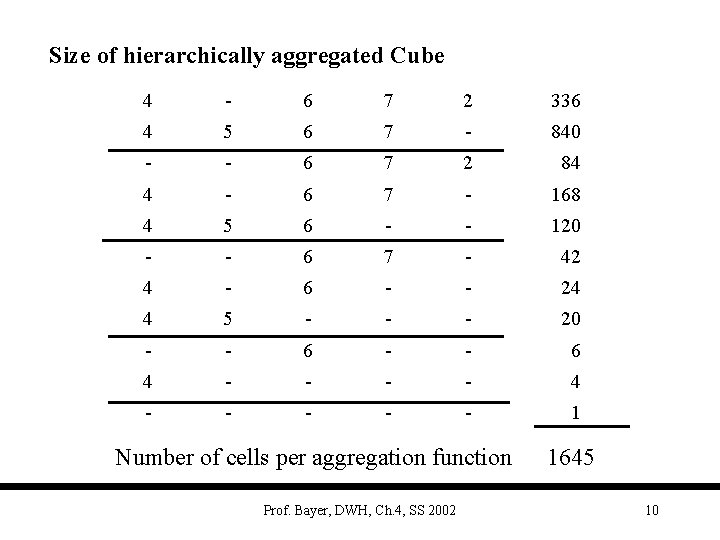
Size of hierarchically aggregated Cube 4 - 6 7 2 336 4 5 6 7 - 840 - - 6 7 2 84 4 - 6 7 - 168 4 5 6 - - 120 - - 6 7 - 42 4 - 6 - - 24 4 5 - - - 20 - - 6 4 - - - - - 1 Number of cells per aggregation function Prof. Bayer, DWH, Ch. 4, SS 2002 1645 10
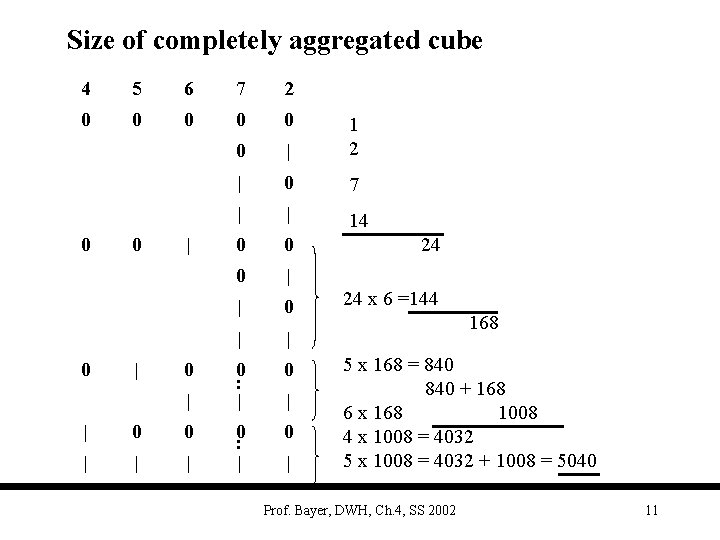
Size of completely aggregated cube 4 5 6 7 2 0 0 0 | 1 2 | 0 7 | | 14 0 0 0 | | 0 : | 0 0 0 0 | | | 24 24 x 6 =144 168 5 x 168 = 840 + 168 6 x 168 1008 4 x 1008 = 4032 5 x 1008 = 4032 + 1008 = 5040 Prof. Bayer, DWH, Ch. 4, SS 2002 11
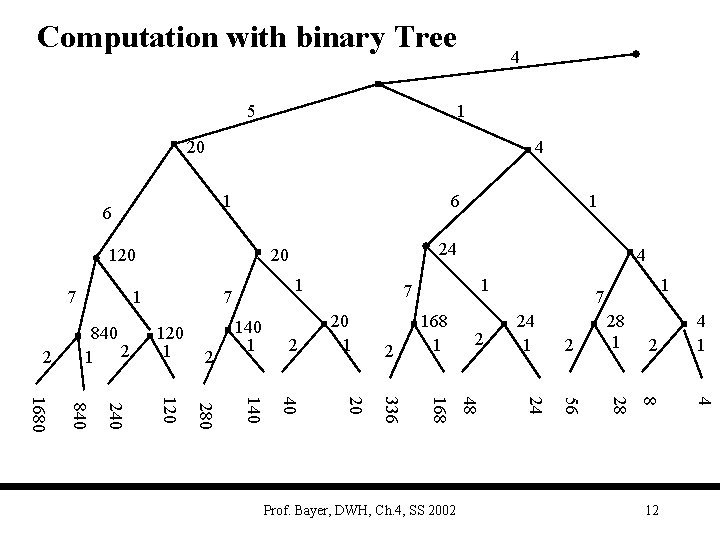
Computation with binary Tree 5 4 1 20 4 1 6 6 120 7 1 7 2 28 1 2 4 1 28 8 4 Prof. Bayer, DWH, Ch. 4, SS 2002 24 1 56 2 1 7 24 20 40 2 168 1 48 20 1 168 2 4 336 140 1 140 2 280 240 840 1680 120 1 120 2 840 2 1 24 20 1 1 12
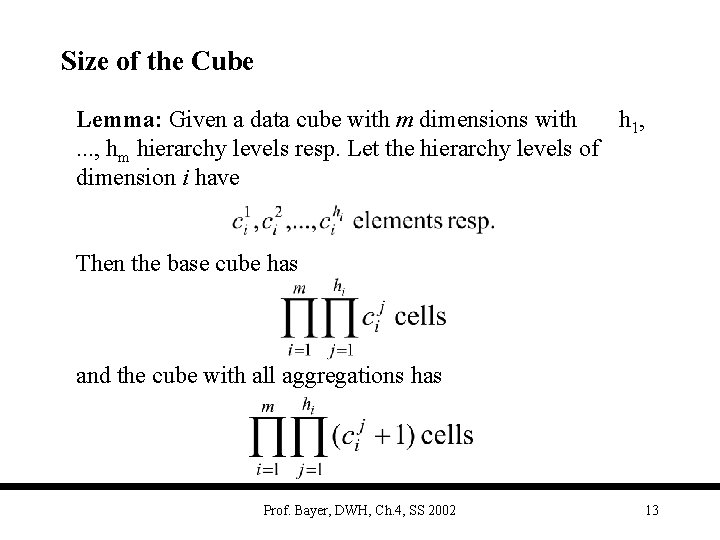
Size of the Cube Lemma: Given a data cube with m dimensions with h 1, . . . , hm hierarchy levels resp. Let the hierarchy levels of dimension i have Then the base cube has and the cube with all aggregations has Prof. Bayer, DWH, Ch. 4, SS 2002 13
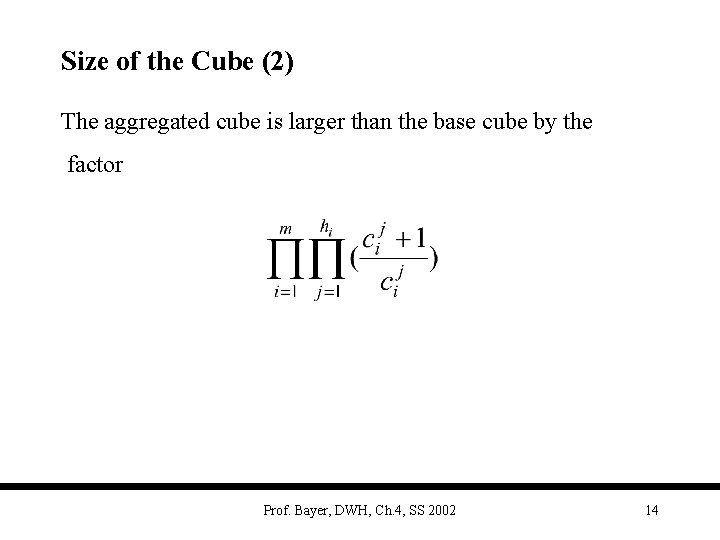
Size of the Cube (2) The aggregated cube is larger than the base cube by the factor Prof. Bayer, DWH, Ch. 4, SS 2002 14
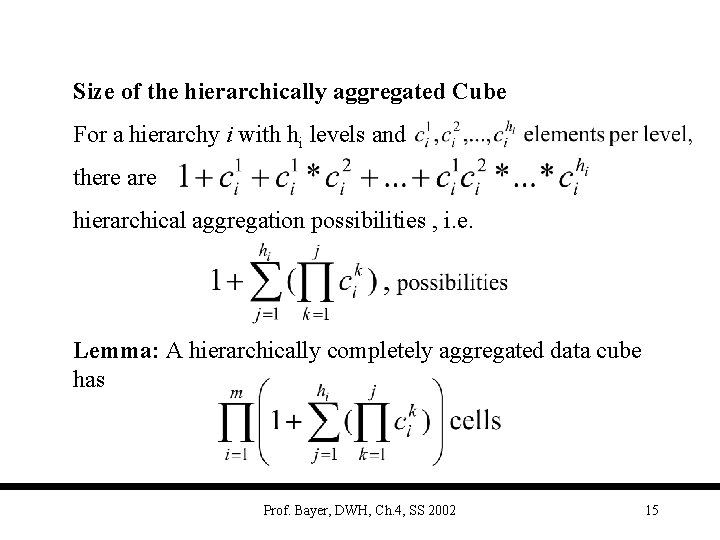
Size of the hierarchically aggregated Cube For a hierarchy i with hi levels and there are hierarchical aggregation possibilities , i. e. Lemma: A hierarchically completely aggregated data cube has Prof. Bayer, DWH, Ch. 4, SS 2002 15
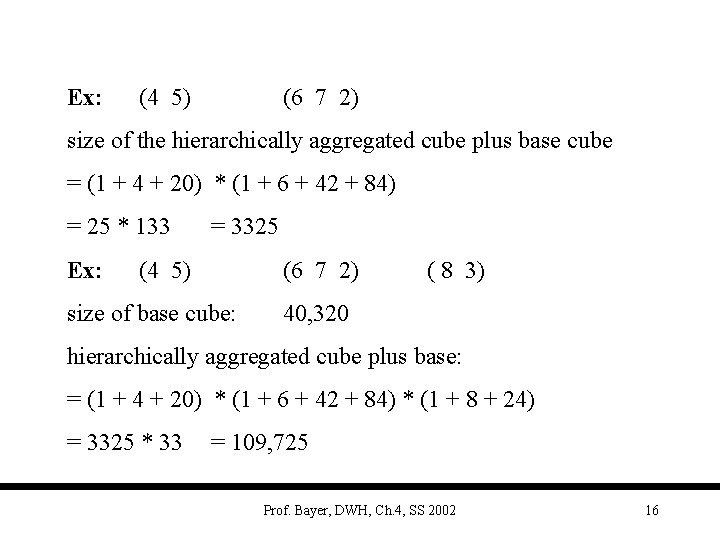
Ex: (4 5) (6 7 2) size of the hierarchically aggregated cube plus base cube = (1 + 4 + 20) * (1 + 6 + 42 + 84) = 25 * 133 Ex: = 3325 (4 5) (6 7 2) size of base cube: ( 8 3) 40, 320 hierarchically aggregated cube plus base: = (1 + 4 + 20) * (1 + 6 + 42 + 84) * (1 + 8 + 24) = 3325 * 33 = 109, 725 Prof. Bayer, DWH, Ch. 4, SS 2002 16
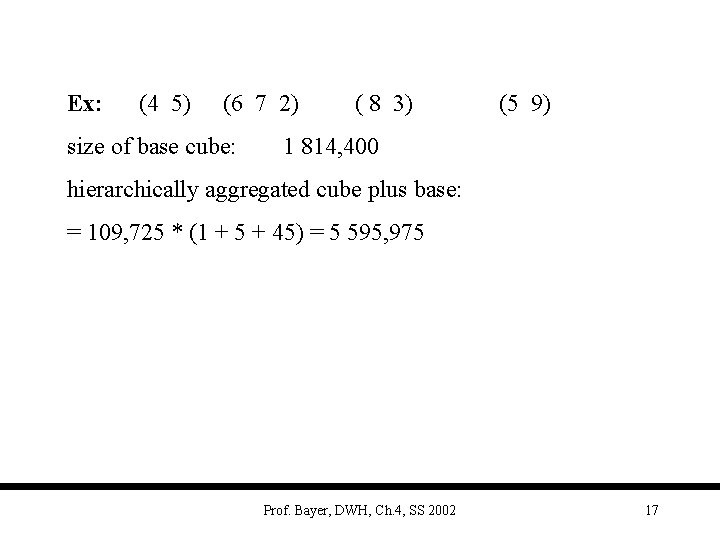
Ex: (4 5) (6 7 2) size of base cube: ( 8 3) (5 9) 1 814, 400 hierarchically aggregated cube plus base: = 109, 725 * (1 + 5 + 45) = 5 595, 975 Prof. Bayer, DWH, Ch. 4, SS 2002 17
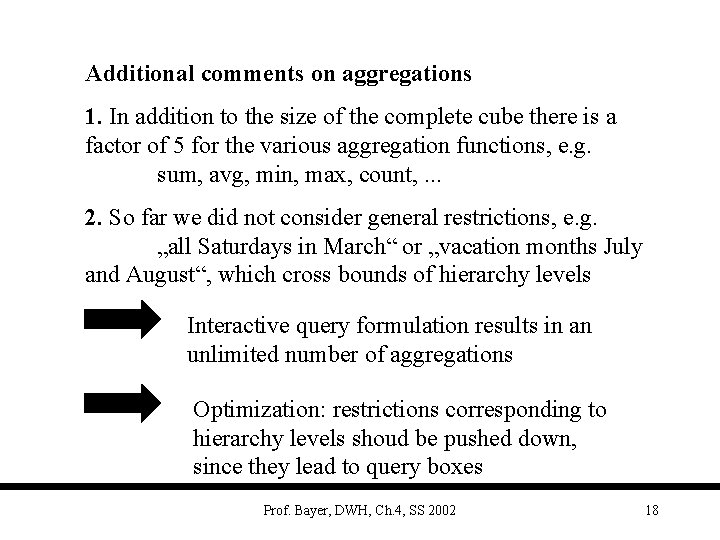
Additional comments on aggregations 1. In addition to the size of the complete cube there is a factor of 5 for the various aggregation functions, e. g. sum, avg, min, max, count, . . . 2. So far we did not consider general restrictions, e. g. „all Saturdays in March“ or „vacation months July and August“, which cross bounds of hierarchy levels Interactive query formulation results in an unlimited number of aggregations Optimization: restrictions corresponding to hierarchy levels shoud be pushed down, since they lead to query boxes Prof. Bayer, DWH, Ch. 4, SS 2002 18
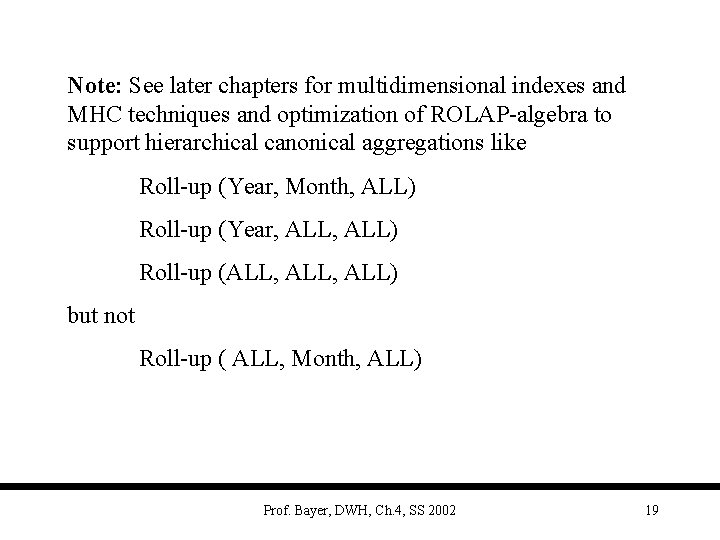
Note: See later chapters for multidimensional indexes and MHC techniques and optimization of ROLAP-algebra to support hierarchical canonical aggregations like Roll-up (Year, Month, ALL) Roll-up (Year, ALL) Roll-up (ALL, ALL) but not Roll-up ( ALL, Month, ALL) Prof. Bayer, DWH, Ch. 4, SS 2002 19
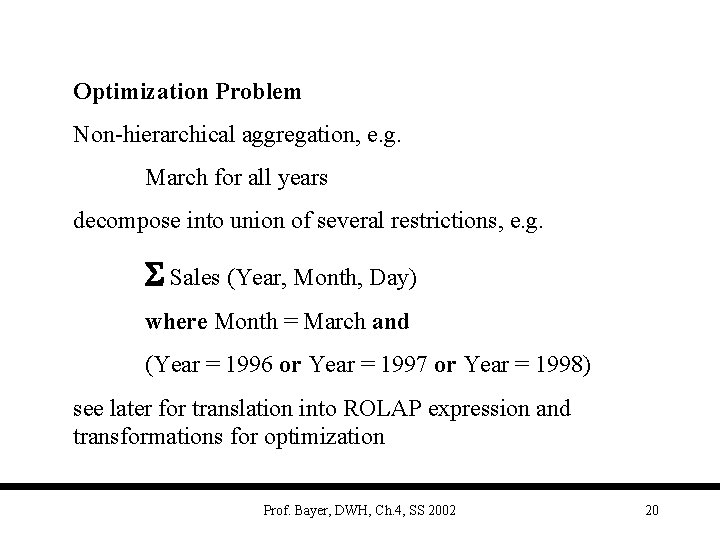
Optimization Problem Non-hierarchical aggregation, e. g. March for all years decompose into union of several restrictions, e. g. S Sales (Year, Month, Day) where Month = March and (Year = 1996 or Year = 1997 or Year = 1998) see later for translation into ROLAP expression and transformations for optimization Prof. Bayer, DWH, Ch. 4, SS 2002 20
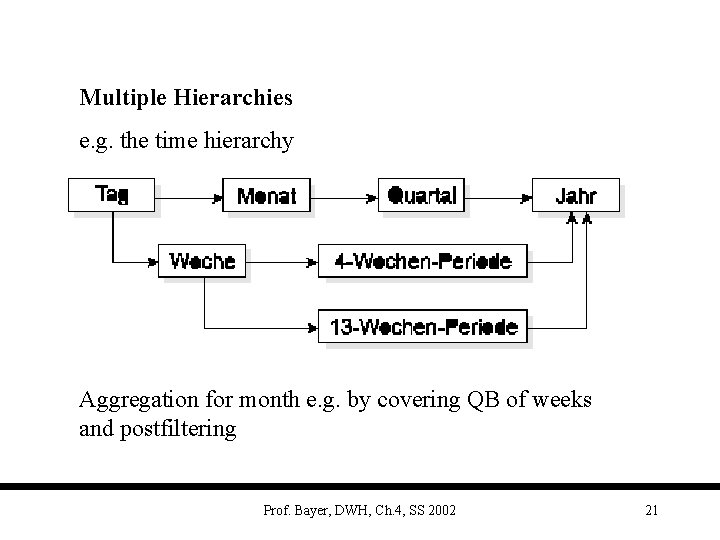
Multiple Hierarchies e. g. the time hierarchy Aggregation for month e. g. by covering QB of weeks and postfiltering Prof. Bayer, DWH, Ch. 4, SS 2002 21
Navigation Operations Drill Down: first show single result for aggregated value, e. g. sales per day, then show: hourly values for days with very high or very low sales in order to plan working hours for sales people better Other Examples: daily sales during Christmas season vacation bookings for skiing on fasching Prof. Bayer, DWH, Ch. 4, SS 2002 22
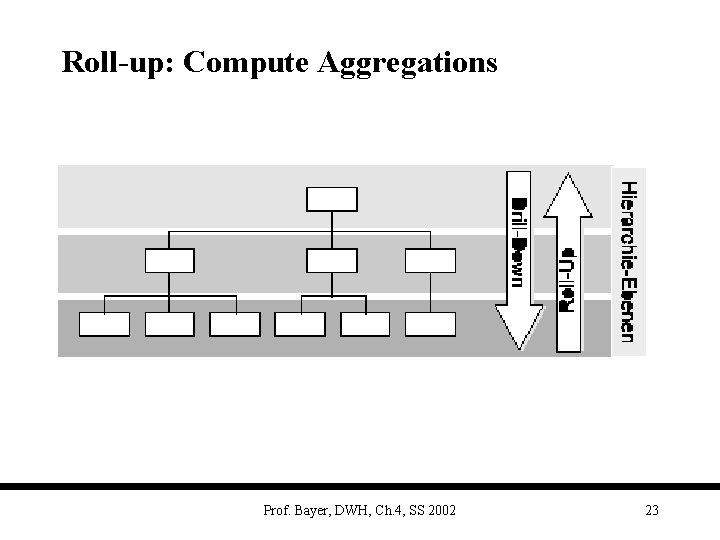
Roll-up: Compute Aggregations Prof. Bayer, DWH, Ch. 4, SS 2002 23
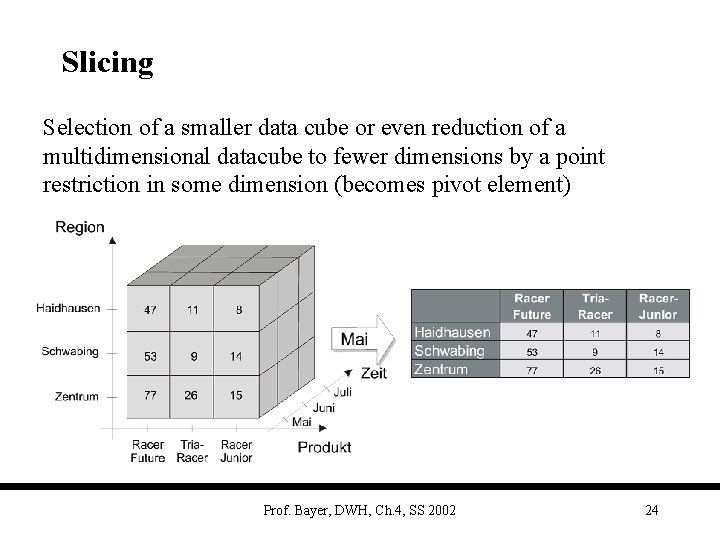
Slicing Selection of a smaller data cube or even reduction of a multidimensional datacube to fewer dimensions by a point restriction in some dimension (becomes pivot element) Prof. Bayer, DWH, Ch. 4, SS 2002 24
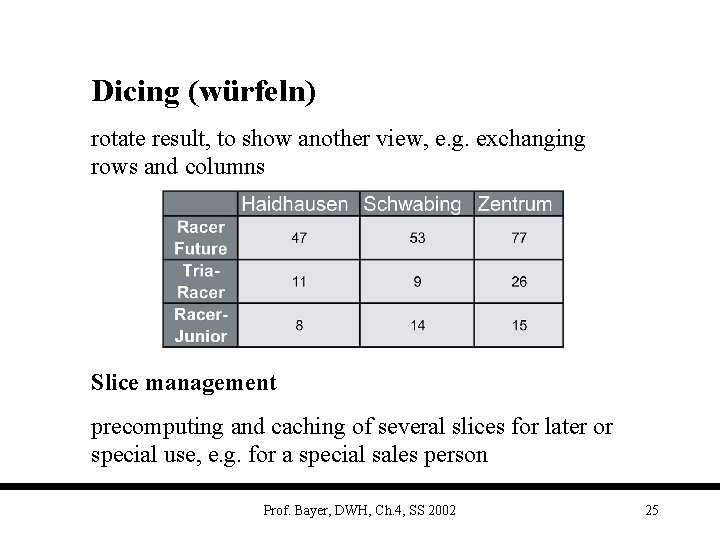
Dicing (würfeln) rotate result, to show another view, e. g. exchanging rows and columns Slice management precomputing and caching of several slices for later or special use, e. g. for a special sales person Prof. Bayer, DWH, Ch. 4, SS 2002 25
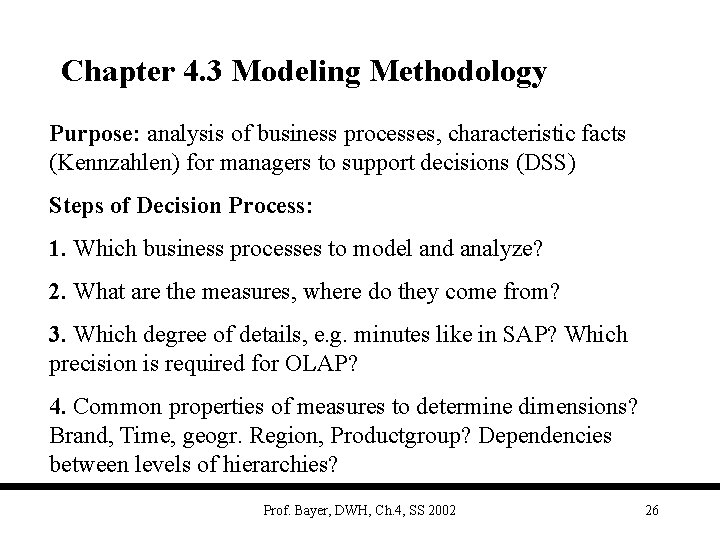
Chapter 4. 3 Modeling Methodology Purpose: analysis of business processes, characteristic facts (Kennzahlen) for managers to support decisions (DSS) Steps of Decision Process: 1. Which business processes to model and analyze? 2. What are the measures, where do they come from? 3. Which degree of details, e. g. minutes like in SAP? Which precision is required for OLAP? 4. Common properties of measures to determine dimensions? Brand, Time, geogr. Region, Productgroup? Dependencies between levels of hierarchies? Prof. Bayer, DWH, Ch. 4, SS 2002 26
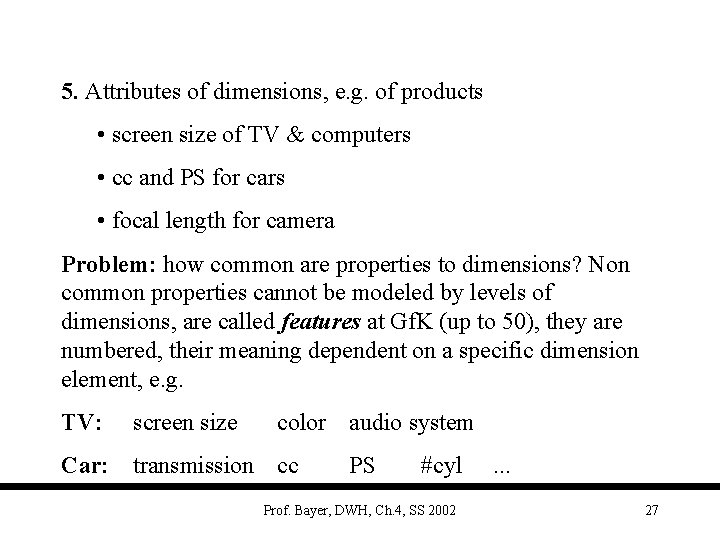
5. Attributes of dimensions, e. g. of products • screen size of TV & computers • cc and PS for cars • focal length for camera Problem: how common are properties to dimensions? Non common properties cannot be modeled by levels of dimensions, are called features at Gf. K (up to 50), they are numbered, their meaning dependent on a specific dimension element, e. g. TV: screen size color audio system Car: transmission cc PS #cyl Prof. Bayer, DWH, Ch. 4, SS 2002 . . . 27
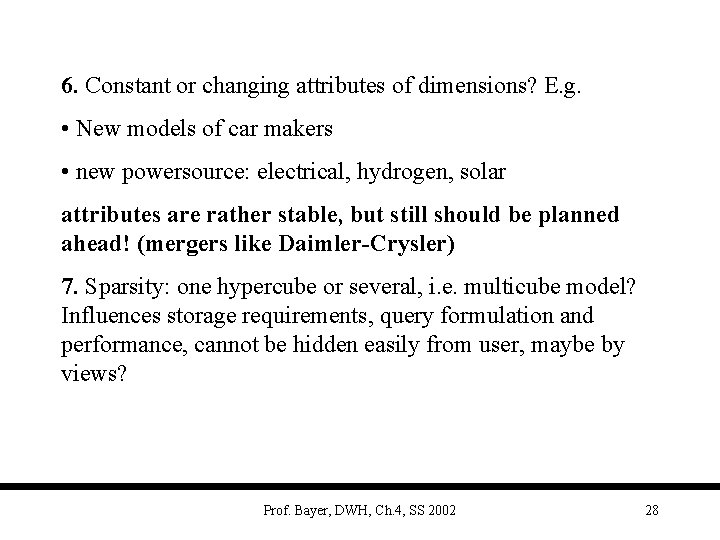
6. Constant or changing attributes of dimensions? E. g. • New models of car makers • new powersource: electrical, hydrogen, solar attributes are rather stable, but still should be planned ahead! (mergers like Daimler-Crysler) 7. Sparsity: one hypercube or several, i. e. multicube model? Influences storage requirements, query formulation and performance, cannot be hidden easily from user, maybe by views? Prof. Bayer, DWH, Ch. 4, SS 2002 28
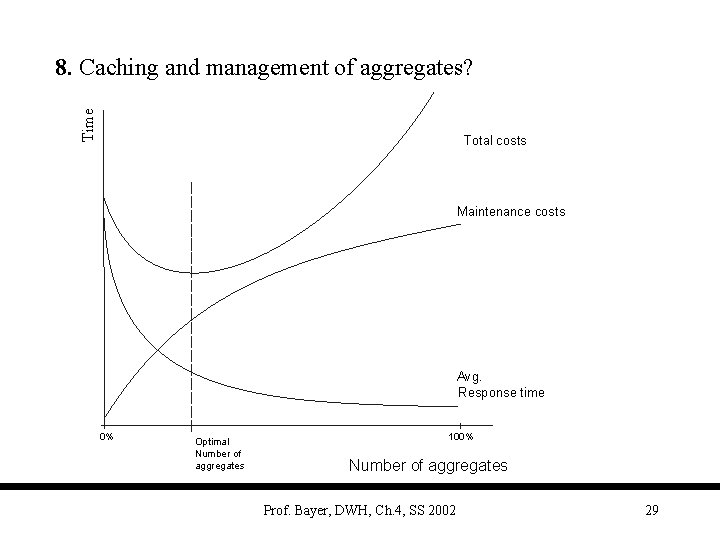
Time 8. Caching and management of aggregates? Total costs Maintenance costs Avg. Response time 0% Optimal Number of aggregates 100% Number of aggregates Prof. Bayer, DWH, Ch. 4, SS 2002 29
Chapter 4. 4 Comparison of OLAP Architectures 1. MOLAP: Multidimensional OLAP 2. ROLAP: Relational OLAP 3. HOLAP: Hybrid OLAP Prof. Bayer, DWH, Ch. 4, SS 2002 30
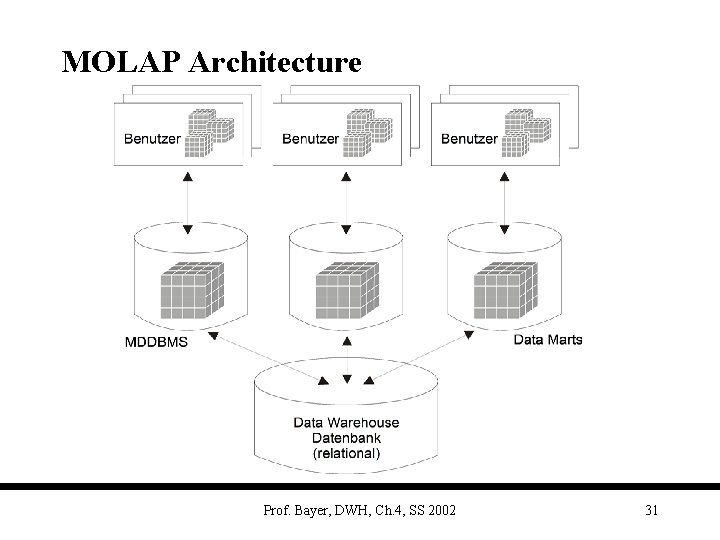
MOLAP Architecture Prof. Bayer, DWH, Ch. 4, SS 2002 31
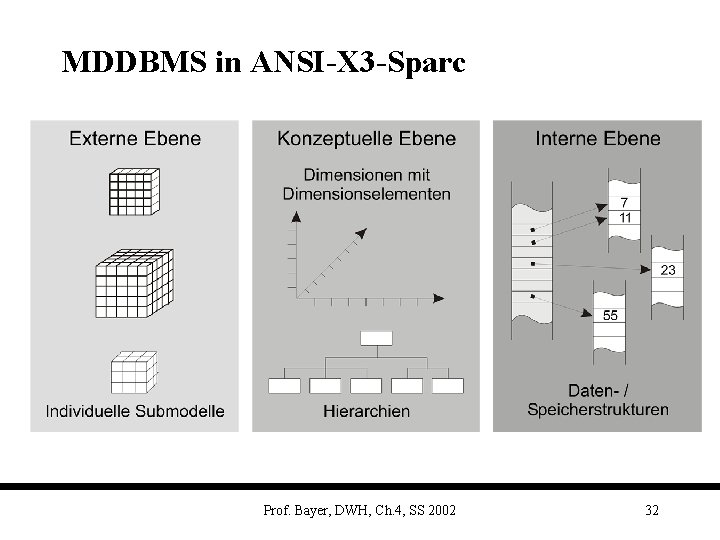
MDDBMS in ANSI-X 3 -Sparc Prof. Bayer, DWH, Ch. 4, SS 2002 32
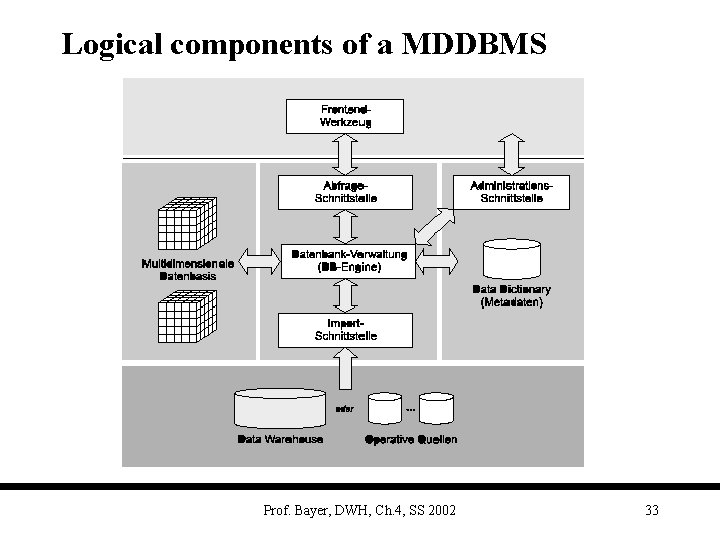
Logical components of a MDDBMS Prof. Bayer, DWH, Ch. 4, SS 2002 33
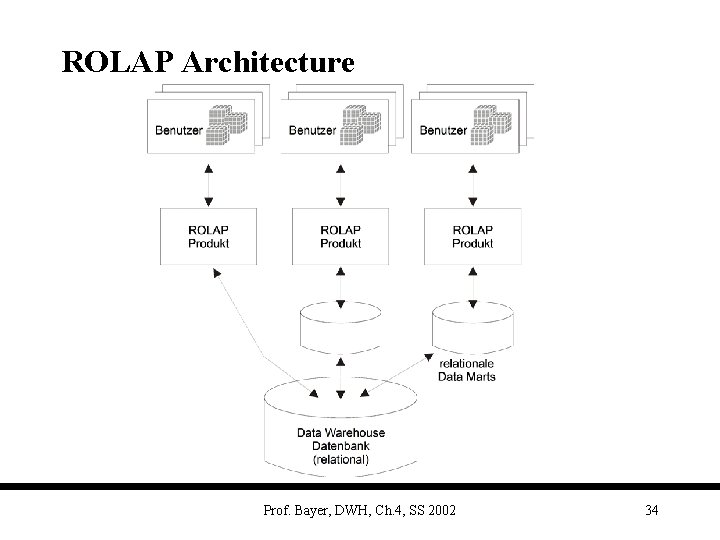
ROLAP Architecture Prof. Bayer, DWH, Ch. 4, SS 2002 34
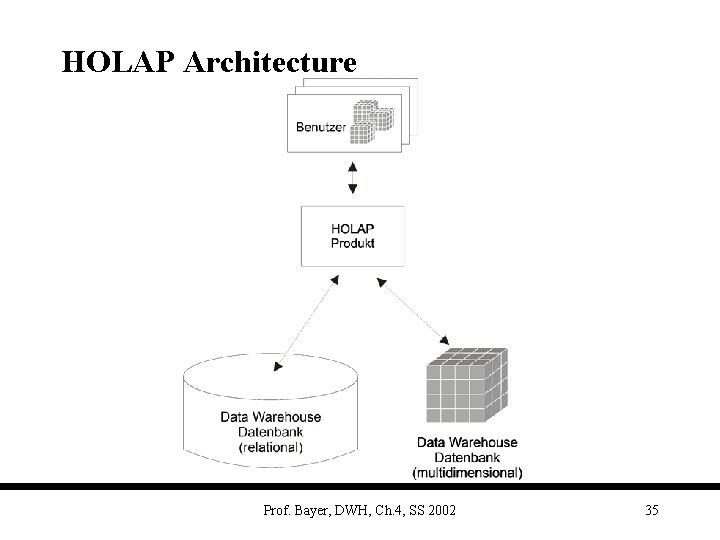
HOLAP Architecture Prof. Bayer, DWH, Ch. 4, SS 2002 35
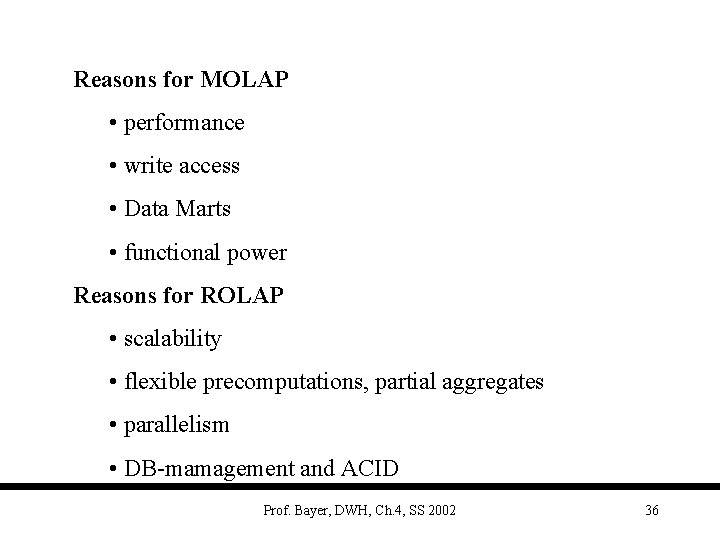
Reasons for MOLAP • performance • write access • Data Marts • functional power Reasons for ROLAP • scalability • flexible precomputations, partial aggregates • parallelism • DB-mamagement and ACID Prof. Bayer, DWH, Ch. 4, SS 2002 36
- Slides: 36