
Chapter 4 Digital Transmission 1 DigitaltoDigital Conversion 2
- Slides: 32
Chapter 4. Digital Transmission 1. Digital-to-Digital Conversion 2. Analog-to-Digital Conversion 3. Transmission Mode Data Communications, Kwangwoon University 4 -1
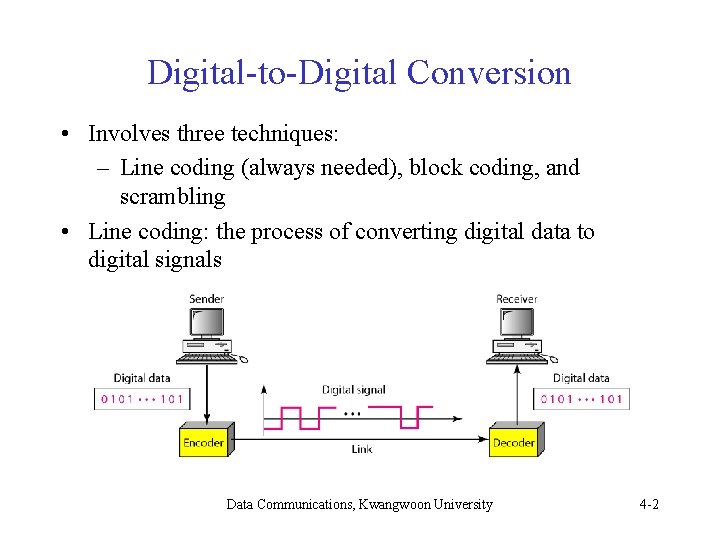
Digital-to-Digital Conversion • Involves three techniques: – Line coding (always needed), block coding, and scrambling • Line coding: the process of converting digital data to digital signals Data Communications, Kwangwoon University 4 -2
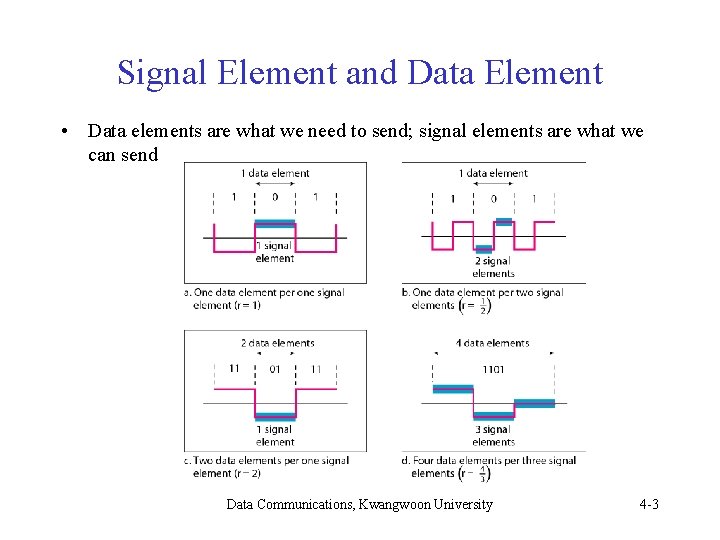
Signal Element and Data Element • Data elements are what we need to send; signal elements are what we can send Data Communications, Kwangwoon University 4 -3
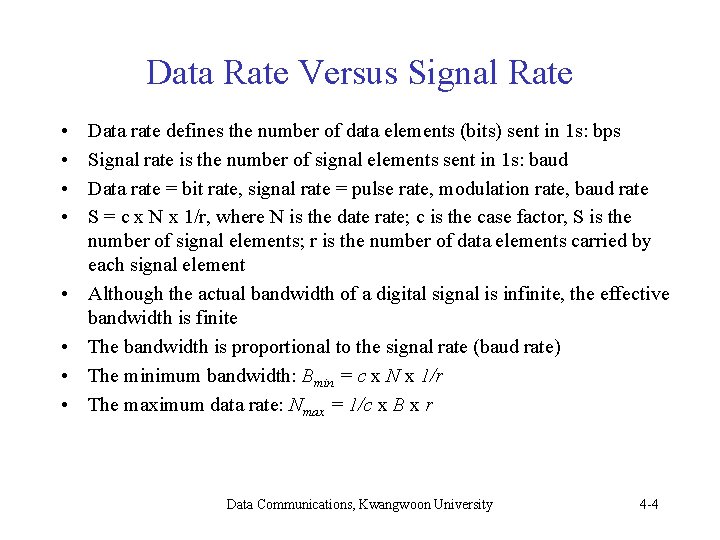
Data Rate Versus Signal Rate • • Data rate defines the number of data elements (bits) sent in 1 s: bps Signal rate is the number of signal elements sent in 1 s: baud Data rate = bit rate, signal rate = pulse rate, modulation rate, baud rate S = c x N x 1/r, where N is the date rate; c is the case factor, S is the number of signal elements; r is the number of data elements carried by each signal element Although the actual bandwidth of a digital signal is infinite, the effective bandwidth is finite The bandwidth is proportional to the signal rate (baud rate) The minimum bandwidth: Bmin = c x N x 1/r The maximum data rate: Nmax = 1/c x B x r Data Communications, Kwangwoon University 4 -4
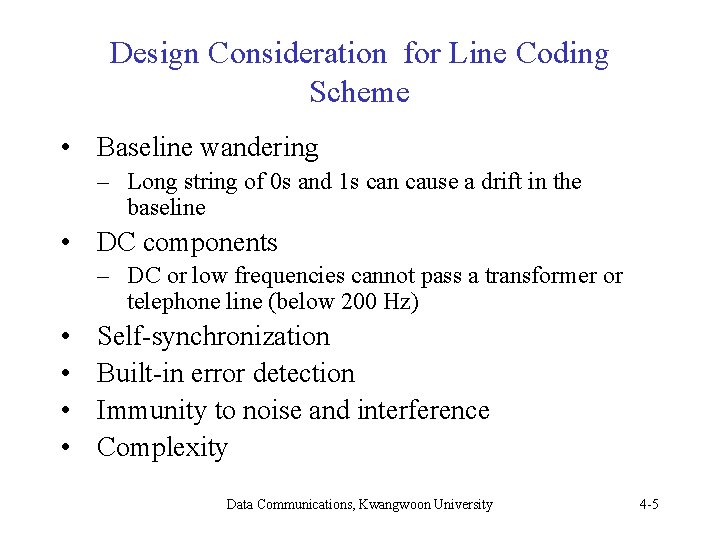
Design Consideration for Line Coding Scheme • Baseline wandering – Long string of 0 s and 1 s can cause a drift in the baseline • DC components – DC or low frequencies cannot pass a transformer or telephone line (below 200 Hz) • • Self-synchronization Built-in error detection Immunity to noise and interference Complexity Data Communications, Kwangwoon University 4 -5
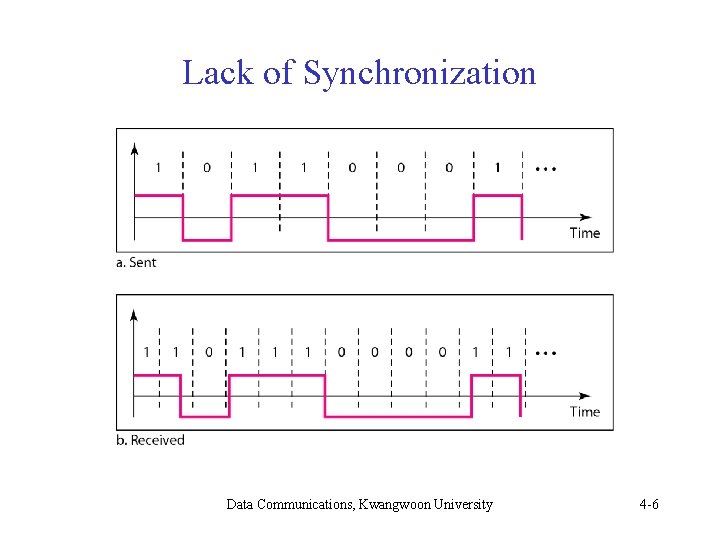
Lack of Synchronization Data Communications, Kwangwoon University 4 -6
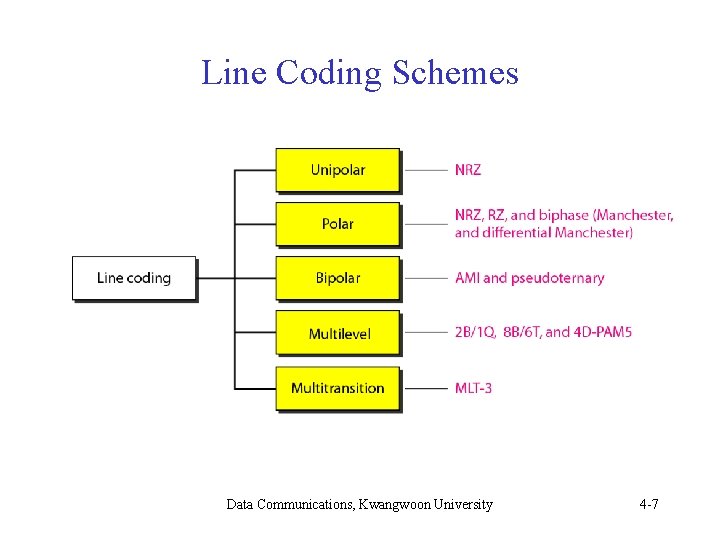
Line Coding Schemes Data Communications, Kwangwoon University 4 -7
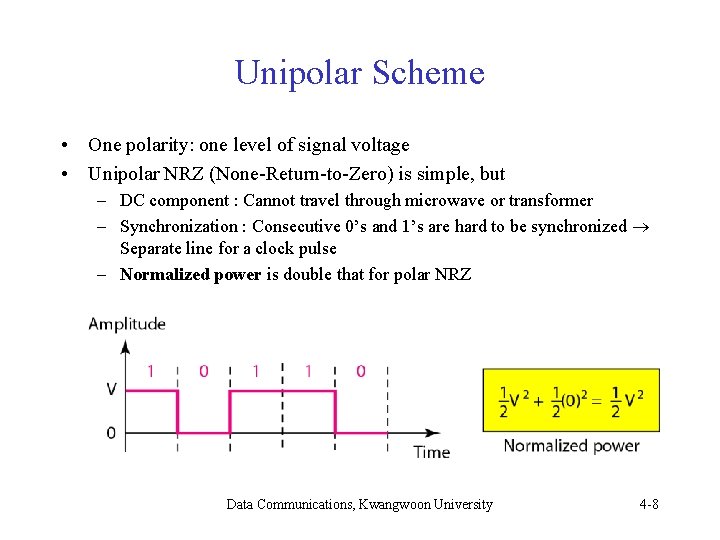
Unipolar Scheme • One polarity: one level of signal voltage • Unipolar NRZ (None-Return-to-Zero) is simple, but – DC component : Cannot travel through microwave or transformer – Synchronization : Consecutive 0’s and 1’s are hard to be synchronized Separate line for a clock pulse – Normalized power is double that for polar NRZ Data Communications, Kwangwoon University 4 -8
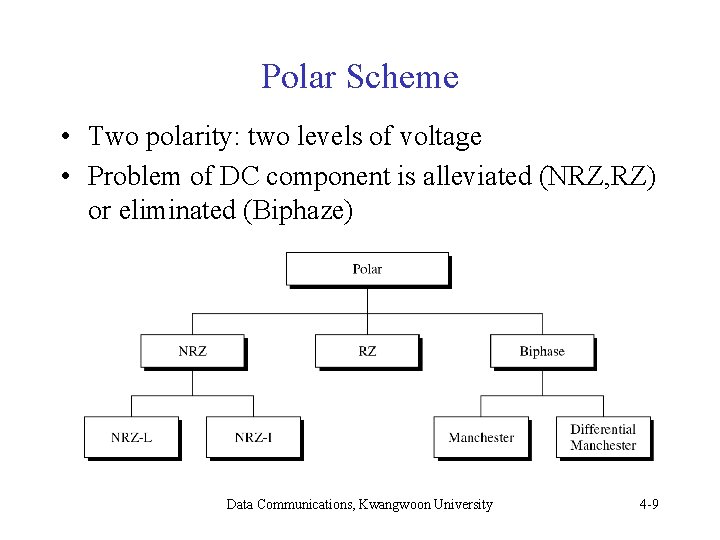
Polar Scheme • Two polarity: two levels of voltage • Problem of DC component is alleviated (NRZ, RZ) or eliminated (Biphaze) Data Communications, Kwangwoon University 4 -9
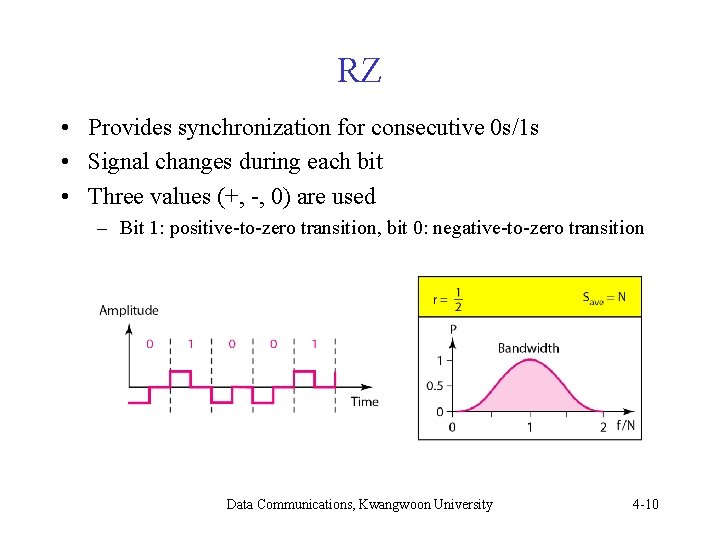
RZ • Provides synchronization for consecutive 0 s/1 s • Signal changes during each bit • Three values (+, -, 0) are used – Bit 1: positive-to-zero transition, bit 0: negative-to-zero transition Data Communications, Kwangwoon University 4 -10
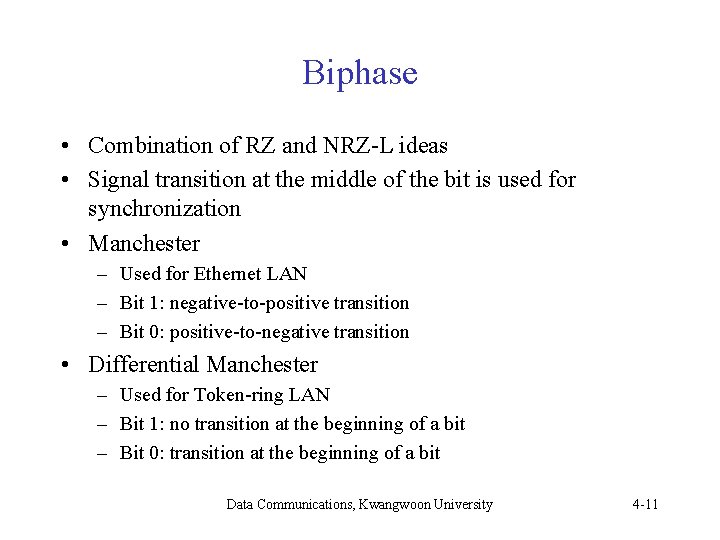
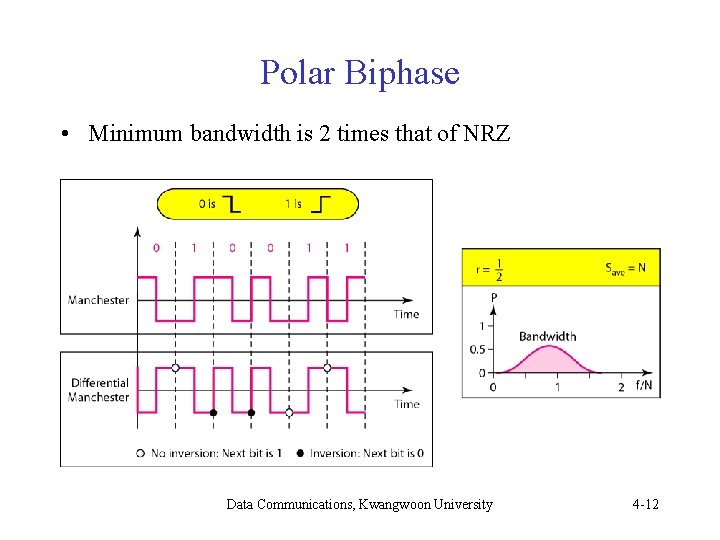
Biphase • Combination of RZ and NRZ-L ideas • Signal transition at the middle of the bit is used for synchronization • Manchester – Used for Ethernet LAN – Bit 1: negative-to-positive transition – Bit 0: positive-to-negative transition • Differential Manchester – Used for Token-ring LAN – Bit 1: no transition at the beginning of a bit – Bit 0: transition at the beginning of a bit Data Communications, Kwangwoon University 4 -11
Polar Biphase • Minimum bandwidth is 2 times that of NRZ Data Communications, Kwangwoon University 4 -12
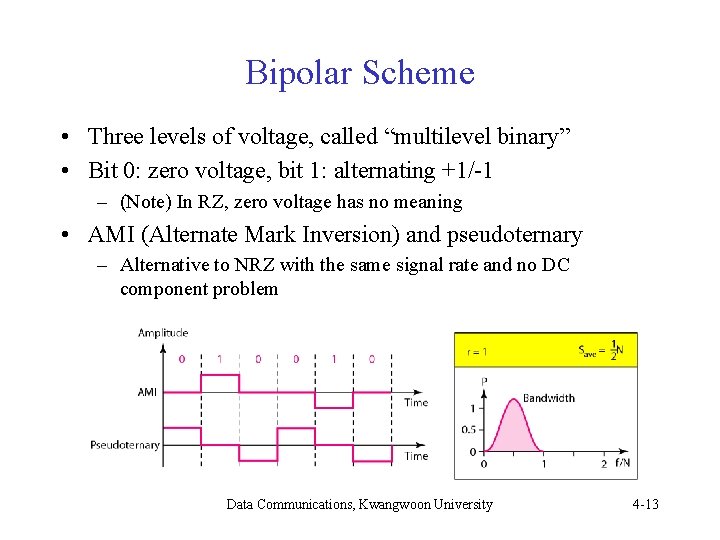
Bipolar Scheme • Three levels of voltage, called “multilevel binary” • Bit 0: zero voltage, bit 1: alternating +1/-1 – (Note) In RZ, zero voltage has no meaning • AMI (Alternate Mark Inversion) and pseudoternary – Alternative to NRZ with the same signal rate and no DC component problem Data Communications, Kwangwoon University 4 -13
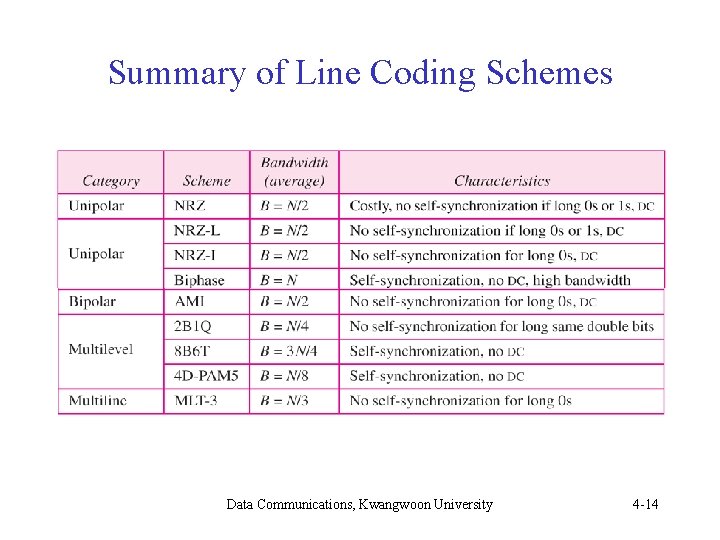
Summary of Line Coding Schemes Data Communications, Kwangwoon University 4 -14
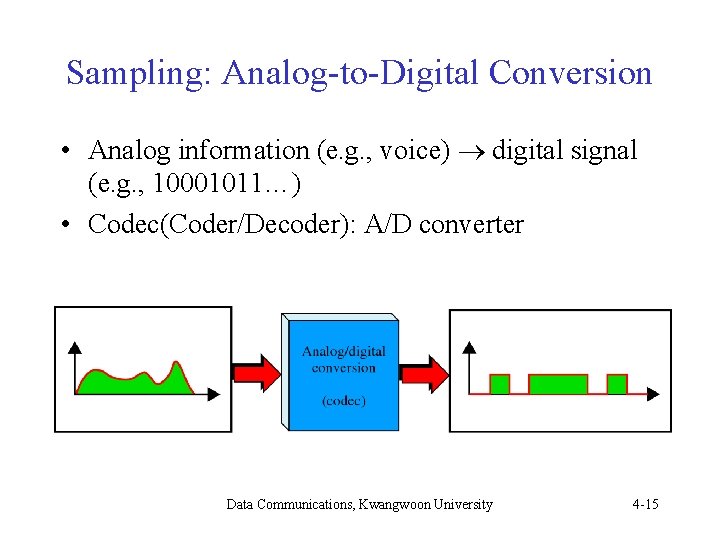
Sampling: Analog-to-Digital Conversion • Analog information (e. g. , voice) digital signal (e. g. , 10001011…) • Codec(Coder/Decoder): A/D converter Data Communications, Kwangwoon University 4 -15
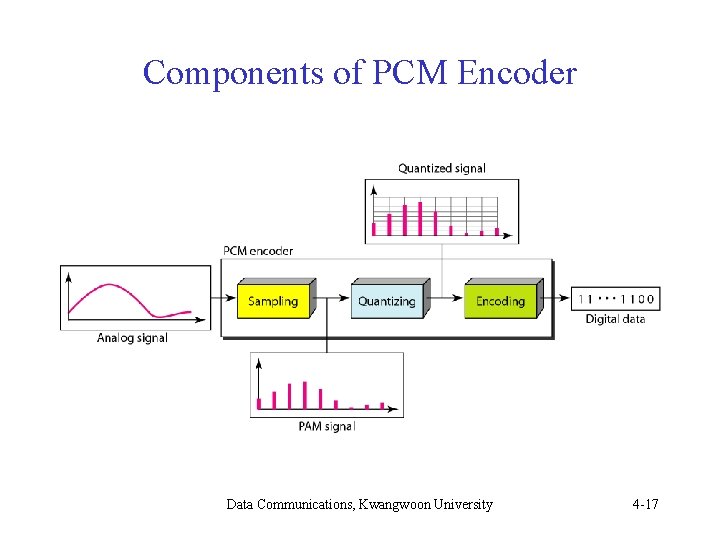
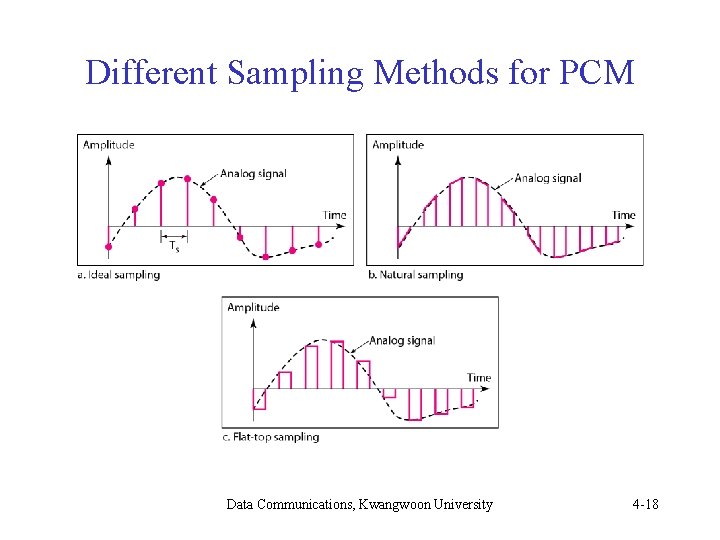
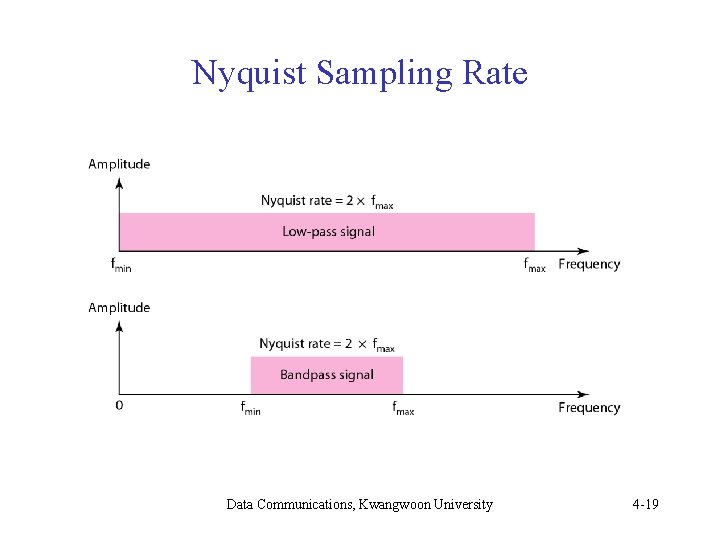
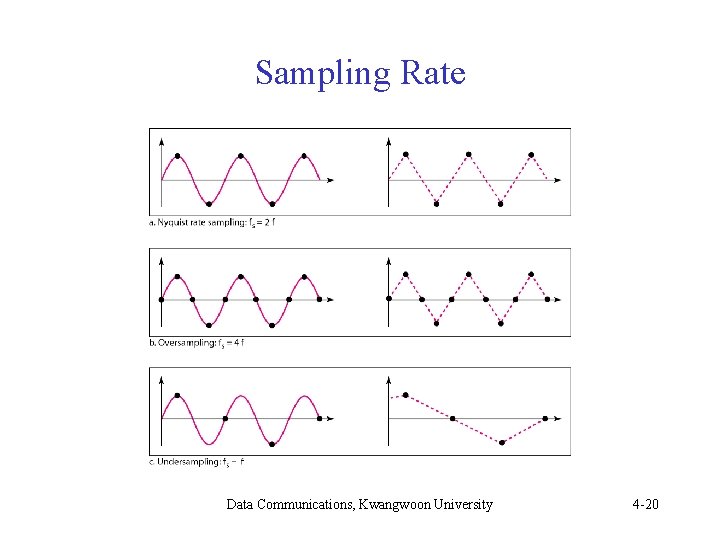
PCM • Pulse Code Modulation • Three processes – The analog signal is sampled – The sampled signal is quantized – The quantized values are encoded as streams of bits • Sampling: PAM (Pulse amplitude Modulation) – According to the Nyquist theorem, the sampling rate must be at least 2 times the highest frequency contained in the signal. Data Communications, Kwangwoon University 4 -16
Components of PCM Encoder Data Communications, Kwangwoon University 4 -17
Different Sampling Methods for PCM Data Communications, Kwangwoon University 4 -18
Nyquist Sampling Rate Data Communications, Kwangwoon University 4 -19
Sampling Rate Data Communications, Kwangwoon University 4 -20
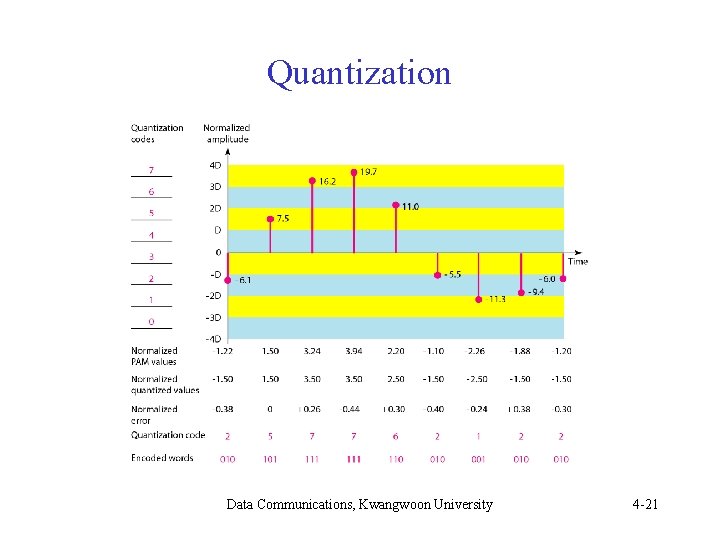
Quantization Data Communications, Kwangwoon University 4 -21
Quantization • Quantization level (L) • Quantization error : depending on L (or nb ) – SNRd. B = 6. 02 nb + 1. 76 d. B • Nonuniform quantization: – Companding and expanding – Effectively reduce the SNRd. B Data Communications, Kwangwoon University 4 -22
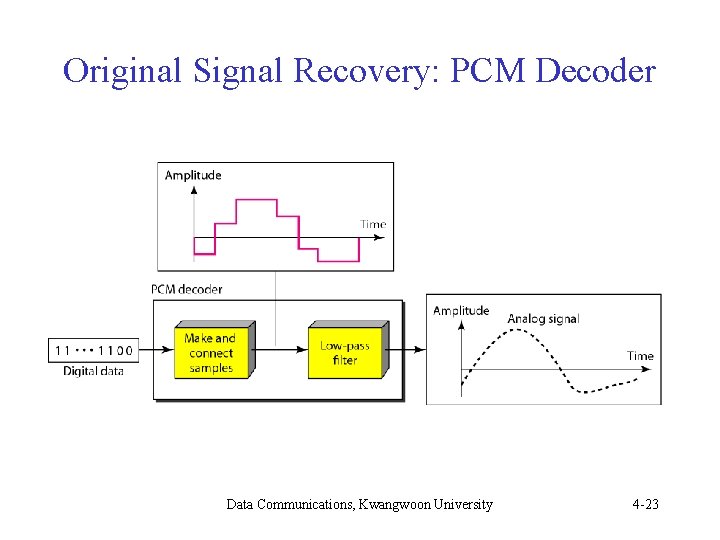
Original Signal Recovery: PCM Decoder Data Communications, Kwangwoon University 4 -23
PCM Bandwidth • The min. bandwidth of a line-encoded signal – Bmin = c x N x 1/r = c x nb x fs x 1/r = c x nb x 2 x Banalog x 1/r = nb x Banalog where 1/r = 1, c = 1/2 • Max. data rate of a channel – Nmax = 2 x B x log 2 L bps • Min. required bandwidth – Bmin = N/(2 x log 2 L) Hz Data Communications, Kwangwoon University 4 -24
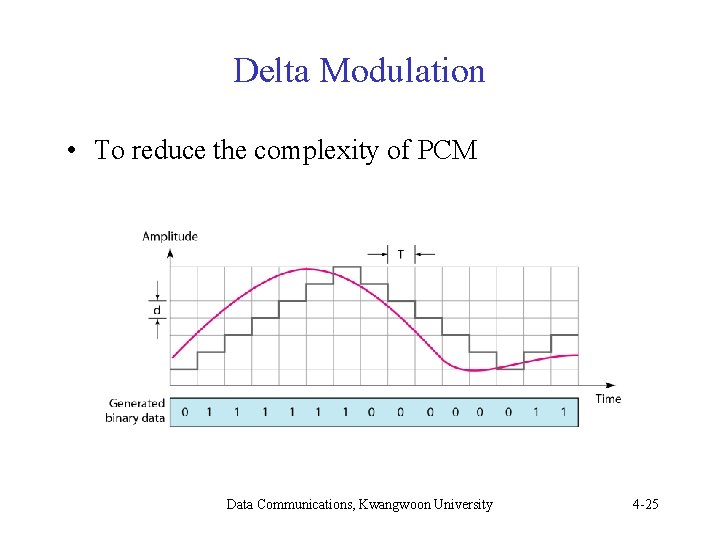
Delta Modulation • To reduce the complexity of PCM Data Communications, Kwangwoon University 4 -25
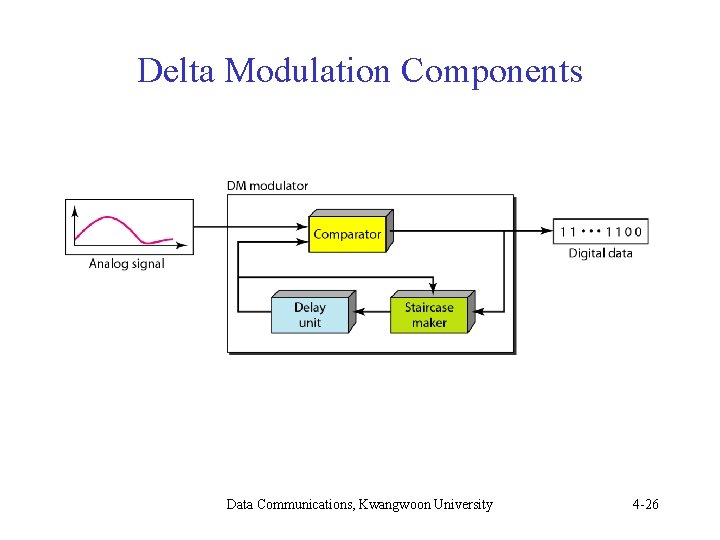
Delta Modulation Components Data Communications, Kwangwoon University 4 -26
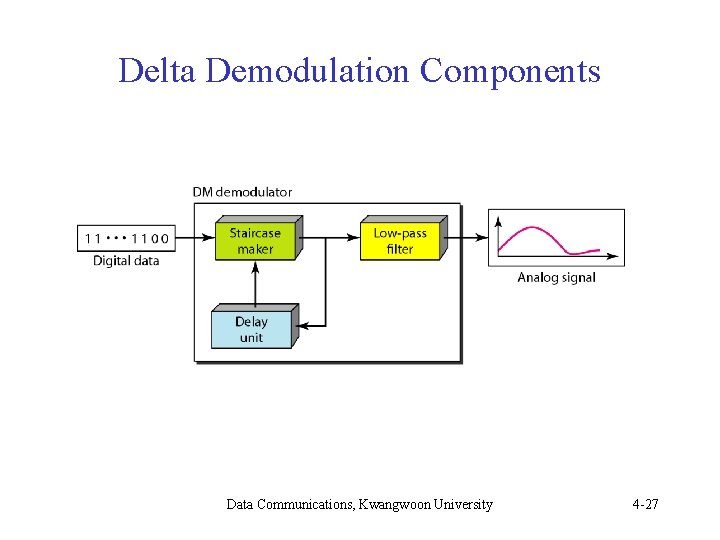
Delta Demodulation Components Data Communications, Kwangwoon University 4 -27
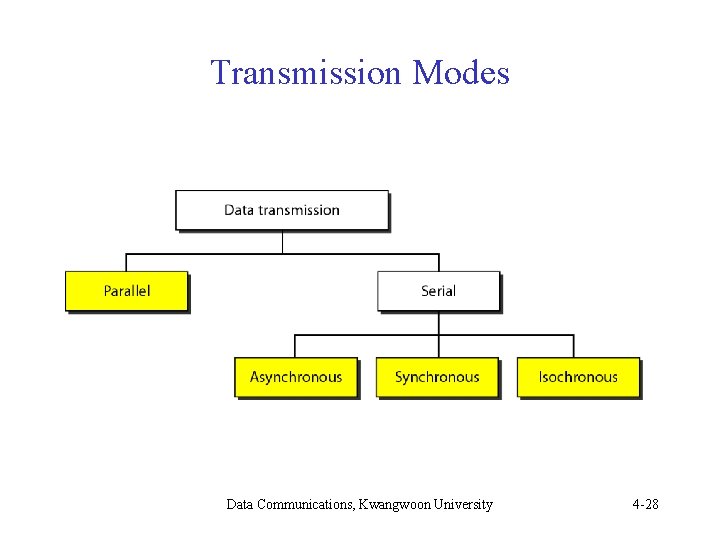
Transmission Modes Data Communications, Kwangwoon University 4 -28
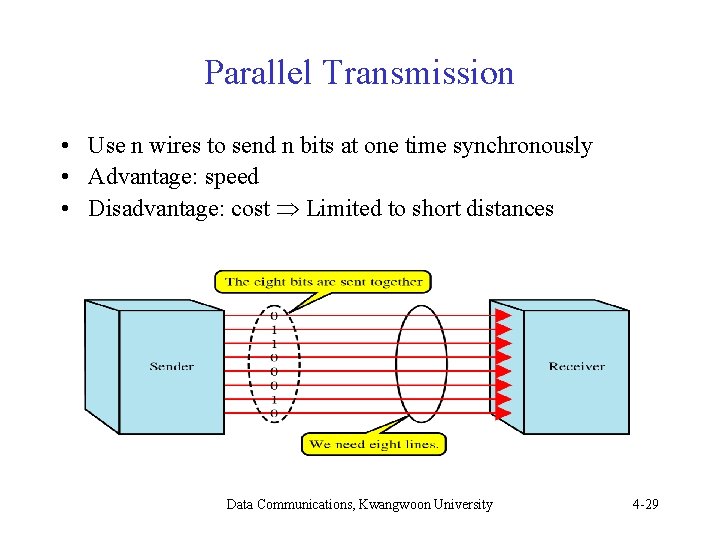
Parallel Transmission • Use n wires to send n bits at one time synchronously • Advantage: speed • Disadvantage: cost Limited to short distances Data Communications, Kwangwoon University 4 -29
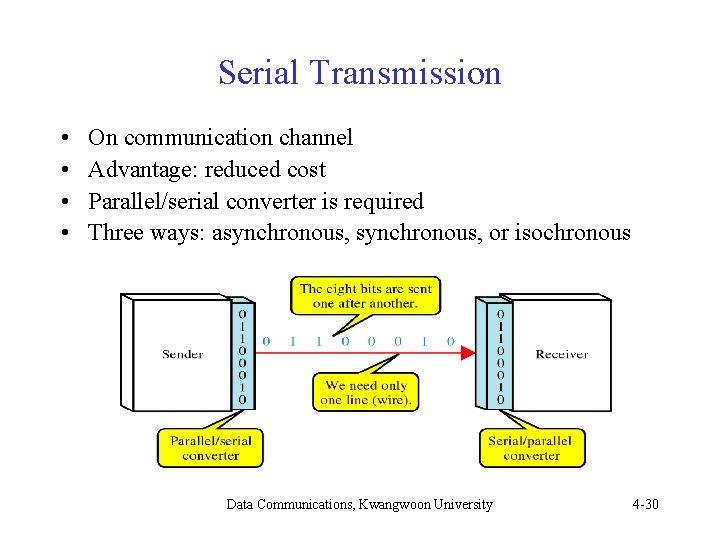
Serial Transmission • • On communication channel Advantage: reduced cost Parallel/serial converter is required Three ways: asynchronous, or isochronous Data Communications, Kwangwoon University 4 -30
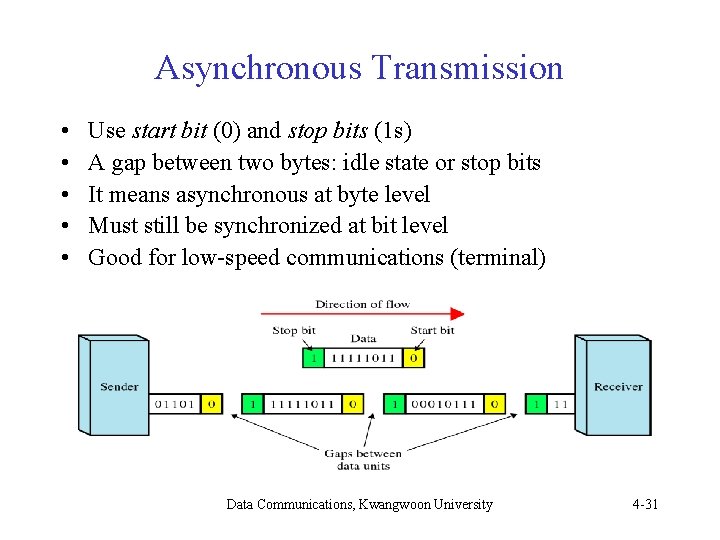
Asynchronous Transmission • • • Use start bit (0) and stop bits (1 s) A gap between two bytes: idle state or stop bits It means asynchronous at byte level Must still be synchronized at bit level Good for low-speed communications (terminal) Data Communications, Kwangwoon University 4 -31
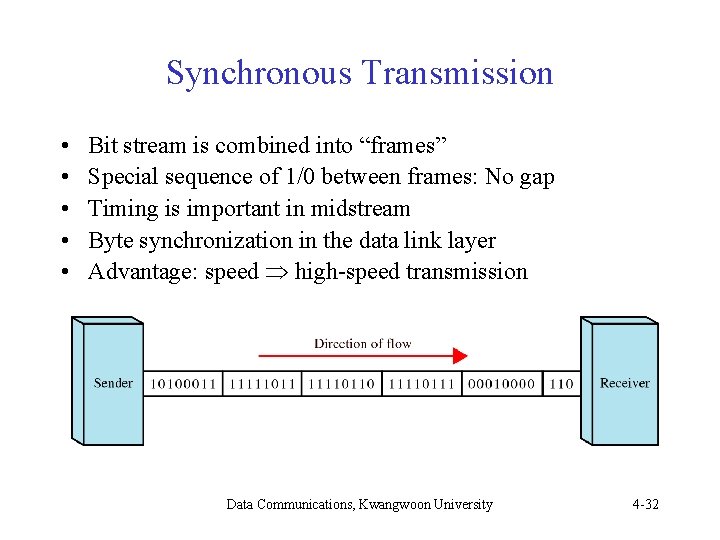
Synchronous Transmission • • • Bit stream is combined into “frames” Special sequence of 1/0 between frames: No gap Timing is important in midstream Byte synchronization in the data link layer Advantage: speed high-speed transmission Data Communications, Kwangwoon University 4 -32