
Chapter 4 Digital Design and Computer Architecture ARM
![Bitwise Operators module gates(input logic [3: 0] a, b, output logic [3: 0] y](https://slidetodoc.com/presentation_image_h/1096469428de6fa326703930a3bb10a5/image-13.jpg "Bitwise Operators module gates(input logic [3: 0] a, b, output logic [3: 0] y")
![Reduction Operators System. Verilog: module and 8(input logic [7: 0] a, output logic y);](https://slidetodoc.com/presentation_image_h/1096469428de6fa326703930a3bb10a5/image-14.jpg "Reduction Operators System. Verilog: module and 8(input logic [7: 0] a, output logic y);")
![Conditional Assignment System. Verilog: module mux 2(input logic [3: 0] d 0, d 1,](https://slidetodoc.com/presentation_image_h/1096469428de6fa326703930a3bb10a5/image-15.jpg "Conditional Assignment System. Verilog: module mux 2(input logic [3: 0] d 0, d 1,")
![Bit Manipulations: Example 1 assign y = {a[2: 1], {3{b[0]}}, a[0], 6'b 100_010}; //](https://slidetodoc.com/presentation_image_h/1096469428de6fa326703930a3bb10a5/image-19.jpg "Bit Manipulations: Example 1 assign y = {a[2: 1], {3{b[0]}}, a[0], 6'b 100_010}; //")
![Bit Manipulations: Example 2 System. Verilog: module mux 2_8(input logic [7: 0] d 0,](https://slidetodoc.com/presentation_image_h/1096469428de6fa326703930a3bb10a5/image-20.jpg "Bit Manipulations: Example 2 System. Verilog: module mux 2_8(input logic [7: 0] d 0,")
![D Flip-Flop module flop(input logic clk, input logic [3: 0] d, output logic [3:](https://slidetodoc.com/presentation_image_h/1096469428de6fa326703930a3bb10a5/image-30.jpg "D Flip-Flop module flop(input logic clk, input logic [3: 0] d, output logic [3:")
![Resettable D Flip-Flop module flopr(input output logic clk, logic reset, logic [3: 0] d,](https://slidetodoc.com/presentation_image_h/1096469428de6fa326703930a3bb10a5/image-31.jpg "Resettable D Flip-Flop module flopr(input output logic clk, logic reset, logic [3: 0] d,")
![Resettable D Flip-Flop module flopr(input output logic clk, logic reset, logic [3: 0] d,](https://slidetodoc.com/presentation_image_h/1096469428de6fa326703930a3bb10a5/image-32.jpg "Resettable D Flip-Flop module flopr(input output logic clk, logic reset, logic [3: 0] d,")
![Latch module latch(input logic clk, input logic [3: 0] d, output logic [3: 0]](https://slidetodoc.com/presentation_image_h/1096469428de6fa326703930a3bb10a5/image-34.jpg "Latch module latch(input logic clk, input logic [3: 0] d, output logic [3: 0]")
![Combinational Logic using case module sevenseg(input logic [3: 0] data, output logic [6: 0]](https://slidetodoc.com/presentation_image_h/1096469428de6fa326703930a3bb10a5/image-38.jpg "Combinational Logic using case module sevenseg(input logic [3: 0] data, output logic [6: 0]")
![Combinational Logic using casez module priority_casez(input logic [3: 0] a, output logic [3: 0]](https://slidetodoc.com/presentation_image_h/1096469428de6fa326703930a3bb10a5/image-40.jpg "Combinational Logic using casez module priority_casez(input logic [3: 0] a, output logic [3: 0]")
- Slides: 60
Chapter 4 Digital Design and Computer Architecture: ARM® Edition Sarah L. Harris and David Money Harris Digital Design and Computer Architecture: ARM® Edition © 2015 Chapter 4 <1>
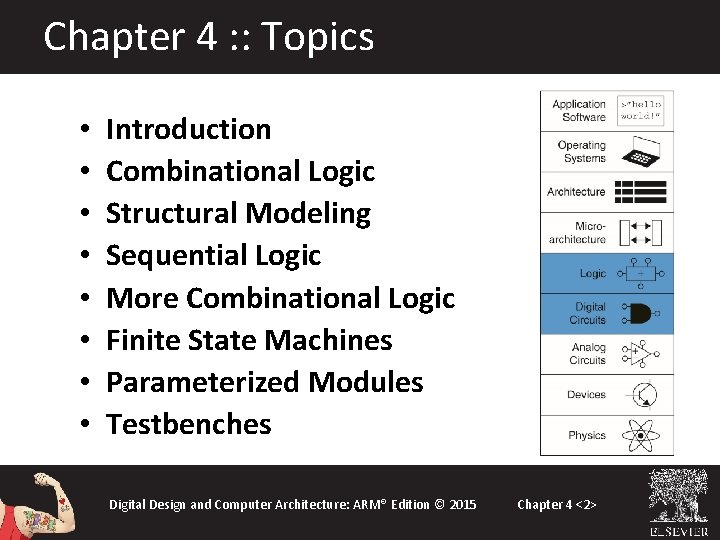
Chapter 4 : : Topics • • Introduction Combinational Logic Structural Modeling Sequential Logic More Combinational Logic Finite State Machines Parameterized Modules Testbenches Digital Design and Computer Architecture: ARM® Edition © 2015 Chapter 4 <2>
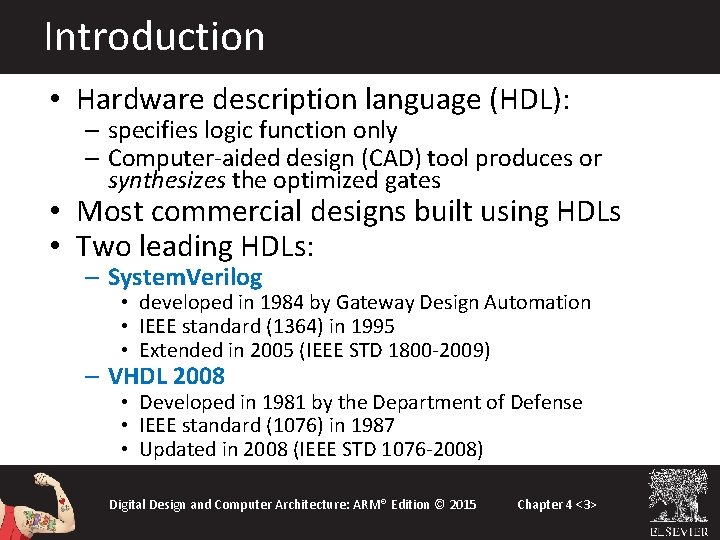
Introduction • Hardware description language (HDL): – specifies logic function only – Computer-aided design (CAD) tool produces or synthesizes the optimized gates • Most commercial designs built using HDLs • Two leading HDLs: – System. Verilog • developed in 1984 by Gateway Design Automation • IEEE standard (1364) in 1995 • Extended in 2005 (IEEE STD 1800 -2009) – VHDL 2008 • Developed in 1981 by the Department of Defense • IEEE standard (1076) in 1987 • Updated in 2008 (IEEE STD 1076 -2008) Digital Design and Computer Architecture: ARM® Edition © 2015 Chapter 4 <3>
HDL to Gates • Simulation – Inputs applied to circuit – Outputs checked for correctness – Millions of dollars saved by debugging in simulation instead of hardware • Synthesis – Transforms HDL code into a netlist describing the hardware (i. e. , a list of gates and the wires connecting them) Digital Design and Computer Architecture: ARM® Edition © 2015 Chapter 4 <4>
HDL to Gates • Simulation – Inputs applied to circuit – Outputs checked for correctness – Millions of dollars saved by debugging in simulation instead of hardware • Synthesis – Transforms HDL code into a netlist describing the hardware (i. e. , a list of gates and the wires connecting them) IMPORTANT: When using an HDL, think of the hardware the HDL should implies Digital Design and Computer Architecture: ARM® Edition © 2015 Chapter 4 <5>
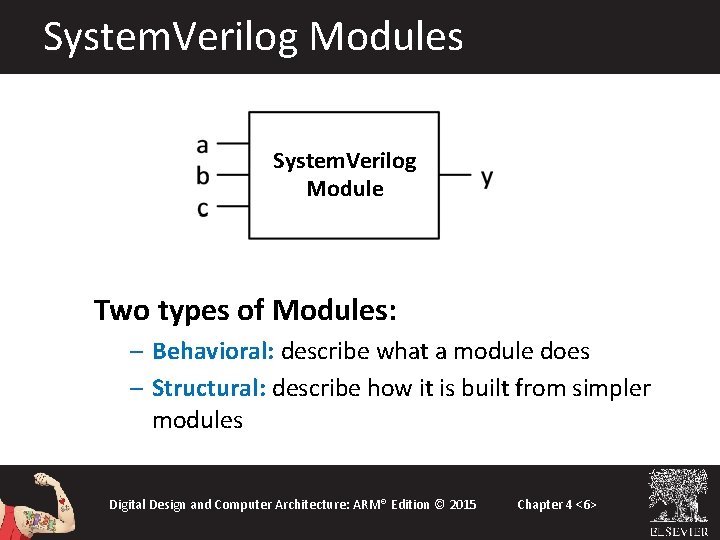
System. Verilog Modules System. Verilog Module Two types of Modules: – Behavioral: describe what a module does – Structural: describe how it is built from simpler modules Digital Design and Computer Architecture: ARM® Edition © 2015 Chapter 4 <6>
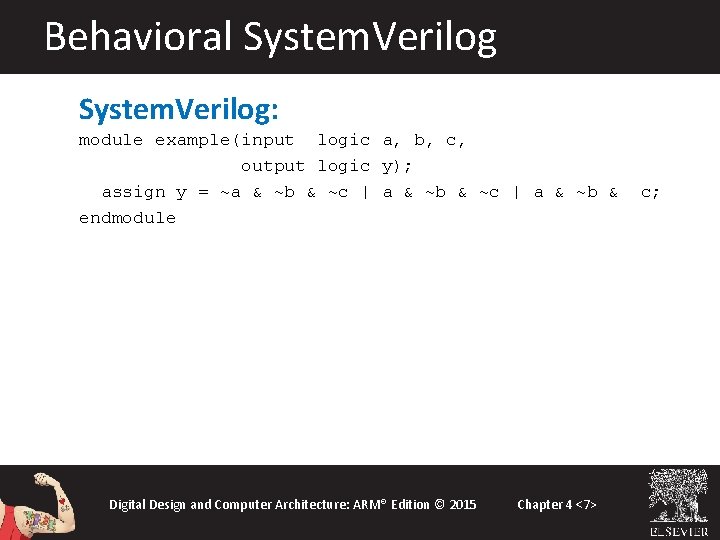
Behavioral System. Verilog: module example(input logic a, b, c, output logic y); assign y = ~a & ~b & ~c | a & ~b & endmodule Digital Design and Computer Architecture: ARM® Edition © 2015 Chapter 4 <7> c;
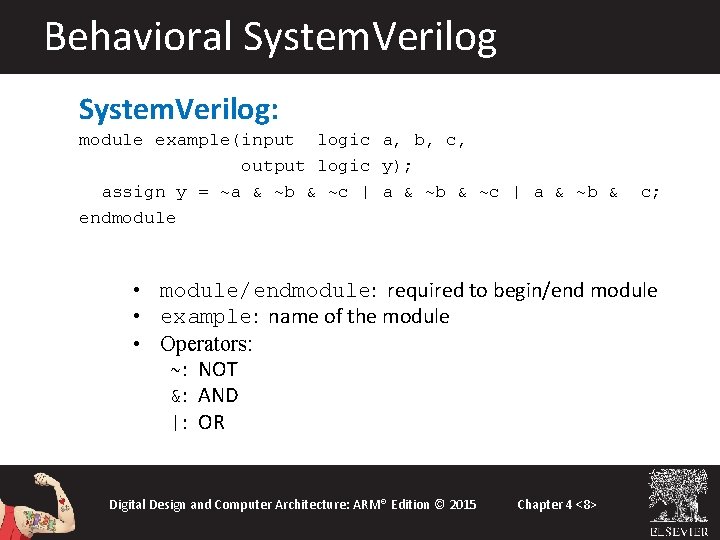
Behavioral System. Verilog: module example(input logic a, b, c, output logic y); assign y = ~a & ~b & ~c | a & ~b & endmodule c; • module/endmodule: required to begin/end module • example: name of the module • Operators: ~: NOT &: AND |: OR Digital Design and Computer Architecture: ARM® Edition © 2015 Chapter 4 <8>
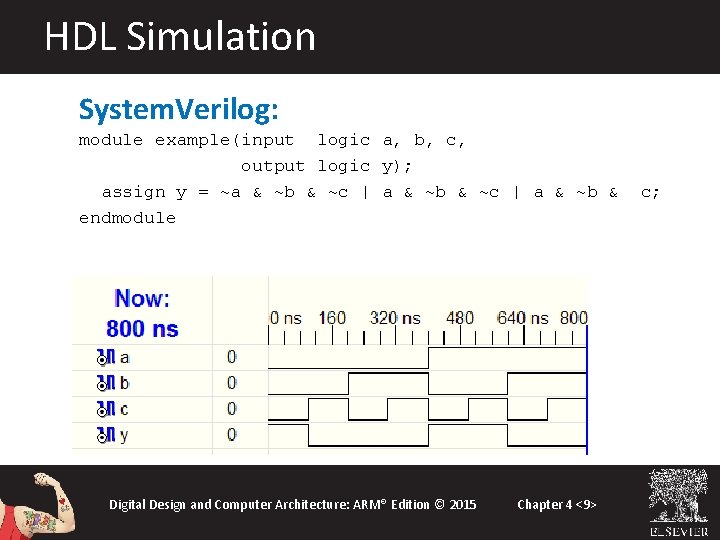
HDL Simulation System. Verilog: module example(input logic a, b, c, output logic y); assign y = ~a & ~b & ~c | a & ~b & endmodule Digital Design and Computer Architecture: ARM® Edition © 2015 Chapter 4 <9> c;
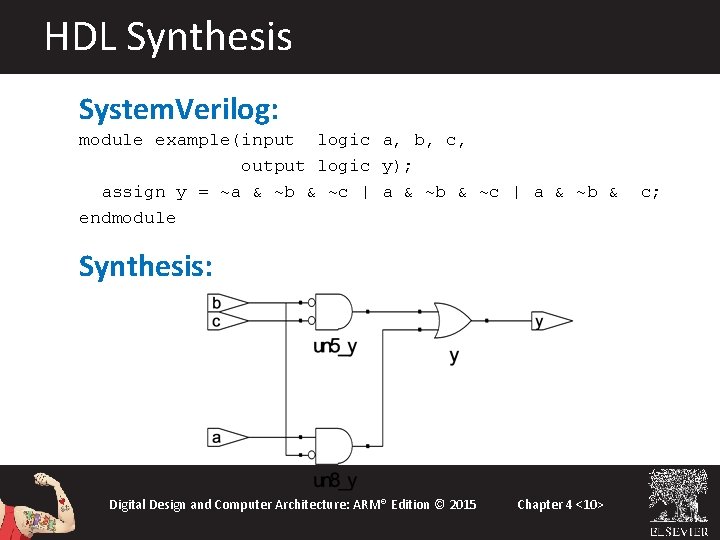
HDL Synthesis System. Verilog: module example(input logic a, b, c, output logic y); assign y = ~a & ~b & ~c | a & ~b & endmodule Synthesis: Digital Design and Computer Architecture: ARM® Edition © 2015 Chapter 4 <10> c;
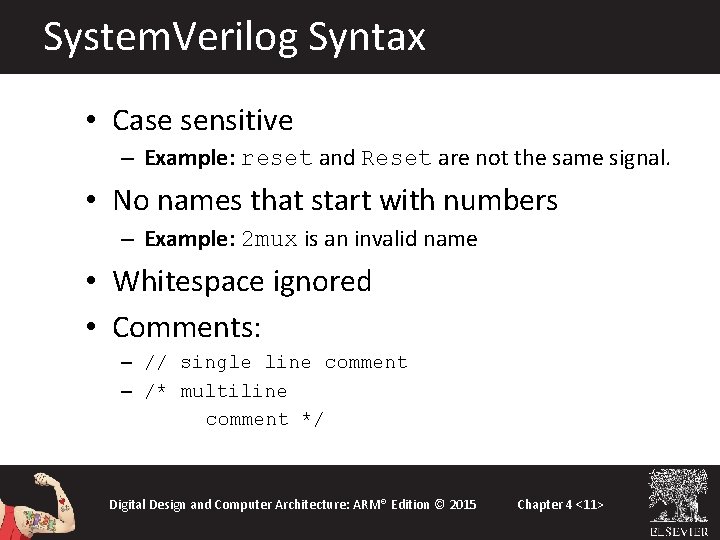
System. Verilog Syntax • Case sensitive – Example: reset and Reset are not the same signal. • No names that start with numbers – Example: 2 mux is an invalid name • Whitespace ignored • Comments: – // single line comment – /* multiline comment */ Digital Design and Computer Architecture: ARM® Edition © 2015 Chapter 4 <11>
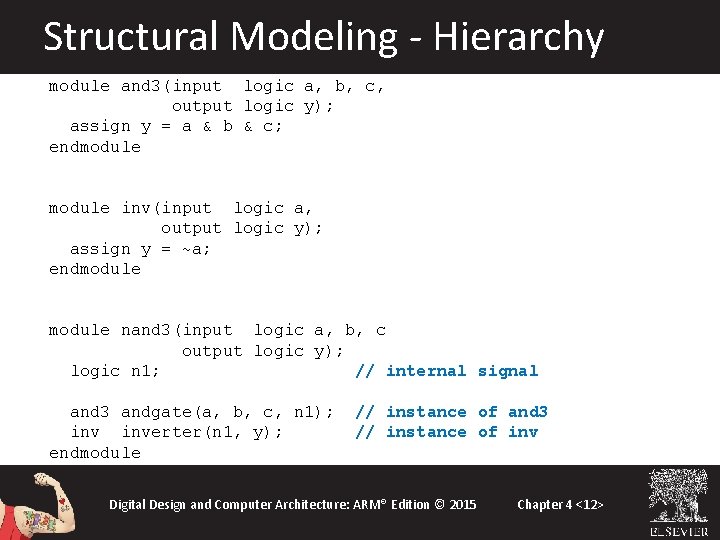
Structural Modeling - Hierarchy module and 3(input logic a, b, c, output logic y); assign y = a & b & c; endmodule inv(input logic a, output logic y); assign y = ~a; endmodule nand 3(input logic a, b, c output logic y); logic n 1; // internal signal and 3 andgate(a, b, c, n 1); inverter(n 1, y); endmodule // instance of and 3 // instance of inv Digital Design and Computer Architecture: ARM® Edition © 2015 Chapter 4 <12>
Bitwise Operators module gates(input logic [3: 0] a, b, output logic [3: 0] y 1, y 2, y 3, y 4, y 5); /* Five different two-input logic gates acting on 4 bit busses */ assign y 1 = a & b; // AND assign y 2 = a | b; // OR assign y 3 = a ^ b; // XOR assign y 4 = ~(a & b); // NAND assign y 5 = ~(a | b); // NOR endmodule Synthesis: // single line comment /*…*/ multiline comment Digital Design and Computer Architecture: ARM® Edition © 2015 Chapter 4 <13>
Reduction Operators System. Verilog: module and 8(input logic [7: 0] a, output logic y); assign y = &a; // &a is much easier to write than // assign y = a[7] & a[6] & a[5] & a[4] & // a[3] & a[2] & a[1] & a[0]; endmodule Synthesis: Digital Design and Computer Architecture: ARM® Edition © 2015 Chapter 4 <14>
Conditional Assignment System. Verilog: module mux 2(input logic [3: 0] d 0, d 1, input logic s, output logic [3: 0] y); assign y = s ? d 1 : d 0; endmodule Synthesis: ? : is also called a ternary operator because it operates on 3 inputs: s, d 1, and d 0. Digital Design and Computer Architecture: ARM® Edition © 2015 Chapter 4 <15>
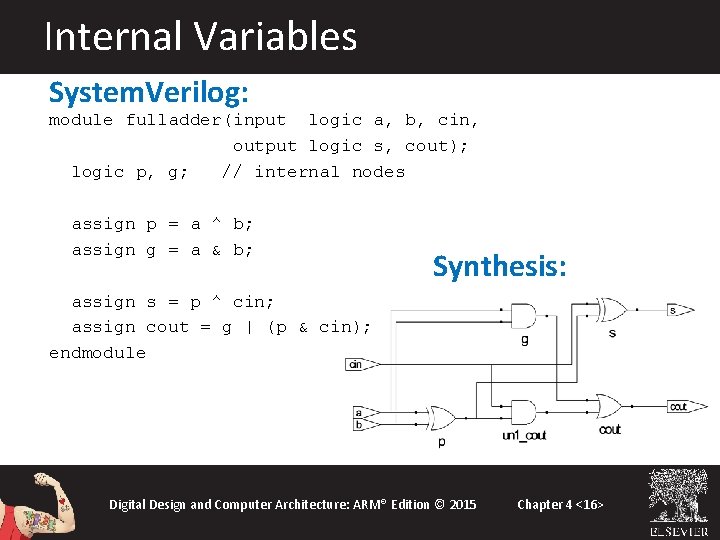
Internal Variables System. Verilog: module fulladder(input logic a, b, cin, output logic s, cout); logic p, g; // internal nodes assign p = a ^ b; assign g = a & b; Synthesis: assign s = p ^ cin; assign cout = g | (p & cin); endmodule Digital Design and Computer Architecture: ARM® Edition © 2015 Chapter 4 <16>
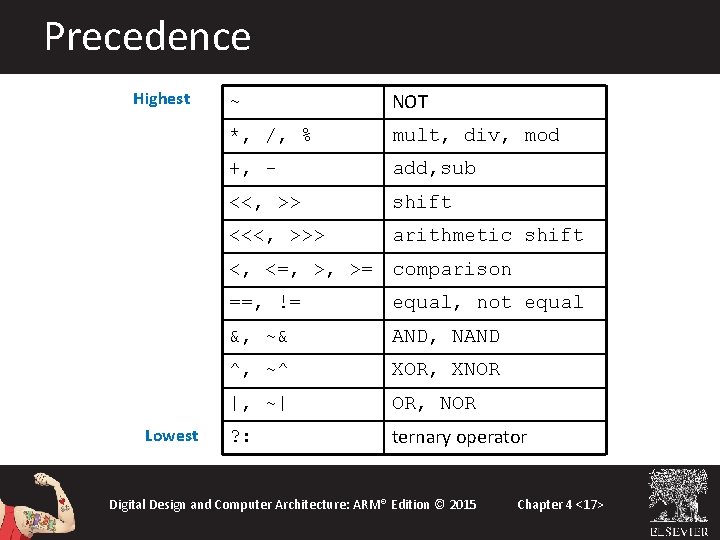
Precedence Highest ~ NOT *, /, % mult, div, mod +, - add, sub <<, >> shift <<<, >>> arithmetic shift <, <=, >, >= comparison Lowest ==, != equal, not equal &, ~& AND, NAND ^, ~^ XOR, XNOR |, ~| OR, NOR ? : ternary operator Digital Design and Computer Architecture: ARM® Edition © 2015 Chapter 4 <17>
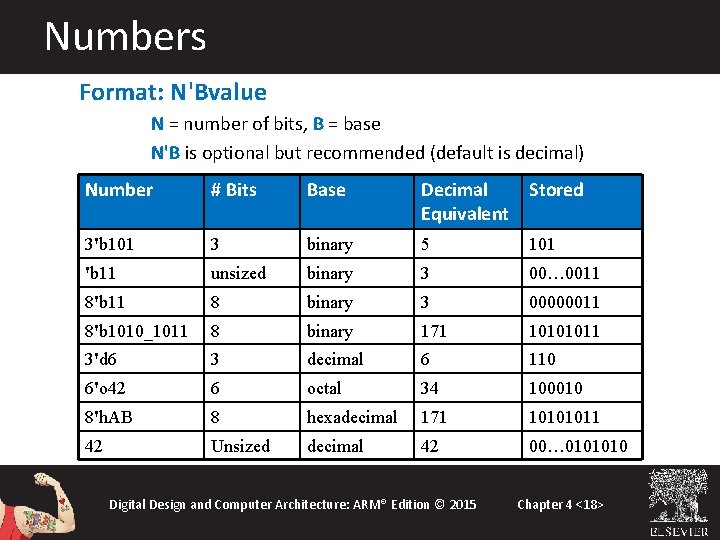
Numbers Format: N'Bvalue N = number of bits, B = base N'B is optional but recommended (default is decimal) Number # Bits Base Decimal Equivalent Stored 3'b 101 3 binary 5 101 'b 11 unsized binary 3 00… 0011 8'b 11 8 binary 3 00000011 8'b 1010_1011 8 binary 171 10101011 3'd 6 3 decimal 6 110 6'o 42 6 octal 34 100010 8'h. AB 8 hexadecimal 171 10101011 42 Unsized decimal 42 00… 0101010 Digital Design and Computer Architecture: ARM® Edition © 2015 Chapter 4 <18>
Bit Manipulations: Example 1 assign y = {a[2: 1], {3{b[0]}}, a[0], 6'b 100_010}; // if y is a 12 -bit signal, the above statement produces: y = a[2] a[1] b[0] a[0] 1 0 0 0 1 0 // underscores (_) are used formatting only to make // it easier to read. System. Verilog ignores them. Digital Design and Computer Architecture: ARM® Edition © 2015 Chapter 4 <19>
Bit Manipulations: Example 2 System. Verilog: module mux 2_8(input logic [7: 0] d 0, d 1, input logic s, output logic [7: 0] y); mux 2 lsbmux(d 0[3: 0], d 1[3: 0], s, y[3: 0]); mux 2 msbmux(d 0[7: 4], d 1[7: 4], s, y[7: 4]); endmodule Digital Design and Computer Architecture: ARM® Edition © 2015 Synthesis: Chapter 4 <20>
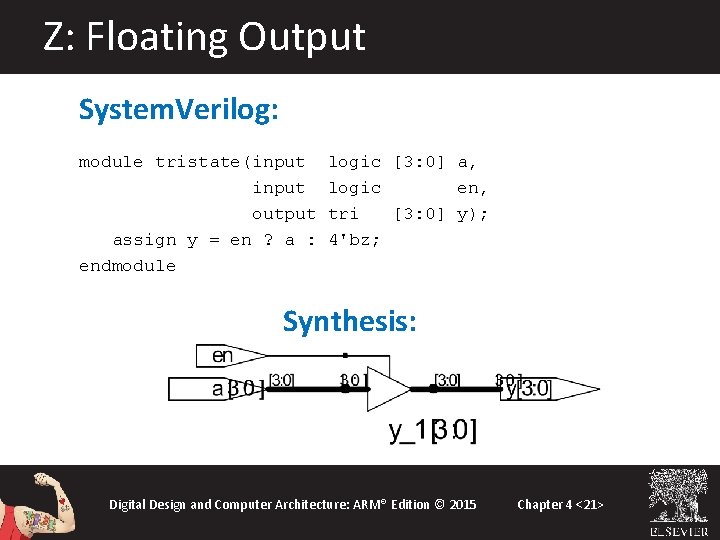
Z: Floating Output System. Verilog: module tristate(input output assign y = en ? a : endmodule logic [3: 0] a, logic en, tri [3: 0] y); 4'bz; Synthesis: Digital Design and Computer Architecture: ARM® Edition © 2015 Chapter 4 <21>
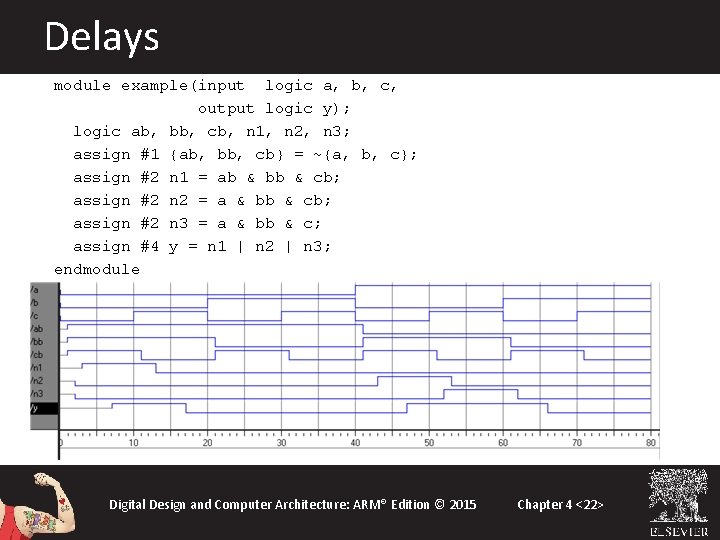
Delays module example(input logic a, b, c, output logic y); logic ab, bb, cb, n 1, n 2, n 3; assign #1 {ab, bb, cb} = ~{a, b, c}; assign #2 n 1 = ab & bb & cb; assign #2 n 2 = a & bb & cb; assign #2 n 3 = a & bb & c; assign #4 y = n 1 | n 2 | n 3; endmodule Digital Design and Computer Architecture: ARM® Edition © 2015 Chapter 4 <22>
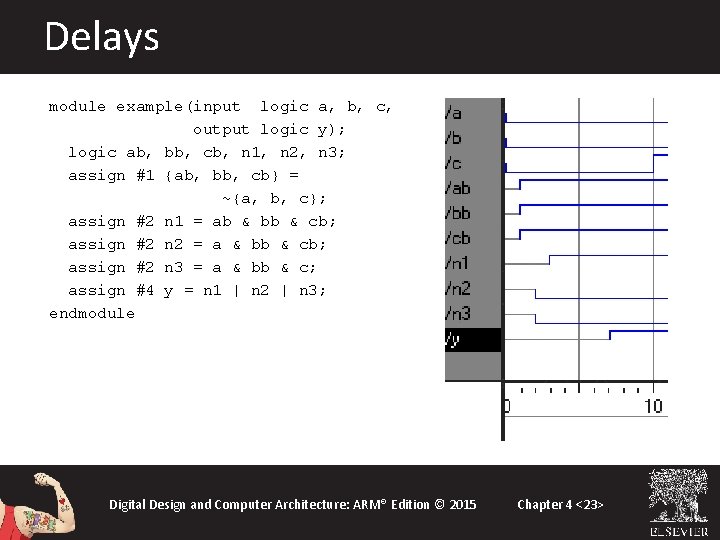
Delays module example(input logic a, b, c, output logic y); logic ab, bb, cb, n 1, n 2, n 3; assign #1 {ab, bb, cb} = ~{a, b, c}; assign #2 n 1 = ab & bb & cb; assign #2 n 2 = a & bb & cb; assign #2 n 3 = a & bb & c; assign #4 y = n 1 | n 2 | n 3; endmodule Digital Design and Computer Architecture: ARM® Edition © 2015 Chapter 4 <23>
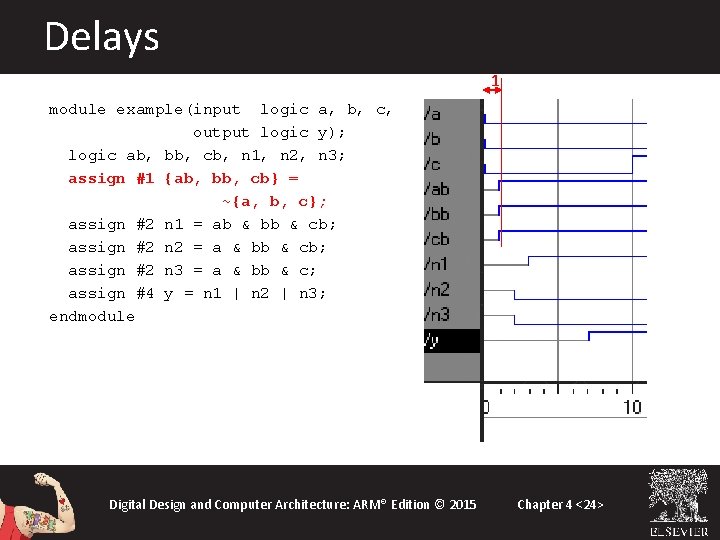
Delays 1 module example(input logic a, b, c, output logic y); logic ab, bb, cb, n 1, n 2, n 3; assign #1 {ab, bb, cb} = ~{a, b, c}; assign #2 n 1 = ab & bb & cb; assign #2 n 2 = a & bb & cb; assign #2 n 3 = a & bb & c; assign #4 y = n 1 | n 2 | n 3; endmodule Digital Design and Computer Architecture: ARM® Edition © 2015 Chapter 4 <24>
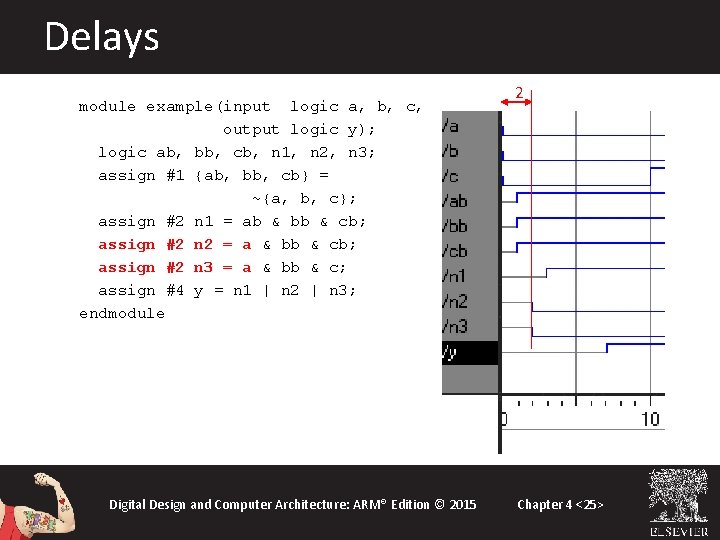
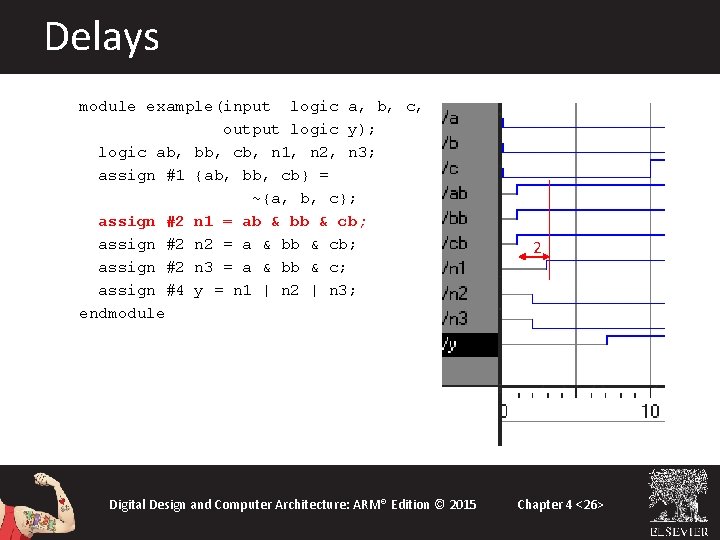
Delays module example(input logic a, b, c, output logic y); logic ab, bb, cb, n 1, n 2, n 3; assign #1 {ab, bb, cb} = ~{a, b, c}; assign #2 n 1 = ab & bb & cb; assign #2 n 2 = a & bb & cb; assign #2 n 3 = a & bb & c; assign #4 y = n 1 | n 2 | n 3; endmodule Digital Design and Computer Architecture: ARM® Edition © 2015 2 Chapter 4 <25>
Delays module example(input logic a, b, c, output logic y); logic ab, bb, cb, n 1, n 2, n 3; assign #1 {ab, bb, cb} = ~{a, b, c}; assign #2 n 1 = ab & bb & cb; assign #2 n 2 = a & bb & cb; assign #2 n 3 = a & bb & c; assign #4 y = n 1 | n 2 | n 3; endmodule Digital Design and Computer Architecture: ARM® Edition © 2015 2 Chapter 4 <26>
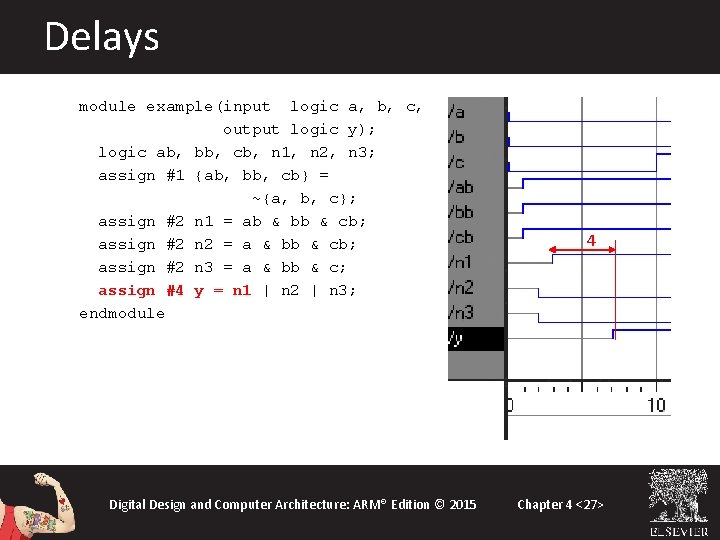
Delays module example(input logic a, b, c, output logic y); logic ab, bb, cb, n 1, n 2, n 3; assign #1 {ab, bb, cb} = ~{a, b, c}; assign #2 n 1 = ab & bb & cb; assign #2 n 2 = a & bb & cb; assign #2 n 3 = a & bb & c; assign #4 y = n 1 | n 2 | n 3; endmodule Digital Design and Computer Architecture: ARM® Edition © 2015 4 Chapter 4 <27>
Sequential Logic • System. Verilog uses idioms to describe latches, flip-flops and FSMs • Other coding styles may simulate correctly but produce incorrect hardware Digital Design and Computer Architecture: ARM® Edition © 2015 Chapter 4 <28>
always Statement General Structure: always @(sensitivity list) statement; Whenever the event in sensitivity list occurs, statement is executed Digital Design and Computer Architecture: ARM® Edition © 2015 Chapter 4 <29>
D Flip-Flop module flop(input logic clk, input logic [3: 0] d, output logic [3: 0] q); always_ff @(posedge clk) q <= d; // pronounced “q gets d” endmodule Synthesis: Digital Design and Computer Architecture: ARM® Edition © 2015 Chapter 4 <30>
Resettable D Flip-Flop module flopr(input output logic clk, logic reset, logic [3: 0] d, logic [3: 0] q); // synchronous reset always_ff @(posedge clk) if (reset) q <= 4'b 0; else q <= d; endmodule Synthesis: Digital Design and Computer Architecture: ARM® Edition © 2015 Chapter 4 <31>
Resettable D Flip-Flop module flopr(input output logic clk, logic reset, logic [3: 0] d, logic [3: 0] q); // asynchronous reset always_ff @(posedge clk, posedge reset) if (reset) q <= 4'b 0; else q <= d; endmodule Synthesis: Digital Design and Computer Architecture: ARM® Edition © 2015 Chapter 4 <32>
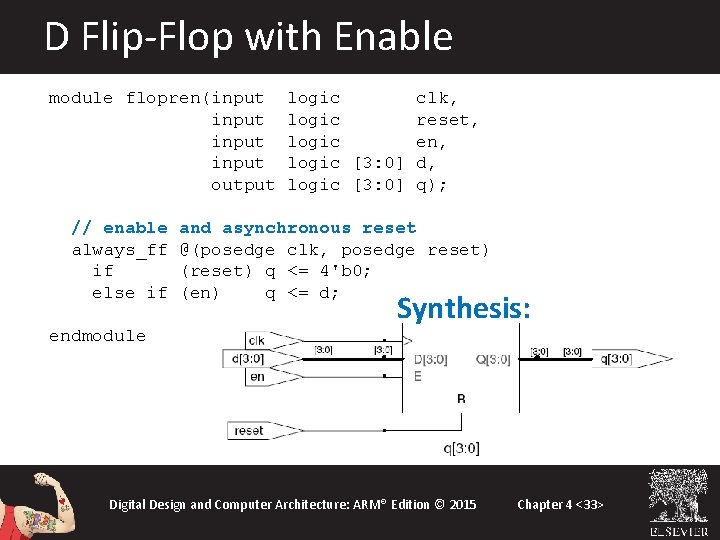
D Flip-Flop with Enable module flopren(input output // enable always_ff if else if logic clk, logic reset, logic en, logic [3: 0] d, logic [3: 0] q); and asynchronous reset @(posedge clk, posedge reset) (reset) q <= 4'b 0; (en) q <= d; Synthesis: endmodule Digital Design and Computer Architecture: ARM® Edition © 2015 Chapter 4 <33>
Latch module latch(input logic clk, input logic [3: 0] d, output logic [3: 0] q); always_latch if (clk) q <= d; endmodule Synthesis: Warning: We don’t use latches in this text. But you might write code that inadvertently implies a latch. Check synthesized hardware – if it has latches in it, there’s an error. Digital Design and Computer Architecture: ARM® Edition © 2015 Chapter 4 <34>
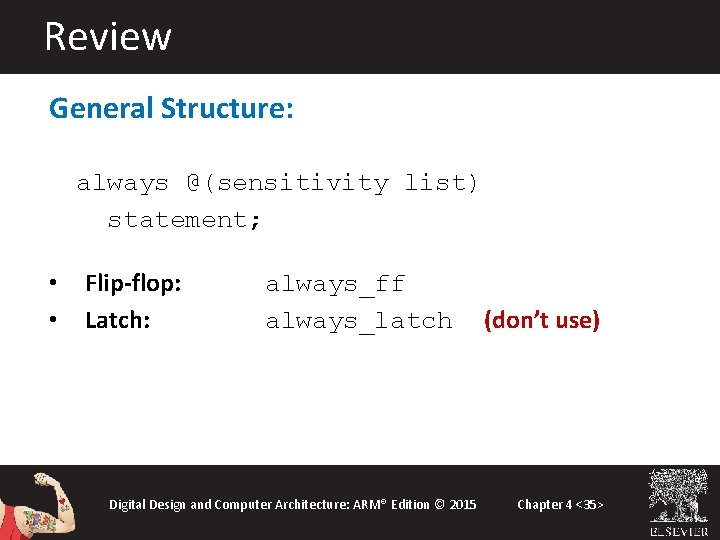
Review General Structure: always @(sensitivity list) statement; • • Flip-flop: Latch: always_ff always_latch Digital Design and Computer Architecture: ARM® Edition © 2015 (don’t use) Chapter 4 <35>
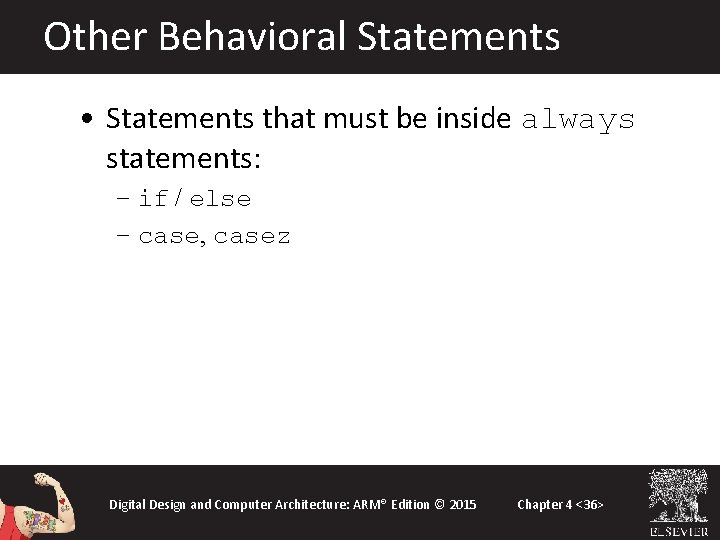
Other Behavioral Statements • Statements that must be inside always statements: – if / else – case, casez Digital Design and Computer Architecture: ARM® Edition © 2015 Chapter 4 <36>
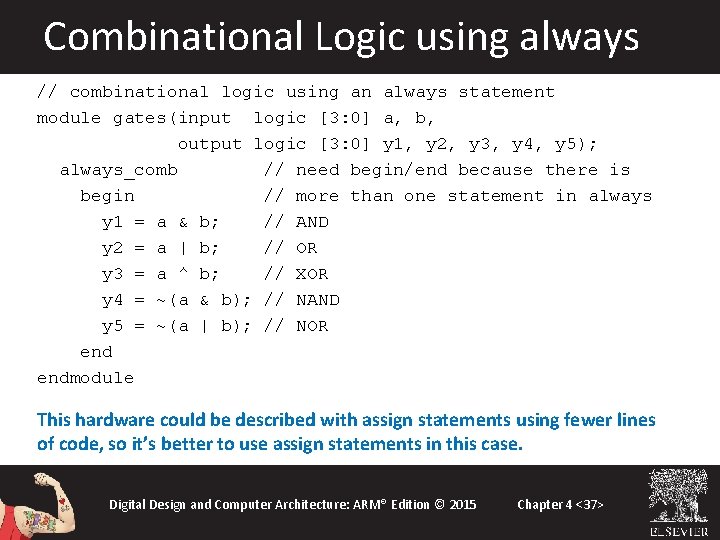
Combinational Logic using always // combinational logic using an always statement module gates(input logic [3: 0] a, b, output logic [3: 0] y 1, y 2, y 3, y 4, y 5); always_comb // need begin/end because there is begin // more than one statement in always y 1 = a & b; // AND y 2 = a | b; // OR y 3 = a ^ b; // XOR y 4 = ~(a & b); // NAND y 5 = ~(a | b); // NOR endmodule This hardware could be described with assign statements using fewer lines of code, so it’s better to use assign statements in this case. Digital Design and Computer Architecture: ARM® Edition © 2015 Chapter 4 <37>
Combinational Logic using case module sevenseg(input logic [3: 0] data, output logic [6: 0] segments); always_comb case (data) // abc_defg 0: segments = 7'b 111_1110; 1: segments = 7'b 011_0000; 2: segments = 7'b 110_1101; 3: segments = 7'b 111_1001; 4: segments = 7'b 011_0011; 5: segments = 7'b 101_1011; 6: segments = 7'b 101_1111; 7: segments = 7'b 111_0000; 8: segments = 7'b 111_1111; 9: segments = 7'b 111_0011; default: segments = 7'b 000_0000; // required endcase endmodule Digital Design and Computer Architecture: ARM® Edition © 2015 Chapter 4 <38>
Combinational Logic using case • case statement implies combinational logic only if all possible input combinations described • Remember to use default statement Digital Design and Computer Architecture: ARM® Edition © 2015 Chapter 4 <39>
Combinational Logic using casez module priority_casez(input logic [3: 0] a, output logic [3: 0] y); always_comb casez(a) 4'b 1? ? ? : y = 4'b 1000; // ? =don’t care 4'b 01? ? : y = 4'b 0100; 4'b 001? : y = 4'b 0010; 4'b 0001: y = 4'b 0001; default: y = 4'b 0000; endcase endmodule Digital Design and Computer Architecture: ARM® Edition © 2015 Synthesis: Chapter 4 <40>
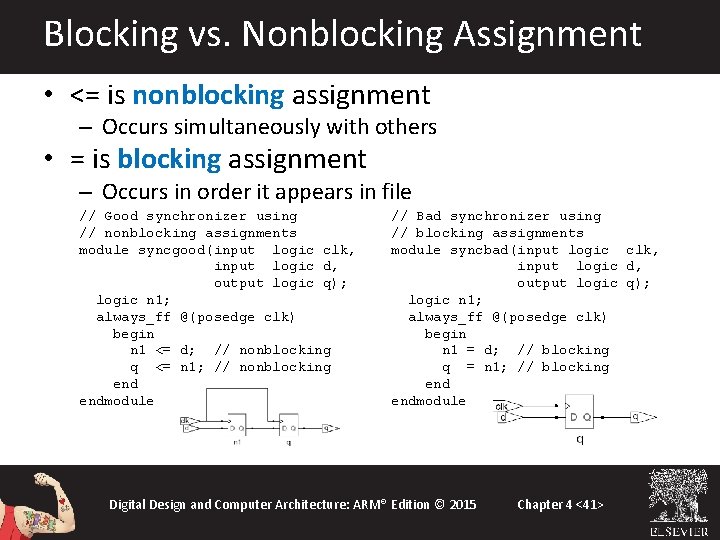
Blocking vs. Nonblocking Assignment • <= is nonblocking assignment – Occurs simultaneously with others • = is blocking assignment – Occurs in order it appears in file // Good synchronizer using // nonblocking assignments module syncgood(input logic clk, input logic d, output logic q); logic n 1; always_ff @(posedge clk) begin n 1 <= d; // nonblocking q <= n 1; // nonblocking endmodule // Bad synchronizer using // blocking assignments module syncbad(input logic clk, input logic d, output logic q); logic n 1; always_ff @(posedge clk) begin n 1 = d; // blocking q = n 1; // blocking endmodule Digital Design and Computer Architecture: ARM® Edition © 2015 Chapter 4 <41>
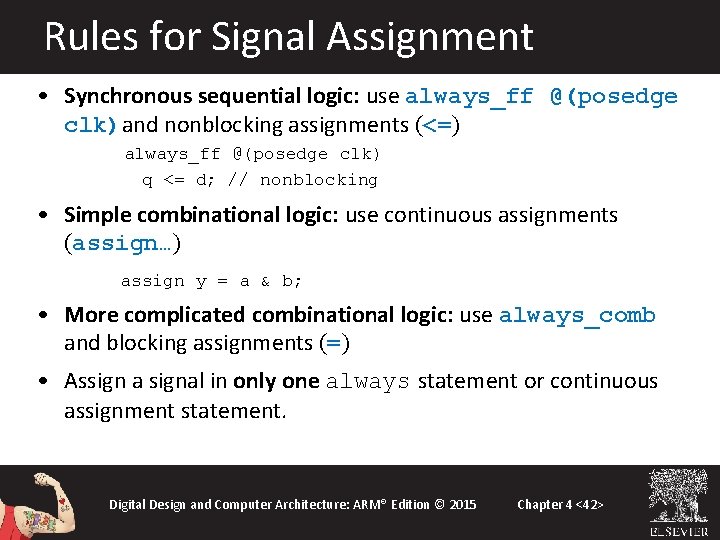
Rules for Signal Assignment • Synchronous sequential logic: use always_ff @(posedge clk)and nonblocking assignments (<=) always_ff @(posedge clk) q <= d; // nonblocking • Simple combinational logic: use continuous assignments (assign…) assign y = a & b; • More complicated combinational logic: use always_comb and blocking assignments (=) • Assign a signal in only one always statement or continuous assignment statement. Digital Design and Computer Architecture: ARM® Edition © 2015 Chapter 4 <42>
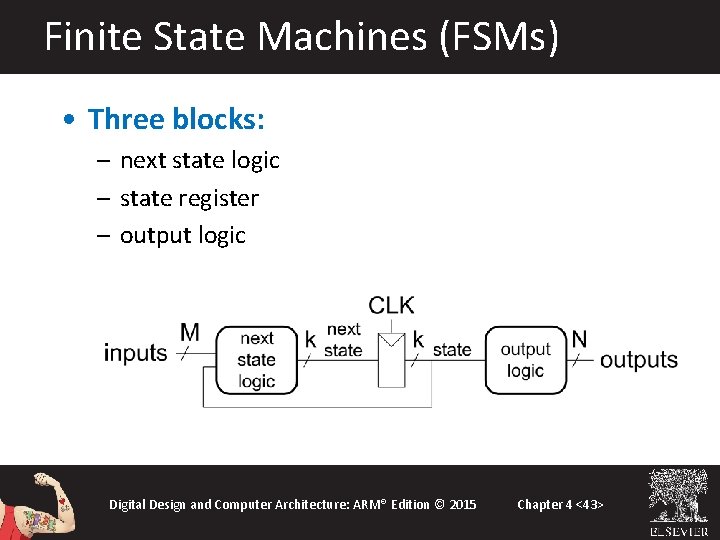
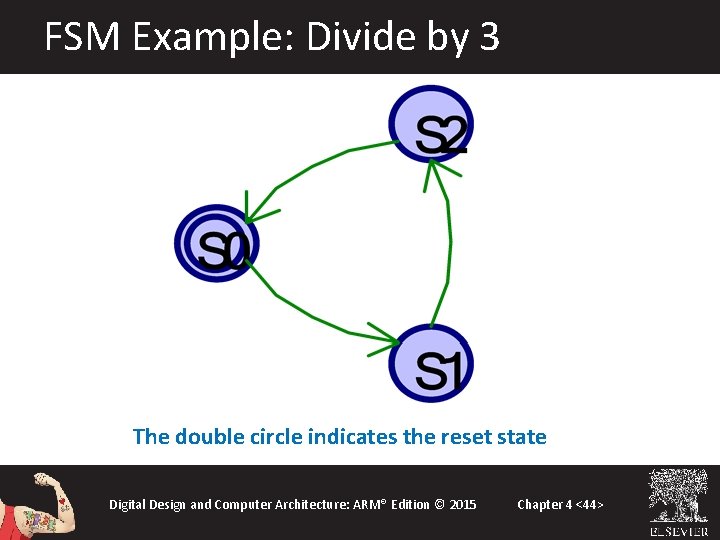
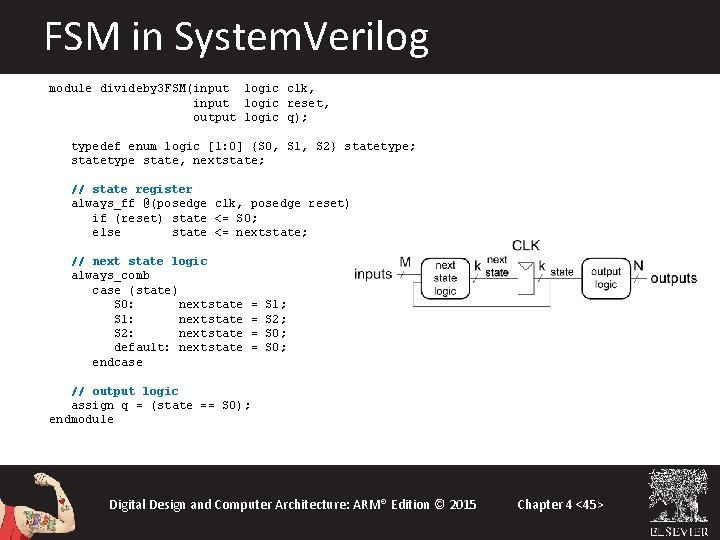
Finite State Machines (FSMs) • Three blocks: – next state logic – state register – output logic Digital Design and Computer Architecture: ARM® Edition © 2015 Chapter 4 <43>
FSM Example: Divide by 3 The double circle indicates the reset state Digital Design and Computer Architecture: ARM® Edition © 2015 Chapter 4 <44>
FSM in System. Verilog module divideby 3 FSM(input logic clk, input logic reset, output logic q); typedef enum logic [1: 0] {S 0, S 1, S 2} statetype; statetype state, nextstate; // state register always_ff @(posedge clk, posedge reset) if (reset) state <= S 0; else state <= nextstate; // next state logic always_comb case (state) S 0: nextstate S 1: nextstate S 2: nextstate default: nextstate endcase = = S 1; S 2; S 0; // output logic assign q = (state == S 0); endmodule Digital Design and Computer Architecture: ARM® Edition © 2015 Chapter 4 <45>
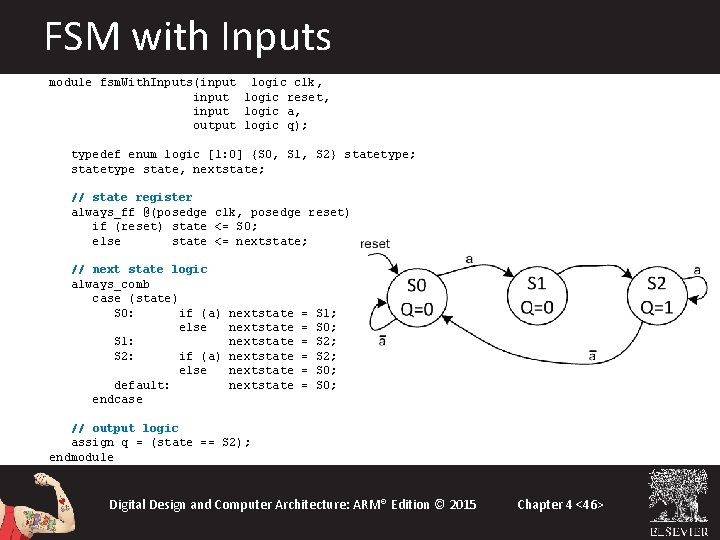
FSM with Inputs module fsm. With. Inputs(input logic clk, input logic reset, input logic a, output logic q); typedef enum logic [1: 0] {S 0, S 1, S 2} statetype; statetype state, nextstate; // state register always_ff @(posedge clk, posedge reset) if (reset) state <= S 0; else state <= nextstate; // next state logic always_comb case (state) S 0: if (a) else S 1: S 2: if (a) else default: endcase nextstate nextstate = = = S 1; S 0; S 2; S 0; // output logic assign q = (state == S 2); endmodule Digital Design and Computer Architecture: ARM® Edition © 2015 Chapter 4 <46>
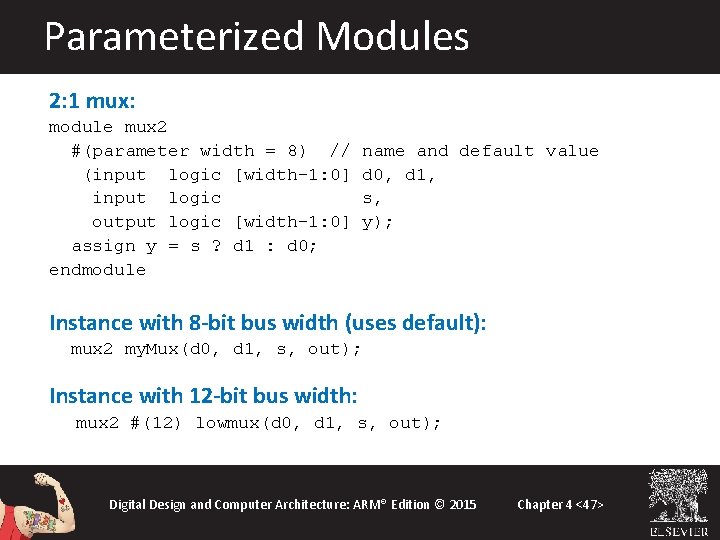
Parameterized Modules 2: 1 mux: module mux 2 #(parameter width = 8) // (input logic [width-1: 0] input logic output logic [width-1: 0] assign y = s ? d 1 : d 0; endmodule name and default value d 0, d 1, s, y); Instance with 8 -bit bus width (uses default): mux 2 my. Mux(d 0, d 1, s, out); Instance with 12 -bit bus width: mux 2 #(12) lowmux(d 0, d 1, s, out); Digital Design and Computer Architecture: ARM® Edition © 2015 Chapter 4 <47>
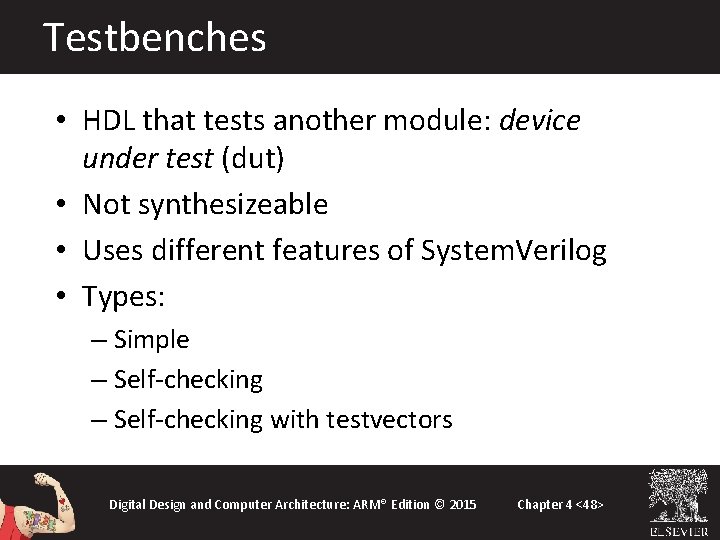
Testbenches • HDL that tests another module: device under test (dut) • Not synthesizeable • Uses different features of System. Verilog • Types: – Simple – Self-checking with testvectors Digital Design and Computer Architecture: ARM® Edition © 2015 Chapter 4 <48>
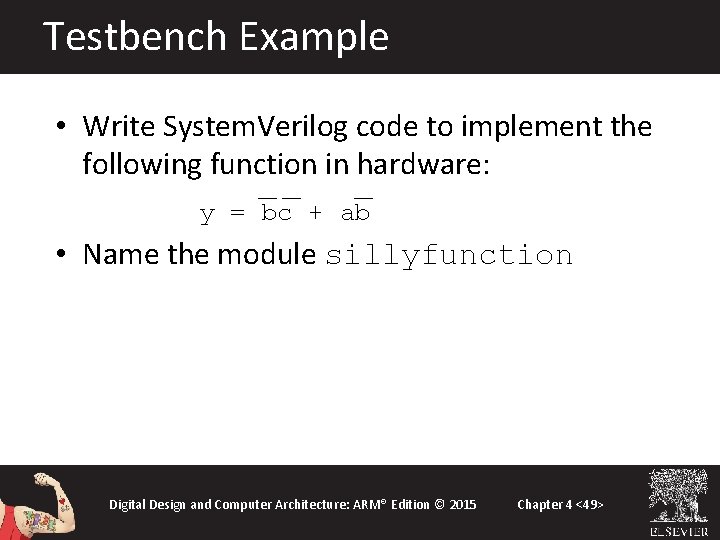
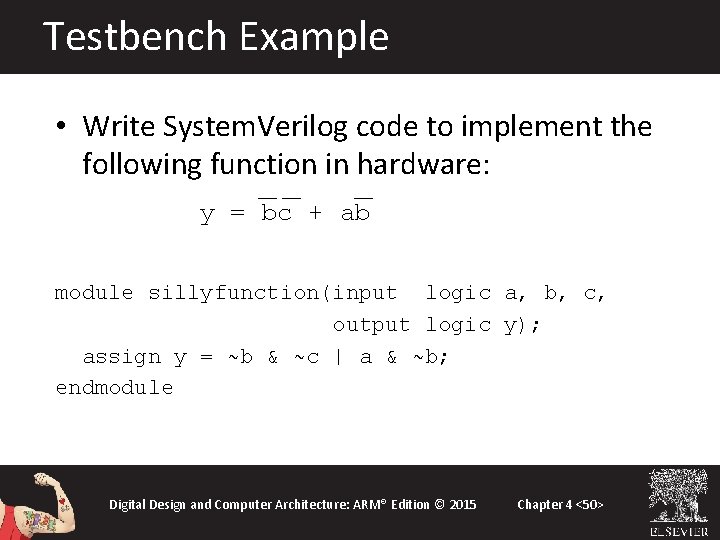
Testbench Example • Write System. Verilog code to implement the following function in hardware: y = bc + ab • Name the module sillyfunction Digital Design and Computer Architecture: ARM® Edition © 2015 Chapter 4 <49>
Testbench Example • Write System. Verilog code to implement the following function in hardware: y = bc + ab module sillyfunction(input logic a, b, c, output logic y); assign y = ~b & ~c | a & ~b; endmodule Digital Design and Computer Architecture: ARM® Edition © 2015 Chapter 4 <50>
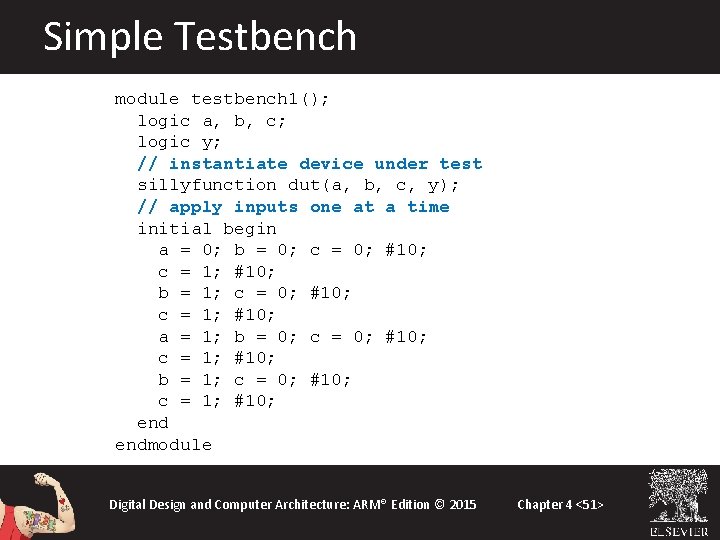
Simple Testbench module testbench 1(); logic a, b, c; logic y; // instantiate device under test sillyfunction dut(a, b, c, y); // apply inputs one at a time initial begin a = 0; b = 0; c = 0; #10; c = 1; #10; b = 1; c = 0; #10; c = 1; #10; a = 1; b = 0; c = 0; #10; c = 1; #10; b = 1; c = 0; #10; c = 1; #10; endmodule Digital Design and Computer Architecture: ARM® Edition © 2015 Chapter 4 <51>
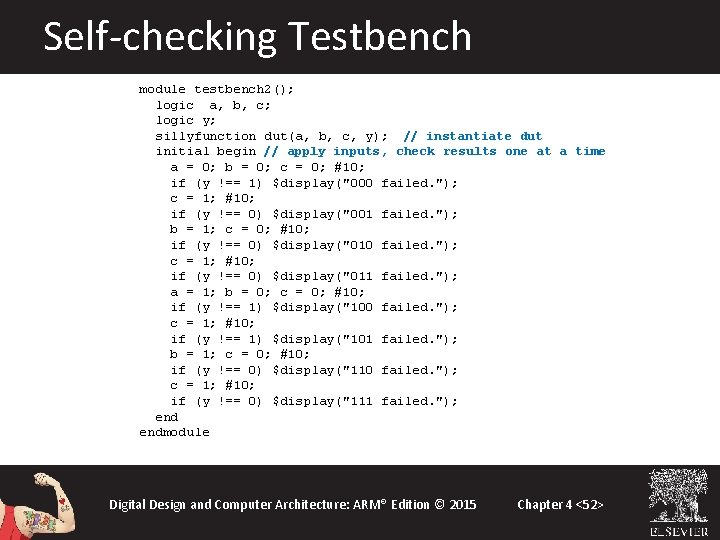
Self-checking Testbench module testbench 2(); logic a, b, c; logic y; sillyfunction dut(a, b, c, y); // instantiate dut initial begin // apply inputs, check results one at a time a = 0; b = 0; c = 0; #10; if (y !== 1) $display("000 failed. "); c = 1; #10; if (y !== 0) $display("001 failed. "); b = 1; c = 0; #10; if (y !== 0) $display("010 failed. "); c = 1; #10; if (y !== 0) $display("011 failed. "); a = 1; b = 0; c = 0; #10; if (y !== 1) $display("100 failed. "); c = 1; #10; if (y !== 1) $display("101 failed. "); b = 1; c = 0; #10; if (y !== 0) $display("110 failed. "); c = 1; #10; if (y !== 0) $display("111 failed. "); endmodule Digital Design and Computer Architecture: ARM® Edition © 2015 Chapter 4 <52>
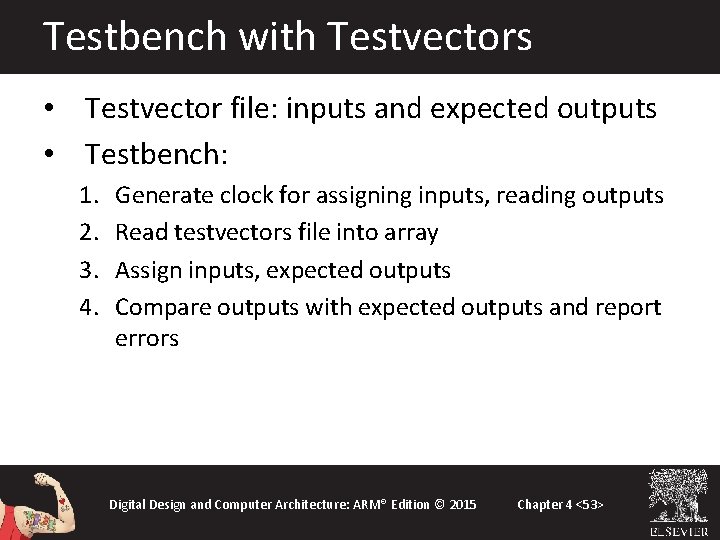
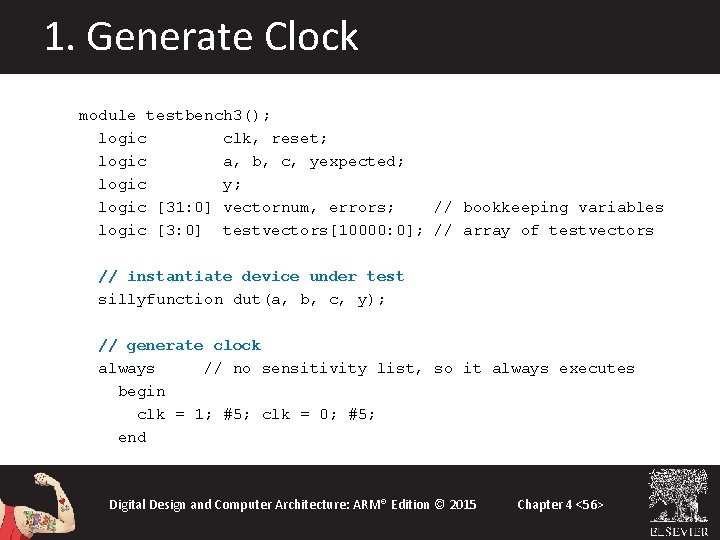
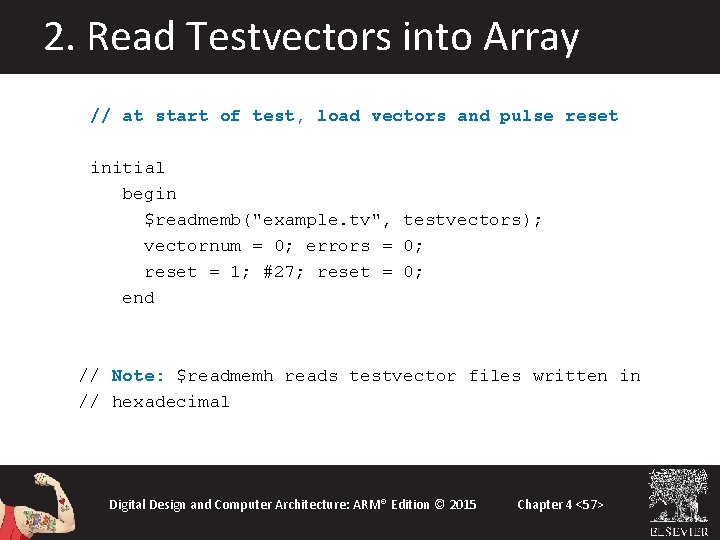
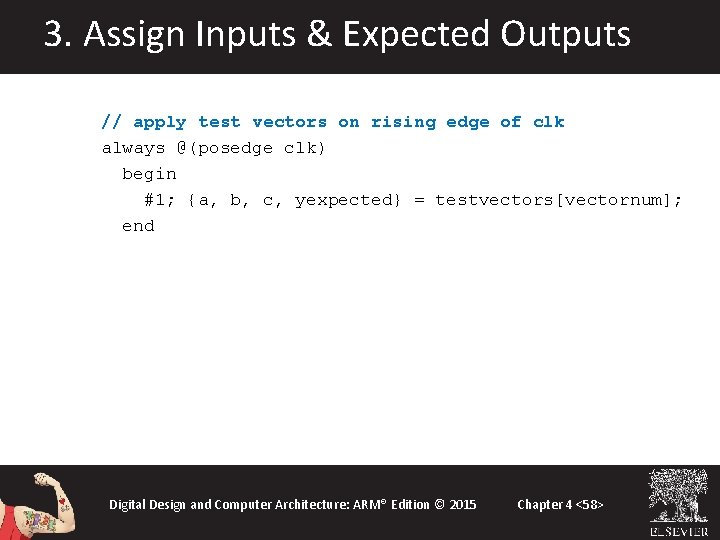
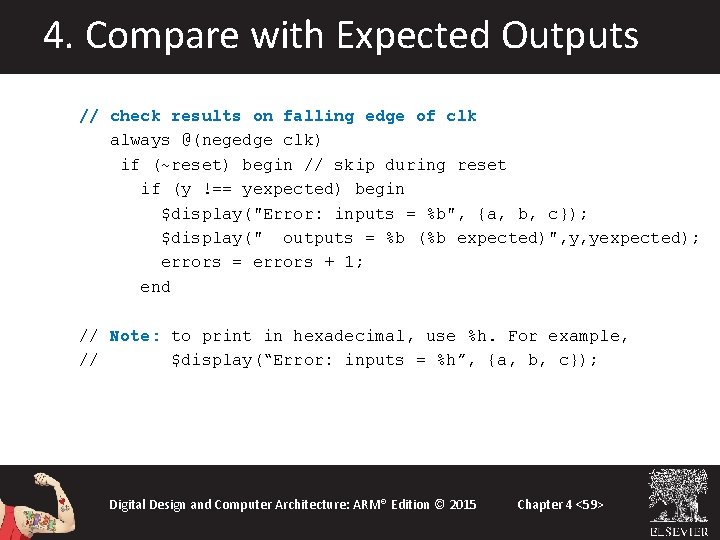
Testbench with Testvectors • Testvector file: inputs and expected outputs • Testbench: 1. 2. 3. 4. Generate clock for assigning inputs, reading outputs Read testvectors file into array Assign inputs, expected outputs Compare outputs with expected outputs and report errors Digital Design and Computer Architecture: ARM® Edition © 2015 Chapter 4 <53>
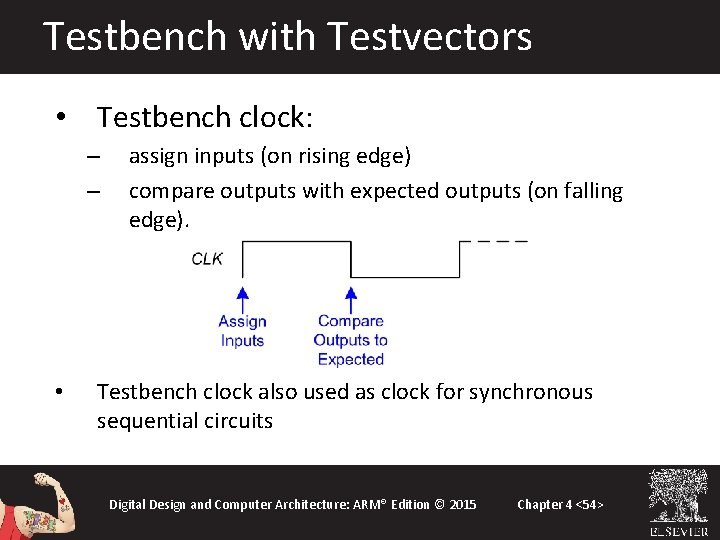
Testbench with Testvectors • Testbench clock: – – • assign inputs (on rising edge) compare outputs with expected outputs (on falling edge). Testbench clock also used as clock for synchronous sequential circuits Digital Design and Computer Architecture: ARM® Edition © 2015 Chapter 4 <54>
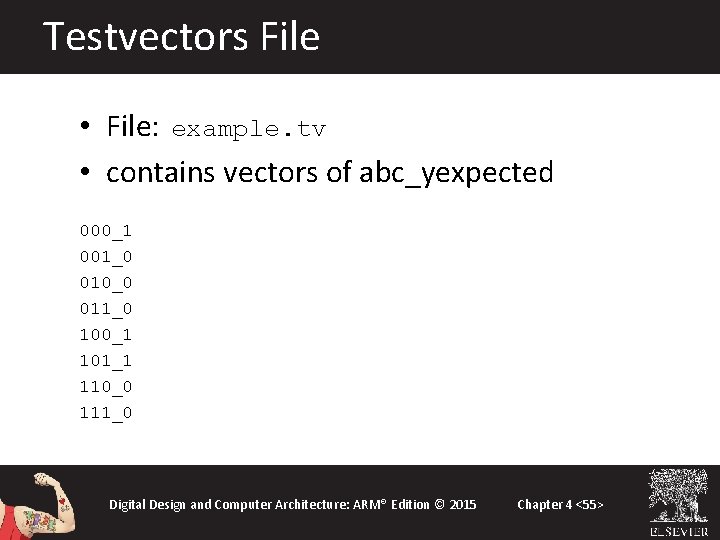
Testvectors File • File: example. tv • contains vectors of abc_yexpected 000_1 001_0 010_0 011_0 100_1 101_1 110_0 111_0 Digital Design and Computer Architecture: ARM® Edition © 2015 Chapter 4 <55>
1. Generate Clock module testbench 3(); logic clk, reset; logic a, b, c, yexpected; logic y; logic [31: 0] vectornum, errors; // bookkeeping variables logic [3: 0] testvectors[10000: 0]; // array of testvectors // instantiate device under test sillyfunction dut(a, b, c, y); // generate clock always // no sensitivity list, so it always executes begin clk = 1; #5; clk = 0; #5; end Digital Design and Computer Architecture: ARM® Edition © 2015 Chapter 4 <56>
2. Read Testvectors into Array // at start of test, load vectors and pulse reset initial begin $readmemb("example. tv", testvectors); vectornum = 0; errors = 0; reset = 1; #27; reset = 0; end // Note: $readmemh reads testvector files written in // hexadecimal Digital Design and Computer Architecture: ARM® Edition © 2015 Chapter 4 <57>
3. Assign Inputs & Expected Outputs // apply test vectors on rising edge of clk always @(posedge clk) begin #1; {a, b, c, yexpected} = testvectors[vectornum]; end Digital Design and Computer Architecture: ARM® Edition © 2015 Chapter 4 <58>
4. Compare with Expected Outputs // check results on falling edge of clk always @(negedge clk) if (~reset) begin // skip during reset if (y !== yexpected) begin $display("Error: inputs = %b", {a, b, c}); $display(" outputs = %b (%b expected)", y, yexpected); errors = errors + 1; end // Note: to print in hexadecimal, use %h. For example, // $display(“Error: inputs = %h”, {a, b, c}); Digital Design and Computer Architecture: ARM® Edition © 2015 Chapter 4 <59>
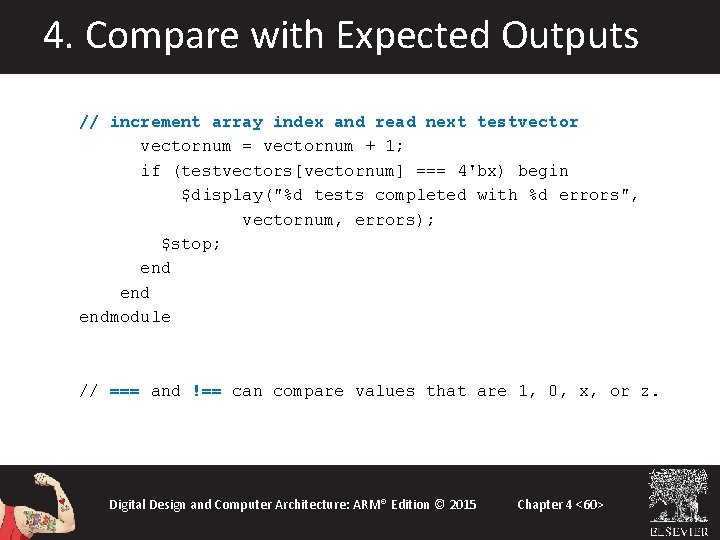
4. Compare with Expected Outputs // increment array index and read next testvectornum = vectornum + 1; if (testvectors[vectornum] === 4'bx) begin $display("%d tests completed with %d errors", vectornum, errors); $stop; end endmodule // === and !== can compare values that are 1, 0, x, or z. Digital Design and Computer Architecture: ARM® Edition © 2015 Chapter 4 <60>