
Chapter 4 Developing Paragraphs 1 Features of a

- Slides: 15
Chapter 4 Developing Paragraphs 1 Features of a paragraph An effective paragraph generally has three fundamental features: a central idea(中心或主题)(a topic sentence主题句) supporting evidence close connection between the sentences句子间的紧 密联系
2 Ways of developing a paragraph段落的展开法 1. Development by time按时间展开 2. In telling a story or recounting an event, the easiest and clearest way is to describe things in order of time: earlier things are mentioned before later things, the first thing first and the last thing last.
2. Development by process按过程展开 When you have to explain how something is done, you usually follow a chronological sequence and give a step-by-step description. As the steps must occur one after another, the exact order in which they are carried out is most important. In giving instructions, imperative sentences(祈使句) and sentences with the indefinite pronoun you as the subject are often used. The present tense should be used if the instructions are still reliable.
3. Developing by space按空间展开 Before we begin to describe a place, whether it is a large country or a small room, we have to decide on the order in which to name the different parts or details. For this we should find out the space relationships between them and arrange our description accordingly. It would only confuse the reader to mention them in a haphazard way. 不论我们要描述的是一个大国家或一个小房间,都要 先设计好描述的顺序。
4. Developing by example举例 Supporting a topic sentence with examples or illustrations makes a general statement specific and easy to understand. An illustration is a case, a specimen, an instance. Vivid illustrations light up abstract ideas and make them clear, interesting, memorable, or convincing. Illustrations may be a single example or a series of examples. It is not always necessary to say “for example” or “for instance”.
Details or examples are usually arranged in climatic order: the least important comes first, followed by others in order of increasing importance. 段落中的细节和例子往往按照它们的重要性或趣味 性排列:分量轻或趣味性弱的靠前,分量重或趣味 性强的置后。
5. Development of comparison and contrast类比和 对比 A comparison points out the similarities between two or more persons or things of the same class. 类比用于指出同一范畴的事物之间或几个人之间的 相似之处。 A contrast points out the differences between them. 对比用于指出他们之间的不同之处。 Comparison and contrast often appear together because people generally compare two things that are similar in certain ways and different in others.
Block presentation (subject-by-subject pattern)整体 类比或整体对比法: to examine one thing thoroughly and then examine the other. In this way, the aspects examined in the two things should be identical and in the same order. 在阐述完一件事物的特点之后,再摆出与之相比的另 一件事物的全部特点。 注意:进行类比或对比的两件事物的方面应一致,顺 序应相同,否则相互脱离不成对比。
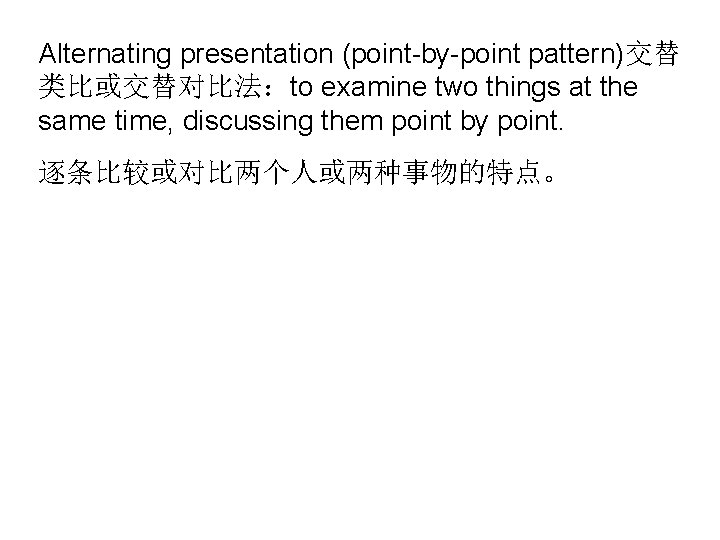
Alternating presentation (point-by-point pattern)交替 类比或交替对比法:to examine two things at the same time, discussing them point by point. 逐条比较或对比两个人或两种事物的特点。
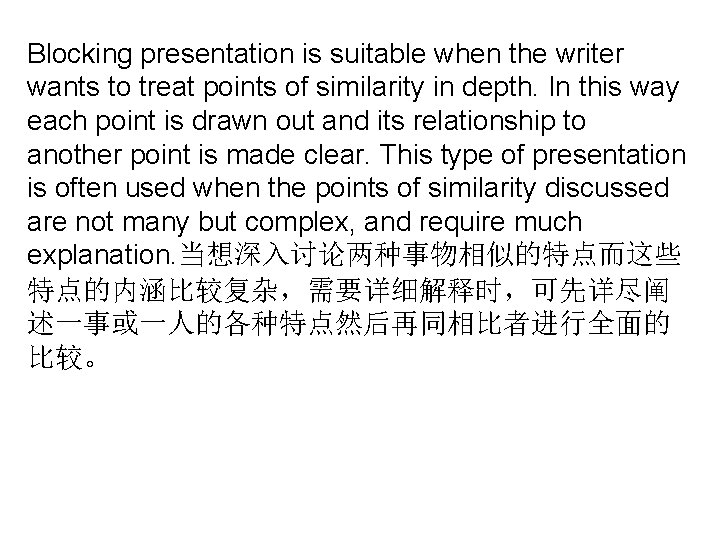
Blocking presentation is suitable when the writer wants to treat points of similarity in depth. In this way each point is drawn out and its relationship to another point is made clear. This type of presentation is often used when the points of similarity discussed are not many but complex, and require much explanation. 当想深入讨论两种事物相似的特点而这些 特点的内涵比较复杂,需要详细解释时,可先详尽阐 述一事或一人的各种特点然后再同相比者进行全面的 比较。
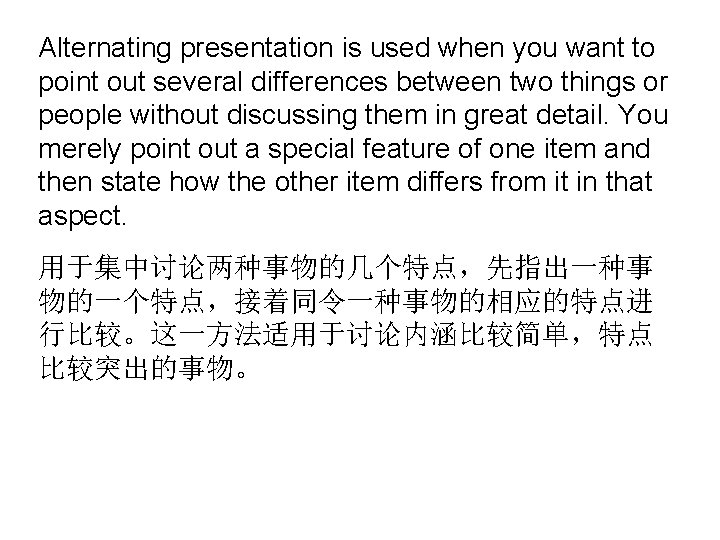
Alternating presentation is used when you want to point out several differences between two things or people without discussing them in great detail. You merely point out a special feature of one item and then state how the other item differs from it in that aspect. 用于集中讨论两种事物的几个特点,先指出一种事 物的一个特点,接着同令一种事物的相应的特点进 行比较。这一方法适用于讨论内涵比较简单,特点 比较突出的事物。
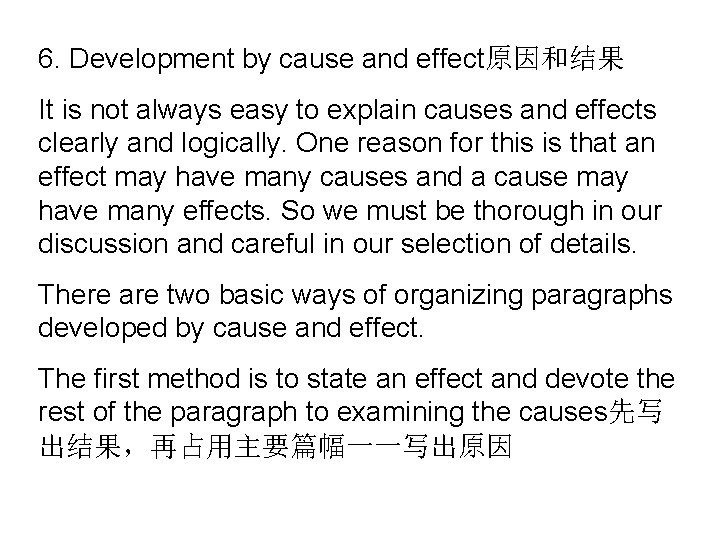
6. Development by cause and effect原因和结果 It is not always easy to explain causes and effects clearly and logically. One reason for this is that an effect may have many causes and a cause may have many effects. So we must be thorough in our discussion and careful in our selection of details. There are two basic ways of organizing paragraphs developed by cause and effect. The first method is to state an effect and devote the rest of the paragraph to examining the causes先写 出结果,再占用主要篇幅一一写出原因
The second method is to state a cause and then mention or predict the effects. 先叙述原因,再写出 或预测后果。
7. Development by classification分类 To classify is to sort things into categories according to their characteristics. 分类就是根据事物的特点分别 归类。 We group things according to their similarities and differences. 根据共性和差别分类。 Essential to a good classification is parallelism. 把握类 别的对应性 In short, in a good classification the parts must be parallel, and they should add up to the whole subject.