
Chapter 4 Determinants of Individual Financial Compensation Part

- Slides: 47
Chapter # 4 Determinants of Individual Financial Compensation (Part 1) Reference Books: ØHuman Resource Management (12 th Edition), R. Wayne Mondy, Pearson Education. ØStrategic Compensation: A Human Resource Management Approach (6 th Edition), Joseph J. , Martocchio Joe, Pearson Education. Resource person: Furqan-ul-haq Siddiqui
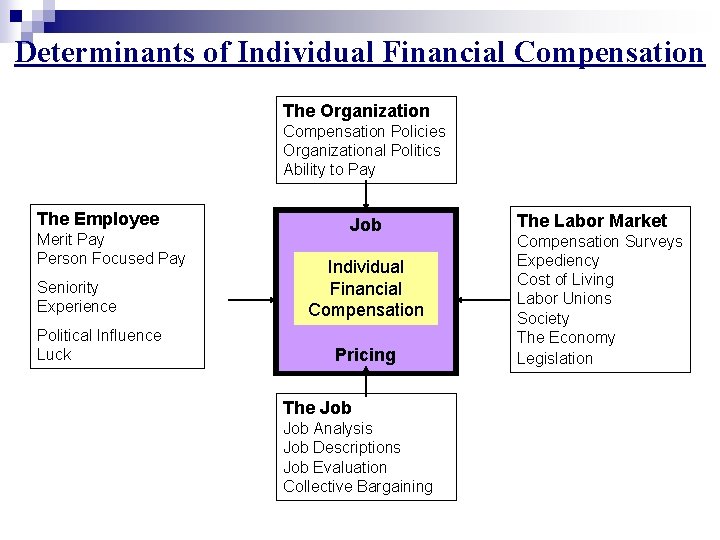
Determinants of Individual Financial Compensation The Organization Compensation Policies Organizational Politics Ability to Pay The Employee Merit Pay Person Focused Pay Seniority Experience Political Influence Luck Job Individual Financial Compensation Pricing The Job Analysis Job Descriptions Job Evaluation Collective Bargaining The Labor Market Compensation Surveys Expediency Cost of Living Labor Unions Society The Economy Legislation
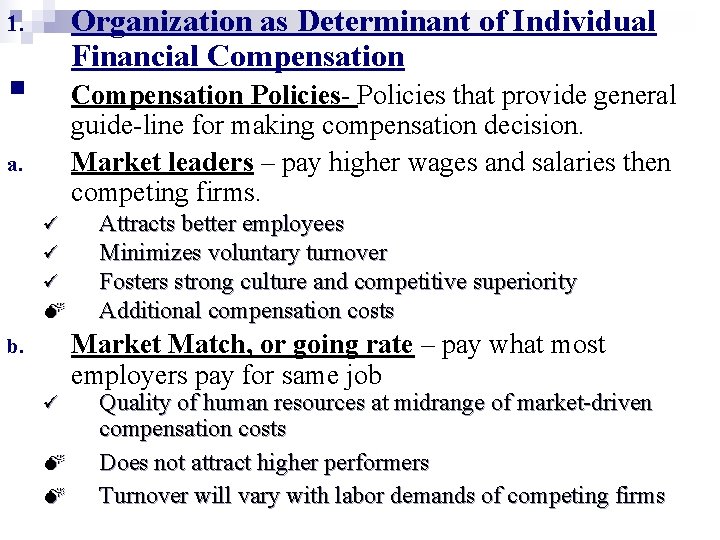
Organization as Determinant of Individual Financial Compensation 1. § Compensation Policies- Policies that provide general guide-line for making compensation decision. Market leaders – pay higher wages and salaries then competing firms. a. ü ü ü M Attracts better employees Minimizes voluntary turnover Fosters strong culture and competitive superiority Additional compensation costs Market Match, or going rate – pay what most employers pay for same job b. ü M M Quality of human resources at midrange of market-driven compensation costs Does not attract higher performers Turnover will vary with labor demands of competing firms
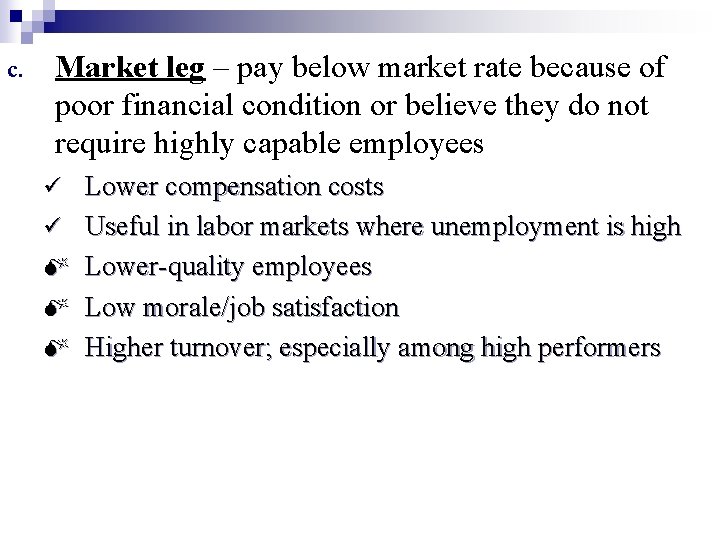
c. Market leg – pay below market rate because of poor financial condition or believe they do not require highly capable employees ü ü M M M Lower compensation costs Useful in labor markets where unemployment is high Lower-quality employees Low morale/job satisfaction Higher turnover; especially among high performers
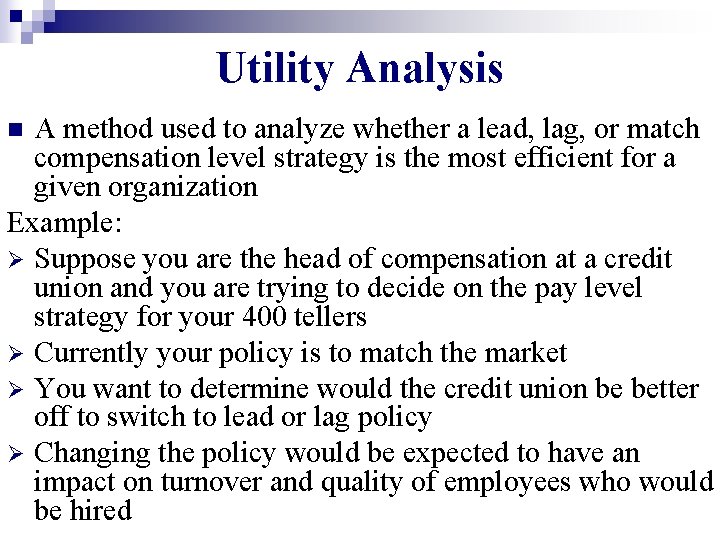
Utility Analysis A method used to analyze whether a lead, lag, or match compensation level strategy is the most efficient for a given organization Example: Ø Suppose you are the head of compensation at a credit union and you are trying to decide on the pay level strategy for your 400 tellers Ø Currently your policy is to match the market Ø You want to determine would the credit union be better off to switch to lead or lag policy Ø Changing the policy would be expected to have an impact on turnover and quality of employees who would be hired n
You have examined other financial institutions that pay more or less than you do, you have found that: ü Firms that pay 20 percent more have a 10 percent lower turnover rate than you do ü Firms that pay 20 percent less than you have a turnover rate 10 percent more than you do ü Your current turn over rate of tellers is running at 30 percent per year ü Each year you have to replace 120 tellers ü You first need to calculate the costs of turnover Ø
ü ü Ø Ø What is the cost of recruiting each teller What is the cost of training them Let us assume that it costs approximately $ 1000 to replace each teller, including advertising, interviewing, and administrative costs of putting the new employee on the payroll and taking the former employee of the payroll Let us suppose that training costs $ 4000 per employee, counting out of pocket training costs and reduced productivity during the training period Currently you are paying each teller $24, 000 direct pay per year, with benefits adding another $ 6000 for a cost of per employee of 30, 000 per year The total costs for tellers per year is the cost of their compensation (400 x$30, 000 = 12, 000) plus the cost of turnover (120 x $5000 = $ 600, 000) for a total of $ 12, 600, 000
You now need to estimate the change in performance that will occur from a change in the quality of your work force due to a lag or lead policy Ø If you lag the market by 20 percent, you expect that your new workforce will produce 5 percent less work and make 7 percent more errors Ø Considering the time needed to identify and correct the errors, you estimate that the new work force will be 12 percent less productive Ø You also need to decide whether lead pay policy would improve the productivity by the same amount Ø Let us suppose it does, now you have to follow through with the analysis for the lag or lead policy in turn n
Ø Ø Ø Ø Ø Lag policy by 20 percent Because productivity is 12 percent less we will now lead 448 tellers At 33 percent turnover we will need to replace 149 tellers per year With 20 percent wage reduction it will now cost us $ 24, 000 per employee per year in salary and benefits The total costs will be 448 x 24, 000 = 10, 752, 000 + 149 x $ 5000 ( 745, 000) = $ 11, 497, 000 considerably the current costs If we have 12 percent more employees then we need 12 percent more office space, 12 percent more office equipment Assuming it costs additional $ 3000 per employee per year for computer equipment and support $ 1000 for office space and miscellaneous expenses We can expect additional cost $ 192, 000 resulting in total cost of $ 11, 689, 000 This is still a saving of nearly a million dollar per year compared to match the market strategy
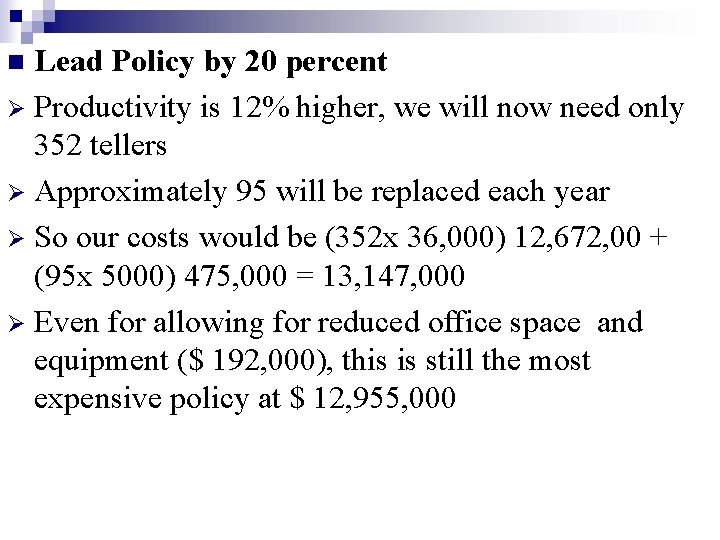
Lead Policy by 20 percent Ø Productivity is 12% higher, we will now need only 352 tellers Ø Approximately 95 will be replaced each year Ø So our costs would be (352 x 36, 000) 12, 672, 00 + (95 x 5000) 475, 000 = 13, 147, 000 Ø Even for allowing for reduced office space and equipment ($ 192, 000), this is still the most expensive policy at $ 12, 955, 000 n
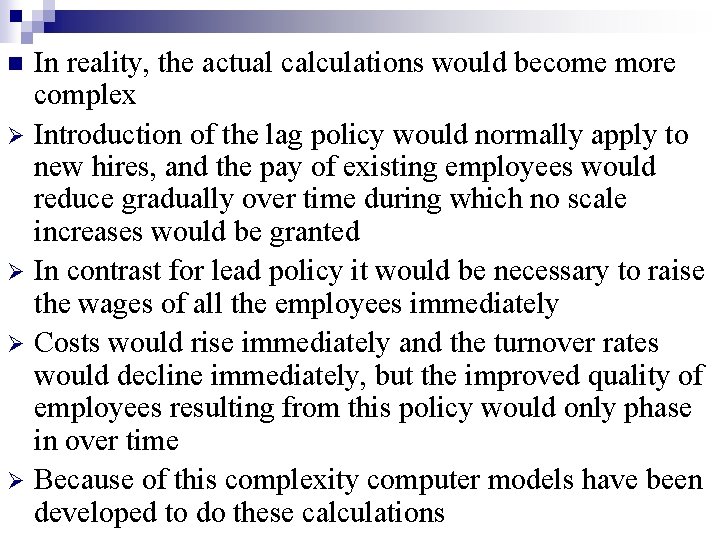
In reality, the actual calculations would become more complex Ø Introduction of the lag policy would normally apply to new hires, and the pay of existing employees would reduce gradually over time during which no scale increases would be granted Ø In contrast for lead policy it would be necessary to raise the wages of all the employees immediately Ø Costs would rise immediately and the turnover rates would decline immediately, but the improved quality of employees resulting from this policy would only phase in over time Ø Because of this complexity computer models have been developed to do these calculations n
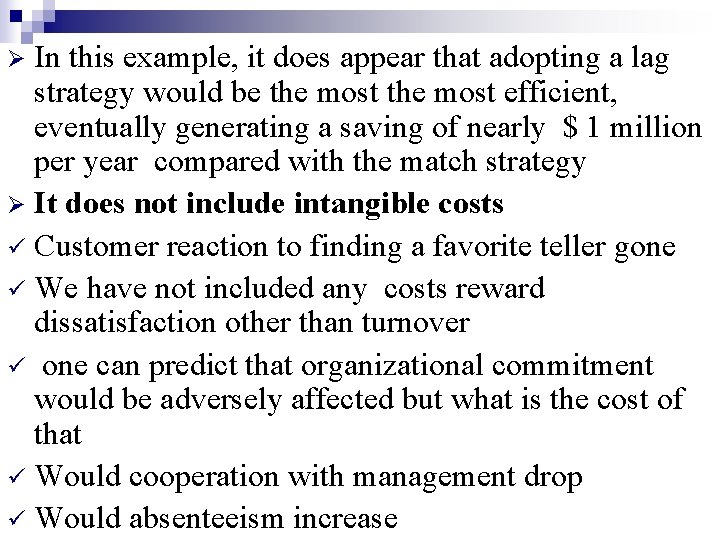
In this example, it does appear that adopting a lag strategy would be the most efficient, eventually generating a saving of nearly $ 1 million per year compared with the match strategy Ø It does not include intangible costs ü Customer reaction to finding a favorite teller gone ü We have not included any costs reward dissatisfaction other than turnover ü one can predict that organizational commitment would be adversely affected but what is the cost of that ü Would cooperation with management drop ü Would absenteeism increase Ø
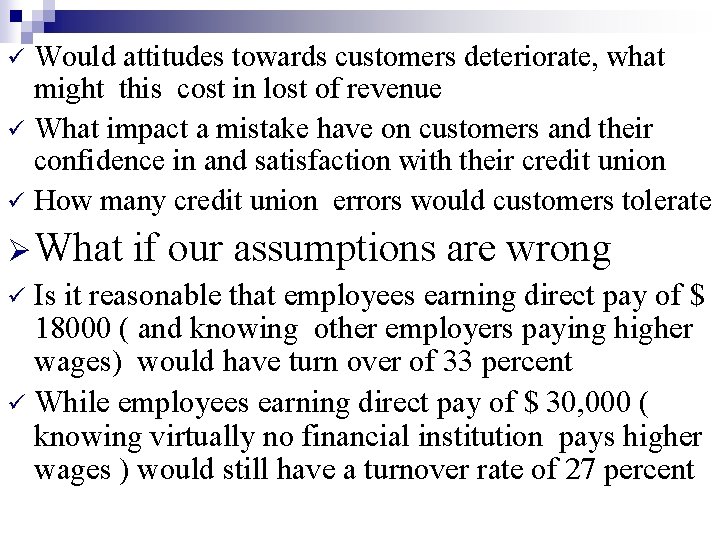
Would attitudes towards customers deteriorate, what might this cost in lost of revenue ü What impact a mistake have on customers and their confidence in and satisfaction with their credit union ü How many credit union errors would customers tolerate ü Ø What if our assumptions are wrong ü Is it reasonable that employees earning direct pay of $ 18000 ( and knowing other employers paying higher wages) would have turn over of 33 percent ü While employees earning direct pay of $ 30, 000 ( knowing virtually no financial institution pays higher wages ) would still have a turnover rate of 27 percent
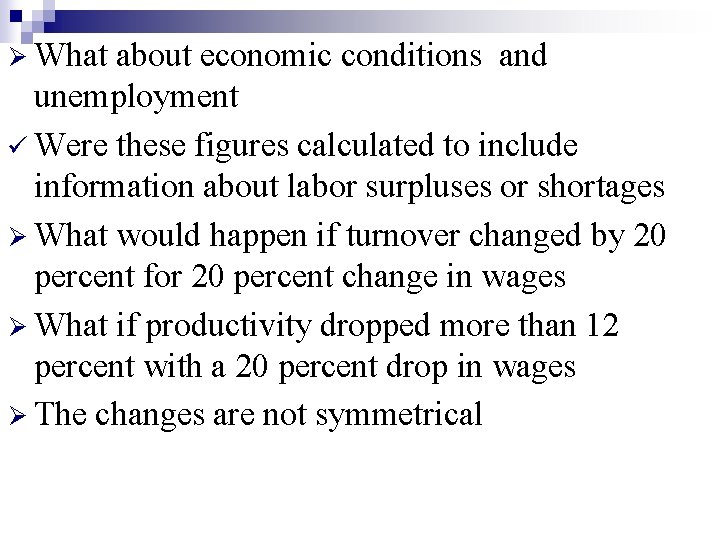
Ø What about economic conditions and unemployment ü Were these figures calculated to include information about labor surpluses or shortages Ø What would happen if turnover changed by 20 percent for 20 percent change in wages Ø What if productivity dropped more than 12 percent with a 20 percent drop in wages Ø The changes are not symmetrical
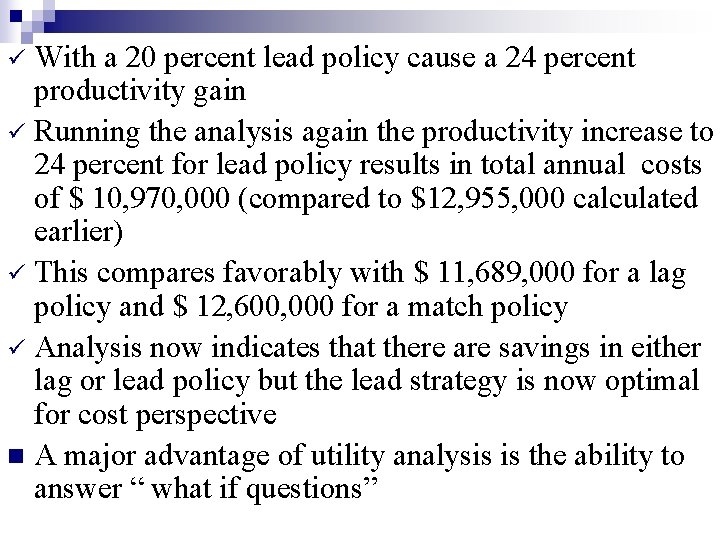
With a 20 percent lead policy cause a 24 percent productivity gain ü Running the analysis again the productivity increase to 24 percent for lead policy results in total annual costs of $ 10, 970, 000 (compared to $12, 955, 000 calculated earlier) ü This compares favorably with $ 11, 689, 000 for a lag policy and $ 12, 600, 000 for a match policy ü Analysis now indicates that there are savings in either lag or lead policy but the lead strategy is now optimal for cost perspective n A major advantage of utility analysis is the ability to answer “ what if questions” ü
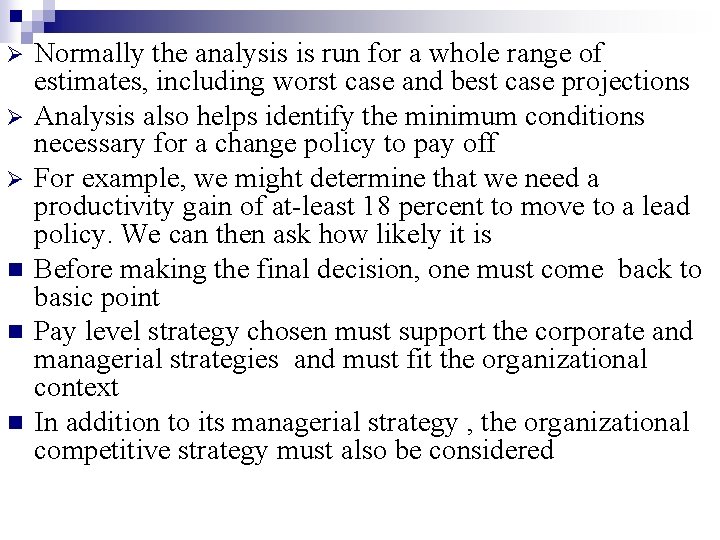
Ø Ø Ø n n n Normally the analysis is run for a whole range of estimates, including worst case and best case projections Analysis also helps identify the minimum conditions necessary for a change policy to pay off For example, we might determine that we need a productivity gain of at-least 18 percent to move to a lead policy. We can then ask how likely it is Before making the final decision, one must come back to basic point Pay level strategy chosen must support the corporate and managerial strategies and must fit the organizational context In addition to its managerial strategy , the organizational competitive strategy must also be considered
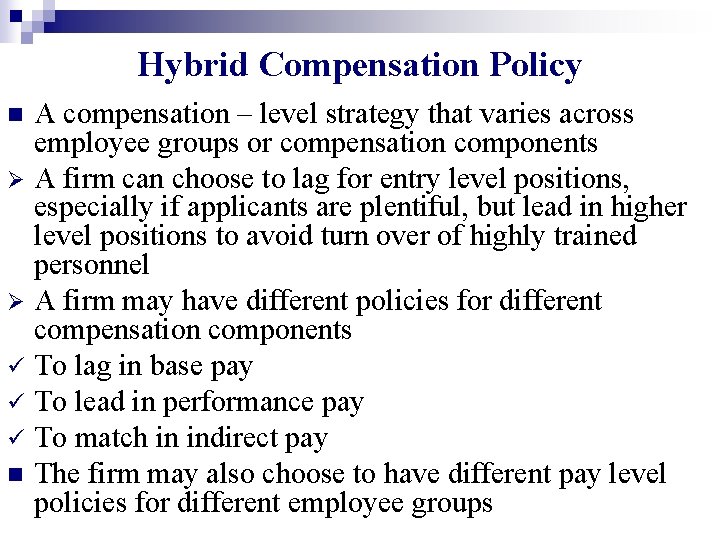
Hybrid Compensation Policy A compensation – level strategy that varies across employee groups or compensation components Ø A firm can choose to lag for entry level positions, especially if applicants are plentiful, but lead in higher level positions to avoid turn over of highly trained personnel Ø A firm may have different policies for different compensation components ü To lag in base pay ü To lead in performance pay ü To match in indirect pay n The firm may also choose to have different pay level policies for different employee groups n
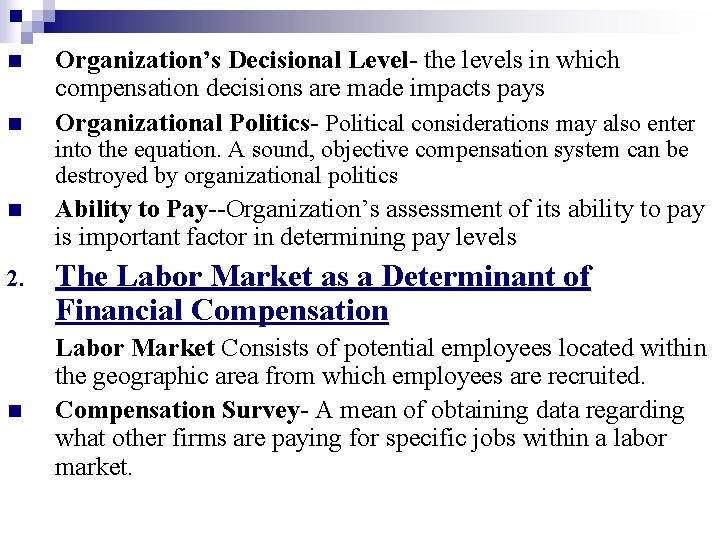
n n Organization’s Decisional Level- the levels in which compensation decisions are made impacts pays Organizational Politics- Political considerations may also enter into the equation. A sound, objective compensation system can be destroyed by organizational politics n Ability to Pay--Organization’s assessment of its ability to pay is important factor in determining pay levels 2. The Labor Market as a Determinant of Financial Compensation n Labor Market Consists of potential employees located within the geographic area from which employees are recruited. Compensation Survey- A mean of obtaining data regarding what other firms are paying for specific jobs within a labor market.
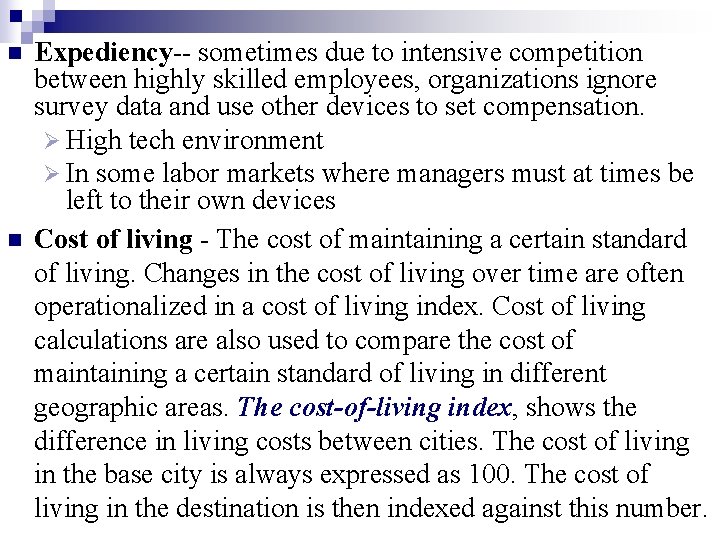
n n Expediency-- sometimes due to intensive competition between highly skilled employees, organizations ignore survey data and use other devices to set compensation. Ø High tech environment Ø In some labor markets where managers must at times be left to their own devices Cost of living - The cost of maintaining a certain standard of living. Changes in the cost of living over time are often operationalized in a cost of living index. Cost of living calculations are also used to compare the cost of maintaining a certain standard of living in different geographic areas. The cost-of-living index, shows the difference in living costs between cities. The cost of living in the base city is always expressed as 100. The cost of living in the destination is then indexed against this number.
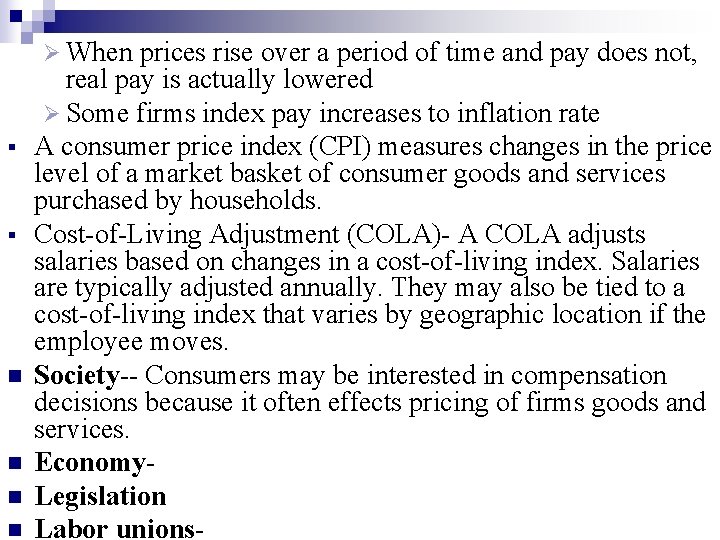
Ø When § § n n prices rise over a period of time and pay does not, real pay is actually lowered Ø Some firms index pay increases to inflation rate A consumer price index (CPI) measures changes in the price level of a market basket of consumer goods and services purchased by households. Cost-of-Living Adjustment (COLA)- A COLA adjusts salaries based on changes in a cost-of-living index. Salaries are typically adjusted annually. They may also be tied to a cost-of-living index that varies by geographic location if the employee moves. Society-- Consumers may be interested in compensation decisions because it often effects pricing of firms goods and services. Economy. Legislation Labor unions-
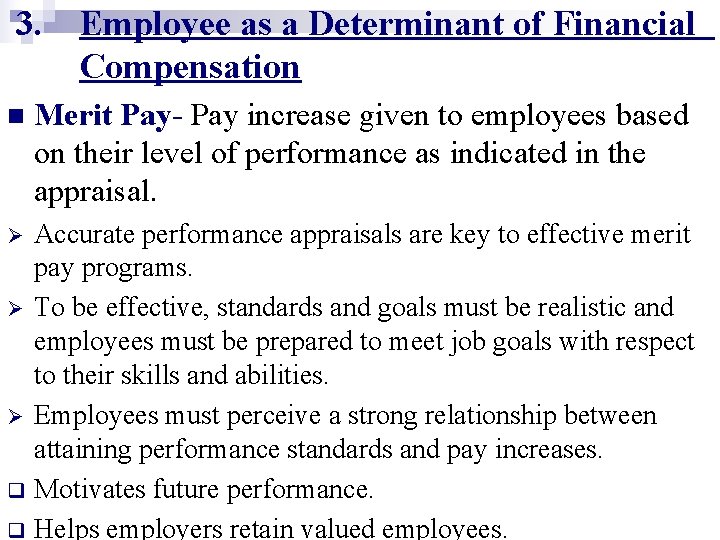
3. n Employee as a Determinant of Financial Compensation Merit Pay- Pay increase given to employees based on their level of performance as indicated in the appraisal. Accurate performance appraisals are key to effective merit pay programs. Ø To be effective, standards and goals must be realistic and employees must be prepared to meet job goals with respect to their skills and abilities. Ø Employees must perceive a strong relationship between attaining performance standards and pay increases. q Motivates future performance. q Helps employers retain valued employees. Ø
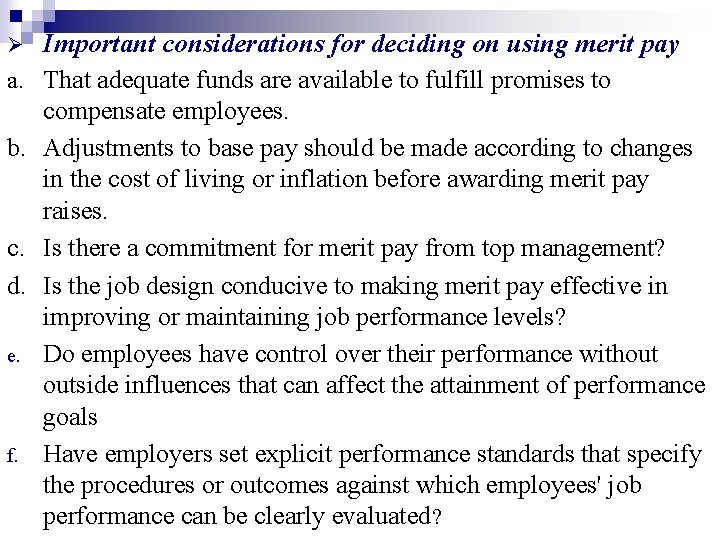
Ø a. b. c. d. e. f. Important considerations for deciding on using merit pay That adequate funds are available to fulfill promises to compensate employees. Adjustments to base pay should be made according to changes in the cost of living or inflation before awarding merit pay raises. Is there a commitment for merit pay from top management? Is the job design conducive to making merit pay effective in improving or maintaining job performance levels? Do employees have control over their performance without outside influences that can affect the attainment of performance goals Have employers set explicit performance standards that specify the procedures or outcomes against which employees' job performance can be clearly evaluated?
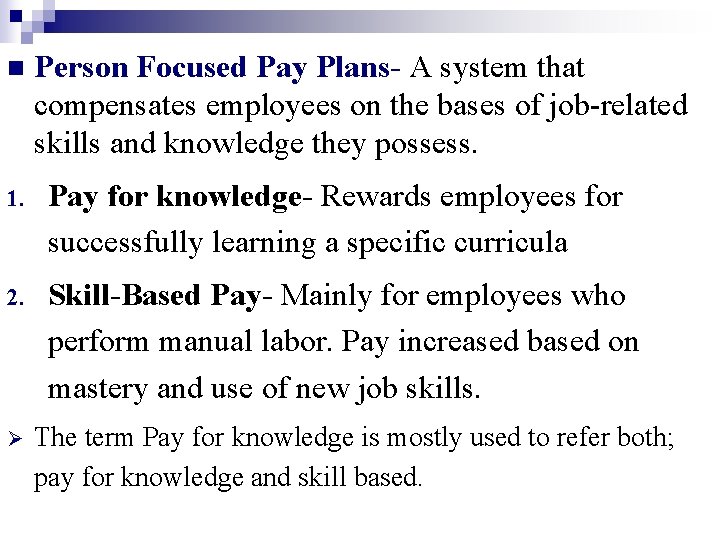
n Person Focused Pay Plans- A system that compensates employees on the bases of job-related skills and knowledge they possess. 1. Pay for knowledge- Rewards employees for successfully learning a specific curricula 2. Skill-Based Pay- Mainly for employees who perform manual labor. Pay increased based on mastery and use of new job skills. Ø The term Pay for knowledge is mostly used to refer both; pay for knowledge and skill based.
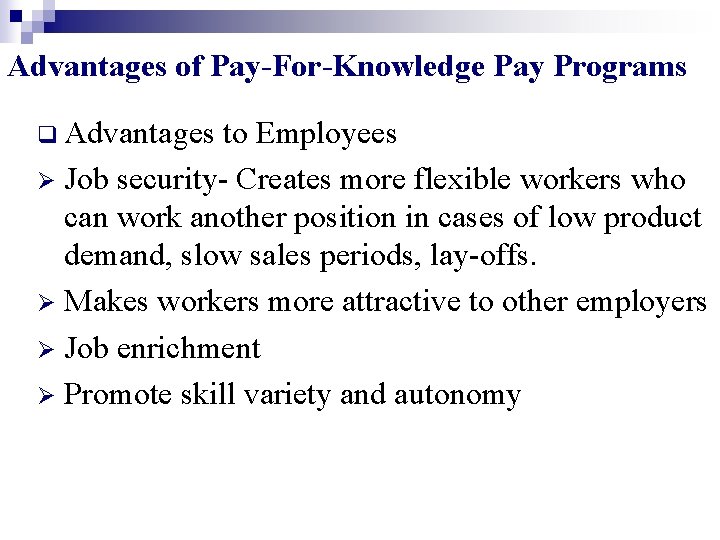
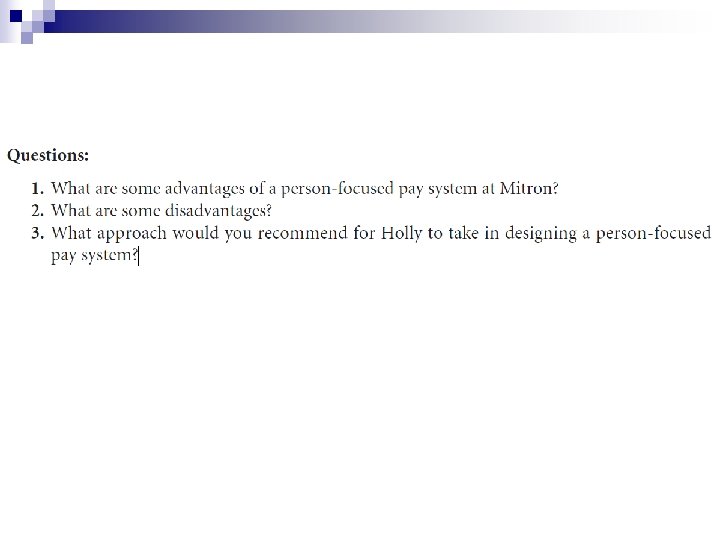
Advantages of Pay-For-Knowledge Pay Programs q Advantages to Employees Ø Job security- Creates more flexible workers who can work another position in cases of low product demand, slow sales periods, lay-offs. Ø Makes workers more attractive to other employers Ø Job enrichment Ø Promote skill variety and autonomy
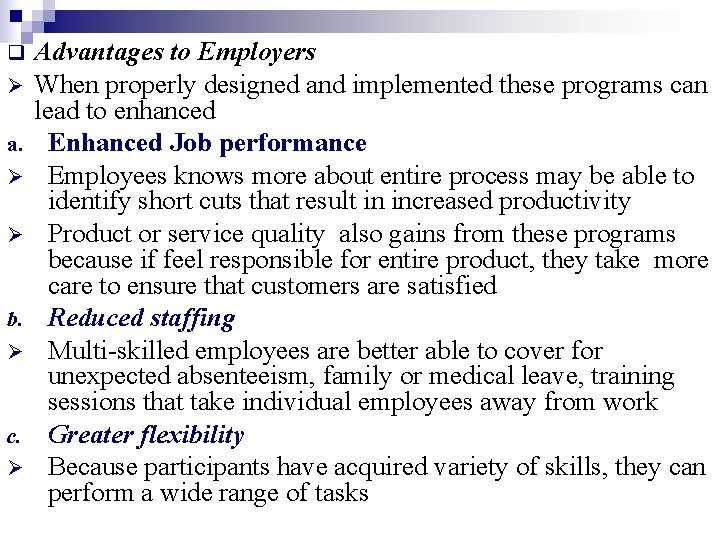
q Ø a. Ø Ø b. Ø c. Ø Advantages to Employers When properly designed and implemented these programs can lead to enhanced Enhanced Job performance Employees knows more about entire process may be able to identify short cuts that result in increased productivity Product or service quality also gains from these programs because if feel responsible for entire product, they take more care to ensure that customers are satisfied Reduced staffing Multi-skilled employees are better able to cover for unexpected absenteeism, family or medical leave, training sessions that take individual employees away from work Greater flexibility Because participants have acquired variety of skills, they can perform a wide range of tasks
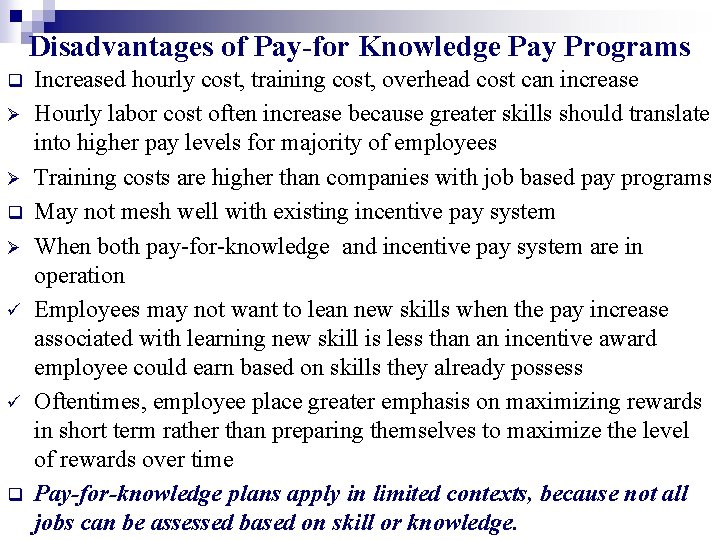
Disadvantages of Pay-for Knowledge Pay Programs q Ø Ø q Ø ü ü q Increased hourly cost, training cost, overhead cost can increase Hourly labor cost often increase because greater skills should translate into higher pay levels for majority of employees Training costs are higher than companies with job based pay programs May not mesh well with existing incentive pay system When both pay-for-knowledge and incentive pay system are in operation Employees may not want to lean new skills when the pay increase associated with learning new skill is less than an incentive award employee could earn based on skills they already possess Oftentimes, employee place greater emphasis on maximizing rewards in short term rather than preparing themselves to maximize the level of rewards over time Pay-for-knowledge plans apply in limited contexts, because not all jobs can be assessed based on skill or knowledge.
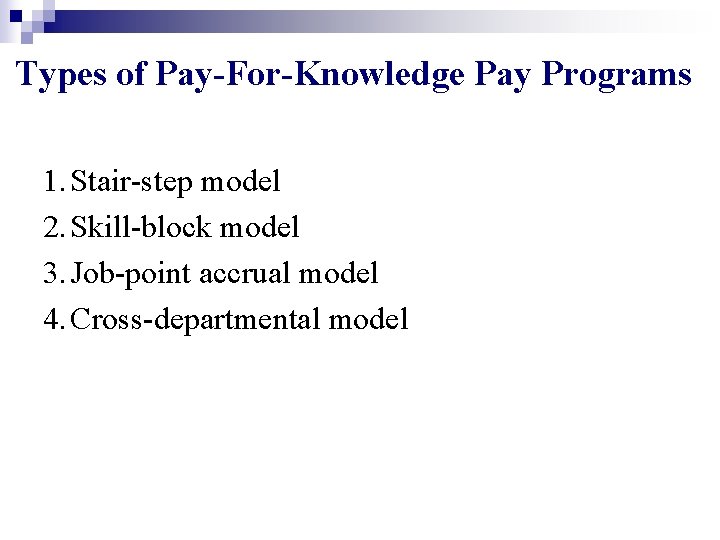
Types of Pay-For-Knowledge Pay Programs 1. Stair-step model 2. Skill-block model 3. Job-point accrual model 4. Cross-departmental model
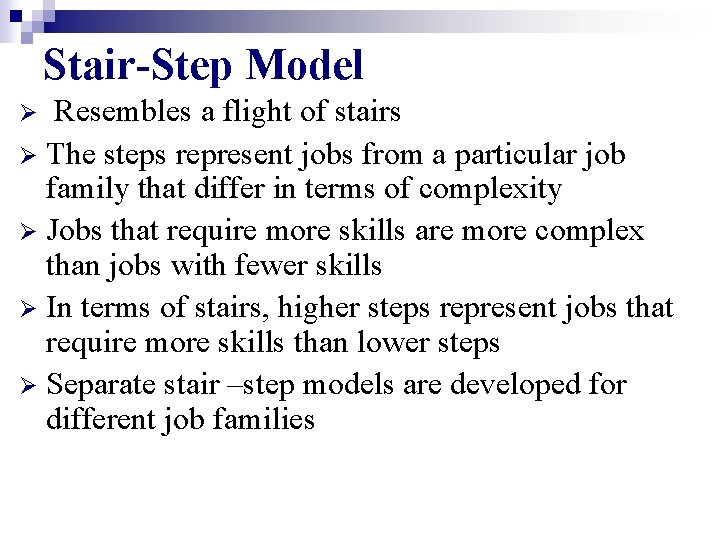
Stair-Step Model Resembles a flight of stairs Ø The steps represent jobs from a particular job family that differ in terms of complexity Ø Jobs that require more skills are more complex than jobs with fewer skills Ø In terms of stairs, higher steps represent jobs that require more skills than lower steps Ø Separate stair –step models are developed for different job families Ø
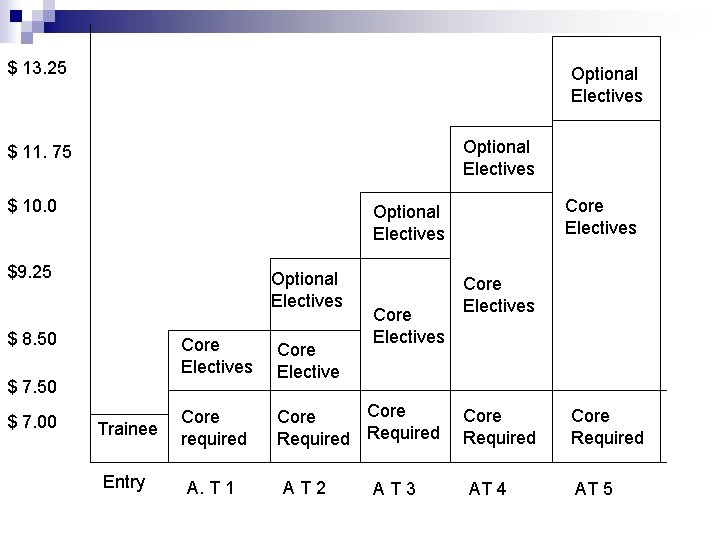
$ 13. 25 Optional Electives $ 11. 75 $ 10. 0 $9. 25 Optional Electives $ 8. 50 Core Electives Core Elective Trainee Core required Core Required Entry A. T 1 $ 7. 50 $ 7. 00 Core Electives Optional Electives AT 2 AT 3 Core Electives Core Required AT 4 Core Required AT 5
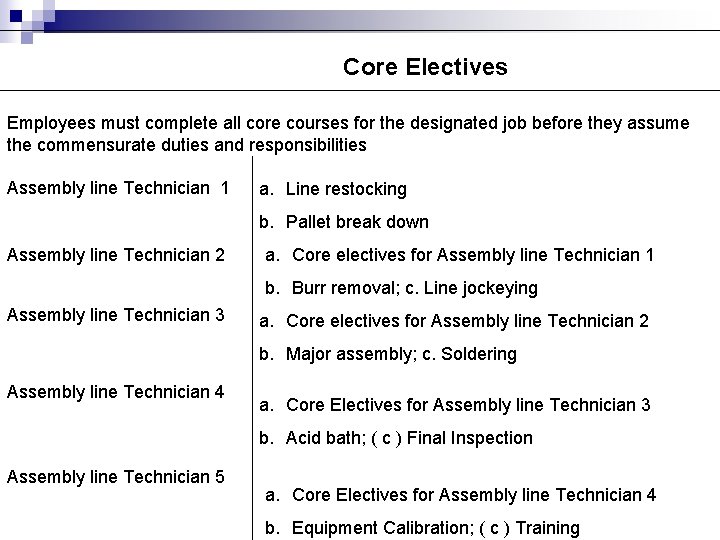
Core Electives Employees must complete all core courses for the designated job before they assume the commensurate duties and responsibilities Assembly line Technician 1 a. Line restocking b. Pallet break down Assembly line Technician 2 a. Core electives for Assembly line Technician 1 b. Burr removal; c. Line jockeying Assembly line Technician 3 a. Core electives for Assembly line Technician 2 b. Major assembly; c. Soldering Assembly line Technician 4 a. Core Electives for Assembly line Technician 3 b. Acid bath; ( c ) Final Inspection Assembly line Technician 5 a. Core Electives for Assembly line Technician 4 b. Equipment Calibration; ( c ) Training
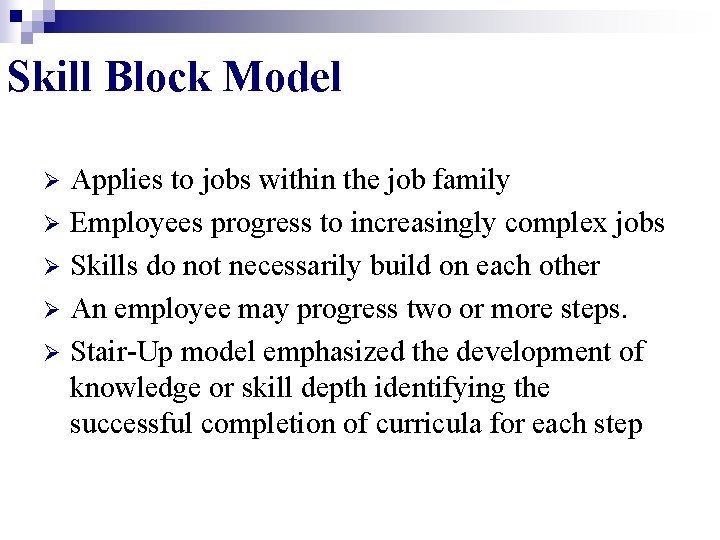
Skill Block Model Applies to jobs within the job family Ø Employees progress to increasingly complex jobs Ø Skills do not necessarily build on each other Ø An employee may progress two or more steps. Ø Stair-Up model emphasized the development of knowledge or skill depth identifying the successful completion of curricula for each step Ø
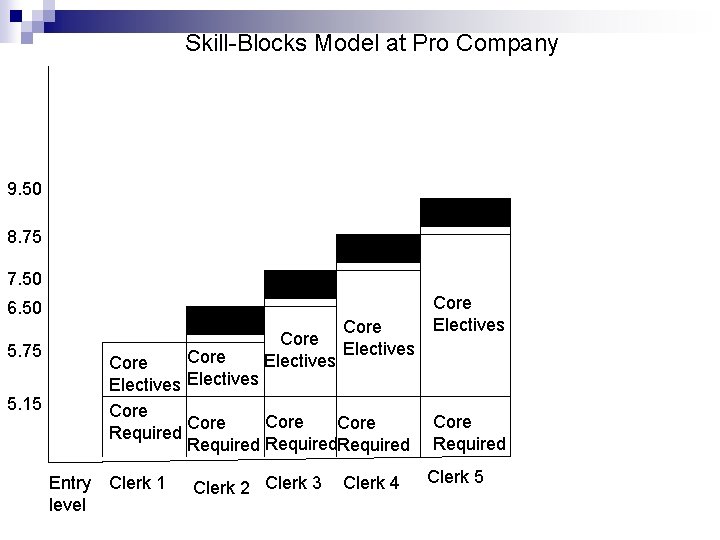
Skill-Blocks Model at Pro Company 9. 50 8. 75 7. 50 6. 50 Core Electives 5. 75 Core Electives Core Required 5. 15 Entry level Clerk 1 Clerk 2 Clerk 3 Clerk 4 Core Electives Core Required Clerk 5
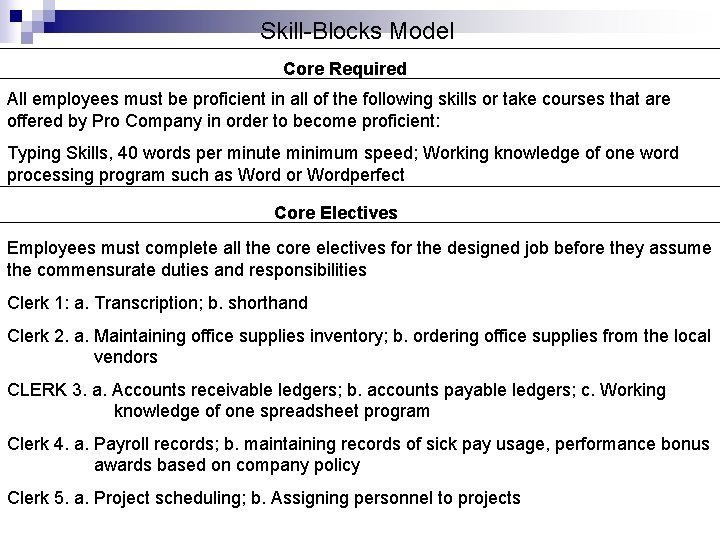
Skill-Blocks Model Core Required All employees must be proficient in all of the following skills or take courses that are offered by Pro Company in order to become proficient: Typing Skills, 40 words per minute minimum speed; Working knowledge of one word processing program such as Word or Wordperfect Core Electives Employees must complete all the core electives for the designed job before they assume the commensurate duties and responsibilities Clerk 1: a. Transcription; b. shorthand Clerk 2. a. Maintaining office supplies inventory; b. ordering office supplies from the local vendors CLERK 3. a. Accounts receivable ledgers; b. accounts payable ledgers; c. Working knowledge of one spreadsheet program Clerk 4. a. Payroll records; b. maintaining records of sick pay usage, performance bonus awards based on company policy Clerk 5. a. Project scheduling; b. Assigning personnel to projects
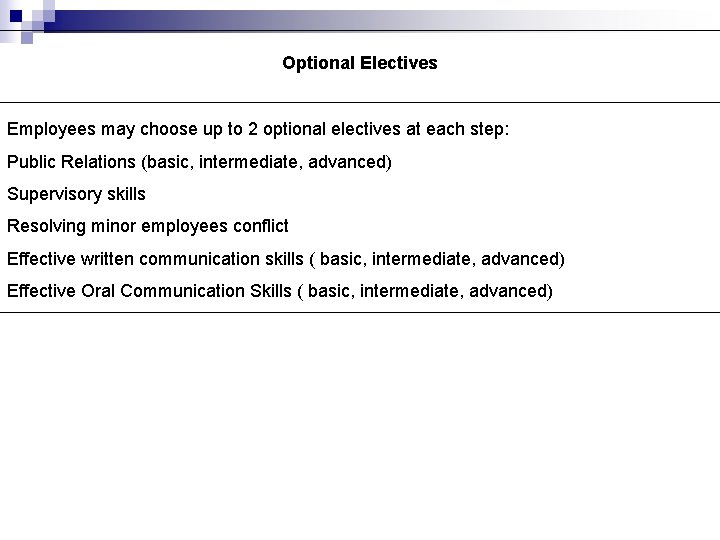
Optional Electives Employees may choose up to 2 optional electives at each step: Public Relations (basic, intermediate, advanced) Supervisory skills Resolving minor employees conflict Effective written communication skills ( basic, intermediate, advanced) Effective Oral Communication Skills ( basic, intermediate, advanced)
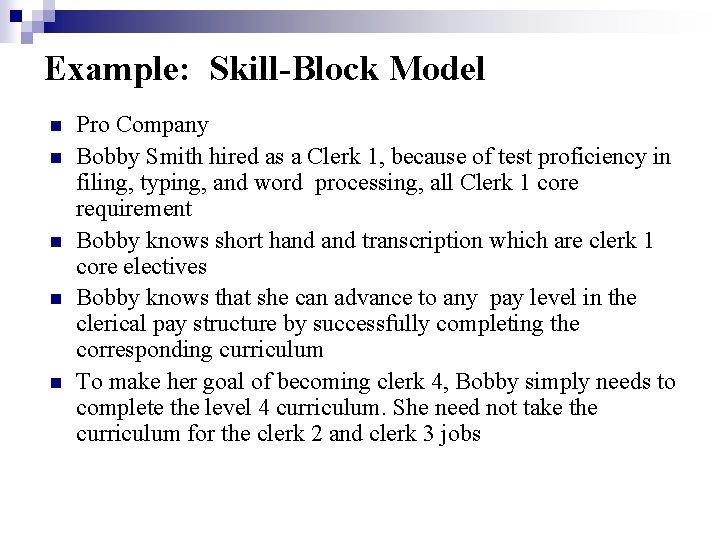
Example: Skill-Block Model n n n Pro Company Bobby Smith hired as a Clerk 1, because of test proficiency in filing, typing, and word processing, all Clerk 1 core requirement Bobby knows short hand transcription which are clerk 1 core electives Bobby knows that she can advance to any pay level in the clerical pay structure by successfully completing the corresponding curriculum To make her goal of becoming clerk 4, Bobby simply needs to complete the level 4 curriculum. She need not take the curriculum for the clerk 2 and clerk 3 jobs
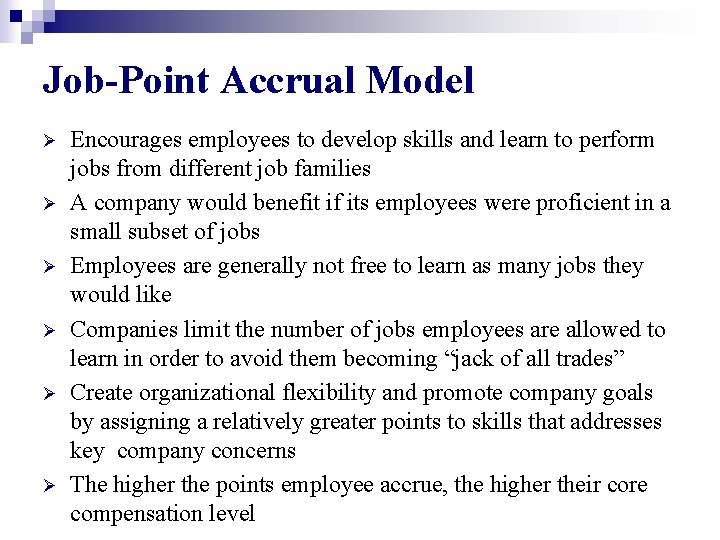
Job-Point Accrual Model Ø Ø Ø Encourages employees to develop skills and learn to perform jobs from different job families A company would benefit if its employees were proficient in a small subset of jobs Employees are generally not free to learn as many jobs they would like Companies limit the number of jobs employees are allowed to learn in order to avoid them becoming “jack of all trades” Create organizational flexibility and promote company goals by assigning a relatively greater points to skills that addresses key company concerns The higher the points employee accrue, the higher their core compensation level
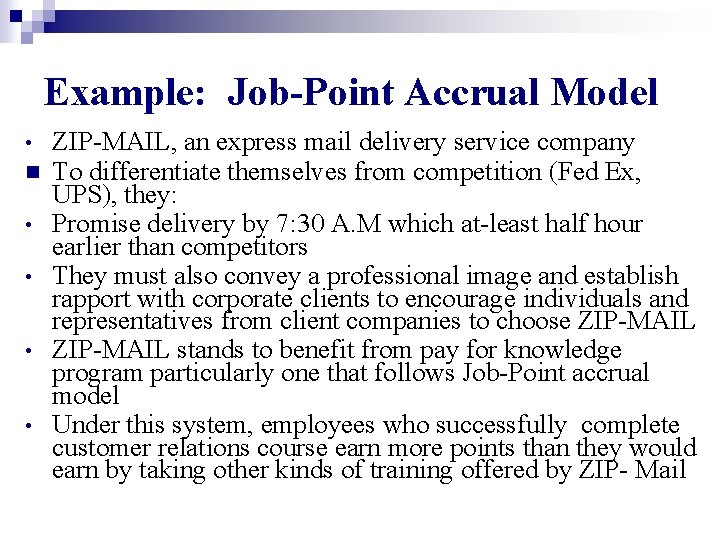
Example: Job-Point Accrual Model • n • • ZIP-MAIL, an express mail delivery service company To differentiate themselves from competition (Fed Ex, UPS), they: Promise delivery by 7: 30 A. M which at-least half hour earlier than competitors They must also convey a professional image and establish rapport with corporate clients to encourage individuals and representatives from client companies to choose ZIP-MAIL stands to benefit from pay for knowledge program particularly one that follows Job-Point accrual model Under this system, employees who successfully complete customer relations course earn more points than they would earn by taking other kinds of training offered by ZIP- Mail
Cross-Departmental Models Promote staffing flexibility by training employees in one department with some of the critical skills they would need to perform effectively in other departments Ø Can help production companies manage sporadic, short-term staffing shortages Ø Can help companies meet seasonal fluctuations in demands for their products or services Ø
Examples: Cross-Departmental Models Sears, Roebuck and Company * Meeting seasonal demands, Sears might train vinyl-siding installers, who usually work in the fall and winter, to install central air conditioners, who generally work in the spring and summer * A custom-made shoe manufacturer and distributor * Prior to the Christmas holiday season, production and sales employees are busy, as Christmas Day draws near, sales and production drops-off, but distribution increases; Company could train production and sales employees in distribution. The sales and production workers will be rewarded for learning how to properly package shoes; how to complete express mail invoices so that they can assist distribution department during its peak activity periods
n Seniority- Length of time an employee has been associated with the company. Ø Performance assessment tends to be subjective rather than objective because accurate job performance measurement are very difficult to obtain In contrast employees’ seniority is easily indexed Implementing such a system that specifies the amount of pay raise an employee will receive according to seniority is automatic. Politically, “automatic “ pay increases protect public sector employees from the quirks of election-year politics The federal, state (provincial) governments can avoid direct responsibility for pay raises, so employees can receive fair pay without political objections Ø Ø
q Effectiveness of Seniority Pay Systems Ø Research demonstrates seniority pay system plans “Less effective”. Ø Will probably disappear from for-profit companies in the future due to: a. Increased global competition b. Rapid technological advances c. Skill deficits of new and current workers d. Aging “baby boomer” generation(1946– 1964), which would make these plans cost-prohibitive.
q Fitting Seniority Pay with Competitive Strategies Ø Seniority pay does not fit well with the imperatives of competitive strategies because employees can count on receiving the same pay raises regardless of performance. Ø With the exception of companies that are shielded from competitive pressures (e. g. , public utilities), it is likely that companies that intend to remain competitive will set aside seniority pay practices.
Experience- Total length of time an employee has been performing same nature of work through out career. n Political Influence n Luck n
Case- Pay for Knowledge at Mitron Computers The technicians at Mitron Computers are integral to the company's success. Mitron builds custom personal computers for several office supply chains. The company's ability to build a quality product to specifications in an efficient manner allows Mitron to hold an advantage over competitors. However, recently the company has experienced some delays in shipments, and the plant manager is growing concerned. Mitron works directly with the retail locations of the office supply chains to meet the needs of customers ordering computers with specific capabilities. A customer at a retail store orders a computer with certain components and the order is sent to Mitron to be fulfilled within a specified time frame. The technicians work in teams to build the computers to the desired specifications. It is a complex process and the technician's ability to build the computers efficiently has helped build Mitron's reputation as a quality producer of personal computers.
Depending on the specifications, building each computer can involve between 10 and 18 different steps. Most technicians have the knowledge and skills to complete one or two of the steps, but some technicians can complete multiple steps. The technicians that can complete multiple steps provide the company greater flexibility in scheduling and ensuring the computers are built on time. Each step in the building process involves intricate procedures and a technician must take the initiative to attend training to learn each new step. However, there is little incentive for the technicians to attend the training. The technicians work in teams to build the computers and they are paid an hourly pay rate plus a team-based bonus payment for each computer that is built on time with no defects. The teams are comprised of technicians that have complementary skills, but the company has had some delays when a team member with the skills to complete a certain step is absent or already working on another computer.
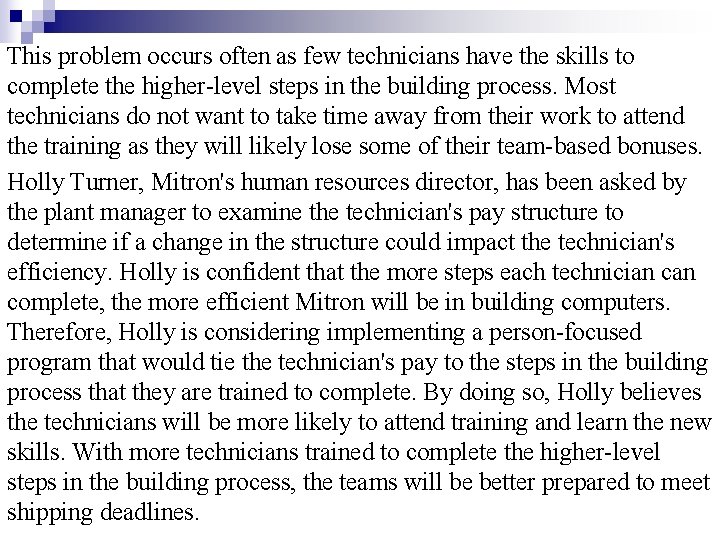
This problem occurs often as few technicians have the skills to complete the higher-level steps in the building process. Most technicians do not want to take time away from their work to attend the training as they will likely lose some of their team-based bonuses. Holly Turner, Mitron's human resources director, has been asked by the plant manager to examine the technician's pay structure to determine if a change in the structure could impact the technician's efficiency. Holly is confident that the more steps each technician complete, the more efficient Mitron will be in building computers. Therefore, Holly is considering implementing a person-focused program that would tie the technician's pay to the steps in the building process that they are trained to complete. By doing so, Holly believes the technicians will be more likely to attend training and learn the new skills. With more technicians trained to complete the higher-level steps in the building process, the teams will be better prepared to meet shipping deadlines.