
Chapter 4 Defining Performance and Choosing a Measurement

- Slides: 22
Chapter 4 Defining Performance and Choosing a Measurement Approach Copyright © 2013 Pearson Education, Inc. publishing as Prentice Hall 4 -1
Overview Ø Defining Performance Ø Determinants of Performance Ø Performance Dimensions Ø Approaches to Measuring Performance Copyright © 2013 Pearson Education, Inc. publishing as Prentice Hall 4 -2
Defining Performance is: n The job related activities (Results and Behavior) expected of a worker and how well those activities were executed. http: //www. businessdictionary. com Copyright © 2013 Pearson Education, Inc. publishing as Prentice Hall 4 -3
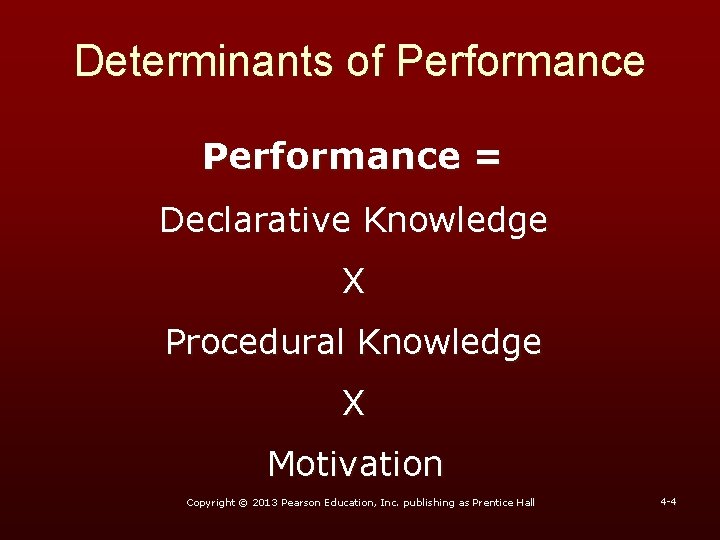
Determinants of Performance = Declarative Knowledge X Procedural Knowledge X Motivation Copyright © 2013 Pearson Education, Inc. publishing as Prentice Hall 4 -4
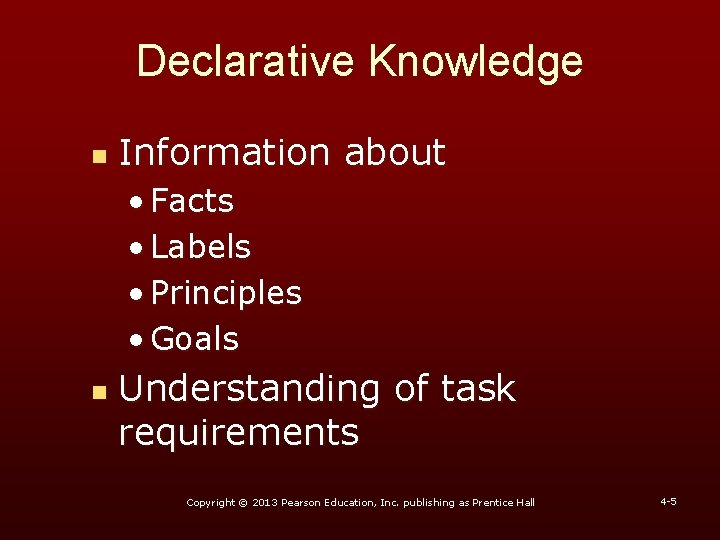
Declarative Knowledge n Information about • Facts • Labels • Principles • Goals n Understanding of task requirements Copyright © 2013 Pearson Education, Inc. publishing as Prentice Hall 4 -5
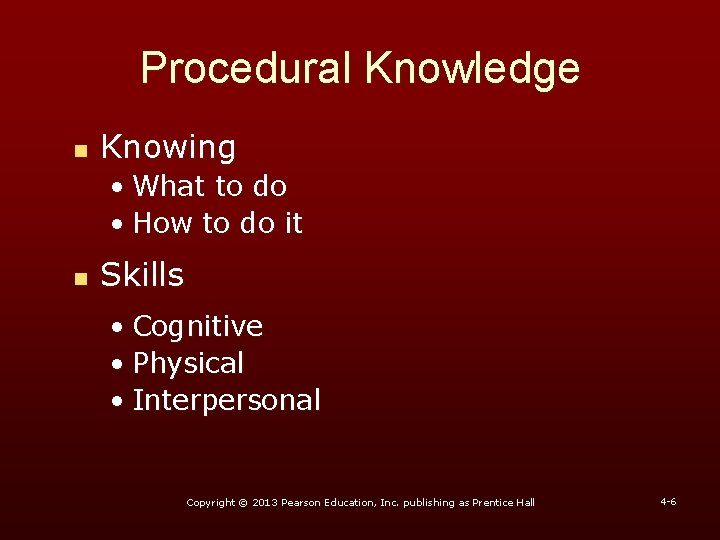
Procedural Knowledge n Knowing • What to do • How to do it n Skills • Cognitive • Physical • Interpersonal Copyright © 2013 Pearson Education, Inc. publishing as Prentice Hall 4 -6
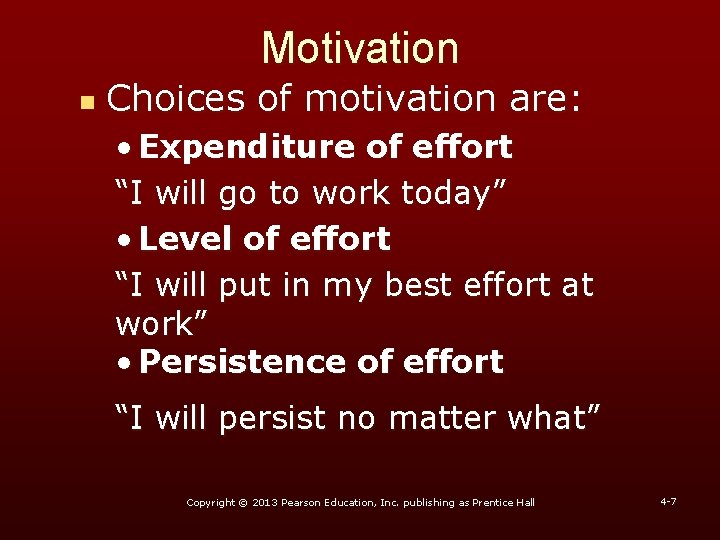
Motivation n Choices of motivation are: • Expenditure of effort “I will go to work today” • Level of effort “I will put in my best effort at work” • Persistence of effort “I will persist no matter what” Copyright © 2013 Pearson Education, Inc. publishing as Prentice Hall 4 -7
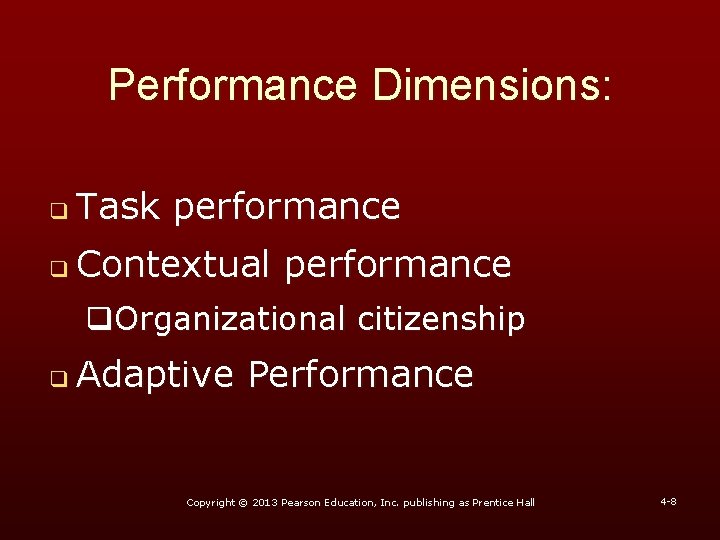
Performance Dimensions: q Task performance q Contextual performance q. Organizational citizenship q Adaptive Performance Copyright © 2013 Pearson Education, Inc. publishing as Prentice Hall 4 -8
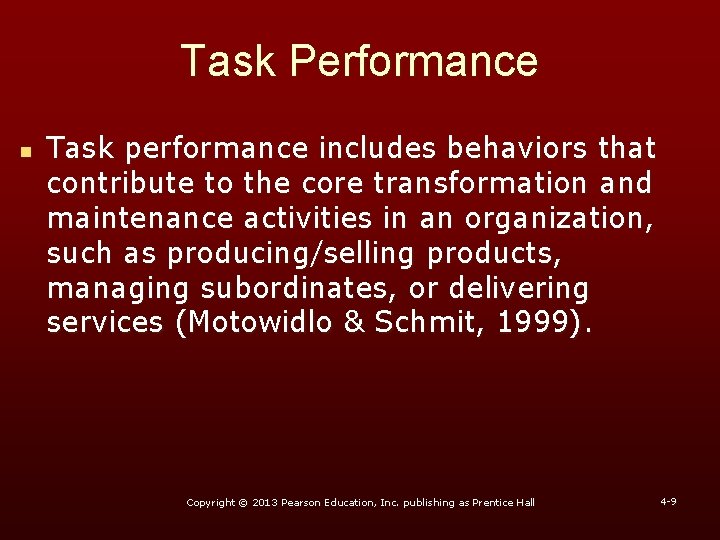
Task Performance n Task performance includes behaviors that contribute to the core transformation and maintenance activities in an organization, such as producing/selling products, managing subordinates, or delivering services (Motowidlo & Schmit, 1999). Copyright © 2013 Pearson Education, Inc. publishing as Prentice Hall 4 -9
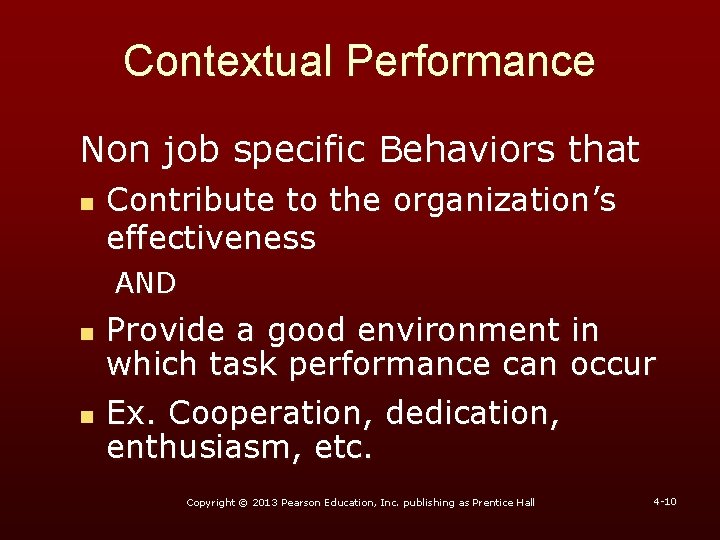
Contextual Performance Non job specific Behaviors that n Contribute to the organization’s effectiveness AND n n Provide a good environment in which task performance can occur Ex. Cooperation, dedication, enthusiasm, etc. Copyright © 2013 Pearson Education, Inc. publishing as Prentice Hall 4 -10
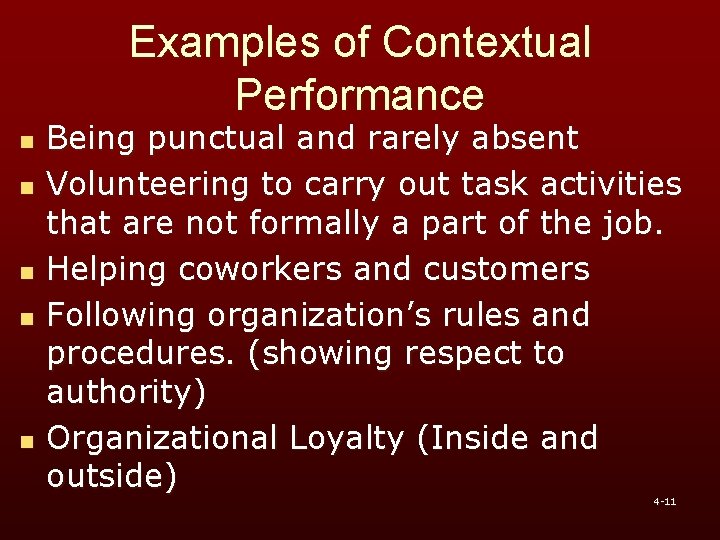
Examples of Contextual Performance n n n Being punctual and rarely absent Volunteering to carry out task activities that are not formally a part of the job. Helping coworkers and customers Following organization’s rules and procedures. (showing respect to authority) Organizational Loyalty (Inside and outside) 4 -11
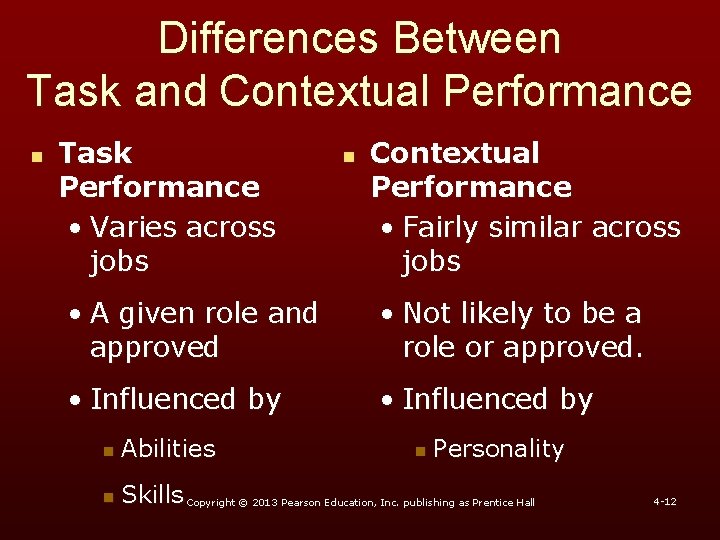
Differences Between Task and Contextual Performance n Task Performance • Varies across jobs n Contextual Performance • Fairly similar across jobs • A given role and approved • Not likely to be a role or approved. • Influenced by n Abilities n Skills Copyright © 2013 Pearson Education, Inc. publishing as Prentice Hall n Personality 4 -12
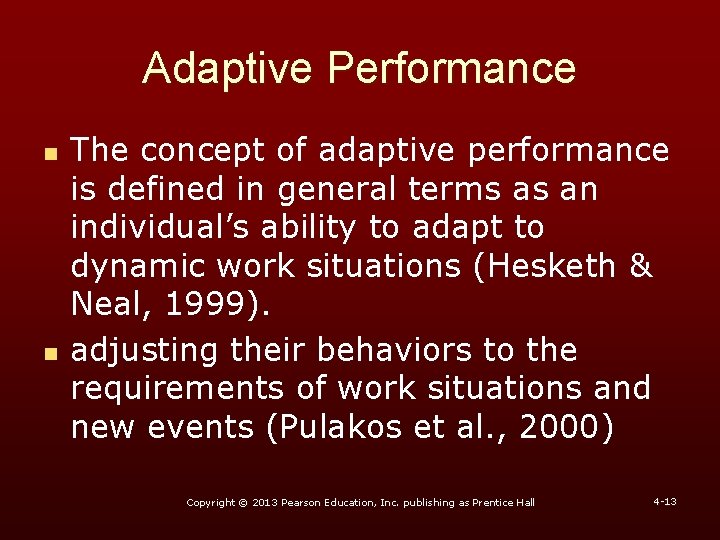
Adaptive Performance n n The concept of adaptive performance is defined in general terms as an individual’s ability to adapt to dynamic work situations (Hesketh & Neal, 1999). adjusting their behaviors to the requirements of work situations and new events (Pulakos et al. , 2000) Copyright © 2013 Pearson Education, Inc. publishing as Prentice Hall 4 -13
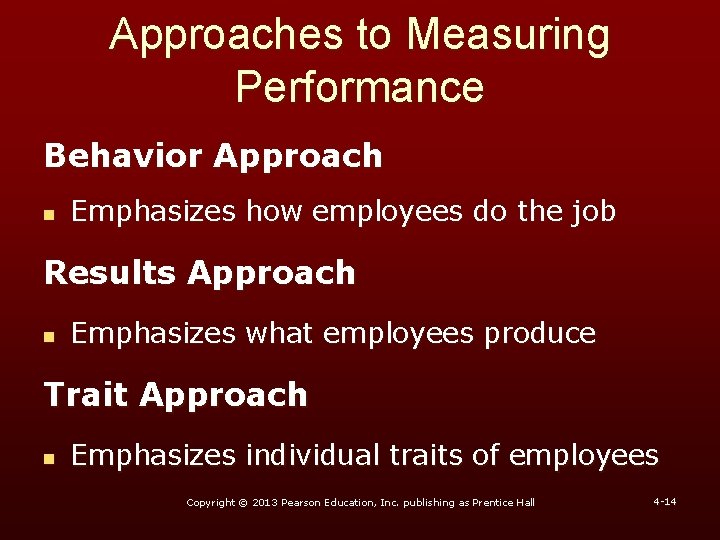
Approaches to Measuring Performance Behavior Approach n Emphasizes how employees do the job Results Approach n Emphasizes what employees produce Trait Approach n Emphasizes individual traits of employees Copyright © 2013 Pearson Education, Inc. publishing as Prentice Hall 4 -14
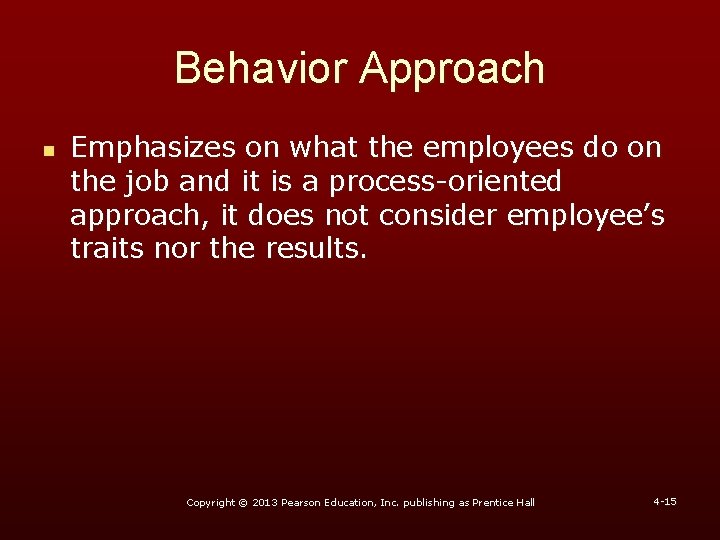
Behavior Approach n Emphasizes on what the employees do on the job and it is a process-oriented approach, it does not consider employee’s traits nor the results. Copyright © 2013 Pearson Education, Inc. publishing as Prentice Hall 4 -15
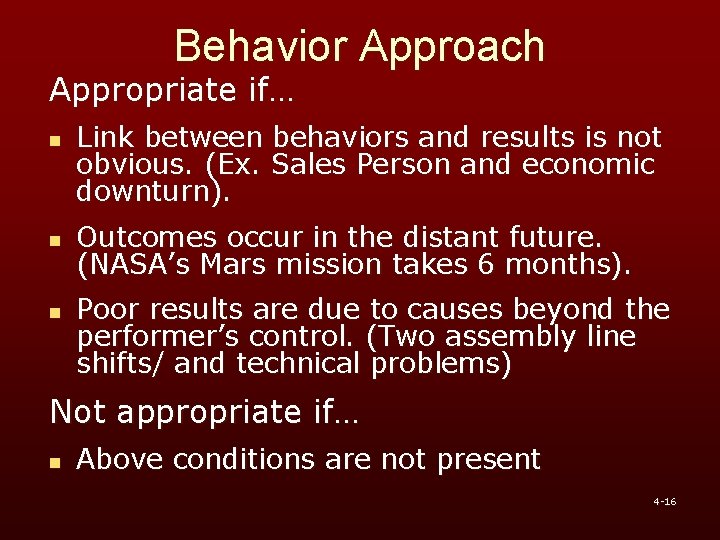
Behavior Approach Appropriate if… n n n Link between behaviors and results is not obvious. (Ex. Sales Person and economic downturn). Outcomes occur in the distant future. (NASA’s Mars mission takes 6 months). Poor results are due to causes beyond the performer’s control. (Two assembly line shifts/ and technical problems) Not appropriate if… n Above conditions are not present 4 -16
Results Approach n n Emphasizes the outcomes and results produced by the employees, regardless of their behavior or traits. It is a bottom-line approach that is not concerned about employee behavior and the process, but what is produced. Copyright © 2013 Pearson Education, Inc. publishing as Prentice Hall 4 -17
Results Approach Most appropriate when: • Workers skilled in necessary behaviors • Behaviors and results obviously related. Copyright © 2013 Pearson Education, Inc. publishing as Prentice Hall 4 -18
Trait Approach n n Emphasizes the individual performer and ignores the specific behavior, and results. Traits, means the skills, personality, and intelligence. Copyright © 2013 Pearson Education, Inc. publishing as Prentice Hall 4 -19
Trait Approach Most appropriate when: n n Emphasis on individual Positive relationship between abilities, personality traits, and desirable work-related behaviors is existed. Copyright © 2013 Pearson Education, Inc. publishing as Prentice Hall 4 -20
Quick Review Ø Defining Performance Ø Determinants of Performance Ø Performance Dimensions Ø Approaches to Measuring Performance Copyright © 2013 Pearson Education, Inc. publishing as Prentice Hall 4 -21
All rights reserved. No part of this publication may be reproduced, stored in a retrieval system, or transmitted, in any form or by any means, electronic, mechanical, photocopying, recording, or otherwise, without the prior written permission of the publisher. Printed in the United States of America. Copyright © 2013 Pearson Education, Inc. publishing as Prentice Hall 4 -22