
Chapter 4 Defining Classes I Slides prepared by
Chapter 4 Defining Classes I Slides prepared by Rose Williams, Binghamton University
Information Hiding and Encapsulation • Information hiding is the practice of separating how to use a class from the details of its implementation – Abstraction is another term used to express the concept of discarding details in order to avoid information overload • Encapsulation means that the data and methods of a class are combined into a single unit (i. e. , a class object), which hides the implementation details – Knowing the details is unnecessary because interaction with the object occurs via a well-defined and simple interface – In Java, hiding details is done by marking them private © 2006 Pearson Addison-Wesley. All rights reserved 2
A Couple of Important Acronyms: API and ADT • The API or application programming interface for a class is a description of how to use the class – A programmer need only read the API in order to use a well designed class • An ADT or abstract data type is a data type that is written using good information-hiding techniques © 2006 Pearson Addison-Wesley. All rights reserved 3

public and private Modifiers • The modifier public means that there are no restrictions on where an instance variable or method can be used • The modifier private means that an instance variable or method cannot be accessed by name outside of the class • It is considered good programming practice to make all instance variables private • Most methods are public, and thus provide controlled access to the object • Usually, methods are private only if used as helping methods for other methods in the class © 2006 Pearson Addison-Wesley. All rights reserved 4
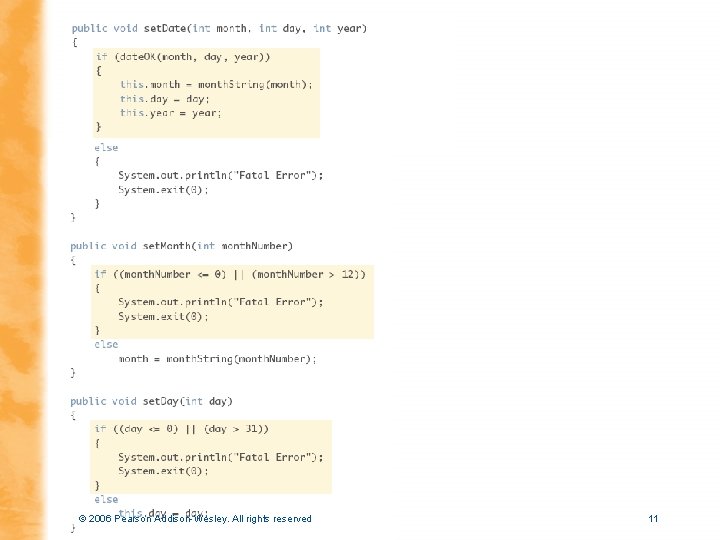
Accessor and Mutator Methods • Accessor methods allow the programmer to obtain the value of an object's instance variables – The data can be accessed but not changed – The name of an accessor method typically starts with the word get • Mutator methods allow the programmer to change the value of an object's instance variables in a controlled manner – Incoming data is typically tested and/or filtered – The name of a mutator method typically starts with the word set © 2006 Pearson Addison-Wesley. All rights reserved 5
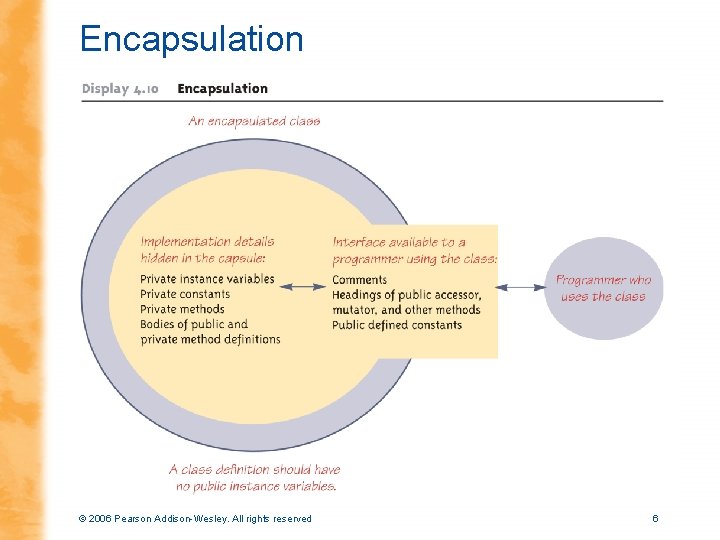
Encapsulation © 2006 Pearson Addison-Wesley. All rights reserved 6
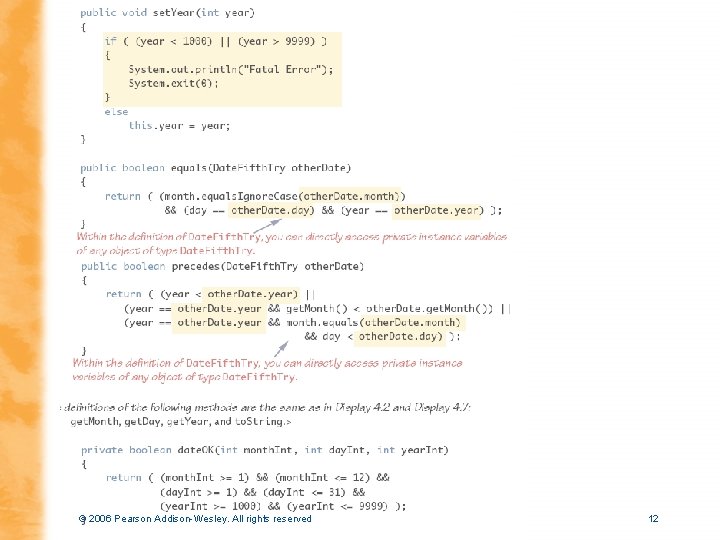
A Class Has Access to Private Members of All Objects of the Class • Within the definition of a class, private members of any object of the class can be accessed, not just private members of the calling object © 2006 Pearson Addison-Wesley. All rights reserved 7
Mutator Methods Can Return a Boolean Value • Some mutator methods issue an error message and end the program whenever they are given values that aren't sensible • An alternative approach is to have the mutator test the values, but to never have it end the program • Instead, have it return a boolean value, and have the calling program handle the cases where the changes do not make sense © 2006 Pearson Addison-Wesley. All rights reserved 8
Preconditions and Postconditions • The precondition of a method states what is assumed to be true when the method is called • The postcondition of a method states what will be true after the method is executed, as long as the precondition holds • It is a good practice to always think in terms of preconditions and postconditions when designing a method, and when writing the method comment © 2006 Pearson Addison-Wesley. All rights reserved 9
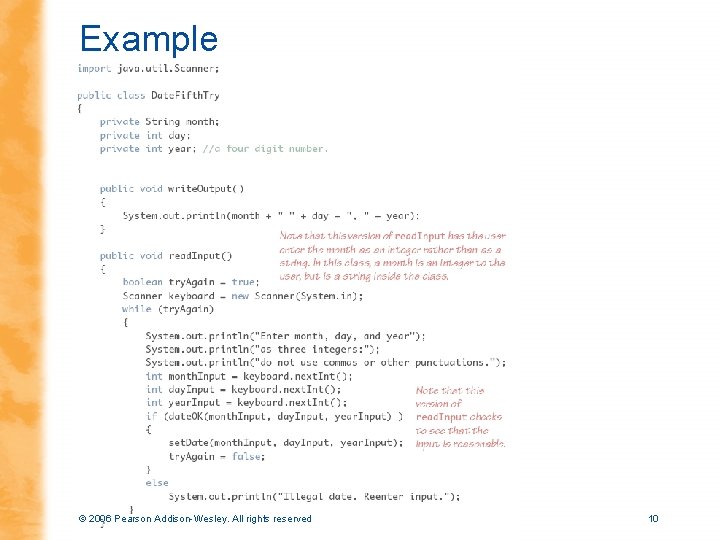
Example © 2006 Pearson Addison-Wesley. All rights reserved 10
© 2006 Pearson Addison-Wesley. All rights reserved 11
© 2006 Pearson Addison-Wesley. All rights reserved 12
© 2006 Pearson Addison-Wesley. All rights reserved 13
- Slides: 13