
Chapter 4 Conventional Solutions to Environmental Problems The
Chapter 4 Conventional Solutions to Environmental Problems: The Command-Control Approach © 2004 Thomson Learning/South-Western
Use of Standards in Environmental Policy Standards are the fundamental basis of most environmental policies l Types of Environmental Standards ¡ Ambient standard – a standard that designates the quality of the environment to be achieved, typically expressed as a maximum allowable pollutant concentration ¡ Technology-based standard – a standard that designates the equipment or method to be used to achieve some abatement level ¡ Performance-based standard – a standard that specifies a pollution limit to be achieved but does not stipulate the technology l 2
Use of Standards in Environmental Policy l Economic Implications of Using Standards ¡ Two important economic implications l The level at which the standards are set l How standards are implemented across polluting sources 3
Are Environmental Standards Set at an Allocatively Efficient Level? l Allocatively efficient standards – standards set such that the associated marginal cost (MSC) of abatement equals the marginal social benefit (MSB) of abatement 4
Are Environmental Standards Set at an Allocatively Efficient Level? l Marginal social benefit (MSB) of abatement – a measure of the additional gains accruing to society as pollution abatement increases ¡ From a market perspective, the MSB of abatement is society’s demand for pollution abatement, or, equivalently, its demand for environmental quality 5

Are Environmental Standards Set at an Allocatively Efficient Level? l Marginal Social Cost of Abatement – the sum of all polluters’ marginal abatement costs plus government’s marginal cost of monitoring and enforcing these activities ¡ Firm-Level Marginal Abatement Cost l Marginal abatement cost – the change in costs associated with increasing abatement, using the leastcost method 6
Are Environmental Standards Set at an Allocatively Efficient Level? ¡ ¡ Market-Level Marginal Abatement Cost – the horizontal sum of all polluters’ MAC functions Marginal Cost of Enforcement – Added costs incurred by government associated with monitoring and enforcing abatement activities 7
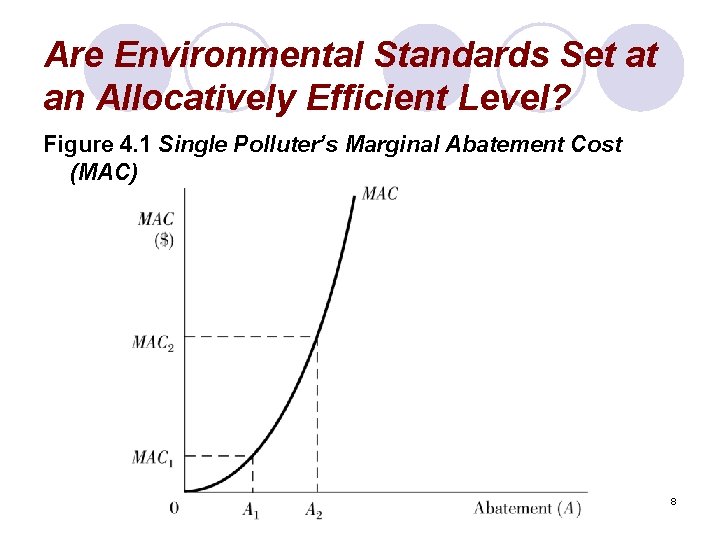
Are Environmental Standards Set at an Allocatively Efficient Level? Figure 4. 1 Single Polluter’s Marginal Abatement Cost (MAC) 8
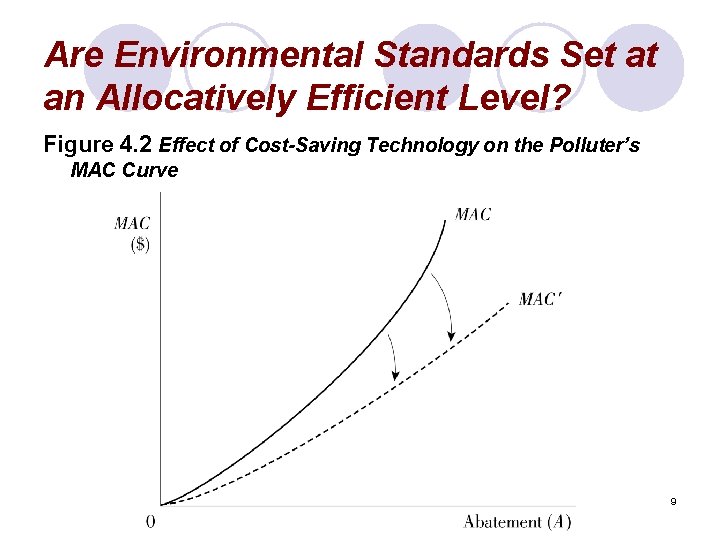
Are Environmental Standards Set at an Allocatively Efficient Level? Figure 4. 2 Effect of Cost-Saving Technology on the Polluter’s MAC Curve 9
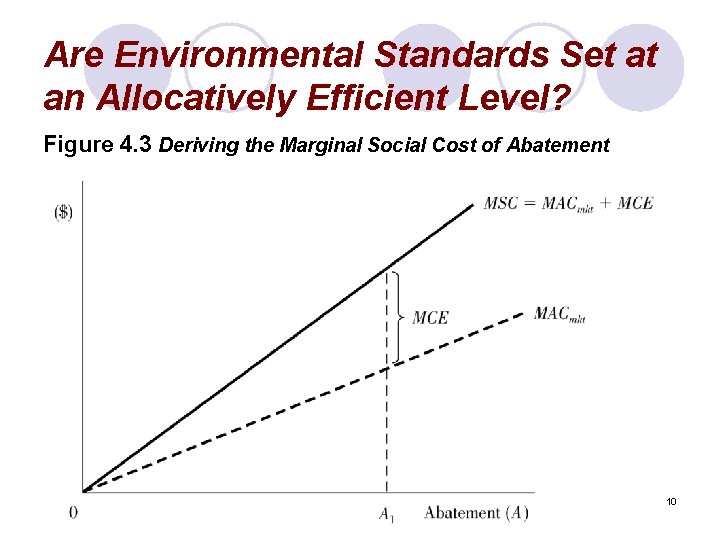
Are Environmental Standards Set at an Allocatively Efficient Level? Figure 4. 3 Deriving the Marginal Social Cost of Abatement 10
Are Environmental Standards Set at an Allocatively Efficient Level? l Are Abatement Standards Set Efficiently? ¡ Legislative Constraints l Benefit-based standard – a standard set to improve society’s well-being with no consideration for the associated cost 11
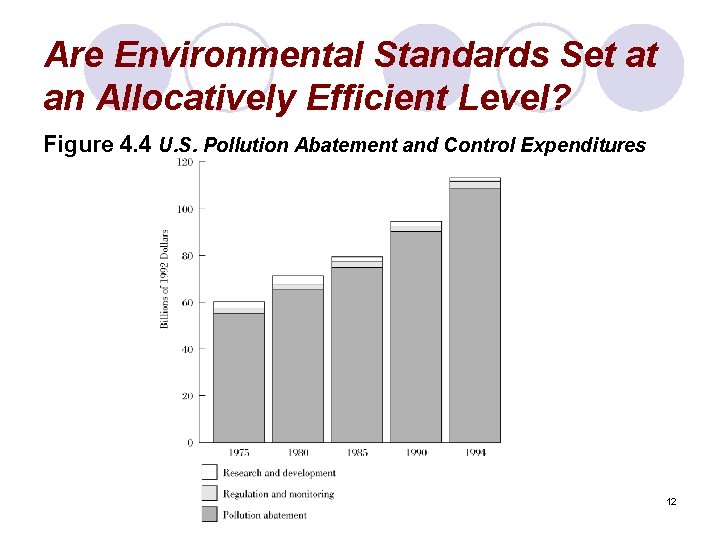
Are Environmental Standards Set at an Allocatively Efficient Level? Figure 4. 4 U. S. Pollution Abatement and Control Expenditures 12
Are Environmental Standards Set at an Allocatively Efficient Level? ¡ Imperfect Information l Even when a cost-benefit balancing is called for by law, the absence of full information would likely prevent the government from identifying the MSB and MSC of abatement. l In the absence of perfect information, it is highly probably that the government will unknowingly establish the abatement standard at some level other than the allocatively efficient one, even if that was the legislated intent 13
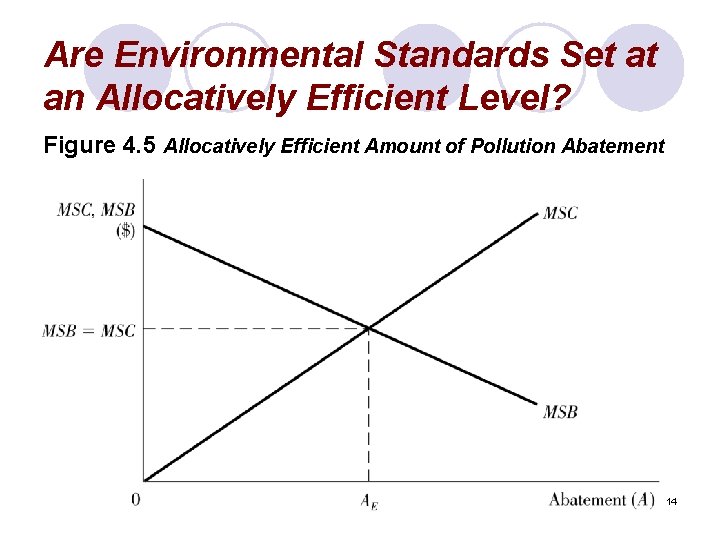
Are Environmental Standards Set at an Allocatively Efficient Level? Figure 4. 5 Allocatively Efficient Amount of Pollution Abatement 14
Are Environmental Standards Set at an Allocatively Efficient Level? ¡ Regional Differences l There is a qualifier on the use of AE as a national standard across all polluting sources because this optimal level is determined from MSB and MSC, both of which assume the absence of regionspecific abatement benefits and costs 15
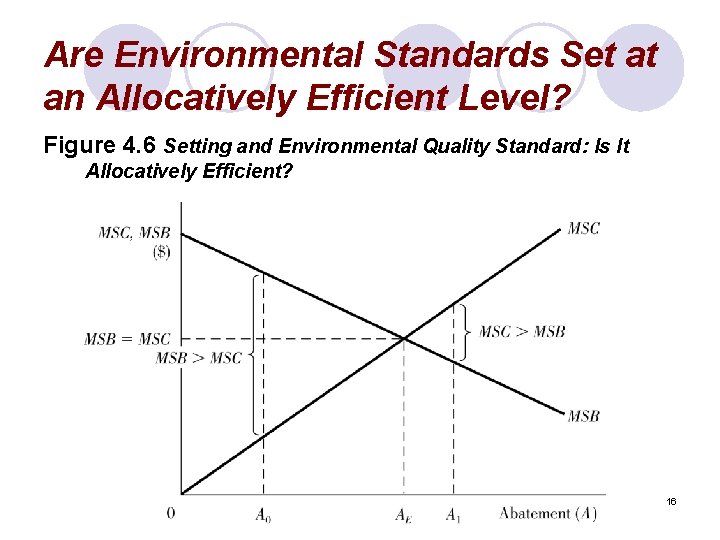
Are Environmental Standards Set at an Allocatively Efficient Level? Figure 4. 6 Setting and Environmental Quality Standard: Is It Allocatively Efficient? 16
Are Environmental Standards Set at an Allocatively Efficient Level? ¡ Nonuniformity of Pollutants l An inefficient outcome can arise within the same region, if changes in releases from polluting sources to not have a uniform impact on the environment 17
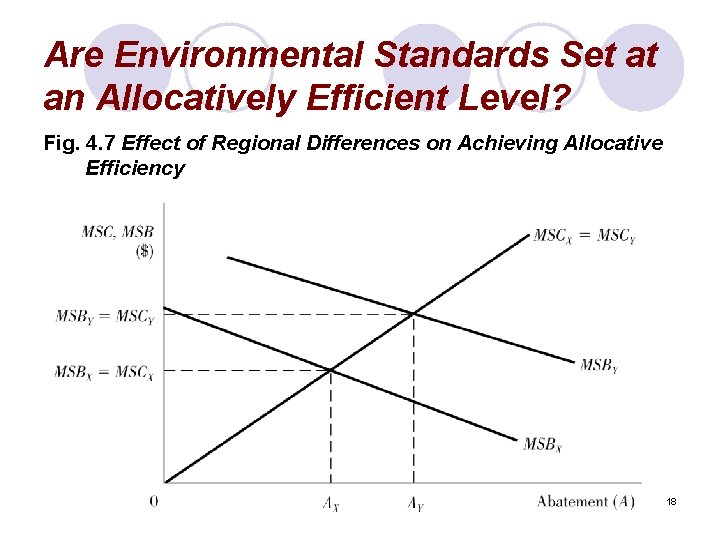
Are Environmental Standards Set at an Allocatively Efficient Level? Fig. 4. 7 Effect of Regional Differences on Achieving Allocative Efficiency 18
General Approaches to Implementing Environmental Policy l l l Cost-effective policy – a policy that meets an objective using the least amount of economic resources Command-control approach – a policy that directly regulates polluters through the use of rules or standards Market approach – an incentive-based policy that encourages conservation practices or pollution reduction strategies 19
Is the Command-Control Approach Cost-Effective l The practical way to assess whether the command-control approach is costeffective is to determine whether society is incurring higher costs than necessary to achieve a given level of environmental quality 20
Is the Command-Control Approach Cost-Effective l Cost-Ineffectiveness of the Technology-Based Standard ¡ Technology-based standard potentially prevents the polluter from minimizing the costs of achieving a given abatement level 21
Is the Command-Control Approach Cost-Effective l Cost-Ineffectiveness of Uniform Standards ¡ ¡ ¡ Under strict command-control framework, standards are often imposed uniformly The use of uniform standards across polluting sources will waste economic resources as long as abatement cost conditions differ among those sources Cost-effective abatement criterion – allocation of abatement across polluting sources such that the MACs for each source are equal 22
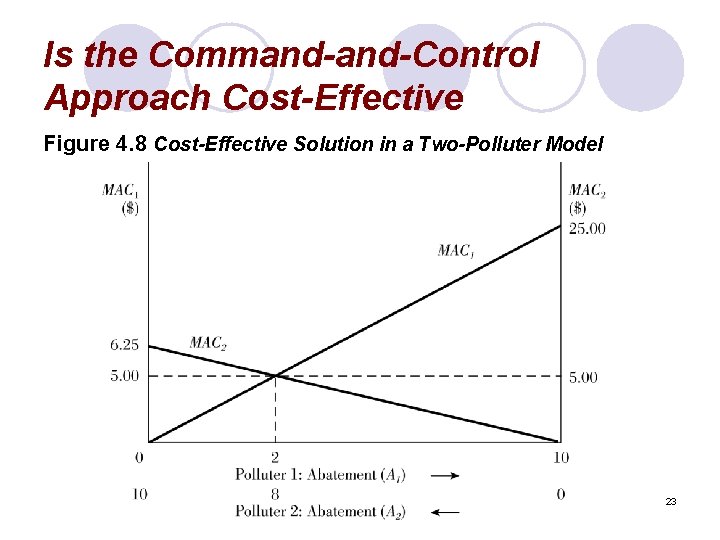
Is the Command-Control Approach Cost-Effective Figure 4. 8 Cost-Effective Solution in a Two-Polluter Model 23
- Slides: 23