
Chapter 4 Contemporary Occupational Therapy Practice Barbara A
Chapter 4 Contemporary Occupational Therapy Practice Barbara A. Boyt Schell, Marjorie Scaffa, Glen Gillen and Ellen Cohn Copyright © 2014 Wolters Kluwer Health | Lippincott Williams & Wilkins
“People are most true to their humanity when engaged in occupation. ” Yerxa et al. , 1989 Copyright © 2014 Wolters Kluwer Health | Lippincott Williams & Wilkins
Learning Objectives After reading this chapter, you will be able to: 1. Define occupational therapy. 2. Explain the focus of the profession using professionally relevant terminology. 3. Discuss the occupational therapy process including core aspects of practice. 4. Describe aspects of the workforce of the profession in the United States and worldwide. 5. Consider possible futures for the profession. Copyright © 2014 Wolters Kluwer Health | Lippincott Williams & Wilkins
Definition of Occupational Therapy Occupational therapy is the art and science of helping people do the day-to-day activities that are important and meaningful to their health and well-being through engagement in valued occupations (American Occupational Therapy Association [AOTA], 2008; World Federation of Occupational Therapists [WFOT], 2010 c) Copyright © 2014 Wolters Kluwer Health | Lippincott Williams & Wilkins
Definition of Occupation • Occupation an older use of the word, meaning how people use or “occupy” their time Hasselkus, 2006 • Includes the complex network of day-to-day activities that enable people to: (a) sustain their health, (b) meet their needs, (c) contribute to the life of their families, and (d) participate in the broader society AOTA, 2008 Copyright © 2014 Wolters Kluwer Health | Lippincott Williams & Wilkins
Definition of Occupational Engagement • Occupational engagement is important because it has the capacity to contribute to health and well-being Clark et al. , 1997; Glass, Mendes de Leon, Marottoli, & Berkman, 1999; Law, Seinwender, & Leclair, 1998 Copyright © 2014 Wolters Kluwer Health | Lippincott Williams & Wilkins
Occupational Therapy Process • Practitioners turn occupation into therapy • Requires understanding occupation and careful analysis of many factors • OTs attend to: – who does the occupation – physical and social contexts – How occupations interweave (supporting and detracting) Copyright © 2014 Wolters Kluwer Health | Lippincott Williams & Wilkins
OT Process (Continued) • Evaluation involves careful attention to: – what clients want (need) to do; and – how personal and contextual factors affect performance • Intervention – careful selection of important factors – skillful use of therapy to promote performance Copyright © 2014 Wolters Kluwer Health | Lippincott Williams & Wilkins
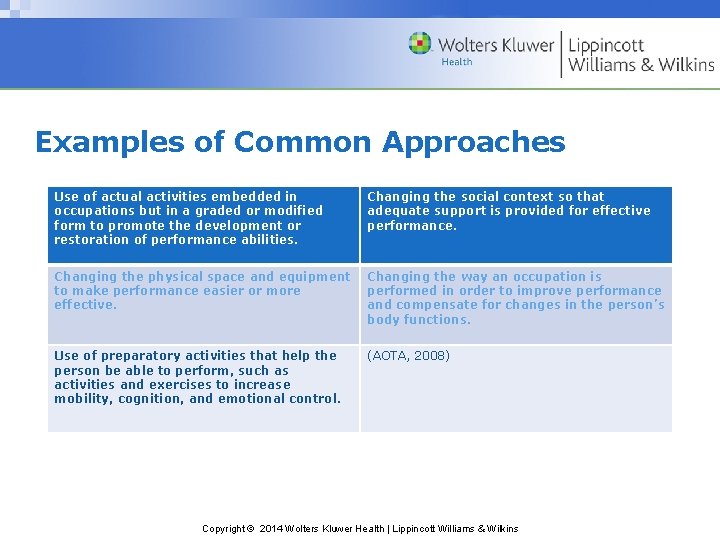
Examples of Common Approaches Use of actual activities embedded in occupations but in a graded or modified form to promote the development or restoration of performance abilities. Changing the social context so that adequate support is provided for effective performance. Changing the physical space and equipment to make performance easier or more effective. Changing the way an occupation is performed in order to improve performance and compensate for changes in the person’s body functions. Use of preparatory activities that help the person be able to perform, such as activities and exercises to increase mobility, cognition, and emotional control. (AOTA, 2008) Copyright © 2014 Wolters Kluwer Health | Lippincott Williams & Wilkins
Language for Occupational Therapy • OT employs terminology that has evolved to reflect specific concerns of the profession • Taxonomies help: – Understand scope of OT; and – Communicate concerns to wider audiences Copyright © 2014 Wolters Kluwer Health | Lippincott Williams & Wilkins

Occupational Therapy Practice Framework (OTPF) 2 nd ed. “…summary of interrelated constructs that define and guide occupational therapy practice” AOTA, 2008, p. 625 • Contributing authors gather commonly agreed terms and concepts See Table 4. 2, p. 53 for details Copyright © 2014 Wolters Kluwer Health | Lippincott Williams & Wilkins
Four Principles that Guide Occupational Therapy Practice 1. Client-centered practice 2. Occupational-centered practice 3. Evidence-based practice 4. Culturally relevant practice Copyright © 2014 Wolters Kluwer Health | Lippincott Williams & Wilkins
Client-Centered Practice • Based on mutual engagement in therapy • Co-created understanding of client’s past, present and future stories – Future stories are co-constructed and revised as therapy continues Copyright © 2014 Wolters Kluwer Health | Lippincott Williams & Wilkins
Occupation-Centered Practice • Clients seek OT for help engaging in valued occupations • Meeting all peoples’ need for engagement is a matter of social justice – Addressing injustices OTs intervene and advocate for clients disempowered by legislation, war, political upheavals, dictatorships or natural disasters Copyright © 2014 Wolters Kluwer Health | Lippincott Williams & Wilkins
Evidence-Based Practice “…increasing demand to base intervention decisions on “the conscientious, explicit, and judicious use of current best evidence”. Sackett, Rosenberg, Muir Granny, Haynes, & Richardson, 1996, p. 71 Copyright © 2014 Wolters Kluwer Health | Lippincott Williams & Wilkins
Evidence-Based Practice (EBP) (Continued) • Three part EBP challenge for OTs: 1. Know how to access, evaluate and interpret research 2. Capacity to synthesize evidence to support interventions 3. Communicate to clients and care providers data sufficient for informed decisions Copyright © 2014 Wolters Kluwer Health | Lippincott Williams & Wilkins
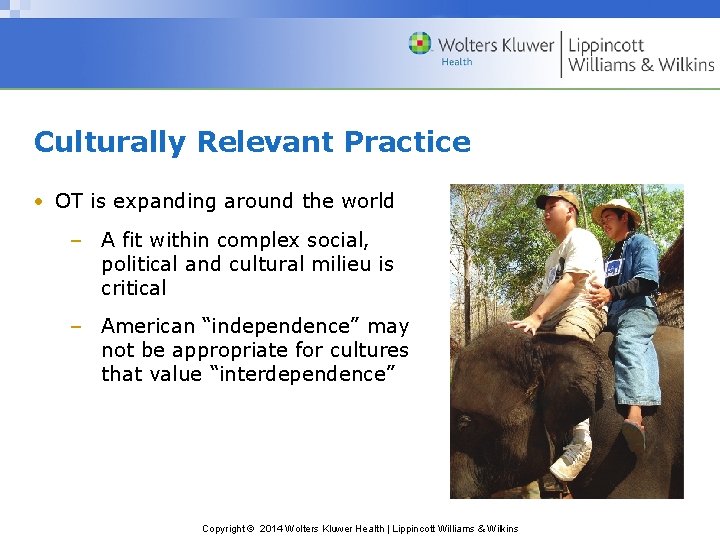
Culturally Relevant Practice • OT is expanding around the world – A fit within complex social, political and cultural milieu is critical – American “independence” may not be appropriate for cultures that value “interdependence” Copyright © 2014 Wolters Kluwer Health | Lippincott Williams & Wilkins
Occupational Therapy Practitioners • OTs use their professional reasoning abilities to actualize their knowledge and skills in therapy • Practitioners have personal, social, and cultural contexts that shape their worldview. – OTs also have: (a) preferred theories and intervention techniques, (b) practical realities of their therapy environment, and (c) co-workers Schell, 2008 Copyright © 2014 Wolters Kluwer Health | Lippincott Williams & Wilkins
Occupational Therapy by the Numbers • WFOT cooperates with 69 national and regional OT associations • Ratios OTs to population (WFOT, 2011) – Denmark and Sweden, 11: 10, 000 – United States, 3: 10, 000 – World average, 2: 10, 000 • Gender of practitioners (AOTA, 2010) – World wide, 81% female – United States, 91. 6% female (OTs and OTAs) Copyright © 2014 Wolters Kluwer Health | Lippincott Williams & Wilkins
Practice Areas in the United States Locations % Hospitals 26% Schools 22% Long-term care/skilled nursing facilities 20% Freestanding outpatient settings 9% Pediatric early intervention programs 5% Academic settings 5% Other settings Smaller % Copyright © 2014 Wolters Kluwer Health | Lippincott Williams & Wilkins
Vision for the Future AOTA Centennial Vision “We envision that occupational therapy is a powerful, widely recognized, science-driven, and evidence-based profession with a globally connected and diverse workforce meeting society’s occupational needs. ” AOTA, 2006, p. 1 Copyright © 2014 Wolters Kluwer Health | Lippincott Williams & Wilkins
Forces that will Affect OT in the Future • New systems or organizing and funding care • Evidence related to effectiveness of traditional and emerging interventions • Impact of human genome projects • Continued development of occupational justice approaches • Responses to community and population disruptions resulting from natural and man-made disasters • Rapid development of technologies Copyright © 2014 Wolters Kluwer Health | Lippincott Williams & Wilkins
- Slides: 22