
Chapter 4 Consumer Motivation Figure 4 1 Model

- Slides: 30
Chapter 4 Consumer Motivation
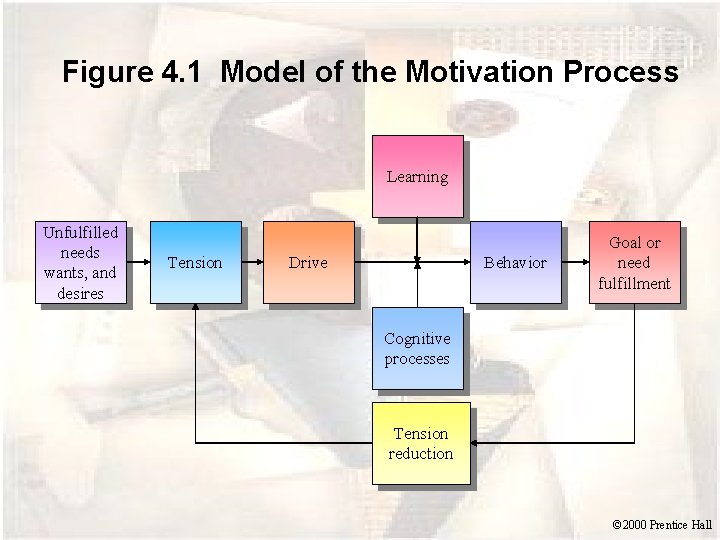
Figure 4. 1 Model of the Motivation Process Learning Unfulfilled needs wants, and desires Tension Drive Behavior Goal or need fulfillment Cognitive processes Tension reduction © 2000 Prentice Hall
Types of Needs • Innate Needs – Physiological (or biogenic) needs that are considered primary needs or motives • Acquired needs – Generally psychological (or psychogenic) needs that are considered secondary needs or motives © 2000 Prentice Hall
Innate Needs Physiological needs for food, water, air, clothing, shelter, and sex. Also known as biogenic or primary needs. © 2000 Prentice Hall
Acquired Needs that are learned in response to one’s culture or environment (such as the need for esteem, prestige, affection, or power). Also known as psychogenic or secondary needs. © 2000 Prentice Hall
Goals • Generic Goals – the general categories of goals that consumers see as a way to fulfill their needs – e. g. , “I want to buy a vehicle” • Product-Specific Goals – the specifically branded products or services that consumers select as their goals – e. g. , “I want to buy a Mercedes” © 2000 Prentice Hall
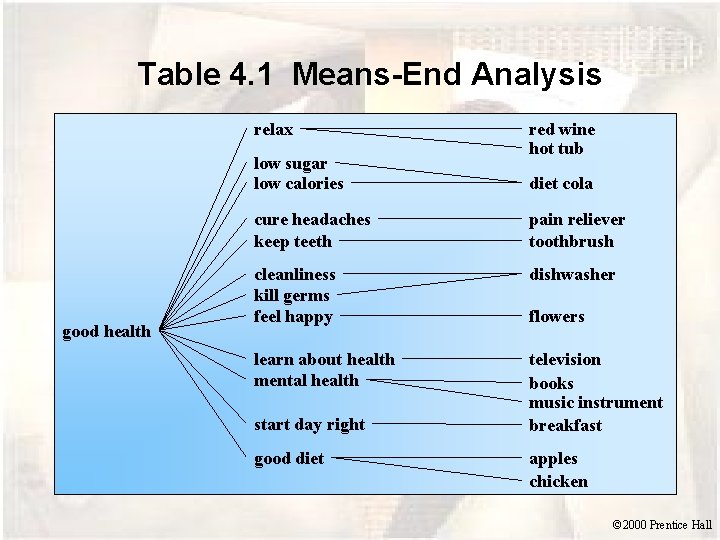
Table 4. 1 Means-End Analysis relax low sugar low calories good health red wine hot tub diet cola cure headaches keep teeth pain reliever toothbrush cleanliness kill germs feel happy dishwasher learn about health mental health television books music instrument breakfast start day right good diet flowers apples chicken © 2000 Prentice Hall
The Selection of Goals • The goals selected by an individual depend on their: – Personal experiences – Physical capacity – Prevailing cultural norms and values – Goal’s accessibility in the physical and social environment © 2000 Prentice Hall
Substitute Goal A goal that replaces an individual’s primary goal when the goal cannot be achieved or acquired. © 2000 Prentice Hall
Positive Motivation A driving force toward some object or condition. © 2000 Prentice Hall
Negative Motivation A driving force away from some object or condition. © 2000 Prentice Hall
Approach Goal A (generally) positive goal toward which behavior is directed © 2000 Prentice Hall
Avoidance Goals A (generally) negative goal from which behavior is directed away © 2000 Prentice Hall
Rational Versus Emotional Motives • Rationality implies that consumers select goals based on totally objective criteria such as size, weight, price, or miles per gallon • Emotional motives imply the selection of goals according to personal or subjective criteria © 2000 Prentice Hall
The Dynamic Nature of Motivation • Needs are never fully satisfied • New needs emerge as old needs are satisfied • People who achieve their goals set new and higher goals for themselves © 2000 Prentice Hall
Defense Mechanism Methods by which people mentally redefine frustrating situations to protect their self -images and their self-esteem. © 2000 Prentice Hall
Defense Mechanisms to Counter Frustration • • Aggression Rationalization Regression Withdrawal Projection Autism Identification Repression © 2000 Prentice Hall
Arousal of Motives • • Physiological arousal Emotional arousal Cognitive arousal Environmental arousal © 2000 Prentice Hall
Philosophies Concerned With Arousal of Motives • Behaviorist School – Behavior is response to stimulus – Elements of conscious thoughts are to be ignored – Consumer does not act, but react • Cognitive School – Behavior is directed at goal achievement – Need to consider needs, attitudes, beliefs, etc. in understanding consumer behavior © 2000 Prentice Hall
Types and Systems of Needs • Hierarchy of Needs • A Trio of Needs – Need for Power – Need for Affiliation – Need for Achievement © 2000 Prentice Hall
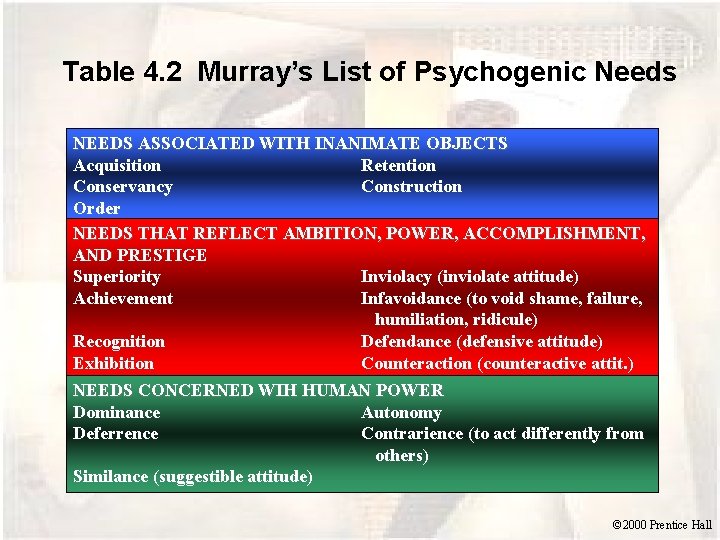
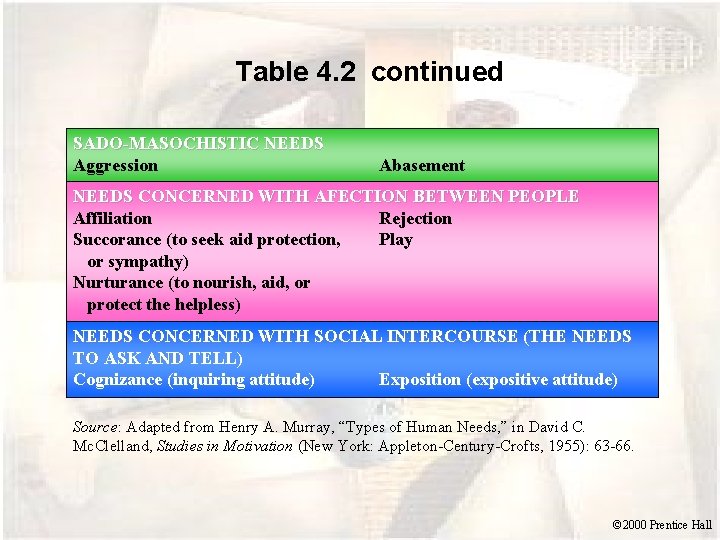
Table 4. 2 Murray’s List of Psychogenic Needs NEEDS ASSOCIATED WITH INANIMATE OBJECTS Acquisition Retention Conservancy Construction Order NEEDS THAT REFLECT AMBITION, POWER, ACCOMPLISHMENT, AND PRESTIGE Superiority Inviolacy (inviolate attitude) Achievement Infavoidance (to void shame, failure, humiliation, ridicule) Recognition Defendance (defensive attitude) Exhibition Counteraction (counteractive attit. ) NEEDS CONCERNED WIH HUMAN POWER Dominance Autonomy Deferrence Contrarience (to act differently from others) Similance (suggestible attitude) © 2000 Prentice Hall
Table 4. 2 continued SADO-MASOCHISTIC NEEDS Aggression Abasement NEEDS CONCERNED WITH AFECTION BETWEEN PEOPLE Affiliation Rejection Succorance (to seek aid protection, Play or sympathy) Nurturance (to nourish, aid, or protect the helpless) NEEDS CONCERNED WITH SOCIAL INTERCOURSE (THE NEEDS TO ASK AND TELL) Cognizance (inquiring attitude) Exposition (expositive attitude) Source: Adapted from Henry A. Murray, “Types of Human Needs, ” in David C. Mc. Clelland, Studies in Motivation (New York: Appleton-Century-Crofts, 1955): 63 -66. © 2000 Prentice Hall
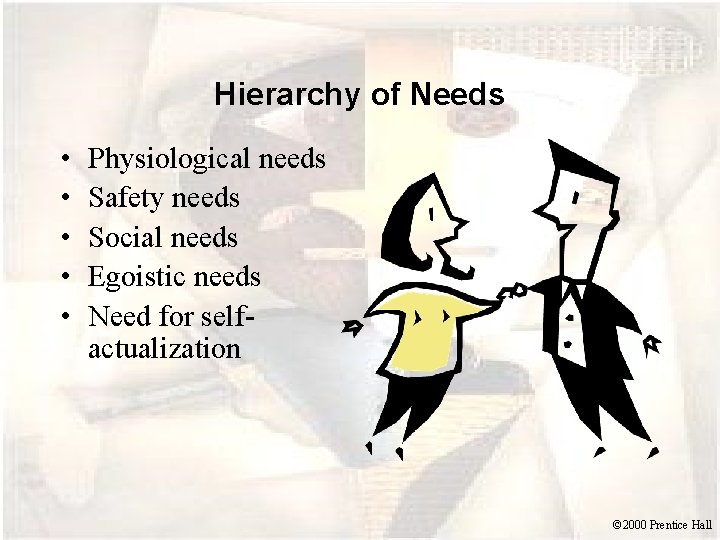
Hierarchy of Needs • • • Physiological needs Safety needs Social needs Egoistic needs Need for selfactualization © 2000 Prentice Hall
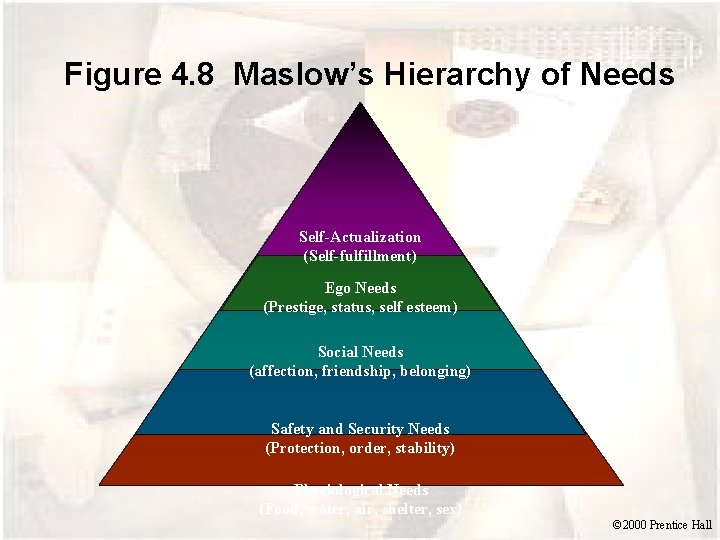
Figure 4. 8 Maslow’s Hierarchy of Needs Self-Actualization (Self-fulfillment) Ego Needs (Prestige, status, self esteem) Social Needs (affection, friendship, belonging) Safety and Security Needs (Protection, order, stability) Physiological Needs (Food, water, air, shelter, sex) © 2000 Prentice Hall
An Evaluation of the Need Hierarchy • Appears to reflect the assumed motivations of people in our society • Sufficiently generic to encompass most needs • No way to test and measure the hierarchy • Seems culture- and time-bound © 2000 Prentice Hall
A Trio of Needs • Power – individual’s desire to control environment • Affiliation – need for friendship, acceptance, and belonging • Achievement – need for personal accomplishment – closely related to egoistic and self-actualization needs © 2000 Prentice Hall
Motivational Research Qualitative research designed to uncover consumers’ subconscious or hidden motivations. The basic premise of motivational research is that consumers are not always aware of, or may not wish to renewal, the basic reasons underlying their actions. © 2000 Prentice Hall
Table 4. 3 Selected Product Personality Profiles Uncovered by Motivational Research Baking An expression of femininity and motherhood, baking evokes pleasant nostalgic memories of the odors pervading the house when one’s mother was baking. To man, a woman is subconsciously and symbolically going through the act of giving birth when baking a cake, and the most fertile moment occurs when the baked product is pulled out of the oven. Ice Cream Ice cream is associated with love and affection. It derives particular potency from childhood memories, when it was given to a child for being “good” and withheld as an instrument of punishment. people refer to ice cream as something they “love” to eat. Ice cream is a symbol of abundance; people prefer round packaging with an illustration that runs around the box panel because it suggests unlimited quantity. © 2000 Prentice Hall
Table 4. 3 continued Power Tools Power tools are a symbol of manliness. They represent masculine skill and competence and are often bought more for their symbolic value than for active do-it-yourself application. Ownership of a good power tool or circular saw provides a man with feelings of omnipotence. Beer For most people, beer is an active, alive sensuous beverage that provides the drinker with a feeling of security. People generally describe the beer they like as “alive, ” “foamy, ” and “sparkling, ” and disliked brands as “flat, ” “dead, ” or “stale. ” © 2000 Prentice Hall
Evaluating Motivational Research • Based on Freud’s psychoanalytic theory • Questionable reliability and validity • Too many exotic (usually sexual) reasons for common purchases © 2000 Prentice Hall