
Chapter 4 CONCEPTS OF LEARNING CLASSIFICATION AND REGRESSION
- Slides: 37
Chapter 4 CONCEPTS OF LEARNING, CLASSIFICATION AND REGRESSION Cios / Pedrycz / Swiniarski / Kurgan
Outline • Main Modes of Learning • Types of Classifiers • Approximation, Generalization and Memorization © 2007 Cios / Pedrycz / Swiniarski / Kurgan 2
Main Modes of Learning • Unsupervised learning • Supervised learning • Reinforcement learning • Learning with knowledge hints and semi-supervised learning © 2007 Cios / Pedrycz / Swiniarski / Kurgan 3
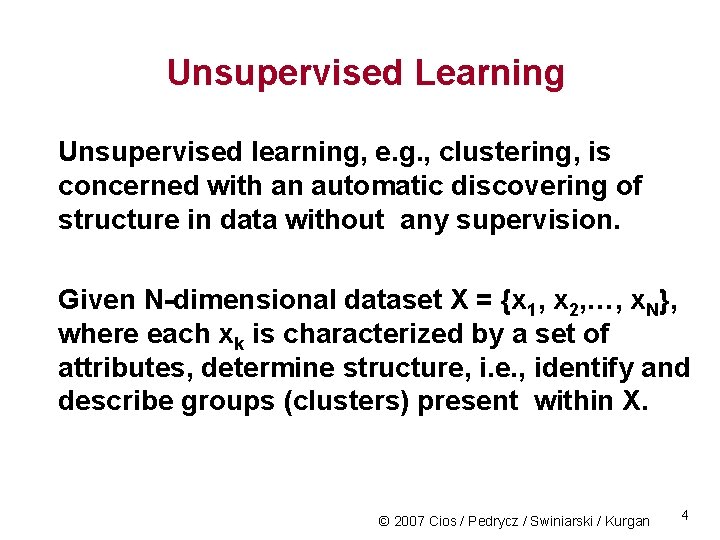
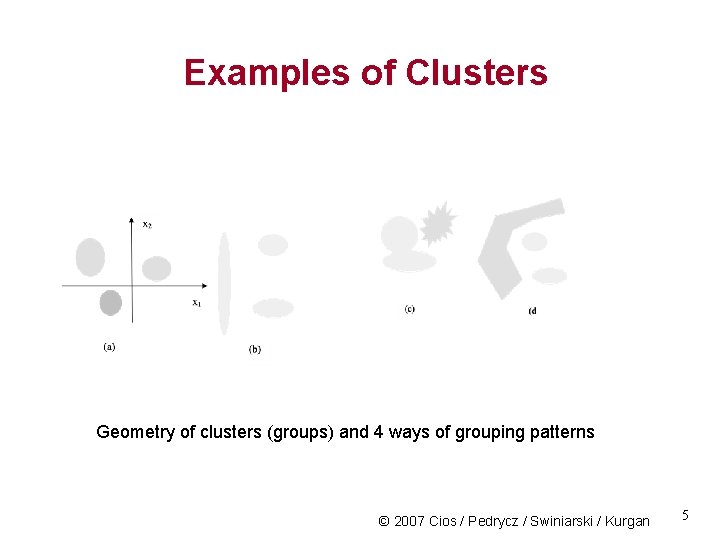
Unsupervised Learning Unsupervised learning, e. g. , clustering, is concerned with an automatic discovering of structure in data without any supervision. Given N-dimensional dataset X = {x 1, x 2, …, x. N}, where each xk is characterized by a set of attributes, determine structure, i. e. , identify and describe groups (clusters) present within X. © 2007 Cios / Pedrycz / Swiniarski / Kurgan 4
Examples of Clusters Geometry of clusters (groups) and 4 ways of grouping patterns © 2007 Cios / Pedrycz / Swiniarski / Kurgan 5
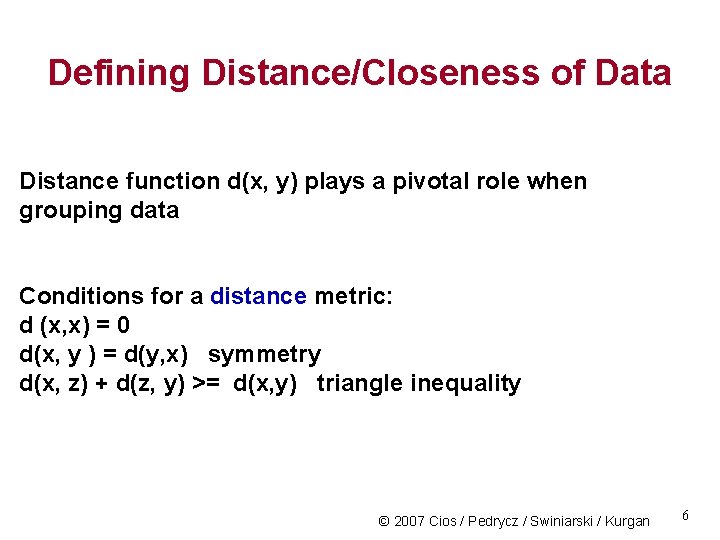
Defining Distance/Closeness of Data Distance function d(x, y) plays a pivotal role when grouping data Conditions for a distance metric: d (x, x) = 0 d(x, y ) = d(y, x) symmetry d(x, z) + d(z, y) >= d(x, y) triangle inequality © 2007 Cios / Pedrycz / Swiniarski / Kurgan 6
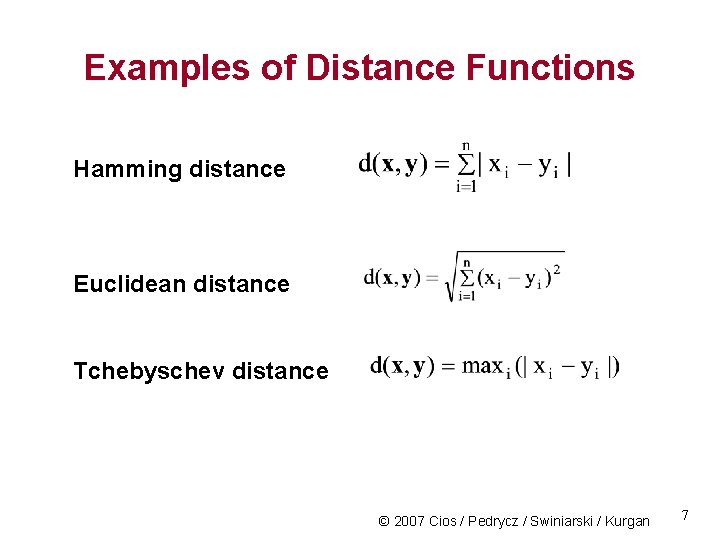
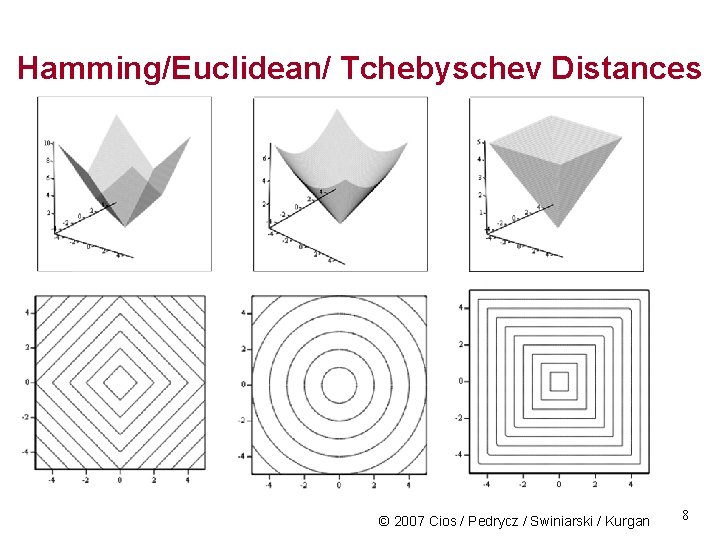
Examples of Distance Functions Hamming distance Euclidean distance Tchebyschev distance © 2007 Cios / Pedrycz / Swiniarski / Kurgan 7
Hamming/Euclidean/ Tchebyschev Distances © 2007 Cios / Pedrycz / Swiniarski / Kurgan 8
Supervised Learning We are given a collection of data (patterns) in two forms: • discrete labels - in which case we have a classification problem • values of a continuous variable – in which case we have a regression or approximation problem © 2007 Cios / Pedrycz / Swiniarski / Kurgan 9
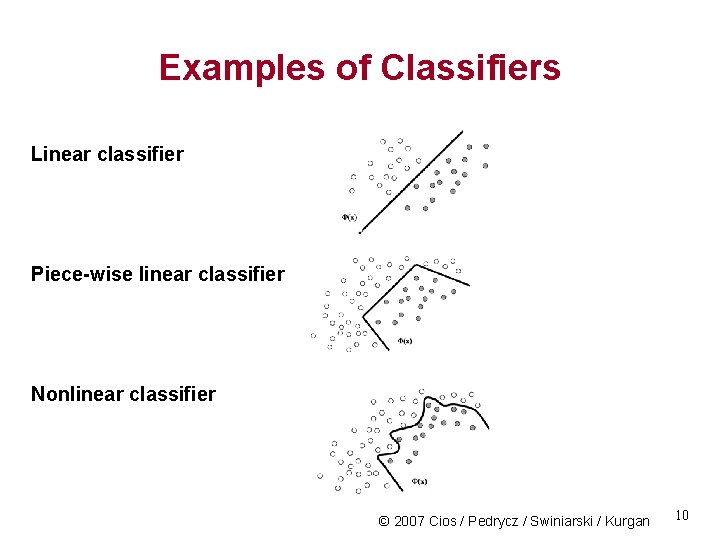
Examples of Classifiers Linear classifier Piece-wise linear classifier Nonlinear classifier © 2007 Cios / Pedrycz / Swiniarski / Kurgan 10
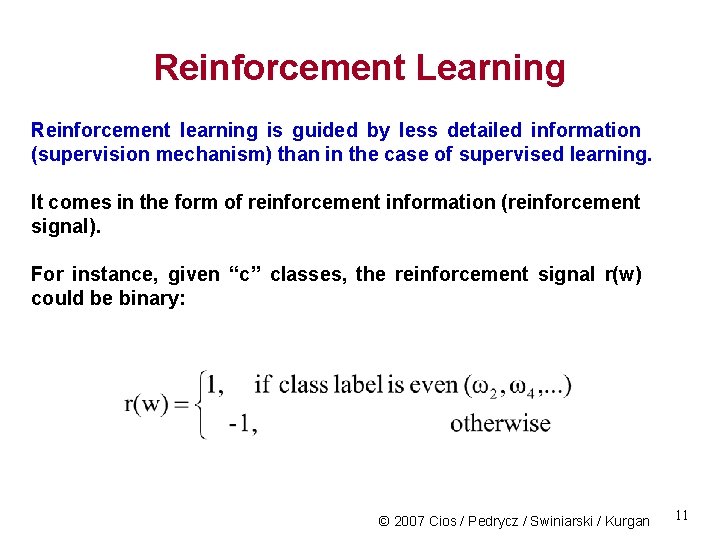
Reinforcement Learning Reinforcement learning is guided by less detailed information (supervision mechanism) than in the case of supervised learning. It comes in the form of reinforcement information (reinforcement signal). For instance, given “c” classes, the reinforcement signal r(w) could be binary: © 2007 Cios / Pedrycz / Swiniarski / Kurgan 11
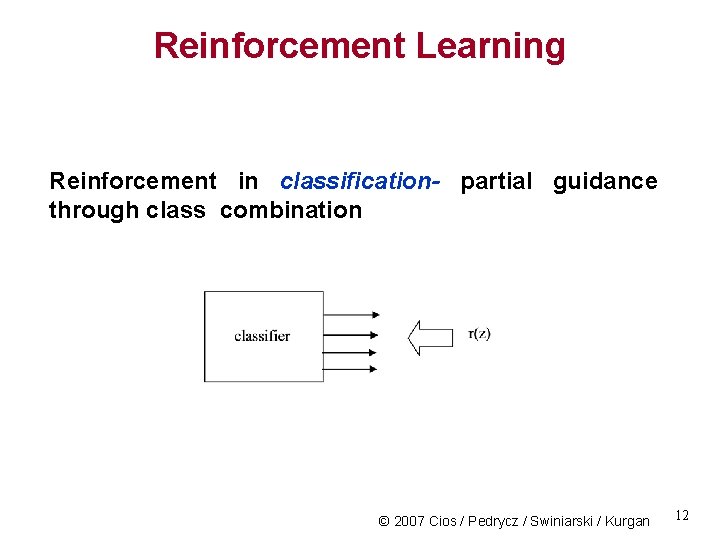
Reinforcement Learning Reinforcement in classification- partial guidance through class combination © 2007 Cios / Pedrycz / Swiniarski / Kurgan 12
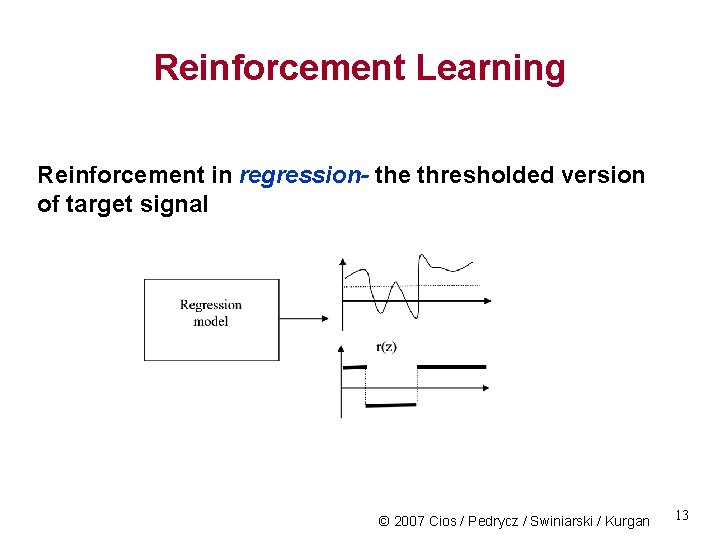
Reinforcement Learning Reinforcement in regression- the thresholded version of target signal © 2007 Cios / Pedrycz / Swiniarski / Kurgan 13
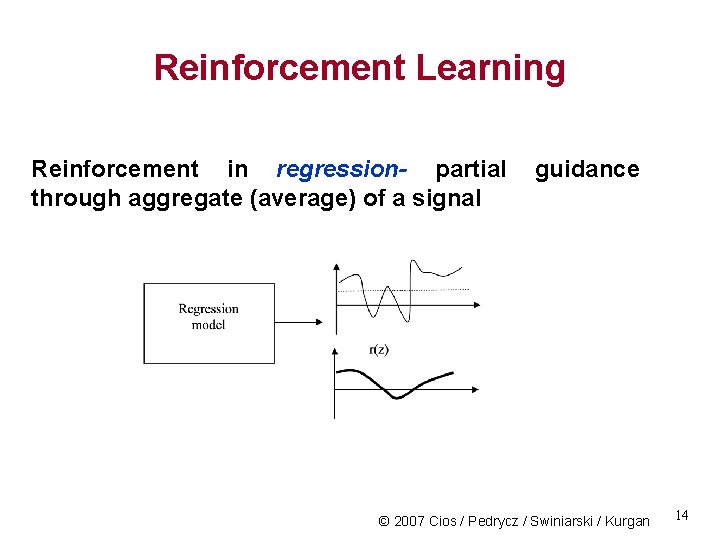
Reinforcement Learning Reinforcement in regression- partial through aggregate (average) of a signal guidance © 2007 Cios / Pedrycz / Swiniarski / Kurgan 14
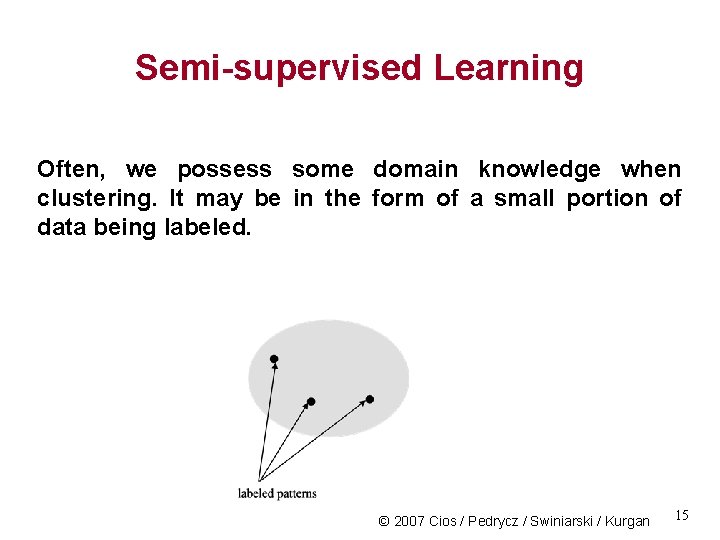
Semi-supervised Learning Often, we possess some domain knowledge when clustering. It may be in the form of a small portion of data being labeled. © 2007 Cios / Pedrycz / Swiniarski / Kurgan 15
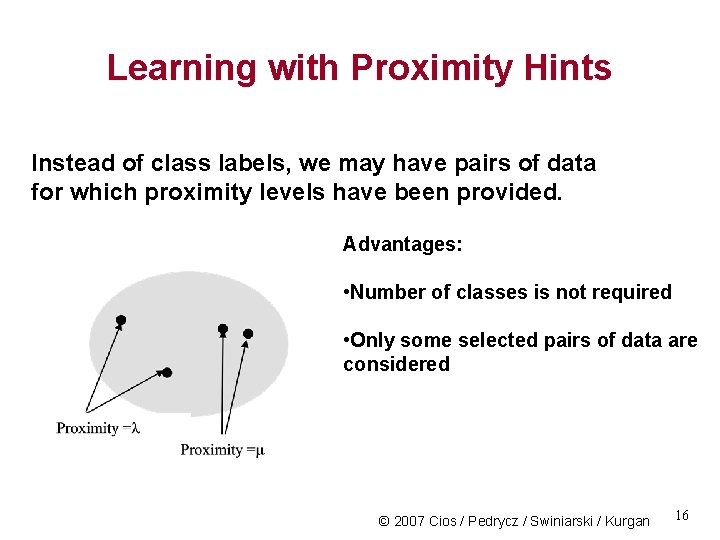
Learning with Proximity Hints Instead of class labels, we may have pairs of data for which proximity levels have been provided. Advantages: • Number of classes is not required • Only some selected pairs of data are considered © 2007 Cios / Pedrycz / Swiniarski / Kurgan 16
Classification Problem Classifiers are algorithms that discriminate between classes of patterns. Depending upon the number of classes in the problem, we talk about two- and many-classifiers. The design of the classifier depends upon the character of data, number of classes, learning algorithm, and validation procedures. Classifier can be regarded as the mapping (F) from feature space to class space F: X {w 1, w 2, …, wc} © 2007 Cios / Pedrycz / Swiniarski / Kurgan 17
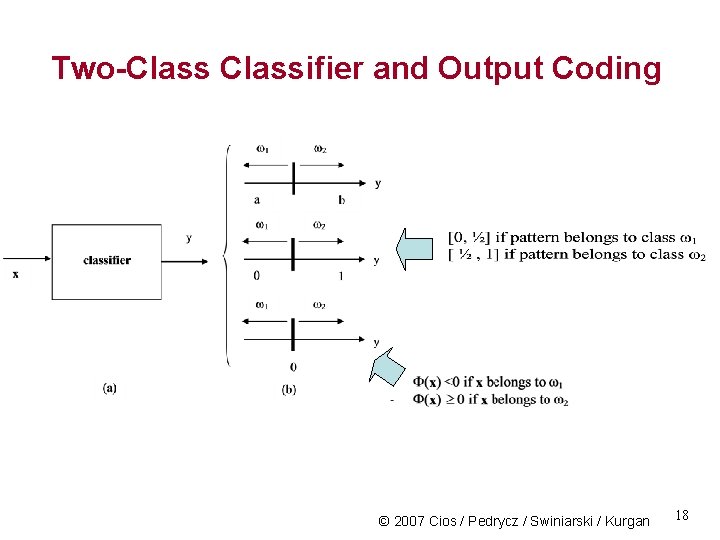
Two-Classifier and Output Coding © 2007 Cios / Pedrycz / Swiniarski / Kurgan 18
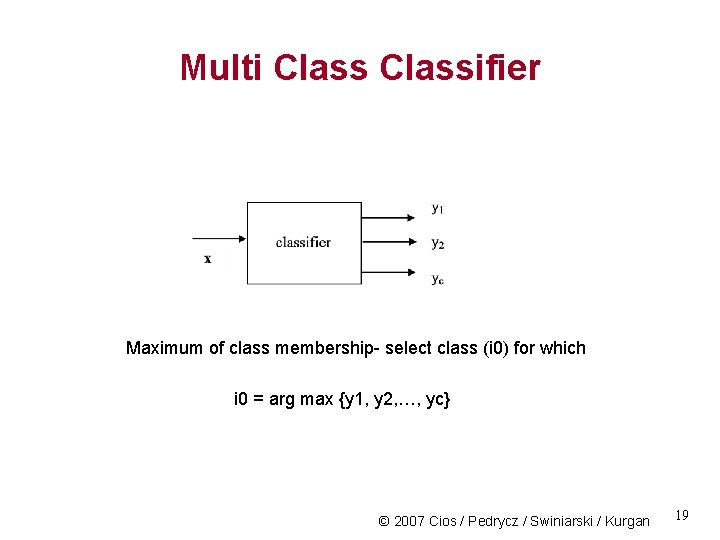
Multi Classifier Maximum of class membership- select class (i 0) for which i 0 = arg max {y 1, y 2, …, yc} © 2007 Cios / Pedrycz / Swiniarski / Kurgan 19
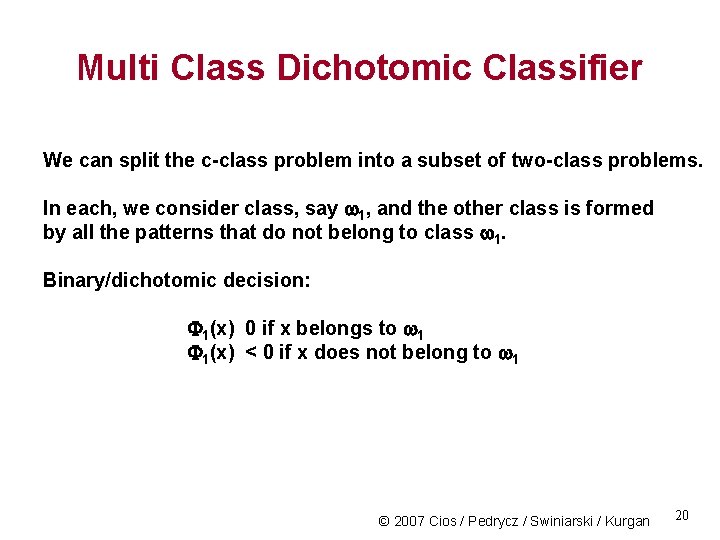
Multi Class Dichotomic Classifier We can split the c-class problem into a subset of two-class problems. In each, we consider class, say w 1, and the other class is formed by all the patterns that do not belong to class w 1. Binary/dichotomic decision: F 1(x) 0 if x belongs to w 1 F 1(x) < 0 if x does not belong to w 1 © 2007 Cios / Pedrycz / Swiniarski / Kurgan 20
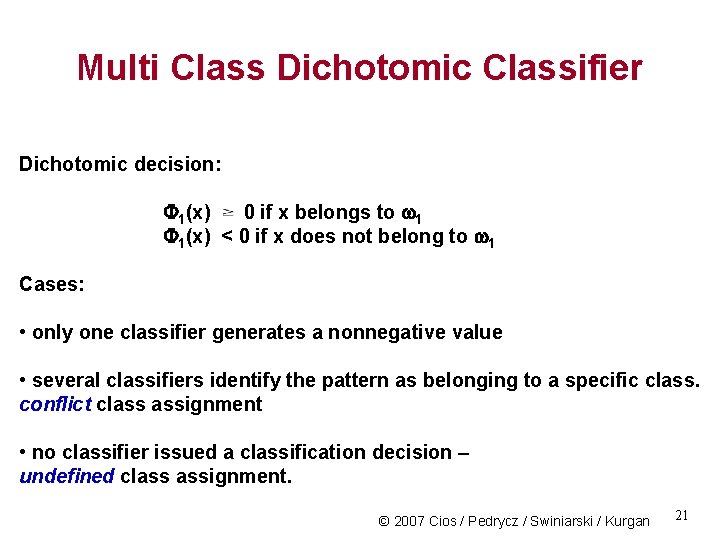
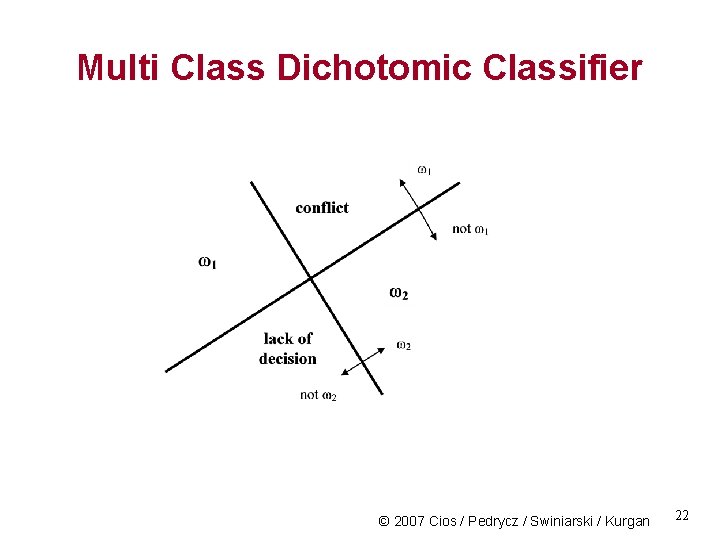
Multi Class Dichotomic Classifier Dichotomic decision: F 1(x) 0 if x belongs to w 1 F 1(x) < 0 if x does not belong to w 1 Cases: • only one classifier generates a nonnegative value • several classifiers identify the pattern as belonging to a specific class. conflict class assignment • no classifier issued a classification decision – undefined class assignment. © 2007 Cios / Pedrycz / Swiniarski / Kurgan 21
Multi Class Dichotomic Classifier © 2007 Cios / Pedrycz / Swiniarski / Kurgan 22
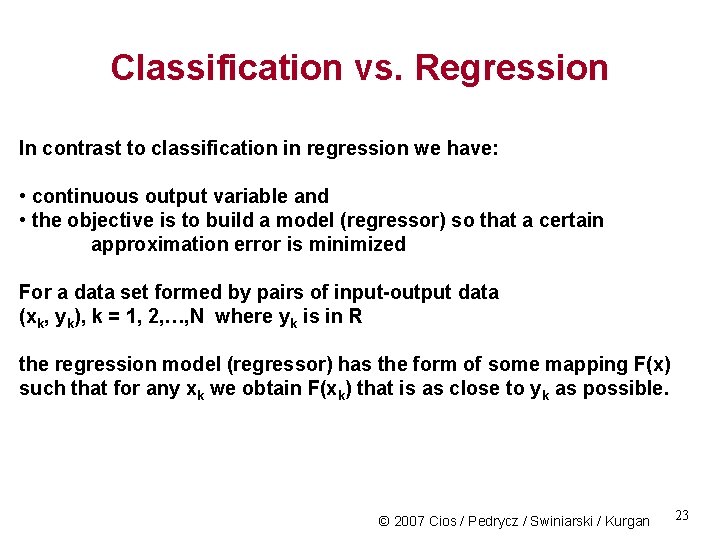
Classification vs. Regression In contrast to classification in regression we have: • continuous output variable and • the objective is to build a model (regressor) so that a certain approximation error is minimized For a data set formed by pairs of input-output data (xk, yk), k = 1, 2, …, N where yk is in R the regression model (regressor) has the form of some mapping F(x) such that for any xk we obtain F(xk) that is as close to yk as possible. © 2007 Cios / Pedrycz / Swiniarski / Kurgan 23
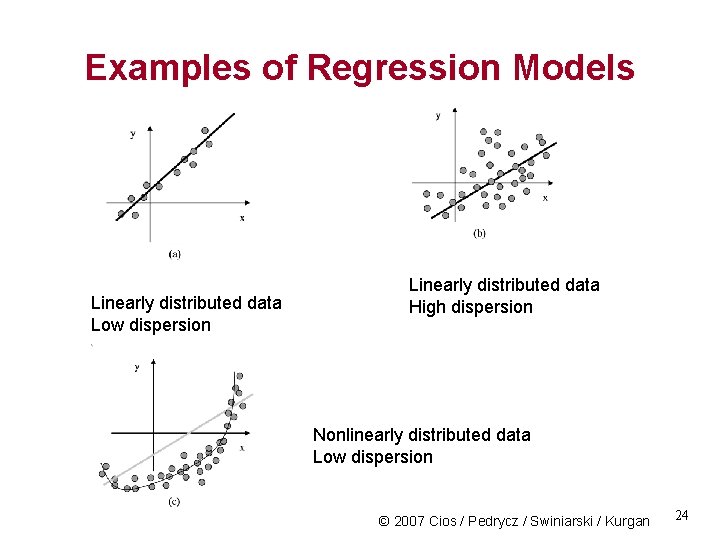
Examples of Regression Models Linearly distributed data Low dispersion Linearly distributed data High dispersion Nonlinearly distributed data Low dispersion © 2007 Cios / Pedrycz / Swiniarski / Kurgan 24
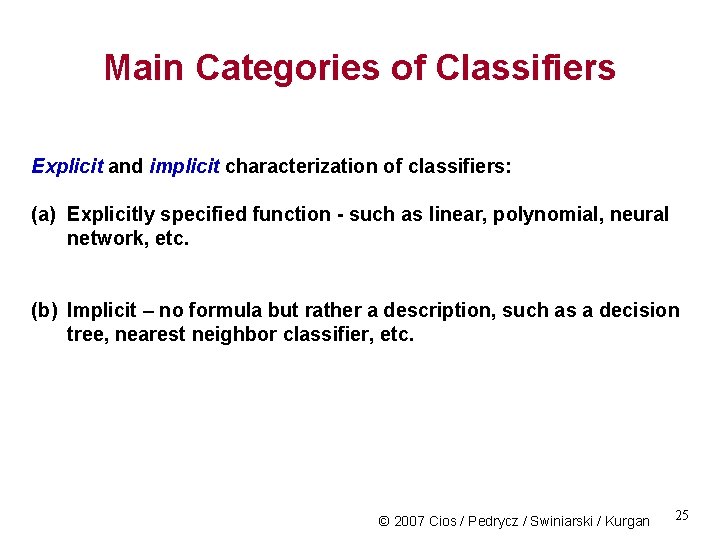
Main Categories of Classifiers Explicit and implicit characterization of classifiers: (a) Explicitly specified function - such as linear, polynomial, neural network, etc. (b) Implicit – no formula but rather a description, such as a decision tree, nearest neighbor classifier, etc. © 2007 Cios / Pedrycz / Swiniarski / Kurgan 25
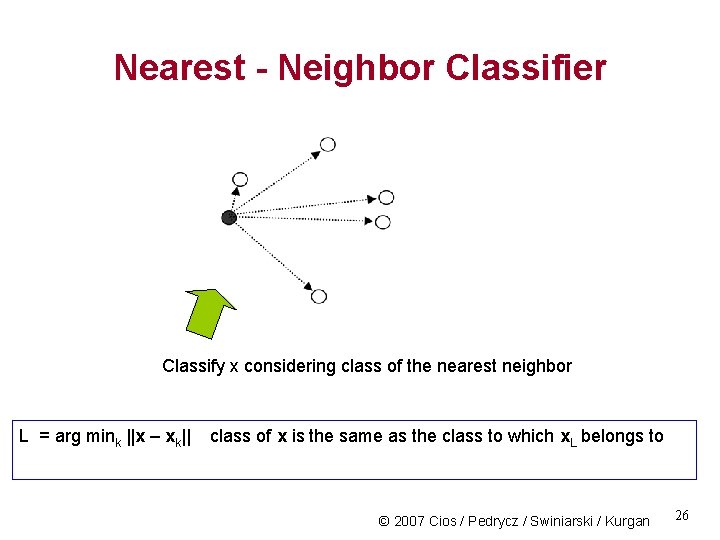
Nearest - Neighbor Classifier Classify x considering class of the nearest neighbor L = arg mink ||x – xk|| class of x is the same as the class to which x. L belongs to © 2007 Cios / Pedrycz / Swiniarski / Kurgan 26
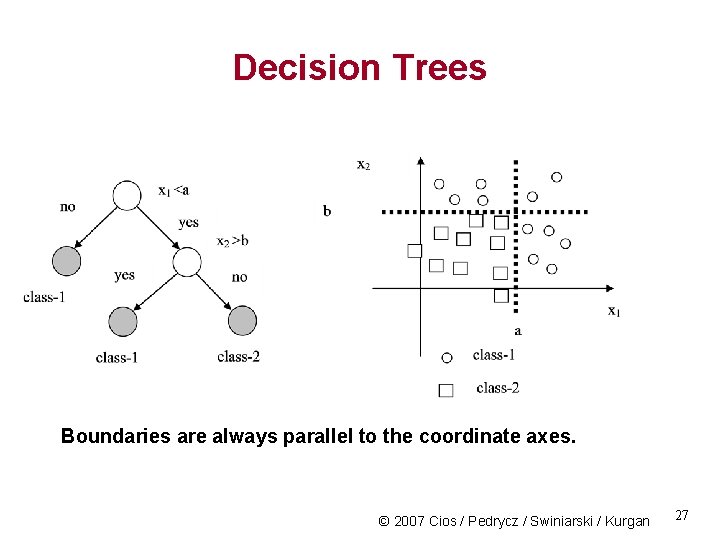
Decision Trees Boundaries are always parallel to the coordinate axes. © 2007 Cios / Pedrycz / Swiniarski / Kurgan 27
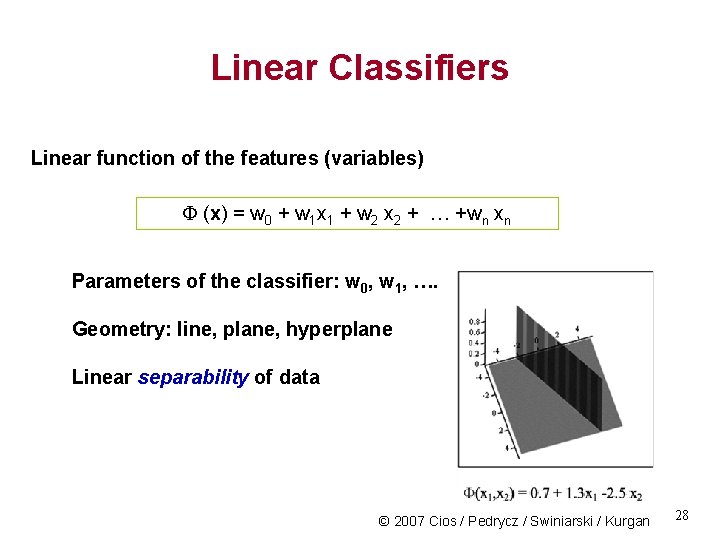
Linear Classifiers Linear function of the features (variables) F (x) = w 0 + w 1 x 1 + w 2 x 2 + … +wn xn Parameters of the classifier: w 0, w 1, …. Geometry: line, plane, hyperplane Linear separability of data © 2007 Cios / Pedrycz / Swiniarski / Kurgan 28
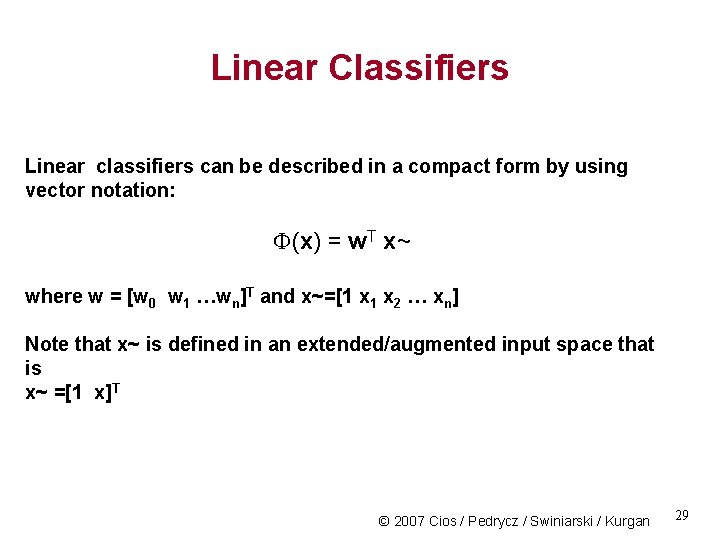
Linear Classifiers Linear classifiers can be described in a compact form by using vector notation: F(x) = w. T x~ where w = [w 0 w 1 …wn]T and x~=[1 x 2 … xn] Note that x~ is defined in an extended/augmented input space that is x~ =[1 x]T © 2007 Cios / Pedrycz / Swiniarski / Kurgan 29
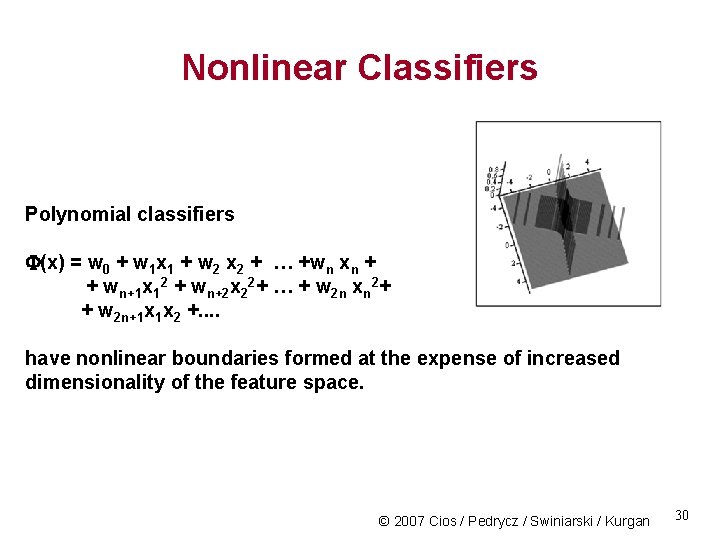
Nonlinear Classifiers Polynomial classifiers F(x) = w 0 + w 1 x 1 + w 2 x 2 + … +wn xn + + wn+1 x 12 + wn+2 x 22+ … + w 2 n xn 2+ + w 2 n+1 x 1 x 2 +. . have nonlinear boundaries formed at the expense of increased dimensionality of the feature space. © 2007 Cios / Pedrycz / Swiniarski / Kurgan 30
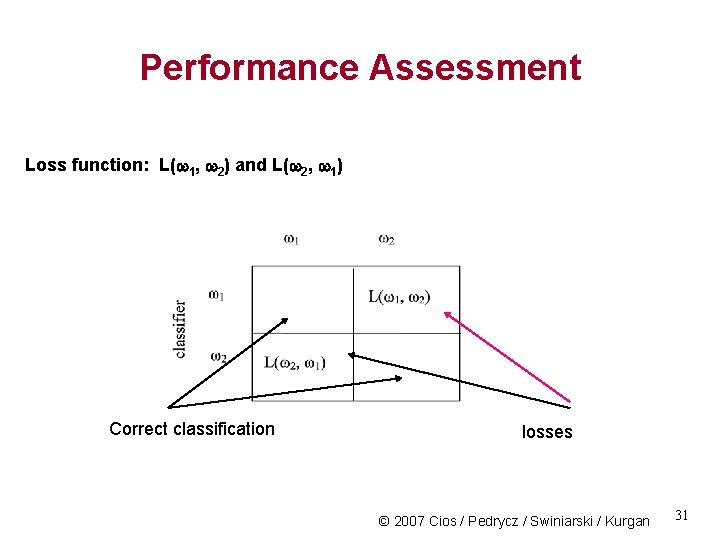
Performance Assessment Loss function: L(w 1, w 2) and L(w 2, w 1) Correct classification losses © 2007 Cios / Pedrycz / Swiniarski / Kurgan 31
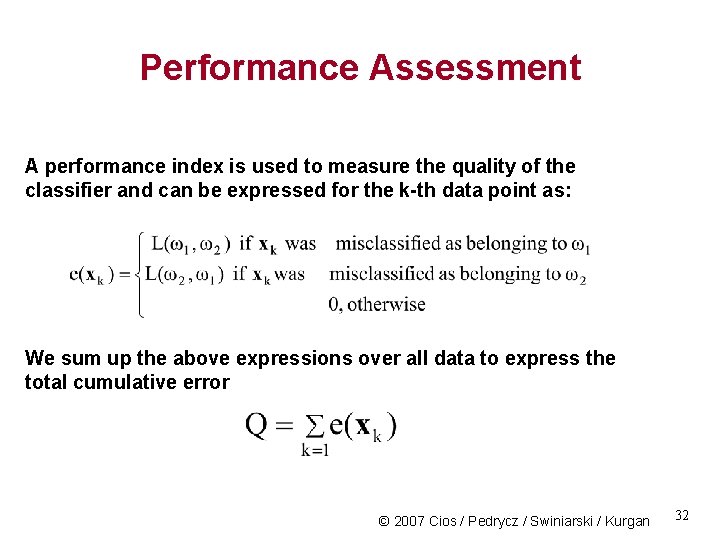
Performance Assessment A performance index is used to measure the quality of the classifier and can be expressed for the k-th data point as: We sum up the above expressions over all data to express the total cumulative error © 2007 Cios / Pedrycz / Swiniarski / Kurgan 32
Generalization Aspects of Classification/Regression Models Performance is assessed with regard to unseen data. Typically, the available data are split into tow or three disjoint subsets • Training • Validation • Testing Training set - used to complete training (learning) of the classifier. All optimization activities are guided by the performance index and its changes are reported for the training data. © 2007 Cios / Pedrycz / Swiniarski / Kurgan 33
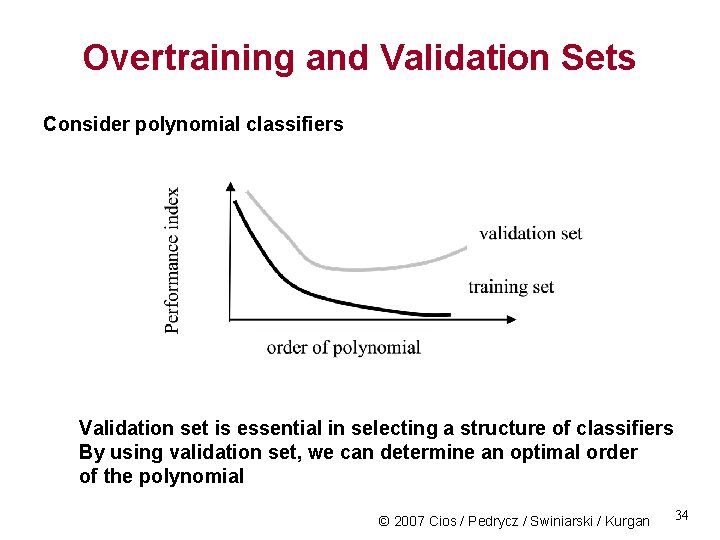
Overtraining and Validation Sets Consider polynomial classifiers Validation set is essential in selecting a structure of classifiers By using validation set, we can determine an optimal order of the polynomial © 2007 Cios / Pedrycz / Swiniarski / Kurgan 34
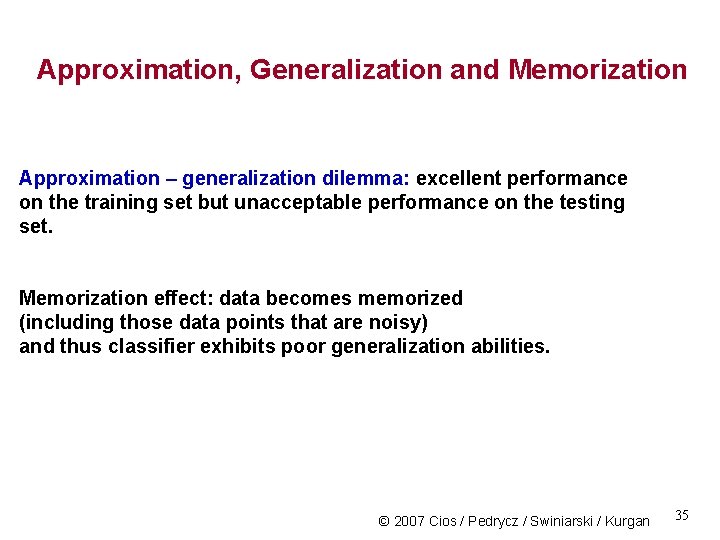
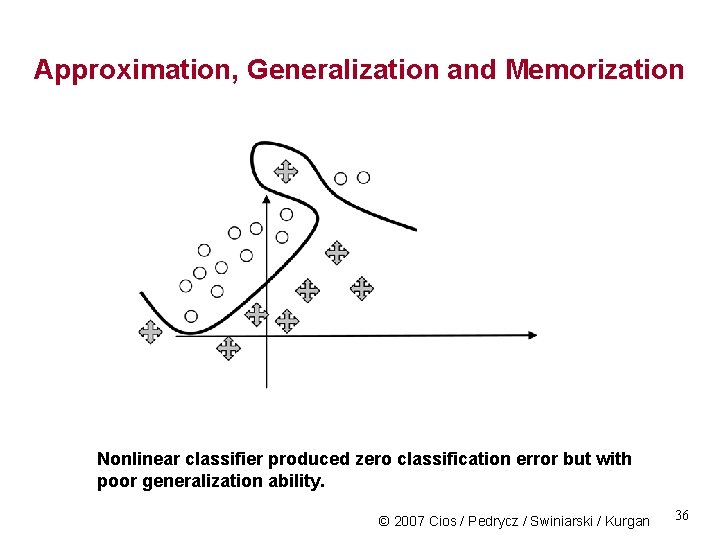
Approximation, Generalization and Memorization Approximation – generalization dilemma: excellent performance on the training set but unacceptable performance on the testing set. Memorization effect: data becomes memorized (including those data points that are noisy) and thus classifier exhibits poor generalization abilities. © 2007 Cios / Pedrycz / Swiniarski / Kurgan 35
Approximation, Generalization and Memorization Nonlinear classifier produced zero classification error but with poor generalization ability. © 2007 Cios / Pedrycz / Swiniarski / Kurgan 36
References Bishop, C. M. 1995. Neural Networks for Pattern Recognition, Oxford University Press Duda, R. O, Hart, PE and Stork DG. 2001 Pattern Classification, 2 nd edition, J. Wiley Kaufmann, L. and Rousseeuw, P. J. 1990. Finding Groups in Data: An Introduction to Cluster Analysis, Wiley Soderstrom, T. and Stoica, P. 1986. System Identification, Wiley Webb, A. 2002. Statistical Pattern Recognition, 2 nd edition, Wiley © 2007 Cios / Pedrycz / Swiniarski / Kurgan 37