
Chapter 4 Compounds and Their Bonds 4 1
Chapter 4 Compounds and Their Bonds 4. 1 Valence Electrons 4. 2 Octet Rule and Ions Lecture. PLUS Timberlake 1
Chemical Bonds Attraction between two or more atoms Interaction between valence electrons Ionic bonds Covalent bonds Metallic bonds Lecture. PLUS Timberlake 2

Valence Electrons in the highest (outer) electron level Have most contact with other atoms Outer shells of noble gases contain 8 valence electrons (except He = 2) Example: Ne 2, 8 Ar 2, 8, 8 Lecture. PLUS Timberlake 3

Electron Dot Structures Symbols of atoms with dots to represent the valence-shell electrons 1 A 2 A 3 A 4 A 5 A 6 A 7 A H 8 A He: Li Be B Na Mg Al C N O Si P S Lecture. PLUS Timberlake : F : Ne : : Cl : Ar : 4
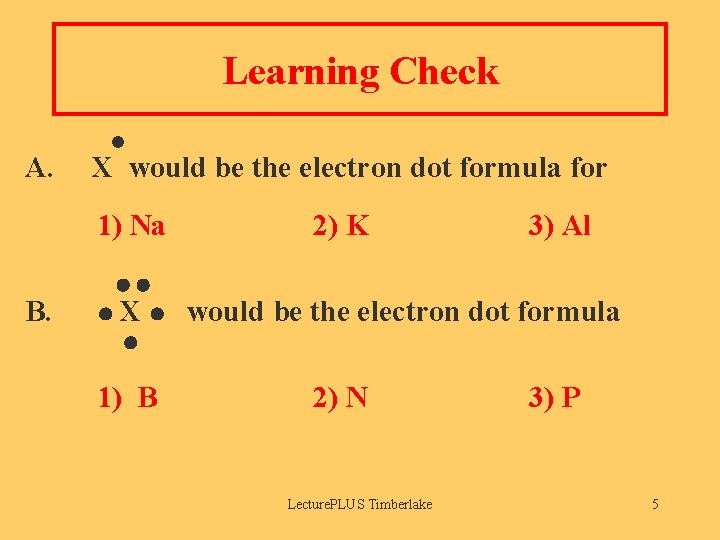
Learning Check A. X would be the electron dot formula for 1) Na B. X 1) B 2) K 3) Al would be the electron dot formula 2) N Lecture. PLUS Timberlake 3) P 5

Solution A. X would be the electron dot formula for 1) Na B. X 2) N 2) K would be the electron dot formula 3) P Lecture. PLUS Timberlake 6
Octet Rule An octet in the outer shell makes atoms stable Electrons are lost, gained or shared to form an octet Unpaired valence electrons strongly influence bonding Lecture. PLUS Timberlake 7
Metals forming ions. Cations (cats have paws-pos) Metals lose electrons to match the number of valence electrons of their nearest noble gas Positive ions form as a result Lecture. PLUS Timberlake 8
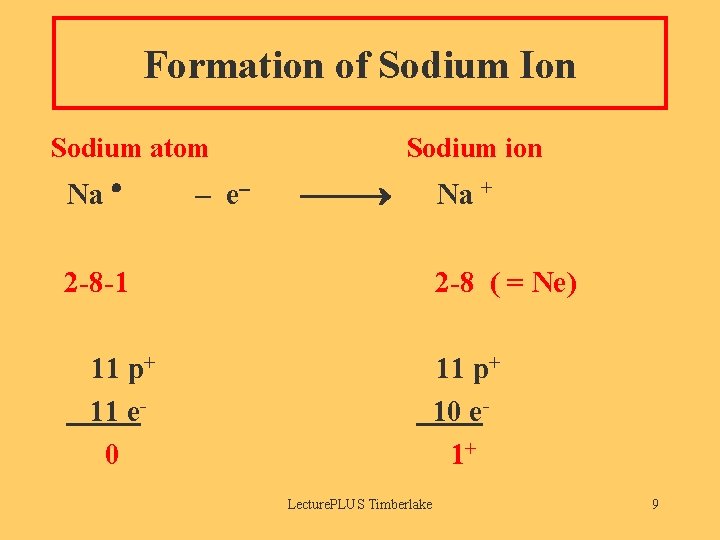
Formation of Sodium Ion Sodium atom Na – e Sodium ion Na + 2 -8 -1 11 p+ 11 e 0 2 -8 ( = Ne) 11 p+ 10 e 1+ Lecture. PLUS Timberlake 9
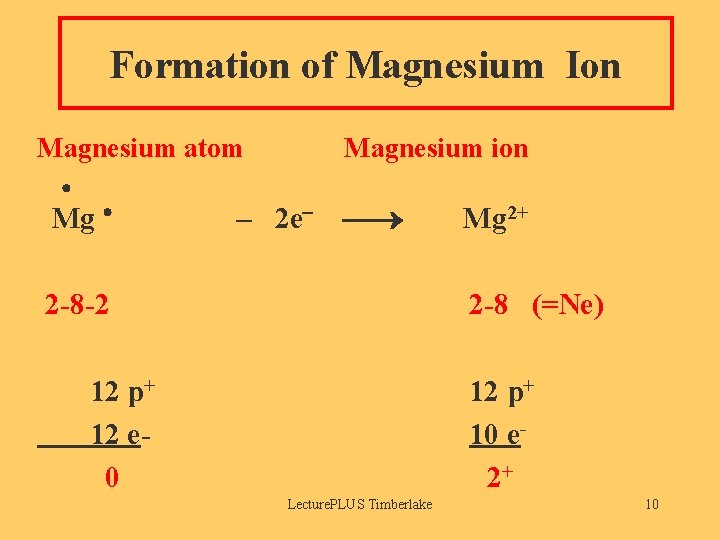
Formation of Magnesium Ion Magnesium atom Magnesium ion Mg – 2 e 2 -8 -2 Mg 2+ 2 -8 (=Ne) 12 p+ 12 e 0 12 p+ 10 e 2+ Lecture. PLUS Timberlake 10
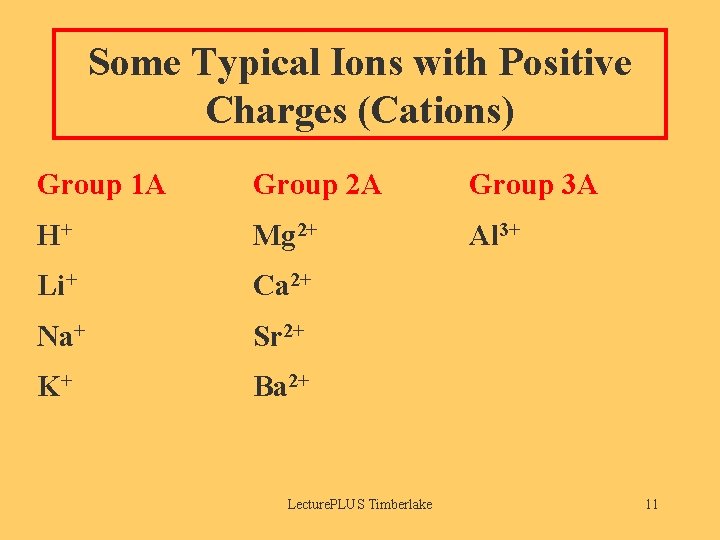
Some Typical Ions with Positive Charges (Cations) Group 1 A Group 2 A Group 3 A H+ Mg 2+ Al 3+ Li+ Ca 2+ Na+ Sr 2+ K+ Ba 2+ Lecture. PLUS Timberlake 11

Learning Check A. Number of valence electrons in aluminum 1) 1 e 2) 2 e 3) 3 e. B. Change in electrons for octet 1) lose 3 e 2) gain 3 e. Ionic charge of aluminum 1) 32) 5 Lecture. PLUS Timberlake 3) gain 5 e- 3) 3+ 12
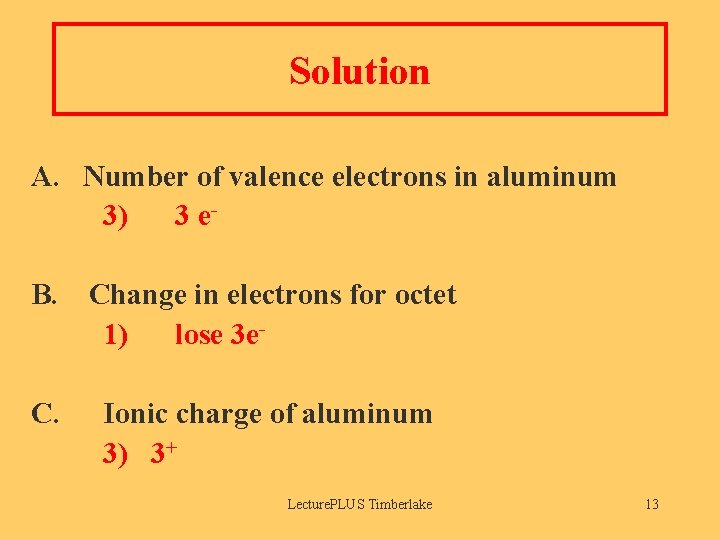
Solution A. Number of valence electrons in aluminum 3) 3 e. B. Change in electrons for octet 1) lose 3 e- C. Ionic charge of aluminum 3) 3+ Lecture. PLUS Timberlake 13
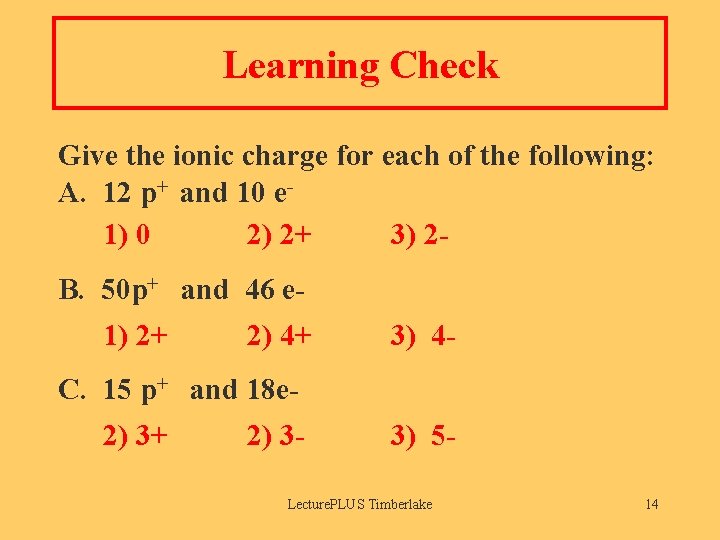
Learning Check Give the ionic charge for each of the following: A. 12 p+ and 10 e 1) 0 2) 2+ 3) 2 B. 50 p+ and 46 e 1) 2+ 2) 4+ 3) 4 - C. 15 p+ and 18 e 2) 3+ 2) 3 - 3) 5 - Lecture. PLUS Timberlake 14
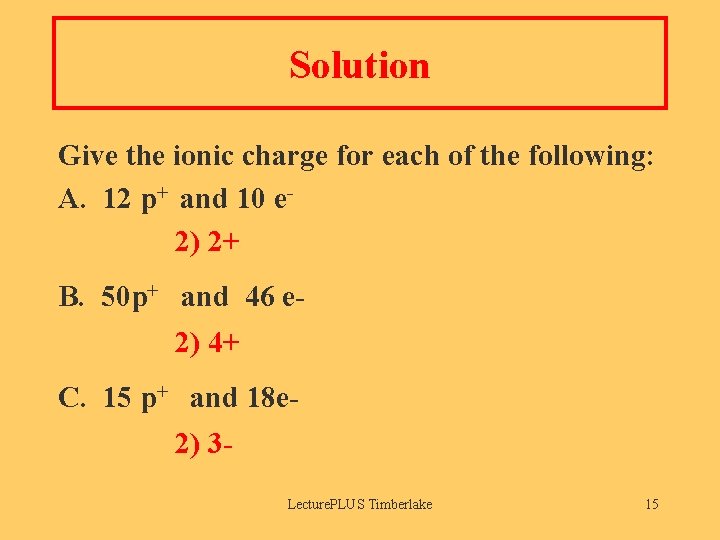
Solution Give the ionic charge for each of the following: A. 12 p+ and 10 e 2) 2+ B. 50 p+ and 46 e 2) 4+ C. 15 p+ and 18 e 2) 3 Lecture. PLUS Timberlake 15
Learning Check A. Why does Ca form a Ca 2+ ion? B. Why does O form O 2 - ion? Lecture. PLUS Timberlake 16
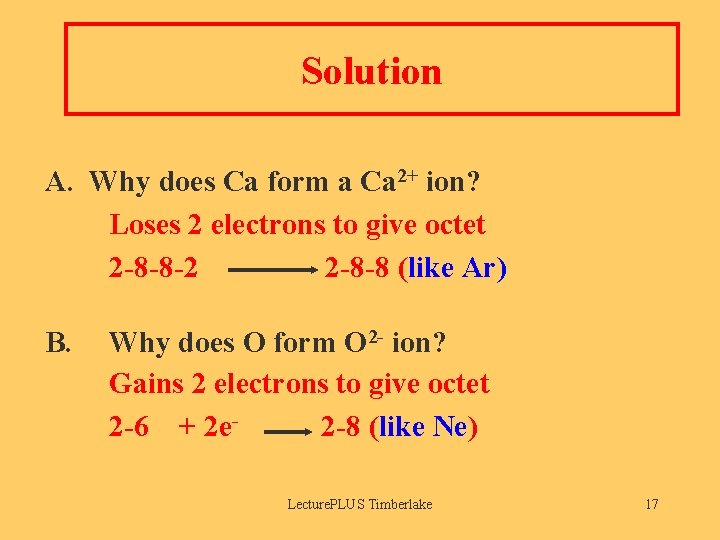
Solution A. Why does Ca form a Ca 2+ ion? Loses 2 electrons to give octet 2 -8 -8 -2 2 -8 -8 (like Ar) B. Why does O form O 2 - ion? Gains 2 electrons to give octet 2 -6 + 2 e 2 -8 (like Ne) Lecture. PLUS Timberlake 17
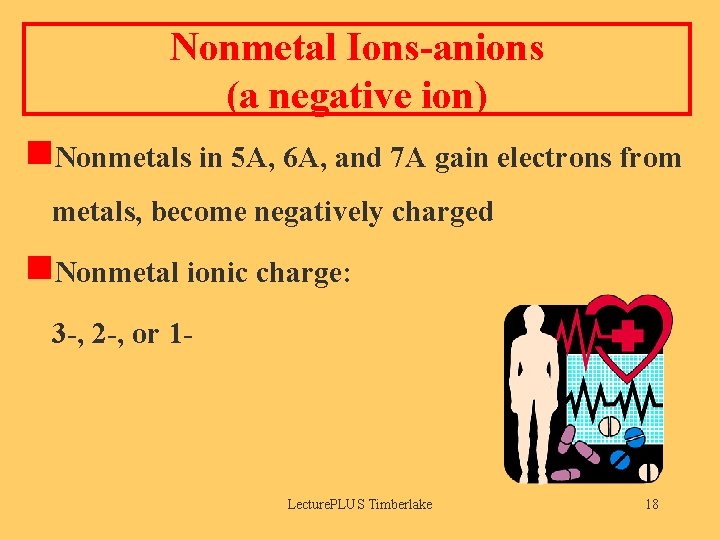
Nonmetal Ions-anions (a negative ion) n. Nonmetals in 5 A, 6 A, and 7 A gain electrons from metals, become negatively charged n. Nonmetal ionic charge: 3 -, 2 -, or 1 - Lecture. PLUS Timberlake 18
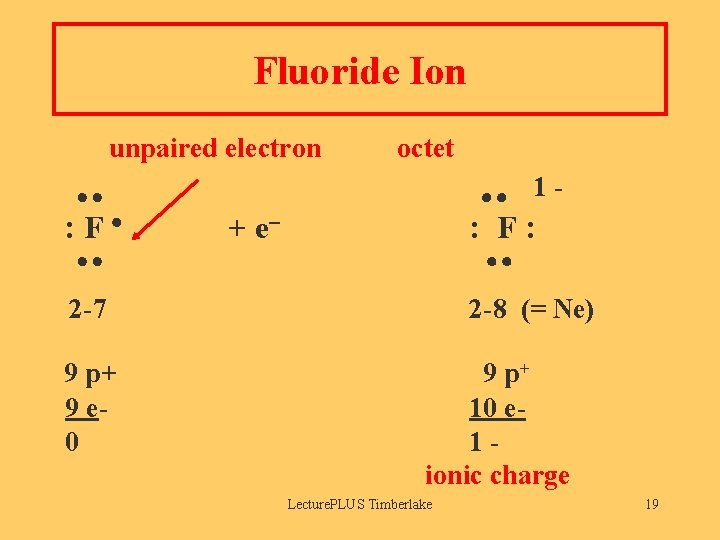
Fluoride Ion unpaired electron : F octet : F: + e 2 -7 9 p+ 9 e 0 1 - 2 -8 (= Ne) 9 p+ 10 e 1 ionic charge Lecture. PLUS Timberlake 19
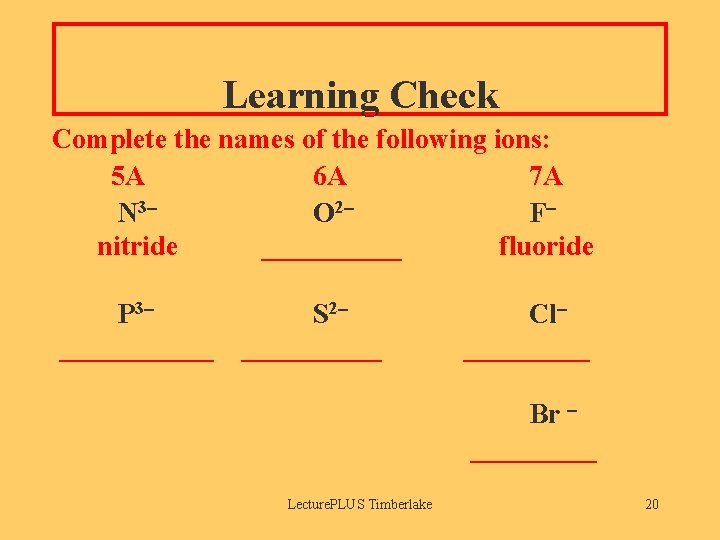
Learning Check Complete the names of the following ions: 5 A 6 A 7 A N 3 O 2 F nitride _____ fluoride P 3 ______ S 2 _____ Cl _____ Br _____ Lecture. PLUS Timberlake 20
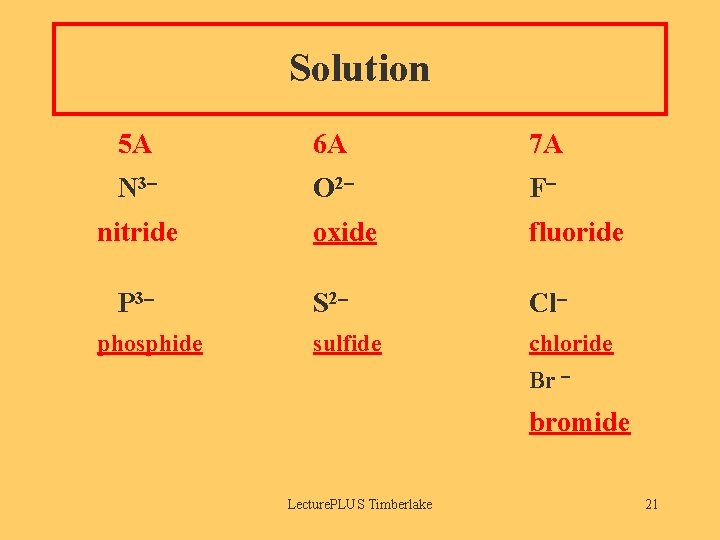
Solution 5 A 6 A 7 A N 3 O 2 F oxide fluoride S 2 Cl sulfide chloride nitride P 3 phosphide Br bromide Lecture. PLUS Timberlake 21
- Slides: 21