
Chapter 4 Communications Theory and Media Postacademic Interuniversity
- Slides: 49
Chapter 4 Communications, Theory and Media Postacademic Interuniversity Course in Information Technology – Module C 1 p 1
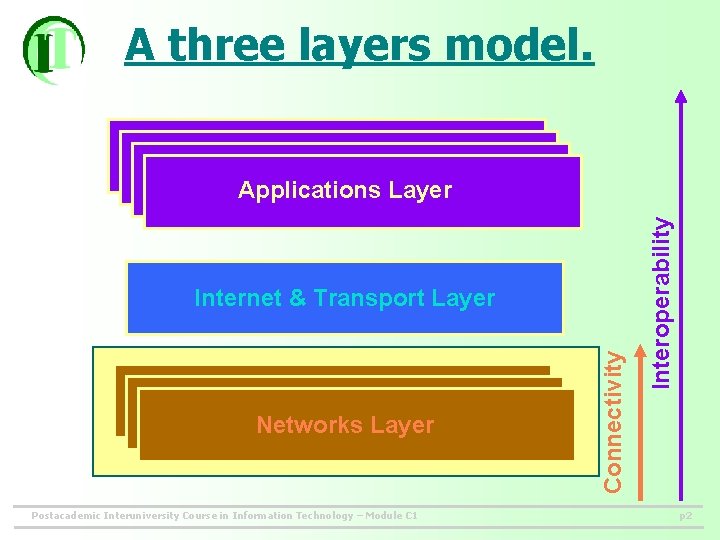
A three layers model. Networks Layer Postacademic Interuniversity Course in Information Technology – Module C 1 Connectivity Internet & Transport Layer Interoperability Applications Layer p 2
Contents • Communications Theory – Parallel vs. serial transmission – Transmission Capacity (Shannon) – Error detection and correction • Communications Media – Optical fibers – Coaxial cables – Twisted pairs – Wireless Postacademic Interuniversity Course in Information Technology – Module C 1 p 3
Contents • Communications Theory – Parallel vs. serial transmission – Transmission Capacity (Shannon) – Error detection and correction • Communications Media – Optical fibers – Coaxial cables – Twisted pairs – Wireless Postacademic Interuniversity Course in Information Technology – Module C 1 p 4
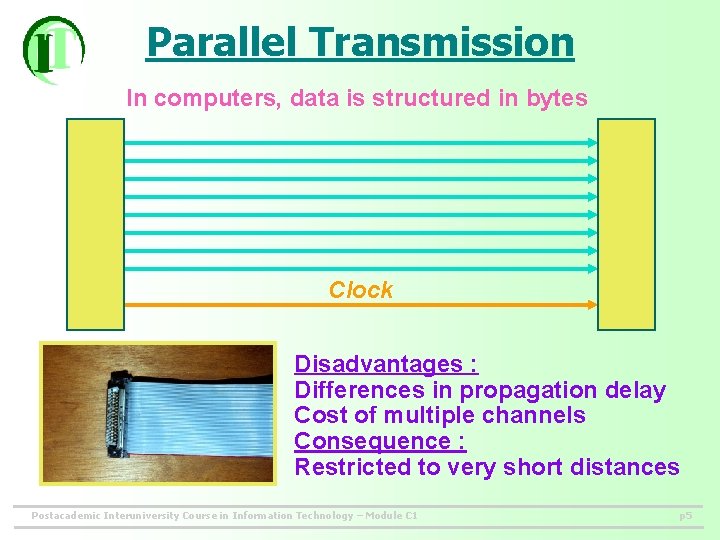
Parallel Transmission In computers, data is structured in bytes Clock Disadvantages : Differences in propagation delay Cost of multiple channels Consequence : Restricted to very short distances Postacademic Interuniversity Course in Information Technology – Module C 1 p 5
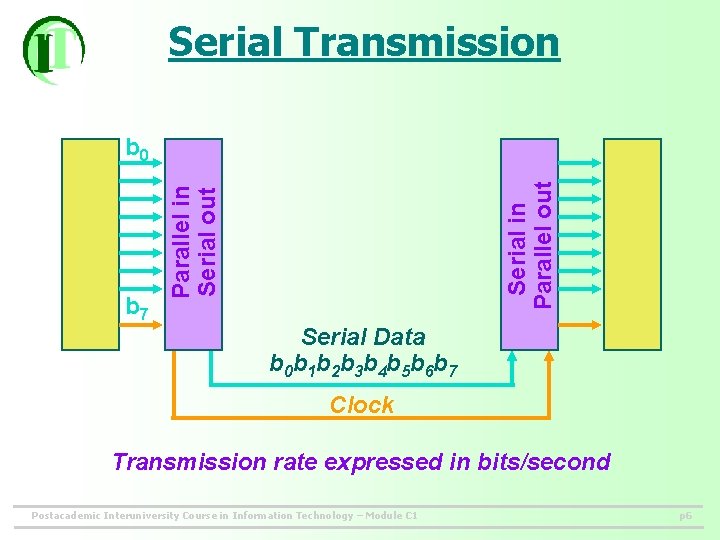
Serial Transmission Parallel in Serial out b 7 Serial in Parallel out b 0 Serial Data b 0 b 1 b 2 b 3 b 4 b 5 b 6 b 7 Clock Transmission rate expressed in bits/second Postacademic Interuniversity Course in Information Technology – Module C 1 p 6
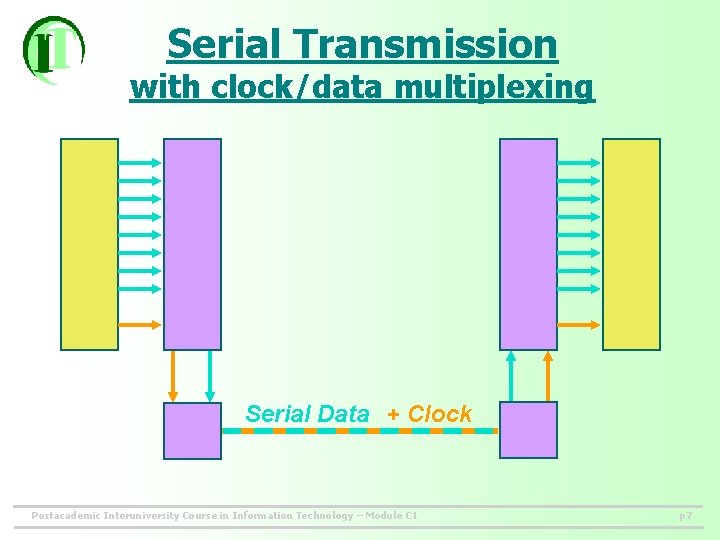
Serial Transmission with clock/data multiplexing Serial Data + Clock Postacademic Interuniversity Course in Information Technology – Module C 1 p 7
Contents • Communications Theory – Parallel vs. serial transmission – Transmission Capacity (Shannon) – Error detection and correction • Communications Media – Optical fibers – Coaxial cables – Twisted pairs – Wireless Postacademic Interuniversity Course in Information Technology – Module C 1 p 8
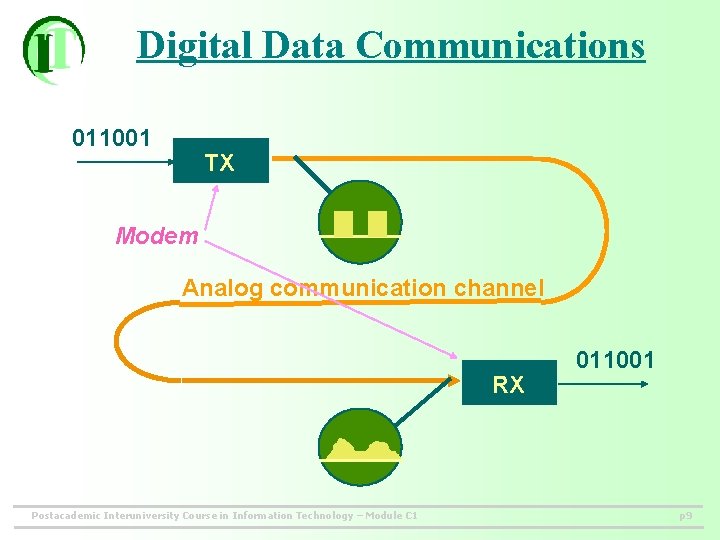
Digital Data Communications 011001 TX Modem Analog communication channel RX Postacademic Interuniversity Course in Information Technology – Module C 1 011001 p 9
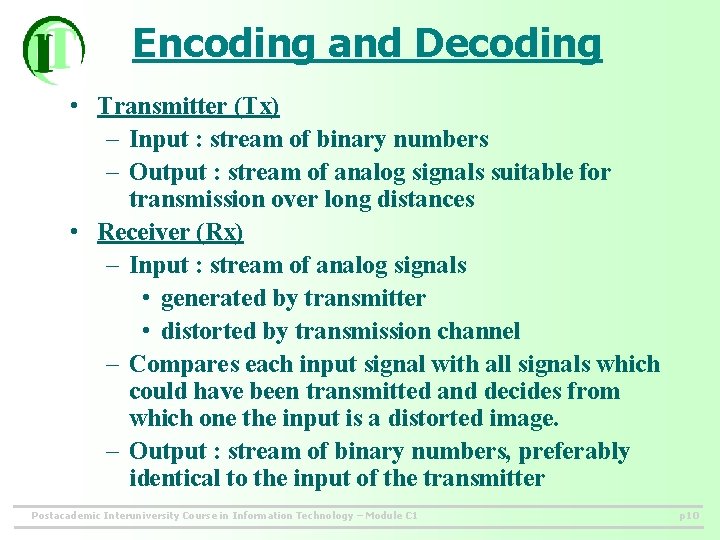
Encoding and Decoding • Transmitter (Tx) – Input : stream of binary numbers – Output : stream of analog signals suitable for transmission over long distances • Receiver (Rx) – Input : stream of analog signals • generated by transmitter • distorted by transmission channel – Compares each input signal with all signals which could have been transmitted and decides from which one the input is a distorted image. – Output : stream of binary numbers, preferably identical to the input of the transmitter Postacademic Interuniversity Course in Information Technology – Module C 1 p 10
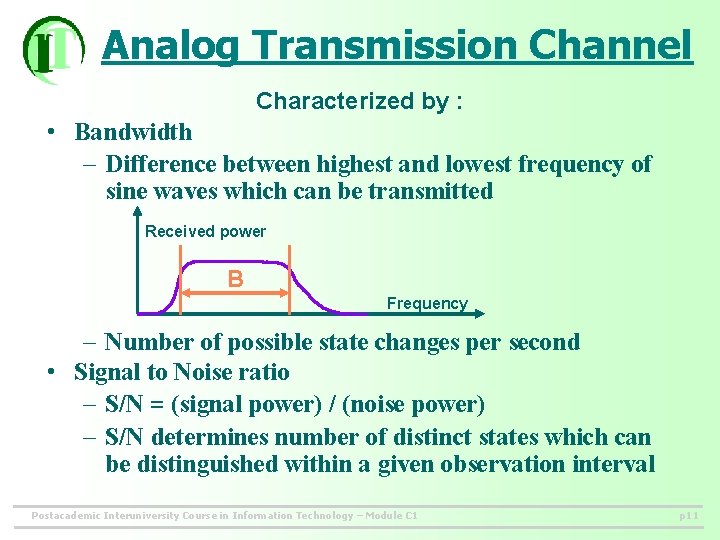
Analog Transmission Channel Characterized by : • Bandwidth – Difference between highest and lowest frequency of sine waves which can be transmitted Received power B Frequency – Number of possible state changes per second • Signal to Noise ratio – S/N = (signal power) / (noise power) – S/N determines number of distinct states which can be distinguished within a given observation interval Postacademic Interuniversity Course in Information Technology – Module C 1 p 11
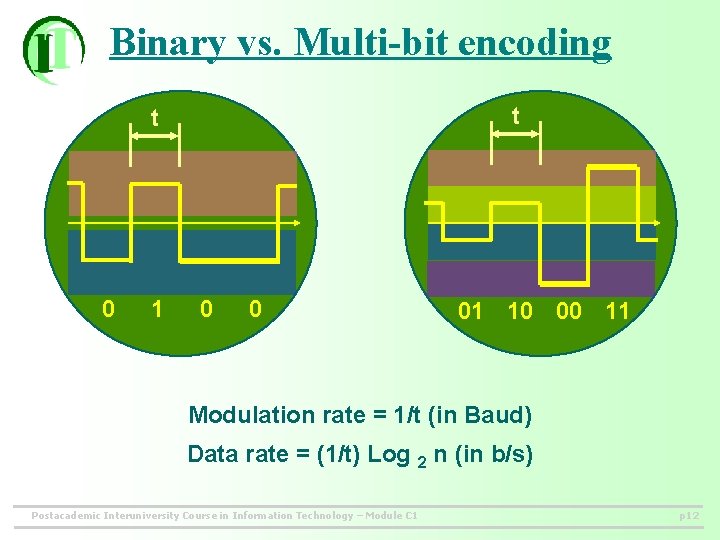
Binary vs. Multi-bit encoding t t 0 1 0 0 01 10 00 11 Modulation rate = 1/t (in Baud) Data rate = (1/t) Log 2 n (in b/s) Postacademic Interuniversity Course in Information Technology – Module C 1 p 12
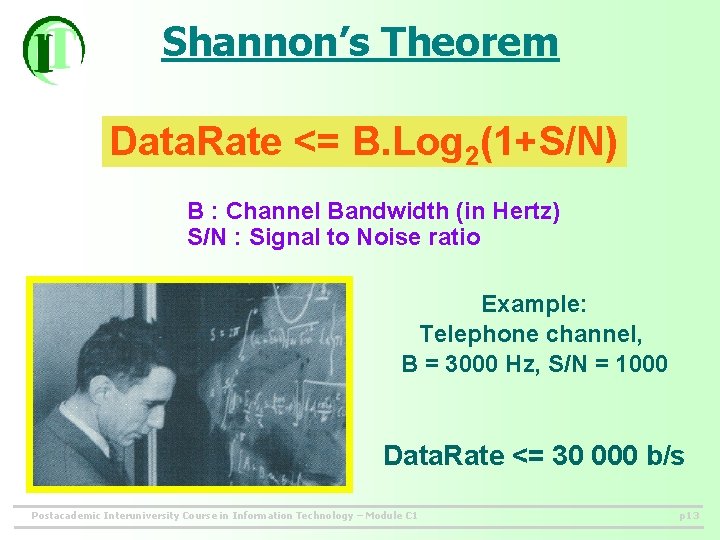
Shannon’s Theorem Data. Rate <= B. Log 2(1+S/N) B : Channel Bandwidth (in Hertz) S/N : Signal to Noise ratio Example: Telephone channel, B = 3000 Hz, S/N = 1000 Data. Rate <= 30 000 b/s Postacademic Interuniversity Course in Information Technology – Module C 1 p 13
Contents • Communications Theory – Parallel vs. serial transmission – Transmission Capacity (Shannon) – Error detection and correction • Communications Media – Optical fibers – Coaxial cables – Twisted pairs – Wireless Postacademic Interuniversity Course in Information Technology – Module C 1 p 14
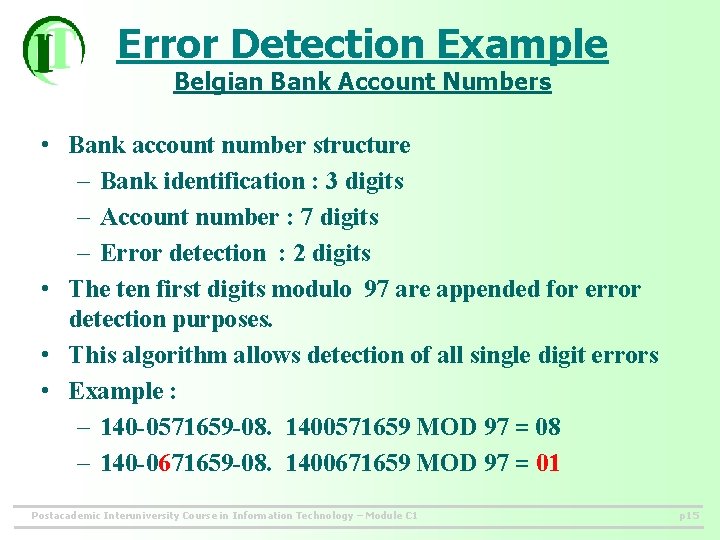
Error Detection Example Belgian Bank Account Numbers • Bank account number structure – Bank identification : 3 digits – Account number : 7 digits – Error detection : 2 digits • The ten first digits modulo 97 are appended for error detection purposes. • This algorithm allows detection of all single digit errors • Example : – 140 -0571659 -08. 1400571659 MOD 97 = 08 – 140 -0671659 -08. 1400671659 MOD 97 = 01 Postacademic Interuniversity Course in Information Technology – Module C 1 p 15
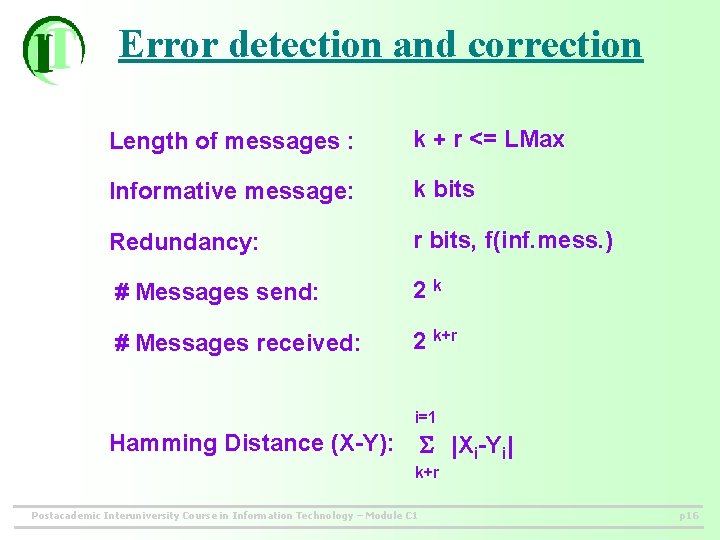
Error detection and correction Length of messages : k + r <= LMax Informative message: k bits Redundancy: r bits, f(inf. mess. ) # Messages send: 2 k # Messages received: 2 k+r i=1 |Xi-Yi| Hamming Distance (X-Y): k+r Postacademic Interuniversity Course in Information Technology – Module C 1 p 16
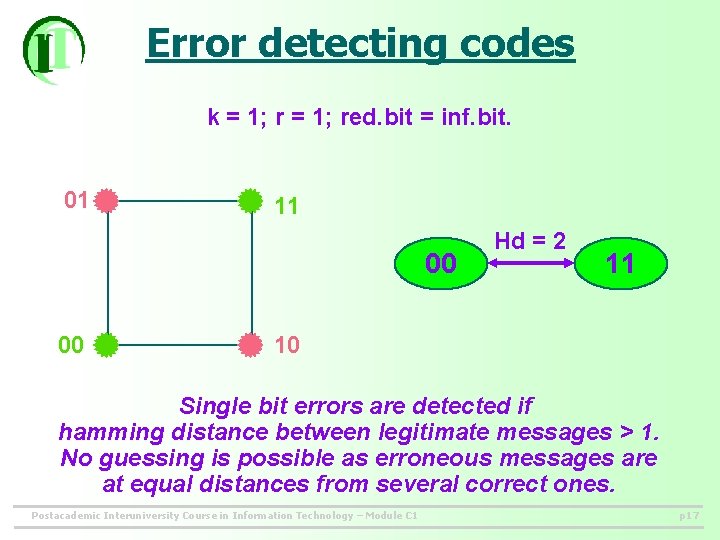
Error detecting codes k = 1; red. bit = inf. bit. 01 11 00 00 Hd = 2 11 10 Single bit errors are detected if hamming distance between legitimate messages > 1. No guessing is possible as erroneous messages are at equal distances from several correct ones. Postacademic Interuniversity Course in Information Technology – Module C 1 p 17
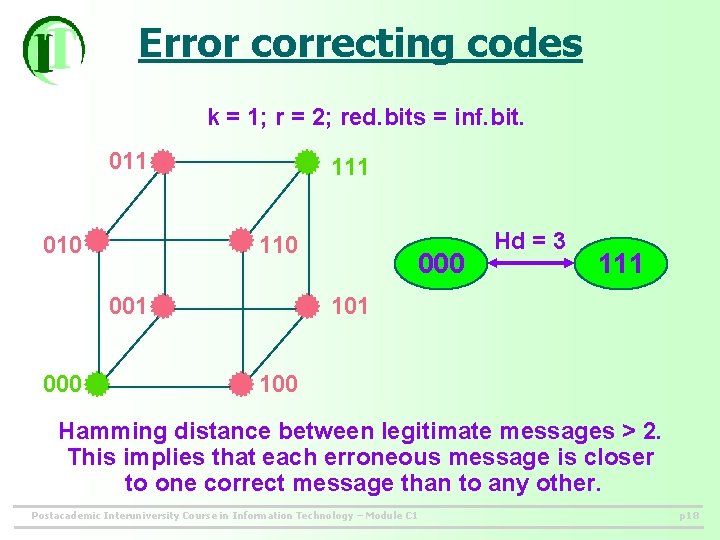
Error correcting codes k = 1; r = 2; red. bits = inf. bit. 011 010 111 110 001 000 Hd = 3 111 100 Hamming distance between legitimate messages > 2. This implies that each erroneous message is closer to one correct message than to any other. Postacademic Interuniversity Course in Information Technology – Module C 1 p 18
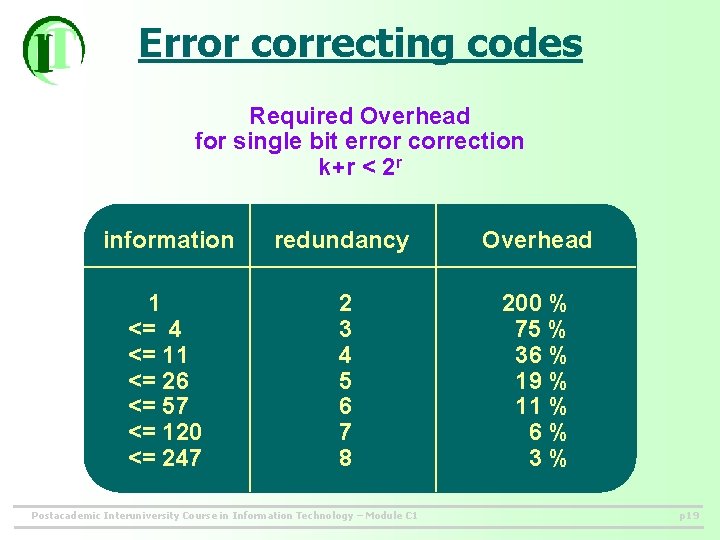
Error correcting codes Required Overhead for single bit error correction k+r < 2 r information redundancy Overhead 1 <= 4 <= 11 <= 26 <= 57 <= 120 <= 247 2 3 4 5 6 7 8 200 % 75 % 36 % 19 % 11 % 6% 3% Postacademic Interuniversity Course in Information Technology – Module C 1 p 19
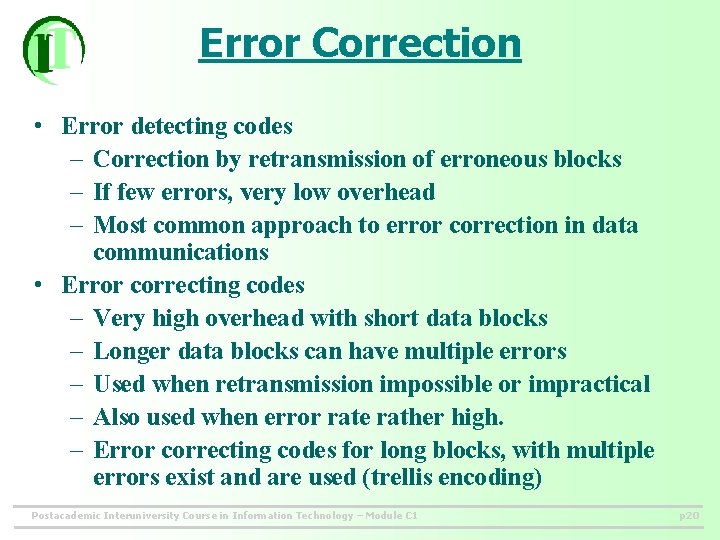
Error Correction • Error detecting codes – Correction by retransmission of erroneous blocks – If few errors, very low overhead – Most common approach to error correction in data communications • Error correcting codes – Very high overhead with short data blocks – Longer data blocks can have multiple errors – Used when retransmission impossible or impractical – Also used when error rate rather high. – Error correcting codes for long blocks, with multiple errors exist and are used (trellis encoding) Postacademic Interuniversity Course in Information Technology – Module C 1 p 20
Contents • Communications Theory – Parallel vs. serial transmission – Transmission Capacity (Shannon) – Error detection and correction • Communications Media – Optical fibers – Coaxial cables – Twisted pairs – Wireless Postacademic Interuniversity Course in Information Technology – Module C 1 p 21
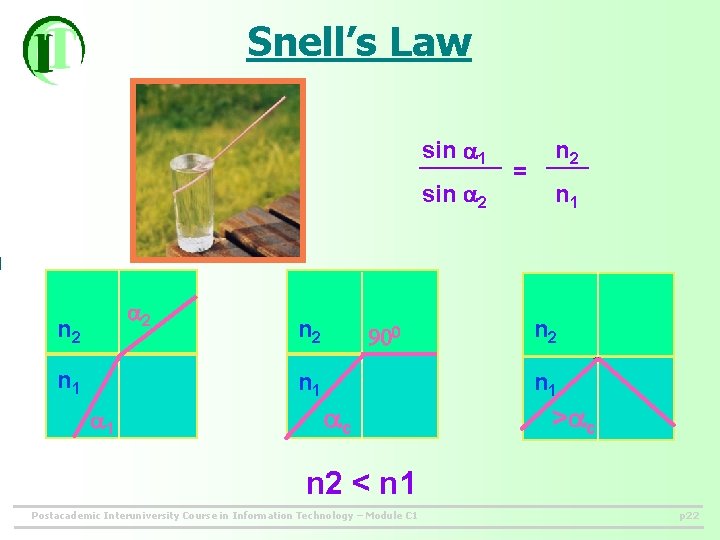
Snell’s Law sin 1 sin 2 2 n 1 n 2 n 1 1 c = n 2 n 1 > c n 2 < n 1 Postacademic Interuniversity Course in Information Technology – Module C 1 p 22
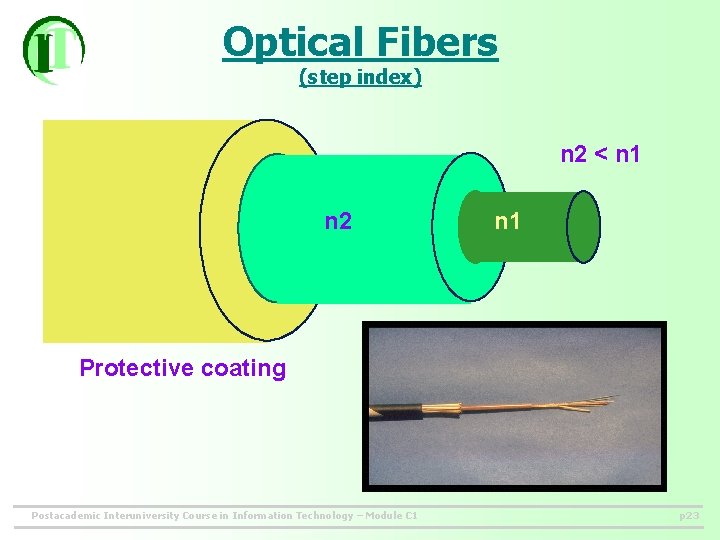
Optical Fibers (step index) n 2 < n 1 n 2 n 1 Protective coating Postacademic Interuniversity Course in Information Technology – Module C 1 p 23
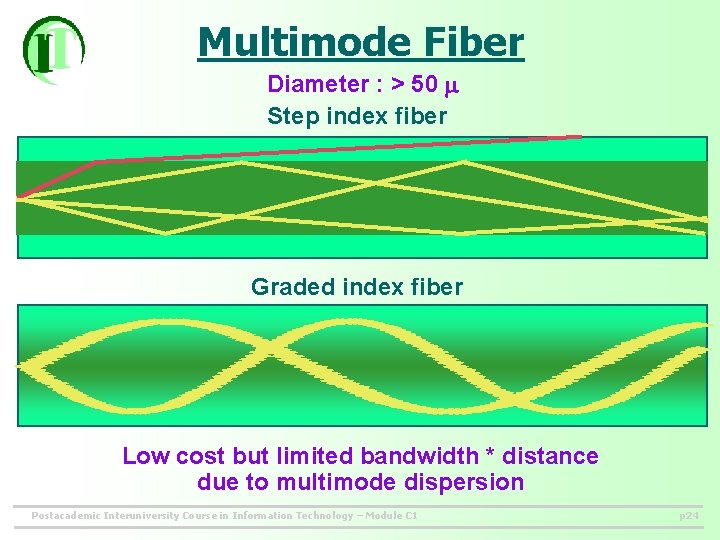
Multimode Fiber Diameter : > 50 Step index fiber Graded index fiber Low cost but limited bandwidth * distance due to multimode dispersion Postacademic Interuniversity Course in Information Technology – Module C 1 p 24
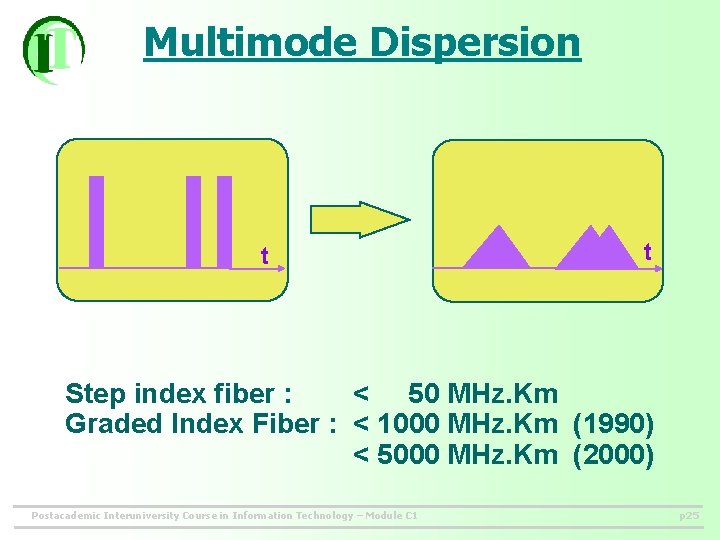
Multimode Dispersion t t Step index fiber : < 50 MHz. Km Graded Index Fiber : < 1000 MHz. Km (1990) < 5000 MHz. Km (2000) Postacademic Interuniversity Course in Information Technology – Module C 1 p 25
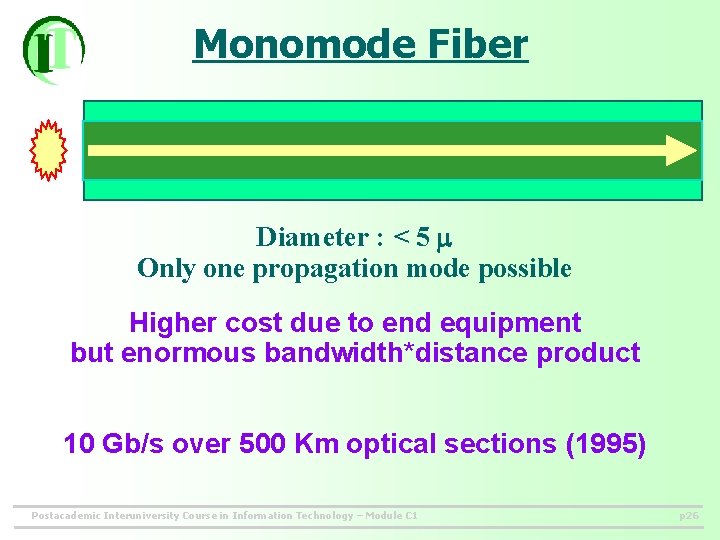
Monomode Fiber Diameter : < 5 Only one propagation mode possible Higher cost due to end equipment but enormous bandwidth*distance product 10 Gb/s over 500 Km optical sections (1995) Postacademic Interuniversity Course in Information Technology – Module C 1 p 26
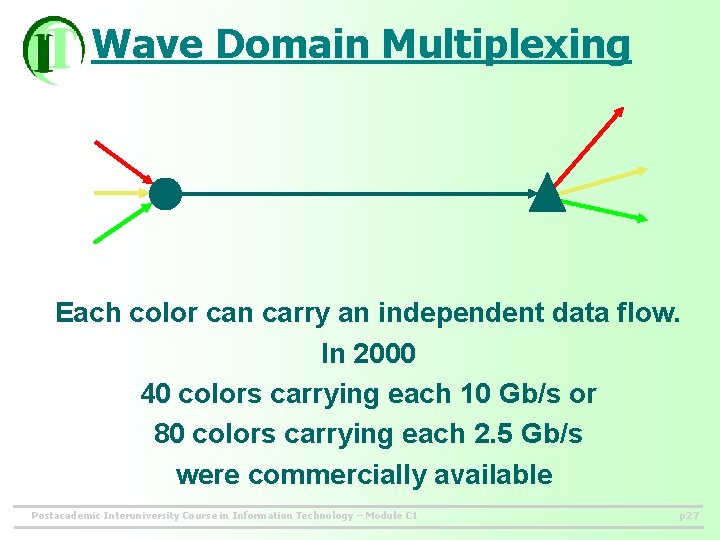
Wave Domain Multiplexing Each color can carry an independent data flow. In 2000 40 colors carrying each 10 Gb/s or 80 colors carrying each 2. 5 Gb/s were commercially available Postacademic Interuniversity Course in Information Technology – Module C 1 p 27
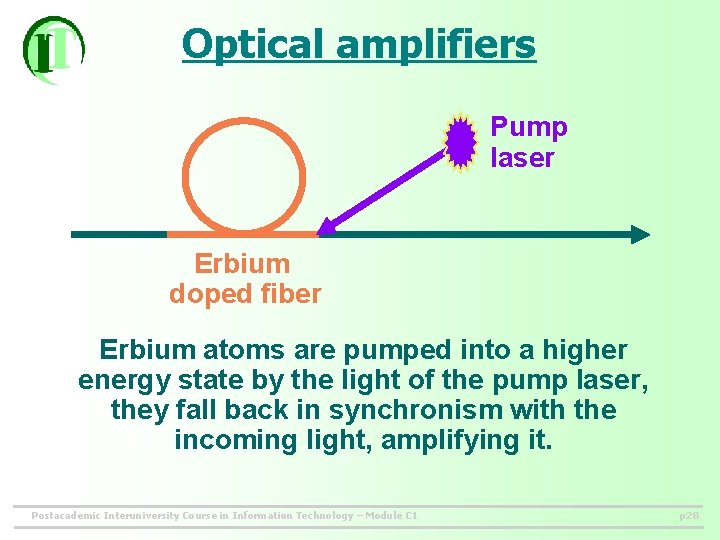
Optical amplifiers Pump laser Erbium doped fiber Erbium atoms are pumped into a higher energy state by the light of the pump laser, they fall back in synchronism with the incoming light, amplifying it. Postacademic Interuniversity Course in Information Technology – Module C 1 p 28
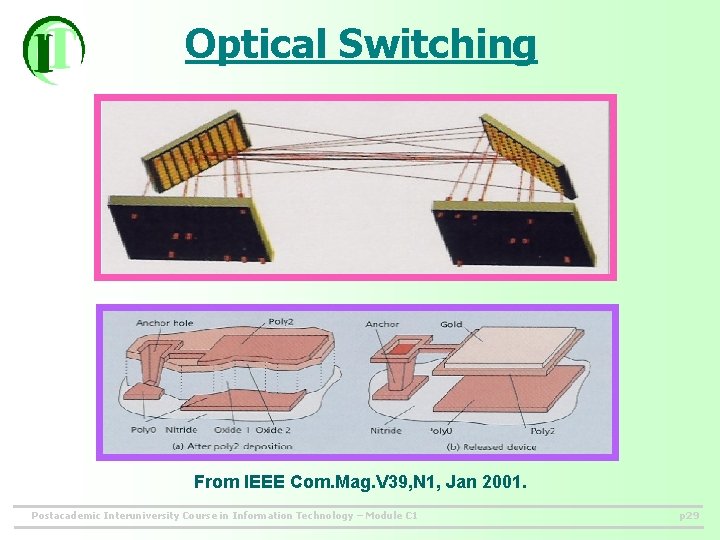
Optical Switching From IEEE Com. Mag. V 39, N 1, Jan 2001. Postacademic Interuniversity Course in Information Technology – Module C 1 p 29
Contents • Communications Theory – Parallel vs. serial transmission – Transmission Capacity (Shannon) – Error detection and correction • Communications Media – Optical fibers – Coaxial cables – Twisted pairs – Wireless Postacademic Interuniversity Course in Information Technology – Module C 1 p 30
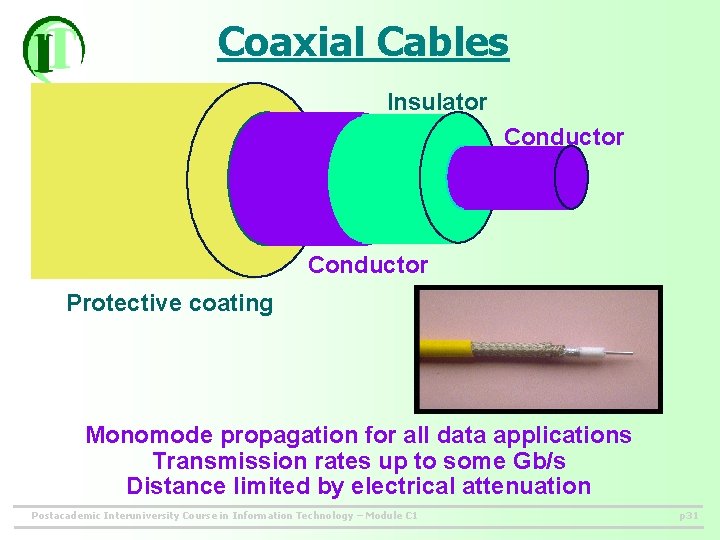
Coaxial Cables Insulator Conductor Protective coating Monomode propagation for all data applications Transmission rates up to some Gb/s Distance limited by electrical attenuation Postacademic Interuniversity Course in Information Technology – Module C 1 p 31
Contents • Communications Theory – Parallel vs. serial transmission – Transmission Capacity (Shannon) – Error detection and correction • Communications Media – Optical fibers – Coaxial cables – Twisted pairs – Wireless Postacademic Interuniversity Course in Information Technology – Module C 1 p 32
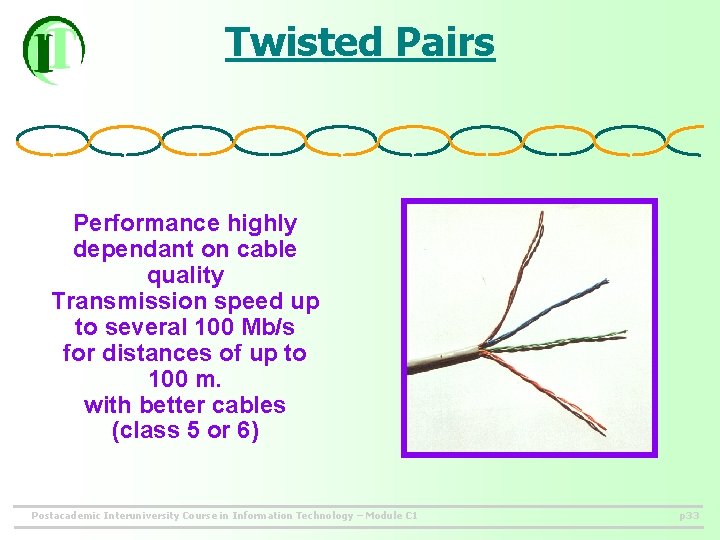
Twisted Pairs Performance highly dependant on cable quality Transmission speed up to several 100 Mb/s for distances of up to 100 m. with better cables (class 5 or 6) Postacademic Interuniversity Course in Information Technology – Module C 1 p 33
Contents • Communications Theory – Parallel vs. serial transmission – Transmission Capacity (Shannon) – Error detection and correction • Communications Media – Optical fibers – Coaxial cables – Twisted pairs – Wireless Postacademic Interuniversity Course in Information Technology – Module C 1 p 34
Wireless Communications Why ? Mobile terminals Cost of wiring Why Not ? Lower data rates Lower reliability Potential Lack of Security Postacademic Interuniversity Course in Information Technology – Module C 1 p 35
Wireless Communications Main restriction: Limited availability of bandwidth in the electromagnetic spectrum Some solutions: • Displace some heavy users • Reuse of frequencies at different locations (cellular radio, infrared LAN’s) • Sharing of a set of frequencies (spread spectrum radio) Postacademic Interuniversity Course in Information Technology – Module C 1 p 36
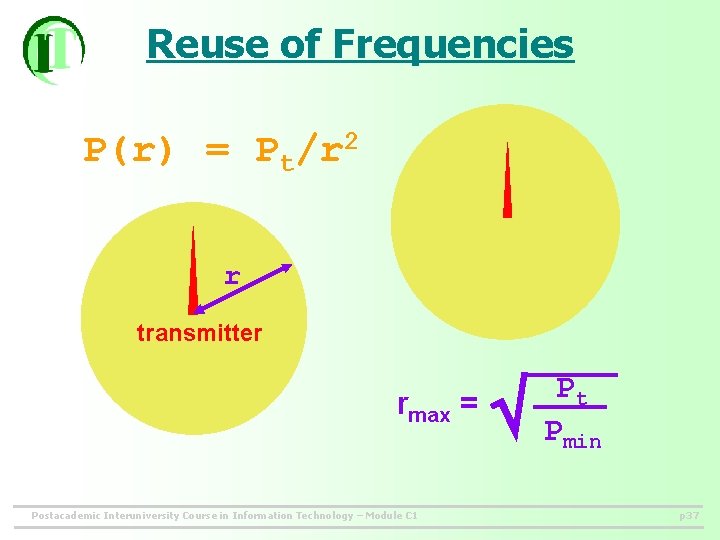
Reuse of Frequencies P(r) = Pt/r 2 r transmitter rmax = Postacademic Interuniversity Course in Information Technology – Module C 1 Pt Pmin p 37
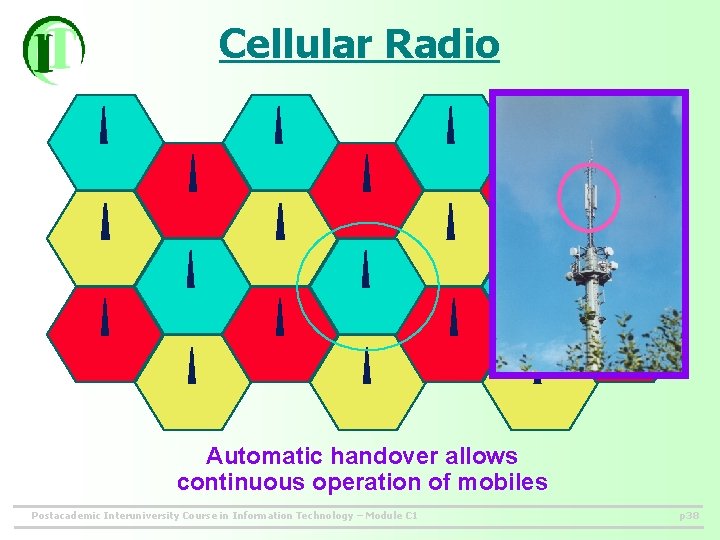
Cellular Radio Automatic handover allows continuous operation of mobiles Postacademic Interuniversity Course in Information Technology – Module C 1 p 38
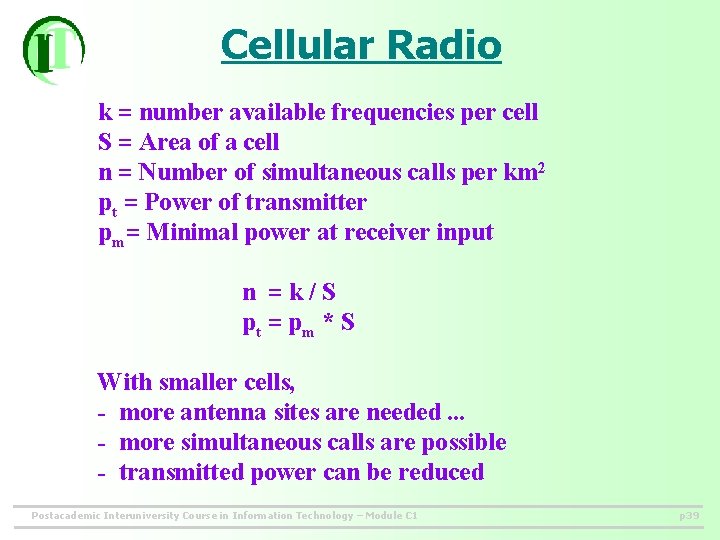
Cellular Radio k = number available frequencies per cell S = Area of a cell n = Number of simultaneous calls per km 2 pt = Power of transmitter pm= Minimal power at receiver input n =k/S pt = pm * S With smaller cells, - more antenna sites are needed. . . - more simultaneous calls are possible - transmitted power can be reduced Postacademic Interuniversity Course in Information Technology – Module C 1 p 39
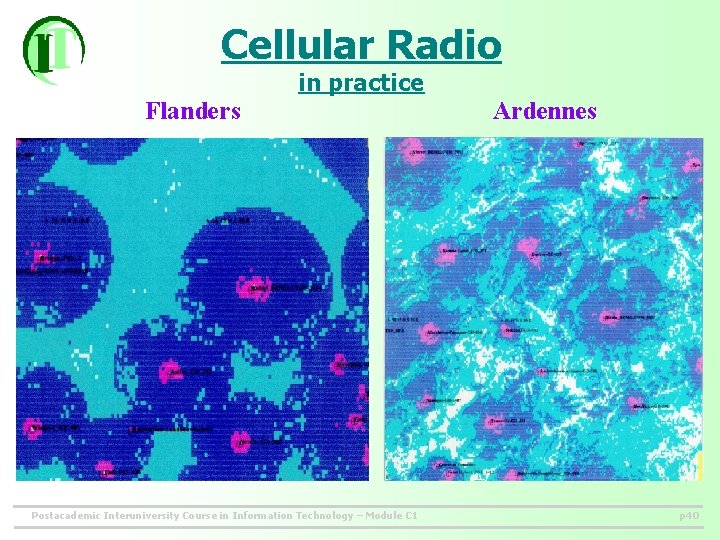
Cellular Radio in practice Flanders Postacademic Interuniversity Course in Information Technology – Module C 1 Ardennes p 40
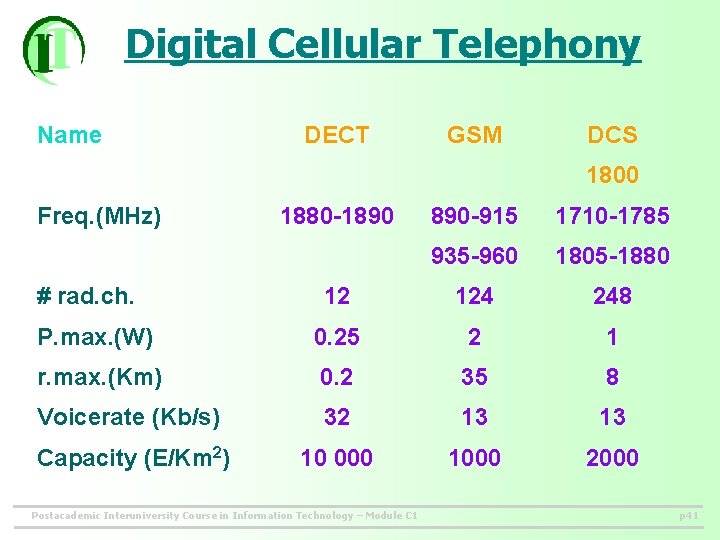
Digital Cellular Telephony Name DECT GSM DCS 1800 Freq. (MHz) 890 -915 1710 -1785 935 -960 1805 -1880 12 124 248 P. max. (W) 0. 25 2 1 r. max. (Km) 0. 2 35 8 Voicerate (Kb/s) 32 13 13 Capacity (E/Km 2) 10 000 1000 2000 # rad. ch. 1880 -1890 Postacademic Interuniversity Course in Information Technology – Module C 1 p 41
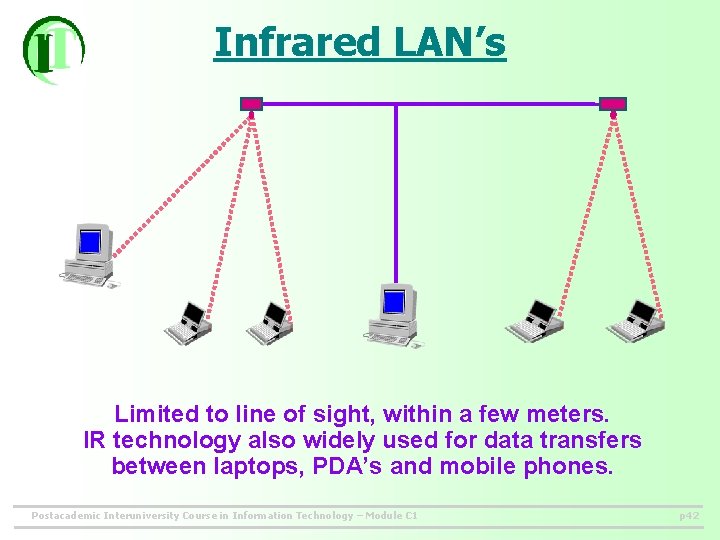
Infrared LAN’s Limited to line of sight, within a few meters. IR technology also widely used for data transfers between laptops, PDA’s and mobile phones. Postacademic Interuniversity Course in Information Technology – Module C 1 p 42
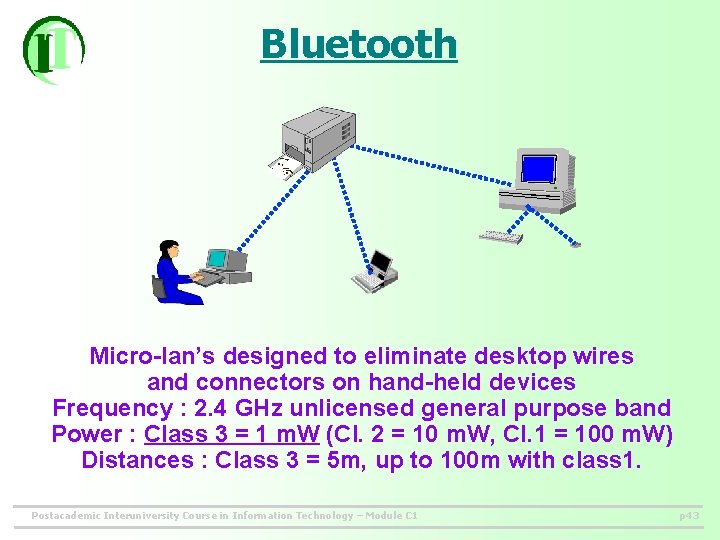
Bluetooth Micro-lan’s designed to eliminate desktop wires and connectors on hand-held devices Frequency : 2. 4 GHz unlicensed general purpose band Power : Class 3 = 1 m. W (Cl. 2 = 10 m. W, Cl. 1 = 100 m. W) Distances : Class 3 = 5 m, up to 100 m with class 1. Postacademic Interuniversity Course in Information Technology – Module C 1 p 43
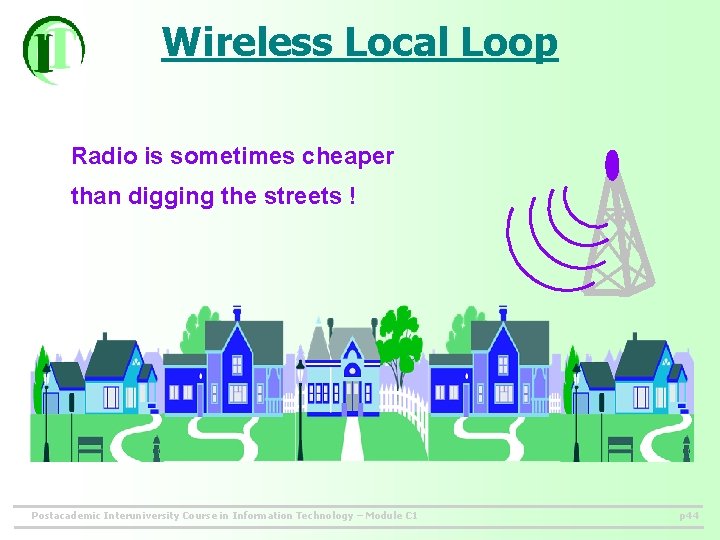
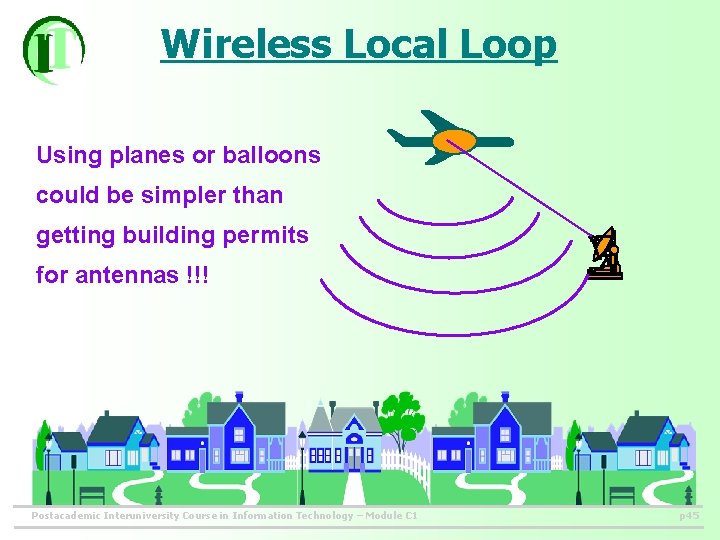
Wireless Local Loop Radio is sometimes cheaper than digging the streets ! Postacademic Interuniversity Course in Information Technology – Module C 1 p 44
Wireless Local Loop Using planes or balloons could be simpler than getting building permits for antennas !!! Postacademic Interuniversity Course in Information Technology – Module C 1 p 45
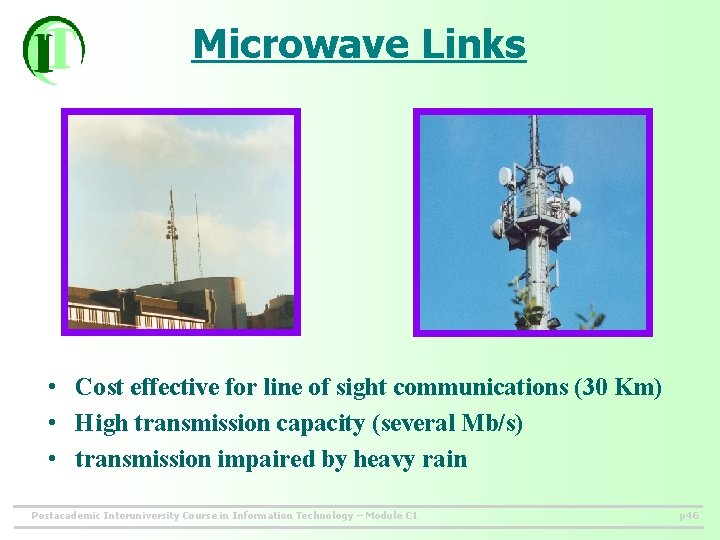
Microwave Links • Cost effective for line of sight communications (30 Km) • High transmission capacity (several Mb/s) • transmission impaired by heavy rain Postacademic Interuniversity Course in Information Technology – Module C 1 p 46
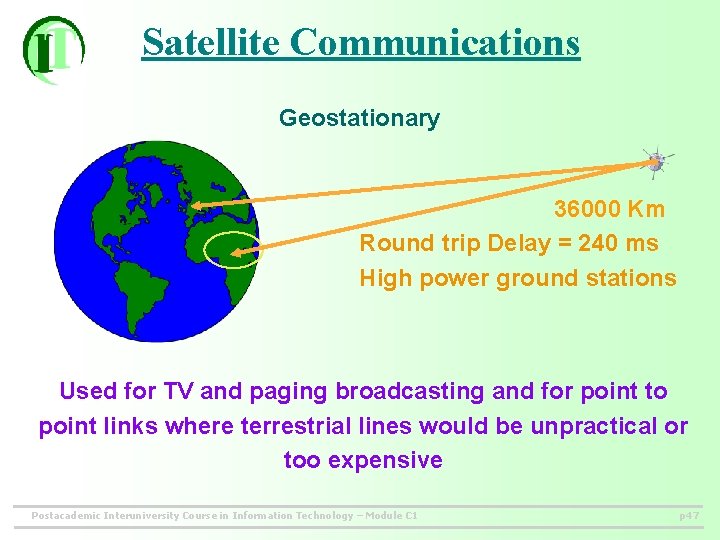
Satellite Communications Geostationary 36000 Km Round trip Delay = 240 ms High power ground stations Used for TV and paging broadcasting and for point to point links where terrestrial lines would be unpractical or too expensive Postacademic Interuniversity Course in Information Technology – Module C 1 p 47
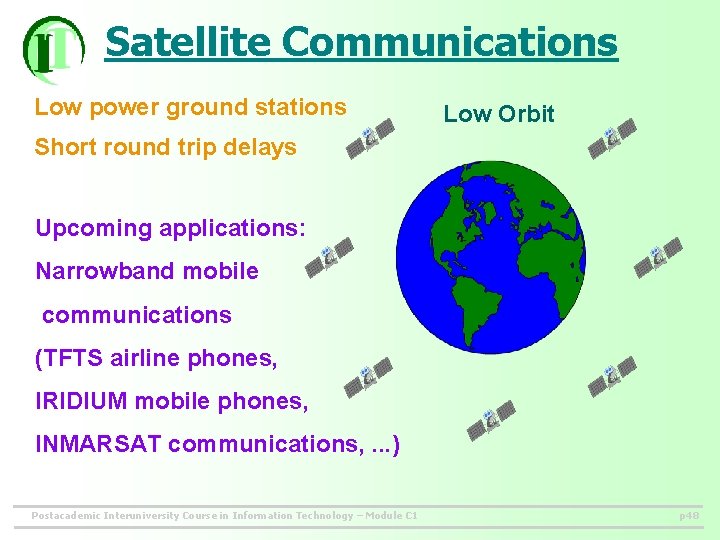
Satellite Communications Low power ground stations Low Orbit Short round trip delays Upcoming applications: Narrowband mobile communications (TFTS airline phones, IRIDIUM mobile phones, INMARSAT communications, . . . ) Postacademic Interuniversity Course in Information Technology – Module C 1 p 48
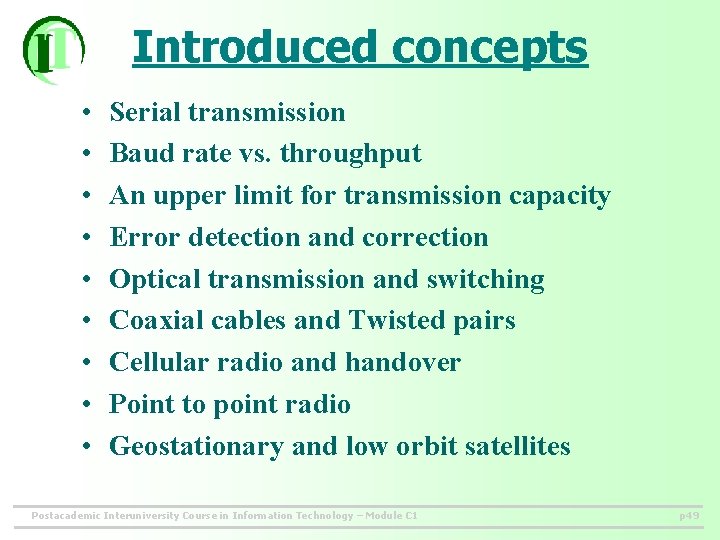
Introduced concepts • • • Serial transmission Baud rate vs. throughput An upper limit for transmission capacity Error detection and correction Optical transmission and switching Coaxial cables and Twisted pairs Cellular radio and handover Point to point radio Geostationary and low orbit satellites Postacademic Interuniversity Course in Information Technology – Module C 1 p 49