
Chapter 4 Communication The Essential Skill Chapter 4
- Slides: 39
Chapter 4 Communication: The Essential Skill
Chapter 4 Objectives • Explain the communication process. • Discuss the factors that impact communication. • Make your communication skills work for you. • Describe how technology is changing worker communication. Chapter 4 Communication: The Essential Skill 2
The Importance of Communication • Communication is the process by which we exchange information through a common system of symbols, signs, or behavior. • The four communication skills: listening, speaking, writing, reading Chapter 4 Communication: The Essential Skill 3
The Importance of Communication (cont. ) • Communication problems occur often: § People hear incorrectly 75 percent of the time. § They don’t accurately remember 75 percent of what they hear within three weeks. § Communication problems account for as much as 80 percent of problems at work. Chapter 4 Communication: The Essential Skill 4
The Importance of Communication (cont. ) • Employers look for employees who have strong communication skills. • Year after year, communications skills rank among the top skills employers want most. Chapter 4 Communication: The Essential Skill 5
The Importance of Communication (cont. ) • Effective communicators understand when to use impersonal, interpersonal, and personal communication. § Impersonal communication normally refers to items such as reports. § Interpersonal communication involves communicating or networking with others. § Personal communication should be used carefully in a work environment. Chapter 4 Communication: The Essential Skill 6
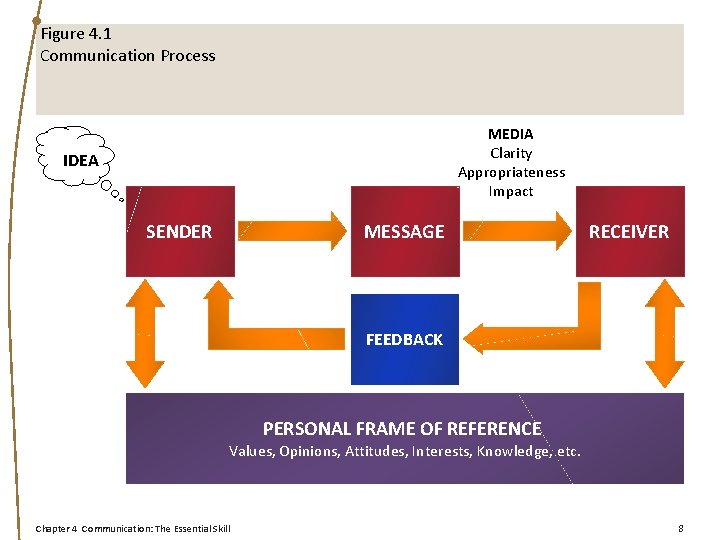
The Importance of Communication (cont. ) Communication Flow • The communication process includes three elements: § The message is the content of the communication. § The sender is the person who transmits the message. § The receiver is the person to whom the message is sent. Chapter 4 Communication: The Essential Skill 7
Figure 4. 1 Communication Process MEDIA Clarity Appropriateness Impact IDEA SENDER MESSAGE RECEIVER FEEDBACK PERSONAL FRAME OF REFERENCE Values, Opinions, Attitudes, Interests, Knowledge, etc. Chapter 4 Communication: The Essential Skill 8
The Importance of Communication (cont. ) Communication Flow (cont. ) • Communication can be verbal or nonverbal. § Verbal communication is either spoken or written, such as questions and responses. § Nonverbal examples are nodding, smiling, or frowning. • Communication can be one way or two way. § One-way communication—a formal speech, bulletin, or report § Two-way communication—a discussion or an instant message Chapter 4 Communication: The Essential Skill 9
The Importance of Communication (cont. ) Communication Flow (cont. ) • Feedback is used to determine that the correct message has been received. • To be most effective, feedback should be timely, frequent, and precise. Chapter 4 Communication: The Essential Skill 10
The Importance of Communication (cont. ) Communication Flow (cont. ) • Ways of obtaining feedback effectively: § Ask questions to determine if the receiver has understood. § Ask the receiver to restate what you have said. § Watch for nonverbal signs of understanding or confusion. § Request a written response to a written request. § Follow up with your request. Chapter 4 Communication: The Essential Skill 11
Factors That Hinder Good Communication • Semantics • Emotions • Role expectations • Personality and appearance • Prejudice Chapter 4 Communication: The Essential Skill • Failure to recognize changes • Poor organization of ideas • Information overload 12
Factors That Hinder Good Communication (cont. ) Time • Frequent tardiness will cause others to view you as disorganized, disrespectful, and even rude. • Being punctual can enhance your communication, relationships, and professional image. Timing • Choose the proper time to communicate. • Keep your supervisor informed in a timely manner. Chapter 4 Communication: The Essential Skill 13
Factors That Hinder Good Communication (cont. ) Context • Consider the context of a message along with its other components to interpret it more accurately. Medium • The medium is the form in which a message is communicated. • Consider not only what medium is suitable, but also what medium the receiver prefers. Chapter 4 Communication: The Essential Skill 14
Factors That Hinder Good Communication (cont. ) Humor • Humor can be a helpful part of your communication. • If you use humor inappropriately or thoughtlessly, you risk causing offense, embarrassment, and misunderstanding. Chapter 4 Communication: The Essential Skill 15
Making Your Communications Skills Work Listening Skills • The most important communication skill is the ability to listen. • Good listening skills are required at every level of an organization. Chapter 4 Communication: The Essential Skill 16
Making Your Communications Skills Work (cont. ) Listening Skills (cont. ) • Barriers to listening: § Lack of interest in the subject/speaker § Outside noises, distractions, fatigue § Limited vocabulary of sender and/or receiver § Poor delivery of message § Thinking ahead to a response § Speaker’s or listener’s lack of knowledge § Prejudices, or hearing what we want to hear Chapter 4 Communication: The Essential Skill 17
Making Your Communications Skills Work (cont. ) Listening Skills (cont. ) • Become a better listener by using active listening. • Active listening is a conscious effort to hear what someone is saying and to be aware of what that person is communicating nonverbally. Chapter 4 Communication: The Essential Skill 18
Making Your Communications Skills Work (cont. ) Listening Skills (cont. ) • To strengthen listening skills: § Give the speaker your undivided attention. § Keep your thoughts in the present. § Avoid prejudging the speaker. § Eliminate distractions. § Ask for clarifications. Chapter 4 Communication: The Essential Skill 19
Making Your Communications Skills Work (cont. ) Listening Skills (cont. ) • To strengthen listening skills (cont. ): § Be ready to give feedback. § Watch for nonverbal communication. § Avoid unnecessary note taking. § Listen for major ideas. § Be sincere and attentive. Chapter 4 Communication: The Essential Skill 20
Making Your Communications Skills Work (cont. ) Speaking Skills • Spoken communication is any message sent or received through oral words. • Effective spoken communication is clear, direct, and to the point. Chapter 4 Communication: The Essential Skill 21
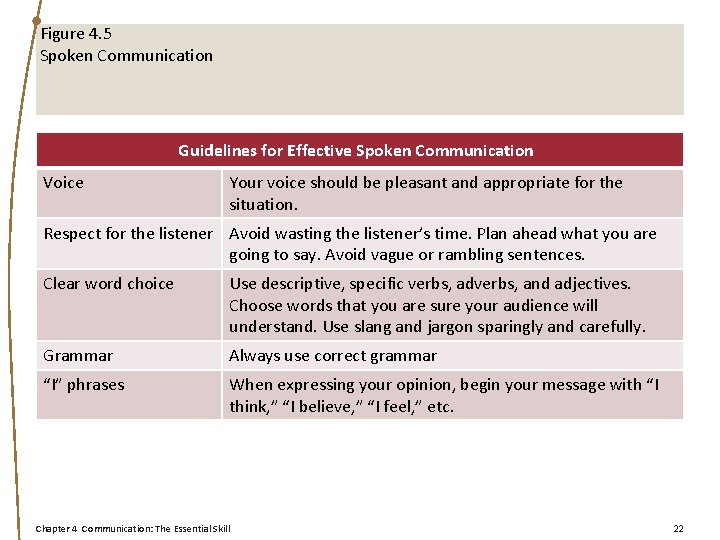
Figure 4. 5 Spoken Communication Guidelines for Effective Spoken Communication Voice Your voice should be pleasant and appropriate for the situation. Respect for the listener Avoid wasting the listener’s time. Plan ahead what you are going to say. Avoid vague or rambling sentences. Clear word choice Use descriptive, specific verbs, adverbs, and adjectives. Choose words that you are sure your audience will understand. Use slang and jargon sparingly and carefully. Grammar Always use correct grammar “I” phrases When expressing your opinion, begin your message with “I think, ” “I believe, ” “I feel, ” etc. Chapter 4 Communication: The Essential Skill 22
Making Your Communications Skills Work (cont. ) Speaking Skills (cont. ) • Choose the right level of communication: § First level—conventional or cliché or cocktail conversation § Second level—exploratory communication about facts or other people § Third level—participative communication about yourself § Last level—free sharing, in which you share your more personal thoughts and feelings Chapter 4 Communication: The Essential Skill 23
Making Your Communications Skills Work (cont. ) Speaking Skills (cont. ) • Respect confidentiality: § Being discreet is important in human relations at work, as well as in personal relationships. § Knowing when not to speak will help identify you as a person who understands and respects confidences. Chapter 4 Communication: The Essential Skill 24
Making Your Communications Skills Work (cont. ) Speaking Skills (cont. ) • To improve spoken communications: § Know when to just listen. § Question assumptions. § Tell the truth. § Think before speaking. § If you’re an unhappy customer, use expressions such as “I’m not upset or angry at you, but I am very upset. ” Chapter 4 Communication: The Essential Skill 25
Making Your Communications Skills Work (cont. ) Written Communication Skills • Writing is a basic and frequent form of communication. • Good writing skills are essential to career success. • The purpose of writing is to communicate, not impress. Chapter 4 Communication: The Essential Skill 26
Making Your Communications Skills Work (cont. ) Written Communication Skills (cont. ) • While preparing a written communication: § Think about your recipients. § Organize your thoughts. § Make an outline or a list of points. • While writing the communication: § Keep sentence length between 15 and 20 words. § Keep it short and simple. § Use active and passive voice appropriately. Chapter 4 Communication: The Essential Skill 27
Making Your Communications Skills Work (cont. ) Written Communication Skills (cont. ) • After writing, check the 5 Cs of communication rule. Is my writing: § Clear § Correct § Concise § Complete § Courteous Chapter 4 Communication: The Essential Skill 28
Making Your Communications Skills Work (cont. ) Written Communication Skills (cont. ) • For formal communications, use a standard business format appropriate for the document. • In any written communication, including e-mail, use your software’s spell and grammar checker. • Proofread carefully after spell checking. Chapter 4 Communication: The Essential Skill 29
Making Your Communications Skills Work (cont. ) Written Communication Skills (cont. ) • Suggestions for appropriate e-mail messages: § Be courteous, brief, and specific. Use only one subject per § § e-mail. Don’t write something you wouldn’t want to be made public. Read the message for clarity before sending it. Don’t immediately send or respond to an angry message. Don’t send jokes or chain letters without permission. Chapter 4 Communication: The Essential Skill 30
Making Your Communications Skills Work (cont. ) Nonverbal Communication • Nonverbal communication is communication without words. • Meaning is conveyed through: § Body language and gestures § Tone of voice § Positioning, posture, and haste Chapter 4 Communication: The Essential Skill 31
Making Your Communications Skills Work (cont. ) Nonverbal Communication (cont. ) • Nonverbal transmitters include: § Posture while sitting and standing § Facial expressions § Eye contact § Voice § Body movements § Personal space § Seating Chapter 4 Communication: The Essential Skill 32
Making Your Communications Skills Work (cont. ) Nonverbal Communication (cont. ) • Enhance nonverbal communication by: § Acting confident § Getting people to open up to you • Nonverbal behaviors such as closeness or touching may be misinterpreted at work. • Nonverbal communication varies from culture to culture. Chapter 4 Communication: The Essential Skill 33
Making Your Communications Skills Work (cont. ) Professional Presentation Skills • Ability to make effective presentations is a communication skill growing in importance. • Making an effective presentation requires speaking, listening, and nonverbal skills. • Presentations also require writing and technology skills to organize the presentation and create effective presentations or visual aids. Chapter 4 Communication: The Essential Skill 34
Making Your Communications Skills Work (cont. ) Professional Presentation Skills (cont. ) • Guidelines for creating effective presentations: § Analyze your audience. § Determine your goal. § Do your homework and research your topic. § Develop confidence by preparing carefully. § Plan how to deliver your presentation. Chapter 4 Communication: The Essential Skill 35
Making Your Communications Skills Work (cont. ) Professional Presentation Skills (cont. ) • Guidelines for creating effective presentations (cont. ): § Make a good first impression. § Keep your audience in mind. § Use visual aids that are appropriate, short, and to the point. § Consider nonverbal aspects of the message. § Have fun! Chapter 4 Communication: The Essential Skill 36
Technology and Worker Communication • Technology is changing how people communicate at work. • Common work technologies include: § Voice mail § Text-based messaging § E-mail § Fax § Teleconferencing/videoconferencing/Web conferencing § Social computing Chapter 4 Communication: The Essential Skill 37
Technology and Worker Communication (cont. ) • Suggestions for intelligent business communications: § Make your telephone a human relations tool. § Know when using the telephone or face-to-face § § communication is preferable to e-mail. Resist the urge to respond quickly when angry. Anything you send electronically could be broadly distributed or reach unintended recipients. Be careful what you post on social networks. Use communication technologies prudently and safely. Chapter 4 Communication: The Essential Skill 38
Key Terms • Communication • Context • Message • Medium • Sender • Active listening • Receiver • Spoken communication • Feedback • 5 C’s of communication • Semantics • Nonverbal • Information overload Chapter 4 Communication: The Essential Skill communication 39