
Chapter 4 Communication Physical and Developmental Assessment Copyright











- Slides: 33
Chapter 4 Communication, Physical, and Developmental Assessment Copyright © 2015, 2011, 2007, 2003, 1999 by Mosby, Inc. , an imprint of Elsevier Inc. All rights reserved.
Communication and Interviewing Establishing the setting Ø Ø Ø Introduction Ensure privacy and confidentiality Appropriate computer and phone communication Copyright © 2015, 2011, 2007, 2003, 1999 by Mosby, Inc. , an imprint of Elsevier Inc. All rights reserved. 2
Case Study A nurse is assessing children in a pediatric health clinic. As part of the physical assessment, the nurse knows that communication is key to a successful interview with the parents and the child. Using an organized approached and including patient teaching will be most effective throughout the process. Copyright © 2015, 2011, 2007, 2003, 1999 by Mosby, Inc. , an imprint of Elsevier Inc. All rights reserved. 3
Communication Parents/Caregivers Encouragement during interviewing Directing the focus Cultural awareness Listening/using silence Empathy Providing anticipatory guidance Avoiding blocks and information overload Using an Interpreter Copyright © 2015, 2011, 2007, 2003, 1999 by Mosby, Inc. , an imprint of Elsevier Inc. All rights reserved. 4
Case Study (Cont. ) 1. When interviewing a child and parent(s) at the beginning of a visit, it will be important for the nurse to follow which of the guiding principles? Select all that apply. A. Address parents however you think would be appropriate B. Include children in the interaction by asking them their name, age, and other information C. Provide as much privacy as possible D. Inform the family of the limits of confidentiality E. Young children should be given play provision to keep them occupied during the parent-nurse interview Copyright © 2015, 2011, 2007, 2003, 1999 by Mosby, Inc. , an imprint of Elsevier Inc. All rights reserved. 5
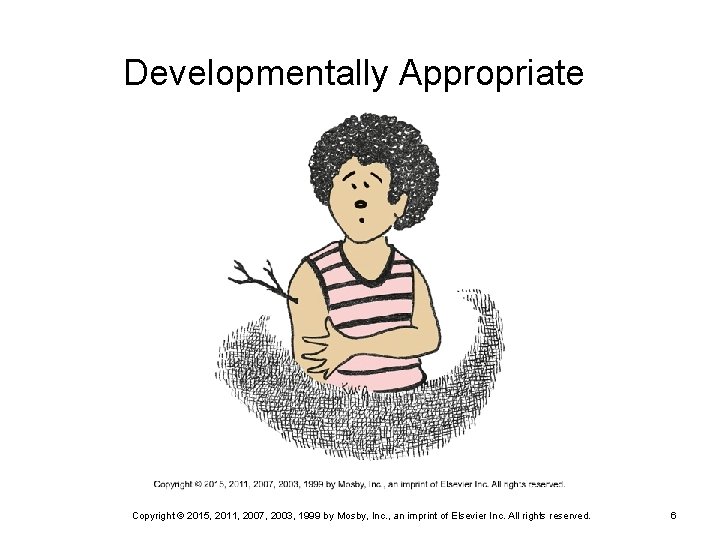
Developmentally Appropriate Communication Copyright © 2015, 2011, 2007, 2003, 1999 by Mosby, Inc. , an imprint of Elsevier Inc. All rights reserved. 6
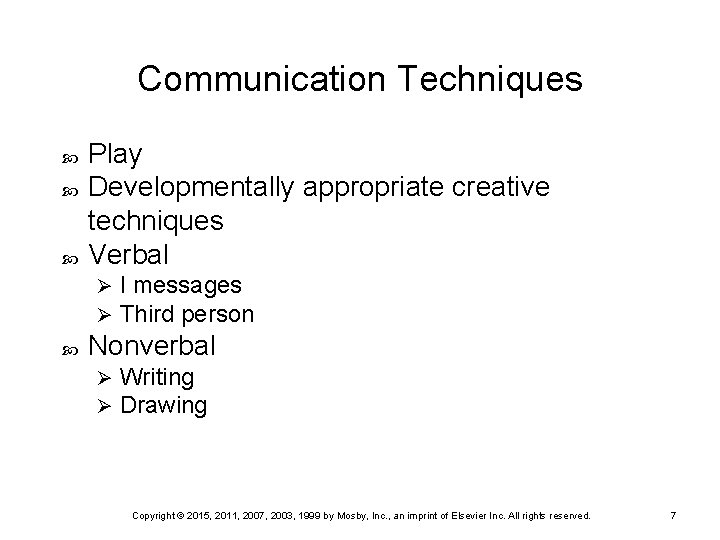
Communication Techniques Play Developmentally appropriate creative techniques Verbal Ø Ø I messages Third person Nonverbal Ø Ø Writing Drawing Copyright © 2015, 2011, 2007, 2003, 1999 by Mosby, Inc. , an imprint of Elsevier Inc. All rights reserved. 7
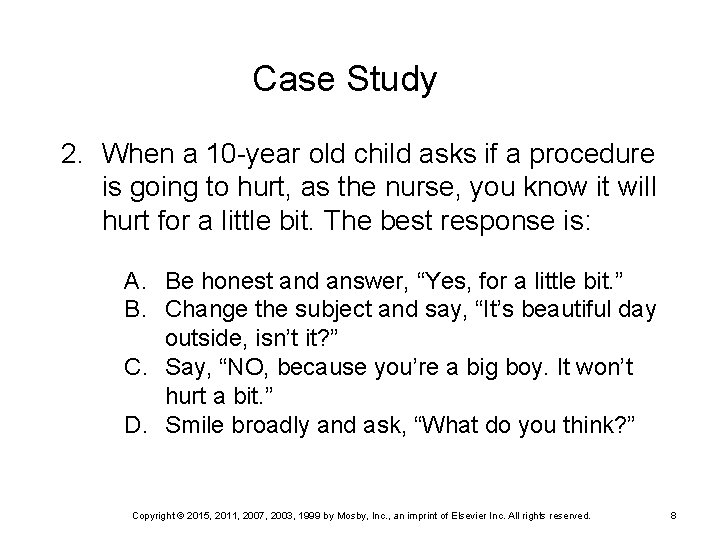
Case Study 2. When a 10 -year old child asks if a procedure is going to hurt, as the nurse, you know it will hurt for a little bit. The best response is: A. Be honest and answer, “Yes, for a little bit. ” B. Change the subject and say, “It’s beautiful day outside, isn’t it? ” C. Say, “NO, because you’re a big boy. It won’t hurt a bit. ” D. Smile broadly and ask, “What do you think? ” Copyright © 2015, 2011, 2007, 2003, 1999 by Mosby, Inc. , an imprint of Elsevier Inc. All rights reserved. 8
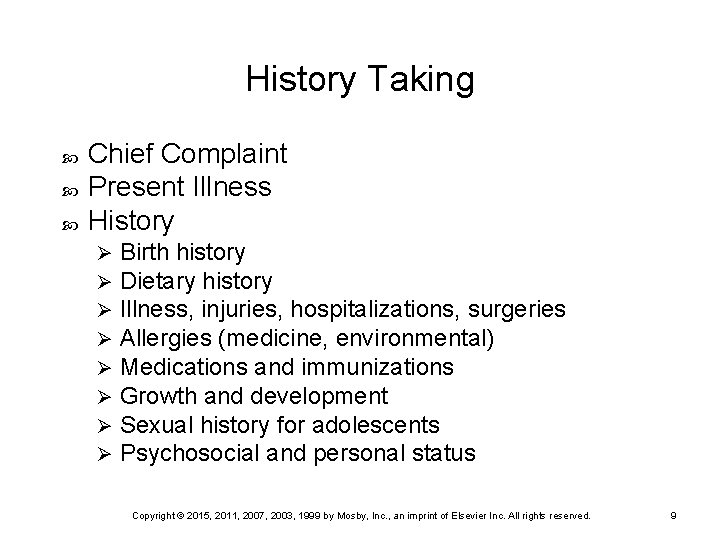
History Taking Chief Complaint Present Illness History Ø Ø Ø Ø Birth history Dietary history Illness, injuries, hospitalizations, surgeries Allergies (medicine, environmental) Medications and immunizations Growth and development Sexual history for adolescents Psychosocial and personal status Copyright © 2015, 2011, 2007, 2003, 1999 by Mosby, Inc. , an imprint of Elsevier Inc. All rights reserved. 9
Review of Systems General Skin HEENT Chest Respiratory CV GI GU/GYN Musculoskeletal Neurologic Endocrine Copyright © 2015, 2011, 2007, 2003, 1999 by Mosby, Inc. , an imprint of Elsevier Inc. All rights reserved. 10
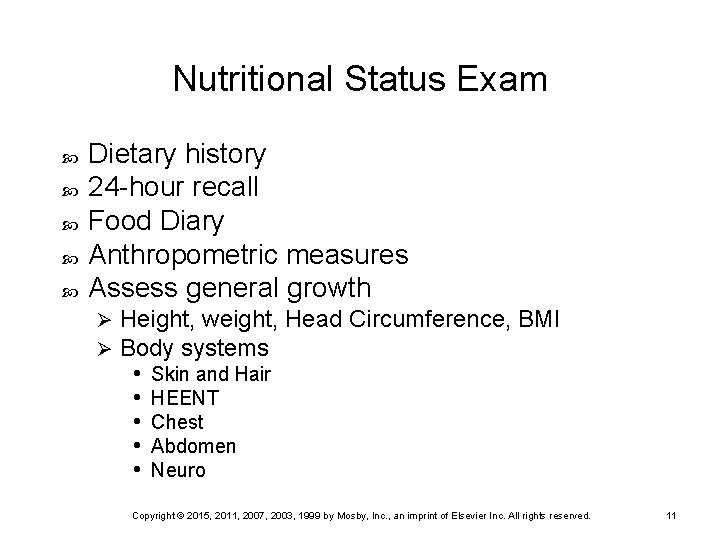
Nutritional Status Exam Dietary history 24 -hour recall Food Diary Anthropometric measures Assess general growth Ø Ø Height, weight, Head Circumference, BMI Body systems • Skin and Hair • HEENT • Chest • Abdomen • Neuro Copyright © 2015, 2011, 2007, 2003, 1999 by Mosby, Inc. , an imprint of Elsevier Inc. All rights reserved. 11
Examining the Child Generally: Ø Use developmental and chronologic age as main criteria for assessment sequence Prepare the child to ensure Atraumatic Care Ø Use guidelines for positioning children of various ages Ø Copyright © 2015, 2011, 2007, 2003, 1999 by Mosby, Inc. , an imprint of Elsevier Inc. All rights reserved. 12
Age-Specific Approaches to Exam Copyright © 2015, 2011, 2007, 2003, 1999 by Mosby, Inc. , an imprint of Elsevier Inc. All rights reserved. 13
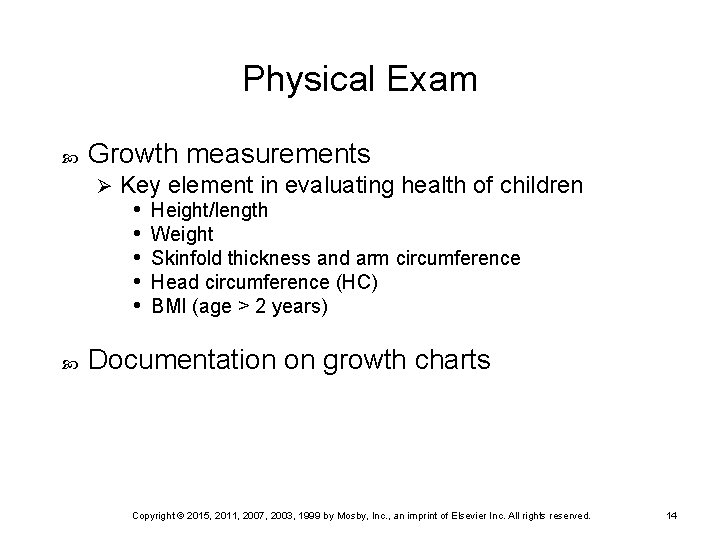
Physical Exam Growth measurements Ø Key element in evaluating health of children • Height/length • Weight • Skinfold thickness and arm circumference • Head circumference (HC) • BMI (age > 2 years) Documentation on growth charts Copyright © 2015, 2011, 2007, 2003, 1999 by Mosby, Inc. , an imprint of Elsevier Inc. All rights reserved. 14
Physiologic Measurements Temperature Method of measurement • Oral • Rectal • Axillary • Tympanic • Temporal Artery Ø Various devices for measurement Ø Measurement based on patient age, development, and illness severity Ø Copyright © 2015, 2011, 2007, 2003, 1999 by Mosby, Inc. , an imprint of Elsevier Inc. All rights reserved. 15
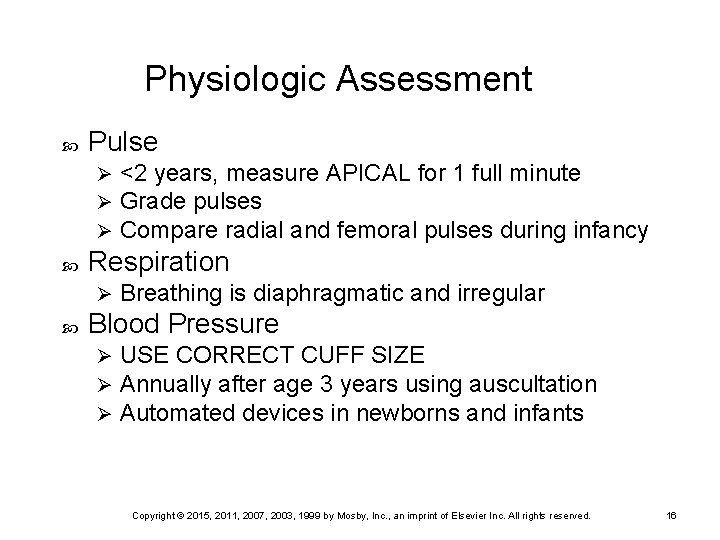
Physiologic Assessment Pulse Ø Ø Ø Respiration Ø <2 years, measure APICAL for 1 full minute Grade pulses Compare radial and femoral pulses during infancy Breathing is diaphragmatic and irregular Blood Pressure Ø Ø Ø USE CORRECT CUFF SIZE Annually after age 3 years using auscultation Automated devices in newborns and infants Copyright © 2015, 2011, 2007, 2003, 1999 by Mosby, Inc. , an imprint of Elsevier Inc. All rights reserved. 16
Infant and Toddler Vital Sign Measurement Count respirations FIRST (before disturbing the child) Count apical heart rate SECOND Measure blood pressure (if applicable) THIRD Measure temperature LAST Copyright © 2015, 2011, 2007, 2003, 1999 by Mosby, Inc. , an imprint of Elsevier Inc. All rights reserved. 17
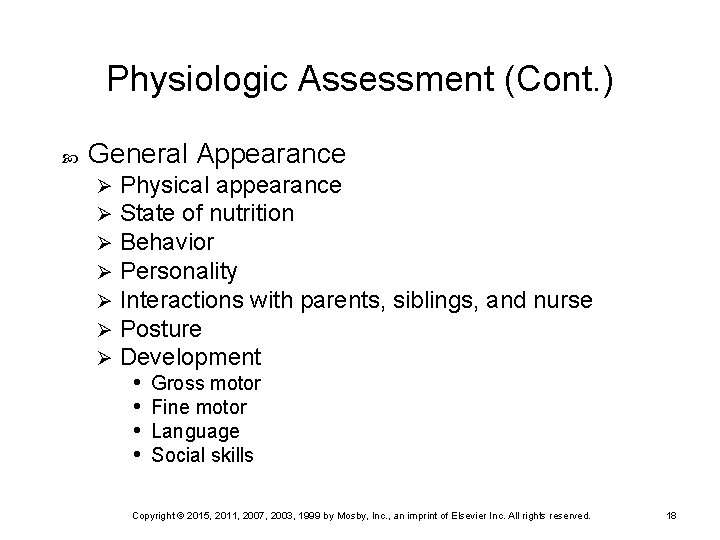
Physiologic Assessment (Cont. ) General Appearance Ø Ø Ø Ø Physical appearance State of nutrition Behavior Personality Interactions with parents, siblings, and nurse Posture Development • Gross motor • Fine motor • Language • Social skills Copyright © 2015, 2011, 2007, 2003, 1999 by Mosby, Inc. , an imprint of Elsevier Inc. All rights reserved. 18
Physiologic Assessment (Cont. ) SKIN Ø Ø Ø Ø Color Texture Temperature Moisture Turgor Lesions or rashes Accessory Structures • Hair and scalp • Nails • Palms Copyright © 2015, 2011, 2007, 2003, 1999 by Mosby, Inc. , an imprint of Elsevier Inc. All rights reserved. 19
Physiologic Assessment (Cont. ) Lymph Nodes Copyright © 2015, 2011, 2007, 2003, 1999 by Mosby, Inc. , an imprint of Elsevier Inc. All rights reserved. 20
Physiologic Assessment (Cont. ) Head and Neck Shape and symmetry Head control and range of motion Suture lines, fontanels, swelling • Anterior fontanel closes between 12 -18 months Ø Face for symmetry, movement and, appearance • “Make a face” Ø Neck for size, movement, range of motion, and skin folds Ø Ø Ø Copyright © 2015, 2011, 2007, 2003, 1999 by Mosby, Inc. , an imprint of Elsevier Inc. All rights reserved. 21
Physiologic Assessment (Cont. ) Eyes Inspect for placement of eyes, symmetry, and lids Assess conjunctivae and sclera Assess pupils for size, shape, movement, and accommodation Ø Check for Red Reflex bilaterally Ø Vision acuity • Light perception, fix, and follow (infants) • Snellen test (after age 3 years) • Peripheral vision Ø Check ocular Alignment • Cover test Ø Ø Ø Copyright © 2015, 2011, 2007, 2003, 1999 by Mosby, Inc. , an imprint of Elsevier Inc. All rights reserved. 22
Physiologic Assessment (Cont. ) Ears Inspect external structure • Alignment • Pinna • Pits/openings/tags or sinuses • Hygiene Ø Inspect internal structure • Assist to provide atraumatic exam • Assess tympanic canal • Tympanic membrane Ø Light reflex and bony landmarks • Auditory testing Copyright © 2015, 2011, 2007, 2003, 1999 by Mosby, Inc. , an imprint of Elsevier Inc. All rights reserved. 23
Case Study (Cont. ) 3. To visualize the eardrum in an infant, in which direction should the nurse pull the pinna? A. B. C. D. Back and forth Up and down Down and back Up and back Copyright © 2015, 2011, 2007, 2003, 1999 by Mosby, Inc. , an imprint of Elsevier Inc. All rights reserved. 24
Physiologic Assessment (Cont. ) Nose Placement and alignment Internal structures • Mucosal lining, turbinates, septum Ø Testing for smell Ø Ø Mouth and Throat Ø Ø Ø Lip color, moisture, symmetry Tongue movement and appearance Buccal mucosa color, moisture, ulcers Teeth, gingiva, mucous membranes Tonsil size, uvula and oropharynx color, moisture Copyright © 2015, 2011, 2007, 2003, 1999 by Mosby, Inc. , an imprint of Elsevier Inc. All rights reserved. 25
Physiologic Assessment (Cont. ) Chest Ø Ø Ø Inspect size, shape, symmetry, movement Bony landmarks Breast development (Tanner staging) Lungs Respiratory effort • Rate, rhythm, depth, and quality Ø Breath sounds Ø Percussion quality Ø Copyright © 2015, 2011, 2007, 2003, 1999 by Mosby, Inc. , an imprint of Elsevier Inc. All rights reserved. 26
Physiologic Assessment (Cont. ) Heart Ø Ø Apical impulse and PMI Assess rate, rhythm, sound (murmur) Copyright © 2015, 2011, 2007, 2003, 1999 by Mosby, Inc. , an imprint of Elsevier Inc. All rights reserved. 27
Physiologic Assessment (Cont. ) Abdomen Four quadrant approach Inspection • Size, shape, skin covering abdomen • Peristaltic waves • Umbilicus size, hygiene, hernias Ø Auscultation • Presence of bowel sounds Ø Palpation using atraumatic approaches • Superficial • Deep palpation • Femoral pulses Ø Ø Copyright © 2015, 2011, 2007, 2003, 1999 by Mosby, Inc. , an imprint of Elsevier Inc. All rights reserved. 28
Physiologic Assessment (Cont. ) Genitalia Ø Ø Ø Use “Matter of fact” approach Ensure privacy (drape) Reinforce self-exam, safety, and hygiene Anus Ø Ø Gluteal folds Anal reflex Copyright © 2015, 2011, 2007, 2003, 1999 by Mosby, Inc. , an imprint of Elsevier Inc. All rights reserved. 29
Physiologic Assessment (Cont. ) Spine and Extremities General curvature of the spine Assess for tuft, hair, dimples, or skin discoloration on lower back Ø Inspect for • Deformity of hands, feet, limbs • Symmetry of limbs • Movement and range of motion of limbs • Assess joints and muscles Ø Ø Strength Movement Range of motion Gait, posture Copyright © 2015, 2011, 2007, 2003, 1999 by Mosby, Inc. , an imprint of Elsevier Inc. All rights reserved. 30
Physiologic Assessment (Cont. ) Neurologic Assessment Physical, behavioral, and emotional assessment throughout exam Ø Cerebellar function • Balance and coordination Ø Reflexes • Consider persistence of primitive reflexes, loss of Ø reflexes, and hyperactivity of deep tendon reflexes Ø Cranial nerves • See Table 4 -11 for strategies of assessment Copyright © 2015, 2011, 2007, 2003, 1999 by Mosby, Inc. , an imprint of Elsevier Inc. All rights reserved. 31
Case Study (Cont. ) 4. After locomotion begins or after age 1, which reflex has typically disappeared? A. B. C. D. Babinski Blinking Palmer Planter Copyright © 2015, 2011, 2007, 2003, 1999 by Mosby, Inc. , an imprint of Elsevier Inc. All rights reserved. 32
Physiologic Assessment (Cont. ) Developmental Assessment Ø Ø Essential component of health appraisal Screening tools are used to gain quick assessment, identifying children below normal for their age so they can be further evaluated • Denver II • Ages and Stages (ASQ) Copyright © 2015, 2011, 2007, 2003, 1999 by Mosby, Inc. , an imprint of Elsevier Inc. All rights reserved. 33