
Chapter 4 Clinical decision making in drug therapy



- Slides: 16
Chapter 4 Clinical decision making in drug therapy Copyright © 2011 Wolters Kluwer Health | Lippincott Williams & Wilkins
Nursing and midwifery: art and science • Assuming increasing responsibilities • Holistic • Nurses and midwives are key healthcare providers • Integrate knowledge of the – Basic sciences – Social sciences – Education – Other disciplines Copyright © 2014 Wolters Kluwer • All Rights Reserved
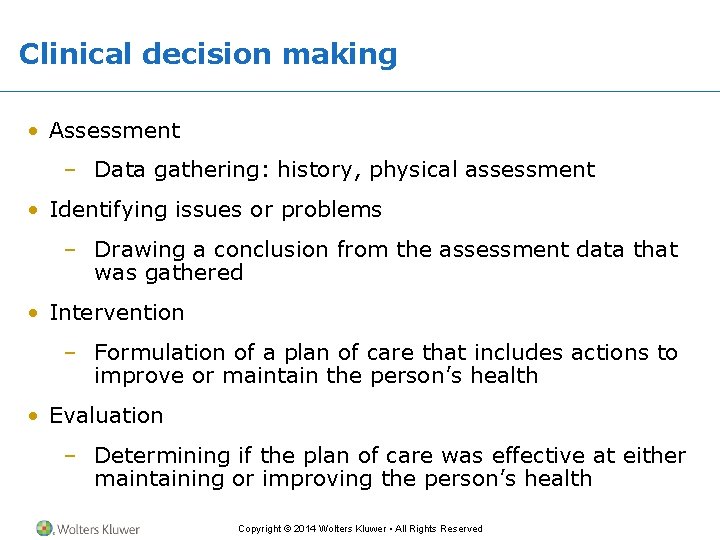
Clinical decision making • Assessment – Data gathering: history, physical assessment • Identifying issues or problems – Drawing a conclusion from the assessment data that was gathered • Intervention – Formulation of a plan of care that includes actions to improve or maintain the person’s health • Evaluation – Determining if the plan of care was effective at either maintaining or improving the person’s health Copyright © 2014 Wolters Kluwer • All Rights Reserved
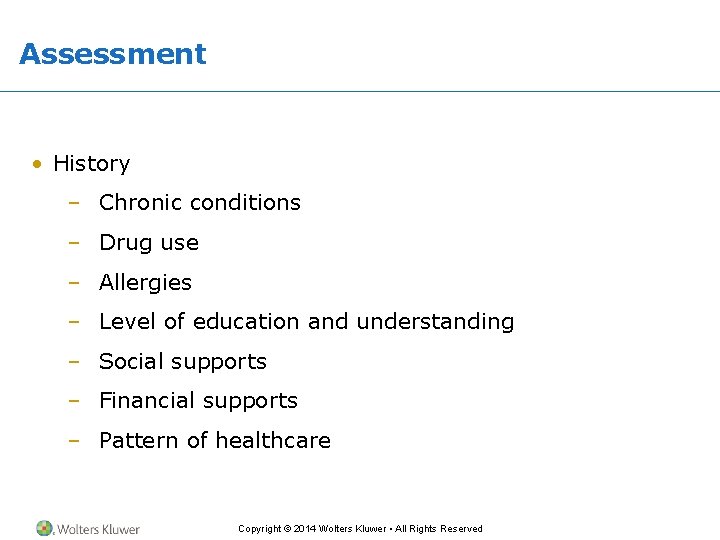
Assessment • History – Chronic conditions – Drug use – Allergies – Level of education and understanding – Social supports – Financial supports – Pattern of healthcare Copyright © 2014 Wolters Kluwer • All Rights Reserved
Physical examination • Weight • Age • Physical parameters related to disease or drug effects Copyright © 2014 Wolters Kluwer • All Rights Reserved
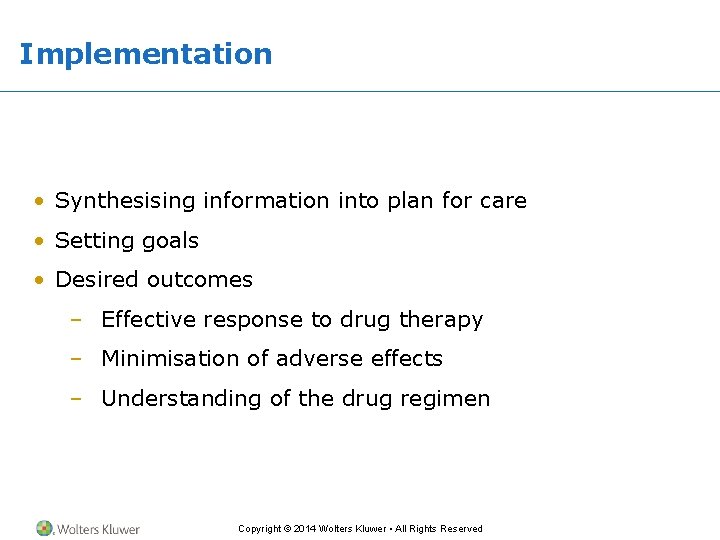
Implementation • Synthesising information into plan for care • Setting goals • Desired outcomes – Effective response to drug therapy – Minimisation of adverse effects – Understanding of the drug regimen Copyright © 2014 Wolters Kluwer • All Rights Reserved
Interventions • Three types of care interventions – Drug administration – Provision of comfort measures – Individual/family education Copyright © 2014 Wolters Kluwer • All Rights Reserved
Proper drug administration (the seven rights) • Drug • Storage • Route • Dosage • Preparation • Timing • Recording Copyright © 2014 Wolters Kluwer • All Rights Reserved
Comfort measures • Help the person cope with the effects of drug therapy • Nurses and midwives are in a unique position for this • Person more likely to be compliant Copyright © 2014 Wolters Kluwer • All Rights Reserved
Promoting drug therapy • Placebo effect • Managing adverse effect • Lifestyle adjustment Copyright © 2014 Wolters Kluwer • All Rights Reserved
Individual and family education • Cornerstone of drug therapy • Nurses and midwives are the primary educators about medications Copyright © 2014 Wolters Kluwer • All Rights Reserved
Elements of teaching • Name, dose and action of drug • Timing of administration • Special storage and preparation instructions • Specific OTC drugs or alternative therapies to avoid • Special comfort or safety measures • Specific points about drug toxicity • Specific warnings about drug discontinuation Copyright © 2014 Wolters Kluwer • All Rights Reserved
Evaluation • Part of the continuing process of care • Leads to changes in assessment, problem/issue identification and intervention Copyright © 2014 Wolters Kluwer • All Rights Reserved
Prevention of medication errors • “To err is human” • Drug regimen process • Series of checks – Nurse’s or midwife’s role – Person’s role • Reporting of medication errors Copyright © 2014 Wolters Kluwer • All Rights Reserved
Question • What information needs to be included in a doctor’s order for a person so the care provider can use the “seven rights” when administering medication? • a. Person’s weight • b. Person’s drug history • c. Person’s name • d. Person’s address Copyright © 2014 Wolters Kluwer • All Rights Reserved
Answer • Person’s name • Rationale: The doctor’s order for a drug needs to include information that allows the care provider to administer the medication according to the seven “rights” to ensure safe and effective drug administration. These are correct drug and person, correct storage of drug, correct and most effective route, correct dosage, correct preparation, correct timing, and correct recording of administration. Copyright © 2014 Wolters Kluwer • All Rights Reserved