
Chapter 4 Class 4 Correlation How strong is

![Correlation Coefficient r= n. Sxy - Sx. Sy [n. Sx 2 - (Sx)2][n. Sy](https://slidetodoc.com/presentation_image_h/7e033dda2322838927f72c4a42e73517/image-3.jpg "Correlation Coefficient r= n. Sxy - Sx. Sy [n. Sx 2 - (Sx)2][n. Sy")
- Slides: 23
Chapter 4 Class 4
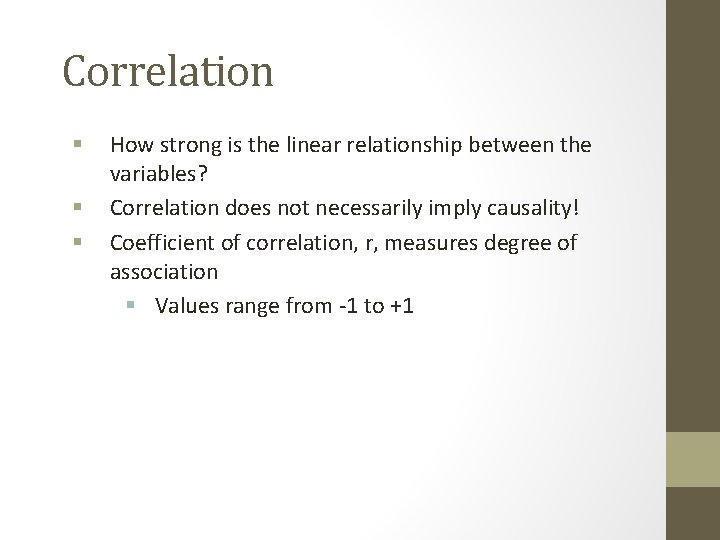
Correlation § § § How strong is the linear relationship between the variables? Correlation does not necessarily imply causality! Coefficient of correlation, r, measures degree of association § Values range from -1 to +1
Correlation Coefficient r= n. Sxy - Sx. Sy [n. Sx 2 - (Sx)2][n. Sy 2 - (Sy)2]
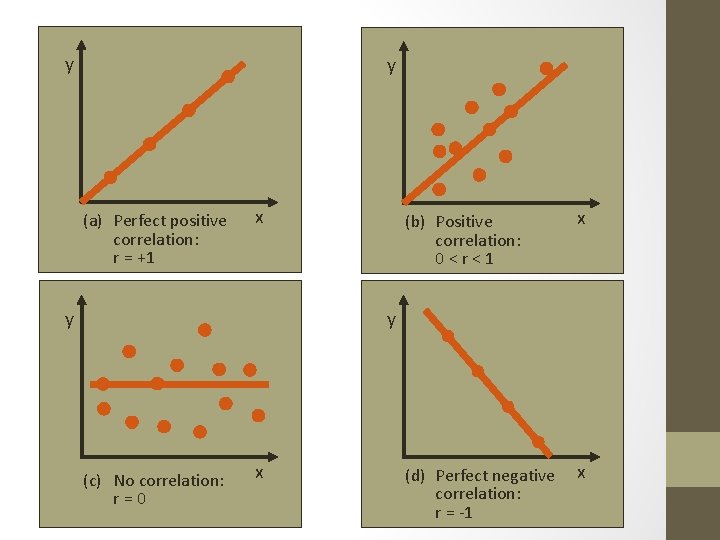
y y (a) Perfect positive correlation: r = +1 x y (b) Positive correlation: 0<r<1 x (d) Perfect negative correlation: r = -1 x y (c) No correlation: r=0 x
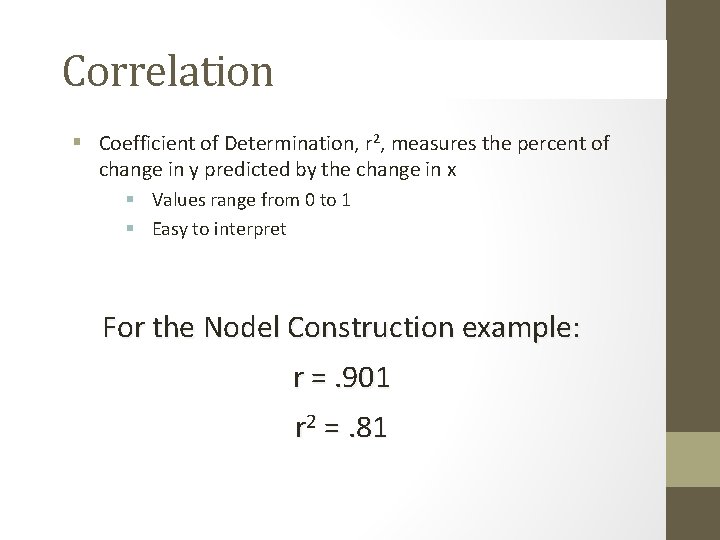
Correlation § Coefficient of Determination, r 2, measures the percent of change in y predicted by the change in x § Values range from 0 to 1 § Easy to interpret For the Nodel Construction example: r =. 901 r 2 =. 81
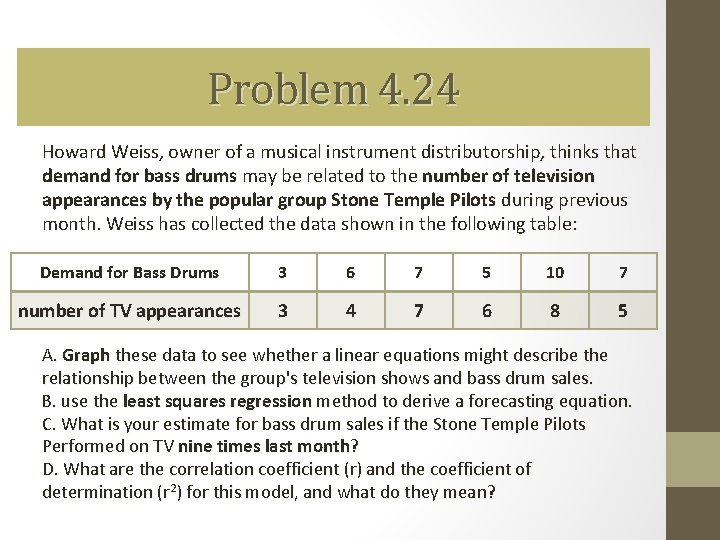
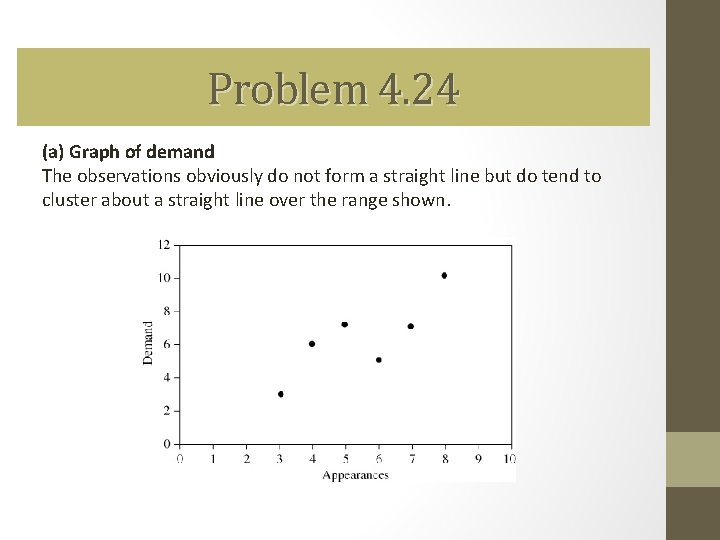
Problem 4. 24 Howard Weiss, owner of a musical instrument distributorship, thinks that demand for bass drums may be related to the number of television appearances by the popular group Stone Temple Pilots during previous month. Weiss has collected the data shown in the following table: Demand for Bass Drums 3 6 7 5 10 7 number of TV appearances 3 4 7 6 8 5 A. Graph these data to see whether a linear equations might describe the relationship between the group's television shows and bass drum sales. B. use the least squares regression method to derive a forecasting equation. C. What is your estimate for bass drum sales if the Stone Temple Pilots Performed on TV nine times last month? D. What are the correlation coefficient (r) and the coefficient of determination (r 2) for this model, and what do they mean?
Problem 4. 24 (a) Graph of demand The observations obviously do not form a straight line but do tend to cluster about a straight line over the range shown.
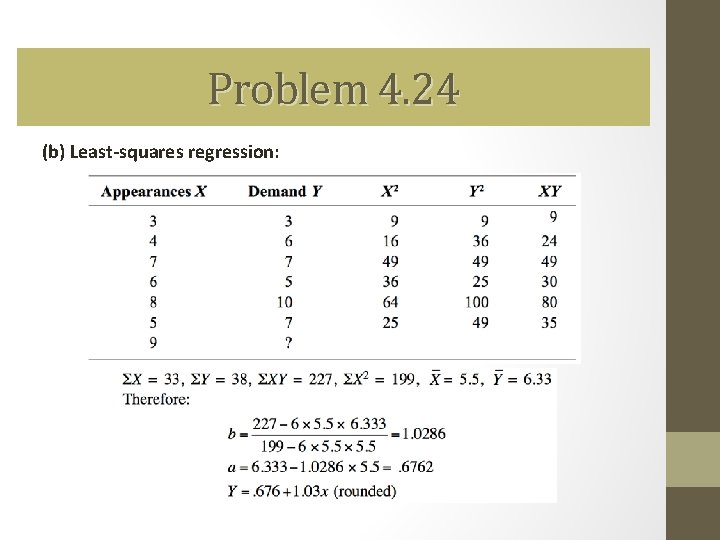
Problem 4. 24 (b) Least-squares regression:
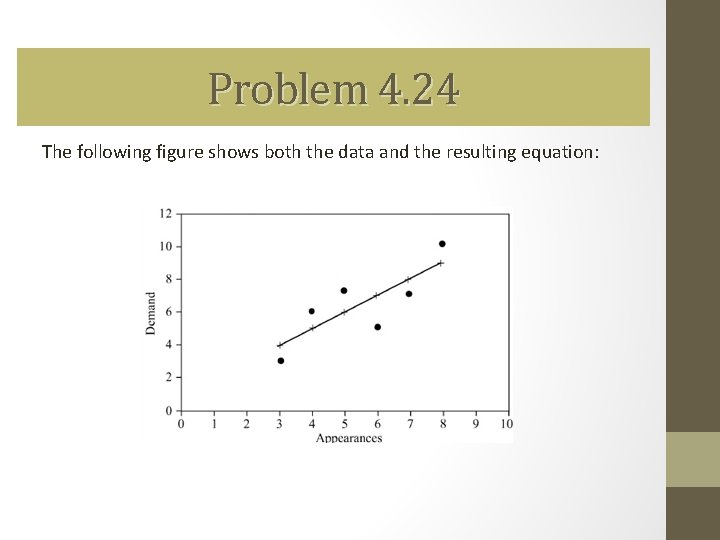
Problem 4. 24 The following figure shows both the data and the resulting equation:
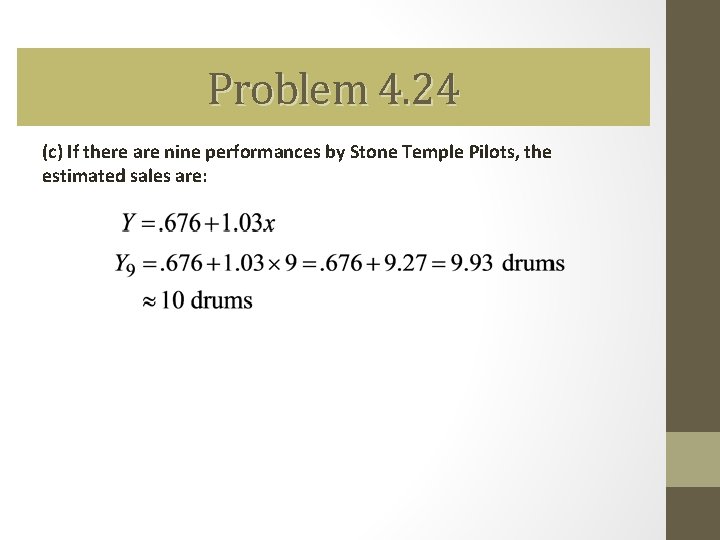
Problem 4. 24 (c) If there are nine performances by Stone Temple Pilots, the estimated sales are:
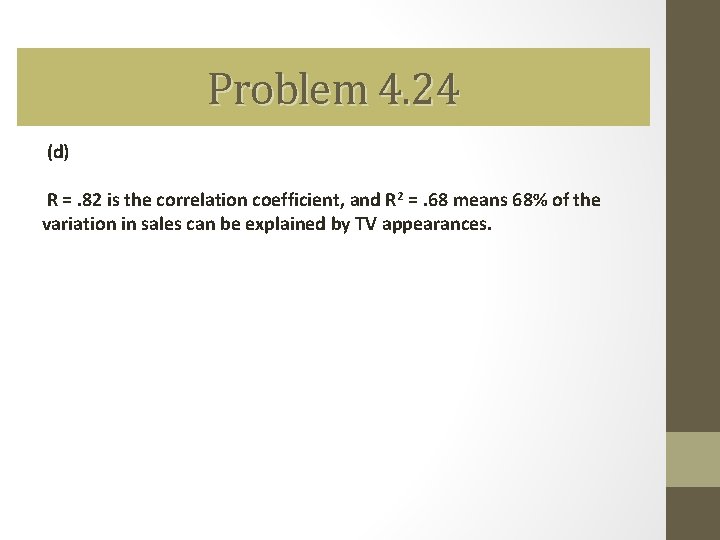
Problem 4. 24 (d) R =. 82 is the correlation coefficient, and R 2 =. 68 means 68% of the variation in sales can be explained by TV appearances.
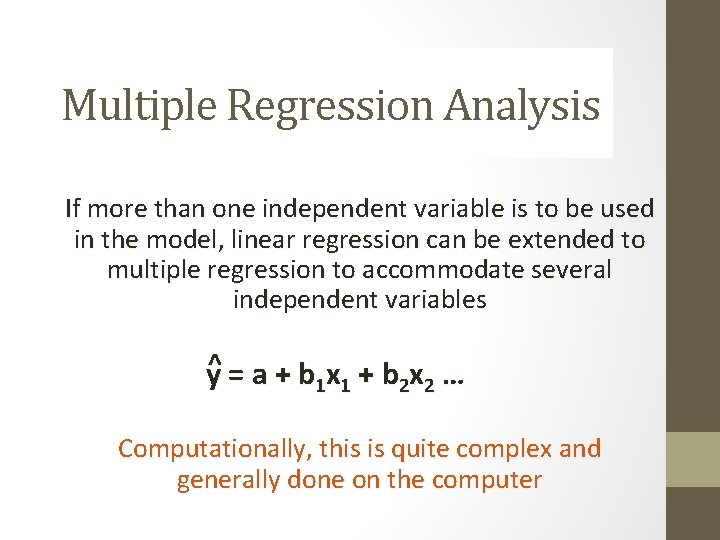
Multiple Regression Analysis If more than one independent variable is to be used in the model, linear regression can be extended to multiple regression to accommodate several independent variables y^ = a + b 1 x 1 + b 2 x 2 … Computationally, this is quite complex and generally done on the computer
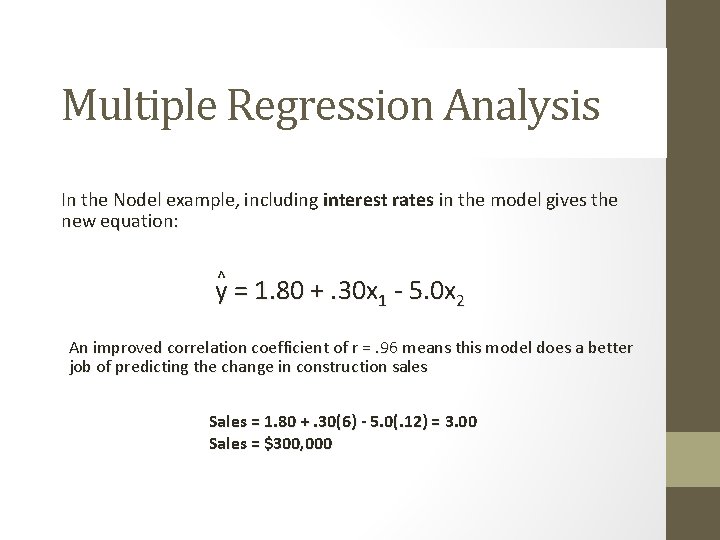
Multiple Regression Analysis In the Nodel example, including interest rates in the model gives the new equation: ^ y = 1. 80 +. 30 x 1 - 5. 0 x 2 An improved correlation coefficient of r =. 96 means this model does a better job of predicting the change in construction sales Sales = 1. 80 +. 30(6) - 5. 0(. 12) = 3. 00 Sales = $300, 000
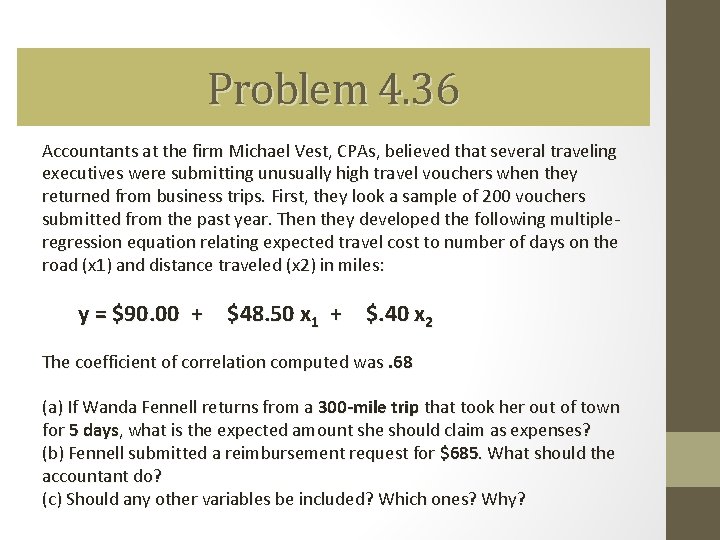
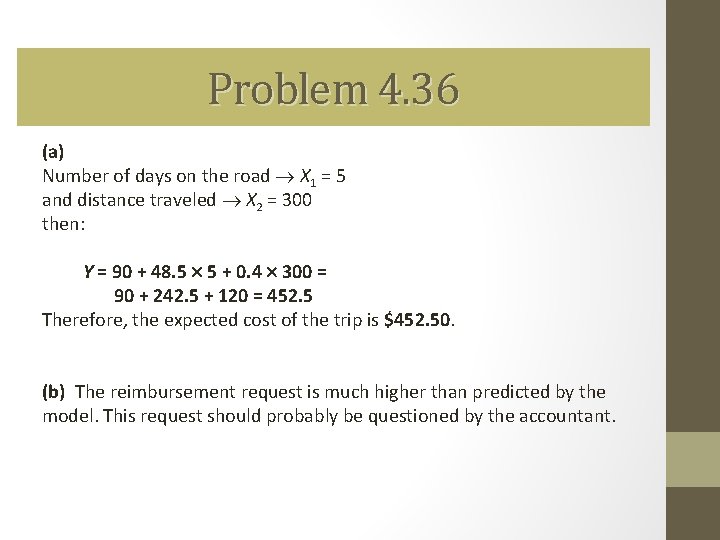
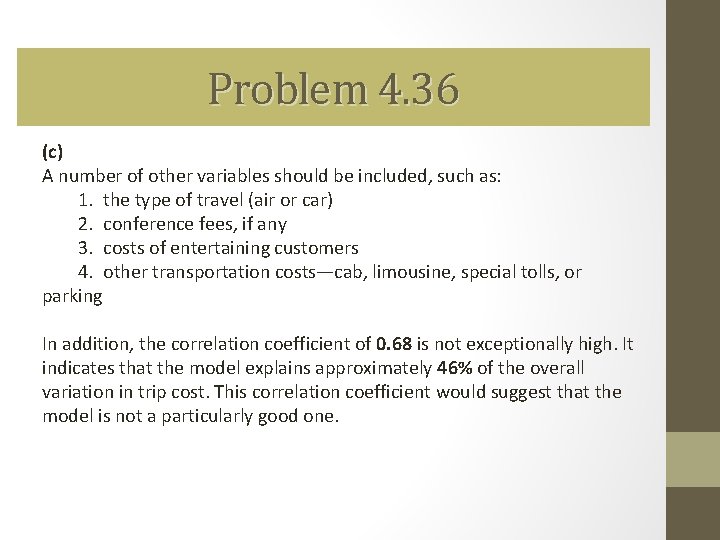
Problem 4. 36 Accountants at the firm Michael Vest, CPAs, believed that several traveling executives were submitting unusually high travel vouchers when they returned from business trips. First, they look a sample of 200 vouchers submitted from the past year. Then they developed the following multipleregression equation relating expected travel cost to number of days on the road (x 1) and distance traveled (x 2) in miles: y = $90. 00 + $48. 50 x 1 + $. 40 x 2 The coefficient of correlation computed was. 68 (a) If Wanda Fennell returns from a 300 -mile trip that took her out of town for 5 days, what is the expected amount she should claim as expenses? (b) Fennell submitted a reimbursement request for $685. What should the accountant do? (c) Should any other variables be included? Which ones? Why?
Problem 4. 36 (a) Number of days on the road X 1 = 5 and distance traveled X 2 = 300 then: Y = 90 + 48. 5 5 + 0. 4 300 = 90 + 242. 5 + 120 = 452. 5 Therefore, the expected cost of the trip is $452. 50. (b) The reimbursement request is much higher than predicted by the model. This request should probably be questioned by the accountant.
Problem 4. 36 (c) A number of other variables should be included, such as: 1. the type of travel (air or car) 2. conference fees, if any 3. costs of entertaining customers 4. other transportation costs—cab, limousine, special tolls, or parking In addition, the correlation coefficient of 0. 68 is not exceptionally high. It indicates that the model explains approximately 46% of the overall variation in trip cost. This correlation coefficient would suggest that the model is not a particularly good one.
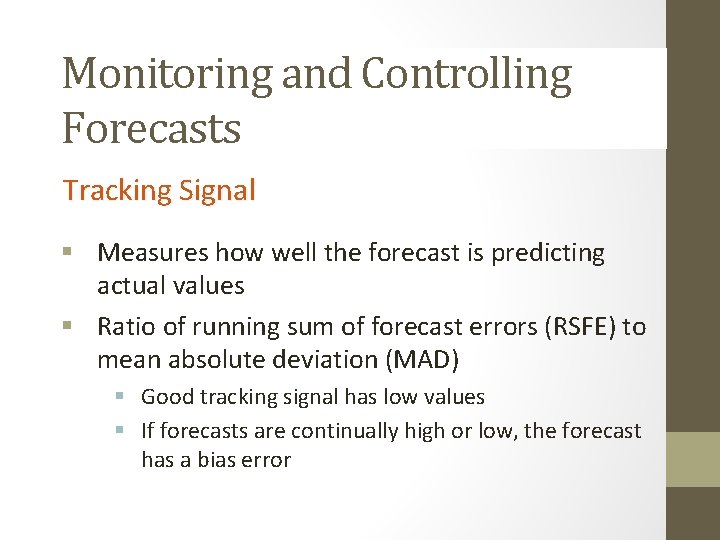
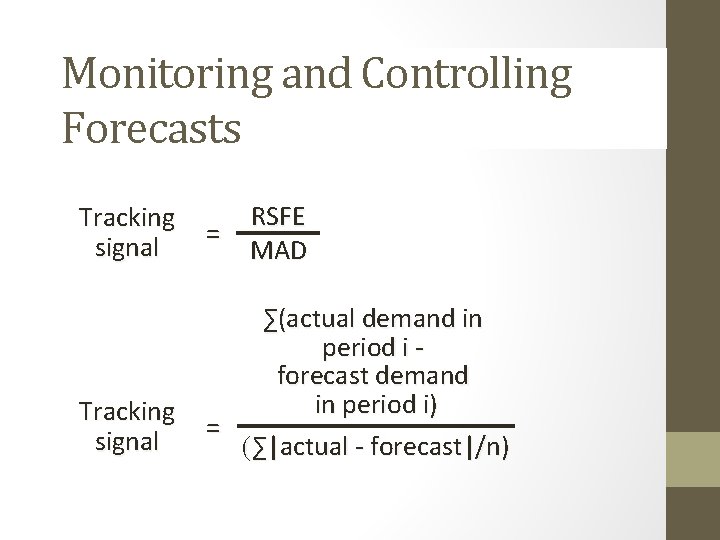
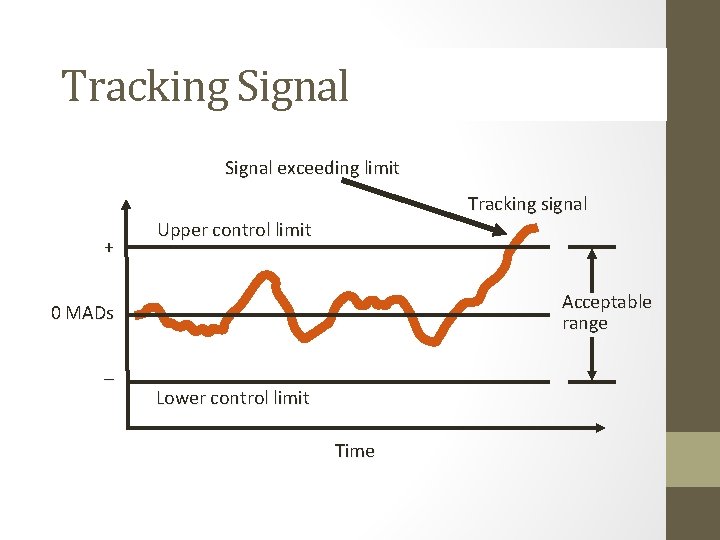
Monitoring and Controlling Forecasts Tracking Signal § Measures how well the forecast is predicting actual values § Ratio of running sum of forecast errors (RSFE) to mean absolute deviation (MAD) § Good tracking signal has low values § If forecasts are continually high or low, the forecast has a bias error
Monitoring and Controlling Forecasts Tracking signal = RSFE MAD ∑(actual demand in period i forecast demand in period i) = (∑|actual - forecast|/n)
Tracking Signal exceeding limit Tracking signal + Upper control limit Acceptable range 0 MADs – Lower control limit Time
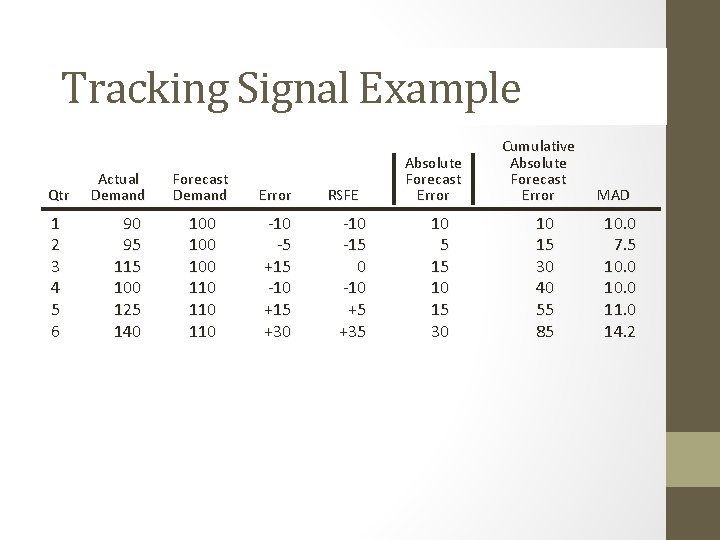
Tracking Signal Example Qtr 1 2 3 4 5 6 Actual Demand 90 95 115 100 125 140 Forecast Demand Error 100 100 110 110 -5 +15 -10 +15 +30 RSFE -10 -15 0 -10 +5 +35 Absolute Forecast Error 10 5 15 10 15 30 Cumulative Absolute Forecast Error 10 15 30 40 55 85 MAD 10. 0 7. 5 10. 0 11. 0 14. 2
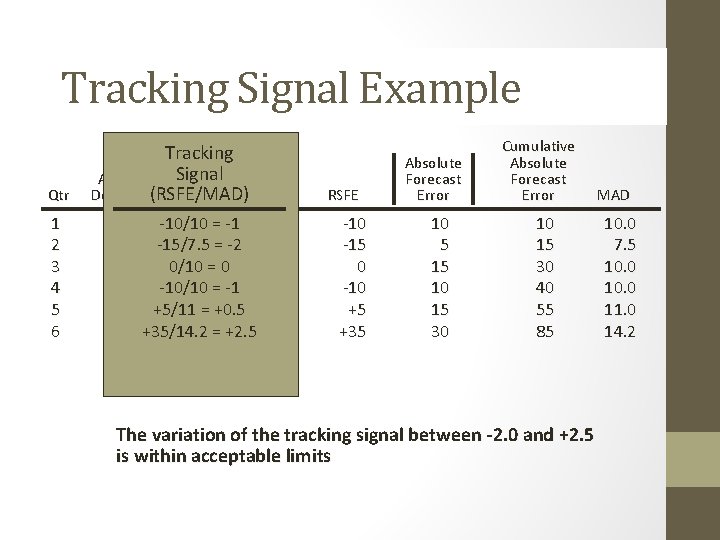
Tracking Signal Example Qtr 1 2 3 4 5 6 Tracking Signal Actual Forecast Demand (RSFE/MAD) Demand 90 -10/10 100= -1 95 -15/7. 5 100= -2 0/10 115 100= 0 100 -10/10 110= -1 = +0. 5 125 +5/11110 140 +35/14. 2 110= +2. 5 Error -10 -5 +15 -10 +15 +30 RSFE -10 -15 0 -10 +5 +35 Absolute Forecast Error 10 5 15 10 15 30 Cumulative Absolute Forecast Error 10 15 30 40 55 85 The variation of the tracking signal between -2. 0 and +2. 5 is within acceptable limits MAD 10. 0 7. 5 10. 0 11. 0 14. 2
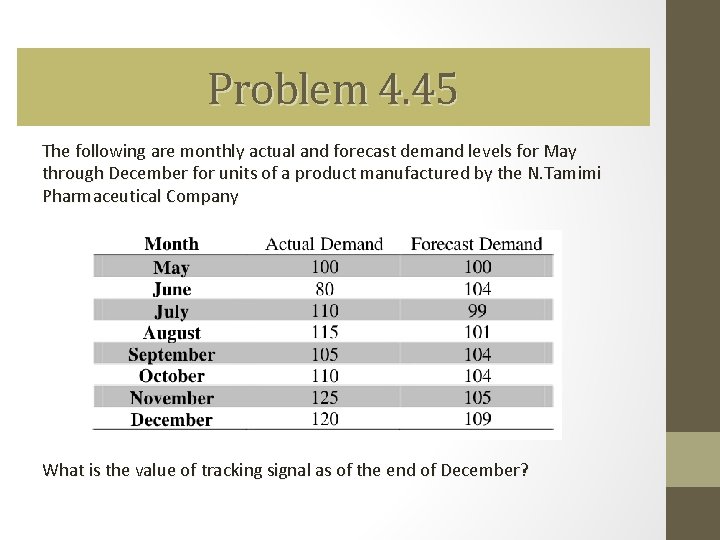
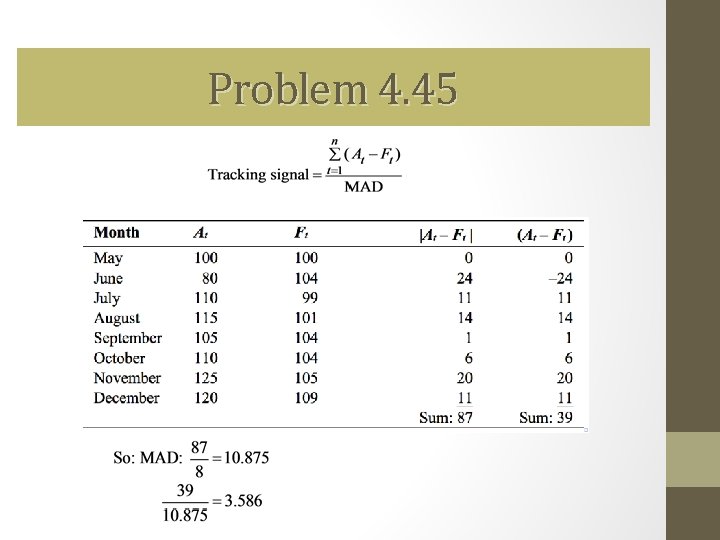
Problem 4. 45 The following are monthly actual and forecast demand levels for May through December for units of a product manufactured by the N. Tamimi Pharmaceutical Company What is the value of tracking signal as of the end of December?
Problem 4. 45