
Chapter 4 Class 2 Exponential Smoothing Form of

- Slides: 38
Chapter 4 Class 2
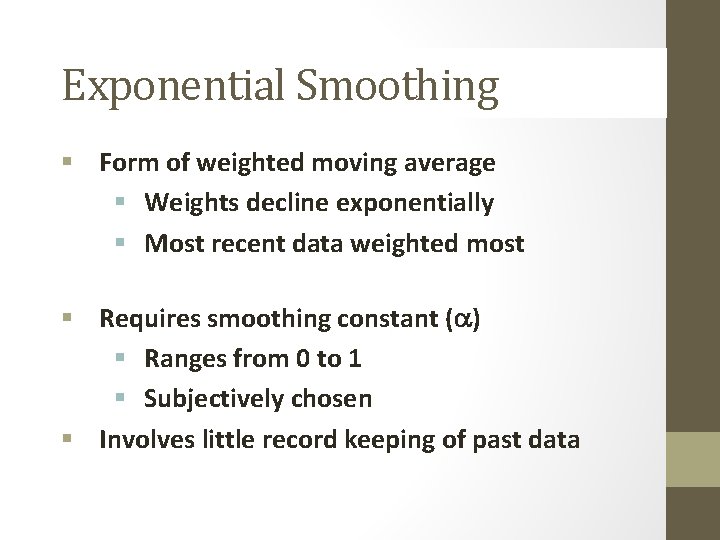
Exponential Smoothing § Form of weighted moving average § Weights decline exponentially § Most recent data weighted most § Requires smoothing constant ( ) § Ranges from 0 to 1 § Subjectively chosen § Involves little record keeping of past data
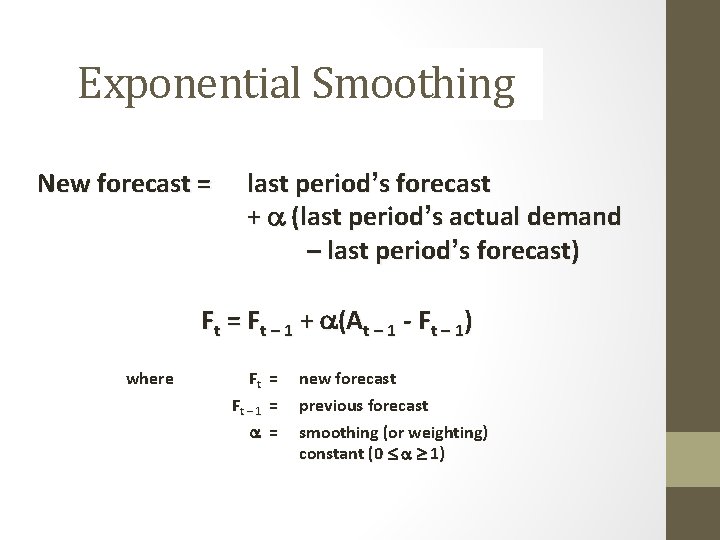
Exponential Smoothing New forecast = last period’s forecast + (last period’s actual demand – last period’s forecast) F t = F t – 1 + (A t – 1 - F t – 1) where Ft = Ft – 1 = = new forecast previous forecast smoothing (or weighting) constant (0 1)
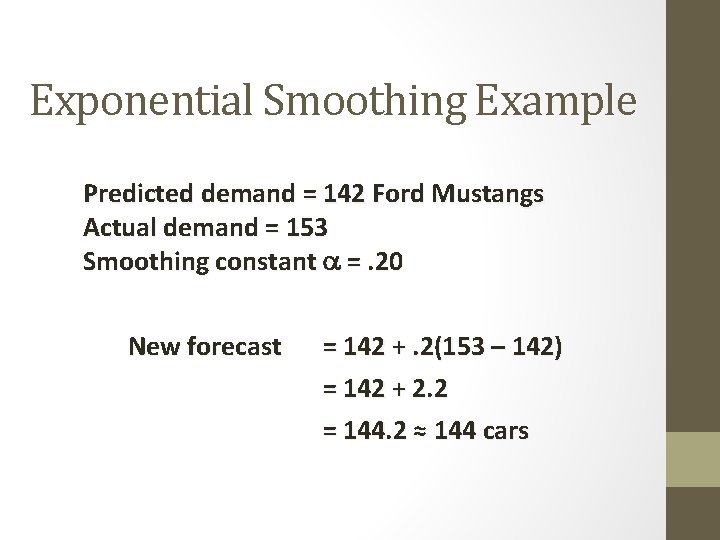
Exponential Smoothing Example Predicted demand = 142 Ford Mustangs Actual demand = 153 Smoothing constant =. 20 New forecast = 142 +. 2(153 – 142) = 142 + 2. 2 = 144. 2 ≈ 144 cars
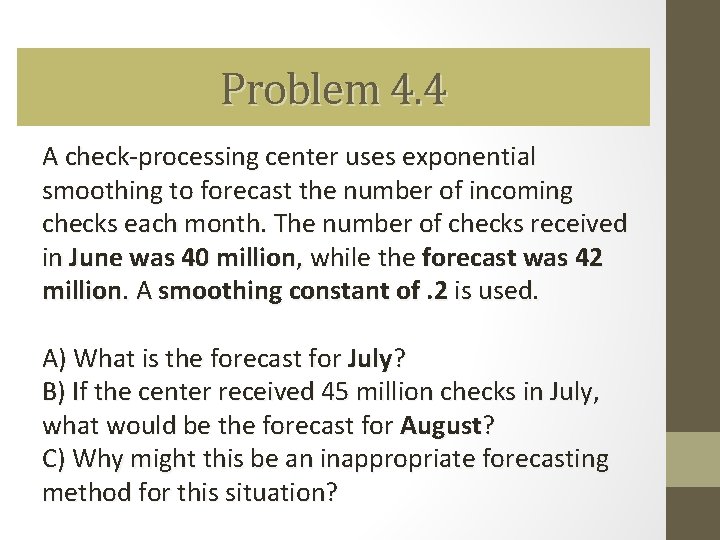
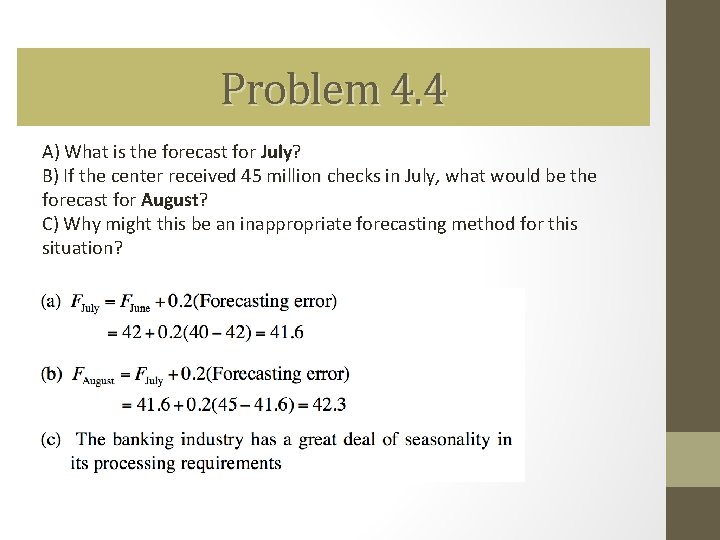
Problem 4. 4 A check-processing center uses exponential smoothing to forecast the number of incoming checks each month. The number of checks received in June was 40 million, while the forecast was 42 million. A smoothing constant of. 2 is used. A) What is the forecast for July? B) If the center received 45 million checks in July, what would be the forecast for August? C) Why might this be an inappropriate forecasting method for this situation?
Problem 4. 4 A) What is the forecast for July? B) If the center received 45 million checks in July, what would be the forecast for August? C) Why might this be an inappropriate forecasting method for this situation?
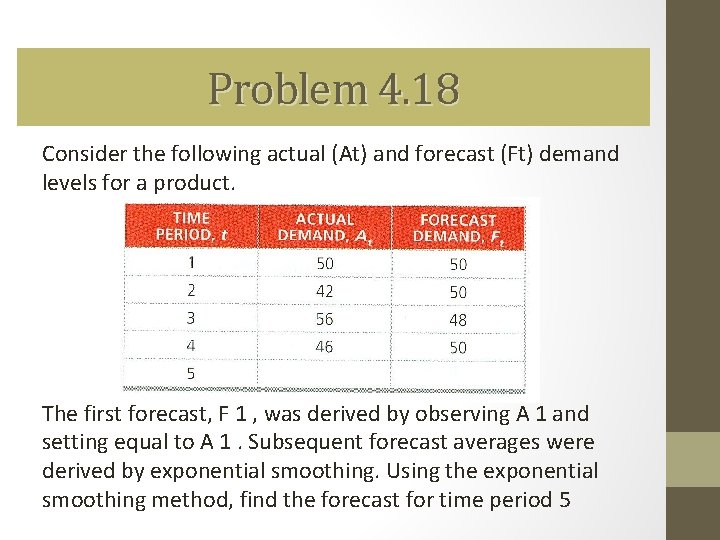
Problem 4. 18 Consider the following actual (At) and forecast (Ft) demand levels for a product. The first forecast, F 1 , was derived by observing A 1 and setting equal to A 1. Subsequent forecast averages were derived by exponential smoothing. Using the exponential smoothing method, find the forecast for time period 5
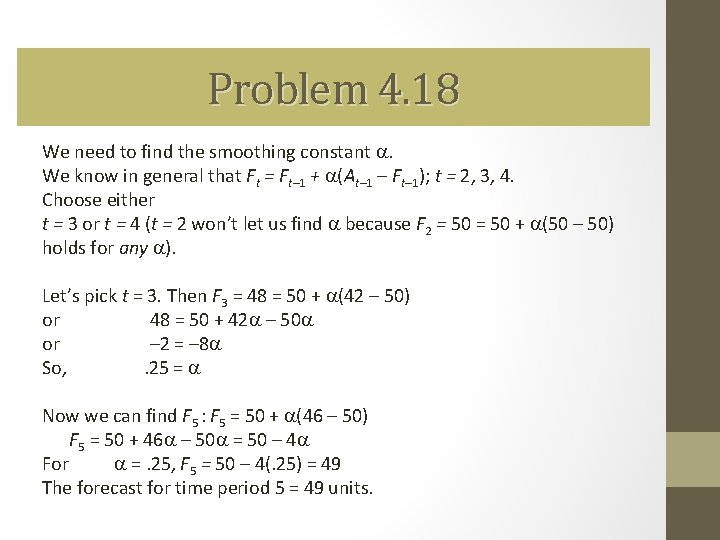
Problem 4. 18 We need to find the smoothing constant . We know in general that Ft = Ft– 1 + (At– 1 – Ft– 1); t = 2, 3, 4. Choose either t = 3 or t = 4 (t = 2 won’t let us find because F 2 = 50 + (50 – 50) holds for any ). Let’s pick t = 3. Then F 3 = 48 = 50 + (42 – 50) or 48 = 50 + 42 – 50 or – 2 = – 8 So, . 25 = Now we can find F 5 : F 5 = 50 + (46 – 50) F 5 = 50 + 46 – 50 = 50 – 4 For =. 25, F 5 = 50 – 4(. 25) = 49 The forecast for time period 5 = 49 units.
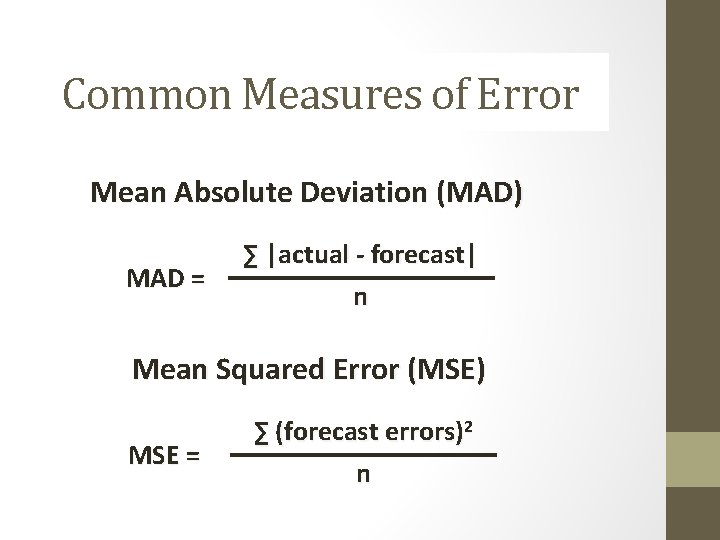
Common Measures of Error Mean Absolute Deviation (MAD) MAD = ∑ |actual - forecast| n Mean Squared Error (MSE) MSE = ∑ (forecast errors)2 n
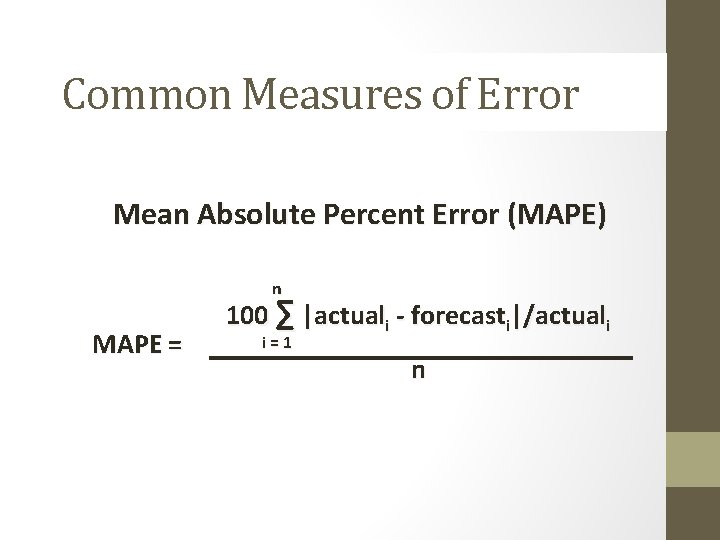
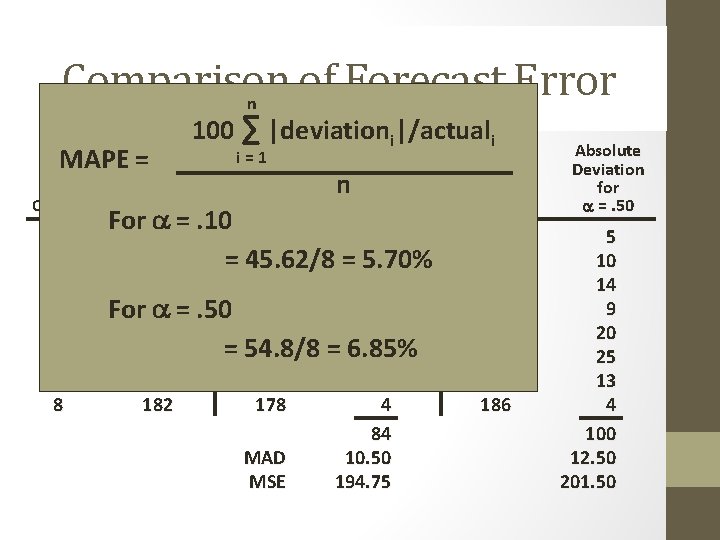
Common Measures of Error Mean Absolute Percent Error (MAPE) n MAPE = 100 ∑ |actuali - forecasti|/actuali i=1 n
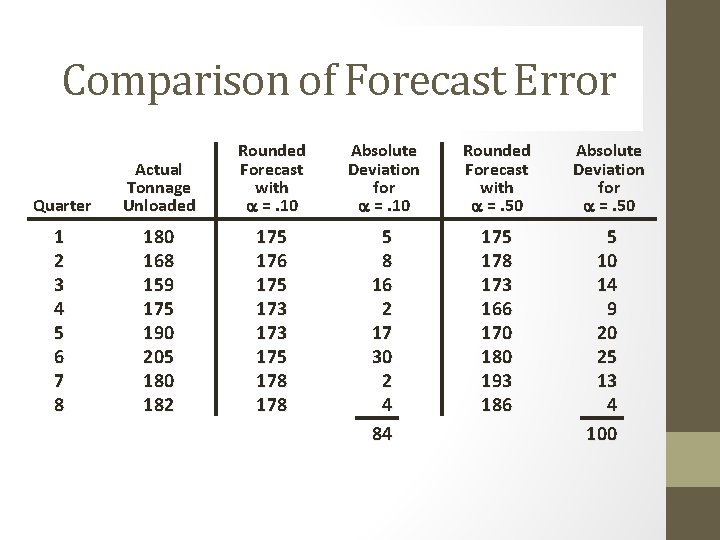
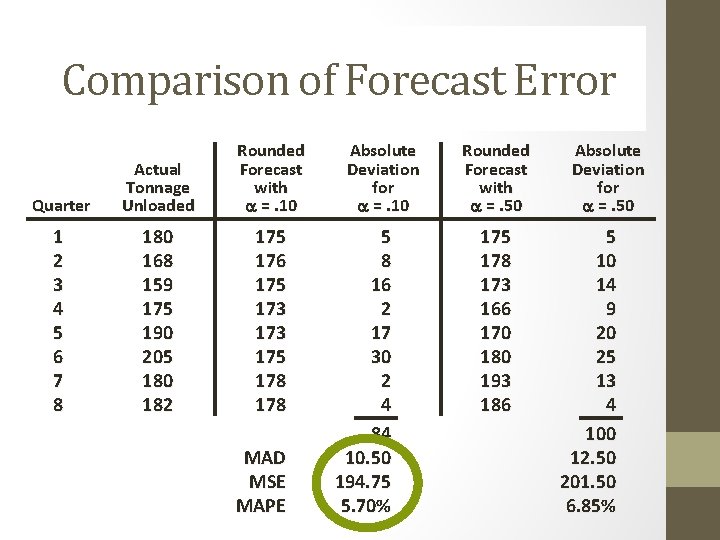
Comparison of Forecast Error Quarter Actual Tonnage Unloaded Rounded Forecast with =. 10 Absolute Deviation for =. 10 Rounded Forecast with =. 50 1 2 3 4 5 6 7 8 180 168 159 175 190 205 180 182 175 176 175 173 175 178 5 8 16 2 17 30 2 4 84 175 178 173 166 170 180 193 186 Absolute Deviation for =. 50 5 10 14 9 20 25 13 4 100
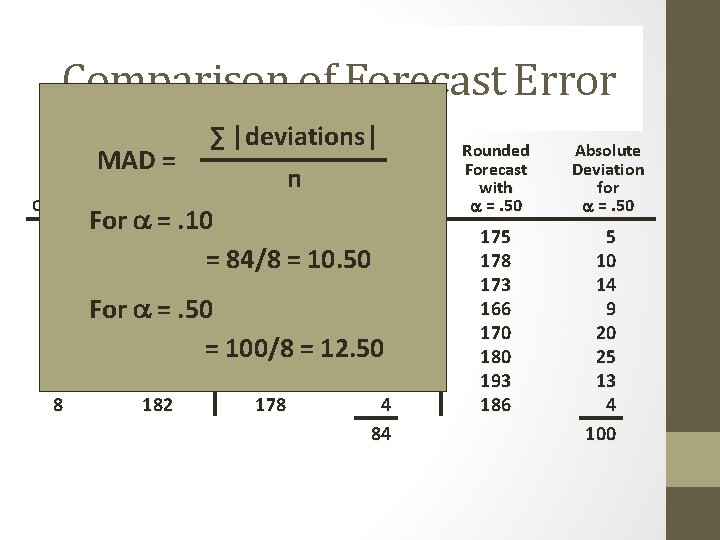
Comparison of Forecast Error MAD = Actual Quarter 1 2 3 4 5 6 7 8 ∑ |deviations| Rounded Absolute Tonage Unloaded Forecast withn =. 10 Deviation for =. 10 For =. 10 180 175 168 176 = 10. 50 = 84/8 For 159 175 =. 50 190 = 205 180 182 175 173 100/8 175 178 = 5 8 16 2 17 12. 50 30 2 4 84 Rounded Forecast with =. 50 175 178 173 166 170 180 193 186 Absolute Deviation for =. 50 5 10 14 9 20 25 13 4 100
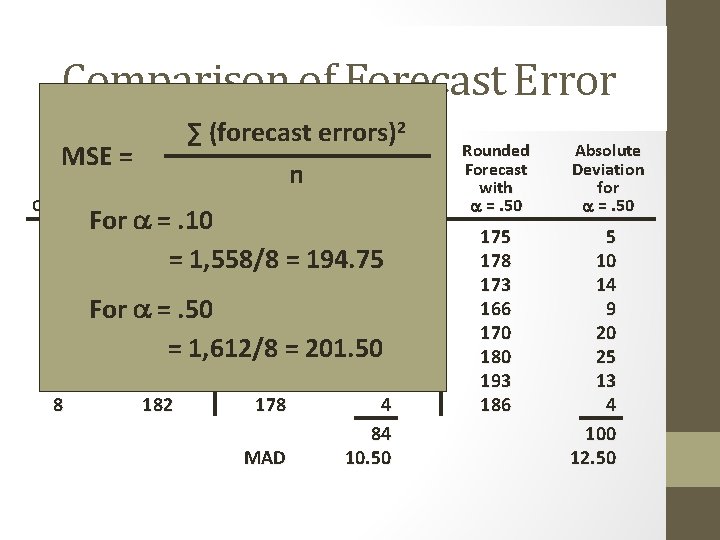
Comparison of Forecast Error MSE = Actual Quarter 1 2 3 4 5 6 7 8 ∑ (forecast errors)2 Tonage Unloaded Rounded Forecast n with =. 10 Absolute Deviation for =. 10 For =. 10 180 175 5 168= 1, 558/8 176= 194. 758 For 159 175 173 175 =. 50 190 173 205= 1, 612/8 175= 180 178 182 178 16 2 17 201. 5030 2 4 84 MAD 10. 50 Rounded Forecast with =. 50 175 178 173 166 170 180 193 186 Absolute Deviation for =. 50 5 10 14 9 20 25 13 4 100 12. 50
Comparison of Forecast Error n MAPE Actual = Quarter 1 2 3 4 5 6 7 8 100 ∑ |deviationi|/actuali Tonage Unloaded i. Rounded =1 Forecast with =. 10 Absolute Deviation n for =. 10 For =. 10 180 175 5 168 176 8 = 45. 62/8 = 5. 70% 159 For 175 = 190 205 180 182 . 50 = 175 173 54. 8/8 175 178 MAD MSE 16 2 17 = 6. 85% 30 2 4 84 10. 50 194. 75 Rounded Forecast with =. 50 175 178 173 166 170 180 193 186 Absolute Deviation for =. 50 5 10 14 9 20 25 13 4 100 12. 50 201. 50
Comparison of Forecast Error Quarter Actual Tonnage Unloaded Rounded Forecast with =. 10 1 2 3 4 5 6 7 8 180 168 159 175 190 205 180 182 175 176 175 173 175 178 MAD MSE MAPE Absolute Deviation for =. 10 5 8 16 2 17 30 2 4 84 10. 50 194. 75 5. 70% Rounded Forecast with =. 50 175 178 173 166 170 180 193 186 Absolute Deviation for =. 50 5 10 14 9 20 25 13 4 100 12. 50 201. 50 6. 85%
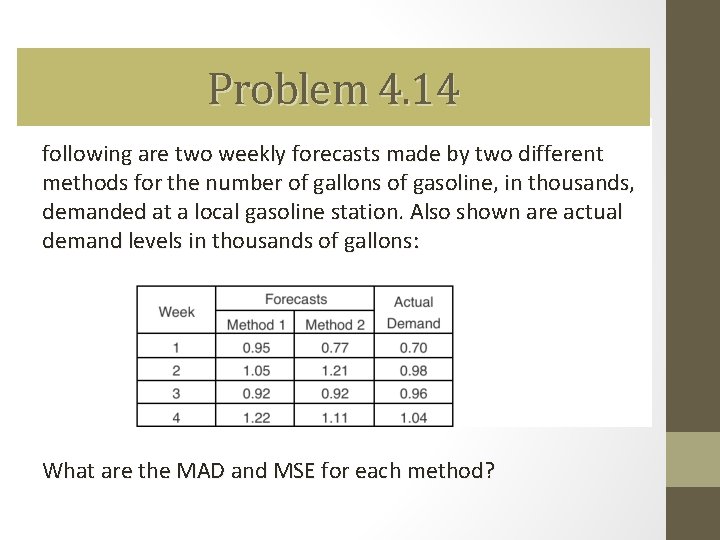
Problem 4. 14 following are two weekly forecasts made by two different methods for the number of gallons of gasoline, in thousands, demanded at a local gasoline station. Also shown are actual demand levels in thousands of gallons: What are the MAD and MSE for each method?
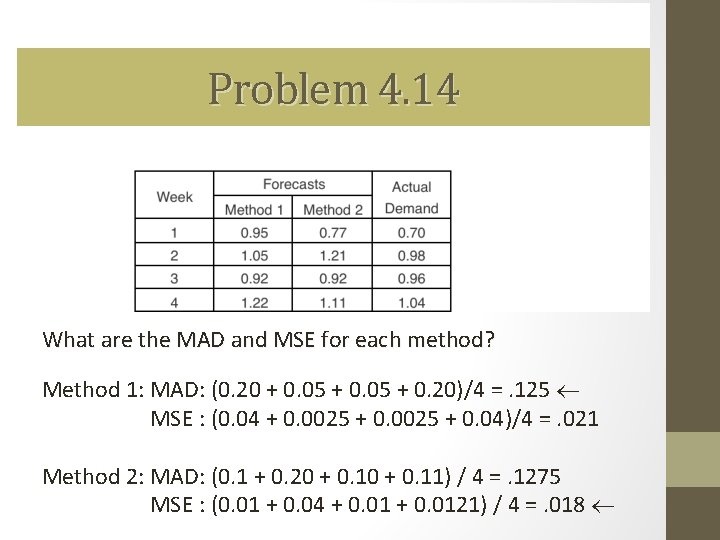
Problem 4. 14 What are the MAD and MSE for each method? Method 1: MAD: (0. 20 + 0. 05 + 0. 20)/4 =. 125 MSE : (0. 04 + 0. 0025 + 0. 04)/4 =. 021 Method 2: MAD: (0. 1 + 0. 20 + 0. 11) / 4 =. 1275 MSE : (0. 01 + 0. 04 + 0. 0121) / 4 =. 018
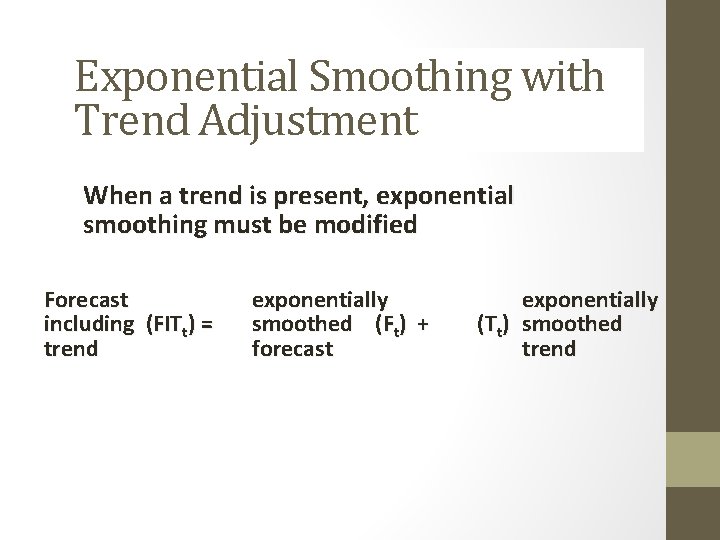
Exponential Smoothing with Trend Adjustment When a trend is present, exponential smoothing must be modified Forecast including (FITt) = trend exponentially smoothed (Ft) + forecast exponentially (Tt) smoothed trend
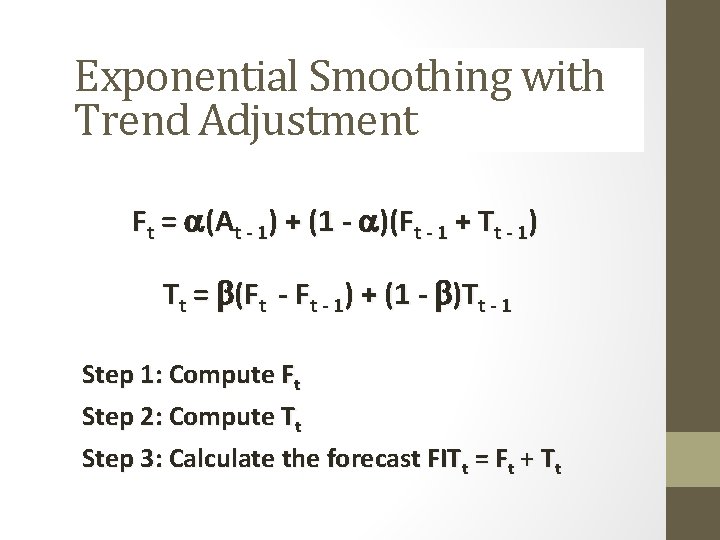
Exponential Smoothing with Trend Adjustment Ft = (At - 1) + (1 - )(Ft - 1 + Tt - 1) Tt = b(Ft - 1) + (1 - b)Tt - 1 Step 1: Compute Ft Step 2: Compute Tt Step 3: Calculate the forecast FITt = Ft + Tt
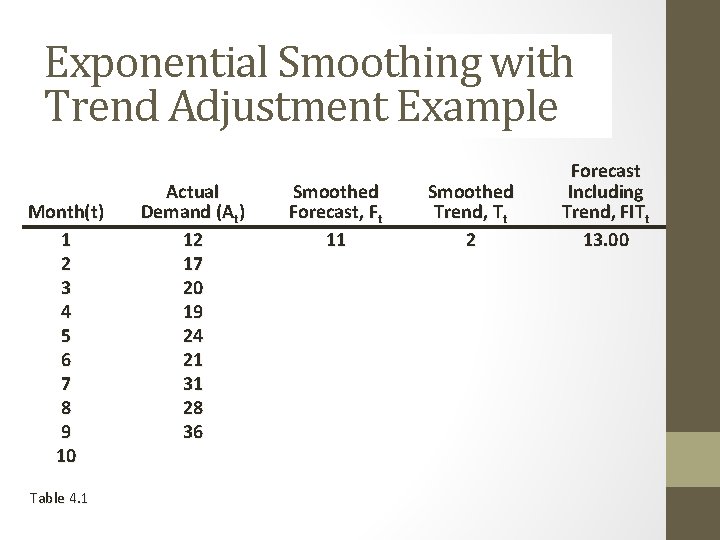
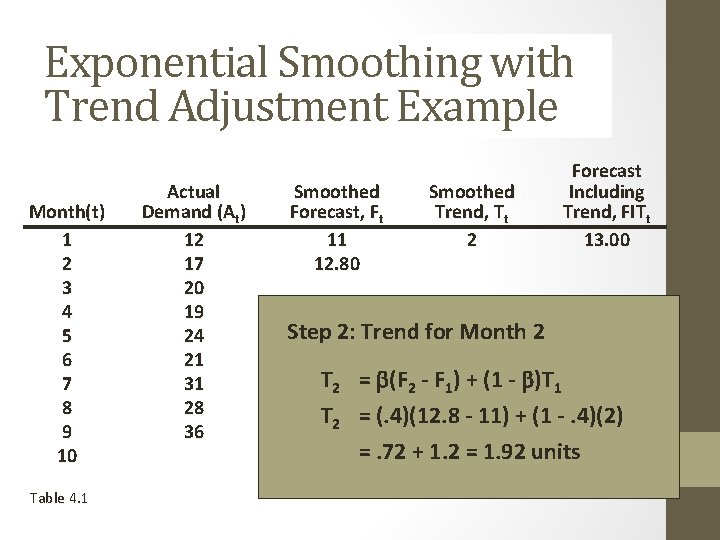
Exponential Smoothing with Trend Adjustment Example Month(t) 1 2 3 4 5 6 7 8 9 10 Table 4. 1 Actual Demand (At) 12 17 20 19 24 21 31 28 36 Smoothed Forecast, Ft 11 Smoothed Trend, Tt 2 Forecast Including Trend, FITt 13. 00
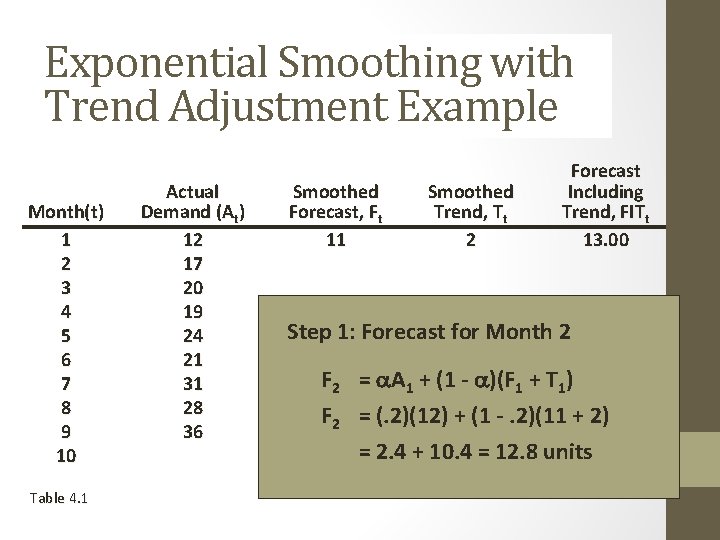
Exponential Smoothing with Trend Adjustment Example Month(t) 1 2 3 4 5 6 7 8 9 10 Table 4. 1 Actual Demand (At) 12 17 20 19 24 21 31 28 36 Smoothed Forecast, Ft 11 Smoothed Trend, Tt 2 Forecast Including Trend, FITt 13. 00 Step 1: Forecast for Month 2 F 2 = A 1 + (1 - )(F 1 + T 1) F 2 = (. 2)(12) + (1 -. 2)(11 + 2) = 2. 4 + 10. 4 = 12. 8 units
Exponential Smoothing with Trend Adjustment Example Month(t) 1 2 3 4 5 6 7 8 9 10 Table 4. 1 Actual Demand (At) 12 17 20 19 24 21 31 28 36 Smoothed Forecast, Ft 11 12. 80 Smoothed Trend, Tt 2 Forecast Including Trend, FITt 13. 00 Step 2: Trend for Month 2 T 2 = b(F 2 - F 1) + (1 - b)T 1 T 2 = (. 4)(12. 8 - 11) + (1 -. 4)(2) =. 72 + 1. 2 = 1. 92 units
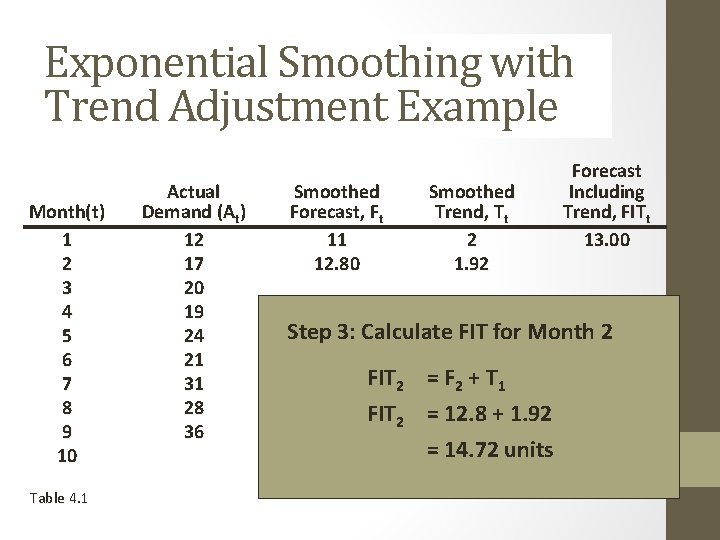
Exponential Smoothing with Trend Adjustment Example Month(t) 1 2 3 4 5 6 7 8 9 10 Table 4. 1 Actual Demand (At) 12 17 20 19 24 21 31 28 36 Smoothed Forecast, Ft 11 12. 80 Smoothed Trend, Tt 2 1. 92 Forecast Including Trend, FITt 13. 00 Step 3: Calculate FIT for Month 2 FIT 2 = F 2 + T 1 FIT 2 = 12. 8 + 1. 92 = 14. 72 units
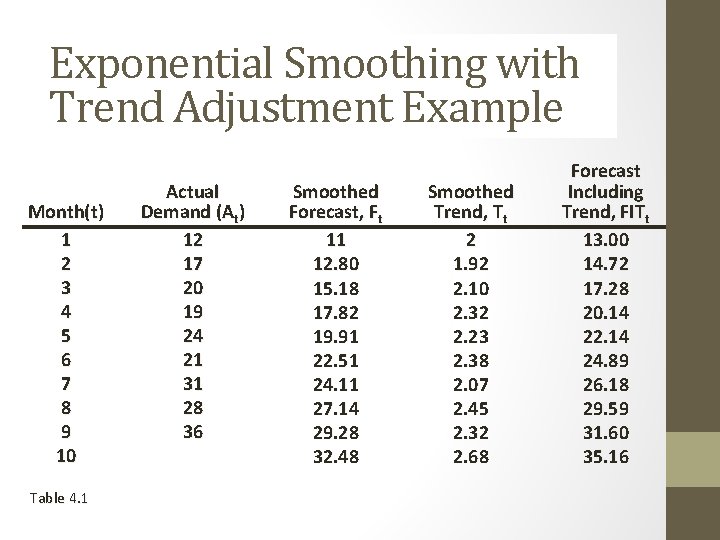
Exponential Smoothing with Trend Adjustment Example Month(t) 1 2 3 4 5 6 7 8 9 10 Table 4. 1 Actual Demand (At) 12 17 20 19 24 21 31 28 36 Smoothed Forecast, Ft 11 12. 80 15. 18 17. 82 19. 91 22. 51 24. 11 27. 14 29. 28 32. 48 Smoothed Trend, Tt 2 1. 92 2. 10 2. 32 2. 23 2. 38 2. 07 2. 45 2. 32 2. 68 Forecast Including Trend, FITt 13. 00 14. 72 17. 28 20. 14 22. 14 24. 89 26. 18 29. 59 31. 60 35. 16
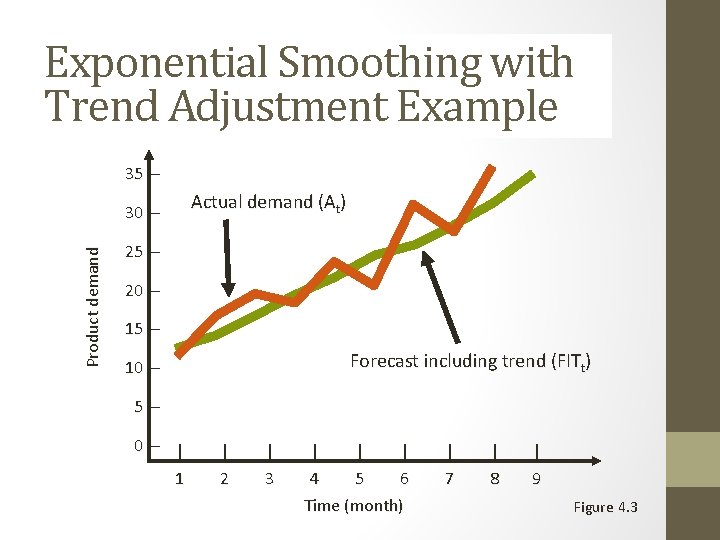
Exponential Smoothing with Trend Adjustment Example 35 – Product demand 30 – Actual demand (At) 25 – 20 – 15 – Forecast including trend (FITt) 10 – 5 – 0 – | 1 | 2 | 3 | 4 | 5 | 6 Time (month) | 7 | 8 | 9 Figure 4. 3
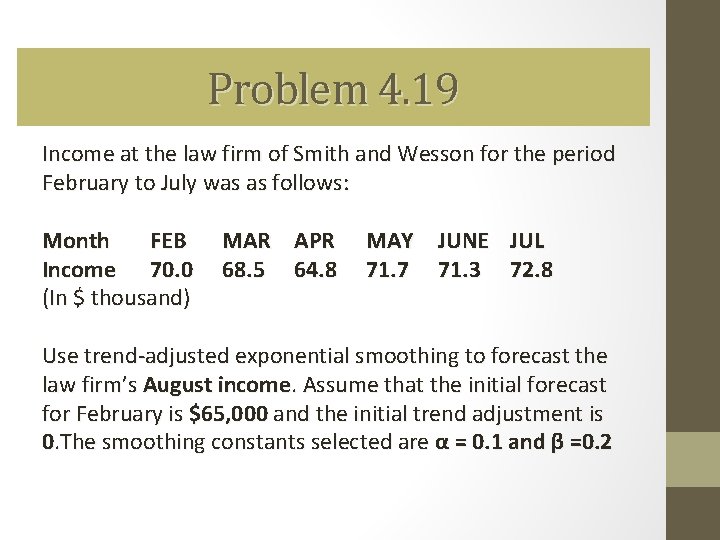
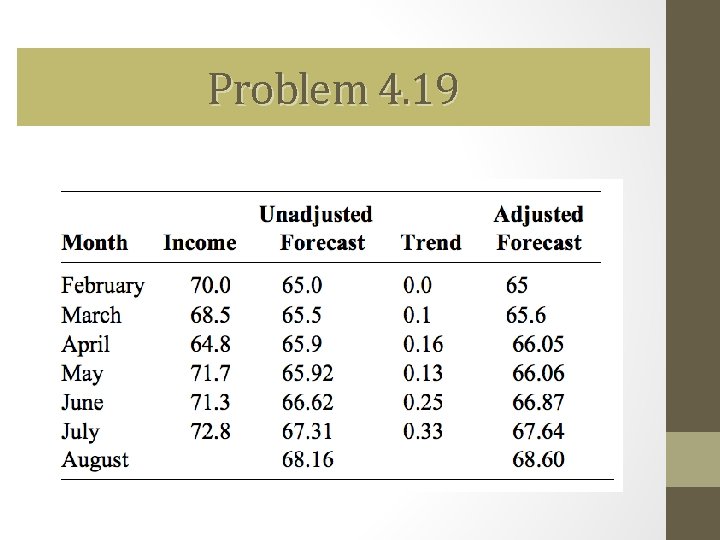
Problem 4. 19 Income at the law firm of Smith and Wesson for the period February to July was as follows: Month FEB Income 70. 0 (In $ thousand) MAR APR 68. 5 64. 8 MAY JUNE JUL 71. 7 71. 3 72. 8 Use trend-adjusted exponential smoothing to forecast the law firm’s August income. Assume that the initial forecast for February is $65, 000 and the initial trend adjustment is 0. The smoothing constants selected are α = 0. 1 and β =0. 2
Problem 4. 19
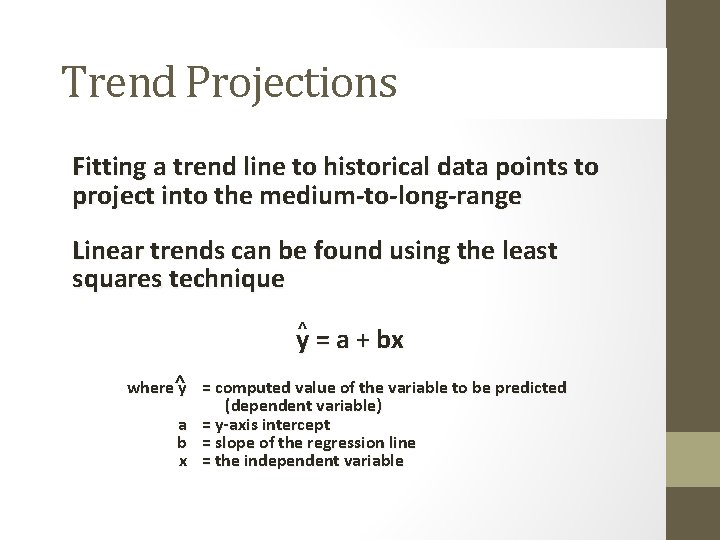
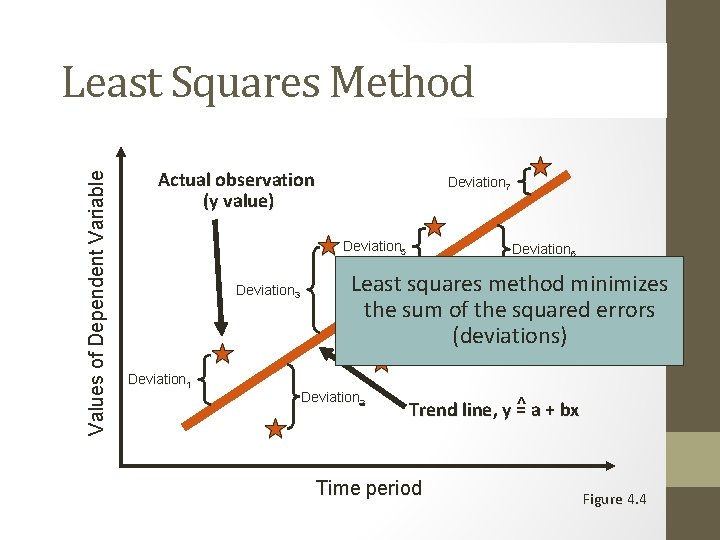
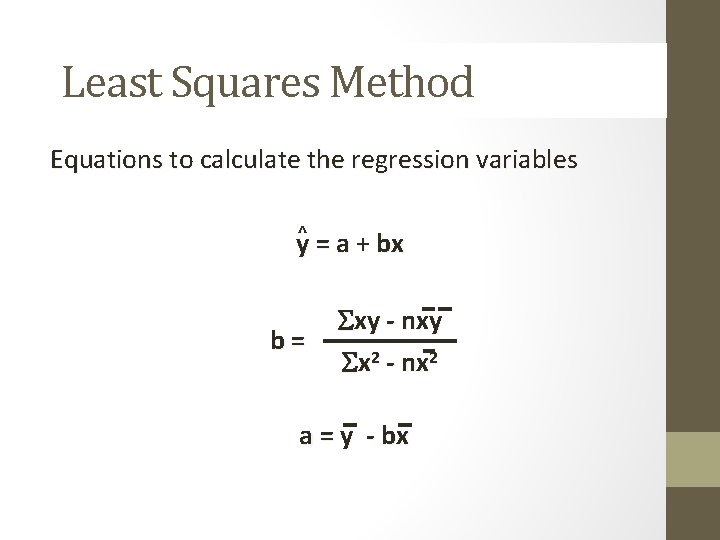
Trend Projections Fitting a trend line to historical data points to project into the medium-to-long-range Linear trends can be found using the least squares technique ^ y = a + bx where ^y = computed value of the variable to be predicted (dependent variable) a = y-axis intercept b = slope of the regression line x = the independent variable
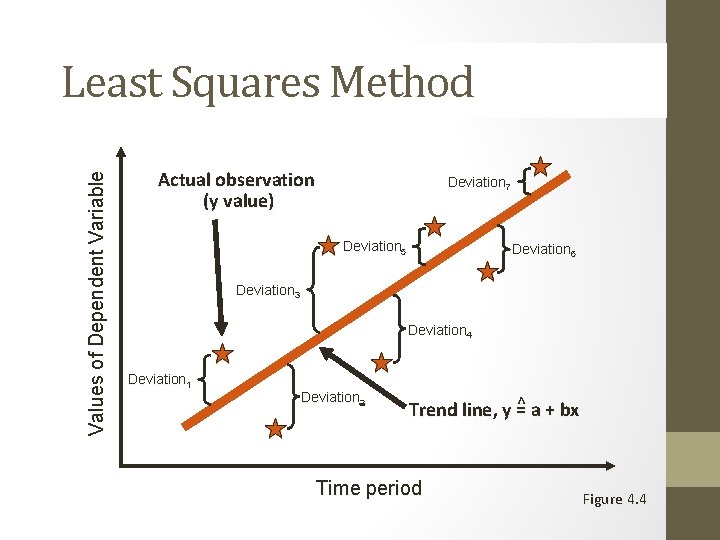
Values of Dependent Variable Least Squares Method Actual observation (y value) Deviation 7 Deviation 5 Deviation 6 Deviation 3 Deviation 4 Deviation 1 Deviation 2 Trend line, y =^ a + bx Time period Figure 4. 4
Values of Dependent Variable Least Squares Method Actual observation (y value) Deviation 7 Deviation 5 Deviation 3 Deviation 6 Least squares method minimizes the sum of the squared errors Deviation (deviations) 4 Deviation 1 Deviation 2 Trend line, y =^ a + bx Time period Figure 4. 4
Least Squares Method Equations to calculate the regression variables ^ y = a + bx b= Sxy - nxy Sx 2 - nx 2 a = y - bx
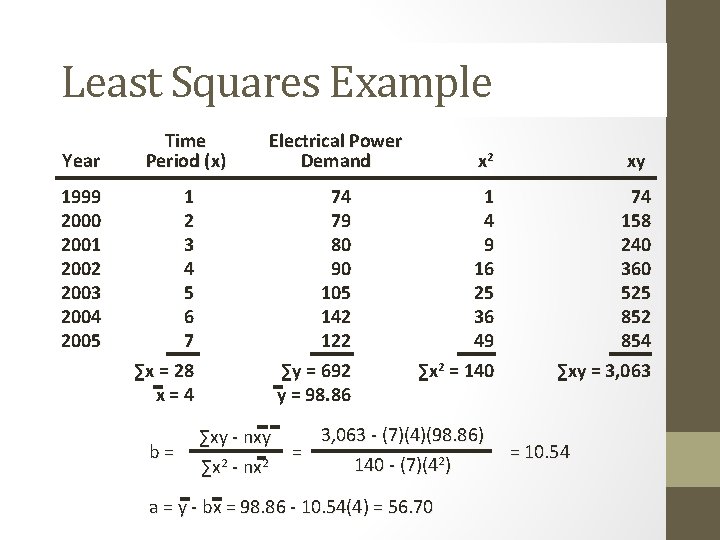
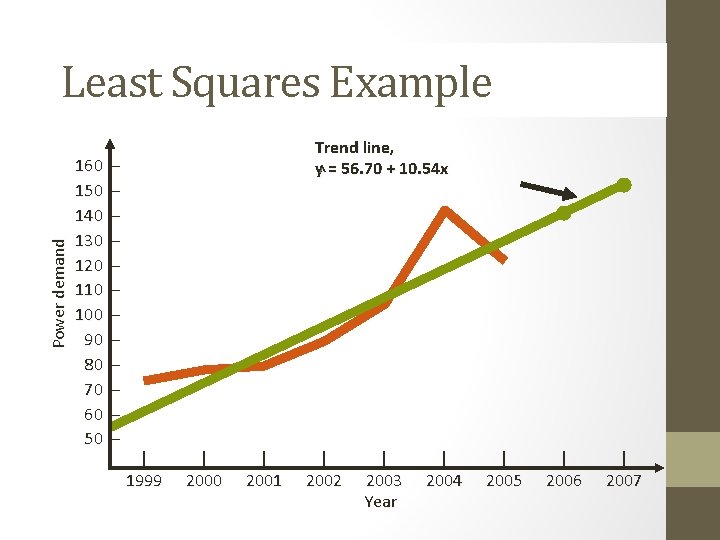
Least Squares Example Year 1999 2000 2001 2002 2003 2004 2005 Time Period (x) 1 2 3 4 5 6 7 ∑x = 28 x=4 b= Electrical Power Demand 74 79 80 90 105 142 122 ∑y = 692 y = 98. 86 x 2 xy 1 4 9 16 25 36 49 ∑x 2 = 140 74 158 240 360 525 852 854 ∑xy = 3, 063 - (7)(4)(98. 86) ∑xy - nxy = 2 2 140 - (7)(42) ∑x - nx a = y - bx = 98. 86 - 10. 54(4) = 56. 70 = 10. 54
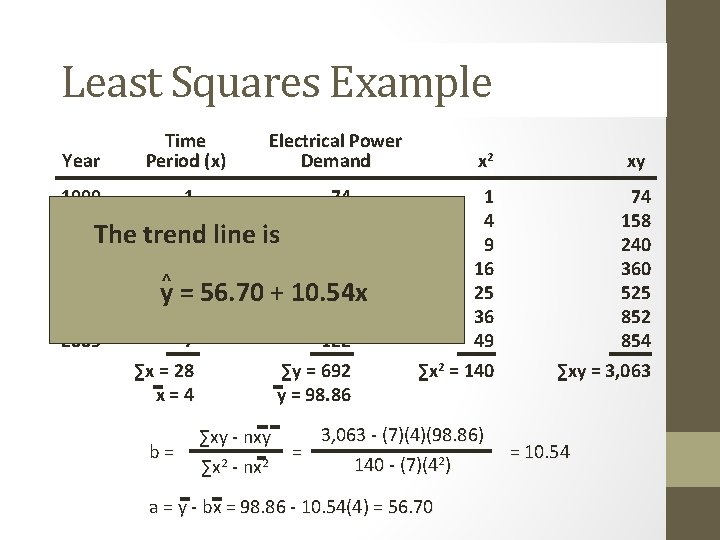
Least Squares Example Year Time Period (x) Electrical Power Demand 1999 1 74 2000 2 79 2001 The trend 3 line is 80 2002 4 90 ^ 2003 105 y =5 56. 70 + 10. 54 x 2004 6 142 2005 7 122 ∑x = 28 ∑y = 692 x=4 y = 98. 86 b= x 2 xy 1 4 9 16 25 36 49 ∑x 2 = 140 74 158 240 360 525 852 854 ∑xy = 3, 063 - (7)(4)(98. 86) ∑xy - nxy = 2 2 140 - (7)(42) ∑x - nx a = y - bx = 98. 86 - 10. 54(4) = 56. 70 = 10. 54
Power demand Least Squares Example 160 150 140 130 120 110 100 90 80 70 60 50 – – – Trend line, y^ = 56. 70 + 10. 54 x | 1999 | 2000 | 2001 | 2002 | 2003 Year | 2004 | 2005 | 2006 | 2007
Least Squares Requirements 1. We always plot the data to insure a linear relationship 2. We do not predict time periods far beyond the database 3. Deviations around the least squares line are assumed to be random
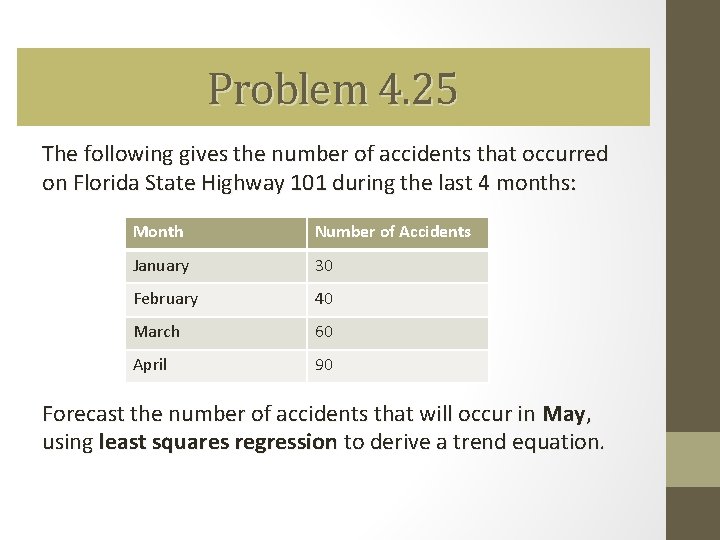
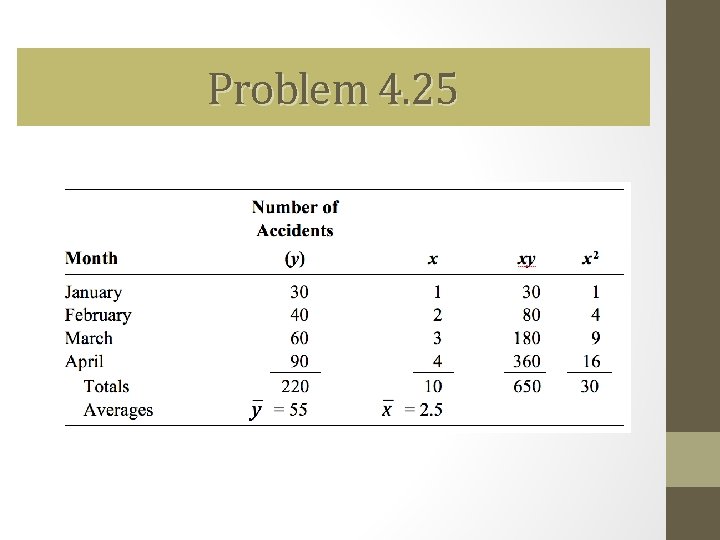
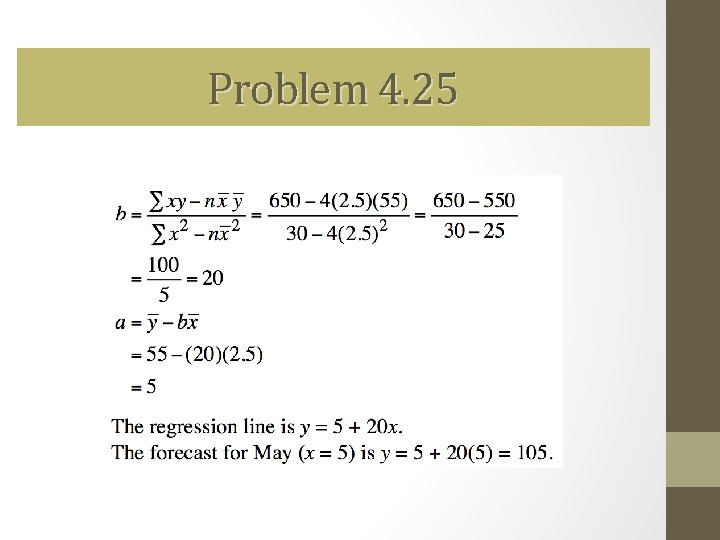
Problem 4. 25 The following gives the number of accidents that occurred on Florida State Highway 101 during the last 4 months: Month Number of Accidents January 30 February 40 March 60 April 90 Forecast the number of accidents that will occur in May, using least squares regression to derive a trend equation.
Problem 4. 25
Problem 4. 25