
CHAPTER 4 CIVIL LIBERTIES AND PUBLIC POLICY PGS
CHAPTER 4 CIVIL LIBERTIES AND PUBLIC POLICY PGS 108 -132 AP US Government- Mr. Valverde
Free Press and Free Trial Bill of rights tries to guarantee both Media can make this very difficult because journalists: 1) Argue the public has the right to know 2) At same time they want to protect “sources” 3) Have “shield laws” in some states Supreme Court has held that the right to free trial preempts reporters’ rights to protect sources. (Zurcher v Stanford Daily 1976)
Obscenity and its Definition Has perplexed the courts because: 1) Standards vary 2) Obscenity or “art” 3) No nationwide concensus 4) Porn degrading women? 5) States may protect kids form the same materials adults have legal access to 6) Supreme Court has said obscenity not protected expression (Roth v US 1957)
Miller v California 1973 Court ruled and CJ Warren Berger wrote: “Items are obscene if taken as a whole appealed to purest interest in sex, had offensive sexual content or lacked in artistic, literary, political or scientific merit” THAT HELPS!! NOT!!!
Libel and Slander Libel- published falsehoods about a person Slander- spoken falsehoods Both causing damage (defamation) Two types and how court has ruled: 1)Public individuals- libelous if statements are made with mailce and disregard for truth (New York Times v Sullivan 1964) 2) You and me- only need to prove defamatory statements were made and author was negligent
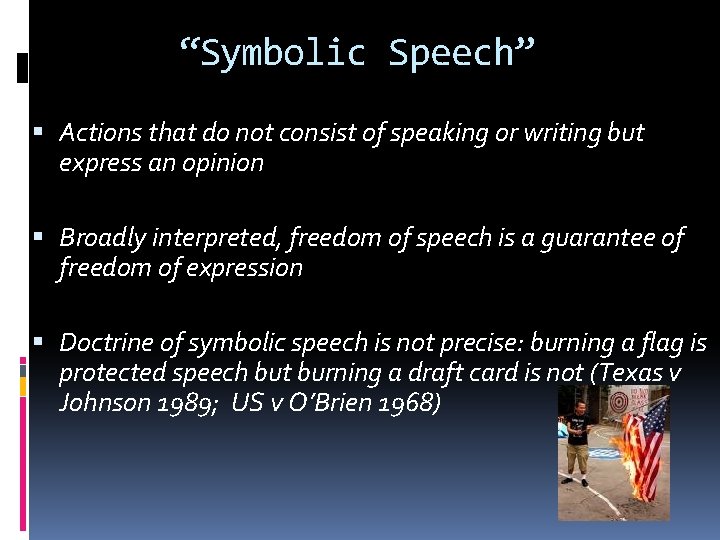
“Symbolic Speech” Actions that do not consist of speaking or writing but express an opinion Broadly interpreted, freedom of speech is a guarantee of freedom of expression Doctrine of symbolic speech is not precise: burning a flag is protected speech but burning a draft card is not (Texas v Johnson 1989; US v O’Brien 1968)
Commercial Speech Such as advertising is more restricted than are expressions of religion, politics or other matters FTC (Federal Trade Commission)- decides what kinds of materials may be advertised on radio and TV Although more restricted, the times are changing to provide more protection for this expression. (ie. Condom ads? ) Radio and TV is more restricted than the print media FCC- (Federal Communications Commission) regulates what content is on radio and TV- HOWARD STERN? TITANIC? Licensed stations must comply to operate
Freedom of Assembly Two facets: 1) Right to assemble if: A) within reasonable limits (time, place and manner) B) on public property (stay off my lawn) C) Does not border on harassment 2) Right to associate: A) gather with people with a common interest to create political change B) 1958 SC found that requiring the NAACP to turn over its membership list to the state of Alabama was a violation of this provision. (NAACP v Alabama)
Rights of the Accused The 1 st amendment guarantees the freedoms of religion, speech, press and assembly Most of the other rights in the Bill of Rights deal with the rights of people accused of crimes These rights originally intended to protect the accused in political arrests and trials Today the 4 th, 5 th, 6 th and 8 th are primarily applied to criminal cases Generally vague Bill of Rights have been applied to the states as well through the incorporation doctrine
4 th Amendment Forbids unreasonable searches and seizures 1) No court may issue a search warrant without probable cause 2) Warrants must say where is to be searched and what they are looking to find Since 1914 courts have used the exclusionary rule to prevent illegally seized evidence from being admitted in court 1) In Mapp v Ohio (1961) the SC used incorporation to apply the exclusionary rule to states as well 2) Critics say criminals getting off on “technicalities” 3) Supporters say rules and protections of the Constitution are the rules Warren court made exceptions ot the Exclusionary Rule by allowing warrantless searches if probable cause existed
5 th Amendment Prohibits forced self-incrimination Suspects can’t be forced to give evidence that can be used against them because: a) Burden of proof on prosecution b) Right applies in all places not just court rooms c) But defendants must testify if granted immunity Miranda v Arizona (1966) – Rights to remain silent, things said can be used against them, right to an attorney Again, Justice Berger made exceptions in saying Miranda right violations not always set in stone if other evidence does exist
6 th Amendment- Part I Right to Counsel Meant in federal courts and not incorporated until recently Progress: 1) 1932 SC ordered states to provide an attorney for indigent accused of a capital crime ( Powell v Alabama) 2) 1963 the court extended the same right to everyone accused of a felony (Gideon v Wainwright only after a paupers’ petition was written by Gideon) 3) Later ruled a lawyer must be appointed whenever imprisonment could be imposed (Argersinger v Hamlin, 1972)
6 th Amendment- Part II Right to Speedy Trial and Impartial Jury Most cases settled through plea bargains which are fast and cheap Opponents say deserving criminals don’t get the punishment they should Size of jury not set by document but by custom is usually 12
8 th Amendment Protection against cruel and unusual punishment but does not define it. Death penalty at the center: Witherspoon v Illinois (1968)- overturned death sentence due to leaving out opponents of death penalty from jury Furman v Georgia (1972) – overturned GA death penalty because of the way it was applied Gregg v Georgia (1976)- only for extreme crimes Mc. Clesky v Kemp (1987) – upheld against charges of 14 th amendment equal protection for minorities Court recently held it is okay to execute 16 and 17 year old as well as retarded people
- Slides: 14