
Chapter 4 CircuitSwitching Networks Multiplexing SONET Circuit Switching
- Slides: 30
Chapter 4 Circuit-Switching Networks Multiplexing SONET
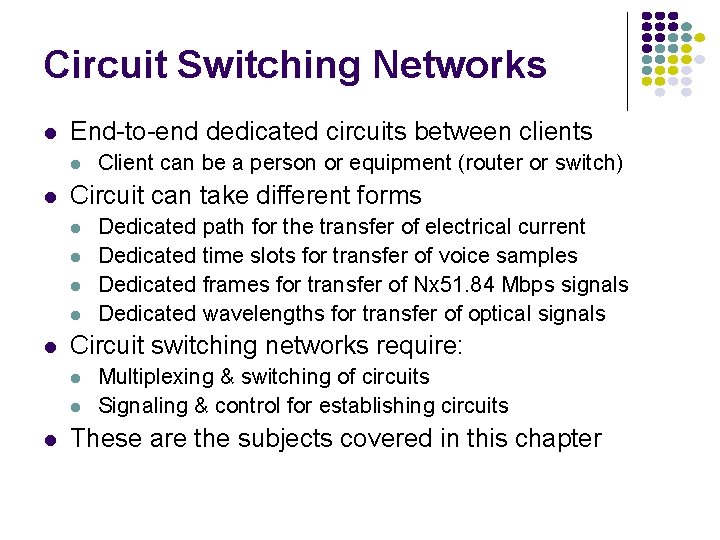
Circuit Switching Networks l End-to-end dedicated circuits between clients l l Circuit can take different forms l l l Dedicated path for the transfer of electrical current Dedicated time slots for transfer of voice samples Dedicated frames for transfer of Nx 51. 84 Mbps signals Dedicated wavelengths for transfer of optical signals Circuit switching networks require: l l l Client can be a person or equipment (router or switch) Multiplexing & switching of circuits Signaling & control for establishing circuits These are the subjects covered in this chapter
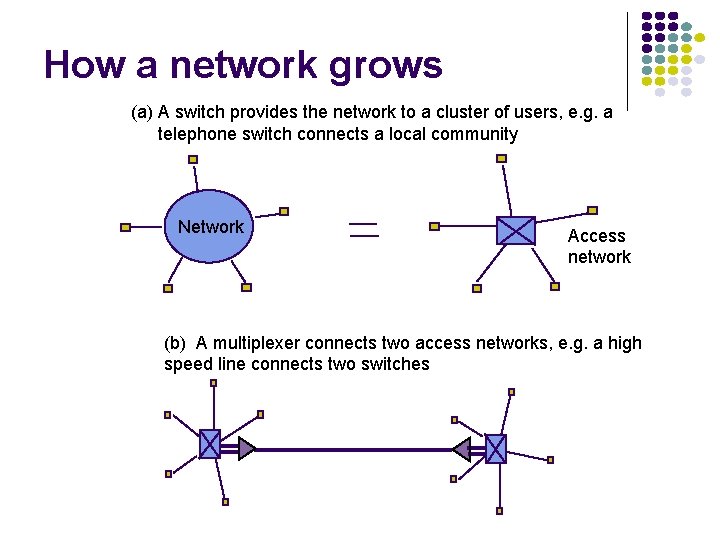
How a network grows (a) A switch provides the network to a cluster of users, e. g. a telephone switch connects a local community Network Access network (b) A multiplexer connects two access networks, e. g. a high speed line connects two switches
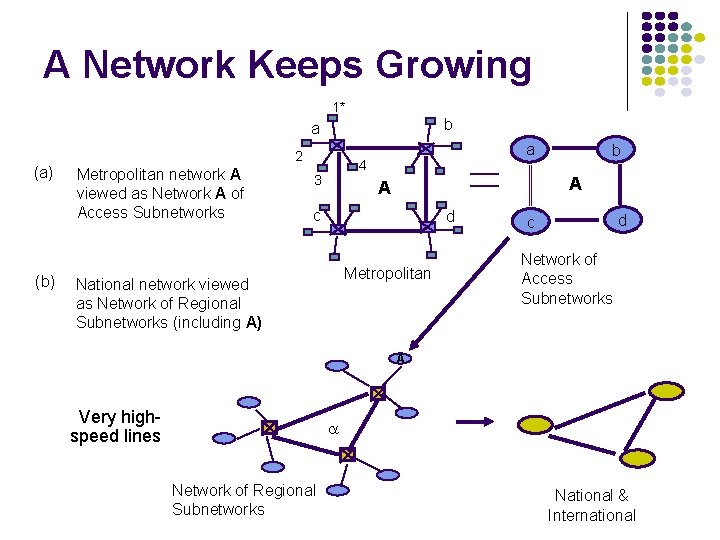
A Network Keeps Growing 1* b a (a) (b) 2 Metropolitan network A viewed as Network A of Access Subnetworks a 4 3 A A c d Metropolitan National network viewed as Network of Regional Subnetworks (including A) b d c Network of Access Subnetworks A l. Very highspeed lines Network of Regional Subnetworks National & International
Chapter 4 Circuit-Switching Networks Multiplexing
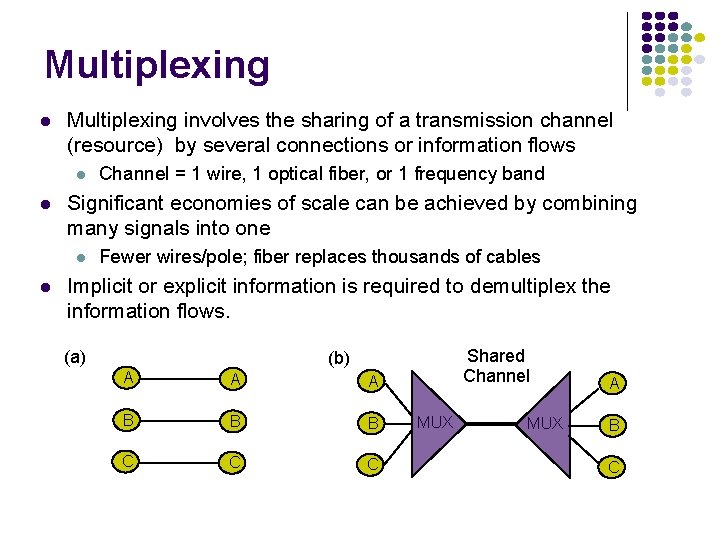
Multiplexing l Multiplexing involves the sharing of a transmission channel (resource) by several connections or information flows l l Significant economies of scale can be achieved by combining many signals into one l l Channel = 1 wire, 1 optical fiber, or 1 frequency band Fewer wires/pole; fiber replaces thousands of cables Implicit or explicit information is required to demultiplex the information flows. (a) Shared Channel (b) A A A B B B C C C MUX A B C
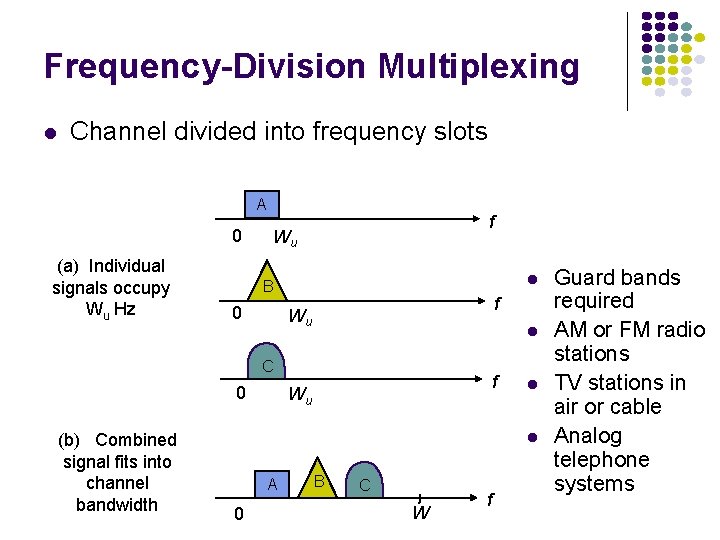
Frequency-Division Multiplexing l Channel divided into frequency slots A 0 (a) Individual signals occupy Wu Hz f Wu l B 0 f Wu l C 0 (b) Combined signal fits into channel bandwidth f Wu l l A 0 B C W f Guard bands required AM or FM radio stations TV stations in air or cable Analog telephone systems
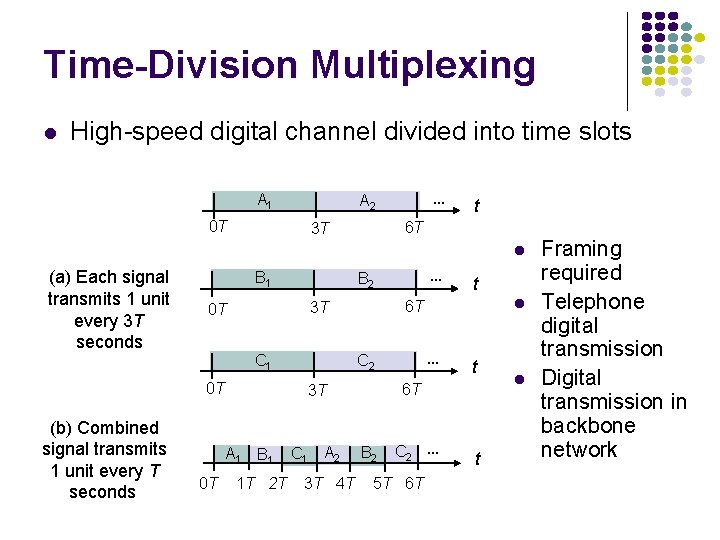
Time-Division Multiplexing l High-speed digital channel divided into time slots A 1 0 T A 2 … t 6 T 3 T l (a) Each signal transmits 1 unit every 3 T seconds B 1 C 1 0 T C 2 1 T 2 T C 1 A 2 3 T 4 T t l … t 6 T 3 T A 1 B 1 … 6 T 3 T 0 T 0 T (b) Combined signal transmits 1 unit every T seconds B 2 C 2 5 T 6 T … t l Framing required Telephone digital transmission Digital transmission in backbone network
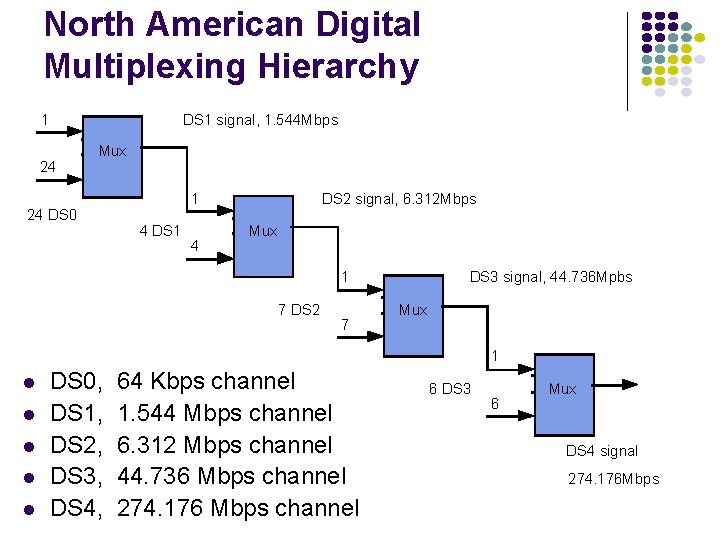
North American Digital Multiplexing Hierarchy 1 24 . . DS 1 signal, 1. 544 Mbps Mux 24 DS 0 1 4 DS 1 4 . . DS 2 signal, 6. 312 Mbps Mux 1 7 DS 2 7 . . DS 3 signal, 44. 736 Mpbs Mux 1 l l l DS 0, DS 1, DS 2, DS 3, DS 4, 64 Kbps channel 1. 544 Mbps channel 6. 312 Mbps channel 44. 736 Mbps channel 274. 176 Mbps channel 6 DS 3 6 . . Mux DS 4 signal 274. 176 Mbps
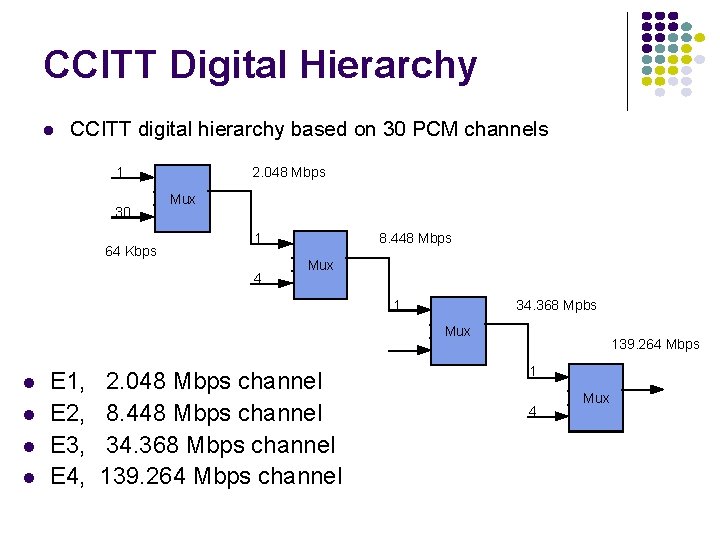
CCITT Digital Hierarchy l CCITT digital hierarchy based on 30 PCM channels 1 30 . . 64 Kbps 2. 048 Mbps Mux 1 4 . . 8. 448 Mbps Mux 1 l l E 1, E 2, E 3, E 4, 2. 048 Mbps channel 8. 448 Mbps channel 34. 368 Mbps channel 139. 264 Mbps channel . . 34. 368 Mpbs Mux 139. 264 Mbps 1 4 . . Mux
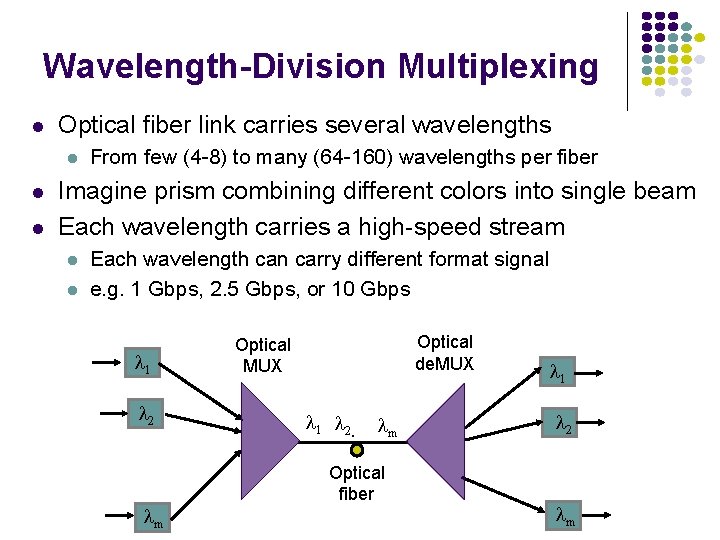
Wavelength-Division Multiplexing l Optical fiber link carries several wavelengths l l l From few (4 -8) to many (64 -160) wavelengths per fiber Imagine prism combining different colors into single beam Each wavelength carries a high-speed stream l l Each wavelength can carry different format signal e. g. 1 Gbps, 2. 5 Gbps, or 10 Gbps 1 2 m Optical de. MUX Optical MUX 1 2. m Optical fiber 1 2 m
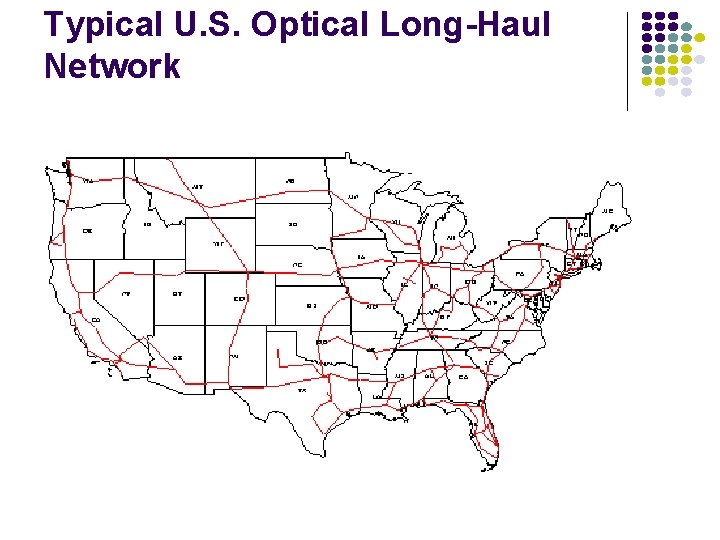
Typical U. S. Optical Long-Haul Network
Chapter 4 Circuit-Switching Networks SONET
SONET: Overview l l l Synchronous Optical NETwork North American TDM physical layer standard for optical fiber communications 8000 frames/sec. (Tframe = 125 sec) l l l compatible with North American digital hierarchy Greatly simplifies multiplexing in network backbone Protection & restoration
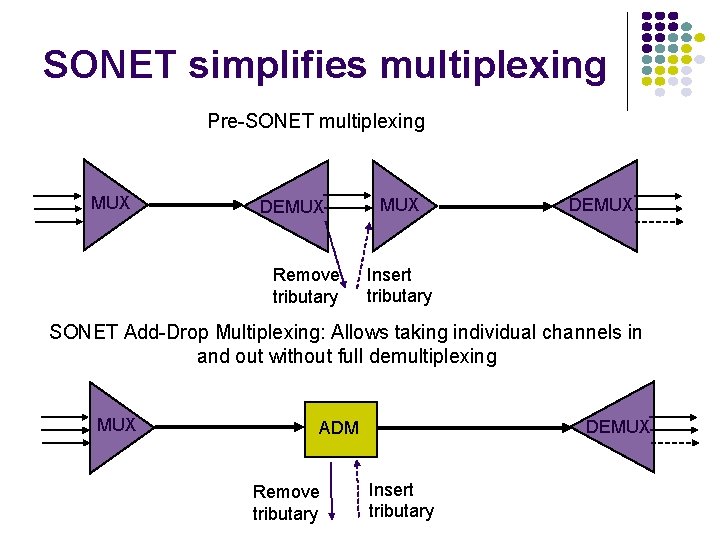
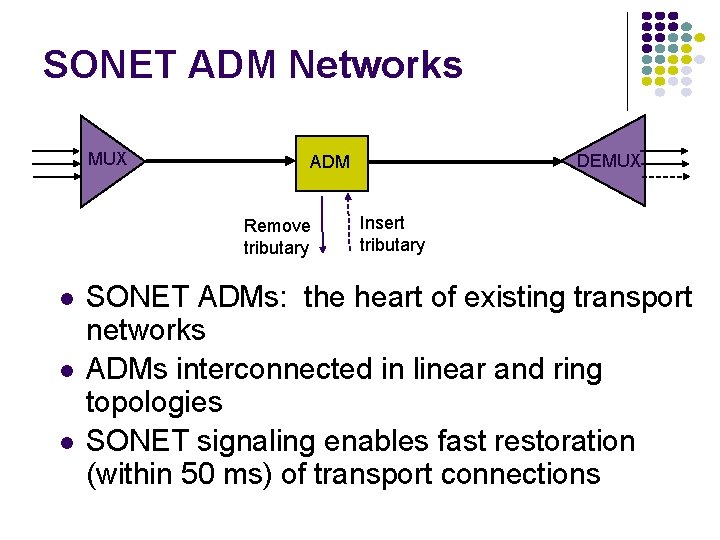
SONET simplifies multiplexing Pre-SONET multiplexing MUX DEMUX Remove tributary MUX DEMUX Insert tributary SONET Add-Drop Multiplexing: Allows taking individual channels in and out without full demultiplexing MUX DEMUX ADM Remove tributary Insert tributary
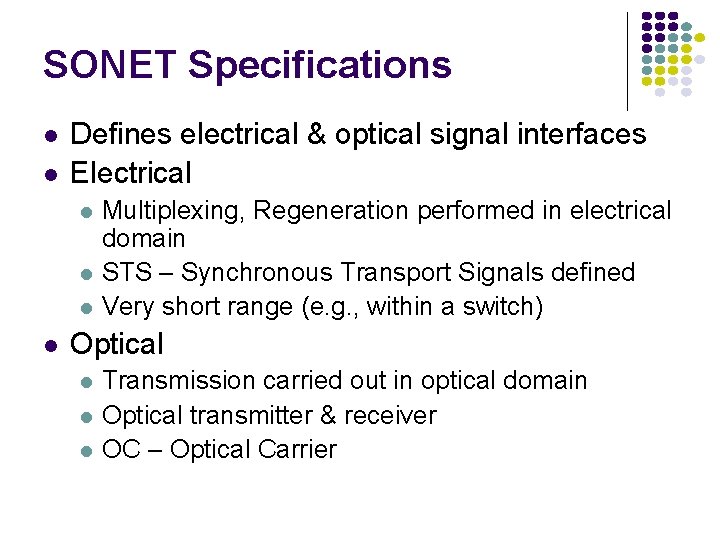
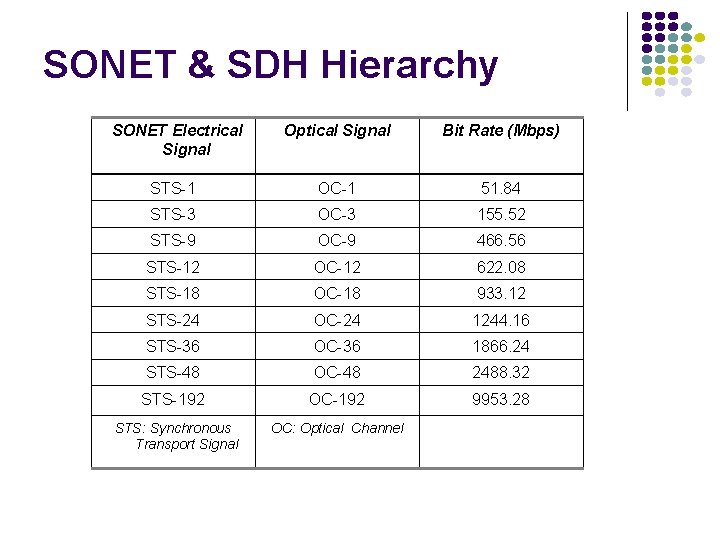
SONET Specifications l l Defines electrical & optical signal interfaces Electrical l l Multiplexing, Regeneration performed in electrical domain STS – Synchronous Transport Signals defined Very short range (e. g. , within a switch) Optical l Transmission carried out in optical domain Optical transmitter & receiver OC – Optical Carrier
SONET & SDH Hierarchy SONET Electrical Signal Optical Signal Bit Rate (Mbps) STS-1 OC-1 51. 84 STS-3 OC-3 155. 52 STS-9 OC-9 466. 56 STS-12 OC-12 622. 08 STS-18 OC-18 933. 12 STS-24 OC-24 1244. 16 STS-36 OC-36 1866. 24 STS-48 OC-48 2488. 32 STS-192 OC-192 9953. 28 STS: Synchronous Transport Signal OC: Optical Channel
SONET ADM Networks MUX Remove tributary l l l DEMUX ADM Insert tributary SONET ADMs: the heart of existing transport networks ADMs interconnected in linear and ring topologies SONET signaling enables fast restoration (within 50 ms) of transport connections
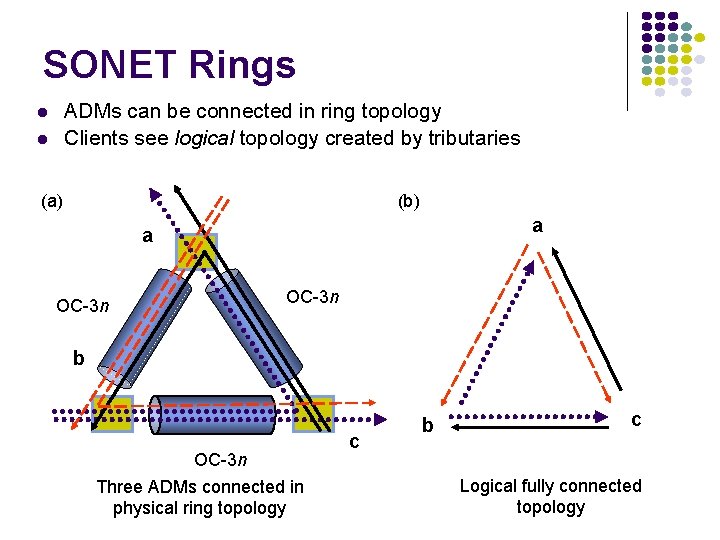
SONET Rings ADMs can be connected in ring topology Clients see logical topology created by tributaries l l (a) (b) a a OC-3 n b OC-3 n Three ADMs connected in physical ring topology c b c Logical fully connected topology
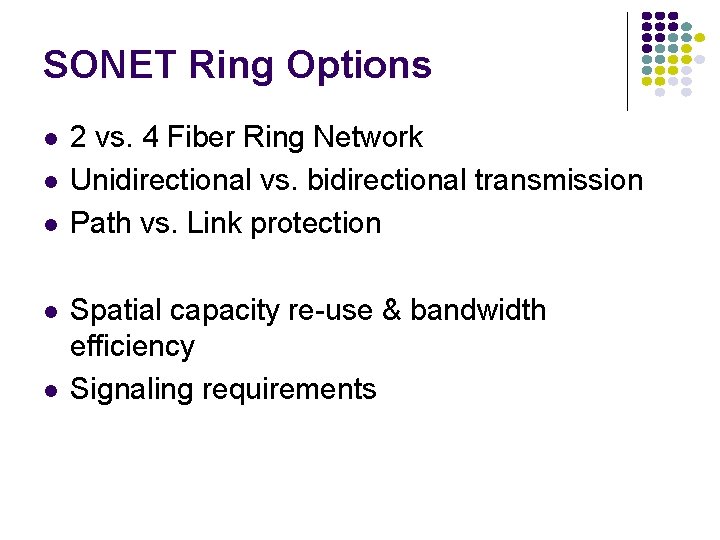
SONET Ring Options l l l 2 vs. 4 Fiber Ring Network Unidirectional vs. bidirectional transmission Path vs. Link protection Spatial capacity re-use & bandwidth efficiency Signaling requirements
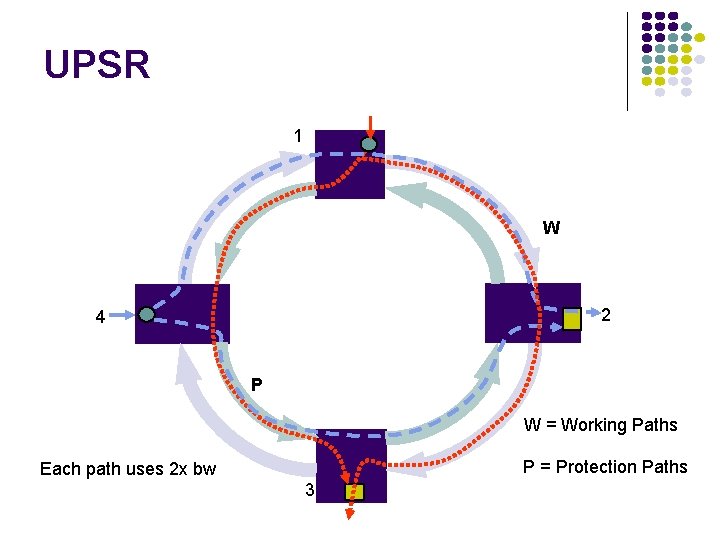
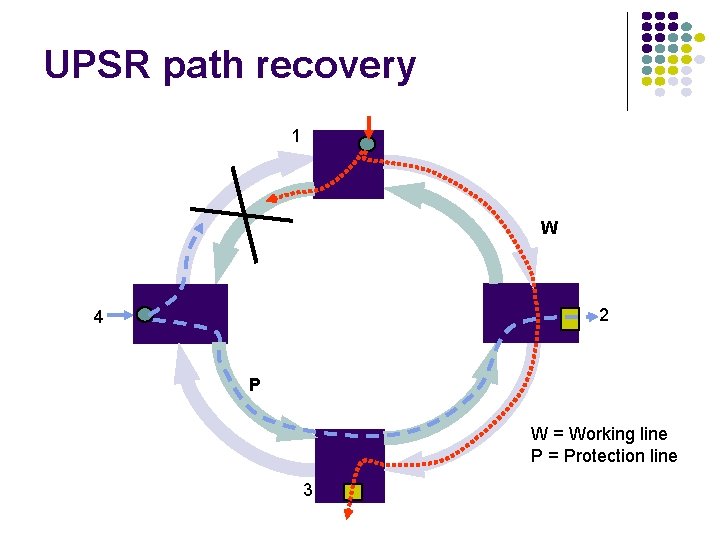
Two-Fiber Unidirectional Path Switched Ring Two fibers transmit in opposite directions l Unidirectional l l Working traffic flows clockwise Protection traffic flows counter-clockwise 1+1 like Selector at receiver does path protection switching
UPSR 1 W 2 4 P W = Working Paths P = Protection Paths Each path uses 2 x bw 3
UPSR path recovery 1 W 2 4 P W = Working line P = Protection line 3
UPSR Properties l l l Low complexity Fast path protection 2 TX, 2 RX Suitable for lower-speed access networks Different delay between W and P path
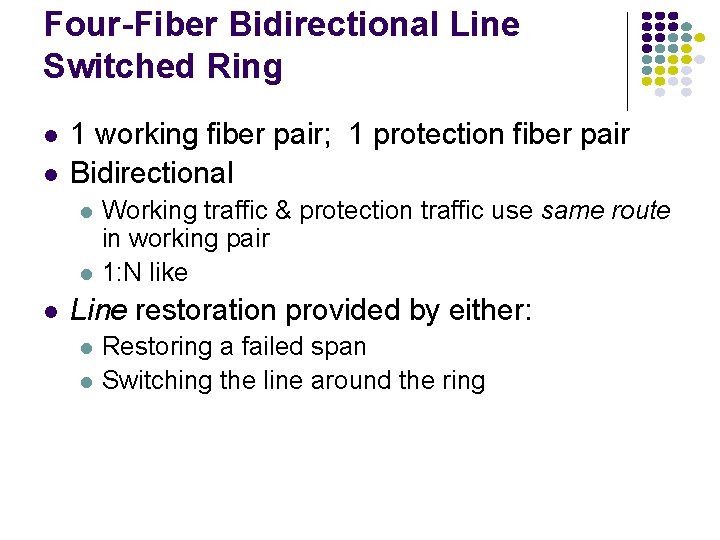
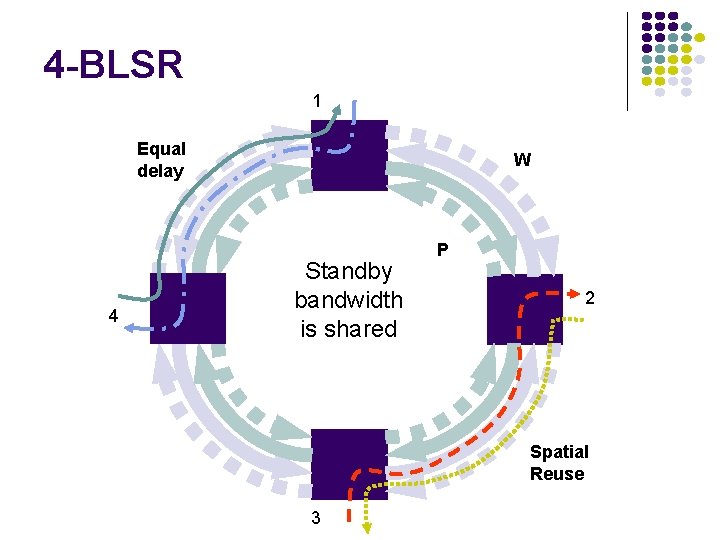
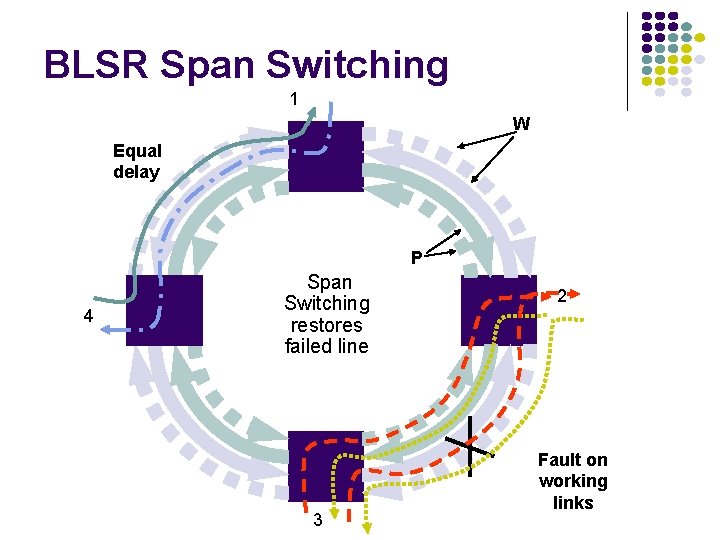
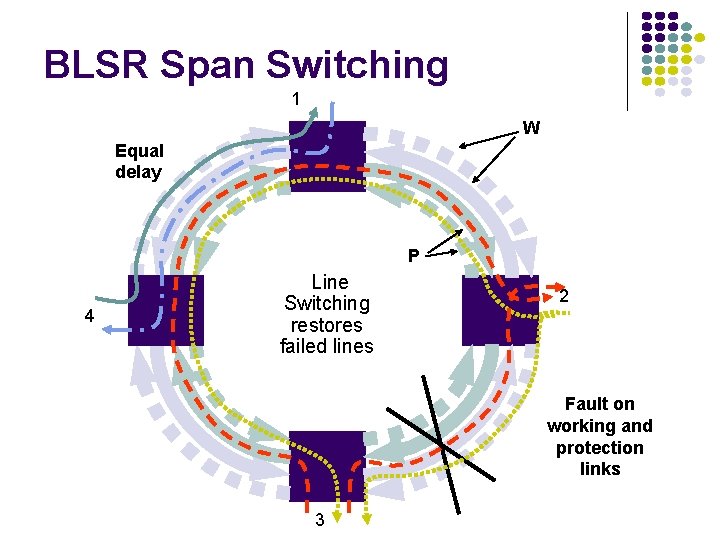
Four-Fiber Bidirectional Line Switched Ring l l 1 working fiber pair; 1 protection fiber pair Bidirectional l Working traffic & protection traffic use same route in working pair 1: N like Line restoration provided by either: l l Restoring a failed span Switching the line around the ring
4 -BLSR 1 Equal delay 4 W Standby bandwidth is shared P 2 Spatial Reuse 3
BLSR Span Switching 1 W Equal delay P l. Span 4 Switching restores failed line 3 2 Fault on working links
BLSR Span Switching 1 W Equal delay P l. Line 4 Switching restores failed lines 2 Fault on working and protection links 3
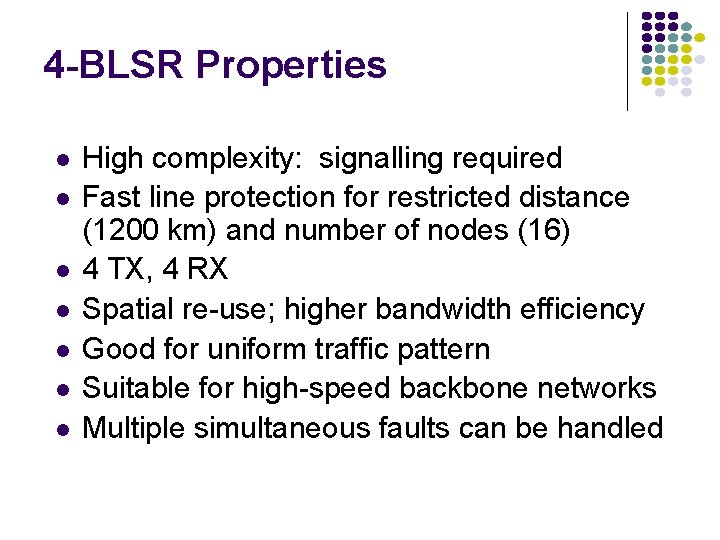
4 -BLSR Properties l l l l High complexity: signalling required Fast line protection for restricted distance (1200 km) and number of nodes (16) 4 TX, 4 RX Spatial re-use; higher bandwidth efficiency Good for uniform traffic pattern Suitable for high-speed backbone networks Multiple simultaneous faults can be handled
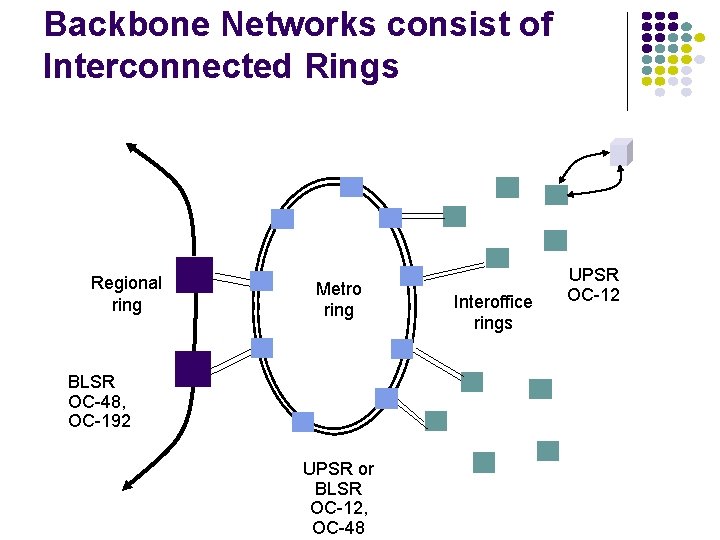
Backbone Networks consist of Interconnected Rings Regional ring Metro ring BLSR OC-48, OC-192 UPSR or BLSR OC-12, OC-48 Interoffice rings UPSR OC-12