
Chapter 4 Chemical Bonding The Ionic Bond Model
Chapter 4. Chemical Bonding: The Ionic Bond Model Introduction to Inorganic Chemistry Instructor Dr. Upali Siriwardane (Ph. D. Ohio State) E-mail: upali@latech. edu Office: 311 Carson Taylor Hall ; Phone: 318 -257 -4941; Office Hours: MWF 8: 00 -9: 00 and 11: 00 -12: 00; TR 10: 00 -12: 00 Contact me trough phone or e-mail if you have questions Online Tests on Following days March 24, 2017: Test 1 (Chapters 1 -3) April 7, 2017 : Test 2 (Chapters 4 -5) April 28, 2017: Test 3 (Chapters 6, 7 &8) May 12, 2017 : Test 4 (Chapters 9, 10 &11) May 15, 2017: Make Up Exam: Chapters 1 -11). 1
Chapter 4 Chemical Bonding: The Ionic Bond Model Table of Contents 4. 1 4. 2 4. 3 4. 4 4. 5 4. 6 4. 7 4. 8 4. 9 4. 10 4. 11 Chemical Bonds Valence Electrons and Lewis Symbols The Octet Rule The Ionic Bond Model The Sign and Magnitude of Ionic Charge Lewis Structures for Ionic Compounds Chemical Formulas for Ionic Compounds The Structure of Ionic Compounds Recognizing and Naming Binary Ionic Compounds Polyatomic Ions Chemical Formulas and Names for Ionic Compounds Containing Polyatomic Ions Copyright © Cengage Learning. All rights reserved 2
Section 4. 1 Chemical Bonds A Chemical Bond • Attractive force that holds two atoms together in a more complex unit. • Form as a result of interactions between electrons found in the combining atoms. Copyright © Cengage Learning. All rights reserved 3
Section 4. 1 Chemical Bonds Two Types of Chemical Bonds • Ionic Bonds (metal + non-metal) Chapter 4 • Covalent Bonds (non-metal + non-metal) Chapter 5 • Metallic Bonds (metal + metal) (not discussed) Copyright © Cengage Learning. All rights reserved 4
Section 4. 1 Chemical Bonds Ionic Bond • Chemical bond formed through the transfer of one or more electrons from one (metal) atom or group of atoms to another (non-metal) atom or group of atoms. • Ionic Compound – A compound in which ionic bonds are present due to charged attractions between cations and anions. Copyright © Cengage Learning. All rights reserved 5
Section 4. 1 Chemical Bonds Covalent Bond • Chemical bond formed through the sharing of one or more pairs of electrons between two nonmetal atoms. • Molecular Compound (Covalent Compound) – A compound in which atoms are joined through covalent bonds. Copyright © Cengage Learning. All rights reserved 6
Section 4. 1 Chemical Bonds Metallic Bond • Chemical bond formed through the sharing of one or more pairs of electrons between all atoms in a solid. • Metals: Metallic elements Metallic properties are due to metallic bonding • Alloys (Metallic compounds) – A compound in which atoms are joined through metallic bonds. Copyright © Cengage Learning. All rights reserved 7
Section 4. 1 Chemical Bonds Bonding • Most bonds are not 100% ionic or 100% covalent. • Most bonds have some degree of both ionic and covalent character. Copyright © Cengage Learning. All rights reserved 8
Section 4. 1 Chemical Bonds Two Fundamental Concepts 1. Not all electrons in an atom participate in bonding. Those that participate are called valence electrons. 2. Certain arrangements of electrons are more stable than others, as is explained by the octet rule. Copyright © Cengage Learning. All rights reserved 9
Section 4. 2 Valence Electrons and Lewis Symbols Valence Electron • An electron in the outermost electron shell of a representative element or noble-gas element. • In these representative elements or nobel gases the valence electrons are found in either s or p subshells. Copyright © Cengage Learning. All rights reserved 10
Section 4. 2 Valence Electrons and Lewis Symbols Lewis Symbol • Chemical symbol of an element surrounded by dots equal in number to the number of valence electrons present in atoms of the element. Copyright © Cengage Learning. All rights reserved 11
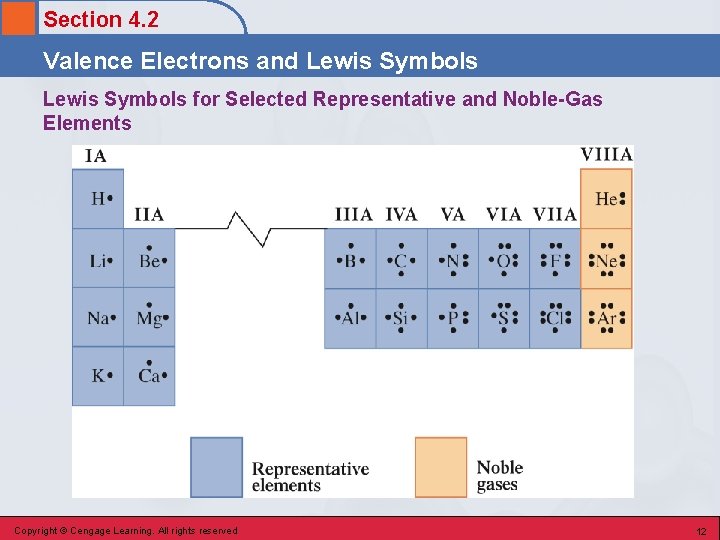
Section 4. 2 Valence Electrons and Lewis Symbols for Selected Representative and Noble-Gas Elements Copyright © Cengage Learning. All rights reserved 12
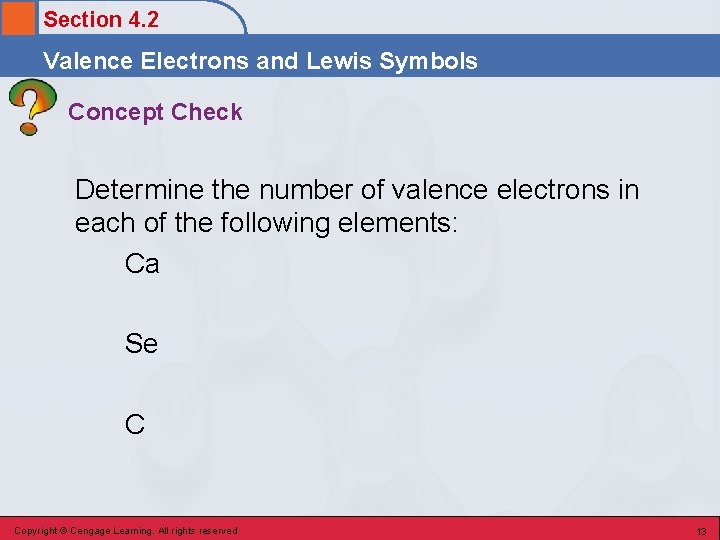
Section 4. 2 Valence Electrons and Lewis Symbols Concept Check Determine the number of valence electrons in each of the following elements: Ca Se C Copyright © Cengage Learning. All rights reserved 13
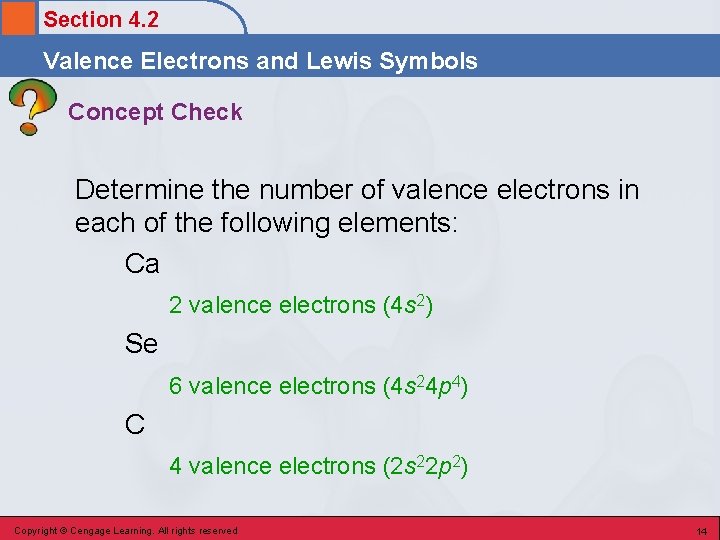
Section 4. 2 Valence Electrons and Lewis Symbols Concept Check Determine the number of valence electrons in each of the following elements: Ca 2 valence electrons (4 s 2) Se 6 valence electrons (4 s 24 p 4) C 4 valence electrons (2 s 22 p 2) Copyright © Cengage Learning. All rights reserved 14
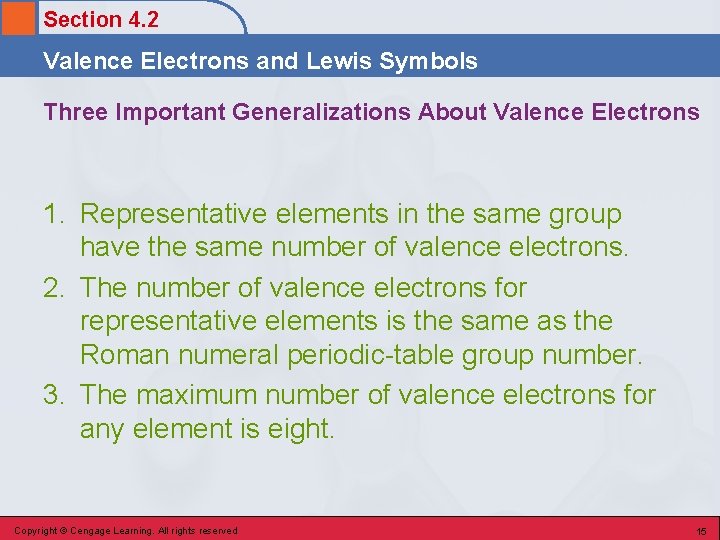
Section 4. 2 Valence Electrons and Lewis Symbols Three Important Generalizations About Valence Electrons 1. Representative elements in the same group have the same number of valence electrons. 2. The number of valence electrons for representative elements is the same as the Roman numeral periodic-table group number. 3. The maximum number of valence electrons for any element is eight. Copyright © Cengage Learning. All rights reserved 15
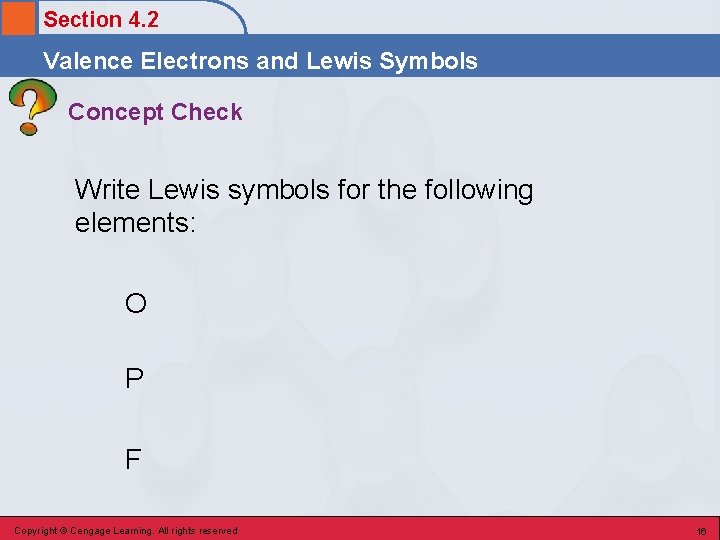
Section 4. 2 Valence Electrons and Lewis Symbols Concept Check Write Lewis symbols for the following elements: O P F Copyright © Cengage Learning. All rights reserved 16
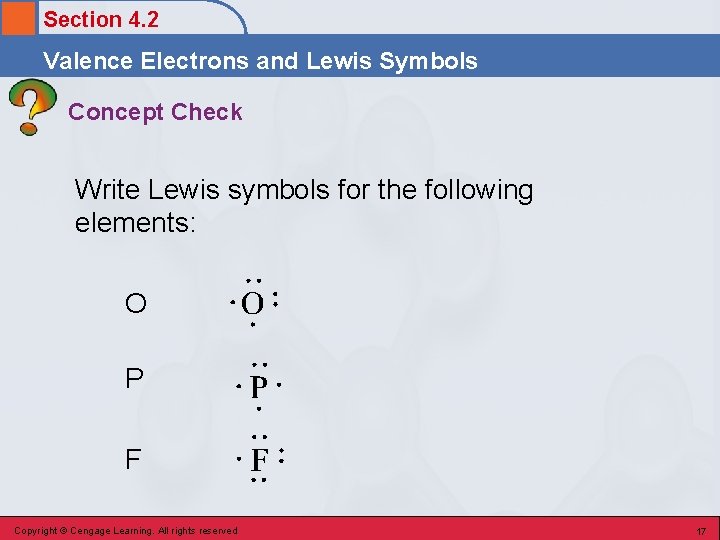
Section 4. 2 Valence Electrons and Lewis Symbols Concept Check Write Lewis symbols for the following elements: O P F Copyright © Cengage Learning. All rights reserved 17
Section 4. 3 The Octet Rule • Certain arrangements of valence electrons are more stable than others. • The valence electron configurations of the noble gases are considered the most stable of all valence electron configurations. Copyright © Cengage Learning. All rights reserved 18
Section 4. 3 The Octet Rule (G. N. Lewis) • In forming compounds, atoms of elements lose, gain, or share electrons in such a way as to produce a noble-gas electron configuration for each of the atoms involved. Copyright © Cengage Learning. All rights reserved 19
Section 4. 4 The Ionic Bond Model Ion • An atom (or group of atoms) that is electrically charged as a result of the loss or gain of electrons. • If an atom gains one or more electrons, it becomes a negatively charged ion (anion). • If an atom loses one or more electrons, it becomes a positively charged ion (cation). Copyright © Cengage Learning. All rights reserved 20
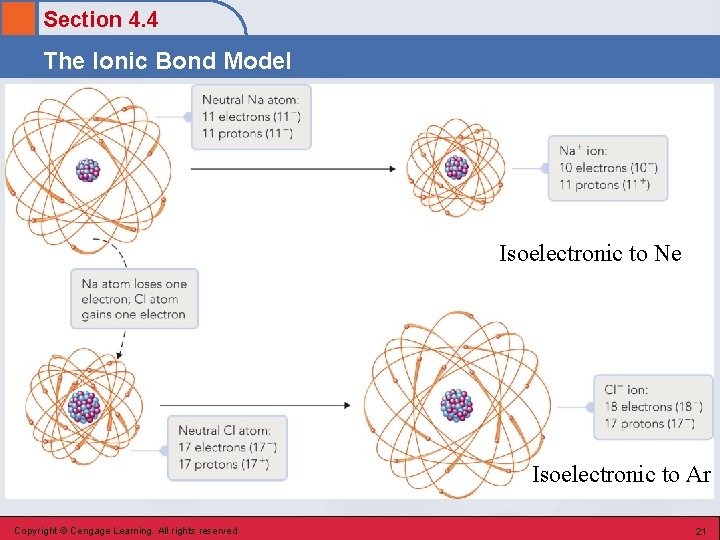
Section 4. 4 The Ionic Bond Model Isoelectronic to Ne Isoelectronic to Ar Copyright © Cengage Learning. All rights reserved 21
Section 4. 4 The Ionic Bond Model Concept Check Give the chemical symbol for each of the following ions. a) The ion formed when a potassium atom loses one electron. b) The ion formed when a sulfur atom gains two electrons. Copyright © Cengage Learning. All rights reserved 22
Section 4. 4 The Ionic Bond Model Concept Check Give the chemical symbol for each of the following ions. a) The ion formed when a potassium atom loses one electron. K+ b) The ion formed when a sulfur atom gains two electrons. S 2– Copyright © Cengage Learning. All rights reserved 23
Section 4. 5 The Sign and Magnitude of Ionic Charge • Atoms tend to gain or lose electrons until they have obtained an electron configuration that is the same as that of a noble gas. § Example: K+ (1 s 22 p 63 s 23 p 6) § Lost one electron to obtain electron configuration for Ar (1 s 22 p 63 s 23 p 6). Copyright © Cengage Learning. All rights reserved 24
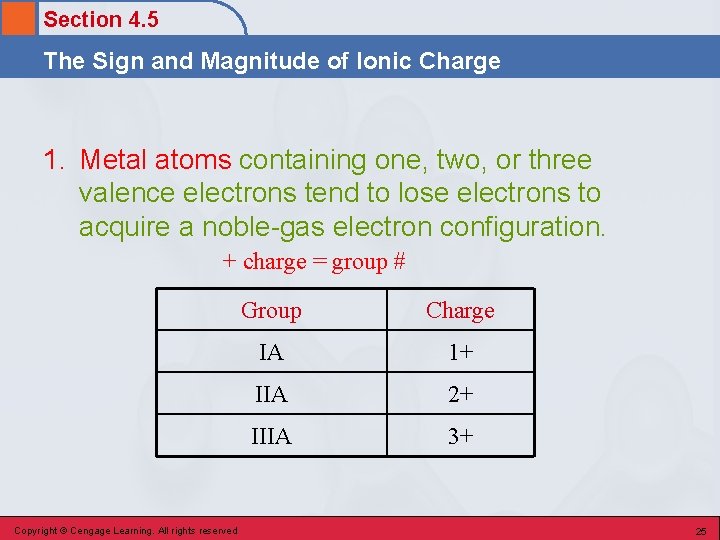
Section 4. 5 The Sign and Magnitude of Ionic Charge 1. Metal atoms containing one, two, or three valence electrons tend to lose electrons to acquire a noble-gas electron configuration. + charge = group # Copyright © Cengage Learning. All rights reserved Group Charge IA 1+ IIA 2+ IIIA 3+ 25
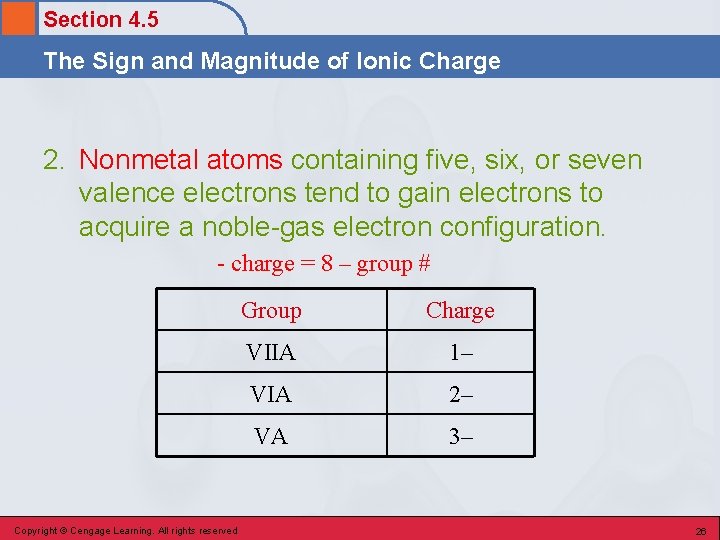
Section 4. 5 The Sign and Magnitude of Ionic Charge 2. Nonmetal atoms containing five, six, or seven valence electrons tend to gain electrons to acquire a noble-gas electron configuration. - charge = 8 – group # Copyright © Cengage Learning. All rights reserved Group Charge VIIA 1– VIA 2– VA 3– 26
Section 4. 5 The Sign and Magnitude of Ionic Charge 3. Elements in Group IVA occupy unique positions relative to the noble gases (could gain or lose four electrons). Eg. C and Si Copyright © Cengage Learning. All rights reserved 27
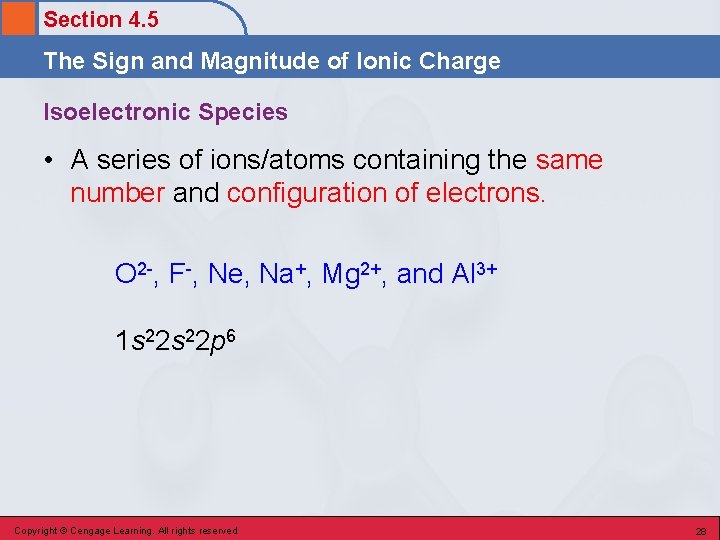
Section 4. 5 The Sign and Magnitude of Ionic Charge Isoelectronic Species • A series of ions/atoms containing the same number and configuration of electrons. O 2 -, F-, Ne, Na+, Mg 2+, and Al 3+ 1 s 22 p 6 Copyright © Cengage Learning. All rights reserved 28
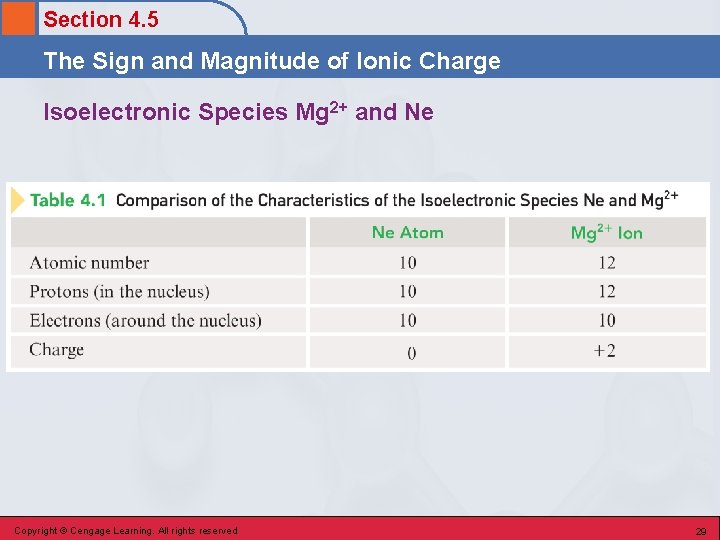
Section 4. 5 The Sign and Magnitude of Ionic Charge Isoelectronic Species Mg 2+ and Ne Copyright © Cengage Learning. All rights reserved 29
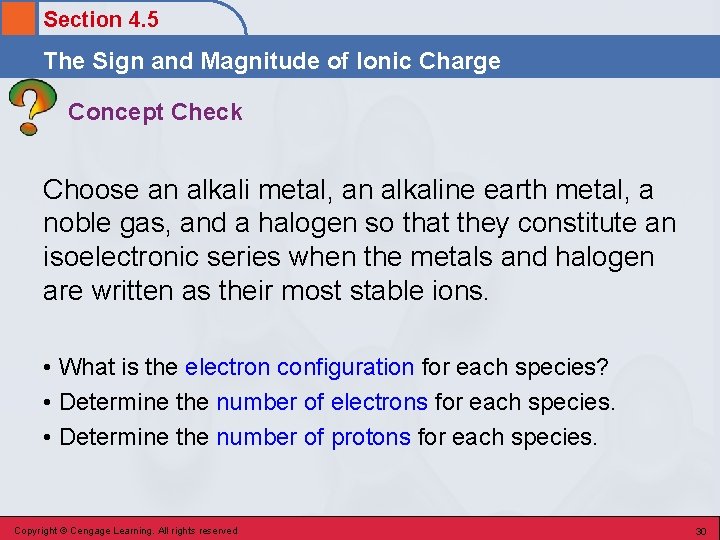
Section 4. 5 The Sign and Magnitude of Ionic Charge Concept Check Choose an alkali metal, an alkaline earth metal, a noble gas, and a halogen so that they constitute an isoelectronic series when the metals and halogen are written as their most stable ions. • What is the electron configuration for each species? • Determine the number of electrons for each species. • Determine the number of protons for each species. Copyright © Cengage Learning. All rights reserved 30
Section 4. 6 Lewis Structures for Ionic Compounds Formation of an Ionic Compound • Ion formation requires the presence of two elements: – A metal that can donate electrons. – A non-metal that can accept electrons. • The electrons lost by the metal are the same ones gained by the nonmetal. • The positive and negative ions simultaneously formed from such electron transfer attract one another. Copyright © Cengage Learning. All rights reserved 31
Section 4. 6 Lewis Structures for Ionic Compounds Lewis Structure • Combination of Lewis symbols that represents either the transfer or the sharing of electrons in chemical bonds. Copyright © Cengage Learning. All rights reserved 32
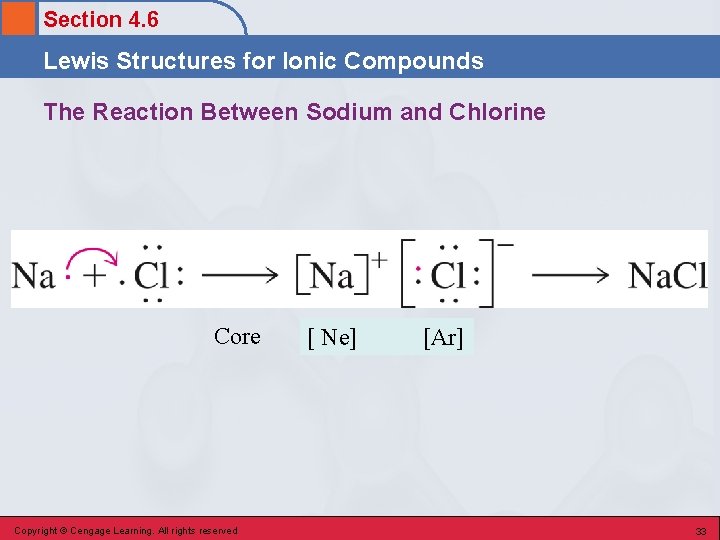
Section 4. 6 Lewis Structures for Ionic Compounds The Reaction Between Sodium and Chlorine Core Copyright © Cengage Learning. All rights reserved [ Ne] [Ar] 33
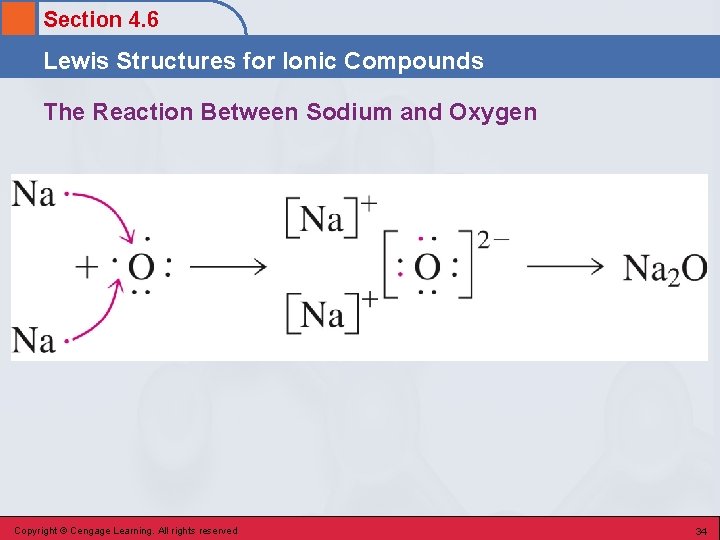
Section 4. 6 Lewis Structures for Ionic Compounds The Reaction Between Sodium and Oxygen Copyright © Cengage Learning. All rights reserved 34
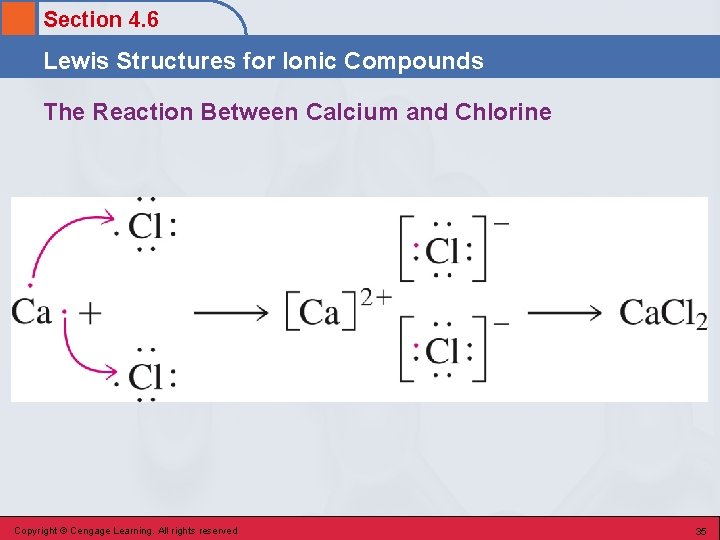
Section 4. 6 Lewis Structures for Ionic Compounds The Reaction Between Calcium and Chlorine Copyright © Cengage Learning. All rights reserved 35
Section 4. 7 Chemical Formulas for Ionic Compounds • Ionic compounds are always neutral; no net charge is present. • The ratio in which positive and negative ions combine is the ratio that achieves charge neutrality for the resulting compound. • Charges on ions determines the subscripts in the formula Eg. Na 1+ O 2 - gives Na 2 O Copyright © Cengage Learning. All rights reserved 36
Section 4. 7 Chemical Formulas for Ionic Compounds Writing Chemical Formulas for Ionic Compounds 1. The symbol for the positive ions is always written first. 2. The charges on the ions that are present are not shown in the formula. 3. The subscripts in the formula give the combining ratio for the ions. Copyright © Cengage Learning. All rights reserved 37
Section 4. 7 Chemical Formulas for Ionic Compounds Example • Compound formed between Li+ and O 2– – Need two Li+ to balance out the 2 - charge on oxygen. • Formula is Li 2 O. Copyright © Cengage Learning. All rights reserved 38
Section 4. 7 Chemical Formulas for Ionic Compounds Concept Check Determine the chemical formula for the compound that is formed when each of the following pairs of ions interact. Ba 2+ and Cl– Fe 3+ and O 2– Pb 4+ and O 2– Copyright © Cengage Learning. All rights reserved 39
Section 4. 7 Chemical Formulas for Ionic Compounds Concept Check Determine the chemical formula for the compound that is formed when each of the following pairs of ions interact. Ba 2+ and Cl– Ba. Cl 2 Fe 3+ and O 2– Fe 2 O 3 Pb 4+ and O 2– Pb. O 2 Copyright © Cengage Learning. All rights reserved 40
Section 4. 8 The Structure of Ionic Compounds Solid Ionic Compounds (ionic lattices). • Consists of positive and negative ions arranged in such a way that each ion is surrounded by nearest neighbors of the opposite charge. • Any given ion is bonded by electrostatic attractions to all the other ions of opposite charge immediately surrounding it. Copyright © Cengage Learning. All rights reserved 41
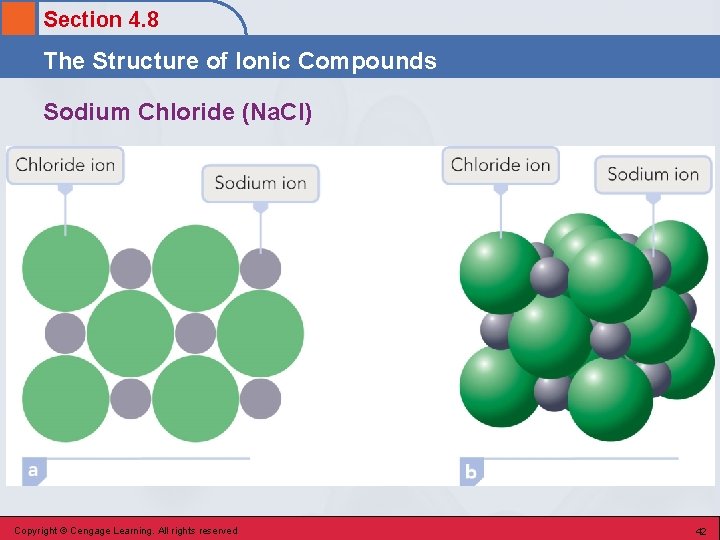
Section 4. 8 The Structure of Ionic Compounds Sodium Chloride (Na. Cl) Copyright © Cengage Learning. All rights reserved 42
Section 4. 8 The Structure of Ionic Compounds Formula Unit • Smallest whole-number repeating ratio of ions present in an ionic compound that results in charge neutrality. • Chemical formulas for ionic compounds represent the simplest ratio of ions present. • Eg. Ca 2+ O 2 - gives Ca 2 O 2 becomes Ca. O Copyright © Cengage Learning. All rights reserved 43
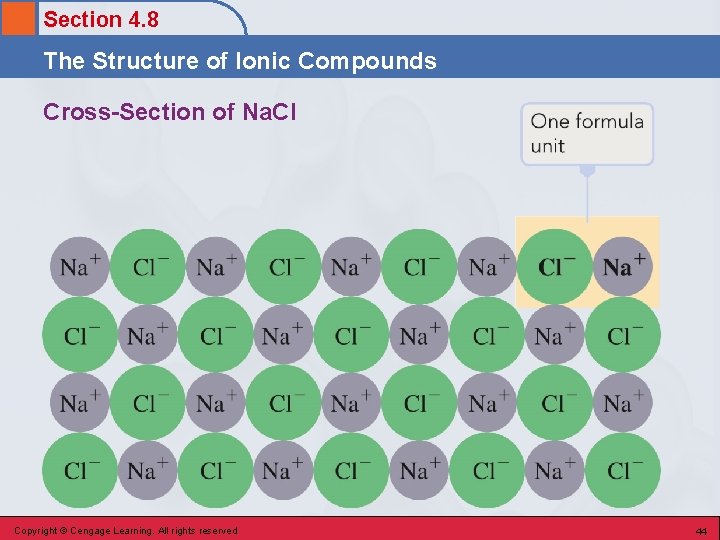
Section 4. 8 The Structure of Ionic Compounds Cross-Section of Na. Cl Copyright © Cengage Learning. All rights reserved 44
Section 4. 9 Recognizing and Naming Binary Ionic Compounds Naming Compounds • Binary Compounds: § Composed of two elements § Ionic and covalent compounds included • Binary Ionic Compounds: § Metal-nonmetal § Metal is always present as the positive ion, and the nonmetal is always present as the negative ion. Copyright © Cengage Learning. All rights reserved 45
Section 4. 9 Recognizing and Naming Binary Ionic Compounds Naming Ionic Compounds • The full name of the metallic element is given first, followed by a separate word containing the stem of the nonmetallic element name and the suffix –ide. Copyright © Cengage Learning. All rights reserved 46
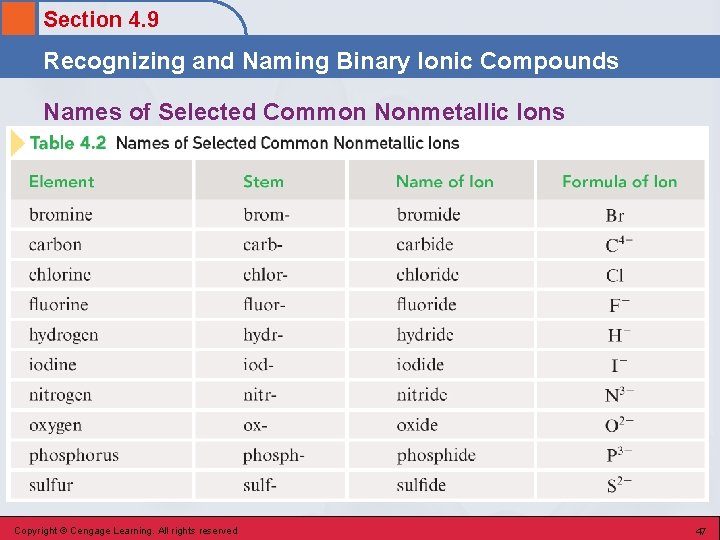
Section 4. 9 Recognizing and Naming Binary Ionic Compounds Names of Selected Common Nonmetallic Ions Copyright © Cengage Learning. All rights reserved 47
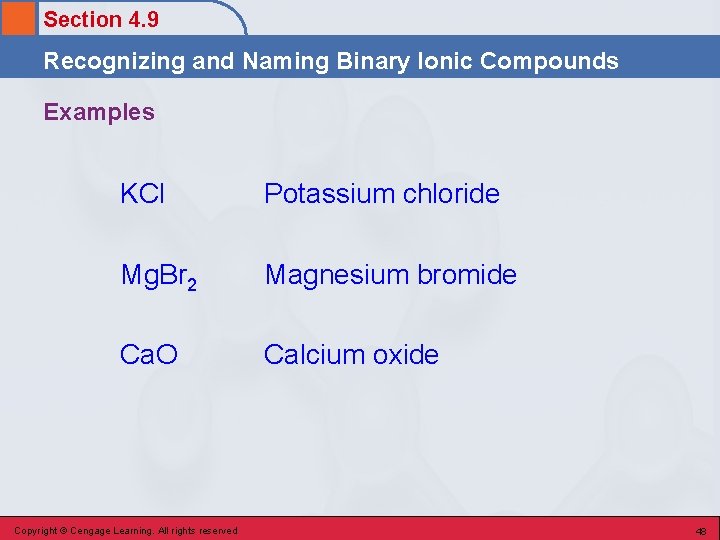
Section 4. 9 Recognizing and Naming Binary Ionic Compounds Examples KCl Potassium chloride Mg. Br 2 Magnesium bromide Ca. O Calcium oxide Copyright © Cengage Learning. All rights reserved 48
Section 4. 9 Recognizing and Naming Binary Ionic Compounds Naming Ionic Compounds (for Metals with Variable Charges) • Metals in these compounds form more than one type of positive charge. • Charge on the metal ion must be specified. • Roman numeral indicates the charge of the metal cation (positively charged ion). • Transition metal cations usually require a Roman numeral. Copyright © Cengage Learning. All rights reserved 49
Section 4. 9 Recognizing and Naming Binary Ionic Compounds Examples Cu. Br Copper(I) bromide Fe. S Iron(II) sulfide Pb. O 2 Lead(IV) oxide Copyright © Cengage Learning. All rights reserved 50
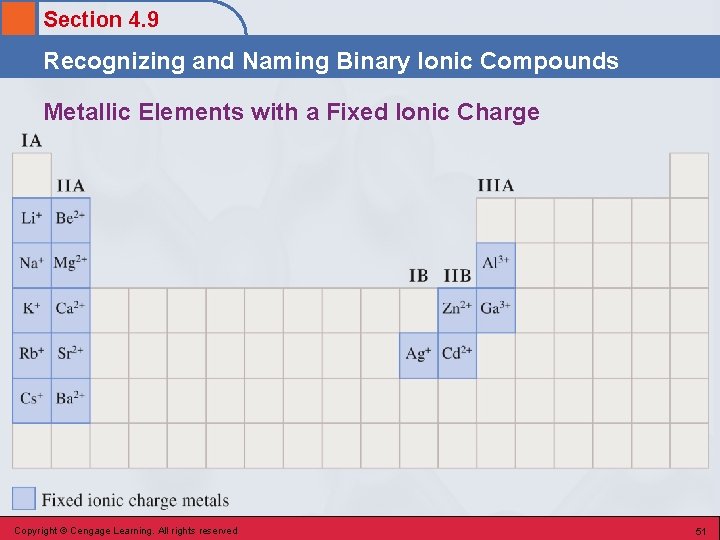
Section 4. 9 Recognizing and Naming Binary Ionic Compounds Metallic Elements with a Fixed Ionic Charge Copyright © Cengage Learning. All rights reserved 51
Section 4. 9 Recognizing and Naming Binary Ionic Compounds Exercise Name each of the following compounds: K 2 S Fe 2 O 3 Co. Cl 2 Copyright © Cengage Learning. All rights reserved 52
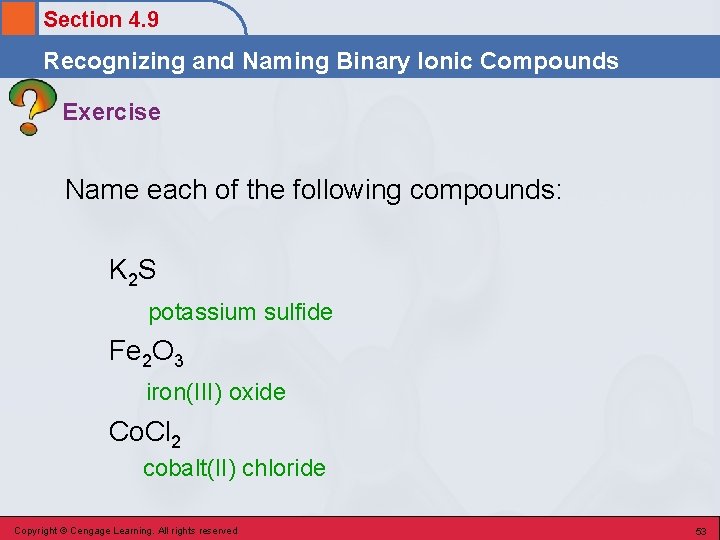
Section 4. 9 Recognizing and Naming Binary Ionic Compounds Exercise Name each of the following compounds: K 2 S potassium sulfide Fe 2 O 3 iron(III) oxide Co. Cl 2 cobalt(II) chloride Copyright © Cengage Learning. All rights reserved 53
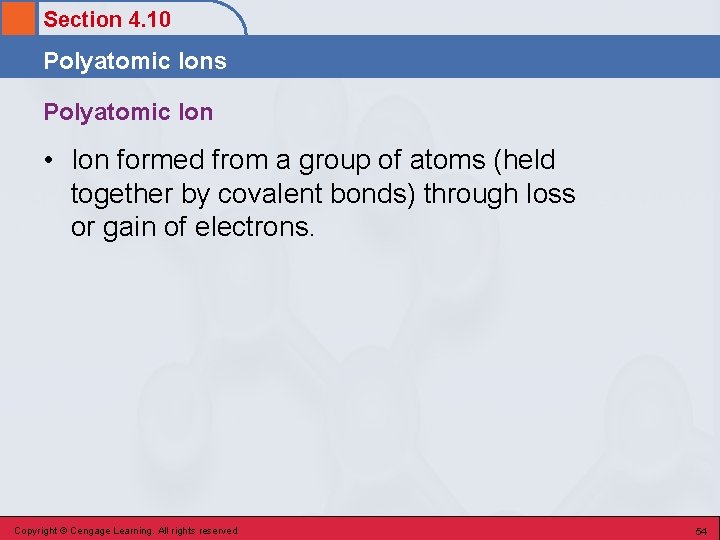
Section 4. 10 Polyatomic Ions Polyatomic Ion • Ion formed from a group of atoms (held together by covalent bonds) through loss or gain of electrons. Copyright © Cengage Learning. All rights reserved 54
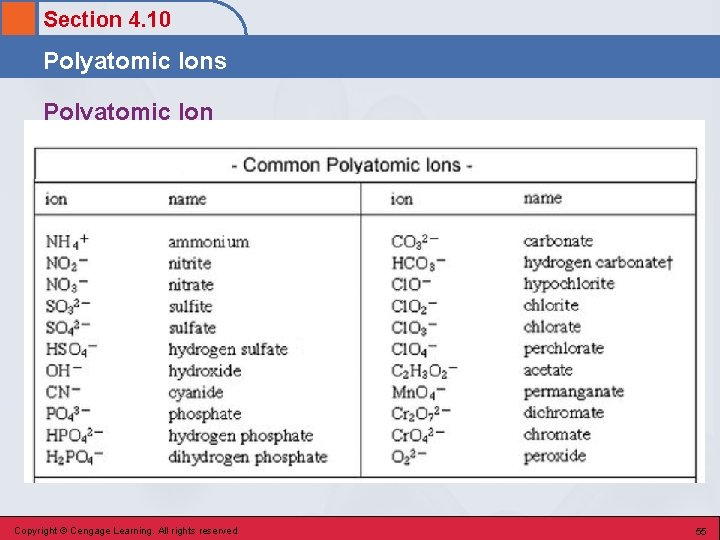
Section 4. 10 Polyatomic Ions Polyatomic Ion • . Copyright © Cengage Learning. All rights reserved 55
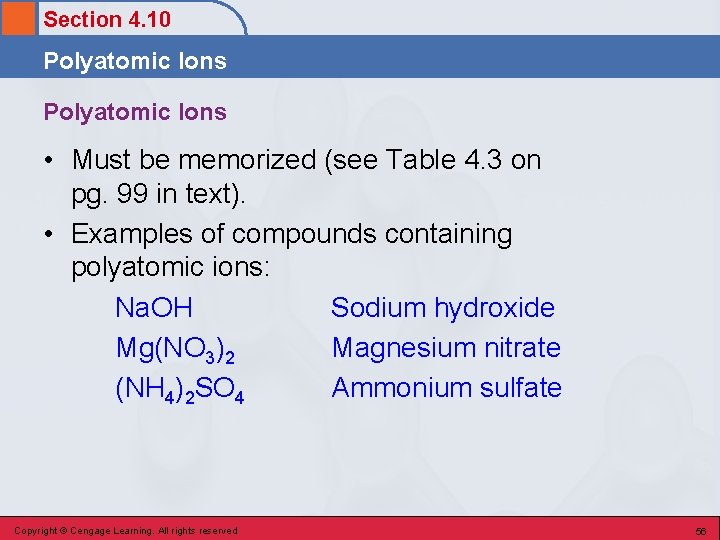
Section 4. 10 Polyatomic Ions • Must be memorized (see Table 4. 3 on pg. 99 in text). • Examples of compounds containing polyatomic ions: Na. OH Sodium hydroxide Mg(NO 3)2 Magnesium nitrate (NH 4)2 SO 4 Ammonium sulfate Copyright © Cengage Learning. All rights reserved 56
Section 4. 10 Polyatomic Ions Generalizations 1. Most of the polyatomic ions have a negative charge. 2. Two of the negatively charged polyatomic ions, OH– and CN–, have names ending in –ide and the rest of them have names ending in either – ate or –ite. Copyright © Cengage Learning. All rights reserved 57
Section 4. 10 Polyatomic Ions Generalizations 3. A number of –ate, –ite pairs of ions exist. The – ate ion always has one more oxygen atom than the –ite ion. Both the –ate and –ite ions of a pair carry the same charge. 4. A number of pairs of ions exist wherein one member of the pair differs from the other by having a hydrogen atom present. In such pairs, the charge on the ion that contains hydrogen is always 1 less than that on the other ion. Copyright © Cengage Learning. All rights reserved 58
Section 4. 11 Chemical Formulas and Names for Ionic Compounds Containing Polyatomic Ions • Determined in the same way as those for ionic compounds that contain monatomic ions. • The positive and negative charges present must add to zero. § Na+ and OH– form Na. OH. § Mg 2+ and NO 3– form Mg(NO 3)2. § NH 4+ and SO 42– form (NH 4)2 SO 4. Copyright © Cengage Learning. All rights reserved 59
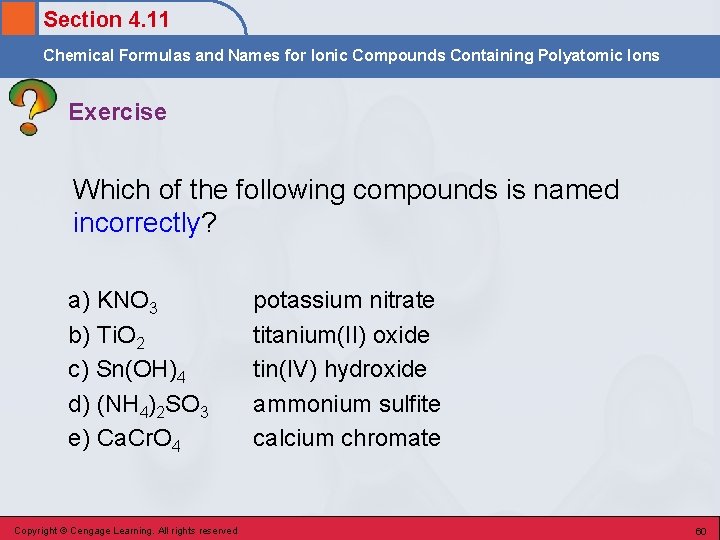
Section 4. 11 Chemical Formulas and Names for Ionic Compounds Containing Polyatomic Ions Exercise Which of the following compounds is named incorrectly? a) KNO 3 b) Ti. O 2 c) Sn(OH)4 d) (NH 4)2 SO 3 e) Ca. Cr. O 4 Copyright © Cengage Learning. All rights reserved potassium nitrate titanium(II) oxide tin(IV) hydroxide ammonium sulfite calcium chromate 60
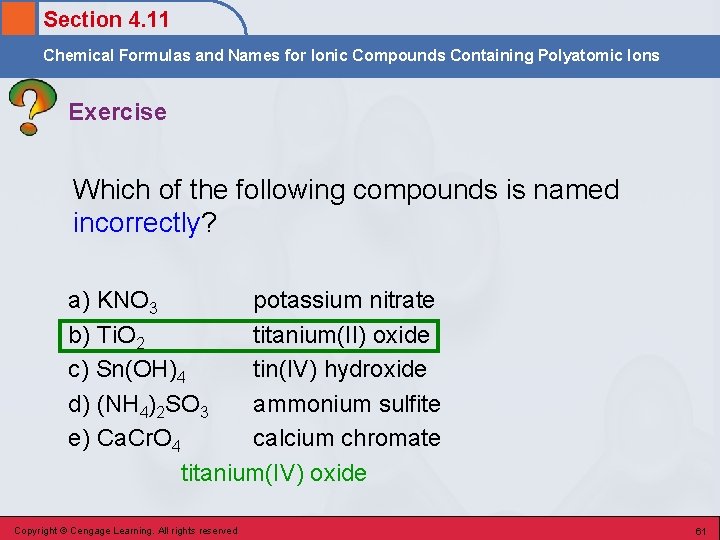
Section 4. 11 Chemical Formulas and Names for Ionic Compounds Containing Polyatomic Ions Exercise Which of the following compounds is named incorrectly? a) KNO 3 potassium nitrate b) Ti. O 2 titanium(II) oxide c) Sn(OH)4 tin(IV) hydroxide d) (NH 4)2 SO 3 ammonium sulfite e) Ca. Cr. O 4 calcium chromate titanium(IV) oxide Copyright © Cengage Learning. All rights reserved 61
- Slides: 61