
Chapter 4 Cellular Metabolism Copyright The Mc GrawHill
Chapter 4 Cellular Metabolism Copyright The Mc. Graw-Hill Companies, Inc. Permission required for reproduction or display. 1
Cellular Respiration • Occurs in a series of reactions: 1. Glycolysis 2. Citric acid cycle (Kreb’s Cycle) 3. Electron transport chain (ETC) 2
Cellular Respiration • Produces: – Carbon dioxide – Water – ATP (chemical energy) – Heat • Includes: – Anaerobic reactions (without O 2) - produce little ATP – Aerobic reactions (requires O 2) - produce most ATP 3
Glycolysis • • • Sugar splitting Series of ten reactions Breaks down glucose into 2 pyruvic acid molecules Occurs in cytosol (cytoplasm) Anaerobic phase of cellular respiration Yields two ATP molecules per glucose molecule Summarized by three main phases or events: 1. Phosphorylation 2. Splitting 3. Production of NADH and ATP 4
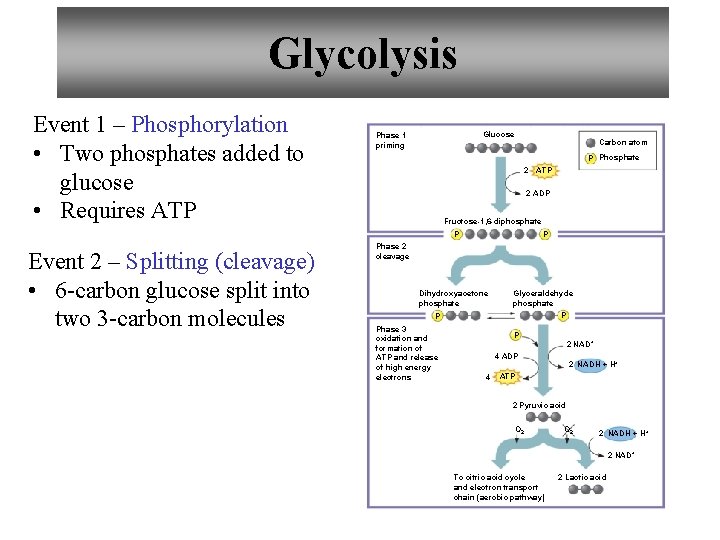
Glycolysis Event 1 – Phosphorylation • Two phosphates added to glucose • Requires ATP Glucose Phase 1 priming Carbon atom P Phosphate 2 2 ADP Fructose-1, 6 -diphosphate P Event 2 – Splitting (cleavage) • 6 -carbon glucose split into two 3 -carbon molecules ATP P Phase 2 cleavage Dihydroxyacetone phosphate Glyceraldehyde phosphate P P Phase 3 oxidation and formation of ATP and release of high energy electrons P 2 NAD+ 4 ADP 4 2 NADH + H+ ATP 2 Pyruvic acid O 2 2 NADH + H+ 2 NAD+ To citric acid cycle and electron transport chain (aerobic pathway) 2 Lactic acid 5
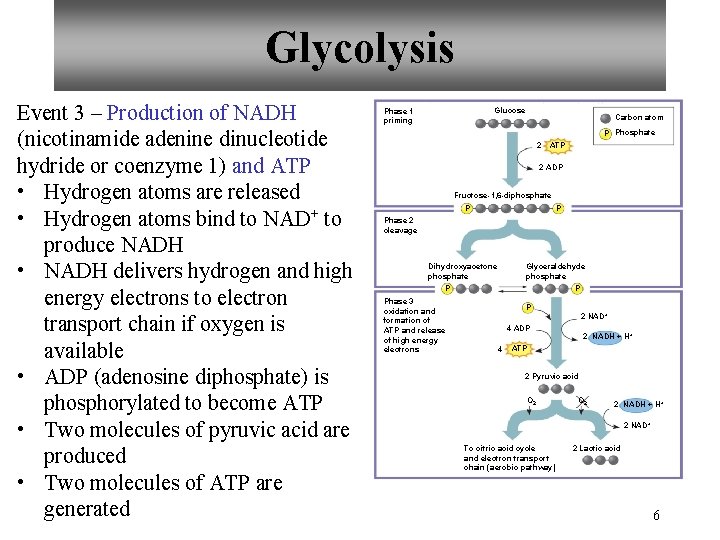
Glycolysis Event 3 – Production of NADH (nicotinamide adenine dinucleotide hydride or coenzyme 1) and ATP • Hydrogen atoms are released • Hydrogen atoms bind to NAD+ to produce NADH • NADH delivers hydrogen and high energy electrons to electron transport chain if oxygen is available • ADP (adenosine diphosphate) is phosphorylated to become ATP • Two molecules of pyruvic acid are produced • Two molecules of ATP are generated Glucose Phase 1 priming Carbon atom P Phosphate 2 ATP 2 ADP Fructose-1, 6 -diphosphate P P Phase 2 cleavage Dihydroxyacetone phosphate Glyceraldehyde phosphate P P Phase 3 oxidation and formation of ATP and release of high energy electrons P 2 NAD+ 4 ADP 4 2 NADH + H+ ATP 2 Pyruvic acid O 2 2 NADH + H+ 2 NAD+ To citric acid cycle and electron transport chain (aerobic pathway) 2 Lactic acid 6
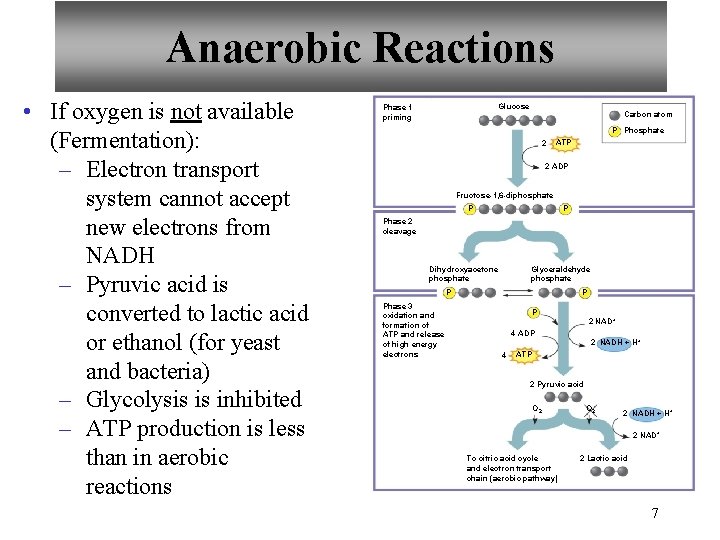
Anaerobic Reactions • If oxygen is not available (Fermentation): – Electron transport system cannot accept new electrons from NADH – Pyruvic acid is converted to lactic acid or ethanol (for yeast and bacteria) – Glycolysis is inhibited – ATP production is less than in aerobic reactions Glucose Phase 1 priming Carbon atom P Phosphate 2 ATP 2 ADP Fructose-1, 6 -diphosphate P P Phase 2 cleavage Dihydroxyacetone phosphate Glyceraldehyde phosphate P P Phase 3 oxidation and formation of ATP and release of high energy electrons P 2 NAD+ 4 ADP 4 2 NADH + H+ ATP 2 Pyruvic acid O 2 2 NADH + H+ 2 NAD+ To citric acid cycle and electron transport chain (aerobic pathway) 2 Lactic acid 7
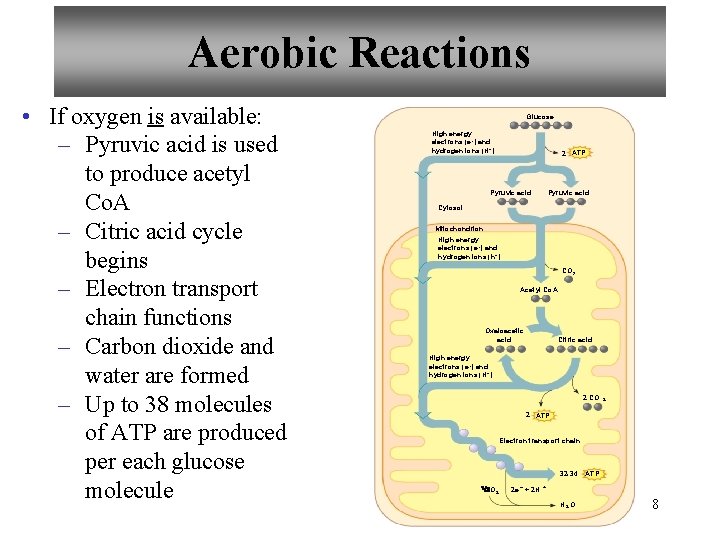
Aerobic Reactions • If oxygen is available: – Pyruvic acid is used to produce acetyl Co. A – Citric acid cycle begins – Electron transport chain functions – Carbon dioxide and water are formed – Up to 38 molecules of ATP are produced per each glucose molecule Glucose High energy electrons (e–) and hydrogen ions (H+) 2 ATP Pyruvic acid Cytosol Mitochondrion High energy electrons (e–) and hydrogen ions (h+) CO 2 Acetyl Co. A Oxaloacetic acid Citric acid High energy electrons (e–) and hydrogen ions (H+) 2 CO 2 2 ATP Electron transport chain 32 -34 O 2 2 e – + 2 H ATP + H 2 O 8
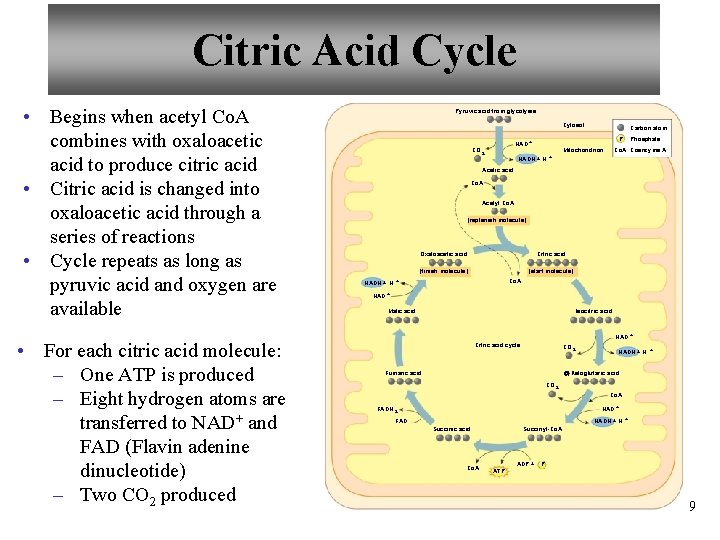
Citric Acid Cycle • Begins when acetyl Co. A combines with oxaloacetic acid to produce citric acid • Citric acid is changed into oxaloacetic acid through a series of reactions • Cycle repeats as long as pyruvic acid and oxygen are available • For each citric acid molecule: – One ATP is produced – Eight hydrogen atoms are transferred to NAD+ and FAD (Flavin adenine dinucleotide) – Two CO 2 produced Pyruvic acid from glycolysis Cytosol NAD + CO 2 Carbon atom P Mitochondrion Phosphate Co. A Coenzyme A NADH + Acetic acid Co. A Acetyl Co. A (replenish molecule) Oxaloacetic acid Citric acid (finish molecule) (start molecule) Co. A NADH + NAD + Malic acid Isocitric acid NAD + Citric acid cycle CO 2 Fumaric acid NADH + -Ketoglutaric acid CO 2 Co. A NAD + FADH 2 NADH + FAD Succinic acid Co. A Succinyl-Co. A ADP + P ATP 9
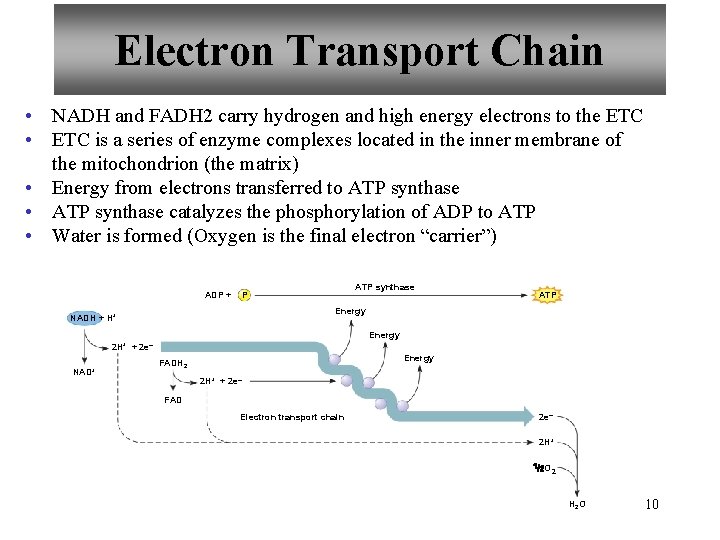
Electron Transport Chain • NADH and FADH 2 carry hydrogen and high energy electrons to the ETC • ETC is a series of enzyme complexes located in the inner membrane of the mitochondrion (the matrix) • Energy from electrons transferred to ATP synthase • ATP synthase catalyzes the phosphorylation of ADP to ATP • Water is formed (Oxygen is the final electron “carrier”) ADP + ATP synthase P ATP Energy NADH + H+ Energy 2 H+ + 2 e– NAD+ Energy FADH 2 2 H+ + 2 e– FAD Electron transport chain 2 e– 2 H+ O 2 H 2 O 10
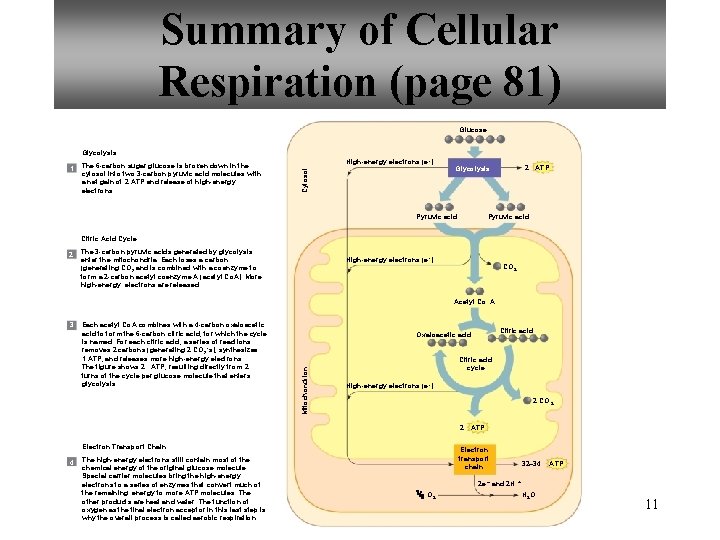
Summary of Cellular Respiration (page 81) Glucose Glycolysis The 6 -carbon sugar glucose is broken down in the cytosol into two 3 -carbon pyruvic acid molecules with a net gain of 2 ATP and release of high-energy electrons. High-energy electrons (e–) Cytosol 1 2 ATP Glycolysis Pyruvic acid Citric Acid Cycle 2 The 3 -carbon pyruvic acids generated by glycolysis enter the mitochondria. Each loses a carbon (generating CO 2 and is combined with a coenzyme to form a 2 -carbon acetyl coenzyme A (acetyl Co. A). More high-energy electrons are released. High-energy electrons (e–) CO 2 Acetyl Co A Each acetyl Co. A combines with a 4 -carbon oxaloacetic acid to form the 6 -carbon citric acid, for which the cycle is named. For each citric acid, a series of reactions removes 2 carbons (generating 2 CO 2’s), synthesizes 1 ATP, and releases more high-energy electrons. The figure shows 2 ATP, resulting directly from 2 turns of the cycle per glucose molecule that enters glycolysis. Citric acid Oxaloacetic acid Mitochondrion 3 Citric acid cycle High-energy electrons (e–) 2 CO 2 2 ATP Electron Transport Chain 4 The high-energy electrons still contain most of the chemical energy of the original glucose molecule. Special carrier molecules bring the high-energy electrons to a series of enzymes that convert much of the remaining energy to more ATP molecules. The other products are heat and water. The function of oxygen as the final electron acceptor in this last step is why the overall process is called aerobic respiration. Electron transport chain 2 e – and 2 H O 2 32– 34 ATP + H 2 O 11
Carbohydrate Storage • Carbohydrate molecules from foods can enter: – Catabolic pathways for energy production – Anabolic pathways for storage 12
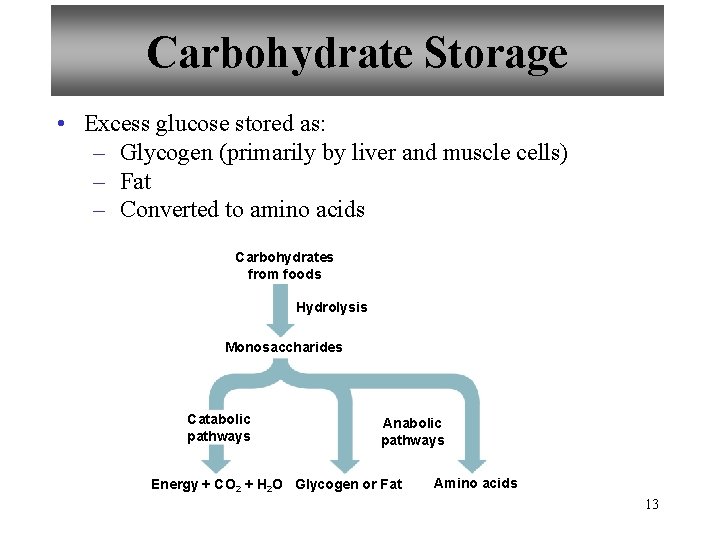
Carbohydrate Storage • Excess glucose stored as: – Glycogen (primarily by liver and muscle cells) – Fat – Converted to amino acids Carbohydrates from foods Hydrolysis Monosaccharides Catabolic pathways Anabolic pathways Energy + CO 2 + H 2 O Glycogen or Fat Amino acids 13
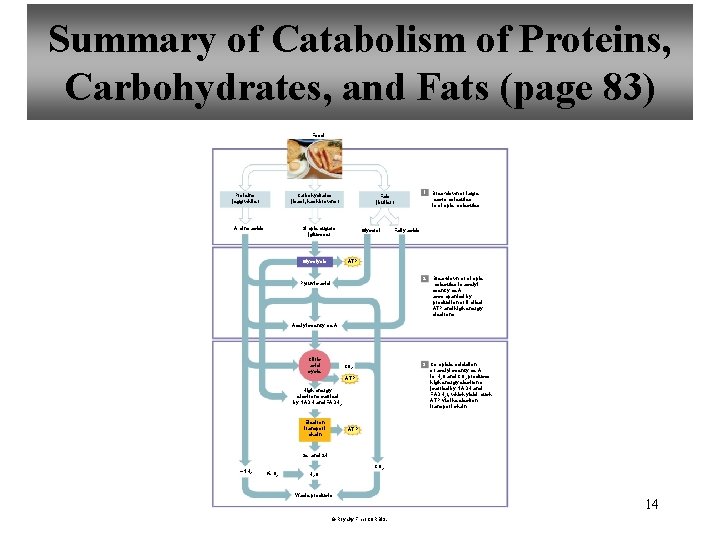
Summary of Catabolism of Proteins, Carbohydrates, and Fats (page 83) Food Proteins (egg white) Carbohydrates (toast, hashbrowns) Amino acids Fats (butter) Simple sugars (glucose) Glycolysis Glycerol 1 Breakdown ofof large macromolecules toto simple molecules 2 Breakdownofofsimple moleculestotoacetyl coenzyme. AA accompaniedbyby productionofoflimited ATP ATPand andhighenergy electrons Fatty acids ATP Pyruvic acid Acetyl coenzyme A A Acetyl Citric acid cycle 3 Complete oxidation of acetyl coenzyme A to H 2 O and CO 2 produces high energy electrons (carried by NADH and FADH 2), which yield much ATP via the electron transport chain CO 2 ATP High energy electrons carried by NADH and FADH 22 Electron transport chain ATP 2 e– and 2 H+ –NH 2 CO 2 ½ O 2 H 2 O Waste products © Royalty Free/CORBIS. 14
- Slides: 14