
Chapter 4 Cell Structure and Function Lectures by
Chapter 4 Cell Structure and Function Lectures by Gregory Ahearn University of North Florida Copyright © 2009 Pearson Education, Inc. .
4. 1 What Features Are Shared By All Cells? § Cells are the smallest unit of ______. § Cells are enclosed by a _________. § Cells use ____ as a hereditary blueprint. § Cells contain _______, the material inside the plasma membrane and outside the DNA-containing nucleus. • Fluid environment: H 20, salts, organic molecules • Metabolic activities: proteins, lipids, carbs, salts, sugars, AA and nucleotides § Cells obtain _____ and ______ from their environment. Copyright © 2009 Pearson Education Inc.

4. 1 What Features Are Shared By All Cells? Copyright © 2009 Pearson Education Inc.
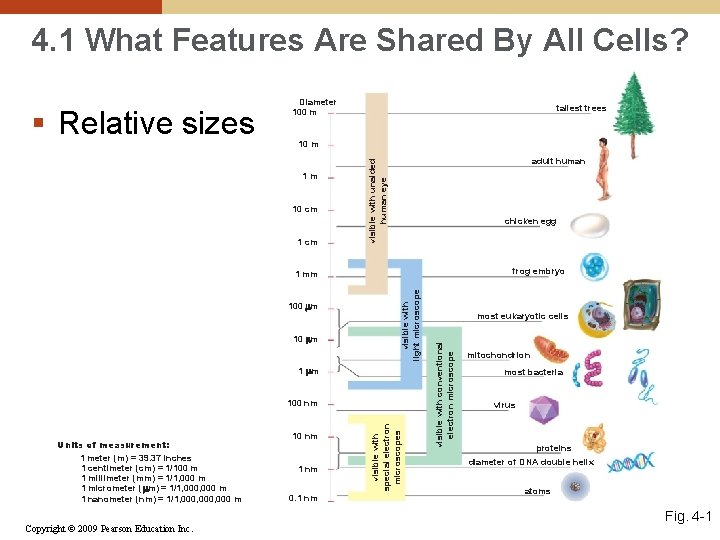
4. 1 What Features Are Shared By All Cells? tallest trees 10 m 1 m 10 cm 1 cm adult human visible with unaided human eye § Relative sizes Diameter 100 m chicken egg frog embryo 10 m 1 m Units of measurement: 1 meter (m) = 39. 37 inches 1 centimeter (cm) = 1/100 m 1 millimeter (mm) = 1/1, 000 m 1 micrometer ( m) = 1/1, 000 m 1 nanometer (nm) = 1/1, 000, 000 m Copyright © 2009 Pearson Education Inc. 10 nm 1 nm 0. 1 nm visible with special electron microscopes 100 nm most eukaryotic cells visible with conventional electron microscope 100 m visible with light microscope 1 mm mitochondrion most bacteria virus proteins diameter of DNA double helix atoms Fig. 4 -1
4. 1 What Features Are Shared By All Cells? § Cell function limits cell size. • Diffusion of molecules across cell membranes limits the diameter of cells. • As cells get bigger, their nutrient and waste elimination needs grow faster than the membrane area to accommodate them. • The volume of cytoplasm grows faster than the plasma membrane area Copyright © 2009 Pearson Education Inc.
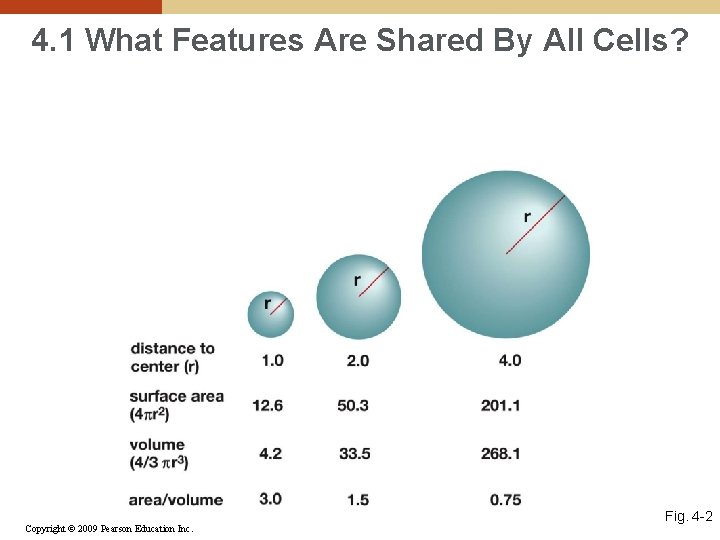
4. 1 What Features Are Shared By All Cells? Copyright © 2009 Pearson Education Inc. Fig. 4 -2
4. 2 How Do Prokaryotic And Eukaryotic Cells Differ? § There are two kinds of cells. • 1) ________ cells • Are found only in two groups of singlecelled organisms: bacteria and archaea • 2) ________ cells • Are structurally more complex cells • Possess a membrane-enclosed nucleus • Probably arose from prokaryotic cells Copyright © 2009 Pearson Education Inc.

4. 3 What Are The Main Features Of Eukaryotic Cells? § Eukaryotic cells possess a number of membrane-enclosed organelles that perform specific cell functions. • • • _______: contains DNA _______: produce energy ___________: synthesizes proteins and lipids ___________: molecule sorting center _________: digest cellular membranes or defective organelles Copyright © 2009 Pearson Education Inc.

4. 3 What Are The Main Features Of Eukaryotic Cells? § A generalized animal cell flagellum cytoplasm rough endoplasmic reticulum ribosome lysosome nuclear pore chromatin (DNA) nucleus nucleolus nuclear envelope centriole intermediate filaments plasma membrane Golgi apparatus vesicle microtubules free ribosome smooth endoplasmic reticulum Copyright © 2009 Pearson Education Inc. vesicle mitochondrion Fig. 4 -3
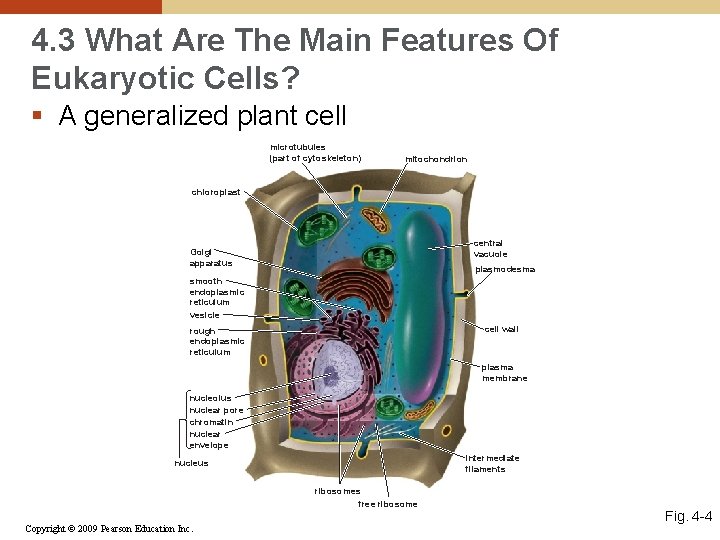
4. 3 What Are The Main Features Of Eukaryotic Cells? § A generalized plant cell microtubules (part of cytoskeleton) mitochondrion chloroplast central vacuole Golgi apparatus plasmodesma smooth endoplasmic reticulum vesicle cell wall rough endoplasmic reticulum plasma membrane nucleolus nuclear pore chromatin nuclear envelope intermediate filaments nucleus ribosomes free ribosome Copyright © 2009 Pearson Education Inc. Fig. 4 -4
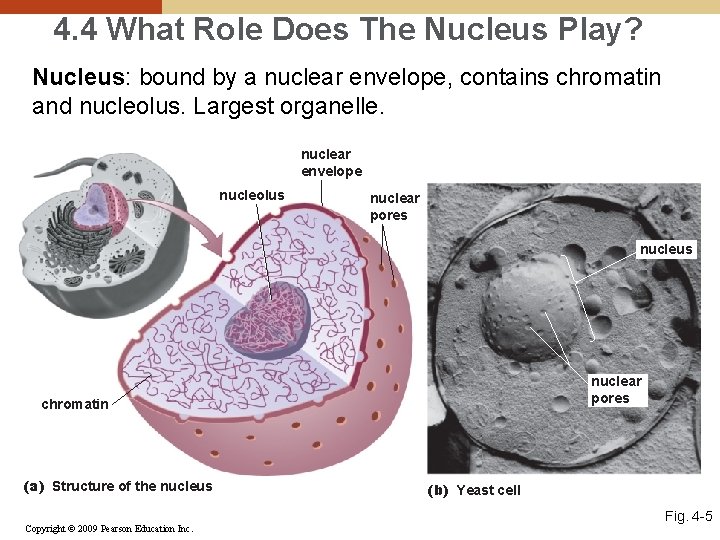
4. 4 What Role Does The Nucleus Play? Nucleus: bound by a nuclear envelope, contains chromatin and nucleolus. Largest organelle. nuclear envelope nucleolus nuclear pores nucleus nuclear pores chromatin (a) Structure of the nucleus Copyright © 2009 Pearson Education Inc. (b) Yeast cell Fig. 4 -5
4. 4 What Role Does The Nucleus Play? § The nuclear envelope is a _____ membrane. • The membrane is perforated with channels called nuclear _______. • Some smaller materials can move through the pores, while others, such as _______, cannot. § The nucleus contains chromosomes. • DNA and protein are closely associated in the nucleus in chromatin. • Chromatin can become condensed into chromosomes. Copyright © 2009 Pearson Education Inc.
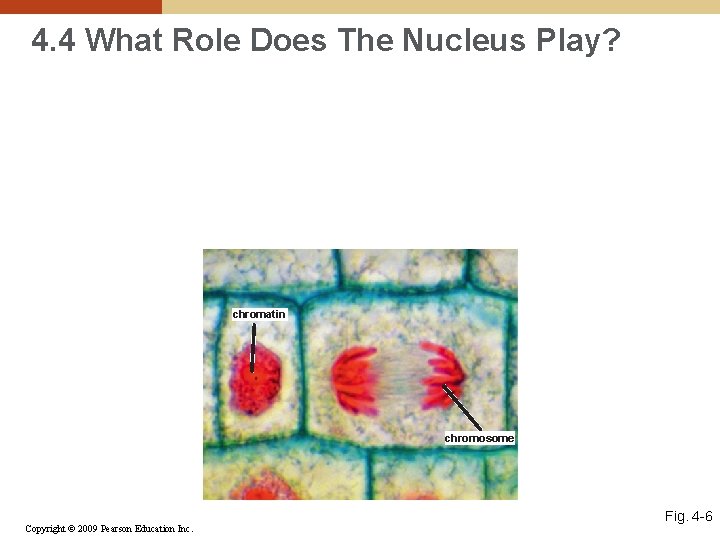
4. 4 What Role Does The Nucleus Play? chromatin chromosome Copyright © 2009 Pearson Education Inc. Fig. 4 -6
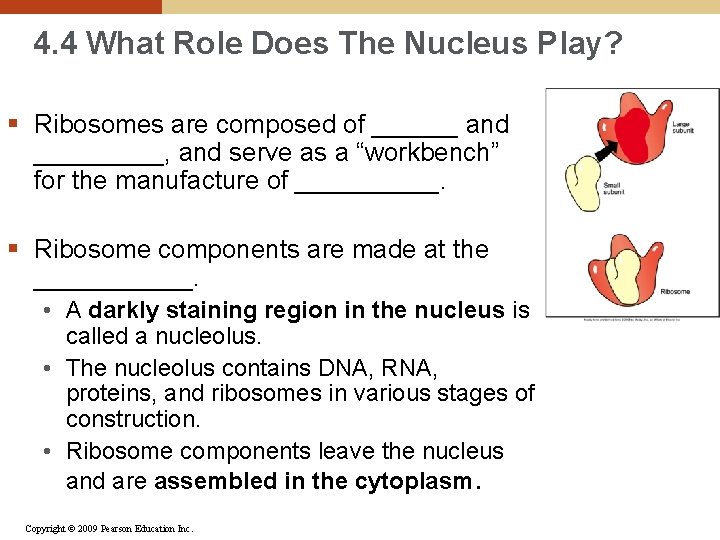
4. 4 What Role Does The Nucleus Play? § Ribosomes are composed of ______ and _____, and serve as a “workbench” for the manufacture of _____. § Ribosome components are made at the ______. • A darkly staining region in the nucleus is called a nucleolus. • The nucleolus contains DNA, RNA, proteins, and ribosomes in various stages of construction. • Ribosome components leave the nucleus and are assembled in the cytoplasm. Copyright © 2009 Pearson Education Inc.
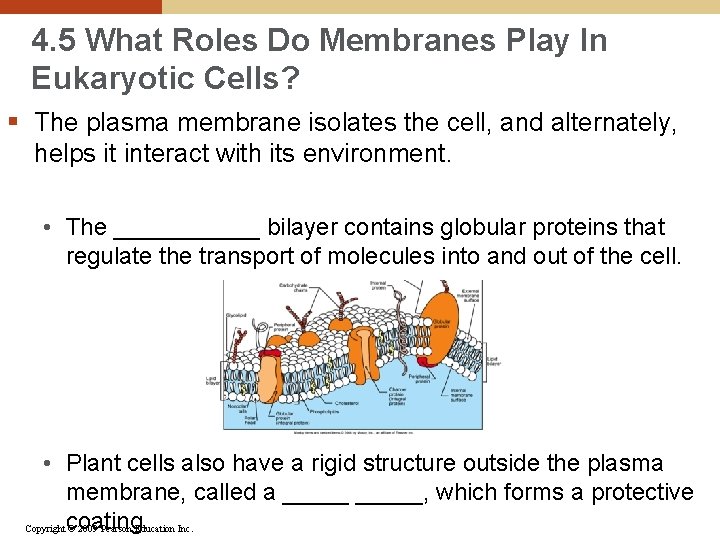
4. 5 What Roles Do Membranes Play In Eukaryotic Cells? § The plasma membrane isolates the cell, and alternately, helps it interact with its environment. • The ______ bilayer contains globular proteins that regulate the transport of molecules into and out of the cell. • Plant cells also have a rigid structure outside the plasma membrane, called a _____, which forms a protective Copyrightcoating. © 2009 Pearson Education Inc.
- Slides: 15